

We need to expand our team of proofreaders as we aim to increase the rate of republication of Satsvarūpa Mahārāja’s books as well as new books that he writes.
This includes a need for fluent bilingual Spanish and English speakers to proofread Spanish translations (we currently have around 20 Spanish translations waiting to be proofread).
Anyone interested in this particular service should contact Manohara dāsa at [email protected]
If you would like to help, please contact Kṛṣṇa-bhajana dāsa at [email protected] or [email protected] and we will find you a service that utilizes your talents.
The morning so far has been lively, different ideas popping about literary projects. But I should really be concentrated on the holy name. I did chant with a good clip from 1-3 A.M., fourteen rounds, but then felt a first twinge behind the eye, so I have to be more careful now.
We’re sort of patting each other on the back here, not in a cheap way, but with feelings of good satisfaction that we’re doing well, we’re doing the best we can. But we know we’re know not pure chanters. I take it as a matter of fact, but there’s not much edge of grief about it. I don’t know of anything much to do other than just try to chant my quota. But I am aware of it all, the fact that I don’t pay attention to the chanting and just get it done, and that’s my childish happiness and satisfaction—just to meet the quota. We’re so satisfied with it that we want to do it again at Karttika time for another week with another set of devotees and introduce them to it. Then they’ll say to me, “Oh, we so much appreciate that you pay attention to the basics.” And I will also be pleased to do that, and maybe, maybe, maybe one of these days, one of these lives, there’ll be something more than just counting.
******
They talk about how you can be subjective about experience and not notice things, not even notice pain. Of course, that’s all a kind of mental work or subconscious work. I only get into that so that I can have more peace and concentration. But the real release is when the spirit soul knows its own self and knows its relationship with Krsna. That’s when we know that Krsna’s name is nondifferent than Himself.
******
We’re working in the right direction when we worship Krsna’s holy name, piling on, accumulating numbers and numbers. Haridasa Thakura chanted 300,000
names. Raghunatha dasa Gosvami chanted 100,000 names a day. That’s almost 130 rounds, or almost 160 rounds every day for those great souls. In addition, for Raghunatha dasa Gosvami, bowing down 2,000 times to Vaipavas and talking three hours a day about the glories of Lord Caitanya.
******
Hare Krsna Hare Krsna, Krsna Krsna Hare Hare
Hare Rama Hare Rama, Rama Rama Hare Hare.
If I could only invest in the rich, this chanting, with some feeling. Counting is important. Feeling is more important. Feeling and saying the Hare Krsna mantra with devotion and faith.
******
When you get a little relief physically, then use your time well. It’ll be taken away again. You’ll be pushed to the brink and then finally pushed over. But in the time that you have, whenever you’re clear, use it for doing something in Krsna’s service.
******
Dear Srila Prabhupada, you’ve given us the perfect way, and I just want to enter it. You’ve concentrated on things that are so important for us, and if we race ahead in the Gaudiya philosophy, it won’t be helpful to us. You will bring us, rather, ahead, step by step. So let me just think about the things that you stress. What did I hear this morning? I can’t remember, but I know it was essential. You always hit right on what we need to know. We’ve heard it, of course, many times before, so we tend to forget it and not listen carefully. You say things such as that we have to give everything for Krsna. If we give something to Krsna something for our sense gratification, then that’s not a pure devotee and pure devotion and Krsna will not reciprocate. You speak of unflinching devotion, faith. You quote yasya deve para bhaktir . . . one who has unflinching faith in God and his spiritual master, that person gets revelation. You gave the example of Gaura-kisora dasa Babaji who was illiterate, and yet Bhaktisiddhanta Sarasvati Thakura accepted him as spiritual master. So revelation comes to the one who has unflinching faith. Let me not flinch when the challenges come, physical pain and danger, whatever they are. When I get a clear field, move it and move ahead, do something nice Krsna and Prabhupada would like.
******
I just chanted three straight hours in the living room before the fire blazing in the fireplace. Toward the end, I was ready to go on and continue it round after round. Three hours didn’t seem like a big thing. Of course, at certain points along the way, it seemed difficult to continue at all. When I went in there, there were three other men there, but then they started to come and go. They have different duties—one had to go shopping, one had to go fix the van, and then one had to cook lunch. I was fortunate I didn’t have anything else to do, and neither was I really restless. My quota per round was slow, varying from about 7.30 to 8.40. But that’s all right. I was like the snail or the turtle, slow but steady, accumulating, accumulating.
******
I’m writing it here to remember it, sublime day. Weather outside, rain nasty, rainy and chilly for April. Very gray day. Perfect day for a fire and to sit and chant and to walk and chant in a living room in a cottage in Scotland where nobody knows you’re there. But Krsna knows, and He likes it when you chant His holy names.
******
Dear Lord, I don’t know anything. I’m just chanting along. I can’t focus on You or Your pastimes, but You’re so merciful that just by chanting Your names, everything is accomplished. One doesn’t have to know anything or achieve anything. Just go on chanting, go on chanting.
******
Just finished sixty-four rounds. On my sixty-third round, I was thinking about how we have hired a genealogist to trace out my Irish ancestors, and so I wasn’t paying attention to the holy name. But then on the sixty-fourth round, I turned back to what is my main concentration during the day. That is, I focus on the mantra itself and I’m attentive to saying it without dropping any syllables, just conscious of the mechanical, outward act of reciting one after another and moving along with it. So the difference between what I just described as a sixty-third and sixty-fourth round is a considerable difference. In one case, I’m deliberately indulging in inattention and the chanting just runs on in the background like an unconscious motor. In the second type of chanting, other thoughts are not my focus, but rather the mantra itself. Of course, this is not very devotional either. It’s just a mechanical act. Nevertheless, it’s an improvement, isn’t it? I can mention this tonight to the devotees when we gather.
******
Now let me go and read some section of Namamrta and see if I can find some quotes. Of course, the quotes are not the actual experience, not the actual life of my day-long chanting. I chant perhaps almost nine hours, and I don’t think of the glories of the holy name as enunciated in the sastras. I just plug along as I’ve described. But still, one can’t just talk about such mechanics in a gathering. Let’s hear the glories of the holy name. It’s because of those glories, because of the sages and the sastras and what they say about hari-nama that we’re able to have faith and keep going with it. We go on the strength of Vedic injunction and because Prabhupada says so. This is more important than what I experience during my nine hours. Hare Krsna.
pp. 6-9
How did I come to read the Bhagavad-gītā? The first thing I read from the Vedic literature was a paperback of the Upaniṣads. I didn’t make much sense of it, but it was mysterious to me. Vedas … gods … I thought it was more interesting, somehow, than Christian churchgoing. I didn’t read the Bhagavad-gītā first, but I read it along the way, and it was a translation from the Sanskrit of Nikhilananda by Christopher Isherwood, a Western scholar. I also read a translation by an Indian fellow, I forget his name, but he teamed up with a poet of the West who knew modern poetry, and they put out this Bhagavad-gītā. I didn’t get much out of that either. There’s that “grand coincidence”—that I was carrying the paperback Bhagavad-gītā when I went to 26 Second Avenue when it was still Matchless Gifts and stood in the foyer. I was still trying to penetrate the Bhagavad-gītā, although I couldn’t. But one of my friends, Murray Mednick, asked to meet with me. I think he was angry at someone who had criticized his poetry, and he was even thinking of violence and wanted me to meet with him in the foyer of 26 Second Avenue. So, the “grand coincidence” was that I was carrying the Bhagavad-gītā in my pocket and trying to meet up with Murray there. That was the same 26 Second Avenue which, months later, became the place where I met A. C. Bhaktivedanta Swami and hooked up with my spiritual life by reading his presentation of Bhagavad-gītā As It Is.
I was young good-for-nothing, still indulging in bad habits. But I was trying to understand the mysteries of the East and thought this Bhagavad-gītā might contain it. It didn’t contain it—or it did contain it, but I couldn’t penetrate it. But I say it’s a grand coincidence that the book which actually saved me was carried by me to my meeting with that brilliant Western poet, M.M. I never really got to touch the Bhagavad-gītā until I met Prabhupāda, Swāmījī. And he was the one, the only one, who opened the mysteries of Bhagavad-gītā as it is.
I might quote a number of verses from the Bhagavad-gītā as Prabhupāda translated it. This is many years later. I would say that I really do not understand Bhagavad-gītā, even now. I’m not like those ISKCON scholars who have memorized many verses of the Bhagavad-gītā and who understand it. Some of them are my disciples now. But I never came to memorize many verses. I’m not sure if I ever came to really understand Bhagavad-gītā.
What am I saying? There was a time when I did love the Bhagavad-gītā. I was very young then, maybe twenty-five, twenty-six years old, and fate had placed me in front of Prabhupāda, Swāmījī, Bhagavad-gītā. My mother saying to me, “You don’t really believe in that, do you?” She said that to me when I was bound up in casts up to the knee after breaking my ankles in my fall from the window. I had to stay six weeks in bed, with casts. And so, I ordered a bunch of books: religions of the East, Confucius. Confucius, confuted, computed, confused! Books of the East! I tried to understand but couldn’t, but liked it, liked it, liked it! Liked it better than the West. Tried to penetrate, Confucius but too convoluted! But I didn’t have a guru. I say, I didn’t have a guru! And I didn’t accept any phony person as a guru. I didn’t go around to guru shops and yoga places. I didn’t go to those places. I didn’t go to those places! I didn’t have any taint or corruption by a bogus sannyāsī swami. I wasn’t touched by it. The first one, the real one, the true one is the one I met, Prabhupāda!!
So, I say it’s a grand coincidence that I was standing in the foyer of 26 Second Avenue holding Bhagavad-gītā, not as it is, but as it isn’t. But I thought myself some kind of follower of that book. And I was waiting for Murray Mednick, and the idea was that we would beat up the guy who had criticized him. That was our intention, but we never did it (but that was our purpose in being there), and I was carrying the Bhagavad-gītā, cur that I was, fool that I was, lover and hunter of women that I was. A sad sack, shy boy who couldn’t conquer a woman or even ask one out for a date. But there I was inside the foyer, with Bhagavad-gītā in my pocket.
tad-vijñānārthaṁ sa gurum evābhigacchet
samit-pāniḥ śrotriyaṁ brahma-niṣṭhamTo understand these things properly, one must humbly approach, with firewood in hand, a spiritual master who is learned in the Vedas and firmly devoted to the Absolute Truth.
—Muṇḍaka Upaniṣad 1.2.12
So, tad-vijñānam, you cannot imagine, speculate. That is not possible. You have to learn it from a person who is tattva-darśinaḥ, who has seen God.
—Śrīla Prabhupāda Lecture on Śrīmad-Bhāgavatam 7.9.3,
February 17, 1977, Māyāpura
One must go to the guru. And who is guru? Guru, śrotriyaṁ brahma-niṣṭham— “One who has heard from the paramparā system and he has become completely convinced in the understanding of Brahman.”
—Śrīla Prabhupāda Lecture on Bhagavad-gītā 7.4,
February 19, 1974, Bombay
pp. 61-64
Lord Śiva praises the efficacy of bhakti. Varṇāśrama-dharma is not enough; it needs to be engaged as bhakti. Similarly, for meditation, the goal is the lotus feet of the Supreme Lord. Śrīla Prabhupāda says that this topmost meditation “will help him not only to see the Lord within constantly but to see Him face to face and become His associate in Vaikuṇṭhaloka or Goloka Vṛndāvana” (Śrīmad-Bhāgavatam 4.24.53, purport).
It is very difficult even for the king of heaven to attain, or for those who identify themselves as one with God, yet it is easily attained by bhakti. What is that? A relationship with Lord Kṛṣṇa. It can’t be known by the blunt senses or impersonal meditation, not by faithlessness, or by those who desire to lord it over. But Kṛṣṇa says bhaktyā mām abhijānāti: “One can understand Me as I am, as the Supreme Personality of Godhead, only by devotional service” (Bhagavad-gītā 18.55).
If someone says, “Yes, this is the conclusion of the bhakti-śāstras, but there are other scriptures and other conclusions,” then I say, “Good. Have those other conclusions if you want them. Reason shows bhakti as the topmost goal. Would you rather rot in the material world? Merge into the Brahman light? Then we cannot tell you the intimate glories of bhakti.”
My dear Lord, pure devotional service is even difficult for liberated persons to discharge, but devotional service alone can satisfy You. Who will take to other processes of self-realization if he is actually serious about the perfection of life?
—Śrīmad-Bhāgavatam 4.24.55
In The Nectar of Devotion, Chapter 14, Śrīla Prabhupāda says that knowledge and renunciation are not necessary for devotional service. “It requires nothing more than sincerity.” Lord Kṛṣṇa and the process of approaching Him, devotional service, are both absolute. Make a sincere attempt to serve the Lord, and you have attained a true relationship with Him. If a person developing Kṛṣṇa consciousness still has some material attachments, they will fall away as he regularly discharges devotional service. Devotional service is so powerful that if one executes even only one of the nine different kinds of bhakti, he can achieve the desired goal—being established in devotional service.
Therefore, it’s significant to me that I should consider my writing life while thinking about my relationship with Lord Kṛṣṇa. My service to the Lord and my sense of self are very much wrapped up in the business of being a writer. I remember one writer asking herself whether she was willing to give up writing if, in exchange, she could see her guru again after his departure from the world. She told herself, yes, she could do it and still live an enlightened, awakened life without writing. Intellectually, she then reasoned that it might be possible to do both, write and be with her guru. When tested, though, she was willing to give up her beloved writing practice. How do I face that test?
Are we more attached to our particular services or work in this world than to Kṛṣṇa? That seems to be part of the subject of this book. In my case, I want Kṛṣṇa and Prabhupāda to accept my writing as service to them. I have a file of letters from devotees who say my writing has helped them. Am I hoping the file will impress the Lord? Is He smiling at me the way He smiled at Arjuna at the beginning of the Bhagavad-gītā, “You are speaking learned words, but you do not know …” Is He about to give me a slap?
Anyway, I think of myself as a writer-servant, but if Kṛṣṇa wants to change my designation, then I can still chant and pray and honor prasādam and learn humility and whatever else He wants to teach me. I don’t insist on being a writer as an independent identity. No, not that.
I feel a liberating energy in writing honestly. Is that my false ego? Maybe. I hope my false ego will dissolve as I write. I hope this service will purify me.
Kṛṣṇa is the ability in man. He is the intelligence by which I can write. He gives the brain and hand, the ink and paper, and He gives the only worthy subject matter, the practice of devotional service to Him.
******
Your literary relationship with the
literary Lord Kṛṣṇa of your literary
imagination is one kind of reality.
There is the literary incarnation of God
in Śrīmad-Bhāgavatam. There is Kṛṣṇa
appearing in Śrīla Prabhupāda’s purports—that’s not
mere literature but kṛṣṇa-upadeśa.
And the Lord is in His holy names.
Take your pick which Kṛṣṇa you
want to relate to.
He appears as Nṛsiṁhadeva to the demon,
as Kṛṣṇa to Rādhā,
take your pick. I’ll take what Śrīla
Prabhupāda gives us, raso vai saḥ,
Kṛṣṇa as source of all rasas, in all
cantos. Kṛṣṇa in the sun and moon and
wind, Kṛṣṇa in silence, in the
cheating of cheats, as Lord Buddha,
whatever Śrīla Prabhupāda says.
I can relate to that.
I am Kṛṣṇa’s, Kṛṣṇa is mine.
Have you heard that before?
It’s Vedic truth. I belong to Him because
He owns everything, me included.
And He is mine when I love Him.
“My Lord,” said Prahlāda, and He
is my Lord too.
How is it some people find such ease
in saying it and others find it
impossible to say—I love Kṛṣṇa?
What kind of a devotee am I?
I can relate to Kṛṣṇa
when He kills Aghāsura inside his mouth
and when He comes out and absorbs
the soul of Agha
and when I walk alone and see flowers
and when I don’t want to see people.
I see Kṛṣṇa in all things and in myself.
I want to see Him where He wants me
to see Him, in innocent conditioned souls.
Give them a chance, the Lord is in their heart.
See Him there, an opportunity to preach,
maybe in a ferry crowd. Just by wearing my
dhotī and shaving my head I relate to Lord Kṛṣṇa and
people see I am His.
He is mine, He comes to me and
lets me write. O Kṛṣṇa, please be mine
in the holy names chanted with devotion.
Please give me the desire I lack
to cry out to You.
Please give me my taste for loving You.
As the years go by I’m almost forgetting
what my spiritual master was like. Please save me.
Give me back my eternal relationship,
sweet Lord of the universe,
scourge of the universe.
Let me relate to You.
pp. 20-23
All glories to the chanting of the holy names. I intend to give a class to disciples here on Saturday, with all selections on chanting Hare Kṛṣṇa. I’m already into “motivated” reading, to prepare for classes. This is typical of the travel life. It’s okay. It’s a way to experience random reading in Śrīla Prabhupāda’s books, which are like a sugar tree. And it will dip me into Śrīmad-Bhāgavatam, which I want.
Even if you can’t surrender to Kṛṣṇa, you can at least chant the holy names. Of all the orders of the Lord, it is the most important. So, it comes first in our day. I can preach this. Some devotees recently admitted to me they’re not chanting their sixteen rounds. So, at least I’m doing my own, numerical strength. I have no desire right now to increase the quota—to twenty, twenty-five or thirty-two—but would very much like to improve the quality in those two and a half hours or more that are dedicated to chanting. It’s so hard because other thoughts need to be put aside and you concentrate not so much on thinking but on the japa yajña, of uttering hari-nāma and hearing it with your ears.
Okay, write soldier. Don’t be afraid that it’s too profuse and not centered. It can be edited away later. You need to get beyond that concern. Write because it helps you, you do it as service. This process of free-writing does provide the best you can do—writing into the unknown. Do what you’re able to do. If it’s too much, it can be removed later. You must swim into it as much as possible—books for the masses.
Hare Kṛṣṇa Hare Kṛṣṇa Kṛṣṇa Kṛṣṇa Hare Hare.
I can edit myself but I don’t have time. I need to go on to writing the next book. This is the way. Haribol.
Kṛṣṇa Kṛṣṇa
So, on Saturday I hope to tell them chant Hare Kṛṣṇa and your life will be sublime. Or at least, “You promised. It’s the most important. This comes first and other needs and priorities in your life should follow it.”
This note taking … Belfast trip starts it off. As if Geaglum were my home. It’s only recently been so. Giving up the imaginary idea that because I have residency in Ireland I should physically stay here. I will come back here but I need to travel. So, there’s no home base but writing pads and a moving pen.
Kṛṣṇa Kṛṣṇa. Tell them I chant in the morning. I don’t have much taste and I don’t have any ability to stay attentive or prayerful, mantra by mantra. But I do it and I know it must be done early, under the best circumstance. Sit by candlelight alone in the room before others are awake.
The mind is plan-making. I do make an effort to slow down the scheming and worrying and plan making. No note taking during japa. Put the worries aside and turn to chanting as your only shelter or solace. With me I often get headaches so I want to get in “good” japa as early as possible. Plus, other daytime activities will be demanding. So, chant early if you can. But chant at any time.
There’s no home base but chanting and reading and writing. Then you move to where preaching is favorable. For me that means going to where disciples are. They need to hear the importance of chanting and obeying, etc. Travel to those places and share Kṛṣṇa’s upadeśa with them.
Write quickly, this is also your time. Kṛṣṇa left for Mathurā, entered Mathurā, left Mathurā. O Lord, I desire to be Your pure devotee. Please help me. The Lord says in His form of Lord Caitanya in Śikṣāṣṭakam: Dear Supreme Lord, You appear in Your holy names with all potencies but I am so unfortunate, I commit offenses and don’t have a taste for chanting. Kṛṣṇadāsa Kavirāja writes that if we hear Lord Caitanya’s verses on hari-nāma, lamentation will go away.
The world is getting worse in Kali-yuga. The filth is all around. Freedom to sin, governments sin, bad reactions come down on everyone. The only hope is to chant the holy names—it should be done loudly so that others may hear. Lord Caitanya was told to do this by His spiritual master. You know the section in Ādi-līlā. He praises the chanting so the Māyāvādī followers of Prakāśānanda can hear it.
I need to hear it and practice it. Got to end this one but may be back again soon.
Keep trying to go beyond a conception of writing to make a book or worries of performance. Just keep going for gut and best expression. Admit what comes into the mind. Go deeply, confess and write the world and the śāstra in the back of the van. That space is tiny but from there I can go all over these three worlds and follow my devotional creeper back to Godhead.
Written yesterday in temple room:
Rādhā-Govinda
please allow me to remember You
and be free of doubts and fears
and envy
and impersonalism.
I pray at Your lotus feet.
pp. 52-55
I bought you on an early visit to the 26 Second Avenue temple, before I was even initiated. I had seen you in Swāmījī’s storefront and wanted to read you. I went into the storefront one day while other boys were gathered there. Swāmījī was also gathered there. At this time, I had come for a brief visit because I was on my lunch hour from the welfare office. I told Swāmījī I wanted to buy his three books. He was cheerfully agreeable and told me you were six dollars each. I bought you, and to show off that I knew something, I said to him, “Are these your commentaries on the Bhāgavatam?” I wanted to establish that I was a big reader and that to me you seemed merely like commentaries, not full śāstras. I soon found that I was in error. Prabhupāda sold me you three books, and I gave him twenty dollars and told him he could keep the change. At first, he endeavored to give me the change, but then let it go.
I was very happy to walk out of the store with the three brick-colored Bhāgavatams. I went home to my apartment and immediately began reading your first volume. It was printed in India and had printing mistakes, but I thought they were nice and took pleasure in them. It was a whole new adventure for me, reading the Indian-printed book.
I fell in love with you books and your philosophy instantly.
Still your servant,
Satsvarūpa dāsa
You joined the Hare Kṛṣṇa movement a few months after its beginning. I remember your own testimony, your saying that you were walking around the Lower East Side, and you were looking for God, and you passed Puerto Rican God-places where they made music, and you made a connection there, and you went into Swāmījī’s place. I don’t remember exactly. But I know you were after me, you didn’t come first. And you were noticeably active after the original devotees. You came months after them. You are in the pictures of Prabhupāda doing kīrtana at Tompkins Square Park, you are standing up and dancing.
Dear Brahmānanda, I first met you in the storefront when you first visited Swāmījī’s temple, and I had already been a devotee for some months. You told me your name was Bruce. You were built like a wrestler. But you were friendly, and right away had a protective spirit toward the devotees. I met with you sitting down in the temple, and we made acquaintance. You told me you were a part-time teacher in high schools. At that time, I was engaged as a case worker for the Department of Welfare. So we both had a little money. We both took quickly to a liking of Swāmījī, and Swāmījī welcomed us and was happy to know we had some possibility of income. Right away we started donating our money towards the needs of the temple.
When Swāmījī was beginning to organize his group into a Society, he spoke with you about who should be the temple president. You said, “Rāya Rāma.” But Swāmījī replied, “No. You should be the temple president.” He saw immediately in you a solid man, a leader, and so picked you as his president. All the other devotees accepted this decision vocally—they liked you as their leader. I was at once a close friend to you. Unlike you, I was not a strong man or a leader. I was a thin, inward kind of person, and Swāmījī didn’t pick me for president or leader. He did pick me as the secretary of ISKCON. You were president, and Gargamuni was treasurer. You became immediately attracted to Swāmījī and ISKCON upon your first contact with them. You spoke by phone with your younger brother Gargamuni, who was going to quit school in Colorado and move to San Francisco. You told your brother about Swāmījī, and your brother was convinced to come immediately to 26 Second Avenue, for a great thing was happening. You convinced him to come and join with the Swami and be part of the Hare Kṛṣṇa movement. Gargamuni (initially known as Greg Scharf) was submissive to you, and without delay he traveled from the west to New York City, where he became a member of ISKCON and its treasurer.
Over the years we saw each other from time to time, you were in New York, and I was in Boston. So we had a friendship. We were both East Coast.
Maybe the last time I saw you was after you got married and I made a visit to your apartment. You remained a sannyāsī until after Prabhupāda left, so this must have been after 1977. I came to your door carrying my daṇḍa and in sannyāsa clothes. I knocked and you personally answered. I was impressed by your big build, always the wrestler looking type, and you were really big then. When you saw me, you expressed great surprise at seeing me again and said, “Oh, you! C’mon in!” Our friendship was intact, and you invited me inside your apartment. There I met your wife, who was a good-looking woman, and she made a joke about getting you when you were in your almost-obese condition. She was grateful she had you, I think because you were a famous devotee in ISKCON because of the service you had rendered to Prabhupāda. I remember you being very emotional and crying a lot when Prabhupāda passed away. And you even cried when you gave a lecture about Prabhupāda.
We talked in a friendly way. You had a little Prabhupāda mūrti. You made no apologies for not being an active devotee anymore and being married. You were still very much attached to Śrīla Prabhupāda. So, we sat down together and talked, you showed me your Prabhupāda mūrti, we talked for a while and then I left. That was the last time I saw you.
pp. 192-94
It is an illusion for anyone to claim that they are the supreme controller or to claim that they are the center of existence. “It is I,” and “It is mine”—both based on the bodily concept of life. Māyā herself is ashamed of her position, “but those who are bewildered by her always talk nonsense.”
After a purport concludes that energies come from the Supreme, how do I apply it? It’s a statement about The Other, God, not about me, the jīva. Yet it is about me. It puts me in my place as His eternal servant, as part of Him, and as meant to serve Him. Know the greatness of that one Supreme from whom all come. Admit I am (have been for a long time) a bewildered soul trying to lord it over and struggle with the others.
Admit I am a victim of atheistic propaganda and of religious leaders who teach nonsense and misbehave. Admit all this and try to become an earnest student of Śrīmad–Bhāgavatam.
See, it does apply. Nārada’s description of the Supreme, Śrīla Prabhupāda’s purport, is truth for me.
The Vedic literatures are made by and are meant for the Supreme Lord, the demigods are also meant for serving the Lord as parts of the body, the different planets are also meant for the sake of the Lord, and different sacrifices are performed just to please Him.
—Śrīmad-Bhāgavatam 2.5.15
Don’t think, “Why is He being so demanding? Why does this bhāgavata party insist on recognizing God?” Throw that out, little death-bound man. Bow to God. Learn it—there is a Supreme Being.
“Any literature not meant for reviving God consciousness is rejected …”
“Inspired by Him only, I [Brahmā] discover what is already created by Him [Nārāyaṇa] under His vision as the all-pervading Supersoul, and I am also created by Him only” (Śrīmad-Bhāgavatam 2.5.17).
The Lord directs His devotees, and sometimes as a result they do wonderful things in His service. The Lord allows the nondevotee to do things on their own account and to suffer the reaction. Devotees await the Lord’s indication. How do we know He’s here and directing? How to tune in? “The subtle presence of the Lord is felt by the intelligent men who can study the psychic effects of thinking, feeling and willing.”
I read this thinking of writing as my service and desiring to be directed by Kṛṣṇa. I don’t want to be a “free-lance writer” whom the Lord allows to act on his own account.
The Supreme Lord “accepts” the modes of nature. He employs them while He is untouched by them. Jīvas are under the control of these guṇas.
It’s amazing to consider that the whole huge conglomeration of activities known as the material world is all His illusory energy. “The material creation is something like a cloud in the limitless sky. The real sky is the spiritual sky …” We take this little spot of time and place and action as the all-in-all.
Everything in creation is put into motion by the Supreme Lord (because we wanted such a playground). Now all the details of creation are being described, kāla, mahatattva—all are introduced by the will of the Supreme.
I am usually not interested in the discussion of material śakti, and the terminology escapes my memory. I read it in connection with Kṛṣṇa, to appreciate Him and to see how we are bewildered, how to get free. Śrīla Prabhupāda speaks of the jīva’s “self-centered egoism,” which disables him from knowing the Supreme Lord. Get out of that. How is God great? Understanding that enables us to see the world around us without becoming overwhelmed or taking it as ultimate.
In false ego the jīva wants to enjoy, so all the ingredients are put into motion to give us the material world. It begins with sky, air, fire, water, and earth, “all but different qualities of the darkness of false ego.”
M. helped me put together a talk on my books. It starts off with an introduction, saying I put so much into my books. They should be interesting and I ought to have some words of guidance about how to approach them. They are not a systematic study of Kṛṣṇa consciousness, but personal reflections covering the philosophy. I start with the assumption that you have either read Śrīla Prabhupāda’s books or are in the process of reading them.
After reading some things from what I have written, I’ll switch to the larger topic of my books being reflective, something we can share in a world of controversy and change. I stress that the basics won’t change.
The real life of my writing is to write what comes, what I care about. It hurts, it peels, it is real, it stumbles and stubs its toe, it is tired and then energetic. I have something to say and death shall have no dominion.
This is Monday of the Christmas season week. Christmas is Saturday. It promises to be a quiet week for me. I hope to use it to grow in my reading of the Bhāgavatam and to build up my habits and convictions.
pp. 102-5
In The Waves of Time I have not mentioned anything yet about my father forcing me to enlist in the Naval Reserve. I wasn’t inclined to do it, but he tricked me and actually told a lie in order to get me to enroll in the Navy. At the time I was of age, my father told me that there was a draft on, and unless I joined the armed forces, I would be forcefully drafted. I was so naïve I didn’t know whether he was speaking the truth. But he himself was a Naval reservist, a lieutenant commander, and he claimed to know the actual situation: you either voluntarily enlist in the armed forces, as a reservist for several years, or you will be drafted. There was no draft on during this period of my life. It was commonly known that if a young man graduated with a BA from college or a BS, he could avoid the military service if he just stayed in the military reserve. If he just went on to get his MA degree after his BA degree, they wouldn’t bother him. But my father told me they would bother me and enlist me. He then told me that it was best to enroll in some program that would lead to becoming an officer. While in college you just had to attend meetings once a week, plus a two-week taking part in the summer. Then when you graduate with your BA degree, you would only have to go in the military service for two weeks. But the pitch I got from my father was that you had do permanent service for two or four years if you didn’t voluntarily join the Army or Navy. Being himself a Navy man, he told me I should join the Navy. The plan with me was called ROC (Reserve Officer Candidate). Once a week we wore our Navy uniforms and went to a hall, where we got preliminary training, mostly of an academic sort. My father had high plans for me in military service. By enlisting me in ROC (Reserve Officer Candidate), after two summers of reserve training for six weeks each, I would become an officer after graduating from college. And he pointed out that being an officer was a great privilege—an officer commissioned by the president of the United States. I signed up for the ROC and went for the first of my two summers of academic training in Newport, R.I. After doing those temporary weeks in ROC, I would become an officer in the Navy. But I intensely disliked the ROC summer of training to be an officer. I thought to myself, “I’d rather be a regular sailor than an officer.” The officers seemed so puffed up and so authoritative over the mere sailors.
Needless to say, I had a great distaste for two years of active service in the Navy. Because of college training and knowledge of typing, I was put into a clerical division. It was pretty easy compared to being in the gun department or some other more aggressive department of the ship.
******
Guests came over for lunch. They arrived late. I only knew one of them, the father of the two children accompanying his wife. I didn’t know any of the family well. He claimed he knew me from the past and served me and sometimes and said he used to serve me when I was younger. He had a disease like (indistinct). He said that he took lots of medicine and it made him sleepy. He told me a story about how he lost his medicine and had to go back and find it again. He looked happy to be with us and ate his portion of supper.
The meal was nice, cooked by Anuradha. Just yesterday she told us that she’s leaving Viraha Bhavan in two weeks, and she said she won’t be back until about two months have passed. I expected to hear that she was going to leave soon, but not so soon. We would have to figure out how to get a regular cook to take her place.
Speaking of medicine, my own eyes are getting heavy, and I didn’t know if I could stay up much later or write anything. I had a vague idea of writing a kind of story, but I couldn’t get it going. I had physical reactions …
After making small talk with them, I excused myself early and said I had to finish an essay for GN Press. I said I had to go upstairs and work on an essay. They asked me what essay was it, and I told them it was an assignment from the GNP. I had to go to bed early and finish it. I was meeting a deadline on my essay. I had to explain it a little to them, how the essay was on the waves of time and I was due to finish it and turn it in within a few days. They excused me nicely, and I went upstairs and worked on my paper. I had been working on the paper for several days, and now I had to finish it to get a good grade.
I went upstairs and took out my papers for the essay, but when I came to the open page and tried to write, my eyes got heavy and I felt sleepy. I kept writing my sentences backwards, putting the end of the sentence first and then ending with the beginning of the sentence. How could I keep this up?
******
Remember, this will be
the things:
the things that are the past,
that are remembered.
The things that are the post-past.
Put a drawing of Frank Andrea with his gun,
and say, “He’s a tough old man.”
The things that are the post-past post
and it’s not coming, not believe
most anyone can come
become.
Umbrella,
everyone come play
on your bouzouki.
Play, don’t be bored;
play at …
play the game right,
be happy in Kṛṣṇa consciousness.
You will be happy
if you become a Naval officer,
(that’s not true)
we will be happy when we become free,
free of Navy office
we will be jolly free, free,
yes indeed, we’ll be free,
we’ll be free …
pp. 184-88
Home life without children is vacant, and the ten directions are vacant when not filled with loving relatives. A fool’s heart is vacant, and poverty is the sum of all emptiness.
According to the Śrīmad-Bhāgavatam, as soon as a person engages in sex life, he or she will require a home (gṛha) and land (kṣetra) on which to produce food, and then children.
The attraction between male and female is the basic principle of material existence. On the basis of this misconception, which ties together the hearts of the male and female, one becomes attracted to his body, home, property, children, relatives and wealth. In this way one increases life’s illusions and thinks in terms of “I and mine.”
Children are the expected product of family life. A sannyāsī may live in a house, but that does not make him a gṛhastha. Śrīla Prabhupāda gave himself as an example: “So we are also living in a house. But we are not gṛhastha.… Śāstra says na gṛham ity āhuḥ: ‘Simply a house is not gṛha, there must be housewife.…’ And another thing, Cāṇakya Paṇḍita says, putra-hīnaṁ gṛhaṁ śūnyam. ‘You have got wife, but you have no children, that gṛha is also void.’”
How does this statement affect devotees? Should devotees perform the śrāddha ceremony? Arjuna said that if the battle of Kurukṣetra was fought, family traditions would be disrupted, and the ancestors of such corrupt families would fall down because the offerings of food and water would be stopped. Prabhupāda writes in his purport:
According to the rules and regulations of fruitive activities, there is a need to offer periodical food and water to the forefathers of the family. This offering is performed by worship of Viṣṇu, because eating the remnants of food offered to Viṣṇu can deliver one from all kinds of sinful reactions. Sometimes the forefathers may be suffering from various types of sinful reactions, and sometimes some of them cannot even acquire a gross material body and are forced to remain in subtle bodies as ghosts. Thus, when remnants of prasādam food are offered to forefathers by descendants, the forefathers are released from ghostly or other kinds of material life. Such help rendered to forefathers is a family tradition and those who are not in devotional life are required to perform such rituals. One who is engaged in devotional life is not required to perform such actions. Simply by performing devotional service one can deliver hundreds and thousands of forefathers from all kinds of miseries (Bg 1.41, purport).
Prabhupāda then quotes from the Bhāgavatam (11.5.41), “devarṣi-bhūtāpta-nṛṇāṁ pitṝṇām, if we take shelter of the lotus feet of Mukunda, then all other obligations are automatically fulfilled.”
We should never minimize the power of full-time devotional service. We don’t have time to go to Gaya and to perform the śrāddha ceremony because we are too busy serving Kṛṣṇa. Devotional service is so spiritually potent that it will take care of all other sacrifices and activities.
In this śloka, Cāṇakya Paṇḍita gives a list of things that are vacant, or purposeless, beginning with home life in the absence of children. ISKCON devotees frequently hear this line and are puzzled by it. “I heard Prabhupāda say that marriage without children is sense gratification. What does that mean?”
Prabhupāda did not apply this to devotees. It does not mean that literally any marriage without children is no good. Prabhupāda also encouraged renounced marriages where couples decide not to have children and instead engage themselves fully in Kṛṣṇa consciousness.
Another question that arises is whether there is any point to such a childless couple’s home life. If two devotees are working together in spiritual life, then that is not an empty home. Specifically, it is more like the vānaprastha stage of life. Sex life is not a requirement of gṛhastha life.
When Śrīla Prabhupāda performed my marriage in 1968, I wrote him asking how to go about having children. He told me that I shouldn’t think I had to have sex just because I was married. He said that if we could avoid sex, that would be better. Later, I wrote him again and asked whether we could have children. My wife was sickly, so Prabhupāda told me that it would be better we avoided it. He said better we become children ourselves than have our own children. “… you and Jadurani become Krishna Conscious children directly.”
He didn’t indicate that if we didn’t have children, we should cancel our marriage, but he has taught that sex life without children as a result is degradation. Such a marriage is void. This is not the same as a couple staying together to perform devotional service, even though they don’t want or cannot have children.
As with so many of these ślokas, there is a transcendental aspect which Cāṇakya doesn’t address. He does accurately address the material situation. Prabhupāda says that for ordinary affairs, Cāṇakya is the authority.
Śrīla Prabhupāda sometimes explained the three steps in devotional service, sambandha, abhidheya and prayojana, by using the analogy of family life. In the first stage, sambandha, the relationship between man and woman is awakened. In the second stage, one engages in the activities of married life, and in the third stage, prayojana, one realizes the ultimate goal of family life, children. Cāṇakya states that if one enters home life, but does not have children, then it is vacant. Does the analogy carry that if we don’t attain love of God, spiritual life is vacant? No, it is not vacant, because sooner or later, a devotee will reach prayojana. Nothing in spiritual life is done in vain. There is no loss or diminution in devotional service, even if we attain only fifty percent of Kṛṣṇa consciousness by the end of this life. That cannot be said of material activities. Death steals material activities away and the conditioned soul must start over again in the next birth. It is true that unless we reach prayojana, our practice of bhakti is incomplete, but we should never think it is void.
After giving two other examples (the directions, when not filled with loving relatives, and a fool’s heart), he then says that poverty is the sum of all emptiness. This means that even if the first three items are in your possession, it will be of no avail if you have no money.
Śrīla Prabhupāda quoted Cāṇakya’s śloka during a Śrīmad-Bhāgavatam lecture: “But if you are poor, then everything is zero. Your vidyā is zero, your home is zero, and your friend is zero because no one will care for you.”1 Cāṇakya’s śloka is an arithmetic calculation of assets. Without family, friends, or knowledge, one has no assets. Even if one has these assets, however, his life is zero if he has no money.

Viraha Bhavan Journal (2017–2018) was written by Satsvarūpa Mahārāja following a brief hiatus in writing activity, and was originally intended to be volume 1 in a series of published journals. However, following its completion and publication, Mahārāja again stopped writing books, subsequently focusing only on what became his current online journal, which began in August of 2018.

At first, I took it hard that I would have to live surrounded by the firemen, and without my own solitude. After all, for decades I had lived in my own house with my own books and my own friends. I was also now a crippled person who couldn’t walk, living among men who did active duties. But when Baladeva explained it to me, how it was not so bad living continually with other firemen and living in the firehouse with its limited facilities, I came to partially accept it and to accept the other men. I came to accept my new situation. I would live continually in the firehouse and mostly not go outside. I would not lead such a solitary life but associate with the other firemen.
Let me write sweet prose.
Let me write not for my own benefit
but for the pleasure of Their Lordships.
Let me please Kṛṣṇa,
that’s my only wish.
May Kṛṣṇa be pleased with me,
that’s my only hope and desire.
May Kṛṣṇa give me His blessings:
Kṛṣṇa Kṛṣṇa Kṛṣṇa Kṛṣṇa Kṛṣṇa he
Rāma Rāghava Rāma Rāghava
Rāma Rāghava rakṣa mām.
You mentioned that your pathway has become filled with stumbling blocks, but there are no stumbling blocks. I can kick out all those stumbling blocks immediately, provided you accept my guidance. With one stroke of my kick, I can kick out all stumbling blocks. —Letter by Śrīla Prabhupāda, December 9, 1972.

The Writing Sessions are my heart and soul. I’m trying my best to keep up with them. I am working with a few devotees, and they are far ahead of me. I wander in the wilderness of old age. I make my Writing Sessions as best I can. Every day I try to come up with a new subject. Today I am thinking of my parents. But I don’t think of them deeply. They are long gone from my life. Śrīla Prabhupāda wrote a poem when he was a sannyāsī, and he said now all my friends and relatives are gone. They are just a list of names now. I am like that too. I am a sannyāsī with a few friends. I love the books of Śrīla Prabhupāda. I try to keep up with them. I read as much as I can and then listen to his bhajanas.
The metaphor is song. Explain it. Yes, particulars may not seem interesting or profound to readers who want structured books.
Wait a minute. Don’t pander to readers or concepts of Art. But Kṛṣṇa conscious criteria are important and must be followed. So, if your little splayed-out life-thoughts are all Kṛṣṇa conscious, then it’s no problem.
I am near the end of my days. But I do like the company of like-minded souls, especially those who are Kṛṣṇa conscious. Yes! I am prone to Kṛṣṇa consciousness. I have been a disciple of Bhaktivedanta Swami Prabhupāda for maybe almost sixty years. Sometimes I fail him. But I always bounce back and fall at his feet. It is a terrible thing that I sometimes do not have the highest love for him. It is a terrible thing. Actually, however, I never fall away from him. He always comes and catches me and brings me back to his loving arms.

This edition of Satsvarūpa dāsa Goswami’s 1996 timed book, Upstate: Room to Write, is published as part of a legacy project to restore Satsvarūpa Mahārāja’s writings to ‘in print’ status and make them globally available for current and future readers.
A factual record of the reform and change in ISKCON guru system of mid ’80s.

Readers will find, in the Appendix of this book, scans of a cover letter written by Satsvarūpa Mahārāja to the GN Press typist at the time, along with some of the original handwritten pages of June Bug. Together, these help to illustrate the process used by Mahārāja when writing his books during this period. These were timed books, in the sense that a distinct time period was allotted for the writing, during SDG’s travels as a visiting sannyāsī
Don’t take my pieces away from me. I need them dearly. My pieces are my prayers to Kṛṣṇa. He wants me to have them, this is my way to love Him. Never take my pieces away.

Many planks and sticks, unable to stay together, are carried away by the force of a river’s waves. Similarly, although we are intimately related with friends and family members, we are unable to stay together because of our varied past deeds and the waves of time.
To Śrīla Prabhupāda, who encouraged his devotees (including me) To write articles and books about Kṛṣṇa Consciousness.
I wrote him personally and asked if it was alright for his disciples to write books, Since he, our spiritual master, was already doing that. He wrote back and said that it was certainly alright For us to produce books.
I have a personal story to tell. It is a about a time (January–July 1974) I spent as a personal servant and secretary of my spiritual master, His Divine Grace A.C. Bhaktivedanta Swami Prabhupäda, founder-äcärya of the International Society for Krishna Consciousness. Although I have written extensively about Çréla Prabhupäda, I’ve hesitated to give this account, for fear it would expose me as a poor disciple. But now I’m going ahead, confident that the truth will purify both my readers and myself.

First published by The Gītā-nāgarī Press/GN Press in serialized form in the magazine Among Friends between 1996 and 2001, Best Use of a Bad Bargain is collected here for the first time in this new edition. This volume also contains essays written by Satsvarūpa dāsa Goswami for the occasional periodical, Hope This Meets You in Good Health, between 1994 and 2002, published by the ISKCON Health and Welfare Ministry.

This book has two purposes: to arouse our transcendental feelings of separation from a great personality, Śrīla Prabhupāda, and to encourage all sincere seekers of the Absolute Truth to go forward like an army under the banner of His Divine Grace A.C. Bhaktivedanta Swami Prabhupāda and the Kṛṣṇa consciousness movement.
A single volume collection of the Nimai novels.
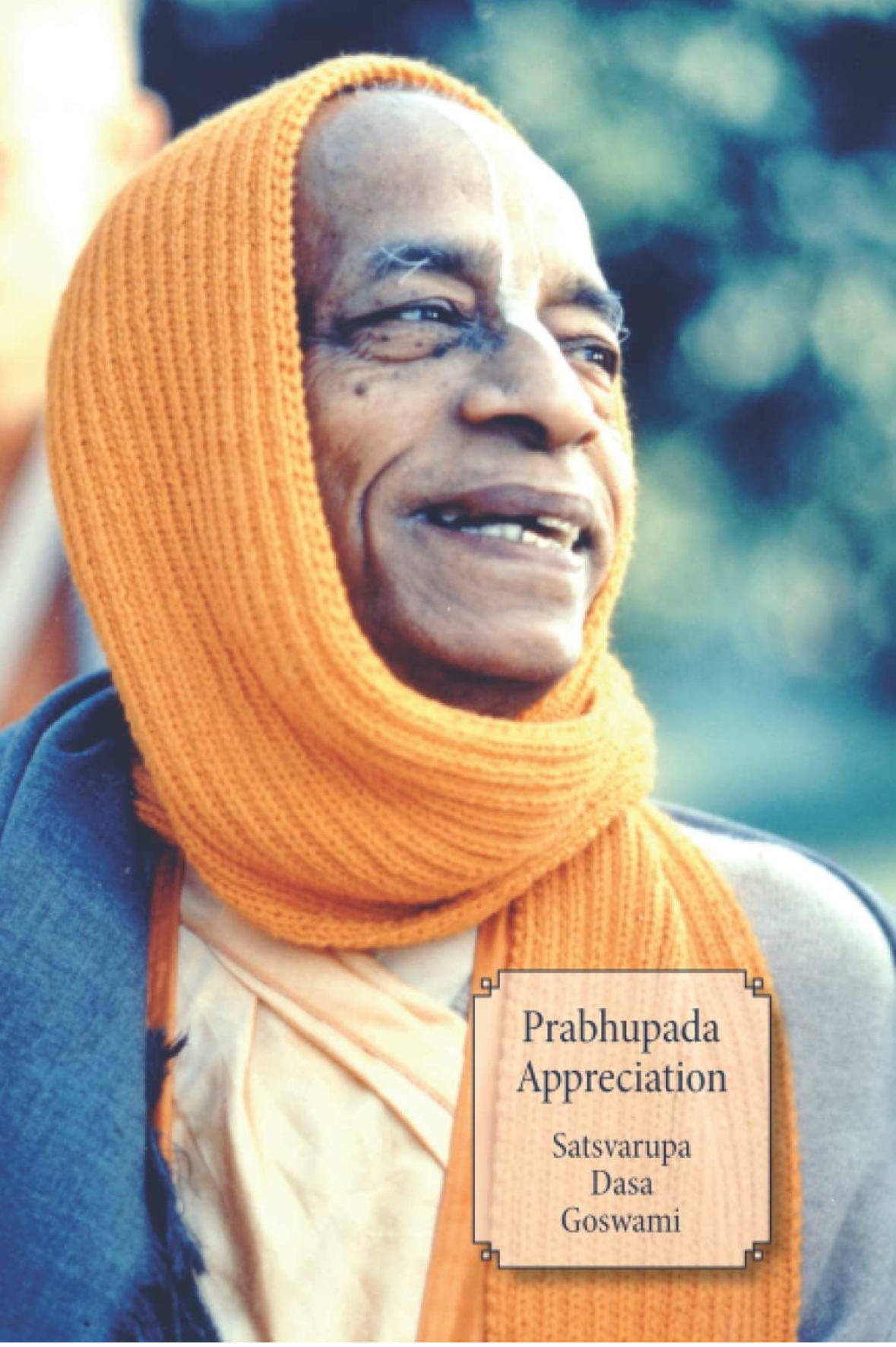
Śrīla Prabhupāda was in the disciplic succession from the Brahmā-Mādhva-Gauḍīya sampradāya, the Vaiṣṇavas who advocate pure devotion to God and who understand Kṛṣṇa as the Supreme Personality of Godhead. He always described himself as simply a messenger who carried the paramparā teachings of his spiritual master and Lord Kṛṣṇa.
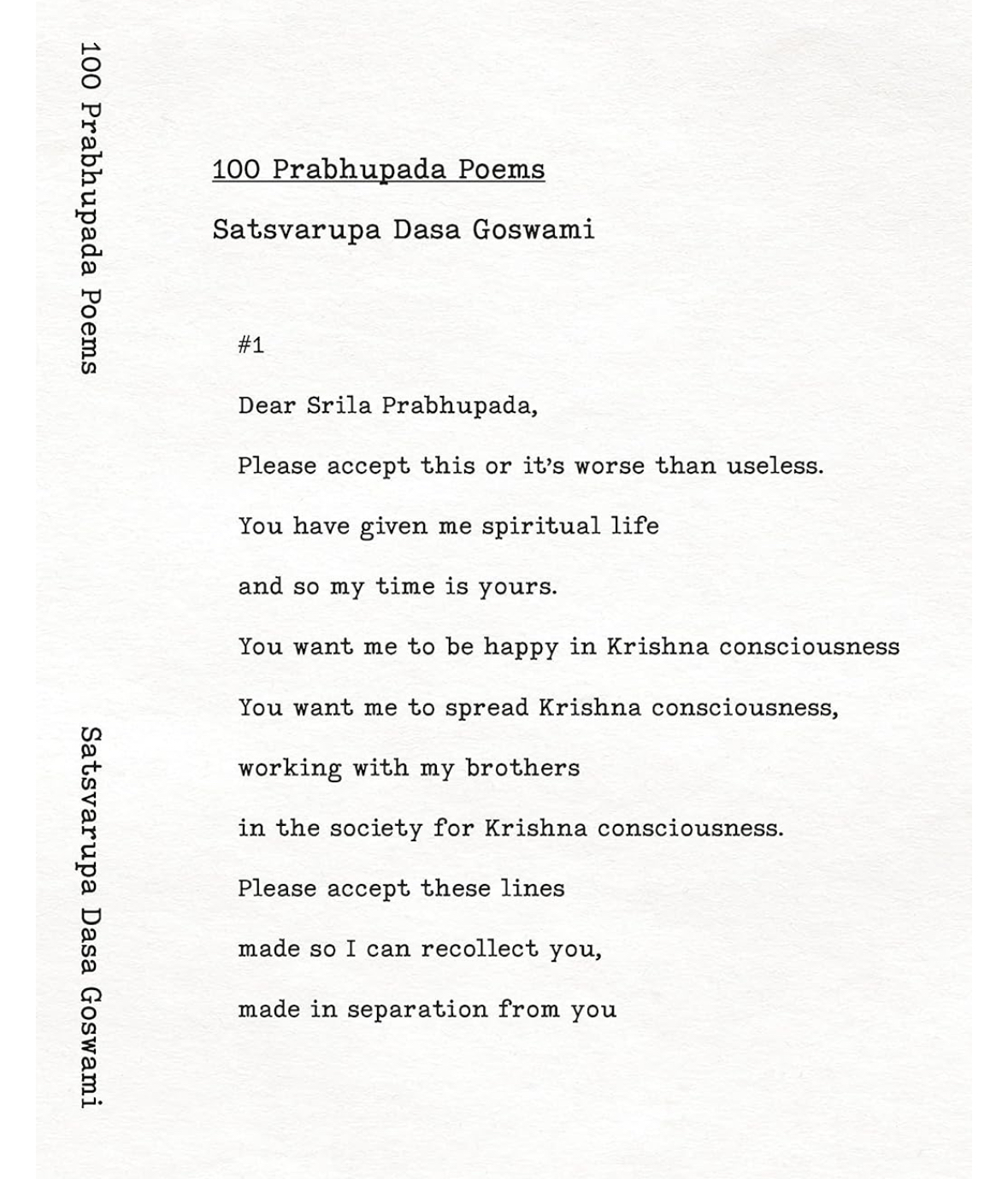
Dear Srila Prabhupada,
Please accept this or it’s worse than useless.
You have given me spiritual life
and so my time is yours.
You want me to be happy in Krishna consciousness
You want me to spread Krishna consciousness,
This collection of Satsvarūpa dāsa Goswami’s writings is comprised of essays that were originally published in Back to Godhead magazine between 1966 and 1978, and compiled in 1979 by Gita Nagari Press as the volume A Handbook for Kṛṣṇa Consciousness.
This second volume of Satsvarūpa dāsa Goswami’s Back to Godhead essays encompasses the last 11 years of his 20-year tenure as Editor-in-Chief of Back to Godhead magazine. The essays in this book consist mostly of SDG’s ‘Notes from the Editor’ column, which was typically featured towards the end of each issue starting in 1978 and running until Mahārāja retired from his duties as editor in 1989.
This collection of Satsvarupa dasa Goswami’s writings is comprised of essays that were originally published in Back to Godhead magazine between 1991 and 2002, picking up where Volume 2 leaves off. The volume is supplemented by essays about devotional service from issues of Satsvarupa dasa Goswami’s magazine, Among Friends, published in the 1990s.

“This is a different kind of book, written in my old age, observing Kṛṣṇa consciousness and assessing myself. I believe it fits under the category of ‘Literature in pursuance of the Vedic version.’ It is autobiography, from a Western-raised man, who has been transformed into a devotee of Kṛṣṇa by Śrīla Prabhupāda.”
 The Best I Could Do
I want to study this evolution of my art, my writing. I want to see what changed from the book In Search of the Grand Metaphor to the next book, The Last Days of the Year.
 a Hare Krishna Man
It’s world enlightenment day
And devotees are giving out books
By milk of kindness, read one page
And your life can become perfect.
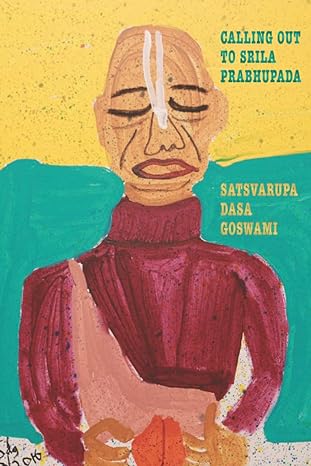 Calling Out to Srila Prabhupada: Poems and Prayers
O Prabhupāda, whose purports are wonderfully clear, having been gathered from what was taught by the previous ācāryas and made all new; O Prabhupāda, who is always sober to expose the material illusion and blissful in knowledge of Kṛṣṇa, may we carefully read your Bhaktivedanta purports.
I use free-writing in my devotional service as part of my sādhana. It is a way for me to enter those realms of myself where only honesty matters; free-writing enables me to reach deeper levels of realization by my repeated attempt to “tell the truth quickly.” Free-writing takes me past polished prose. It takes me past literary effect. It takes me past the need to present something and allows me to just get down and say it. From the viewpoint of a writer, this dropping of all pretense is desirable.
 Geaglum Free Write
This edition of Satsvarūpa dāsa Goswami’s 1996 timed book, Geaglum Free Write Diary, is published as part of a legacy project to restore Satsvarūpa Mahārāja’s writings to ‘in print’ status and make them globally available for current and future readers.