

We need to expand our team of proofreaders as we aim to increase the rate of republication of Satsvarūpa Mahārāja’s books as well as new books that he writes.
This includes a need for fluent bilingual Spanish and English speakers to proofread Spanish translations (we currently have around 20 Spanish translations waiting to be proofread).
Anyone interested in this particular service should contact Manohara dāsa at [email protected]
If you would like to help, please contact Kṛṣṇa-bhajana dāsa at [email protected] or [email protected] and we will find you a service that utilizes your talents.
While you can, chant. While the blood flows within the body and the bones are not cracked and you are not dead—chant.
******
Sure, there are many other services. I said it’s probably common in ISKCON to chant the sixteen rounds inattentively and get them out of the way. But this week we have gone beyond that. Since our vow is to do sixty-four each day, you can’t chant thinking, “I’ll get them out of the way as soon as possible and go on to more important activities of the day.” The chanting is the main activity. And this is a written record of it.
******
The first two days here, the sun shone and it was gorgeous spring weather. Then a transition day, then two days rain and overcast sky. We don’t mind bad weather, remaining indoors is okay, taking shelter of the holy name. Make your life simple.
******
Bhakti-rasa read Narada’s and Prabhupada’s advice that one should build a cottage (like the hunter did) and live there and chant Hare Krsna. People respected the chanter and brought him food. He lived simply. So where is your hut for chanting and your so simple and austere life? Srila Prabhupada said in his purport that you can build a hut with four logs and a grass roof and cleanse the inside—or you can live in a big city like New York or London and keep a tulasi plant there and go on chanting Hare Ki-na and achieve full success.
******
If we develop the strong habit of chanting, then we can non-hypocritically tell people that spiritual life is very simple. All you need to do is take beads and chant Hare Krsna all the time, as Narada advised the hunter. Sri-krsna-caitanya prabhu nityananda.
******
Cops and robbers. Financial woes. Drive to work in traffic jam. Eight hours or more at the work place, drive back home in traffic jam. Problems at home. Where is the time for simple consciousness? Now the upcoming challenge will be how much of this consciousness we can continue after our week is up. Our quota will go down to sixteen. Or can we keep a little increase? Can we stay above that offensive level of deliberate inattentive chanting where we mull over and live in our thoughts with the japa a mere background noise? I hope that there will be a continued improvement in my case.
******
I’m not an all-out lover of the holy names. But I do understand it is the most important (Prabhupada and the sastras say so) and it is the easiest access to love of God. Who but a stubborn fool will avoid it?
******
Hare Krsna Hare Krsna, I will not abandon Thee, precious mantra given to me by my spiritual master. I will chant You all the days of my life until and including the hour of my death. Please stay with me, holy names. I don’t know anything. I need your love. You are God in most convenient form.
******
I embrace you, harer nama. You reciprocate. You are given to me in disciplic succession.
Hare Krsna is my days and nights. On beads he gave me. My Swami, my leader has kindly said chant Hare Krsna. We are writing and that’s good too. But don’t neglect your chanting.
******
Power of ISKCON and GBC to mold the life of the devotees in the movement. In regards to chanting Hare Krsna mantra, you can rest assured that there will never be a resolution forbidding it. As for impetus to do it, that will come from your own practice and relationship with your spiritual master and with hari-nama.
“Please continue reading our books with great care, studying again and again.”
—Letter to Bhakta Steve, December 16, 1974
Some adolescent devotees spoke to me recently of their dislike for reading Prabhupāda’s books. They had already read the Mahābhārata and Śrīmad-Bhāgavatam, and now they wanted to read karmī books. They said that Prabhupāda’s books were too repetitive for them. In this way the fickle mind always seeks some repetitiveness, without looking deeply into the matter. They think that repetitiveness means monotonous and dull. It is a fact that many of the ideas found in Prabhupāda’s books are often repeated many times throughout those books, and this does not make Prabhupāda’s books repetitive. Moreover, in the letter quoted above, Prabhupāda instructs us to study those repetitive books again and again. But he does not say or intend that we dull our brain on his books. Rather the repetitive quality of Prabhupāda’s books is similar to the repetitive nature of chanting Hare Kṛṣṇa, and like most of our chanting, the books contain much more than we have as yet appreciated. But to gain realization of the books, we must apply ourselves diligently.
—Reading Reform, p. 49
“So far our activities in Kṛṣṇa consciousness are concerned, every one of us should read this book very attentively because all conclusive statements in the kingdom of bhakti are contained in this transcendental valuable book. It is the essence of all Vedic scriptures enlightening about Kṛṣṇa consciousness. If anyone will read this Nectar of Devotion very carefully, he will have all guidance in bhakti … So in the temple class some portions of this book must be regularly discussed.”
—Letter to Advaita, June 18, 1970
In this letter Prabhupāda expresses excitement and enthusiasm upon receiving newly published copies of The Nectar of Devotion, and he indicates that the book contains everything necessary for understanding Krishna consciousness. On another occasion Prabhupāda instructed his disciples to read The Nectar of Devotion very carefully, and he said that upon finishing the book, the devotees should read it again and yet again. In this way, Prabhupāda repeatedly encouraged his disciples to study this “law book” of ISKCON. We should not, therefore, take the enthusiasm. Prabhupāda shows in giving this book to his disciples to be a kind of temporary or a passing feeling. Rather, we should ourselves take up Prabhupāda’s mood and become “lawyers” of ISKCON by reading this book regularly.
In saying “Every one of us should read this book very attentively,” Prabhupāda intends himself as well. If Prabhupāda includes himself among those who should study The Nectar of Devotion, who among us can think he need not read it? Not to read The Nectar of Devotion is not to enter the kingdom of bhakti. As Prabhupāda states in the preface of the book, “The Nectar of Devotion will give us practical hints how we can live in this material world perfectly engaged in devotional service, and thus fulfill all our desires in this life and the next.”
The Nectar of Devotion discusses the most basic principles of bhakti, as well as the most advanced topics of the relations of Rādhā and Kṛṣṇa. On many occasions, Prabhupāda himself gave class on the book, and in this letter, he instructs all temples to hold such classes regularly.
—Reading Reform, pp. 31–32
I read maybe one hour in the afternoon. Not very good. Struggling to be attentive and awake, reading about the Lord’s reception in Dvārakā. Śrīla Prabhupāda was saying ideal life is in nice surroundings, unlike urban industry. This is an important subject, but I was barely paying attention.
—Reading Reform, p. 59
pp. 385-90
I began the Prabhupada Meditations series in 1989. The Prabhupada-lilamrta was already completed and I had written a few other books about Prabhupada, but I remember feeling at that time that I wanted to write something more about him. I had no idea what. Sometimes we get clear ideas how we want to serve, and sometimes the ideas form themselves more vaguely in our minds. The closest I had to a plan was to save some time for writing at Saranagati Farm in British Columbia.
By the time I arrived at the farm, I still had no indication what I should write. I was waiting for inspiration, and that waiting built into a kind of pressure. Everything was arranged for my convenience—Jaya Gauracandra had built me a small cabin, there were typists, pens, paper, and time—but I didn’t know what would come up.
Saranagati is a beautiful, silent, pine-filled place. I was studying Bhagavad-gita and trying to be close to Krsna at that time. It was summer, and quite hot. I took walks outside the cabin with my Bhagavad-gita and read and prayed to Krsna, and waited.
Then ideas started to come. A devotee sent me a copy of A Room of One’s Own, by Virginia Woolf. There was something in the beginning of that book that set off a spark in me for a way to begin Prabhupada Meditations. Her book is based on a series of lectures she gave before a women’s society in England in the 1920’s. She begins:
When you asked me to speak about women and fiction, I sat down on the bank of a river and began to wonder what the words meant. They might mean simply a few remarks about [and she names different women authors], but at second sight, the words seem not so simple. The title “Women and Fiction” might mean, and you have meant it to mean, women and what they are like . . . Maybe what you meant is that all of these different themes are inextricably mixed together and you want me to consider them in that light. But when I began to consider the subject in this last way, which seemed the most interesting, I soon saw that it had one fatal drawback. I should never be able to come to a conclusion and present before you in an hour’s discourse, a nugget of pure truth to wrap up between the pages of your notebooks.
What sparked me was that she had an assignment, a commission. An assignment is given to you by someone else and you just do it. Here I was without an assignment and not knowing what to do with my freedom. Nobody was asking me to write about Prabhupada, so I decided to pretend someone was asking me. I began as it is printed in the first volume: “The manager of the Vaisnava Institute for Higher Education wrote asking me to give a series of lectures as part of an upcoming seminar to be held in Vrndavana, India. He suggested that my topic could be “Prabhupada Meditation.’”
I worried about the ethics of this little white lie, although now it seems completely harmless. I don’t think anyone even noticed it. No one ever asked me about it, including the managers of the VIHE. Anyway, it was an important start for me because that fictional beginning allowed me to write the whole book.
I also took from Virginia Woolf the idea that the subject matter could be considered in different ways. I wasn’t using her musing as a gimmick, but as a way to face the fact that the subject of Srila Prabhupada is so vast that it cannot be contained in one idea. Everyone has their idea of who and what Srlla Prabhupada is. It helped me to admit in the beginning that the territory is huge and I can only address “Prabhupada meditations” as they are meaningful to me.
What could the words “Prabhupada meditation” mean? It might mean simply a few thoughts about Prabhupada. Maybe those who gave me the assignment wanted me to give a series of biographical sketches modeled after the Prabhupada-lilamrta. On second thought, the words were not so simple. “Prabhupada meditation” might mean the way Prabhupada meditates. Or it might mean the technique by which we meditate on Prabhupada. From the Introduction to the first volume:
“It might mean that all these themes are inextricably mixed together and the VIHE wanted me to consider them in that way.”
Therefore, this is an opinionated series of books and I tried to make that clear in the beginning. That’s why some devotees don’t like to read them. They are interested in Prabhupada, but not so much in my personal meditations on him. The Prabhupada Meditations series tells the story of how I have taken up Prabhupada meditation, pondered it, and made it work in and out of my daily life.
That’s how these books gradually evolved. They are a way to contact Prabhupada memories. It was a challenge. I hadn’t really exhausted my Prabhupada memories because I hadn’t really remembered them in depth. What I had to do was find a way to remember and actually live in the different times I had been with Prabhupada. I wanted to remember the sensory impressions, the smells, the sights, the way things felt. I wanted to remember what I heard at those times that I was with Srila Prabhupada. I was looking for the whole experience of being with Prabhupada again.
There are professionals who help people to remember things that have been forgotten or buried. Often, they use hypnosis. I had thought about this years before when I was beginning to write the biography because as soon as I would try to remember Prabhupada, I found I couldn’t do it. Not just me, but almost everyone we interviewed had trouble accessing their memories in detail. It was so much work to track someone down and get their permission for an interview, and it would be so disappointing to find that they couldn’t remember anything. I remember I bought a paperback on self-hypnosis while I was at Gita-nagari writing the Lilamrta. The first lessons teach you to put yourself into a relaxed state. Then you are supposed to be able to let your hand move by itself. I could never get my hand to go up. I thought I must not be a fit subject for hypnosis and I put it aside.
When I began Prabhupada Meditations, I wanted to try something that would help me get at my memories. This time, I took the help of a friend and disciple, Baladeva Vidyabhusana dasa, who had among other qualifications, an intense desire to hear me talk about my relationship with and memories of Prabhupada. He was prepared to be patient and to go through the many hours it would take to get at the memories.
When we remember something that happened long ago, we usually remember it in an encapsulated form. Some people call that “canned” memory. To actually go beyond the canned memories and find the fresh details that are also stored in the memory takes more work. Baladeva and I would work at my memories in what I began to call “recall sessions.” If I came up with even a small detail that I hadn’t remembered previously, we would consider it a great gain. And the quality of the writing produced from that energy was encouraging. There was a new vividness to it.
In one of those first sessions, I came up with something new. It was something I had never remembered, but suddenly, by talking about it in this way, a little bubble of detail came to the surface. It was a small detail, but I liked it very much. It was about how we used to say “Mmmm,” imitating Swamiji. Almost all of us did it, but I hadn’t thought about that detail in years. Later, when I showed this manuscript to people before I published it, some of them liked this detail too.
Baladeva and I felt encouraged that there was plenty of work to be done, and since that time, I have gone on and done several more volumes.
In addition to the recall work, we had to edit down the raw memories into something that could be read. You don’t just start remembering and everything comes out smooth. A lot of it is “ah,” “uh,” and “urn.” I decided to mix the recall work with short, philosophical essays and some poems for variety.
pp. 9-13
The inmates are in beds early after a rough day. It’s an open dorm with a few private rooms. How long will this go on? Even when lights go out, they talk and listen to noises in the walls. Some stay up completing their japa quotas. No more visitors, at last. Darkness. Will the simhasana arrive without cracks in it from transit? I don’t want to write goofy so I won’t order a new book by a poet they said was goofy. War on pain. Be religious and meet you in the spiritual world.
Humorous description of Gopal in Prayaga. He’s dumb, yet he goes on chanting his Gopal mantra, given by Kamyaka. Therefore, he makes advancement. Other forms of God don’t attract him. He needs a guru and better association, however, to attain the lotus feet of the object of the sixteen-syllable mantra. I like hearing how he is dumb and even offensive, yet he makes advancement because he’s so determined to chant—until he much enjoys chanting—this highest mantra. What a lucky fellow. If he just persists, he’ll make it.
Take that as a lesson, my friends. Monitor comes through dorm and asks the japa chanter and the chatterers to cease all sound. It’s time for needed sleep so the body can serve Krsna. Let’s get to know the individuals. An all-male ward. They’ll play and pray in the morning. Some have special friends. But in the eating times, all hear about Gopal. That’s their study. This scribe is too wounded to do more this evening. Shouldn’t have written a certain letter, should write other letters. Oh Lord, help me to persevere and take whatever comes. And may I remove all blockages in devotion to my master, understand his love for me and accept his individuality.
Take it easy. I’ll sneak in a
lullaby. Hurt eye he’s telling
his friend. Shouldn’t write
then. People aren’t quiet as
they should be. It’s too late
to meet. I’ll see you tomorrow.
Rest in Krsna’s arms
figuratively and real someday. Eons away but your
spiritual master is for this lifetime. Don’t throw it away. Make it grow.
Your strategies. He told me not to be so risky, because I live in an institution. We know what they did but some are still hiding out.
The secret police can wreak havoc. So many friends are coming and I
try to meet them. They sit
by your bed in the ward (have you a private room?) and talk only an hour.
Tell some laid-back tales
but try not to forget you are
bhaktas and should chant
and hear. Run out of gas, why push it?
Tomorrow is another day. A day
of up and down. I can’t
take any more tonight.
Each sub-person on his own now, own dreams and troubles, but one God and that’s why we are in the Prabhupada ward.
Don’t kick us out even if we never recover. We are grateful.
Up early in the morning and saying their japa. Some sitting up in bed, some sitting in their chairs, some walking back and forth. Some were allowed to use clickers because their minds couldn’t concentrate using the beads and they didn’t know which way they were going to count properly. But most had beads in the japa-mala. The monitor didn’t allow the chanting to get too loud be-cause some inmates were disturbed. Lucky ones in the private rooms. And how the minds went all over the universe. Picking up trivia, dwelling on troubles, going blank and falling asleep. And those small periods of yearning to actually hear, to actually understand that this was the most important thing in the day. Not embarrassed in front of the others because we all know it’s a struggle. If someone was actually advanced and tuned into the value of the Holy Name, well good for him, we’re not envious. We want his association. Hare Krsna, Hare Krsna, Krsna Krsna, Hare Hare / Hare Rama, Hare Rama, Rama Rama, Hare Hare. That’s all there is to it, the simple repetition of those names. Lord Caitanya made it as easy as can be, so a fool can do it, can handle the precious gem and get benefit. What to speak of a learned brahmana?
An hour goes by. Some have chanted more than others. All are encouraged. And then they take a break.
Spaced-out. Reviewing a Laurel and Hardy plot. Faces float by. Something someone said. Drink water and pee. Just hear, just hear. Look over at another inmate and see how he’s doing. He has allergy and the pollen count is record high; he’s scratching his eye, which makes it worse. “I can’t help it.” One nods out and becomes aware others are looking at him so he picks up his head and chants loudly and distinctively for a while. Where is the inner experience of the mantra? Gopal sometimes saw the Deity of his mantra. We mostly just see heads and feet, some have decorative bead bags, ink-stained, and the clickers. Everyone is making at least some progress.
The Holy Name is absolute. Even if you chant mockingly or by accident or the sounds aren’t spaced— words like “Ramada”— still, it has the effect of chanting the Holy Name. The inmates knew this and so they chanted, knowing even a poor recitation was the most important thing to accomplish in a day. The numeri-cal strength is also important. So don’t excuse yourself. Meet you in the spiritual world. Don’t fall behind.
The sun began to pour through the window blinds. Another day had begun. They filed into the temple room to watch a few brahmanas undress and bathe and redress Radha-Govinda. Then they went down for breakfast. There was an early-morning guest so they got prepared to see him and embrace him, half-regretful that it would take away some japa time. But they tried for it later. Hare Krsna, Hare Krsna, Krsna Krsna, Hare Hare / Hare R?ma, Hare R?ma, R?ma R?ma, Hare Hare.
Inmates recover in this way. They live in harmony under the shelter of the Holy Name.
Light blue, chipped teeth, mashed hand, my good friend brings an unbroken simhasana across the sea and now Radha-Govinda and Prabhupada are joined happily on the little altar in Radha’s barn.
We can climb the stairs and sit on our rockers and
listen to Swami sing a half hour and join in the chorus.
We can bathe them in the morning. No time to do Prabhupada in weakened condition. Pray to him early in the morning even if it takes a walk upstairs, you can do it. Hare Krsna music and art.
Light blue means he’s not outgoing but he’s happy he gets to go near the japa quota and he’s so dependent on dear friends who don’t mind taking care of him even though he’s a grownup man.
He’s making it up, he
never loved and read
like he said in his
younger days. He’s making up
everything as he goes along
praying to keep a decent reputation.
He’s keeping to the outskirts but meeting famous people as they come through. They lecture to crowds and give him a little private time in his private room of the sanatorium.
Keep the tune. To a friend who does not mind he plays “Coming on the Hudson” and says “I just like it always even though now I’m an enrolled renunciate for my whole life.”
I dig it says A.
and they don’t let the others hear
because they couldn’t understand a monk loving God in his own way each one, and God accepts them all.
pp. 42-45
Glad and grateful to feel clear this morning, responding to alarm clock’s up-and-at-’em. Grateful too I’m not a fireman who has to slide down a pole and onto a truck to a fire somewhere.
Then what am I, and what call am I responding to?
My spiritual master’s call because there’s no truth superior to Krsna. “There is no truth superior to Me. Everything rests upon Me, as pearls strung on a thread.” It’s good to be near a verse of Bhagavad-gita. Writing can be used in Krsna’s service and I need to write. That means breaking through the gremlin’s grip on me. Listen, even if this book doesn’t “click” into an enlightened, clear, and simple treatise, I have to go on with my work. Anything can be purified.
Green grow the rushes O,
he wanted to know
why poems a penny each?
Do you think you are the proprietor
or renouncer?
These things I learned at twenty-six years old:
to revere guru,
eat prasadam only, chant
on red beads, abstain from
sex, read Srimad-Bhagavatam
and clear off living with karma.
Bold Progresso flag unfurled.
“There is no truth . . . ” I ride with
the Supreme Lord.
This is madness said
the Mad Hatter. I told him
if you don’t like it, jump off
and go to your tea party.
Alice? She’s someone else’s creation. I got a date with the heavy-weight champ. I got a chimp on a chain to rattle.
No old bear on a chain and a guy with heavy metal rod hitting him to make him dance from Agra to Delhi. Tourists stop to pay. The cops.
You ain’t goin’ to Karttika?
Where have you been?
Look, they all know you are
in this place instead of Vrndavana.
No harm, no harm. Come out, old man, and show
us your haircut.
Come out, come out wherever you are.
Come out with your arms up
and surrender
your concentration—this book
seeking progress
—where will it get you?
Ah, they got my number. I’m
faulty in so many ways,
am salty from sea spray.
Seek asylum.
The Lord is Lord.
I hear Him in the trees’ leaves’ rustle.
Alone, He touches my face and
I worship Him in quiet,
pre-morning air
and rest my case.
After I recited my poem, a brother turned to another and said, “Pretty intense. What’s next?” He passed on from Satsvarupa to the rest. 0 Krsna, we don’t want mays even in our explicit/ implicit tunes.
I mean it—not in
birds or headaches
in Mayapur or memories
because there were those years when
the Swami was here. Now I’m
a real separation-poet
doncha know.
Lord, I pray for a sweet song.
Asphodels. Pinwheels. Toys. Lunch. What do you want, a Brahman, nonsentient atmosphere?
No.
Heaven? Like the subterranean heavenly planets where it’s no problem, no sweat, no bad odor, no wrinkles, no fighting, and lots of sex? The only problem there is that you have to die.
No, I don’t want that.
Then what? The transcendental abode? Did you put in your application for transfer?
Yes, done that. I’ve even got a ticket issued by Srila Prabhuoda, fortunately valid forever.
I need to grow completely detached from the material world—not care a fig for anything in it. Know there’s no happiness. And on the spiritual side, I need to be fully attached to anyabhilasita sunyam.. That’s uttama-bhakti. Get it?
They ask, “But I thought even if you chanted one Hare Krsna mantra by mistake while falling from a roof, that was good enough to take you immediately to Goloka. I thought membership in ISKCON did the trick.”
Yes, ISKCON membership helps. Don’t damn this movement or its leaders. Membership is a valuable resource for those wanting to go back to the spiritual world. Better than an American passport, that’s for sure. Our native land.
O ISKCON …
Still, it’s not so easy. There are perpendiculars to cross, right angles. You got to be a man and face the facts: they don’t admit flaky devotees up there. Those kinds of devotees have to wait. And no Americans allowed (Indians either). Only pure spirit souls.
One of my Godbrothers said, in defense of the GBC, “Everyone can go to the spiritual world, even the GBC men.” I quipped, “Can they go as GBC men?”
Maybe, wise guy. Better to ask, “Can they go as retired GBC men?” Ha! The laugh’s on you.
Oh no, you have to be totally sincere. You have to want nothing else but Krsna, and you have to have complete faith in guru. Those are the guys who get to board the spiritual airplane. Those other guys, they don’t really want to go back to Godhead, not in their innermost hearts. They’re still harboring other desires and Krsna, out of kindness, grants them. Someone might want to be a better author (more appreciated), so he comes back for that and his face winds up on the dollar bill of some country (preferably U.S.A.).
You nonsense. You think you can book your reservation as if Goloka Vrnavana were some five-star hotel by the beach, but you can’t pay the price. It costs tears, laulyam, the real thing.
Oh, you ain’t nothin’ but a hound dog
a-cryin’ all the time.
You ain’t never caught a rabbit
and you ain’t no friend of mine.
They said you was high-class
well that was just a lie…
Back to Godhead blues: a medley of old songs interpreted into the bhakti perspective by Satsvarupa dasa.
Why, the daisies you’ve doodled, are they symbolic of your spiritual desires? They’re childlike flowers with big round balls and stocky oblong petals. Or are they popularized lotuses blooming to spiritual perfection?
I don’t know. They’re daisies, I guess, flowers of aspiration. Grow, daisy. Soak in the sunlight and turn like
a sunflower
reaching higher
never ceasing
to feel bhakti.
Protect thy stout stem
with prayer and service,
nourish the creeper
of desire for
Krsna consciousness.
pp. 159-61
I just heard a tape of Srila Prabhupada on a morning walk in Geneva, June 1974. He was speaking favorably of the practice of prayer and worship of God in other religions, provided they actually follow their scriptures. During that whole spring tour—Rome, Geneva, Paris, Germany, Australia—Prabhupada got quite involved in exchanges with Christian priests, and he expressed ecumenical ideas to his own disciples.
On the Geneva walk, he began by asking whether there were many churches in the city. When he was told, “Not so many,” he replied. “That means godlessness.” He said that when he first went to Butler, Pennsylvania, he saw at least a dozen well-attended churches, although it was a small county. “I very much appreciated,” he said. “Churches mean God consciousness. I never criticize churches or mosques—never. Because whatever it may be, at least there is God consciousness. Then they are good. In details [they may differ], but I only criticize those who don’t follow. Otherwise, we don’t criticize.”
“We’re not sectarian,” said one of the devotees.
“Why?” said Srila Prabhupada. “God is one. Why sectarian? According to circumstances, he’s doing. And that prayer is also vandanam. Sravanam kirtanam visnoh-smaranam pada sevanam. This vandanam is prayer. That is bhakti, one of the items of bhakti.”
Devotee: “Everyone needs to be encouraged in their God consciousness.”
Prabhupada repeated his point about vandanam, offering prayer, and he acknowledged that it also existed, at least in a preliminary stage, in churches of different religions.
Devotee: “Is it required for them to have a spiritual master to guide them?”
Prabhupada: “Certainly. But these rascals, the priests, they do not guide them. They’re also fallen. Otherwise, Christian religion is very nice. If they follow. So many times they ask me. I say, ‘Yes, if you follow. Your Christian religion will make you perfect.’ And Caitanya Mahaprabhu proved devotional service from the Koran. It requires a devotee who can explain from any godly literature about God.”
This last statement particularly struck me: It requires a devotee who can explain from any godly literature about God.” I have often been skeptical about ecumenical or inter-faith exchanges. Sometimes ecumenicists seem to be no more than polite sectarian opponents feeling each other out so that they can then go later and preach to members of the opposing religion and be more expert at their conversions. Or else it seems to be quite mundane, an indulgence for religionists who have n conclusive path. But Prabhupada spoke of a substantial service to be done for religionists, especially by one who knows the science of God. I want to try to understand better what he meant, especially as he expressed it during his tour through Europe and Australia in 1974.
Chanting my rounds in the sandy front yard while visnu sahasranama is chanted by devotees at the Janardana temple. I’m awake, alive, and a pleasing cool breeze is encouraging me to go on chanting Hare Krsna.
I was disappointed in Dale Carnegie’s chapter on prayer in How to Stop Worrying and Start Living. His stress is not on pure devotional service. He is very enthusiastic and positive about prayer, and so his words may have some benefit, especially in inducing nonbelievers to try prayer (vandanam). But it is all geared toward getting relief from suffering and gaining benefits within the material world. He writes, “I am tremendously interested in what religion does for me.” He certainly has an appreciation for the power and vitality of a religious life, but we cannot minimize the highest goal of religious practice—to please the Supreme Personality of Godhead with all our activities.
Carnegie gives us the lowest common denominator. His faith stories tell of those who avoided suicide and insanity by praying to God. He tells of a discouraged book salesman who fell into debt and began to dread his occupation. After finding a Gideon Bible in his hotel room and praying while at a very low point, the salesman went out the next day and made more sales than he had in weeks. “That evening I proudly returned to my hotel like a conquering hero!” relates the converted salesman. “I felt like a new man. And I was a new man, because I had a new and victorious mental attitude. No dinner of hot milk that night. No, sir! I had a steak with all the fixin’s. From that day on, my sales zoomed.”
Carnegie also turns, almost naively, to the psychologists for support. He quotes many psychologists who speak of the practical mental benefits of belief in God. Religion is good because it’s practical. It solves mental problems. He even interprets that Jesus was a revolutionary because “he preached that religion should exist for man—not man for religion . . . He talked more about fear than He did about sin. The wrong kind of fear is a sin—a sin against your health, a sin against the richer, fuller, happier, courageous life that Jesus advocated.”
Carnegie and the converts who give testimony in his pages are certainly fired-up about their God consciousness. They’ll challenge you with their enthusiasm, and they won’t be dampened. So rather than debate the issue, we simply have to be more enthusiastic about our own propagation of pure devotional service, which is beyond the realm of fruitive religion. Fruitive religion can also lead to the higher goal. This is what Krsna means in the Bhagavad-gita when He says that even those who are in distress, if they come to Him, are sukrtina, or saintly. But best among them is one who is not seeking a reward from God, but who becomes enamored at some point or other in his devotional service, by the name, form, and activities of Krsna, and simply wants to chant and serve the Lord eternally.
pp. 1-602
sa vai puṁsāṁ paro dharmo
yato bhaktir adhokṣaje
ahaituky apratihatā
yayātmā suprasīdatiThe supreme occupation [dharma] for all humanity is that by which men can attain to loving devotional service unto the transcendent Lord. Such devotional service must be unmotivated and unin-terrupted to completely satisfy the self. —Srimad-Bhagavatam 1.2.6
Before I had been initiated by Sri1a Prabhupada, I was already attracted to his “cult.” One day in his apartment, I took up a scrap of Prabhupada’s saffron cadar. One of the boys said I could have it. It was smaller than the size of a scarf, and the next time I came to the temple I wore that piece of cloth wrapped around my neck. I’m not sure what I thought I was doing—was I starting a new clothing fashion or just indulging a whim? But I had a definite purpose—I was showing Prabhupada that I thought of myself as one of his men. Prabhupada glanced at me in the motley audience of the storefront and seemed to notice my new scrap of cloth worn around the collar of my shirt. He never said anything, but I thought his glance signaled mostly alarm at the eccentricity I was displaying. Later when I read the Caitanya-caritamrta and saw how Lord Caitanya looked with displeasure at the fancy woolen blanket of the mendicant Sanatana, it reminded me of this. Sanatana got the message, although unspoken, and traded his good blanket for one suitable for a mendicant. I also got rid of my “swami scarf.” As Prabhupada said of a drunken bowery bum who wandered into the storefront and did some service by donating toilet rolls, “Just see, he’s not in order, but he wanted to do some service.” So I also wanted to show you, Swamiji, that you were winning me over.
The East Village Other described Swamiji’s congre¬gation as “the world’s toughest audience—Bohemians, acidheads, potheads, and hippies.” After what we had been through and what we had rejected in the name of middle-class America, who would have thought we would have joined an organized religion? But we didn’t think of ISKCON that way. We just kept coming back to see Swamiji, attracted to his gracious, humble self and his way of living. He was the personification of ahaituky apratihata, serving Lord Krsna without motivation and without interruption.
And he said that we could do it too. Those were happy days. There was no hierarchy, no firmly established liturgy, no management, and even the degree of commitment was a matter of choice. Important things were forming but in a “homemade” way, just as Swamiji cooked the noonday vegetables and capatis. Sri Krsna Himself was also noninstitutional. He danced at night and attracted other men’s wives. He played all day in the woods with His cows in an enchanting place called Goloka Vrndavana, and He killed demons. But if Krsna consciousness came to us in a noninstitutional way, that didn’t mean it was something invented by Prabhupada. Swamiji told us that millions of people in India worshiped Krsna and that the science of Krsna, as described in the Sanskrit Vedas, was the most sublime and comprehensive theology of God consciousness of any culture in the world.
And so we imbibed spiritual family love from our guru and accepted an education in the topmost secret wisdom, as passed down through the centuries from one spiritual master to another.
The Vaisnava scholar and friend of ISKCON, Professor Thomas Hopkins, likes to tell the story of his early visits to 26 Second Avenue. The main feature of his recollection is how the “devotees” whom he met had never even heard of Srimad-Bhagavatam and barely even knew of Lord Caitanya. Professor Hopkins must have visited in the first months of Prabhupada’s work, because gradually we became familiar at least with the term “Srimad-Bhagavatam,” because that was the name of Swamiji’s book which he had brought from India, and “Lord Caitanya” was the incarnation of Krsna who was dancing in the picture on Swamiji’s table. Professor Hopkins was right: we were ignorant. But one thing we knew—that we had met “a very nice saintly person,” a pure sadhu who walked barefoot in his apartment, who had no money at all but was not in anxiety, who was dignified and had serious literary work to do each day, and yet was always free to talk with us, and who didn’t mind if we were bearded, dirty, and had recently been drugheads. We were ignorant, but we were following, as we were fond of saying to guests, “a self-realized person.”
One doesn’t forget such impressions, even after the innocent days and years fade into the past. Something indelible happened to your mind and heart, and even if you can recall but a few details now, the impression of holiness, of ahaituky apratihata remains and gives you life-breath. You know, “I met a pure devotee. He lived with us. He fed us, he taught us, he loved us.”
The sages at Naimisaranya had asked Suta Gosvami to summarize all the scriptures and tell them the most essential part. They requested this on behalf of people of Kali-yuga whose time and energy is very limited. Rita therefore proposed to eliminate all talk of materialistic religion. This was already declared in the second verse of the first chapter of Srimad-Bhagavatam, dharmah projjhita-kaitavo—religion which is motivated with material desires is rejected from the Srimad-Bhagavatam. Only the highest dharma is taught here, and there is no need to learn anything else from other scriptures.
Srila Prabhupada defines dharma as occupational duty, and he boldly proclaims that everyone has only one duty, no matter what shape or form it may take in terms of varna or asrama. The one duty is to render loving service to the Supreme Personality of God-head. That will deliver a conditioned soul from the miseries of repeated birth and death and completely satisfy the self.
Srila Prabhupada often lectured on this verse, sa vai pumsam paro dharmo, and he said it defined “the best religion.” The best religion is not Hinduism, Christianity, Islam, Buddhism, or any other sect. The best religion is love of God. And one can ascertain if that paro dharma is being performed by these symptoms: the devotee serves the Supreme Lord without any profit motive, and he serves full-time without interruption. Only then does dharma satisfy the self, because the self is meant to serve the whole, just as the hand is meant to render service to the body.
Did Swamiji promise us something that hasn’t come true? No, he never said that we would become pure devotees overnight, although he said it was possible. “You can become Krsna conscious in a moment or you may fail to become Krsna conscious after millions of births,” he said. He soon saw our tendency to fight among ourselves and warned us that it could ruin everything. He promised us bliss in the chanting of Hare Krsna and a brilliant future for going back to Godhead—provided we became like him, unmotivated and uninterrupted in our service. Prabhupada didn’t bluff or cheat or make false rosy pictures. He pointed us toward the spiritual world and said he would guide us at every step. He is doing that still if we wish to follow.

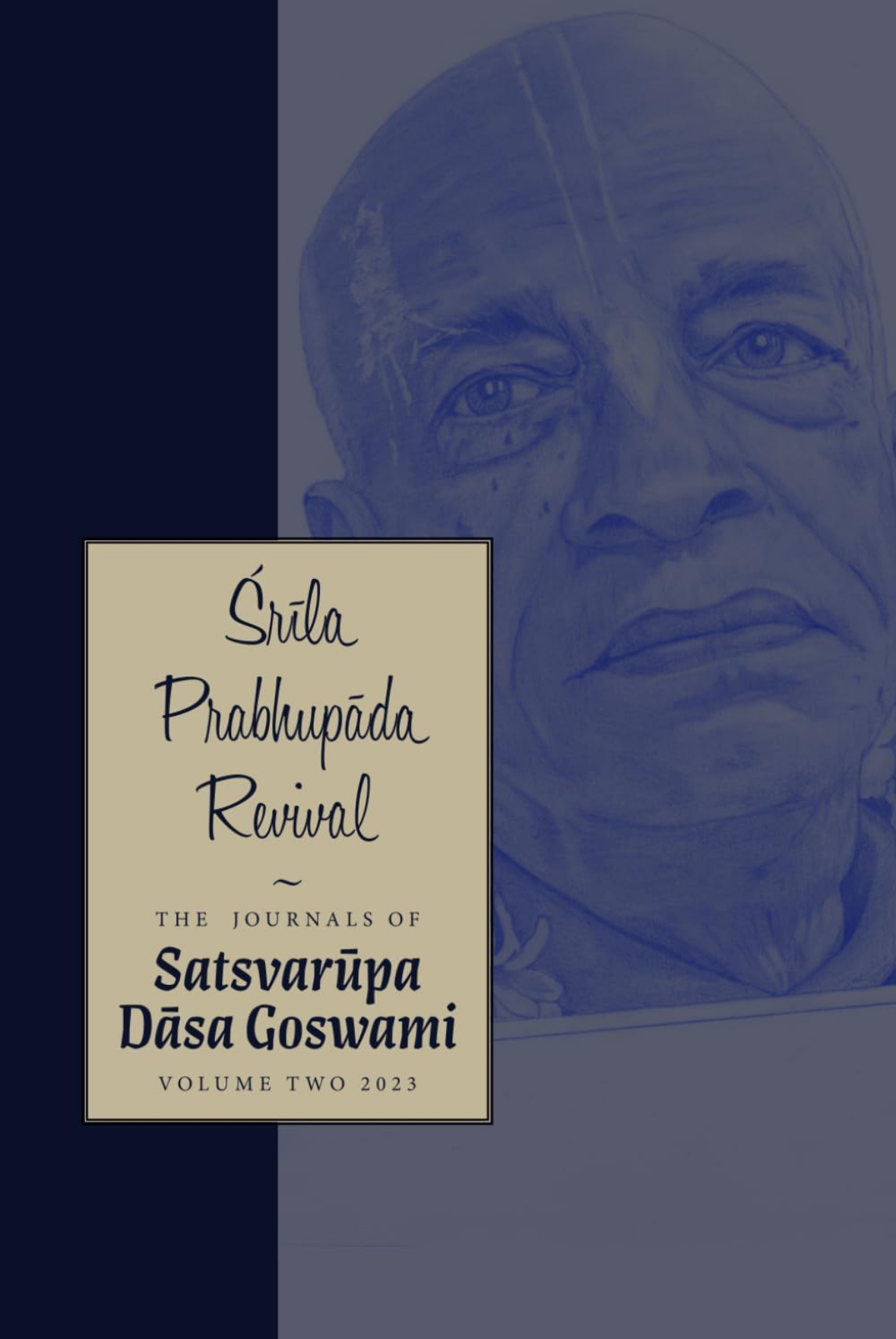
Viraha Bhavan Journal (2017–2018) was written by Satsvarūpa Mahārāja following a brief hiatus in writing activity, and was originally intended to be volume 1 in a series of published journals. However, following its completion and publication, Mahārāja again stopped writing books, subsequently focusing only on what became his current online journal, which began in August of 2018.

At first, I took it hard that I would have to live surrounded by the firemen, and without my own solitude. After all, for decades I had lived in my own house with my own books and my own friends. I was also now a crippled person who couldn’t walk, living among men who did active duties. But when Baladeva explained it to me, how it was not so bad living continually with other firemen and living in the firehouse with its limited facilities, I came to partially accept it and to accept the other men. I came to accept my new situation. I would live continually in the firehouse and mostly not go outside. I would not lead such a solitary life but associate with the other firemen.
Let me write sweet prose.
Let me write not for my own benefit
but for the pleasure of Their Lordships.
Let me please Kṛṣṇa,
that’s my only wish.
May Kṛṣṇa be pleased with me,
that’s my only hope and desire.
May Kṛṣṇa give me His blessings:
Kṛṣṇa Kṛṣṇa Kṛṣṇa Kṛṣṇa Kṛṣṇa he
Rāma Rāghava Rāma Rāghava
Rāma Rāghava rakṣa mām.
You mentioned that your pathway has become filled with stumbling blocks, but there are no stumbling blocks. I can kick out all those stumbling blocks immediately, provided you accept my guidance. With one stroke of my kick, I can kick out all stumbling blocks. —Letter by Śrīla Prabhupāda, December 9, 1972.
The Writing Sessions are my heart and soul. I’m trying my best to keep up with them. I am working with a few devotees, and they are far ahead of me. I wander in the wilderness of old age. I make my Writing Sessions as best I can. Every day I try to come up with a new subject. Today I am thinking of my parents. But I don’t think of them deeply. They are long gone from my life. Śrīla Prabhupāda wrote a poem when he was a sannyāsī, and he said now all my friends and relatives are gone. They are just a list of names now. I am like that too. I am a sannyāsī with a few friends. I love the books of Śrīla Prabhupāda. I try to keep up with them. I read as much as I can and then listen to his bhajanas.
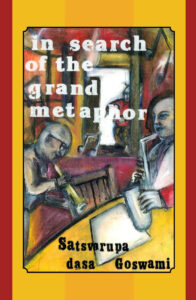
The metaphor is song. Explain it. Yes, particulars may not seem interesting or profound to readers who want structured books.
Wait a minute. Don’t pander to readers or concepts of Art. But Kṛṣṇa conscious criteria are important and must be followed. So, if your little splayed-out life-thoughts are all Kṛṣṇa conscious, then it’s no problem.
I am near the end of my days. But I do like the company of like-minded souls, especially those who are Kṛṣṇa conscious. Yes! I am prone to Kṛṣṇa consciousness. I have been a disciple of Bhaktivedanta Swami Prabhupāda for maybe almost sixty years. Sometimes I fail him. But I always bounce back and fall at his feet. It is a terrible thing that I sometimes do not have the highest love for him. It is a terrible thing. Actually, however, I never fall away from him. He always comes and catches me and brings me back to his loving arms.

This edition of Satsvarūpa dāsa Goswami’s 1996 timed book, Upstate: Room to Write, is published as part of a legacy project to restore Satsvarūpa Mahārāja’s writings to ‘in print’ status and make them globally available for current and future readers.
A factual record of the reform and change in ISKCON guru system of mid ’80s.

Readers will find, in the Appendix of this book, scans of a cover letter written by Satsvarūpa Mahārāja to the GN Press typist at the time, along with some of the original handwritten pages of June Bug. Together, these help to illustrate the process used by Mahārāja when writing his books during this period. These were timed books, in the sense that a distinct time period was allotted for the writing, during SDG’s travels as a visiting sannyāsī
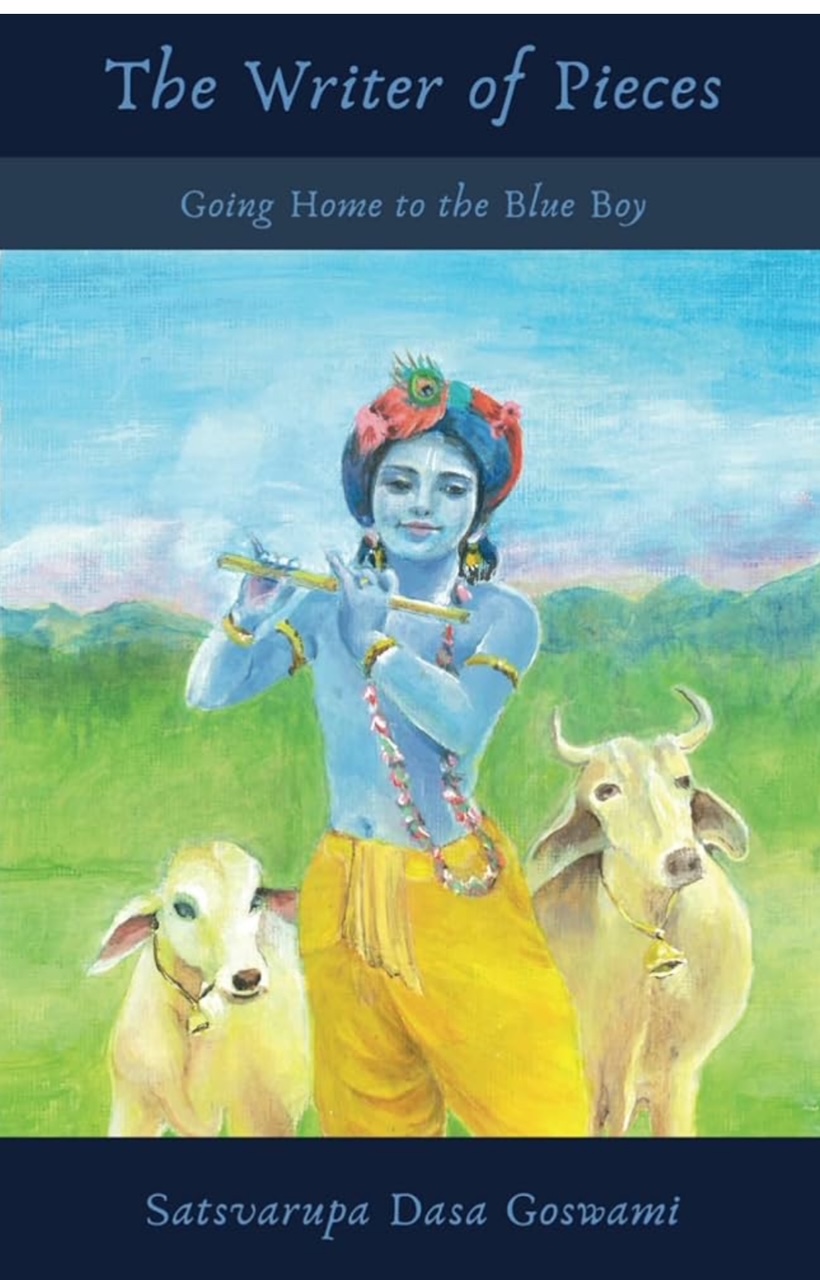
Don’t take my pieces away from me. I need them dearly. My pieces are my prayers to Kṛṣṇa. He wants me to have them, this is my way to love Him. Never take my pieces away.

Many planks and sticks, unable to stay together, are carried away by the force of a river’s waves. Similarly, although we are intimately related with friends and family members, we are unable to stay together because of our varied past deeds and the waves of time.
To Śrīla Prabhupāda, who encouraged his devotees (including me) To write articles and books about Kṛṣṇa Consciousness.
I wrote him personally and asked if it was alright for his disciples to write books, Since he, our spiritual master, was already doing that. He wrote back and said that it was certainly alright For us to produce books.
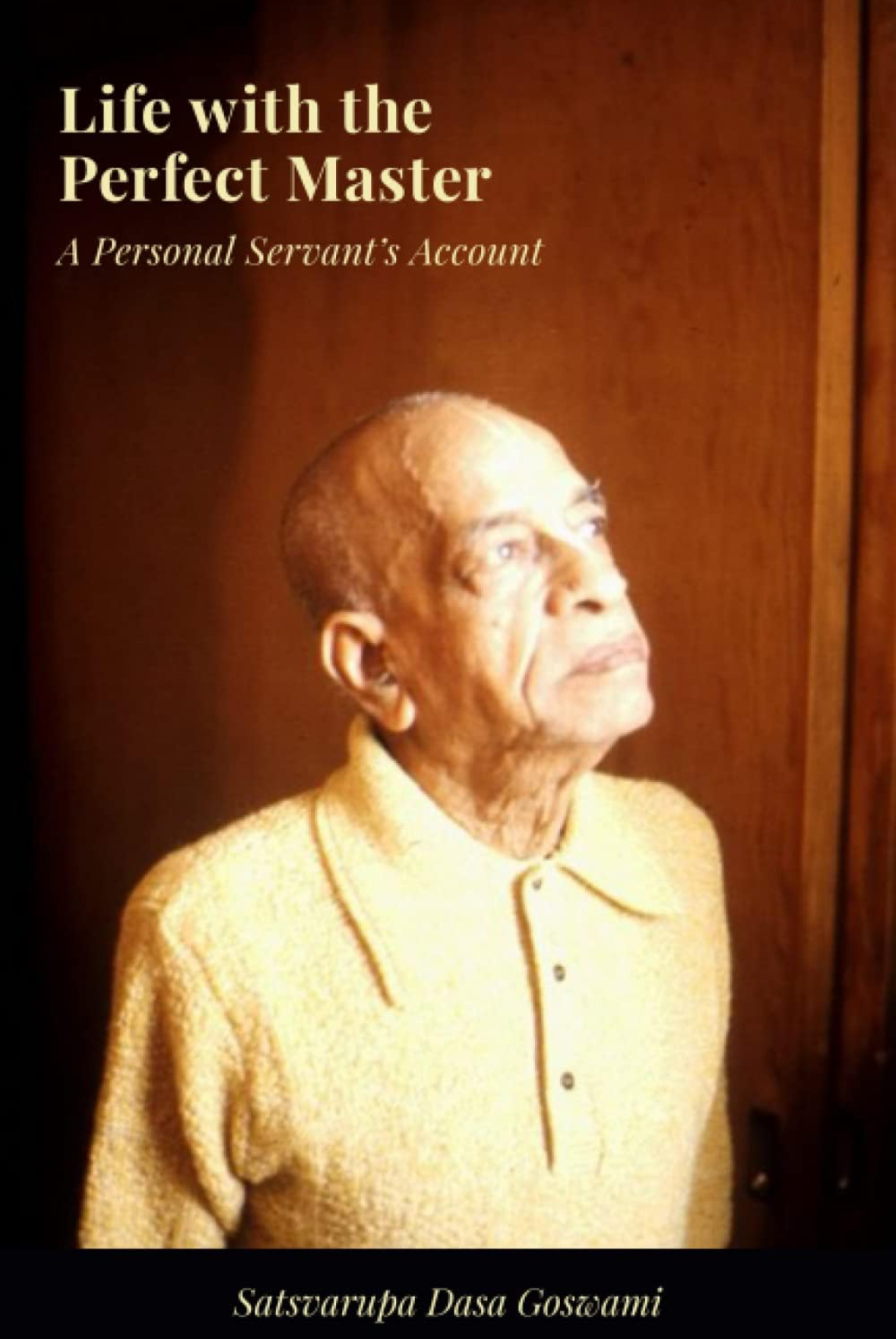
I have a personal story to tell. It is a about a time (January–July 1974) I spent as a personal servant and secretary of my spiritual master, His Divine Grace A.C. Bhaktivedanta Swami Prabhupäda, founder-äcärya of the International Society for Krishna Consciousness. Although I have written extensively about Çréla Prabhupäda, I’ve hesitated to give this account, for fear it would expose me as a poor disciple. But now I’m going ahead, confident that the truth will purify both my readers and myself.

First published by The Gītā-nāgarī Press/GN Press in serialized form in the magazine Among Friends between 1996 and 2001, Best Use of a Bad Bargain is collected here for the first time in this new edition. This volume also contains essays written by Satsvarūpa dāsa Goswami for the occasional periodical, Hope This Meets You in Good Health, between 1994 and 2002, published by the ISKCON Health and Welfare Ministry.

This book has two purposes: to arouse our transcendental feelings of separation from a great personality, Śrīla Prabhupāda, and to encourage all sincere seekers of the Absolute Truth to go forward like an army under the banner of His Divine Grace A.C. Bhaktivedanta Swami Prabhupāda and the Kṛṣṇa consciousness movement.
A single volume collection of the Nimai novels.
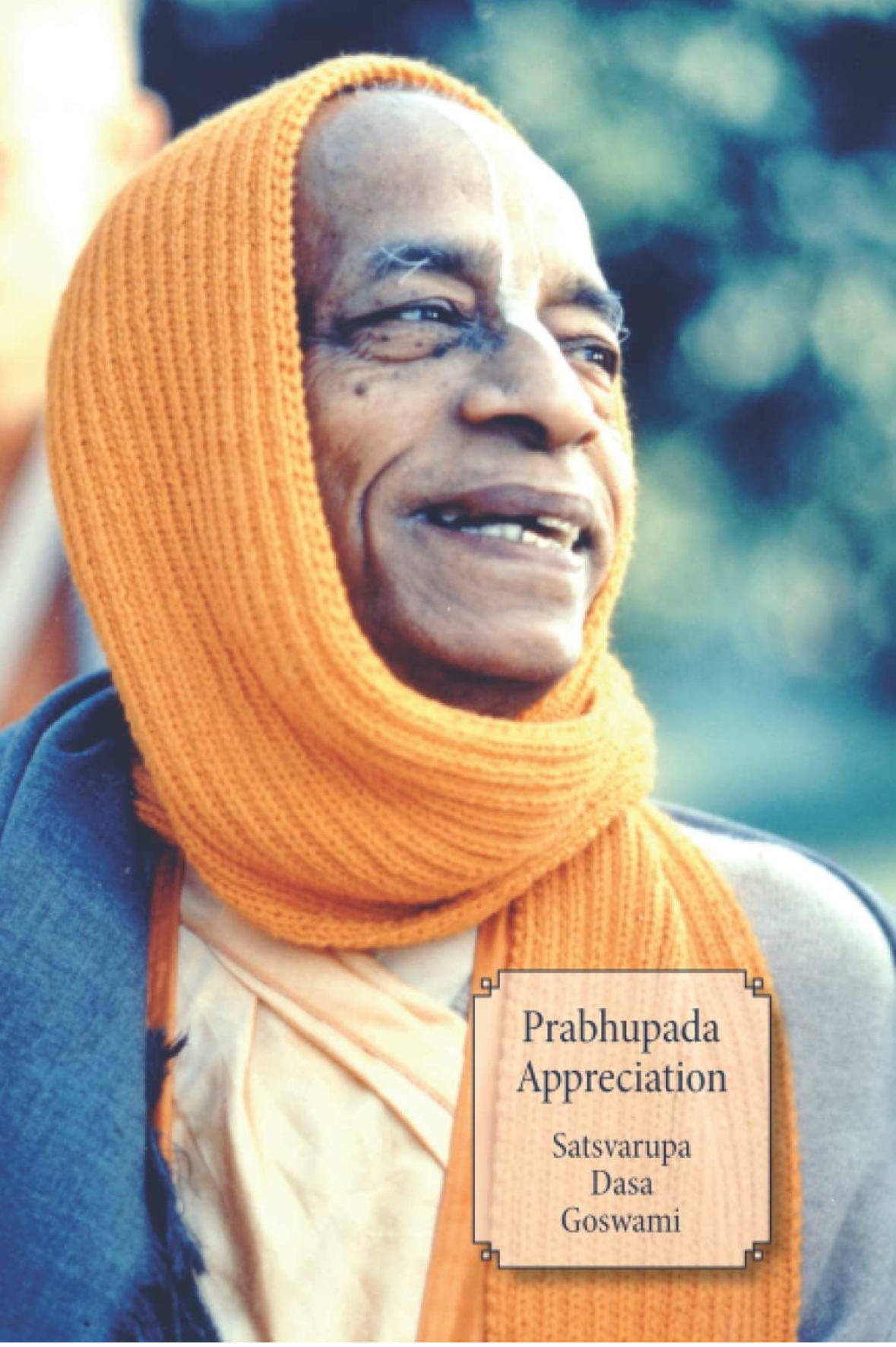
Śrīla Prabhupāda was in the disciplic succession from the Brahmā-Mādhva-Gauḍīya sampradāya, the Vaiṣṇavas who advocate pure devotion to God and who understand Kṛṣṇa as the Supreme Personality of Godhead. He always described himself as simply a messenger who carried the paramparā teachings of his spiritual master and Lord Kṛṣṇa.
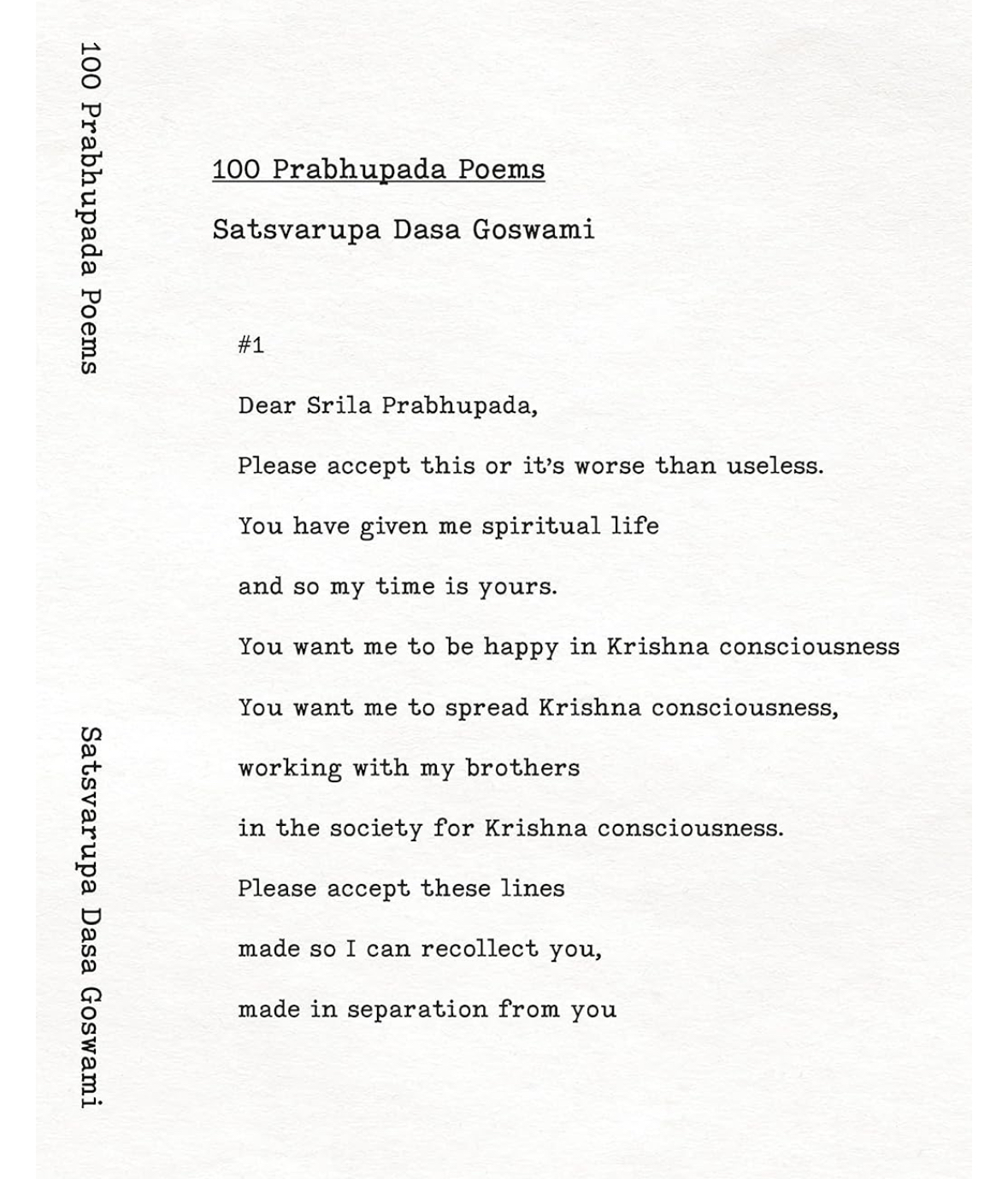
Dear Srila Prabhupada,
Please accept this or it’s worse than useless.
You have given me spiritual life
and so my time is yours.
You want me to be happy in Krishna consciousness
You want me to spread Krishna consciousness,
This collection of Satsvarūpa dāsa Goswami’s writings is comprised of essays that were originally published in Back to Godhead magazine between 1966 and 1978, and compiled in 1979 by Gita Nagari Press as the volume A Handbook for Kṛṣṇa Consciousness.

This second volume of Satsvarūpa dāsa Goswami’s Back to Godhead essays encompasses the last 11 years of his 20-year tenure as Editor-in-Chief of Back to Godhead magazine. The essays in this book consist mostly of SDG’s ‘Notes from the Editor’ column, which was typically featured towards the end of each issue starting in 1978 and running until Mahārāja retired from his duties as editor in 1989.

This collection of Satsvarupa dasa Goswami’s writings is comprised of essays that were originally published in Back to Godhead magazine between 1991 and 2002, picking up where Volume 2 leaves off. The volume is supplemented by essays about devotional service from issues of Satsvarupa dasa Goswami’s magazine, Among Friends, published in the 1990s.

“This is a different kind of book, written in my old age, observing Kṛṣṇa consciousness and assessing myself. I believe it fits under the category of ‘Literature in pursuance of the Vedic version.’ It is autobiography, from a Western-raised man, who has been transformed into a devotee of Kṛṣṇa by Śrīla Prabhupāda.”
 The Best I Could Do
I want to study this evolution of my art, my writing. I want to see what changed from the book In Search of the Grand Metaphor to the next book, The Last Days of the Year.
 a Hare Krishna Man
It’s world enlightenment day
And devotees are giving out books
By milk of kindness, read one page
And your life can become perfect.
 Calling Out to Srila Prabhupada: Poems and Prayers
O Prabhupāda, whose purports are wonderfully clear, having been gathered from what was taught by the previous ācāryas and made all new; O Prabhupāda, who is always sober to expose the material illusion and blissful in knowledge of Kṛṣṇa, may we carefully read your Bhaktivedanta purports.
I use free-writing in my devotional service as part of my sādhana. It is a way for me to enter those realms of myself where only honesty matters; free-writing enables me to reach deeper levels of realization by my repeated attempt to “tell the truth quickly.” Free-writing takes me past polished prose. It takes me past literary effect. It takes me past the need to present something and allows me to just get down and say it. From the viewpoint of a writer, this dropping of all pretense is desirable.
 Geaglum Free Write
This edition of Satsvarūpa dāsa Goswami’s 1996 timed book, Geaglum Free Write Diary, is published as part of a legacy project to restore Satsvarūpa Mahārāja’s writings to ‘in print’ status and make them globally available for current and future readers.