

We need to expand our team of proofreaders as we aim to increase the rate of republication of Satsvarūpa Mahārāja’s books as well as new books that he writes.
This includes a need for fluent bilingual Spanish and English speakers to proofread Spanish translations (we currently have around 20 Spanish translations waiting to be proofread).
Anyone interested in this particular service should contact Manohara dāsa at [email protected]
If you would like to help, please contact Kṛṣṇa-bhajana dāsa at [email protected] or [email protected] and we will find you a service that utilizes your talents.
At 26 Second Avenue in 1966, His Divine Grace Śrīla Prabhupāda would personally lead us in kīrtana as well as japa. After morning kīrtana just before his lecture, he would order: “Chant one round.” Then he would finger his japa beads and chant Hare Kṛṣṇa, Hare Kṛṣṇa, Kṛṣṇa Kṛṣṇa, Hare Hare / Hare Rāma, Hare Rāma, Rāma Rāma, Hare Hare. And the assembled devotees, seated on the floor, would chant aloud their individual japa.
******
I used to both chant and finger the beads intently. One time, absorbed in this chanting and fingering, I looked up at Śrīla Prabhupāda and was surprised to find him looking right at me with great concern. It seemed that he saw me, although a most fallen wretch, struggling intently to chant, and this caused him great compassion and concern. It seemed as if even he was awed at the mercy of the holy name.
******
I also remember my first chanting of japa in my apartment around the corner from the temple. Fingering the beads and passing them through my hands gave me a sensation of opulence and luxury. I felt like an ancient sādhu. I recall trying to chant clearly and intently.
******
Over the years, however, my japa became less distinct. More and more my attention would wander. I began to think of other devotional duties I had to perform during the day. I neglected to carefully pronounce each word. Sometimes I would attempt to reform the quality of my sixteen rounds, but eventually the bad habits of unclear pronunciation and wandering attention would creep back in. Although I would preach to other devotees, “It is an offense to be inattentive while chanting Hare Kṛṣṇa,” I would repeatedly commit the offense myself. How many other offenses I committed due to the offense against the holy name (nāma aparādha), I cannot say. How much I slowed down my devotional growth, I do not know, but certainly it was not auspicious.
******
But then I received anew the mercy of Śrīla Prabhupāda and Kṛṣṇa in the form of a Godbrother’s instructions on japa. I became determined to reform, to chant my japa pronouncing each word and syllable. My japa improved immediately. I then understood the chanting was most important and could not be neglected. I felt I was learning a crucial, confidential secret, although Śrīla Prabhupāda is constantly repeating it, “Chant sixteen rounds and avoid the offenses in chanting.” It is a practice. It takes practice. Whatever you practice, the body can learn to do. Chant, chant, chant!
******
Most difficult is controlling the mind. But the chanting itself is intended to control the mind. So you must practice until you become expert, until you are perfectly pronouncing the holy names and controlling the mind.
******
Maintain a fighting spirit. The mind always wanders. The senses always tend to drowse in the early morning hours. Therefore, good japa is a matter of successfully combating these things. Like the example of steering a car: keeping control means keeping from going out of control—it is natural that the car heads off the road.
******
You can expect difficulty after many years of offensive chanting. As Śrī Kṛṣṇa says, “The mind is the friend of the conditioned soul and his enemy as well. For him who has conquered the mind, the mind is the best of friends; but for one who has failed to do so, his very mind will be the greatest enemy” (Bhagavad-gītā 6.5–6). As for controlling the mind while chanting japa: “It is undoubtedly very difficult to curb the restless mind, but it is possible by constant practice and detachment” (Bg. 6.34). Wherever the mind goes due to its restless, flickering nature, bring it back under the control of the higher self. You can only pray to Kṛṣṇa that, with practice, sleep and inattentiveness will be overcome.
pp. 64-68
Happy quiet fifty-fifth birthday. I’m not dying yet. At least that’s my opinion.
I let myself write freely because it’s a good method to lead me to interesting thoughts. I mean, to provoke helpful truths to appear—truths to live by and all that rot.
I write words too strong to hurt myself, words of a mudslinger, bomb-thrower. I say “rot” and I say “fool” and all that, but actually I am a tender fillet of sole. See what I mean? When you write without control, that’s what comes.
How it comes is that several subpersons throw in their points. It’s like several artists painting on the same canvas. It’s not the best arrangement. One wants to paint something tender, while another throws on the alkaline, throws sand into the sweet rice, and laughs like a madman.
Still, I have faith that if I can write with my whole self, digest experience, and speak with conviction, the whole me will come out. Hari Sauri Prabhu said that when Srila Prabhupada was going down the elevator, about to leave the New York ISKCON building and never come back, he said with complete gravity and clarity, “I simply want the benediction, like Arjuna, to fight for Krsna to the last breath.” Complete conviction and clarity. My whole self writing: it will be good for me. Nothing squeaky or held back. Don’t let those points screaming for attention lie by the wayside. Get it all out.
It’s Moksada Ekadasi today and the flames are jumping in the fireplace. I’m feeling okay to be here. We have planned no big escapes andexpect not big revelations from Krsna other than what he is kindly giving. Prabhupada said we have to become fire to enter fire. We have to have a suitable body to enter the spiritual atmosphere. When we are fully serving Krsna, then Hrslkesa will reveal Himself to us, but if we remain unchanged, then how can we expect . . .
I d o n ’t expect, although I aspire. I want the full darsana, as Narada received, and I want to have it as a follower of Lord Caitanya. Therefore, I pray in the sannyasa-mantra every day to offer myself as a seed into the yajnic fire of gopi-bhava. I want to be pure, as Prabhupada expected.
Since it is my birthday today, I’m going to allow myself the gift of free-writing. But first I need a sponge with which to wipe my floor, and some paper towels, and extra pieces of wood for the fire. Give me that benediction. Allow me to let off steam and to talk tonight in a therapeutic way about why I allowed myself to become guru in New York and what subsequently happened.
I also want to think about how I can write more sensitive letters to my correspondents, take more time at it, and of our travel plans. I would like to think over what someone said: “You may like the excitement of traveling to Sicily or Gita Nagari each year, but you will not always be able to do it just because it happens to enliven you. Your health may not permit it.”
I cannot imitate Prabhupada (I just read how Prabhupada vomited twice in the car to Bhaktivedanta Manor and asked for a wheelchair on the plane, but when it didn’t come immediately, he walked . . . ). I can’t keep going as relentlessly as he did, and neither is my traveling worth so much. The movement does not depend on me to do it. I have to consider all that. My health slows me, and my lack of advancement. I am neither a great preacher nor an absorbed babaji.
pp. 59-60
This is a warning: if you come near me, I’ll kill you.
I realize this is about as silly as you can get, thinking you can write letters to mosquitoes. I might as well write a letter to the fireflies. I could say, “You look enchanting the way you light up spots of darkness in the tropical jungle of this backyard.” I might as well write a letter to the little white cat. Its face has been roughed-up and it’s not so pretty to look at. It roams around this house where they’re letting me stay. It probably kills mice and rats. But this letter is a warning to the mosquitoes.
Life is rich and I’m trying to record it in a Krsna conscious way. There’s so much I want to say that I can’t say it all. There are different people on my mind. I am thinking about Vrndavana, thinking about how to advance in Krsna consciousness, thinking things I don’t dare to say, things that are here and things that are far away. Out of all this richness, it’s natural to think of somebody to share it with. If you’re lucky you can find a person, a close friend, and pour out everything. But when you can’t do that, then you can write a letter to a mosquito and tell him to bug off or you’ll kill him.
As poor mosquitoes, you can’t respond not only to my letter, but to my warning. All you know is blood. That’s the way the material energy is constructed. That’s your karma from the past. I suppose if I were an extremely renounced saint like the leper Vasudeva, I wouldn’t bother you in your attempt to suck my blood. And to some degree, I’m trying to tolerate you. Therefore, although I’m giving you this warning, I’m going to avoid your association entirely by getting under the mosquito net. This letter is just for any stray ones that I happen to encounter before I get under that net.
P.S. When I went in the backyard to dictate this letter to the mosquitoes, I looked out and saw the rich darkness just before night, the fireflies everywhere, and the white cat roaming around in the dark.
pp. 93-94
My boots are making so much noise on the gravel road that I can hardly hear you singing. Now I’ve stopped to listen.
There are so many of you little fellows out there in the gray dawn that I can’t tell one from the other. Please excuse me for not knowing your names or being able to distinguish your songs. I just want to say in this letter that life on earth is made pleasant by the songs of birds. And birds come from Krsna. We hear the birds in Vmdavana, and even in the cities. They start to sing just near the end of our most intense, early morning bhajana.
Of course, I can’t talk poetically about bird-song without eventually thinking how birds are spirit souls locked in little feathery bodies (which isn’t so nice for them). The birds are also preying upon other creatures and eating them. But still, we cannot deny that the singing of birds enhances our humanness. It places us deep within our humble earthiness. Your songs bring us back to our childhoods. We remember all kinds of times, some of them hard times, when we were up in the morning and you were singing in the background.
You have hard times too, especially in winter when food is not so available. But you’re always so faithful and dutiful and, at least to us, you sound joyful early in the morning.
I hope I don’t ever get so old or self-absorbed that I stop noticing the spring and the birds’ songs. I want to always be grateful that Krsna is giving me another springtime on this earth. I think of it not in terms of mortal longevity, which is a vain pursuit, but in terms of my limited devotional service in this lifetime. I want to keep performing small acts of devotional service. I want to preach for another springtime, another summer. We belong to the earth, at least while we’re here, and then we go away. It’s Krsna’s place and His trademark is the singing of the birds.
Our appreciation of your music is part of our longing for the spiritual world. There will be birds there too. Early in the morning it’s the birds’ singing, impelled by Vmda-devi, that wakes Radha and Krsna. Will the day come when I will be able to hear the birds like that, as warnings to Radha and Krsna to wake up and go home? Will I ever have my own services to do as a servant of Their servants?
Let me share these thoughts with you, morning singers, here in Italy. In your ever-fresh quality and your undaunted courage, you are like gurus to me. I can take instruction and example even from your life of small consciousness. Hail to you, blithe spirits. Birds you never were.
pp. 96-102
Your letter is very much pleasing to me with the report of the book distribution. Whenever I get report of my books selling I feel strength. Even now in this weakened condition I have got strength from your report. You should know that in this work you have Krsna’s blessings… So go on with your work there in America and distribute my books to these libraries. This is very encouraging to me, to write more books.
Our books are being appreciated by learned circles, so we should take advantage. Whatever progress we have made, it is simply due to distributing these books. So go on, and do not divert your mind for a moment from this.
My request is that you print as much as possible and distribute profusely. That is the great success of our movement … Continue this work. Whenever there is any publication in any language, it enlivens me 100 times.
Regarding sankirtana and book distribution, both should go on, but book distribution is more important. It is brhad kirtana. In Tokyo airport one boy had come up to me asking if he could speak with me. I said yes and then he asked me, “Swami, where do you get all that knowledge in your books?” Of course, it is Krsna’s knowledge, not mine. But the effect is there. So for wider kirtana, book distribution is better. Book distribution is also kirtana. Regarding making hundreds of traveling parties, yes do that please as far as possible.
These statistics are very nice. I like very much to receive the report of my book sales. I think it also gives encouragement to the devotees who distribute the books. Here at Mayapur my Guru Maharaja was printing one paper. It was selling for only a few paise. Sometimes whenever one brahmacary would go to Nabadwipa and sell even a few copies, I would see my Guru Maharaja become very much pleased. Even if the brahmacary was not a very important member, my Guru Maharaja would become very, very pleased with him. He personally instructed me that books are more important than big temples. At Radha Kunda he told me that “Since constructing the big temple at Bagh Bazar (Calcutta), there have been so many difficulties; our men are envious over who will live in which room. I think it would be better to take off all the marble and sell it and print books.” He told me this personally. So I am always emphasizing book distribution. It is better kirtana. It is better than chanting. Of course, chanting should not stop, but book distribution is the best kirtana.
Regarding Gurukula, they are in financial difficulty, so introduce book distribution. Sankirtana and book distribution should be pushed side by side, and there will be no difficulties. That is our experience.
This book selling is the real preaching of our cult. Especially when you sell Caitanya-caritamrta and Srimad-Bhagavatam. They will understand what we mean by reading these books. So you organize freely. You are the incarnation of book distribution. So take the leadership and do the needful. I pray that by Krsna’s grace you will have all success. Yes, you are correct that by distributing books, that income will be sufficient for all programs.
Regarding the book distribution, apart from our books, the Communist Party has become popular simply by distributing their literatures. I know in Calcutta the Communist agents were inviting friends and reading their literature. The Russians never came to India, but by distributing literature in every language they get a pretty good number of followers. So if it is possible for ordinary, third class, mundane literature, why should not our transcendental literature create devotees all over the world? I see practically how our books and magazines are becoming popular in your country. So there is good potency for pushing on these literatures very vigorously. So organize this propaganda work very carefully and our movement will be very much successful by introducing literature from village to village. Lord Caitanya wants this, so carry out His order … So go on with your preaching work solidly. Krsna will be pleased and Caitanya Mahaprabhu will be kind. He is already kind. You simply have to go village to village, and your life will be perfect.
You know that I also was selling my books in this way to the schools and colleges and libraries. I would write, then publish, and then distribute without any help. So how much pleased I am with you that you are helping me in this mission. So go on with your work. Krsna will help you. You are sincere in your purpose. This is very important engagement of visiting the professors and the colleges and libraries, and getting the standing orders. This is the most important engagement. Do not doubt this.
Regarding introducing records in the USA, yes, why not, but do not minimize the book selling. Better if a different party is engaged in record selling, so that the book selling may not be affected. Both book selling and record selling are good, but book selling is better and permanent. Record selling is temporary … So concentrate on publishing books as far as possible and sell.
So German people are not coming to join this movement? So far I have seen your German devotees, they are very en-thusiastic and steady workers. So if you get some good souls to join, then there will be no difficulty for selling the books. So it doesn’t matter if we are selling more or less, so far the publications are there. We may sell or not, but the books must be there.
Your sankirtana reports are very encouraging, especially that one girl, Gauri dasi, who has set an all ISKCON women’s record of 108 big books. This is very wonderful. Formerly this would have been considered impossible, but now by Krsna’s grace everything is becoming possible. Encourage them all to increase more and more.
pp. 102-7
I am reluctant to dance the old dances of material consciousness or to open the pain of old wounds, yet when I encourage myself to open the doors in writing and write whatever comes, for me, that means that I open myself up to the entire iceberg and not just the tip. The iceberg isn’t necessarily the point; I want to penetrate deep into ice and find out where my Kṛṣṇa consciousness is. So I chip away at the ice. Shards fly past me—the old memories, the dreams, the past lives of sense gratification, the misery. No! Enough! Stop chipping!
But later I ask myself again, “Why don’t you write whatever comes?” A memory floats up—being twelve years old and lying exhausted on the grass with my baseball glove on. I smell the delicious earth-and of course I know this is the romanticized version of a fifty-six-year-old man.
Then I say again, let me shut that out. But then what does it mean to write freely? Why do you think it will lead you to Kṛṣṇa? What are you trying to expose in the free-writing? I can’t always figure it out.
There was a movie once directed by Ingmar Berman about the love between a boy and a girl who met over the summer. Of course, it portrayed sexual intimacy and romantic love as the most wonderful thing in the world. All nature was celebrating with the lovers in that movie. But then the man dies at end of the summer, and the film ends.
I used to think that—that romantic love was the most beautiful thing in the world, but I never experienced it in my own life, at least not as it is portrayed in movies. Why couldn’t I see the illusion then? Why couldn’t I understand it as something that exists only in the imagination? When I was young, I kept a photograph in my diary of a blond girl and boy sitting under a fully blossoming apple tree. I thought this photo expressed what I wanted from life. I worshipped it. But when has real life ever been like that? Poets like Shelly and Keats tried to make it seem possible. They were the Romantics. A romantic is someone who believes in something beautiful, even if it’s not true, even if it is really filled with ugliness. A romantic believes in “someday.”
That yearning for an ideal is part of who we are, but we have to find that ideal in the real world with our real selves. We cannot be trying to keep up the façade of being the supreme enjoyer. We don’t have infallible lovers and friends. Even if they don’t cheat us or leave us, they grow old and then we are cheated by death.
True love is possible only with God. People hear this and are disappointed. They can’t conceive of God as a lover. They see Him only as an old man. And even if they have some conception of God as a lover, they don’t have refinement to understand pure service and rasa. For us, our knowledge is becoming more refined. We know Kṛṣṇa as Rādhā’s lover.
I am writing whatever comes to me. I have to keep chipping away, discarding and clearing and looking deeper. I am not just trying to reminisce; I am looking for the real world and my real self.
The root cause of all despondency is to identify the self with the body or the mind. Śrī Nārada Muni analyzed that Śrīla Vyāsadeva was not cheerful because of this mistake. So begins the Bhāgavatam chapter, Nārada’s Instructions on “Śrīmad–Bhāgavatam.”
I am trying to realize the purport of Vyāsadeva’s dilemma in my own life. Who am I and what do I need to find my happiness? I know that I must seek the answer in the self transcendentally situated beyond body and mind. To do that, I have to take help from my self-realized spiritual master.
Śrīla Vyāsadeva openly admits his deficiency. Unless we admit ours, how can we improve? Vyāsadeva said he was dissatisfied and felt a sense of incompleteness even though he had just spent a lifetime contributing his learning and compassion to humanity by compiling the Vedas, Vedānta-sūtras, and Mahābhārata. Vyāsadeva diagnosed himself thus: “This may be because I didn’t specifically point out the devotional service of the Lord, which is dear both to perfect beings and to the infallible Lord” (Śrīmad-Bhāgavatam 1.4.31).
If only every troubled person in the world could see his defect so simply and clearly, and if only the world’s counselors, analysts, and trouble-shooters could see it too. Our normal happy situation is to be fully engaged in pure devotional service. Naturally we feel empty when we are not personally in contact with Kṛṣṇa, kṛṣṇa-kathā, and Kṛṣṇa’s pure devotees. This is what’s wrong in each and every case. We can start to see that by looking at ourselves.
Sometimes we publicly admit our deficiency, but then don’t do anything to rectify it. I need to improve the quality of my chanting, hearing, remembering and serving Śrī Kṛṣṇa (śravaṇaṁ-kīrtanaṁ viṣṇoḥ smaraṇaṁ pada-sevanam). In Vyāsadeva’s case, he was deeply committed to religious vows and the study of scripture, and he was interested in helping others, but his noble activities had to be focused on devotional service to Kṛṣṇa in His original form to make him feel complete.
We may experience a little sat (sense of eternal transcendence) and some cit (knowledge of the difference between matter and spirit), but we may not taste ānanda-vigraha (the bliss of the self in loving service to the Supreme Personality of Godhead). To this I could add that we may be following the orders of a bona-fide spiritual master in disciplic succession from Śrī Nārada. If we don’t wholeheartedly apply ourselves to hearing the Śrīmad–Bhāgavatam, however, especially hearing about Kṛṣṇa’s pastimes in Vṛndāvana, if we don’t chant His name while thinking of His sweet pastimes, name, and form, if we don’t hear the Bhāgavatam attentively then we are going through the motions of bhakti while investing our vital energy elsewhere. How can that make us happy?
Unless we recognize what is wrong and are willing to correct ourselves, we will remain in that state. If I have to counsel others, I must at least know my own incompleteness and be working to gain full self-satisfaction. Without hesitation, I should also offer this advice to others: “Are you satisfied by identifying with the body and mind as objects of self-realization?”
Life is complicated, but Kṛṣṇa consciousness is simple. Others may think that kṛṣṇa-bhakti is impossible to follow, but it isn’t.
“Śrī Nārada said: You have not actually broadcast the sublime and spotless glories of the Personality of Godhead. That philosophy which does not satisfy the transcendental senses of the Lord is considered worthless” (Śrīmad-Bhāgavatam 1.5.8).
This advice to all jīvas. I can’t help but think that many devotees are searching in the wrong direction when they seek to fulfill themselves without considering in a practical way whether what they are doing is satisfying to Kṛṣṇa.
Still, I have to start with myself. It takes more than obedience to God’s laws to go back to Goloka Vṛndāvana. If we are not feeling deep satisfaction (yenātmā suprasīdati), then we need “juicier” bhakti. We need to practice real bhakti and to give it to others.
pp. 80-87
Sanjaya dasa suggested:
Write about Ireland
mixing experience with
the Absolute Truth.
But what can I say?
I am a stranger here.
Daisies are tinier,
white petals, tinged with pink
yellow grosse bushes
everywhere you see
the brogue is vogue
only for tourists, Irish-Americans
returning to old sod
to see where their O’Sullivans
once died in a small stone house.
Now Guiness Stout,
Boom Town Rats lead
Dublin’s fair city
and today Belfast’s
shot-dead son has two
live brothers, both
joined the Hare Krsna movement.
That’s Patrick and Martin,
now Uddhava and Patri dasa.
Uddhava laughs when reporters ask
how he suffered in H-block cell,
happy now he’s sheltered
by Prabhupada.
Ireland’s transformed
as never before.
Although the land is ancient,
they never had the Vedas,
now she has new sons,
harer nama sankirtana,
on O’Connel Street, and a
Krsna conscious lecture
at Trinity College.
We have a farm in Glen Gariff,
have to give it a name.
What about calling it
Krsna-nagari?
I’ve come
as guru
beyond the modes of nature
history and culture
are only background
to our transcendental work.
In the North
where Uddhava comes from
we are popular;
on a wall with graffiti,
“Brits Quit” etc.,
there was, “Long Live Hare Krishna!”
We’re neither Catholic or Protestant
Irish or British
but we chant and dance in these bombed-out streets
and when we don’t go out they complain,
“Where were you?”
We get our best men from there.
Appeared on TV
with a priest, nun
and pretty presenter,
she introduced me
as one who gets the youths
that used to go to Mass.
Seans, Phillips, Patricks,
now Krsna’s devotees,
raw, happy, a little fallen,
but eager, led by one of Prabhupada’s
ISKCON lieutenants from Germany.
“We don’t want to hear
just about you.
What about the view
from your room’?”
Mist on mountain top.
“And what is the difference
between the Irish
and English trees?”
The Irish
are light green,
the European are dull.
Poets of Ireland and England,
why do you dwell on earth and body and vague thought? Even your best verbal contraptions
are decorations of a dead body.
When you’re dead
you take the next life
which you doubt.
You don’t know
you don’t praise Krsna
your religion at best
is to speak honest and sincere
but that’s not enough.
“Many times,” wrote William Butler Yeats,
“man lives and dies …
and ancient Ireland knew it all.”
But all they knew
was a faint idea, concocted,
and when Saint Patrick arrived
transmigration was hidden.
Only now does Ireland know
Bhagavad-gita As It Is
thanks to Srila Prabhupada.
Land of meat-eating religion,
pub-drinking clergy
I don’t want to criticize.
I’m here to initiate
Prabhupada’s men
and speak the truth,
behave myself properly.
But when I heard
what the Pope ate and drank
on his Aer Lingus flight from Rome
—beef, eel, salmon, lobster
(toss ’em alive in boiling water)
washed down with two glasses
of Mercot wine, Irish Coffee—
and said to the stewardess, round-eyed,
“This was fit for a team!”
—then I knew for sure
it can’t be topmost.
Prthu dasa said he believed
the appearance of the Virgin
at Knock, why not?
At least we uphold
the divine appearance of the Lord.
There is a verse that sums it up:
“The Lord appears through
lower systems of worship
according to one’s desires,
although He appears as the demigods
and not in His original form.
What is the use of these other forms?
May the original Supreme Personality of Godhead
please fulfill my desires.”
North and South and Southwest Cork,
throughout this little Isle
the sankirtana is going forth.
It won’t be long now
before Radha, the loveliest colleen
joins Krsna the Supreme Godhead
and blesses the mountains of Caha.
Since television
even the villagers
are going degraded
with media’s immorality
from illicit Dublin and New York,
and Kali-yuga is daily expanding.
Still, Lord Caitanya’s mercy
can save this misty, greeny place
where millions have suffered
for thousands of years.
But it’s up to us
to climb the ladder
taking Erin with us
to Krsna’s place.
Now in each moment the future is die-cast.
But I feel as I grow old it becomes too late
to change or say any longer For Sure that I am Right.
All I can say is I am committed in a certain direction
and the die is cast.
I am trying to be a devotee and convinced that is right,
but I cannot say the quality of my devotion
and the decisions I make in surrendering to Krsna
are absolutely right.
What more can I do?
When day turns to twilight
I cannot say it should be daytime,
but must live with less time.
I wish I could change!
We put the month and year on Back to Godhead
and with wristwatch keep the time:
mangala-arati early in the morning, then time
to chant, time to read Bhagavatam, time to write
time when a black cloud pushes into my head
with lusty thoughts and then goes away,
time for impulses of purity, desires to preach and surrender,
time when I go to speak,
riding in the car, talking to disciples,
time is passing, going down the hourglass,
sastra says the day passes and all that happens
is one loses another day of his duration,
except for the pure devotee.
Time is the way you spend your life
time is the clock for the karmis
Time is the impersonal form of Krsna
time is running out for the earth
complete ruin and collapse of the nations
all buildings to dust unless
before relative time runs out
they change their karma.
How much time?
Khatvanga asked.
The demigods said,
you have only a moment to live.
He dove to the earth where Krsna was
and bowed at His feet
made Bhagavatam prayers,
“I always think of You
I surrender everything to You
I honor the brahmanas.
You are the sum total and You are in all hearts,
You are the Supreme, please accept me
as Your most menial servant
and the servant of Your servants.”
The Lord accepted that prayer
and thus Khatvanga was saved.
I asked Prabhupada about that—
“How can we be mature—”
he cut me off and said, “Never think you are mature.
Think you are not mature and yet
you have very little time
at any moment you may die.
Death will come into the home
of even the multimillionaire
and say, ‘You stole so much oil which belonged to Krsna. Now you have to be punished.’ “
Don’t go the wrong way!
Chant Hare Krsna,
this is all that is needed,
and serving the great souls.
Your time is now saved,
it is all right,
now you can leave at any time,
the time of dark moon or full moon,
it doesn’t matter
everything is safe at guru’s feet
and even if you haven’t made a hundred percent
you can still continue
in the next life
pure devotional service.

Viraha Bhavan Journal (2017–2018) was written by Satsvarūpa Mahārāja following a brief hiatus in writing activity, and was originally intended to be volume 1 in a series of published journals. However, following its completion and publication, Mahārāja again stopped writing books, subsequently focusing only on what became his current online journal, which began in August of 2018.

At first, I took it hard that I would have to live surrounded by the firemen, and without my own solitude. After all, for decades I had lived in my own house with my own books and my own friends. I was also now a crippled person who couldn’t walk, living among men who did active duties. But when Baladeva explained it to me, how it was not so bad living continually with other firemen and living in the firehouse with its limited facilities, I came to partially accept it and to accept the other men. I came to accept my new situation. I would live continually in the firehouse and mostly not go outside. I would not lead such a solitary life but associate with the other firemen.
Let me write sweet prose.
Let me write not for my own benefit
but for the pleasure of Their Lordships.
Let me please Kṛṣṇa,
that’s my only wish.
May Kṛṣṇa be pleased with me,
that’s my only hope and desire.
May Kṛṣṇa give me His blessings:
Kṛṣṇa Kṛṣṇa Kṛṣṇa Kṛṣṇa Kṛṣṇa he
Rāma Rāghava Rāma Rāghava
Rāma Rāghava rakṣa mām.
You mentioned that your pathway has become filled with stumbling blocks, but there are no stumbling blocks. I can kick out all those stumbling blocks immediately, provided you accept my guidance. With one stroke of my kick, I can kick out all stumbling blocks. —Letter by Śrīla Prabhupāda, December 9, 1972.
The Writing Sessions are my heart and soul. I’m trying my best to keep up with them. I am working with a few devotees, and they are far ahead of me. I wander in the wilderness of old age. I make my Writing Sessions as best I can. Every day I try to come up with a new subject. Today I am thinking of my parents. But I don’t think of them deeply. They are long gone from my life. Śrīla Prabhupāda wrote a poem when he was a sannyāsī, and he said now all my friends and relatives are gone. They are just a list of names now. I am like that too. I am a sannyāsī with a few friends. I love the books of Śrīla Prabhupāda. I try to keep up with them. I read as much as I can and then listen to his bhajanas.
The metaphor is song. Explain it. Yes, particulars may not seem interesting or profound to readers who want structured books.
Wait a minute. Don’t pander to readers or concepts of Art. But Kṛṣṇa conscious criteria are important and must be followed. So, if your little splayed-out life-thoughts are all Kṛṣṇa conscious, then it’s no problem.
I am near the end of my days. But I do like the company of like-minded souls, especially those who are Kṛṣṇa conscious. Yes! I am prone to Kṛṣṇa consciousness. I have been a disciple of Bhaktivedanta Swami Prabhupāda for maybe almost sixty years. Sometimes I fail him. But I always bounce back and fall at his feet. It is a terrible thing that I sometimes do not have the highest love for him. It is a terrible thing. Actually, however, I never fall away from him. He always comes and catches me and brings me back to his loving arms.

This edition of Satsvarūpa dāsa Goswami’s 1996 timed book, Upstate: Room to Write, is published as part of a legacy project to restore Satsvarūpa Mahārāja’s writings to ‘in print’ status and make them globally available for current and future readers.
A factual record of the reform and change in ISKCON guru system of mid ’80s.

Readers will find, in the Appendix of this book, scans of a cover letter written by Satsvarūpa Mahārāja to the GN Press typist at the time, along with some of the original handwritten pages of June Bug. Together, these help to illustrate the process used by Mahārāja when writing his books during this period. These were timed books, in the sense that a distinct time period was allotted for the writing, during SDG’s travels as a visiting sannyāsī
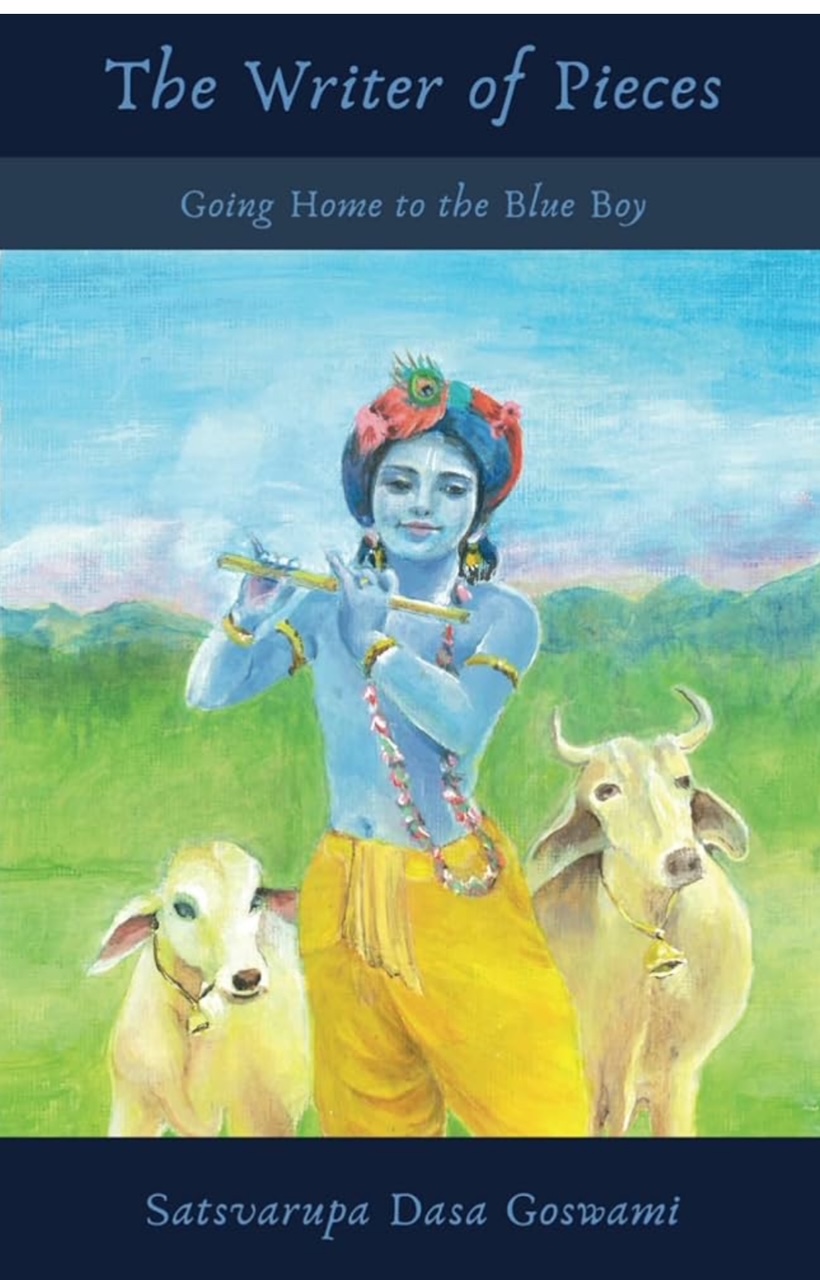
Don’t take my pieces away from me. I need them dearly. My pieces are my prayers to Kṛṣṇa. He wants me to have them, this is my way to love Him. Never take my pieces away.

Many planks and sticks, unable to stay together, are carried away by the force of a river’s waves. Similarly, although we are intimately related with friends and family members, we are unable to stay together because of our varied past deeds and the waves of time.
To Śrīla Prabhupāda, who encouraged his devotees (including me) To write articles and books about Kṛṣṇa Consciousness.
I wrote him personally and asked if it was alright for his disciples to write books, Since he, our spiritual master, was already doing that. He wrote back and said that it was certainly alright For us to produce books.
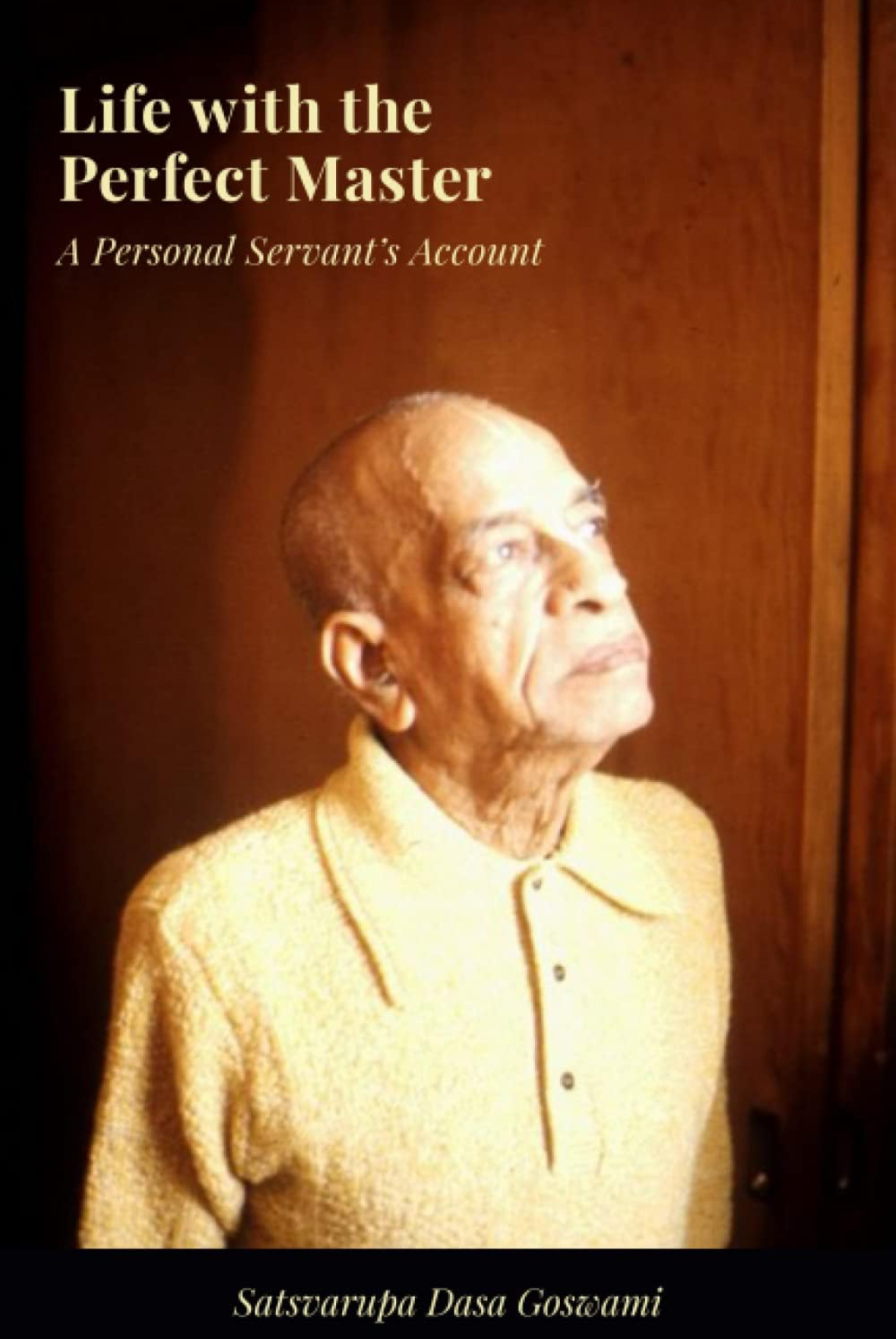
I have a personal story to tell. It is a about a time (January–July 1974) I spent as a personal servant and secretary of my spiritual master, His Divine Grace A.C. Bhaktivedanta Swami Prabhupäda, founder-äcärya of the International Society for Krishna Consciousness. Although I have written extensively about Çréla Prabhupäda, I’ve hesitated to give this account, for fear it would expose me as a poor disciple. But now I’m going ahead, confident that the truth will purify both my readers and myself.

First published by The Gītā-nāgarī Press/GN Press in serialized form in the magazine Among Friends between 1996 and 2001, Best Use of a Bad Bargain is collected here for the first time in this new edition. This volume also contains essays written by Satsvarūpa dāsa Goswami for the occasional periodical, Hope This Meets You in Good Health, between 1994 and 2002, published by the ISKCON Health and Welfare Ministry.

This book has two purposes: to arouse our transcendental feelings of separation from a great personality, Śrīla Prabhupāda, and to encourage all sincere seekers of the Absolute Truth to go forward like an army under the banner of His Divine Grace A.C. Bhaktivedanta Swami Prabhupāda and the Kṛṣṇa consciousness movement.
A single volume collection of the Nimai novels.
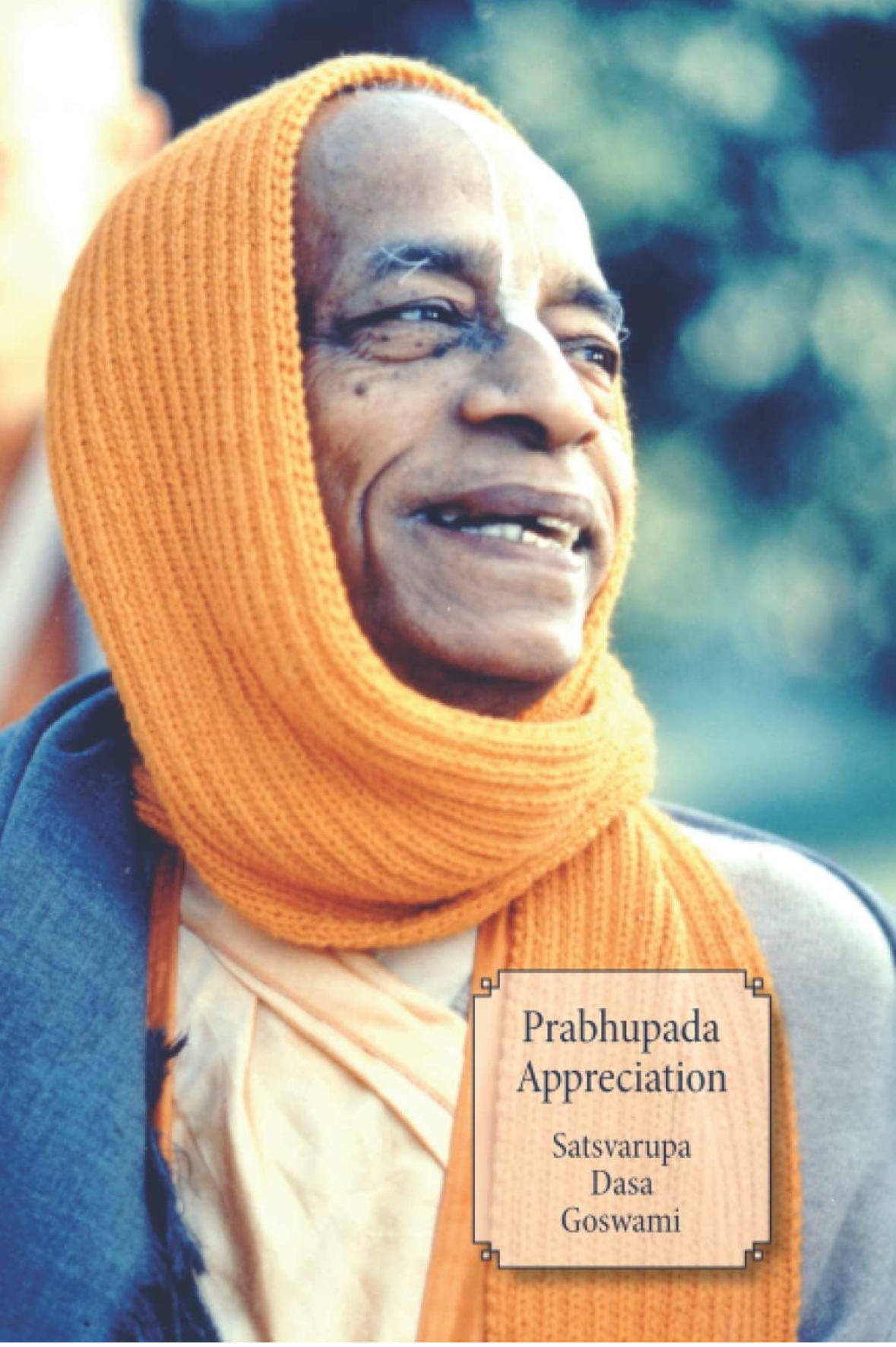
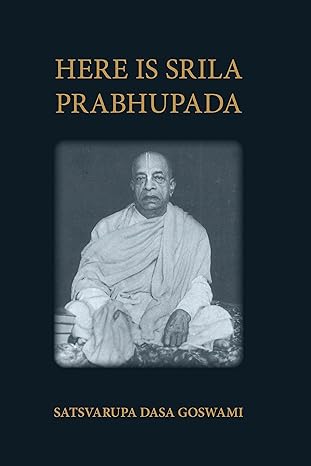
Śrīla Prabhupāda was in the disciplic succession from the Brahmā-Mādhva-Gauḍīya sampradāya, the Vaiṣṇavas who advocate pure devotion to God and who understand Kṛṣṇa as the Supreme Personality of Godhead. He always described himself as simply a messenger who carried the paramparā teachings of his spiritual master and Lord Kṛṣṇa.
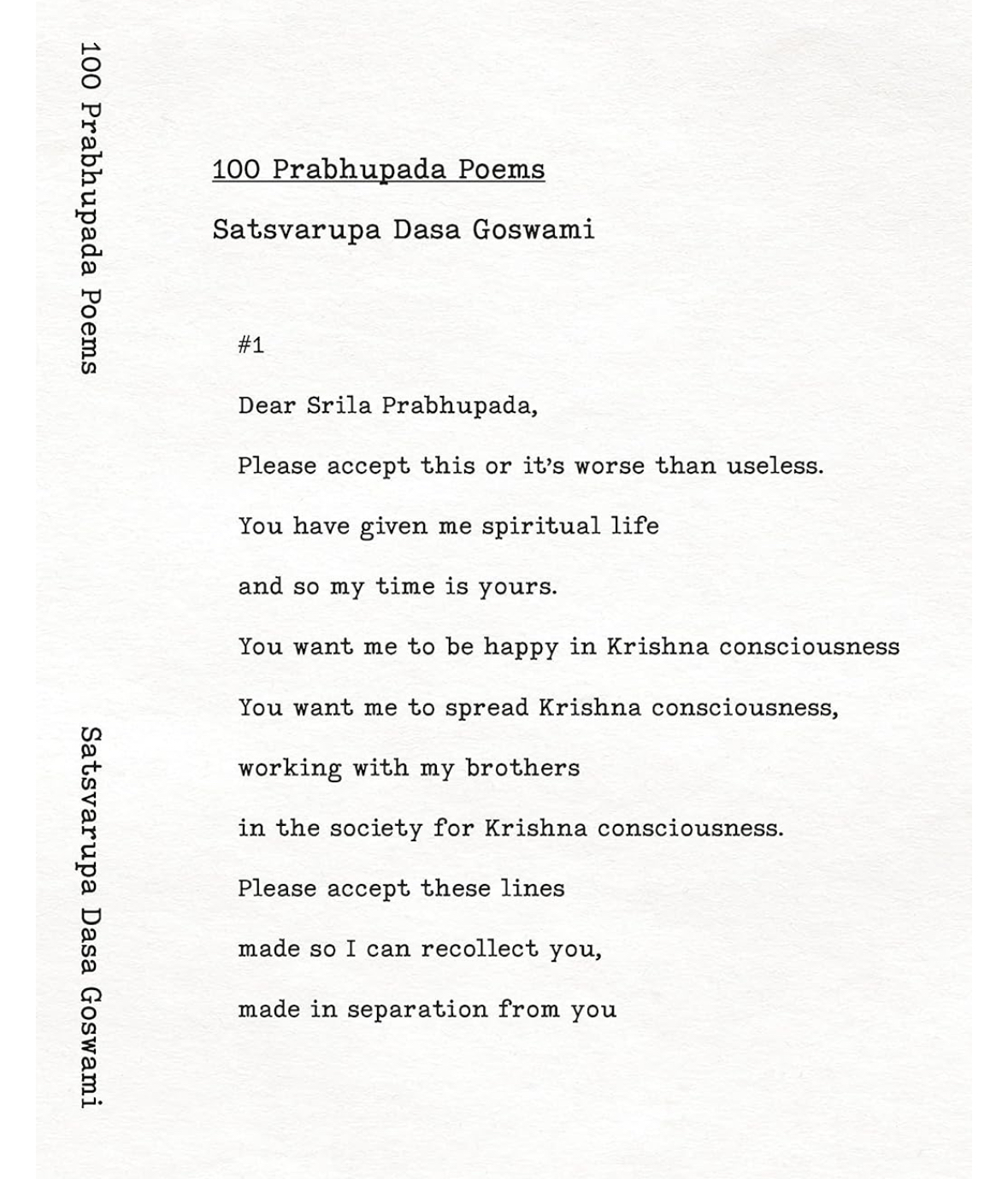
Dear Srila Prabhupada,
Please accept this or it’s worse than useless.
You have given me spiritual life
and so my time is yours.
You want me to be happy in Krishna consciousness
You want me to spread Krishna consciousness,
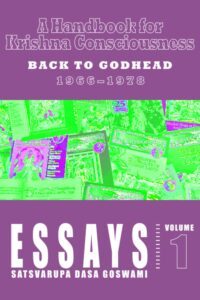
This collection of Satsvarūpa dāsa Goswami’s writings is comprised of essays that were originally published in Back to Godhead magazine between 1966 and 1978, and compiled in 1979 by Gita Nagari Press as the volume A Handbook for Kṛṣṇa Consciousness.

This second volume of Satsvarūpa dāsa Goswami’s Back to Godhead essays encompasses the last 11 years of his 20-year tenure as Editor-in-Chief of Back to Godhead magazine. The essays in this book consist mostly of SDG’s ‘Notes from the Editor’ column, which was typically featured towards the end of each issue starting in 1978 and running until Mahārāja retired from his duties as editor in 1989.
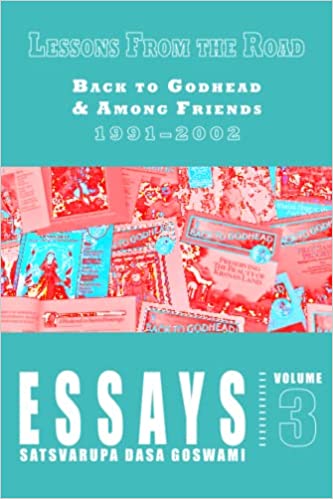
This collection of Satsvarupa dasa Goswami’s writings is comprised of essays that were originally published in Back to Godhead magazine between 1991 and 2002, picking up where Volume 2 leaves off. The volume is supplemented by essays about devotional service from issues of Satsvarupa dasa Goswami’s magazine, Among Friends, published in the 1990s.

“This is a different kind of book, written in my old age, observing Kṛṣṇa consciousness and assessing myself. I believe it fits under the category of ‘Literature in pursuance of the Vedic version.’ It is autobiography, from a Western-raised man, who has been transformed into a devotee of Kṛṣṇa by Śrīla Prabhupāda.”
 The Best I Could Do
I want to study this evolution of my art, my writing. I want to see what changed from the book In Search of the Grand Metaphor to the next book, The Last Days of the Year.
 a Hare Krishna Man
It’s world enlightenment day
And devotees are giving out books
By milk of kindness, read one page
And your life can become perfect.
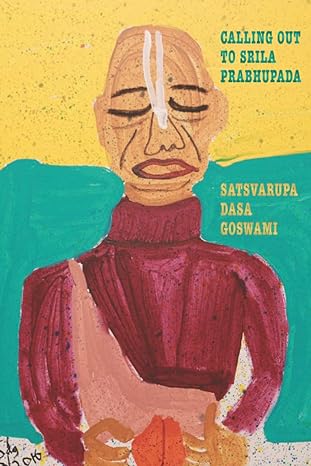 Calling Out to Srila Prabhupada: Poems and Prayers
O Prabhupāda, whose purports are wonderfully clear, having been gathered from what was taught by the previous ācāryas and made all new; O Prabhupāda, who is always sober to expose the material illusion and blissful in knowledge of Kṛṣṇa, may we carefully read your Bhaktivedanta purports.
I use free-writing in my devotional service as part of my sādhana. It is a way for me to enter those realms of myself where only honesty matters; free-writing enables me to reach deeper levels of realization by my repeated attempt to “tell the truth quickly.” Free-writing takes me past polished prose. It takes me past literary effect. It takes me past the need to present something and allows me to just get down and say it. From the viewpoint of a writer, this dropping of all pretense is desirable.
 Geaglum Free Write
This edition of Satsvarūpa dāsa Goswami’s 1996 timed book, Geaglum Free Write Diary, is published as part of a legacy project to restore Satsvarūpa Mahārāja’s writings to ‘in print’ status and make them globally available for current and future readers.