
We need to expand our team of proofreaders as we aim to increase the rate of republication of Satsvarūpa Mahārāja’s books as well as new books that he writes.
This includes a need for fluent bilingual Spanish and English speakers to proofread Spanish translations (we currently have around 20 Spanish translations waiting to be proofread).
Anyone interested in this particular service should contact Manohara dāsa at [email protected]
If you would like to help, please contact Kṛṣṇa-bhajana dāsa at [email protected] or [email protected] and we will find you a service that utilizes your talents.
Sorry to have been off-line for so long. Haribol!
SDG has been very intensely writing with regularity during both day and night for the last several months. Maharaja gets one or two headaches per day, mainly from reading too intensely without regular breaks. The headaches force him to slow down. He rest for usually no more than three hours at a time. The headaches can come anytime day or night. His appetite is good, which satisfies his doctor, Nitai Gaurasundara. And he keeps up his correspondence and book production regularly.
SDG Maharaja is looking forward to presenting a large batch of new books at the summer festival Saturday, July 4. The press team is is on its usual marathon to make this happen.
Hari Hari,
Baladeva
Doing other things while chanting is not good. Still, sometimes out of expediency you do it. But you should try to put off so-called expedient actions until after chanting. Chant at a designated time and chant loudly. Let other things wait. If you acknowledge that your chanting is very poor and at the same time you acknowledge that it’s important to improve it, then you’ll be much better qualified to chant and preach.
******
If you have some basic dissatisfaction or worry, then chanting will be difficult. Try telling yourself, “Put this trouble aside. In these two hours, just turn to the name.”
******
Of course the mind is sometimes thinking of other things besides the sound of Kṛṣṇa’s names. Then at least maintain the virtue of pronouncing the names clearly and of staying alert. And if you cannot control the mind, then cry (like a child cries for its mother) to put the mind at the lotus feet of the holy name and taste the nectar of surrender to the name.
******
An unfortunate but common predicament: You are not crying to the holy name as a child cries for its mother. Who can say he is completely free of this predicament? Why does it happen? One common reason is the mind’s preoccupation with other things. But what about chanting Hare Kṛṣṇa? Does it take devastation for you to cry out to the holy name Himself? But then when devastation comes, chanting will be especially difficult.
******
Why aren’t we chanting in a helpless mood? Because we are clinging to material attachments. The last offense in chanting is to maintain material attachments (ahaṁ mameti) even after understanding the chanting and hearing so many instructions on spiritual life. It is engaging in spiritual life with our anchor out. That wedding party was rowing all night, but because they still had the anchor out, they did not go anywhere. The anchor is attachment to sense gratification. Śrīla Prabhupāda said, “You can chant and chant for hundreds of years and not get the result, if you chant with the anchor out.” So much work is done without result, because they are trying to prosecute spiritual duties while maintaining their sense gratification. We should be introspective, take apart these anarthas and rectify our situation to have an open road in our chanting of Hare Kṛṣṇa—so we can go back to Godhead very quickly. Nothing else is necessary in this age but to be a chanter of Hare Kṛṣṇa.
******
Inattention is a serious problem in chanting. As the nondevotee does not understand the value of human life or the urgency to be Kṛṣṇa conscious, so a devotee sometimes does not fully understand the urgency and necessity of calling on the holy name. Then despite his theoretical acceptance of the principle of chanting Hare Kṛṣṇa, he stubbornly deliberates on other things while uttering the holy name. Inattention then explains why, when a devotee chants, tears do not come to his eyes, his voice does not choke up with the utterance of the holy name, and his hairs do not stand on end, and why he does not feel the world is all vacant without Kṛṣṇa.
******
“Unless a devotee actually develops transcendental love for the Lord, it is not possible for him to think always of the Lord within his heart.”
******
Lord Kṛṣṇa says in the Twelfth Chapter of the Gītā that you should always think of Him in spontaneous love. But if you can’t do that, then try to follow the regulative principles of bhakti-yoga. And if you can’t do even that, then try to work for Kṛṣṇa, and if you can’t do that, then cultivate selfless work, and if you can’t do that, then cultivate knowledge. Lord Caitanya Mahāprabhu also advises that you give your whole life to Kṛṣṇa, but if you cannot do that, then you should give your money, and if you cannot do that, then you should at least give your intelligence, and if you do not have intelligence, you should at least give your words. Similarly, for chanting japa, we can advise that a devotee should constantly cry out in full love of God, completely surrendering himself to the Lord, and tasting the nectar of ecstatic love of Kṛṣṇa. But if you cannot do that, then cry out, “My dear Lord, I am unable to sincerely cry out Your name in surrendered love. Please forgive me.”
******
But we may have to admit that we cannot even cry out sincerely about our inability to cry out in spontaneous love. What then? At least you should cry out, lamenting your inability to even feel any inability: “My dear Lord, I am just a dull stone. I cannot chant Hare Kṛṣṇa with any quality, only mechanically. I cannot even lament my inability.” Somehow or other, come out with an utterance, a cry. Do not remain a dull stone without feeling. Starting immediately from whatever point you are at (no matter how low), utter the available cry of your heart and go on from there.
pp. 122-28
Tittenhurst
15th October, 1969
My Dear Satsvarupa,
Please accept my blessings. I beg to acknowledge receipt of your letter dated October 10, 1969, with the deeds enclosed. I do not understand the technical language, but I can follow that there is a property in the name of the society. Yes, Krishna is the Proprietor of not only this property, but all the properties of all the universes. He is the Supreme Enjoyer of everything, and He is the most Beloved, Sincere Friend of everybody. That is a fact. People do not know it or they have forgotten it, and our Krishna Consciousness Movement is trying to understand this philosophy and make others understand it. So you are a sincere devotee of Krishna and He has given you a great opportunity of service, perhaps #1 in all the centers. You are the only pioneer center who possess your own property and press. I am so glad to learn that things are going on nicely and Krishna is giving you good income also. Please therefore manage things very nicely, both husband and wife and other assistants. You are also very fortunate to have an assistant like Giriraj. This boy has so quickly taken up the Krishna Consciousness cause and I am very much pleased with his behavior. Now Advaita should be assisted by some other intelligent man. Jadurany should be given sufficient space for her painting work, assisted by other artists. And Giriraj is the right leader of Samkirtan Party. I am sorry that Murari has left. Pray to Krishna that he may come back again soon. Yes, this Uher tape recorder is very nice. It can act both as tape recorder and dictaphone also. It has got exactly the same speed for direct typewriting, but because you have not got a tape recorder that plays at this dictaphone speed, we send you higher speed tapes.
In BTG the rasa leela episode cannot be published. We are writing on the activities of Krishna and rasa leela is one of the most important Pastimes of His transcendental activities. Therefore it must be published in the book, but it cannot be published in any public paper. That is the instruction of my Guru Maharaja. Actually, rasa leela means to curb down the lusty propensities of the conditioned soul. Unfortunately, it acts differently on the conditioned soul if he is not prepared to understand what is Krishna. So do not try to print this.
Yes, I am very much anxious to go to Boston as soon as possible, but at the same time I want to see London center well established. Since I have come here Krishna has given us our permanent place which was in dispute at 7, Bury Place. It is very well situated, and perhaps London center will also come out very successful in the near future. The Hare Krishna record is going on in England nicely, and I heard that in Australia it stands 4th on the list of 50 important records.
I have heard also from Brahmananda that he plans to spend 3 days per week at Boston, but I have also heard that during his absence 3 devotees have left the temple. So things should be managed so nicely that our devotees may not leave us. We get a devotee after great endeavor, and we must train such devotee in a nice way so that he may not go back and be at large in the clutches of Maya. I think I shall visit Boston in December surely, if not in November, and I shall let you know the exact time and date. As you are talking of myself that I am your only shelter, similarly I am always thinking that you all boys and girls are only my hopes. When I was first in Boston in the same Commonwealth Port I was thinking how I shall be able to establish my mission in this country. Now, by Krishna’s Grace, the time has come when I see Boston is the first center and in Boston we have got so many nice devotees.
Please offer my blessings to all the others. I hope this will meet you in good health.
Your ever well-wisher,
A.C. Bhaktivedanta Swami
P.S. Ask Dayananda to write me. He is so nice boy and I want to hear from him. Recently I got one letter from Nandarani. She is so nice as her husband.
In a previous letter, Prabhupāda asked me about the deed for the new house. I wrote to him and enclosed a copy of it. We were pleased and proud that it had finally come through. Prabhupāda didn’t only want to look at the deed, he wanted to keep it on file. After all, this was his property. In the space marked “owner,” I had written in “Kṛṣṇa.” I not only wrote it in, but I pointed it out to Prabhupāda. We all felt good about calling Kṛṣṇa the proprietor of this house. We had just begun to understand how present Kṛṣṇa was in our lives and how actively He moved on His devotees’ behalf.
Prabhupāda again replied in a sober way: “Yes, Krishna is the Proprietor of not only this property, but all the properties of all the universes. He is the Supreme Enjoyer of everything, and He is the most Beloved, Sincere Friend of everybody. That is a fact.” He exposed my knowledge as theoretical by expressing his own realization. God owns all of the houses on the block, although people claim them as their own. Receiving this letter made us more conscious of this point.
I also became aware that I had missed Prabhupāda’s point by pressing my own. Prabhupāda wasn’t joking. He took Kṛṣṇa’s proprietorship very seriously. Therefore, he paraphrased Bhagavad-gītā 5.29, bhoktāraṁ yajña-tapasāṁ, sarva-loka-maheśvaram: Kṛṣṇa is the supreme proprietor of all the planets, the supreme enjoyer, and the supreme friend.
Prabhupāda was guru, heavy, and as disciples, we tended to be light. If we joked with him in a lighthearted way, he would speak the Absolute Truth and force us to become silent and serious. Therefore, it is better to approach the spiritual master in a serious and sober mood. Sobriety shouldn’t smother our affection, however. The relationship between guru and disciple is similar to the relationship between father and son. The disciple is allowed to be himself, to say something light or something perhaps not steeped in siddhānta provided that when the spiritual master brings the discussion to the absolute level, the disciple becomes attentive to what the spiritual master says. That balance of heavy and light adds sweetness to the relationship. In effect, in a childlike way, I said, “Look, Prabhupāda,” and Prabhupāda as my father responded with affection, “Yes, my dear son, but actually you should know that Kṛṣṇa is the owner of everything.” This balance of light and heavy can set the stage for a regular exchange between guru and disciple.
Neither is there any harm in being corrected by the spiritual master. When we spoke to Prabhupāda, it immediately became obvious that we were speaking to someone grave, to a pure devotee who knew Kṛṣṇa. Still, we couldn’t immediately change ourselves and take on the gravity of Mahārāja Parīkṣit as he questioned Śukadeva Gosvāmī. We were who we were and Prabhupāda accepted that. When Prabhupāda gave Bhāgavatam lectures, for example, we would listen and be pleased. When the lecture was over, we would revert back to our absorption in the immediate. At least now “the immediate” meant service in his mission.
We didn’t expect to associate with Prabhupāda as equals. Sometimes we asked Prabhupāda questions and he would not feel obliged to answer our question directly. Sometimes he jumped off the question into what he wanted to say to us. Because we recognized that Prabhupāda was a pure devotee, we thought of him as a different category of being. He wasn’t an ordinary man who was obliged to respond to us on our level. Even externally, he was so much older than we were, and he came from a completely different culture. If he changed the nature of a conversation, we always listened respectfully and tried to follow his mood.
Few devotees can imitate Prabhupāda’s power in these ways. It also seems that devotees are more demanding now, that what they are saying is important and that the spiritual master must speak on their level in order to answer them. The spiritual master may say what is on his mind, but the disciple often comes back and says, “Yes, but that’s not what I meant.” We did not behave in this way with Prabhupāda; neither did Prabhupāda feel obliged to respond to us if we did.
Even though we cannot imitate Prabhupāda, it is important for devotees who have accepted senior devotees as their spiritual master to understand this principle and to allow the spiritual master to function as guru. If they treat him as an ordinary man, then the basis of affection and surrender cannot form itself properly in the relationship. Even if someone is close to the spiritual master’s age and level of spiritual advancement, a disciple should not question the difference between him and his spiritual master. Rather, the disciple has to give the relationship permission to take place according to the classical model.
pp. 74-76
Struggle to get here without increasing eye ache, through wet rushes (green fields, thistles). Scared a pheasant—complete surprise to her as I approached softly chanting—she flew up squawking—and I also called out in alarm. My heart wants calm.
Now, I am free to say even the little things. You await some music tapes in the mail like children’s toys, for sense pleasure, even though you know you probably won’t care for them because they’re not directly Kṛṣṇa conscious (although you think it’s possible, they could be included within Kṛṣṇa consciousness, Vivaldi and Desmond)—and because they are not soft and calm enough to qualify as medicine, to listen to when my head pressure mounts. When I’m dipping. When the body wants rest. When the head feels pressure.
I did not have time for a late morning Caitanya-caritāmṛta reading and I opted for this writing. I do remember, however, the branches of the tree … and my desire to continue reading. Earlier this morning I read Śrīla Prabhupāda’s purport—biographies on Jīva Gosvāmī and Rūpa and Sanātana. Now coming up is Gopāla Bhaṭṭa Gosvāmī. Big branches. Jīva and Sanātana not only wrote books but they saw people, especially Vaiṣṇavas, and helped them. Jīva trained the big three, Narottama, Śrīnivāsa and Dukhi Kṛṣṇa dāsa, and they took the Goswamis’ books to Bengal. And Jīva Goswami blessed Krsnadasa Kaviraja and also Śrīnivāsa and he received Ma Jāhnavī and many other Vaiṣṇavas who came to Vṛndāvana. Not that the Goswamis were always in seclusion.
******
I want to recover the sense that writing is an act itself and doesn’t have to strive to become a book. You just do it and the act of dictating onto a tape and even making it into a private edition is part of the bhajana. Beyond that it’s the editor’s work. I am interested in it but it’s not my direct work. Write like that as you go into October, repeated acts of kindness.

2:50 P.M., Shed
You don’t want to write so much. You are glad (glad?) your headaches have finally cleared after all morning of waiting for it. And now that you are free, you have “nothing” to say. You read a little more, names of the branches of the Caitanya tree. That’s all.
Dry pen. Bottle of water.
Fly bumping against the pane but I won’t work to get him out (two of them). And don’t correct.
Lord Caitanya’s arms upraised imploring everyone to chant like Him, surrender to Lord Kṛṣṇa by chanting His holy names. I’m planning to go over to the island at 4 pm to see Rādhā-Govinda. Prepare yourself. I will bow down to Them and pray to Them. May I remember Their forms as I travel.
Thinking of items to put in the van for months of travel, and writing ‘stops,’ places where I’ll stop and write. It must come out of a life of devotional service. That doesn’t mean you have to scoop news out of things you just did: “Went to the dentist yesterday, traveled to the temple today, Śrīmad-Bhāgavatam class tomorrow.” Go deeper. Do you want to serve the devotees, especially your disciples? How can you best serve them? Standard answer: Make yourself perfect and then you can serve, āpani ācari prabhu jīvere śikhāya.
Also, even before you are a perfect example, extend yourself to them. Go sit with a sick friend, he’s still in trauma from a car accident. Give each what he wants or what he or she can take and what you are capable of giving. Mostly that means I speak śāstra simply.
******
Pleasure boats go by distracting me from writing. Listen man, there’s no way you can do this.
Whatcha talkin’ about? Lord Kṛṣṇa’s activities? Give up my diary-self and what’s left? Pass up dreams. Kṛṣṇa Kṛṣṇa Kṛṣṇa.
******
Hi ho. Aren’t Aindra’s bhajanas enough?
I am here boasting.
I drew another Art picture
of a man and a man-woman,
house and stick figures and
dog and tree. No van.
O Kṛṣṇa, the time of Lord Brahmā ends in death. An ant may be amazed if it could hear how long a human lives. And we are amazed to hear the length of Brahmā’s one day. Geez. Christ’s compassion and his suffering. Śrīla Prabhupāda said he didn’t really suffer. Christians say he did.
Got to raise this writing above the news of just this day. And while it’s good to say what you just read, we also need more than that. Gee whiz. Ceeripes, I am a practicing devotee thirty years and a pre-Kṛṣṇa conscious fellow only twenty-six years, so you ought to tell more devotee stories, yes? The time we acquiesced, the time we felt beholden. Hung the wash on the line in between white painted log poles stuck in the ground by my dad. Mom hung the wash and brought it in. Windy day. Pulley creaked like the sound of a blue jay. Horrible, blind lost days and years, don’t remember them as “nice.”
Try to recall surrendering to guru and believing in Kṛṣṇa and worshiping Him. Did you ever have a profound spiritual experience and can you tell us about it? Uh … I cried once during a Rātha-yātrā film shown in the storefront in Allston. I … gave many lectures. Some said I was good and simple. But a profound spiritual experience? Can’t recall. To meet our spiritual master was very spiritual and memorable but he didn’t create miraculous auras. He taught and you surrendered to him as much as you could. Did what he said. He approved of you as a bona fide devotee. O dear master, I thrived on such praise.
O dear master, where are you now? Am I afraid of you? Built up an image in my mind of displeased, heavy, etc., or you with the managers. It would hardly be possible for you to please all factions that now exist if you came back. And no one does that, comes back. When Rūpa Gosvāmī left, he didn’t come back unless you want to say he reincarnated as Viśvanātha Cakravartī. But Viśvanātha was a new individual different than Rūpa Gosvāmī.
pp. 77-80
Sixteen rounds in less
than two hours. You
are a speeder, but
are you going over the
limit? No. Prabhupāda
said sixteen rounds should
take two hours, but
the quality is most
important, not galloping
like a race horse.
I think it was all right,
but there is always room
for improvement. You
can sink more into
the feeling for Nāma
Prabhu beyond the numbers.
1,728 is just a number,
the real point is devotion.
Chanting sixteen rounds all
in a row, makes a
man happy and
satisfied. Prabhupāda
said when he published a book
he felt he had “conquered”
an empire. Chanting sixteen
rounds makes you feel you
have conquered inertia
and pleased your spiritual
master. Does it mean you
have to start at 1 A.M.?
Maybe not—that’s hard
to do—but that’s what
happened today. It is
good to rise somewhat early
and say as many as you
can in quiet, peaceful
time, awake and alert,
listening to the mantras
in your mind, and
remembering the value
of this gift.
The japa man does
not choose to bash
himself. He stands
(or bows) before Nāma
Prabhu and claims
he’s done his duty.
We know he’s not
in śuddha-nāma, and
we are humbled by
that fact. “One
should chant the holy
name in a humble state
of mind thinking oneself lower
than a straw in the street,”
This is a qualification for
constant chanting. I
keep my place before the
Lord and patiently
endure my soul.
Quantity and quality,
the quality is more
important. I chanted
them as quickly as
possible and aware
of each mantra as it
passed through my mind.
Sooner than usual,
I finished 16.
But something was missing,
and it’s elusive to gain,
The heart fixed on Rādhā
and Kṛṣṇa. You solace
yourself, “But the names
are Rādhā and Kṛṣṇa”—
and yet
and yet …
Who is to say when your
chanting is good? It’s up
to Kṛṣṇa. But you get a
feeling of your own, and this
morning I felt lively and
rapid and attentive to the names.
On days like this you are
pleased with yourself, but
you don’t know what Kṛṣṇa
is rating you. If I feel good
does it mean He’s pleased?
It’s a mystery, but at least
when you are not drowsy,
distracted or in pain there is
a better chance for
reciprocation with Rādhā
and Kṛṣṇa. You pray that
is so.
To be perfect is very hard,
seemingly impossible.
But to make partial achievement
is highly satisfying. I
accumulate my rounds in the
brāhma-muhūrta, wide awake
and attentive to the Names.
To perform the act is very
easy, just the repetition
of the sounds,
but to do it with love is an elusive
attainment. You relax and
utter harināma, but the
kind of ecstatic emotion described
in the chanting of Caitanya Mahāprabhu
is far away, like a star
high in the predawn sky. I
merely look upon it from
my space on the ground and
yearn for the day when
my taste will increase,
and I can rise to the star.
Your chanting keeps away
the messengers of Yamarāja
who come to pull out the
soul at death and deliver
him for punishment.
You pray that the Viṣṇudūtas
will come for you and
deliver you back to Godhead
or at least to a Vaiṣṇava
human birth. So much
depends upon chanting with
attention and devotion.
Can you do it? Can you do
the right thing? Sometimes
you assess yourself as
doing the right process
but doing it poorly and
you don’t know your destination.
Only try harder and
keep awake, whisper
the names and concentrate.
You hold yourself awake
and chant the mahā-mantra.
You’re aware that Kṛṣṇa
is watching you and
reciprocating as you say
His names. Your mind
is attracted to the names
and taken off other subjects.
Japa is the bedrock of
the Hare Kṛṣṇa movement.
He has charged you with
the responsibility to chant
a required number of names.
This is Vaiṣṇava behavior,
as prescribed by Caitanya Mahāprabhu.
In Vṛndāvana, He chanted
and induced even the cows,
deer, trees and creepers to
say the holy names in an
echo to His kīrtana.
I think of Him now,
Mahāprabhu, the great chanter,
and I stumble in His footsteps
with awareness that this
is the only way.
It is good to chant
japa in the same place
every day, at the same
time, and early morning
is the best time for spiritual
practices. You rise, and before
engaging in any worldly
or passionate endeavors, you
calmly sit alone or with
friends, and utter the holy names.
This morning I’m hearing in a
peaceful place, begging to Nāma
Prabhu to allow me to taste
the nectar, begging to place
my attention in the syllables
of the names, with faith
that this is nondifferent
than direct association with
the Divine Couple, Rādhā and
Kṛṣṇa.
pp. 98-101
On the back of the door to the room was a large sheet of white card on which were columns of quotations written by Seymour and Buddy from various world literatures. Zooey starts by reading verses from Bhagavad-gītā, and includes an interesting line from Epictetus that resonates with something that devotees quote: “Not a blade of grass moves without the will of the Supreme Lord,” only this one says, “I move not without Thy knowledge,” which is paraphrasing Ulysses and Socrates and is getting at something slightly different—omniscience rather than omnipotence (p.176).
Other quotes from the back of the door could be discussed but they are not so overt in their Kṛṣṇa conscious content. Yet others clearly possess God consciousness but because of the source (Ramakrishna for instance) the devotee reader is on guard because of the association with impersonalism and Māyāvādism. One such quote, however, from The Gospel of Sri Ramakrishna, seems on point: “… Do you think God does not know that He is being worshiped in the images and pictures? If a worshiper should make a mistake, do you not think God will know his intent?” (p.177). The final quote given from the door, from Mu-Mon-Kwan, clearly possesses impersonal and Māyāvāda connotations (p.178).
There, Zooey quit reading. Once again, he leaned forward on his elbows and buried his face in his hands. This time he sat motionless for almost a half hour (p.181). Zooey resumes his conversation with Franny by calling her on an internal phone line from Buddy and Seymour’s room but pretending to be Buddy. As the conversation progresses, Franny realizes it is Zooey she’s talking to and so they pick up their conversation from earlier. Zooey apologizes for apparently criticizing her faith in and practice of saying the Jesus Prayer (p.193). Zooey says, “I suppose I more-or-less called to tell you to go on with your Jesus Prayer if you want to. I mean that’s your business. It’s a goddam nice prayer, and don’t let anybody tell you anything different.” This is a lesson Śrīla Prabhupāda also taught the devotees, that they should not attempt to undermine or discredit a person’s faith in their own genuine religion:
… we should not criticize others’ methods of religion. There are different types of religious systems operating under different qualities of material nature … A devotee, instead of criticizing such systems, will encourage the followers to stick to their principles so that gradually they can come to the platform of religion in goodness. Simply by criticizing them, a devotee’s mind will be agitated. Thus, a devotee should tolerate and learn to stop agitation.
—Śrīmad-Bhāgavatam 4.22.24, purport
Zooey continues to counsel Franny, modifying his approach so that he is helping her to better understand her chosen method of prayer:
If you’ve had a freakish education, at least use it, use it. You can say the Jesus Prayer from now till doomsday, but if you don’t realize that the only thing that counts in the religious life is detachment, I don’t see how you’ll ever move an inch. Detachment, buddy, and only detachment. Desirelessness. ‘Cessation from all hankerings.’”
—Franny and Zooey, p.196
This bears some similarity to Bhagavad-gītā 2.48:
yoga-sthaḥ kuru karmāṇi
saṅgaṁ tyaktvā dhanañjaya
siddhy-asiddhyoḥ samo bhūtvā
samatvaṁ yoga ucyatePerform your duty equipoised, O Arjuna, abandoning all attachment to success or failure. Such equanimity is called yoga.
Zooey then posits that Franny’s hankering in a previous life to be a good actor is why that is what she is now, and rather than walk out of it she should do it for God (p.197) and not waste any of the small amount of time that we get in this life. Here he seems to invoke Kṛṣṇa’s instruction in Bhagavad-gītā 9.27:
yat karoṣi yad aśnāsi
yaj juhoṣi dadāsi yat
yat tapasyasi kaunteya
tat kuruṣva mad-arpaṇamWhatever you do, whatever you eat, whatever you offer or give away, and whatever austerities you perform—do that, O son of Kuntī, as an offering to Me.
Franny’s a good girl. She’s an actress, and her brother Zooey, who is in another room, but Franny doesn’t know it, has telephoned her and has encouraged her to be the actress she is, which is her dharma, the theater her prabhu-datta-deśa, her place to live a saintly life.
Finally, Zooey encourages Franny to do her best as an actor and not worry about the audience’s reaction, because she’s doing her best for God.
To summarize, Franny’s brother Zooey teaches Franny and enlightens her. He does this by telling her she should take up her actress career again but offer the results to Jesus. She should be her natural self and be an actress, but she should do it for Kṛṣṇa. So, this has a bhakti element to it. He furthermore says that Jesus is everywhere. Jesus is everywhere hints at Kṛṣṇa’s statement in Bhagavad-gītā 6.30 about a person who sees Him everywhere:
yo māṁ paśyati sarvatra
sarvaṁ ca mayi paśyati
tasyāhaṁ na praṇaśyāmi
sa ca me na praṇaśyatiFor one who sees Me everywhere and sees everything in Me, I am never lost, nor is he ever lost to Me.
pp. 184-87
Śrīla Prabhupāda was a theologian. We do not often think of him as such, but according to the dictionary, theology is “a science which treats the facts and phenomena of religion,” and a theologian is “one who is learned in the science of religion.” Upon hearing the phrases, “science of religion” or “science of God,” it becomes evident that Śrīla Prabhupāda was a theologian. Śrīla Prabhupāda himself translated the verse, “kibā vipra kibā ’nyāsī” (Caitanya-caritāmṛta, Madhya 8.128) as “Whoever knows the science of Kṛṣṇa is guru.”
Prabhupāda described Kṛṣṇa consciousness as a science. Although it is not exactly the same as a material science, it has scientific laws of cause and effect, and can be studied both through theory and practice. Prabhupāda wanted to appeal to people’s respect for scientific authority in his use of the phrase “Kṛṣṇa conscious science,” but he also wanted to show that Kṛṣṇa consciousness was a process with a definite and determinable outcome for one who followed it carefully.
In the Śrīmad-Bhāgavatam, Śrīla Prabhupāda used the word “science” in many places. One example of this mentions science four times:
The Śrīmad-Bhāgavatam is the science of Kṛṣṇa, the Absolute Personality of Godhead of whom we have preliminary information from the text of the Bhagavad-gītā. Śrī Caitanya Mahāprabhu has said that anyone, regardless of what he is, who is well-versed in the science of Kṛṣṇa (Śrīmad-Bhāgavatam and Bhagavad-gītā), can become an authorized preacher or preceptor in the science of Kṛṣṇa. There is a need for the science of Kṛṣṇa in human society for the good of the suffering humanity of the world, and we simply request the leaders of all nations to pick up this science for their own good … (Introduction to Śrīmad-Bhāgavatam)
And Kṛṣṇa Himself says in the Bhagavad-gītā (10.32), “Of all sciences I am the spiritual science of the self.”
But Prabhupāda was not a theologian in the Western academic, speculative sense of the term, and he criticized such persons. He used the word theologian in the 6th Canto of Śrīmad-Bhāgavatam, in a translation of the prayers of Vṛtāsura:
Many modern theologians argue about right and wrong without knowing what is actually right. Their arguments are always false and their judgements inconclusive because they have no authorized process with which to gain knowledge of You. Because their minds are agitated by scriptures containing false conclusions, they are unable to understand the truth concerning You. Furthermore, because of polluted eagerness to arrive at the right conclusion, their theories are incapable of revealing You, who are transcendental to their material conceptions. (Śrīmad-Bhāgavatam 6.9.36)
The interesting part of Prabhupāda’s purport to this verse is that it exposes theologians as being baffled by the contradictions in the Supreme Personality of Godhead. He says, “Nondevotees cannot understand the contradictions present in the Supreme Lord and His devotees. Therefore in the Bhagavad-gītā, the Lord says, bhaktyā mām abhijānānti: The transcendental pastimes can be understood through devotional service. To nondevotees they are inconceivable.” (Bhagavad-gītā 18.55) Prabhupāda’s translated phrase, “because of polluted eagerness to arrive at the right conclusion” is also interesting. Theologians may eagerly want to know the truth, but they are polluted. This is similar to the phrase, “aviśuddha buddhaya,” impure intelligence.
On some of his morning walks, Śrīla Prabhupāda discussed the latest trends in theological speculation, such as “God is dead.” Prabhupāda would call for Prajāpati Prabhu, who was a graduate student in theology. “So Mr. Theologician, what are the theologists saying?”
Prabhupāda also met with various professors of religion. Sometimes he would challenge the scholars about their knowledge of God. The scholars usually admitted that they did not know. Prabhupāda would then tell them that were not actually theologians if they did not know God. He said they are only speculating, and that this was theosophy rather than theology.
Śrīla Prabhupāda was not this type of theologian; he was a theologian in the tradition of the great ācāryas who systematically studied the śāstra and who guided the whole Vedic culture. These great teachers are referred to in Prabhupāda’s purport to the Bhagavad-gītā (7.15) where he discusses the four kinds of pious and impious people. Śrīla Prabhupāda asks the question, “If surrender to Kṛṣṇa gives liberation, why don’t learned people and leaders of society surrender?” His answer is that truly learned people do surrender:
Those really learned leaders of society, like Brahmā, Śiva, Kapila, the Kumāras … and later on Mādhvācārya, Rāmānujācārya, Śrī Caitanya and many others—who are faithful philosophers, politicians, educators, scientists, etc., surrender to the lotus feet of the Supreme Personality of Godhead, the all-powerful authority. Those who are not actually philosophers, scientists, educators, administrators, but who pose themselves as such do not accept the path of the Supreme Lord. They have no idea of God.
There are examples of great Vedic theologians in the history of the Vaiṣṇava sampradāyas. For example, Rāmānujācārya was born in 1037 AD in South India. He wrote three major commentaries, Vedartha-sangraha—on the Vedas, Śrī-bhaṣya—on Vedānta-sūtra, and Bhagavad-gītā-bhaṣya. He is best known for his robust presentation of Vaiṣṇavism and his opposition to impersonal monism. Rāmānuja expounded viśiṣṭādvaita, or qualified nondualism. He taught that there is a difference between the Supreme Brahman and the jīva, and he accepted bhakti as the siddhānta of the Vedas. On the other hand, Rāmānujā accepted the Vedic statements concerning the qualitative oneness of the Supreme and the jīvas. He thus presented his philosophy of qualified oneness by giving logical reasons to show that the Absolute includes both what is changing (in the material world and the jīvas caught up in saṁsāra) and what is changeless (the transcendental Lord).
Another great ācārya in our disciplic succession was Mādhvācārya (1239-1319), a theologian who devoted himself to combating Śaṅkara’s impersonal monistic philosophy. Mādhvācārya taught a doctrine called śuddha-dvaita (pure dualism), which states that there are three entities—the Supreme Lord, the jīva, and the material world. Even more emphatically than Rāmānuja, Madhvācārya maintained that God and the living entities are eternally distinct. Whereas Śaṅkara has described the Lord as the material cause of the cosmos, Mādhva accepted the direct meaning of the smṛti–śāstras and held that the Lord is transcendental to the material world, which is the product of His inferior energy.
Mādhvācārya maintained that although the jīvas are superior to matter, they are distinct from the Lord and His servitors. The Lord is independent and the jīvas are totally dependent on Him. Mādhva taught that the Lord creates, maintains and annihilates the cosmos and at the same time, in His original form as Kṛṣṇa, the Lord remains superior to manifest and unmanifest matter. In addition, each person molds his own karma. Through bhakti, one can eliminate all his karma and return to his original position of serving Kṛṣṇa in the spiritual world.
Śrīla Prabhupāda approved of the use of theological argument to support God consciousness. He mentions this in a purport about Lord Caitanya’s logical arguments to defeat some Buddhists. “Those who are preachers in ISKCON will certainly meet many people who believe in intellectual arguments. Most of these people do not believe in the authority of the Vedas. Nevertheless, they accept intellectual speculation or argument. Therefore the preachers of Kṛṣṇa consciousness should be prepared to defeat others by argument, just as Śrī Caitanya Mahāprabhu did.” (Caitanya-caritāmṛta, Madhya 9.49) But Prabhupāda acknowledges that you cannot actually know the Absolute Truth by argument alone because one person may be more expert in the art of argument than another. Therefore, the path of argument is never safe.
pp. 65-69
Swamiji, they want to know
why I didn’t keep a diary
filled with the life
of those days.
I thought everything was in your words, and they were in books and tape recording.. I also made notes of them.
What is it I should have saved for the future? Should I have kept notes like, “He has brown eyes . . . . . Today Hayagriva made a joke . . . I feel happy in Krsna consciousness, haven’t smoked pot in two months?” Maybe I thought it was maya.
But I’m sorry now
I didn’t keep a journal of it all.
I had no presence of mind—
for me the main thing
wasthat you were restoring me to life—
I was fully occupied
holding on to your lotus feet.
Maybe I thought there was no need
to write it down because
we would never forget
everything that you did and said.
No, there’s no excuse for it.
Please bless me now, Master,
to live in those days
remembering your kirtanas and
the time I met you
on the street and bowed down
on the sidewalk before you.
As I rose you touched me with your hand.
You were in ecstasy!
On your morning walk—
and I proceeded to the welfare office
to break through the line
of angry workers on strike.
aim guru devaya vidmahe
krsnandaya dimahe
tan no nanga pracodayat
Let us try to understand my spiritual master who is always in blissful Krsna consciousness. Let me meditate on him being enthused as he enthused us.
The gayatri mantra provides us with a meditation on the spiritual master which may be applied to Srila Prabhupada. There are actually two mantras to the spiritual master in the gayatri. The first is aim gurave namah: “I make my respectful obeisances unto my spiritual master.” This means we should approach Srila Prabhupada not as a buddy, but as we would approach the Supreme Personality of Godhead, bowing down and offering obeisances. Srila Prabhupada actually is a most intimate friend, but he should not be taken as an ordinary person.
The gayatri mantra advises us “to meditate on him being enthused.” One time when he was commenting on the word enthusiasm (utsaha), as used in Rupa Gosvami’s Upadesamrta, Srila Prabhupada gave himself as an example. He said, “How could I have come to America at such an old age unless I was enthusiastic?” He was enthusiastic to come to America because his guru ordered, and when for a whole year he got almost no response in America, Srila Prabhupada remained patient, but still enthusiastic. That enthusiasm can be heard on tape recordings of Prabhupada lecturing on the Lower East Side, where his voice often cracks with earnestness to deliver the message of Krsna consciousness.
Prabhupada was so enthusiastic to write Srimad-Bhagavatam that he would rise at one in the morning to do so. His composing of his purports was the perfect example of combined patience and enthusiasm. As he said, “Little drops of water wear away the stone. In this way, I’ve written all these books.”
“Let us meditate”—the gayatri mantra advises, and so one can continue on his own, or in the association of devotees. to think about and to discuss the enthusiastic moods and activities of His Divine Grace Srila Prabhupada. Prabhupada’s translation contains a particularly interesting phrase, “Let me meditate on him being enthused as he enthused us.” A genuine disciple has become enthusiastic in devotional service, and he knows that this is due to the enthusiasm of his spiritual master.
We may meditate on how our enthusiastic spiritual master has transferred this sakti of utsaha to us. Prabhupada said that the mother of his disciple, Acyutananda, complained that her son used to lounge around the house all the time and was unwilling to go on errands. But since he had come to live with Swamiji, he was always enthusiastic to cook and to run any errands asked by his spiritual master. Srila Prabhupada was also fond of a pamphlet produced by a Christian minister in Boston which made reference to Srila Prabhupada’s enthusiastic disciples. The minister said that he met a Hare Krsna devotee giving out literature in the neighborhood of the church. The priest said, “These are actually our boys, but previously they were never interested in going to church. Now they have become mad after God.” Srila Prabhupada also said that it was only by the enthusiasm of his disciples that the Krsna Consciousness Movement was spreading around the world.
When we do not feel enthusiastic, let us meditate on the enthusiasm of Srila Prabhupada. Let it ignite within us our natural enthusiasm to serve Krsna. This is krsna-ananda, which motivates all the thoughts and activities of a pure devotee of the Lord. Whether he is grave and silent, or dancing in the kirtana of Lord Caitanya, whether he is being honored by many followers, or treated as an outcaste, the pure Vaisnava is always merged in enthusiasm and bliss. Let us meditate upon him being enthused just as he enthused us.

Viraha Bhavan Journal (2017–2018) was written by Satsvarūpa Mahārāja following a brief hiatus in writing activity, and was originally intended to be volume 1 in a series of published journals. However, following its completion and publication, Mahārāja again stopped writing books, subsequently focusing only on what became his current online journal, which began in August of 2018.

At first, I took it hard that I would have to live surrounded by the firemen, and without my own solitude. After all, for decades I had lived in my own house with my own books and my own friends. I was also now a crippled person who couldn’t walk, living among men who did active duties. But when Baladeva explained it to me, how it was not so bad living continually with other firemen and living in the firehouse with its limited facilities, I came to partially accept it and to accept the other men. I came to accept my new situation. I would live continually in the firehouse and mostly not go outside. I would not lead such a solitary life but associate with the other firemen.

Let me write sweet prose.
Let me write not for my own benefit
but for the pleasure of Their Lordships.
Let me please Kṛṣṇa,
that’s my only wish.
May Kṛṣṇa be pleased with me,
that’s my only hope and desire.
May Kṛṣṇa give me His blessings:
Kṛṣṇa Kṛṣṇa Kṛṣṇa Kṛṣṇa Kṛṣṇa he
Rāma Rāghava Rāma Rāghava
Rāma Rāghava rakṣa mām.
You mentioned that your pathway has become filled with stumbling blocks, but there are no stumbling blocks. I can kick out all those stumbling blocks immediately, provided you accept my guidance. With one stroke of my kick, I can kick out all stumbling blocks. —Letter by Śrīla Prabhupāda, December 9, 1972.

The Writing Sessions are my heart and soul. I’m trying my best to keep up with them. I am working with a few devotees, and they are far ahead of me. I wander in the wilderness of old age. I make my Writing Sessions as best I can. Every day I try to come up with a new subject. Today I am thinking of my parents. But I don’t think of them deeply. They are long gone from my life. Śrīla Prabhupāda wrote a poem when he was a sannyāsī, and he said now all my friends and relatives are gone. They are just a list of names now. I am like that too. I am a sannyāsī with a few friends. I love the books of Śrīla Prabhupāda. I try to keep up with them. I read as much as I can and then listen to his bhajanas.
The metaphor is song. Explain it. Yes, particulars may not seem interesting or profound to readers who want structured books.
Wait a minute. Don’t pander to readers or concepts of Art. But Kṛṣṇa conscious criteria are important and must be followed. So, if your little splayed-out life-thoughts are all Kṛṣṇa conscious, then it’s no problem.
I am near the end of my days. But I do like the company of like-minded souls, especially those who are Kṛṣṇa conscious. Yes! I am prone to Kṛṣṇa consciousness. I have been a disciple of Bhaktivedanta Swami Prabhupāda for maybe almost sixty years. Sometimes I fail him. But I always bounce back and fall at his feet. It is a terrible thing that I sometimes do not have the highest love for him. It is a terrible thing. Actually, however, I never fall away from him. He always comes and catches me and brings me back to his loving arms.

This edition of Satsvarūpa dāsa Goswami’s 1996 timed book, Upstate: Room to Write, is published as part of a legacy project to restore Satsvarūpa Mahārāja’s writings to ‘in print’ status and make them globally available for current and future readers.
A factual record of the reform and change in ISKCON guru system of mid ’80s.

Readers will find, in the Appendix of this book, scans of a cover letter written by Satsvarūpa Mahārāja to the GN Press typist at the time, along with some of the original handwritten pages of June Bug. Together, these help to illustrate the process used by Mahārāja when writing his books during this period. These were timed books, in the sense that a distinct time period was allotted for the writing, during SDG’s travels as a visiting sannyāsī
Don’t take my pieces away from me. I need them dearly. My pieces are my prayers to Kṛṣṇa. He wants me to have them, this is my way to love Him. Never take my pieces away.

Many planks and sticks, unable to stay together, are carried away by the force of a river’s waves. Similarly, although we are intimately related with friends and family members, we are unable to stay together because of our varied past deeds and the waves of time.
To Śrīla Prabhupāda, who encouraged his devotees (including me) To write articles and books about Kṛṣṇa Consciousness.
I wrote him personally and asked if it was alright for his disciples to write books, Since he, our spiritual master, was already doing that. He wrote back and said that it was certainly alright For us to produce books.
I have a personal story to tell. It is a about a time (January–July 1974) I spent as a personal servant and secretary of my spiritual master, His Divine Grace A.C. Bhaktivedanta Swami Prabhupäda, founder-äcärya of the International Society for Krishna Consciousness. Although I have written extensively about Çréla Prabhupäda, I’ve hesitated to give this account, for fear it would expose me as a poor disciple. But now I’m going ahead, confident that the truth will purify both my readers and myself.

First published by The Gītā-nāgarī Press/GN Press in serialized form in the magazine Among Friends between 1996 and 2001, Best Use of a Bad Bargain is collected here for the first time in this new edition. This volume also contains essays written by Satsvarūpa dāsa Goswami for the occasional periodical, Hope This Meets You in Good Health, between 1994 and 2002, published by the ISKCON Health and Welfare Ministry.

This book has two purposes: to arouse our transcendental feelings of separation from a great personality, Śrīla Prabhupāda, and to encourage all sincere seekers of the Absolute Truth to go forward like an army under the banner of His Divine Grace A.C. Bhaktivedanta Swami Prabhupāda and the Kṛṣṇa consciousness movement.
A single volume collection of the Nimai novels.
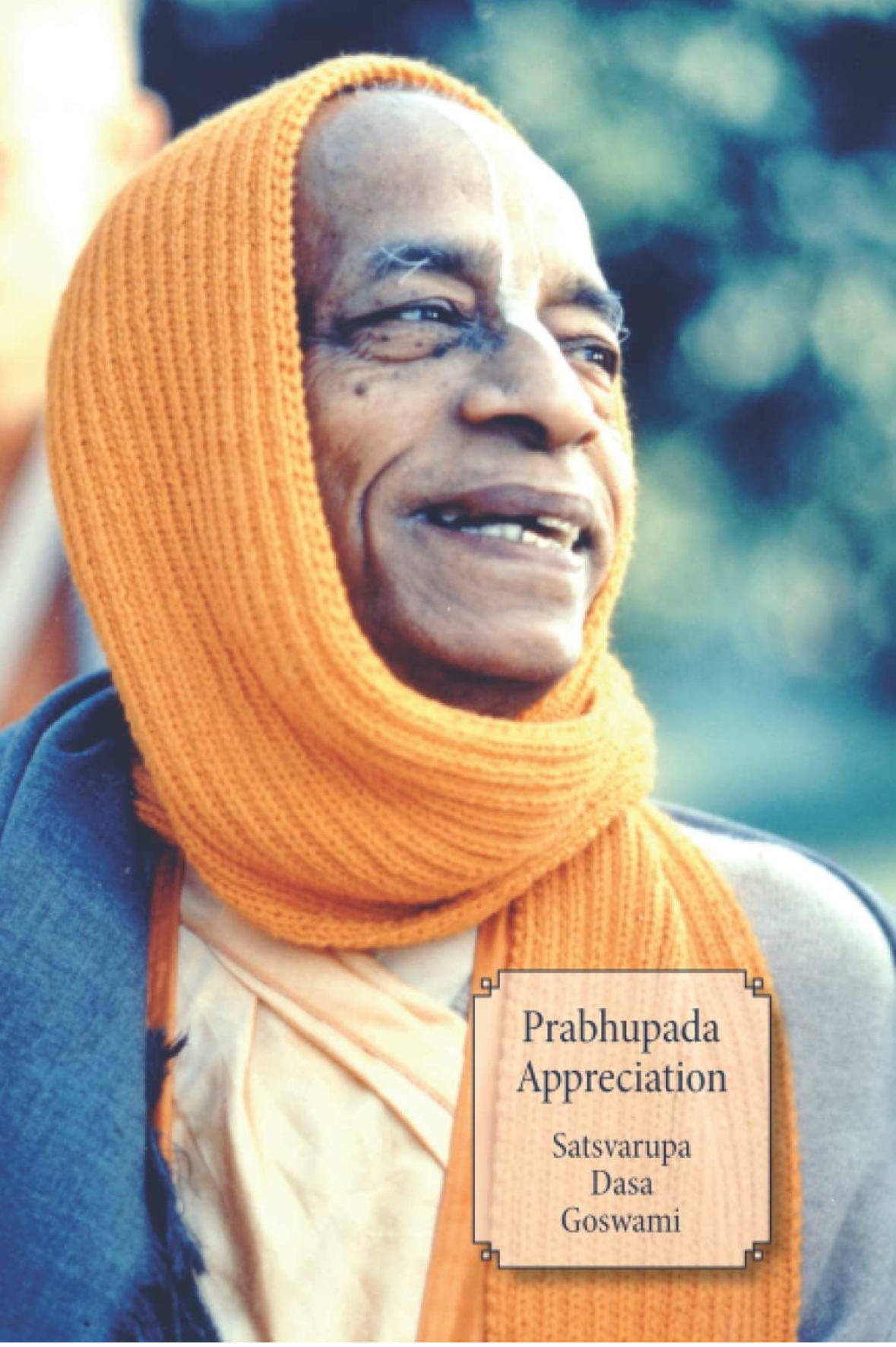
Śrīla Prabhupāda was in the disciplic succession from the Brahmā-Mādhva-Gauḍīya sampradāya, the Vaiṣṇavas who advocate pure devotion to God and who understand Kṛṣṇa as the Supreme Personality of Godhead. He always described himself as simply a messenger who carried the paramparā teachings of his spiritual master and Lord Kṛṣṇa.
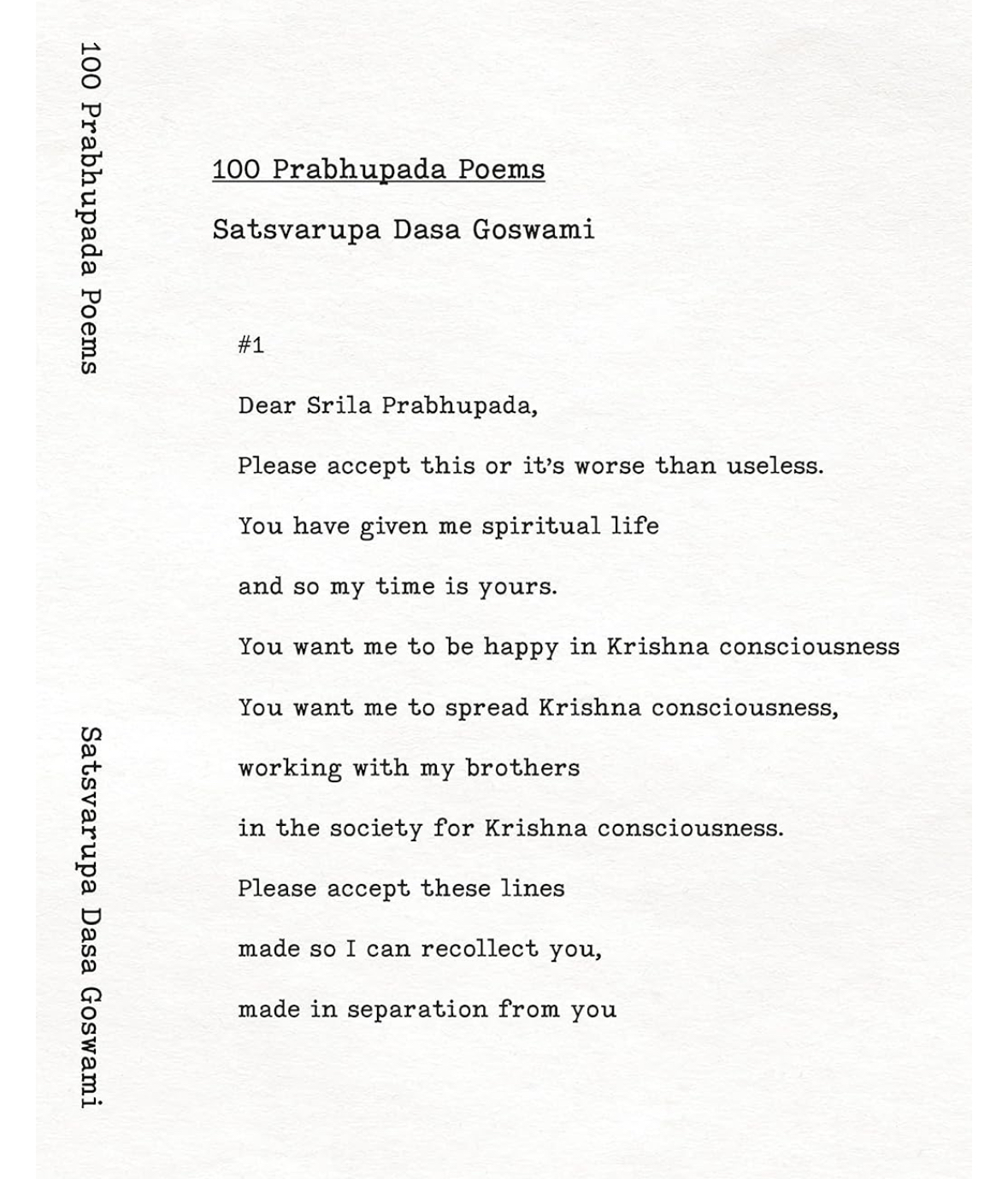
Dear Srila Prabhupada,
Please accept this or it’s worse than useless.
You have given me spiritual life
and so my time is yours.
You want me to be happy in Krishna consciousness
You want me to spread Krishna consciousness,
This collection of Satsvarūpa dāsa Goswami’s writings is comprised of essays that were originally published in Back to Godhead magazine between 1966 and 1978, and compiled in 1979 by Gita Nagari Press as the volume A Handbook for Kṛṣṇa Consciousness.

This second volume of Satsvarūpa dāsa Goswami’s Back to Godhead essays encompasses the last 11 years of his 20-year tenure as Editor-in-Chief of Back to Godhead magazine. The essays in this book consist mostly of SDG’s ‘Notes from the Editor’ column, which was typically featured towards the end of each issue starting in 1978 and running until Mahārāja retired from his duties as editor in 1989.

This collection of Satsvarupa dasa Goswami’s writings is comprised of essays that were originally published in Back to Godhead magazine between 1991 and 2002, picking up where Volume 2 leaves off. The volume is supplemented by essays about devotional service from issues of Satsvarupa dasa Goswami’s magazine, Among Friends, published in the 1990s.

“This is a different kind of book, written in my old age, observing Kṛṣṇa consciousness and assessing myself. I believe it fits under the category of ‘Literature in pursuance of the Vedic version.’ It is autobiography, from a Western-raised man, who has been transformed into a devotee of Kṛṣṇa by Śrīla Prabhupāda.”
 The Best I Could Do
I want to study this evolution of my art, my writing. I want to see what changed from the book In Search of the Grand Metaphor to the next book, The Last Days of the Year.
 a Hare Krishna Man
It’s world enlightenment day
And devotees are giving out books
By milk of kindness, read one page
And your life can become perfect.
 Calling Out to Srila Prabhupada: Poems and Prayers
O Prabhupāda, whose purports are wonderfully clear, having been gathered from what was taught by the previous ācāryas and made all new; O Prabhupāda, who is always sober to expose the material illusion and blissful in knowledge of Kṛṣṇa, may we carefully read your Bhaktivedanta purports.
I use free-writing in my devotional service as part of my sādhana. It is a way for me to enter those realms of myself where only honesty matters; free-writing enables me to reach deeper levels of realization by my repeated attempt to “tell the truth quickly.” Free-writing takes me past polished prose. It takes me past literary effect. It takes me past the need to present something and allows me to just get down and say it. From the viewpoint of a writer, this dropping of all pretense is desirable.
 Geaglum Free Write
This edition of Satsvarūpa dāsa Goswami’s 1996 timed book, Geaglum Free Write Diary, is published as part of a legacy project to restore Satsvarūpa Mahārāja’s writings to ‘in print’ status and make them globally available for current and future readers.