

We need to expand our team of proofreaders as we aim to increase the rate of republication of Satsvarūpa Mahārāja’s books as well as new books that he writes.
This includes a need for fluent bilingual Spanish and English speakers to proofread Spanish translations (we currently have around 20 Spanish translations waiting to be proofread).
Anyone interested in this particular service should contact Manohara dāsa at [email protected]
If you would like to help, please contact Kṛṣṇa-bhajana dāsa at [email protected] or [email protected] and we will find you a service that utilizes your talents.
Mandalesvara and I walking, chanting in beautiful twilight of Gita Nagari. I am on my seventeenth round. I ask, “Is there anything you want to discuss?” He says no. I say, “Yes, the chanting is enough.” We go on walking through pre-spring mud: “Hare Krsna, Hare Krsna, Krsna Krsna, Hare Hare/ Hare Rama, Hare Rama, Rama Rama, Hare Hare.”
******
I remember an old Zen story. Two monks walking in a forest. They hear nearby the loud roar of a lion. One of them breaks into laughter. The Zen story is incomplete realization, to say the least. You can laugh at death, at nothingness, at fear, at pain, at violence, at illusion—but the laugh or meditation on nothingness won’t actually help you. You will have to take another birth and again experience dualities. But, ante narayana-smrtih, your devotional service will be tested at the time of death. Practice to chant the Hare Krsna mantra. Do not chant like the parrot who may learn to utter “Hare Krsna,” but when grabbed at the throat cries, “Caw caw!” Prabhupada said practice so that when death comes you will chant Hare Krsna.
******
“If one’s heart does not change, tears do not flow from his eyes, his body does not shiver nor his hair stand on end as he chants the Hare Krsna maha-mantra, it should be understood that his heart is as hard as iron. This is due to his offenses at the lotus feet of the Lord’s holy name.”
This verse should not make us try to force or imitate this state, but it should make us humble about our chanting. When we chant, does our heart change? Do tears flow, the body shiver? We give warning again and again—don’t try to bring this on, but see your humble position because this is not happening; the chanting is not first-class, due to offenses to the holy name. Chant heart and soul early in the morning and you will be prepared to take on all obstacles in the day.
******
We want to save ourselves and we want to propagate the holy name, and it’s the holy name itself that will save us. Krsna will be pleased that we are chanting and pleased that we are distributing. Isvara Puri advised Lord Caitanya,
“My dear child, continue dancing, chanting, and performing sankirtana in association with devotees. Furthermore, go out and preach the value of chanting krsna-nama, for by this process you will be able to deliver all fallen souls.”
******
You must think of chanting in terms of serving the spiritual master, not just as your own sadhana. I am thinking Srila Prabhupada has given me different responsibilities, and if I don’t carry them out he will be displeased with me.
******
Spiritual life rests on chanting. That’s the main teaching. Chant Hare Krsna, chant sixteen rounds. So how can that not be thought of as service to the spiritual master? Sometimes the spiritual master may find out, “Oh, some disciple, he is not chanting. What kind of a disciple is that? He promised he would chant. We are always stressing chant.” I can’t advance in devotional service unless I chant. Therefore, it’s not just your sadhana, but everything you do is to serve Krsna and the spiritual master. Everything. That should be our dedication, that there is nothing apart.
******
I think I would do better to ignore the mind’s dwelling on a piece of dirt rather than keep holding it up for inspection, exclaiming, “Gosh, it’s still there; and again, look, it’s still there; how persistently it stays! What a disease! Will I ever be rid of this before the time of death?” This is like too much of a challenge to the rascal mind. So let me try not to be so worried and instead turn my mind elsewhere, even though the piece of dirt (or mental thorn) remains. There is a Canakya sloka which says that mental dirt cannot be cleaned away after hundreds of times of bathing in a sacred river. And yet the holy name, according to the Siksastakam, can clean away the dirt accumulated for many lifetimes together.
******
Today in the class in New York I was stressing that the devotees chant feeling a personal connection with their spiritual master. This in itself will help keep one’s mind fixed on the holy name. Always remember that you promised your spiritual master to chant Hare Krsna without offenses, including the offense of inattentive chanting. It is a personal obligation, and one should chant keeping the order of the spiritual master in mind and therefore keeping the personal connection.
******
Study sections in the scriptures about the holy names, such as the chanting of Ajamila or Haridasa Thakura’s instructions about the holy name or Lord Caitanya’s descriptions in Adi-lila, Chapter Seven, about chanting the holy name under the direction of Isvara Puri. Then absorbing such things and realizing more the importance of the holy name, you should humbly chant with surrender.
pp. 20-25
Srila Prabhupada said we have done only 1% of our work. It is all in Srimad-Bhagavatam. Now we have to demonstrate it. ISKCON is like the appearance of the Varaha incarnation, who sprung from Brahma’s nostril in a small size and suddenly grew half the size of the universe. Brahman means bigger than the biggest and still becoming bigger. In every one of our centers there must be arati and sankirtana going on, or else Krsna consciousness becomes slack. We have to keep alive Thus, daytime sleep should be avoided. We can take a little rest, but otherwise, if tired, chant Hare Krsna. Our centers are there to invite people to keep alive.
Discussing a book in Bengali about an assembly of sinners who were amazed at the appearance of Lord Caitanya, and lamented that now that Lord Caitanya has appeared, there will be no more illicit sex and other sinful activities. He said people in the West think like that about the Hare Krsna movement—shocked that we intend to end meat-eating, illicit sex.
Crossing the Ganges in an old wooden boat. Prabhupada sat. People calling out to us, “Hare Krsna.” He said that wherever we go and people see us, they say Hare Krsna. Even when he arrived in a plane stopover at night, they chanted Hare Krsna.
Calcutta—Went to the kaviraja’s house. He felt Srila Prabhupada’s pulse. Then Prabhupada went to another room and everyone in the house came to receive darsana and offer fruit. We held Hare Krsna kirtana. Me, terrible headache, weak from cholera shot, leading chanting in kaviraja’s, Srila Prabhupada pleased. Big basket of fruit.
Riding in the car afterwards, we said hardly anything. Then this morning we visited another man’s home, a modest apartment, seemingly mundane things (talking in Bengali), and Prabhupada finally told them to chant Hare Krsna.
I was very sick for two days, now returned to life, eating, digesting, working. Srila Prabhupada ate a kacauri yesterday, cooked by his sister, and now he has become sick again. Plans are uncertain now about going to London. Thinking to ask him how I can expand my activities in the zone. I am so saturated with self-interest—if I could only think, “What is best for Krsna,” then I would get direction how to do big things for the zone. Festivals coming together, parades in Chicago, Detroit, Cleveland.
Srila Prabhupada is ill. His sister is coming to see him but not helping. Took picture of Nrsimhadeva from altar.
Srila Prabhupada subdued us. He called in his big GBC and sannyasi leaders—their consensus was go to good climate, Hawaii or L.A., to rest. No, he wanted to preach in the West. All leaders subdued by his calm forceful statement of “strength of mind.”
He said, “Strike while the iron is hot. I think that is an English maxim. Then you can keep it in shape.”
“In the West they are fed up. I want to give spiritual enlightenment. Two very misleading theories: (1) life comes from matter, (2) there is no life after death (so enjoy), everything is matter. As this movement grows, Communism will be curbed.
“They try for unity, but this simply means our Ratha-yatra festival. They have no brain to see. By the complicated League of Nations and United Nations, still they fail. This simple method all over the world. Gandhi’s method was to cut up India into India and Pakistan, and now who cares for noncooperation, nonviolence? But by our movement this culture is spread all over the world. Jagannatha means ‘Lord of the Universe.’ International God, thanks to ISKCON.”
He criticized Western civilization for ruination of human living. They are thinking there is no time for self-realization. Not only must they work eight hours a day, but they try to save time for spending at naked dancing, vacations, intoxication. Our movement is fighting this. It is not religious sentiment, but trying to save humanity from ruin.
Regarding Midwest zone, he said that since centers are established there, then go into interior—come and go, come and go, some go south, some go north, in this way (cover all the towns and villages). If we make some devotees, we can open centers. Centers should not be opened whimsically, opened one day and closed the next.
I can go with my party and encourage the centers also to send parties; not just to do hard-core book distribution. Give them direction—but preach, meet people, hold feasts in cities—go to the interior, chanting in Kansas City, Topeka, Minneapolis, etc.
Riding home in a taxi from the pandal, question asked by Jayapataka Swami: “If we gain political power, will we follow Manu-samhita?”
“First gain power,” he said. “Then yes, Manu-samhita. Actually everything is in the Gita and Bhagavatam in gist. Manu-samhita is based on varnasrama, and that is in the Gita: ‘I created the four orders.’ First we would divide society into orders by quality and work, not birth. Someone made a brahmana would have to act like a brahmana or else he would be punished.”
Being asked, he told Pancadravida Swami how to preach to smartas in South India who may know Sanskrit:
Learn five slokas a month; in six months you’ll know thirty slokas. That should be enough to present Bhagavad-gita. PDS said Hrsikesananda was going to help him with pronunciation. Prabhupada said, this-ananda, that-ananda, be your own person. Do not be dependent on someone else to learn your work for you. When asked how to preach to Shaivites, he said, “Ask them, ‘My dear sir, do you accept Bhagavad-gita?’ They will all say yes. Then quote: ‘Those whose intelligence is maddened worship the demigods.’ Come to understand Bhagavad-gita well, even in English, and you can preach.”
About me and getting through international airlines, customs entanglement, “He is doing his best, but he does not have experience. If every month a new man, then I have to suffer.” TKG said, “But we suffer when you get angry upon us.” He said, “But your suffering is secondary.” He was detained three hours in Paris and practically jailed four days from Africa to Australia. “I am coming and going so much. I am a little bit known. I should not have to wait on lines. That is the job of the secretary. He should be so expert that these rascals with all their rules are answered and I am not detained as an ordinary person.”
I would say, “It is all right. I have checked everything.” He would reply, “You say that, but then I will be stopped at the airport.” If everything is not cleared, he is detained.
“You have to have a brain, always alert. One who has a brain has strength.”
pp. 121-23
Prabhupada visited Boston for a second time in 1969. We were still in the first storefront, and we found him an apartment right across the street. He carried small Radha Krishna Deities with him. Himavati made him a set of clothes for Them. Radharani’s skirt was a little short. “That is all right,” he wrote, “It affords us a look at Her lotus feet.” He arrived from a visit to Buffalo. We sat in his room, and he played us the recording of the last lecture he gave there, at the student hall. A boy had raised his hand for a question. “What happens when you go inside and you look further and further and further and further and further!?” He was crazy. Prabhupada replied, “That I do not know. You know.” That boy chanted Hare Krishna and became an initiated disciple in time, named Kusakratha. He became a great Sanskrit scholar.
Prabhupada stayed two weeks in Boston. He was accessible to devotees, and he gave college lectures. Just before he came, the newspapers did a feature story on us for the colored section of the Sunday paper. A lot of it was favorable. They said we were American transcendentalists, like Thoreau. He called me the “lean chieftain” of the temple. But at the end of the article he hit a sour note. He brought a friend to our Sunday feast. His friend said, “There but for the grace of God I could wind up, or one of my kids.” I was upset by that part and showed it to Prabhupada. He said I should write a letter of complaint to the newspaper, and I did.
By now I was married and lived in an apartment across the street from the temple. My wife and I stayed in one room, and three girls painted in another room, under Jadurani’s direction. There was a big, rough, black guy who lived with his girlfriend on the floor below us. As soon as we moved in he came storming upstairs and pounded on our door. He threatened us and said he didn’t want to hear any cymbals chanting or he would come up with a shotgun. Jadurani had answered the door. She had a way of trying to laugh people off when they confronted her. She did it to this guy, and he imitated her sound and threatened her more. I came to the door and assured him we were not going to have kirtanas in our apartment. That was saved for the temple. “You better not or I’ll kick your block off,” he said to me. I asked him to calm down and not be so angry. He calmed down a little but left us with a threat. He had a double standard. He could make noise if he wanted. He would stand in the street and shout up three floors to his white girlfriend, “Hey Red!” One time Prabhupada was coming back from his walk with Devananda, and as he stepped up on the curb from the road, the big, black guy crossed right in front of him, coming close to bumping him. He didn’t do it maliciously, but he was just treating Prabhupada like a nonentity, not giving him the royal right-of-way as he deserved. I saw it from the window and became angry. He was such a jerk, such a boor. Just to finish the incident I saw this guy a few years later after we had moved. I bumped into him on a subway platform. He was completely different. He greeted me in a friendly way and asked, “Where have you been?” I told him we had moved. He said it was nice to see me again, and he hoped I was doing all right. I played along with his mood, and we even shook hands. He smiled and was a gentleman. I don’t know what changed him. He was entirely different after living for two weeks on the same street as Prabhupada.
The biggest event of Prabhupada’s visit was that he conducted a triple wedding. Some of the girls had minor illnesses, and Prabhupada said it was because they weren’t married. As soon as the word got around that he said this, Saradiya, who was about seventeen years old and very beautiful, went to Prabhupada like a trusting daughter and frankly told him that she wanted to marry a boy named Vaikunthanatha who had come to Boston to help us prepare for Prabhupada’s visit. He was a good handyman and very worshipful towards Prabhupada. Prabhupada assured Saradiya that he would make arrangements with Vaikunthanatha. He then called Vaikunthanatha and told him that Saradiya wanted to marry him. Vaikunthanatha was agreeable to the suggestion, and it was settled. Then there was talking, confiding and gossiping among the women. Rukmini, who was eighteen years old and had joined the temple to learn painting from Jadurani, was also a beautiful girl and serious about Krishna consciousness. She confessed to her friends that she wanted to marry Baradraja, an artist who was visiting Boston from Montreal. Baradraja was very aesthetic, and when he gave class he spoke often of lotus flowers and lotus feet. He was an independent kind of spirit. He agreed to marry Rukmini, and Prabhupada approved. That left one unmarried girl, pretty Jahnavi, who was a painter who knew the philosophy well. Behind the scenes, as these things were done (without Prabhupada’s matchmaking), Nanda Kishora and Janavi agreed to marry. Nanda Kishora was visiting Boston for Prabhupada’s visit. He was a likeable fellow who used to inquire from Srila Prabhupada about aspects of Krishna conscious philosophy. So it was arranged, a temple wedding. One day Rukmini stopped me in the hall of the apartment building and thanked me for taking care of her, which I thought was sweet. The ceremony was held in the storefront with a fire built of orange crate wood. There were no interruptions, and it went smoothly, with all the couples taking vows of obedience in marriage. The girls wore new saris and the boys wore clean kurtas and dhotis. Prabhupada presided and made a speech about ideal marriage. I was proud that Boston, like the first time Prabhupada came and held the first brahmana initiations, was pulling off the first triple wedding under his own direction. Unfortunately, at first, the married couples did not plan to stay in Boston, so that was a disappointment. But it turned out differently so they all stayed. That’s a different story. In fact, at first it seemed that everyone was going to leave when Prabhupada left. I went to him, and asked if he could give me some manpower. He sympathized and asked Devananda, who was planning to leave, to stay with us.
During this day a wonderful new boy became interested. At an engagement at Brandeis University, a young man named Glen walked into the auditorium after the lecture was over and I was leading the second kirtana. He started talking with the devotees and became interested. They invited him to come in the car to the temple with them. He had his own mixed up philosophy in which he thought he was God, and the devotees engaged in friendly debate and preaching with him. He liked their points very much. The next night he attended the temple program where Prabhupada gave the lecture. He raised his hand and engaged in questions and answers with Prabhupada. By force of logic and spiritual presence, Prabhupada got Glen to admit he was not God. Glen submitted and bowed down before Prabhupada. Glen attended a few more meetings and talked with Prabhupada, and by the time Prabhupada was leaving, he had a serious new candidate for Krishna consciousness. Glen was dark-haired, gentle and sweet-tempered, and all the devotees liked him and encouraged him. After Prabhupada left, Glen moved into the little storefront to live. And after a few months Prabhupada sent him his name in a letter. He was Giriraja dasa Brahmacary.
pp. 130-32
[Nimai]: There was a wheelbarrow in a woodshed which I used to carry chopped wood from the forest to the cabin. After a couple of months, Gurudeva still couldn’t walk, except very slowly with two canes, and so I began to think that I could make the wheelbarrow into a palanquin for carrying him to some nearby places. I had favorite places which Gurudeva hadn’t seen, such as the creek, the lake, a nice grove, and other spots which I wanted to share with him. When I first mentioned my idea, he laughed and scoffed at it. But I kept telling him it would be nice and comfortable and that he would be happy to see more of Krsna’s wilderness. Then one day I just went ahead and cleaned up the wheelbarrow, padded it with some clothes and a cloth and presented it at the door, introducing myself as a pukka rickshaw driver. Gurudeva accepted the ride, and I took him along the path I had worn leading into the forest and toward the lake. We were both glad that he took the ride, because it opened up new vistas for Gurudeva, who had been cooped up in the one room with all its reminders of trappers and hunters.
A few days after Gurudeva’s first palanquin ride, the ice on the lake suddenly broke up. A big piece of brittle ice that spanned the lake was pushed against the shore by the wind. Slowly it drove against the shore in piles of jagged, broken crystals with a sound like thousands of dinner plates breaking. It continued for a few days like that, crashing and crunching on the rocks and scarring trees, until eventually the lake was thawed out. The ducks soon found out about it and began landing on the lake and diving after fish. I also began to notice more animal tracks, either because there were actually more animals walking about, or because I was noticing things better. I was noticing details that escaped me at first, and I was becoming at least a little bit attuned to the natural world around us.
By now it was over a month since we had been eating only what we found in the woods. During the first four or five days of “fasting,” I had headaches and other bodily discomforts, but then the body seemed to resign itself and allow my mind to be free. It was harder to do chores, but we also didn’t burn wood twenty-four hours a day in the stove, and so my work wasn’t as much.
One day when we came back from a nature walk, Gurudeva announced that he wanted to start a forest school and that it required my cooperation. I had noticed that he had been writing intensely for a week or so. He said he had prepared a syllabus for different courses that he hoped could be taught by different senior devotees, and that he wanted to form a Krsna consciousness institute whenever we returned to civilization. I thought it was a wonderful idea, and I told him I would love to help him bring it about once we returned to temples and association of devotees.
“But I want to start it now,” said Gurudeva. “We will begin our own experimental school, just you and me right here in the mountains.” At first I couldn’t grasp it, until he explained that I would be the only student in all the classes and that he would teach me. I didn’t like the prospect. It seemed like too much responsibility for me, but Gurudeva was so excited by it that his voice was extra forceful and his eyes were shining.
“There will be six courses, Nimai, and you’ll be the star pupil in all of them. There is brahminical culture, logic and public speaking, prayer and inner life, Sanskrit and verse memorization, a writing course, and a course on Srimad-Bhagavatam. What do you think?”
“I don’t know if I can do it, Gurudeva,” I replied limply. “But I’ll try.”
“If you try, you’ll succeed,” he said. I was glad that Gurudeva was confident in me, but afraid that if I did fail to hold up my end, he might become frustrated in his plan for the institute.
“There will be homework in each course,” he said, “and exams.” I never cared for academic institutions and Gurudeva knew that, so he assured me, “It won’t be like an ordinary school. You’ll like it.” I hoped so.
My participation in the courses turned out to be a lot of foolishness, and I would rather not tell about it. I don’t know what good it will do unless you want to laugh at me. Gurudeva’s forest school has since developed successfully and so my initial difficulties don’t have much significance. But he wanted me to tell about it. He said it’s history and people can benefit from hearing the mistakes of the first blundering pioneer. So only out of duty I’ll tell some of it, but make it brief. One excuse for my behavior is that when you go a long time without eating, you daydream a lot due to lightness.
In the course called Brahminical Culture, I became very enthusiastic but imitative. I’m not an initiated brahmana, so I had to function as a “blind uncle.” In case you don’t know what a blind uncle is, it comes from a story told by Prabhupada. There was once an orphan who was crying because he had no mother and father. His uncle came to him and volunteered that he would act as the child’s parent, but unfortunately this uncle was blind. The bereft child accepted the offer, saying, “A blind uncle is better than none.” So I was the blind uncle/student at the forest school.
One of the important purposes of the Brahminical Culture course, according to Gurudeva, was to understand the deep cultural and spiritual meaning underlying the different acts which a devotee performs, which we may take as ritualistic unless we know why we’re doing them. I missed that point and became more interested in imitating the refined behaviors of a spiritual person. I would end up doing wrong things with a flair. For example, no one is supposed to recite the Gayatri mantras unless he is an initiated brahmana. But I reasoned to myself that since I was taking the brahminical class, I might be an exception to this rule. As Gurudeva’s servant, I used to carry an envelope containing sheets of the Gayatri mantra for when he initiated brahmanas, although I wasn’t supposed to look. But I began to recite the Gayatri when I became a student in the course for brahmana Another thing only brahmanas can do is worship salagrama-sila. This is a form of the Lord like the statues in the temple of Radha and Krsna, only the Sila is worshiped just as it appears in nature, as a stone from sacred places in India, like Govardhana Hill. In the brahminical mood, I picked up a rock from the stream nearby and while I didn’t actually start anything with it, I was toying with the idea of considering it like a practice Sila. Gurudeva must have read my mind, because when he saw me carrying it he said, “What do you think you’re doing?” I tried not to admit what was on my mind, but as I say, he seemed to read me, and he reprimanded me strongly. He told a story at that time of a brahmana who put two little balls inside of his pot, and all other brahmanas imitated him without knowing what he was doing.
I also had been practicing little things I had seen other brahmanas in the Movement do, such as facing the sun when saying mantras and lying down at night facing the East and folding your dhoti with special pleats and wearing armbands, although I didn’t wear an earring like some of them do. Although I experimented, I wasn’t really sure which direction to face or exactly how to move your fingers in the mula mantras and things like that. Gurudeva got pretty disgusted with my antics and decided that it wasn’t a good idea to teach someone like me, who wasn’t yet a brahmana, in a course for brahmi nical culture. So for the time being he dropped that from the syllabus.
pp. 75-78
Arjuna is perplexed whether to fight. There was some argument. (Prabhupāda turns to a boy in the audience and asks him what is he doing? He says he is reading the translations of the verses of Bhagavad-gītā. Prabhupāda says, “Don’t turn your attention.”)
From the worldly point of view Arjuna is making a good proposal. He was speaking with gentlemanly behavior. Kṛṣṇa didn’t like it. Kṛṣṇa is inducing him. He tells Arjuna that he is an Āryan (a touchy word for a 1960’s American audience). Prabhupāda: “People at the present moment” (are against war) so we may do something that the public doesn’t agree with. (But we must remember) Kṛṣṇa was supreme. This is an important point. Arjuna argued. He said if many people were killed no śraddhā would be offered to the ancestors, the women would become adulterated and there would be unwanted population. He argued in so many ways and said, “I cannot fight.” (But Arjuna had the consciousness that Kṛṣṇa can make a solution.)
A kṣatriya has to fight. If he is challenged, a kṣatriya has to gamble. The Pāṇḍavas lost everything by betting and had to go into exile for 12 years. Arjuna is aware that he is deviating from the duty of a kṣatriya. He says, “You should tell me. All right, now I accept You as my spiritual master.”
(Prabhupāda discusses Vedic marriage. He says the parents are very careful to arrange the marriage. He discusses the red line in the part of a woman’s hair which indicates that she is married.) Prabhupāda compares the red mark in the woman’s part to a disciple wearing a sacred thread. He mentioned Mr. Cohen, who has seen Prabhupāda’s sacred thread. A girl wearing the red mark in the middle of her hair is seen as respectable. The relationship of the spiritual master and the disciple brings the solution of life. It is conducted with questions and answers. Arjuna knows Kṛṣṇa is perfect … They were engaging in friendly talks, but Arjuna wanted to accept Kṛṣṇa as his spiritual master. If you accept the wrong spiritual master your life is ruined.
A man from the audience indicates that he wants to ask a question. Prabhupāda allows him. The man asks, “If the disciple is in ignorance, how can he know who to pick as his spiritual master?”
Prabhupāda answers that at least one should know something of spiritual life. If one wants to find a good school, if he is searching for a good school, he should not go to a cloth shop. You must know (by investigating schools, what is a good school). Prabhupāda quotes Sanskrit and says, “A spiritual master is for one who wants knowledge.” The disciple has to have preliminary knowledge. He wants a definite answer.
Everyone is suffering. But the animals don’t have higher consciousness, they can’t enquire. There are three kinds of sufferings, by the body, by the mind, by nature … (Prabhupāda says suffering by nature is out of our control. He gives the example of a heavy snowfall in New York City and everyone’s inconvenience.) The other kind of suffering is from other living beings. We don’t want suffering. You need a spiritual master to awaken you to the solution. Prabhupāda gives the example of education. He says everyone is seeking education to get a good job. Prabhupāda says that if you want to purchase jewelry you have to go to a jewelry shop. You have to have preliminary knowledge of what jewelry is and go to the proper place to get it (not a grocery store). Vedic knowledge is for ending the suffering for good. The spiritual master is a representative of Kṛṣṇa. Why is Kṛṣṇa accepted? (Here Prabhupāda is getting on to touchy ground. He is allowed to put forward Kṛṣṇa as God, to an audience that has never heard about Kṛṣṇa).
He asked, “Why is Kṛṣṇa accepted?” Arjuna says, “My lamentation can’t be alleviated even if I get a kingdom like the whole universe.”
Kṛṣṇa is addressed as Hṛṣīkeśa. God can come (into the world). Kṛṣṇa is the Supreme Personality of Godhead. He is the Lord of the senses. In the Sanskrit that Prabhupāda quotes the word Govindam also appears and Prabhupāda says this means one who gives pleasure to the cows and the senses … The proprietor of the senses is God (Prabhupāda makes a comparison to the room they are in. He says it is a rented room and he can use it as he likes, as long as he satisfies the landlord). He says, “This is my tape recorder. I use it for my purpose.” Similarly, the senses are used for God purpose. Raw materials (like iron) are given by God.
Kṛṣṇa is smiling. Prabhupāda quotes “Śrī Bhagavān uvāca”. He says Bhagavān means one who possesses all six opulences. (A man in the audience doesn’t understand Prabhupāda saying “opulence”. Prabhupāda pronounces it again.) (He also satisfied the boy who wanted to know if a disciple is in ignorance how does he know who to choose as a spiritual master. After Prabhupāda’s explanation he asked the man if now he understood and he said yes.)
The six opulences are: all wealth, all beauty, all strength, all knowledge, all renunciation, and all fame. One who possesses all six opulences in full is God.
He has all wealth. He married 16,108 wives and gave them each a fabulous palace (this is a “far-out” statement which his audience will have trouble accepting. But Prabhupāda doesn’t hesitate to state it. He remarks people may think this is “Something like stories.”
He says Kṛṣṇa has all beauty. Then he asks, “Have you seen a picture of Kṛṣṇa?” He gets no response from his audience. He asks again, “Have you seen a picture of Kṛṣṇa?” No response. Prabhupāda says that in the battlefield of Kurukṣetra Kṛṣṇa was ninety years old with grown-up children and grandchildren, but He looks just like a boy. He is a new youth which is of the age of 16-24. He says Kṛṣṇa has all knowledge. He refers to the Bhagavad-gītā and says it is read by a great scholar in India, Dr. Radhakrishnan, who is now the President of India. He puts forward the name of Einstein. He says Hitler read the Bhagavad-gītā.
(How did that go over with the American audience?)
You can’t call anyone as Bhagavān.
Kṛṣṇa says to Arjuna, “You are speaking learned words but a wise man (a paṇḍita) does not lament. Indirectly He is calling Arjuna a fool. Prabhupāda says, “If I say Mr. Green, what you are doing is not correct or intelligent” he is indirectly calling Mr. Green a fool. A paṇḍita doesn’t lament over the living or the dead. Prabhupāda gives the example of Socrates who believed that the soul was immortal. There is a difference between the body and the soul.
At this point Prabhupāda says, “Now we shall stop.”
******
Prabhupāda is fearless and bold. The way he asserts Kṛṣṇa (who is not known to anyone in the audience as God, “the Supreme Personality of Godhead”). No other swāmīs presented Kṛṣṇa in the Bhagavad-gītā in this way. The amazing thing is that Prabhupāda attracted thousands of disciples by the straight, non-interpreted, presentation of the Bhagavad-gītā.
I am not satisfied with the journaling in this book so far. Each day I have a solid “Prabhupāda-kathā” (either a lecture or interview with a disciple) and an excerpt from Kavi-Karṇapūra’s poem on Caitanya’s life. But as yet I have not expressed my own spiritual longings. I can’t be phony. I can’t write with the pen of blazing fire.
******
I could never understand the Lord in the heart, the Supersoul. I was enlightened to find in the Brahma-saṁhitā, that the pure devotee sees the Śyāmasundara form of the Lord in his heart—the devotee whose eyes are smeared with the ointment of love. I want to know that Lord in the heart, not the four-armed form. Chanting Hare Kṛṣṇa is the best thing to do. And thinking of the pastimes of the Lord.
Just now I have begun to express my spiritual longings.
Speak to me, Lord. Tell me who I am. Teach me how to love you.
pp. 69-72
I was hesitant to come out here and do another story. I don’t want to do one that walks on stilts.
Let’s be earnest. If a bug crawls up on my bare leg I’m not going to tolerate it. I’ll flick it off. Same goes for horseflies or too much heat and so on. But I will be directly Krsna conscious as soon as possible.
I could spend my whole afternoon finishing the last pages of Hari-sauri’s Transcendental Diary. This is my second reading of it. You stay with Srila Prabhupada in 1976 and endure the pressure vicariously in his shelter as if you are part of his personal party. Harikesa was Prabhupada’s typist and cook, and when he took sannyasa and left to go preaching he felt misgivings at first. He said, “Everyone knows once you leave Srila Prabhupada’s personal party you never come back!” But with the Diary you can read some, put it aside while you do other things, and then come back again. And Hari-sauri does all the work; he stays up late massaging Srila Prabhupada and brunts all the possible difficulties, and he remembers it all in his trusty diary. So it’s not difficult to read alone. But I’ll soon be finished and can’t keep re-reading.
Thus this story must be approached, and as I said, I want to do it in a straightforward way. Yet it’s not a free-for-all Writing Session. It’s a story about the locust high up in the tree way in the woods. I didn’t know that white birches could be so tall.
If you’re not in Srila Prabhupada’s personal party, even vicariously, then how will you speak Krsna consciously? The first symptoms of a man, Srila Prabhupada writes in Bhagavad-gita purport 2.54, is how he speaks. A well-dressed fool remains hidden until he begins to talk. I lectured on those verses on the ISKCON farm in Poland, Bhagavad-gita 2.54-2.56, the symptoms of one fixed in Krsna conscious samadhi (sthita-dhi-muni). lie is not depressed by unhappiness or elated by happiness. Srila Prabhupada gave the example that if I receive an MA degree, I may be applauded at the convocation ceremony. But what is this honor? The degree is awarded to the body which will cease to exist. If I get some palatable food I think, “How happy I am!”, but it’s the tongue which is enjoying; I am not my tongue. A few days after lecturing on those verses I went to the temple in Prague and there they were up to the Fourteenth Chapter of the Bhagavad-gita. There’s a verse similar to 2.54 where Arjuna again asks for the symptoms of the person who has transcended the modes of nature. We want practical proofs. A devotee’s behavior sets the standard for dharma.
Practice tolerance. Stick to your principles. Don’t run and retreat just because some small red ants are roaming around on the flagstones. You represent to them a huge moving tower, and an unfathomable giant. I am so big the ants don’t even know it, they are so limited. And there are giants and towers that hover over me and take no account of me. Or they see me and I am fully under their control, but I can’t even see it. Demigods are like that.
Lord Krsna is the greatest “giant.” But He’s also smaller than the smallest. He’s in the heart of each ant, and even in the stone in a very limited form of consciousness. God is all-pervading. He is also untouched by matter and apart even from the work of His immediate Visnu expansions. He is not menacing to me unless I’m foolish enough to try to menace Him or His creation or His devotees.
We are moving along. I have been three days in South France and have to leave in three. I’ve been fifty-four and a half years in this body and have to leave in ___?___. This story has stretched out to two pages, and when I want I can fold it up. Just say the bugs became intolerable and I began scratching but didn’t want to draw blood so I decided to stop and go inside. Make some excuse or explanation.
The shade retreated on the patio and it was all exposed to sunlight (not true). A naked man ran by, a horse ran by in Africa and I felt it (not true, not true). I wound up writing this story on stilts after all (that’s for the reader to judge).
Now the purport. I tend to forget purports as soon as I read them. When I lecture I place those sticky Post-Its in a page with notes to remind me what to say. That way I give an organized lecture, to the point. Srila Prabhupada didn’t have to do that, and yet he always went to the heart of the subject matter. He spoke in a scholarly way, analyzing Sanskrit words in the sloka and quoting relevant slokas from other scriptures. But he was never pedantic. Not confined. Said what occurred to him and what Lord Krsna wanted him to say. He spoke from the strong, unassailable position of a pure surrendered soul. He was most qualified to speak of Bhagavad-gita and Srimad-Bhagavatam.
We take turns sitting on the temple vyasasana. Now I am not on one. I’m on a pillow on flagstones, lying back against the stone wall. I’m not facing an audience who will detect a mistake as soon as I make one, and show it in their faces. I’m outdoors, under a clear sky and the only sound is nature’s, wind on summer leaves, locusts, bird songs. I came here to do a story with a Krsna conscious meaning. So this is it. You can be with Srila Prabhupada in Hari-sauri’s Diary and ride the airplane with him, be alone in his room with his servant and not even be noticed, observe the crossfire of his chastisement without being caught in it—but be careful. Your conscience will speak to you. You have to ask yourself, “What am I doing to serve him as the others are doing?” You can’t just hide anonymously in a crowd of five hundred during his Mayapur lecture.
As I write, a red spider dangles in mid-air beside me. He is riding his amazing invisible cable that extends toward my leg—and suddenly he lands on my leg—and I dismiss him abruptly. I know I’ve got work to do, and so do you, dear reader. First, you have to fix up a prabhu-datta-desa or a vocation of service in ISKCON. You need to follow strict sadhana. Keep revising how you are doing. You can’t be too hard on yourself these days, but neither too easygoing. My story would like to help you. Sit a while in the shade while the locusts chime and scrape unearthly yet very earthly sounds. It’s a brief respite. I offer it to you. What do you think? I mean about yourself, what are you doing in Krsna consciousness? As for me, I’m going to go inside now where it’s cool. I’ll read some more Srlmad-Bhagavatam or Diary and think over what we have said (pray Krsna will teach us to improve and make best use of human life).
pp. 103-9
The retreat you thought you had set up in February is shaky—so do you want to fight for it, to go ahead and . . . you are a beggar and you seek a network of places you can use free of charge in different places of the world. This one was offered. Maybe we could get another one, say in U.S.A., in the South. Will someone give us a whole house in which I have a room that I don’t have to share with anyone?
You can arrange for that although you can’t always get it. But then the question is, why do it and what do you write while you are there?
Bleary eyed in afternoon, I sought a half hour in the Bhagavad-gita, that the soul is spread throughout the body by consciousness. No one can destroy the soul. Read it. There’s a life force in the body that makes it live and function. It’s so small, one ten thousandth, etc., and materialists say it doesn’t exist. But Krsna clearly says it exists. This is the spiritual science. Hear about it, read about it, you are bleary-eyed yet you do it.
Then he comes in and says you can have a retreat but you must fix your purpose on it and identify with that purpose. If I were writing say a novel or a book on varnasrama-dharma or gopi-bhava or whatever and I needed a few weeks alone to write, I could say, “Okay, we have nowhere else to go, we are beggars, let’s go there and do our craft.” We read and write somewhere or other, it doesn’t matter where.
But I don’t have that kind of project. I have letters to answer, and Srila Prabhupada’s books to study, and I can do radio shows and other monologues as a writer. And I have to ask myself why am I not at the Hare Krsna world convention with 3,000 other devotees at this time?
You see what this gets into. I would have preferred to just count down my days here, complain mildly about the “drawing stones” and keep focused on “I’m on very last days of retreat after which we’ll leave for India.” Now my mind is pulled out of it. But that’s life. It’s the popping of a bubble one way or another, sooner or later. No one can be happy or comfortable here.
I think of writers. Raymond Carver wrote an essay, “Fires,” about his writing life. He said when he read the statement by Henry Miller that he always had a chair being pulled out from beneath him, he (Carver) very much identified with that. He said he too for years tried to practice the art in trade of writing but had no settled residence, and the chair was always being pulled out from under him. So that happens with me too. A positive way of expressing it is to say that you are always looking for a space where you can get use of a chair and a quiet clean place for a few weeks where you can pursue your work. And your work is to stay apart from temple life yet in touch with the devotees, and write writing sessions.
My health makes it difficult to perform. And my temperament. I get more and more used to this solitude. It grows on you. You seek out more places to do it. It’s what you want but you can’t quite admit it to yourself. Is this really who I am? Yes. Yes. I can live with the scriptures and with writing projects.
The more I write, I am more likely to get into some continuity that will be successful. Keep it up. Don’t lose your nerve.
You were planning at least three seminars in 1996. By the end of January, you will have completed one. Vrndavana will be intense association for you, with many of your disciples there on campus. After 24 days you will leave. That’s when you are scheduled to go to this retreat which has now become shaky. (It’s still on, but one of the hosts can’t make it there. They say we still can go and use it. We plan to bring a typist too.)
Oxen butting heads, eating grass as it gets late.
Truck making some of its last rounds. I presume when
it gets dark they won’t keep coming. And I’m free, free
to write these little notes.
May Lord Krsna give the writer
his space and subject
so he may glorify the Lord.
Krsna teaches us eternal soul
and it’s up to us to imbibe it.
I have nothing more to say right now.
Just give me five more minutes and then I’ll let you nose around, read WS from May, seek an inkling of who you are with your repeated retreats, what you hope to achieve by the constant writing practice. That’s really the question. If you could answer it and say, “I have great steady conviction in the writing process.” Sometimes I’m doing writing practice sessions in which there is no theme or book being created, and I go ahead and do them as bhajana, self-searching, etc. And sometimes I get into a theme and write it out. But in either case, I’m committed to it. And so I just want as much time as possible. Give me a room and relative quiet and I’ll work at it 3-5 hours a day along with similar projects like Radio Shows and maybe poems, and all this done with a daily foundation of reading in Srila Prabhupada’s books with notes. That’s my life for 50% of the time, and then the other half I travel and stay in temples and devotee communities and give lectures. I’m happy with this. Although I fall far short of complete surrender and sacrifice to Krsna, yet I would also fall short if I lived a different kind of life, more actively involved in the institution. I accept the fact that I am this way, solitary often and using my own time in the pursuit of quiet studies, quiet reading, and japa alone. I like it. I offer it to my spiritual master.
Who will tell me, “No, this isn’t good enough?” Krsna Himself and Srila Prabhupada.
I fight to know what’s best for me.
Don’t write anything phony. If you need to talk about this, then do so in your writing session.
Srila Prabhupada said one shouldn’t say to Krsna, “I can’t accept what You are asking me to do. Give me another program instead. Something I like to do.” But Krsna and Srila Prabhupada aren’t asking me to do something else. They are giving me the space. Respond by more study in his books, more focus on Krsna consciousness in writing. But you can do that in your 50-50 program; time on your own and time with the devotees.
I have “earned” the right to live by myself and with myself. I like my company and that of M. and maybe one other friend in a quiet setting for reading and writing. I write the process, what comes.
An artist spends full time in a studio, trying to find himself in art. A writer too. Why not me? Fashion something revolutionary in a quiet way to serve ISKCON. It will come to you because you spend time at your desk and you don’t quit.
Therefore as long as you do have a chair (and a desk lamp and tolerable health and pen, etc.), keep on writing, in health clinic, in Vrndavana, in Gujarat (the village).
Don’t deviate.
Ask the question, “How is this service to Srila Prabhupada? How is this helping the people of the world? Am I sacrificing my interests to serve the interests of Krsna? The examen folks say, “God’s will is generally for us to do more of whatever we are most grateful for or whatever gives us the most life.”
I say Srila Prabhupada approves of my being alone provided I’m active in it and get work done to serve the movement and also I’m happy and fit to be a better sannyasi.
So dear reader, dear snooper into my privacy, this is what happened. A retreat set for February became a little shaky when one of the hosts said she couldn’t be there but we could still go and use the facility. It has made me question more again the whole lifestyle of going to these retreats. You see?
I’ve written of it here. Outwardly I’m sticking to the plan of going there in an obscure place and doing our thing. Inwardly I’m facing more what I actually would do there and how I justify it as a disciple of the world preaching acarya, and as a member of the world preaching movement.
(44 minutes, November 10, Lough Derg house, quiet at this moment in between the truck’s rounds)
pp. 93-100
I don’t think I have
to be one of you people
who jingle and jangle.
I want to be an altar
boy. I want to be
a safe person with food and
altar of Radha and Krsna and
Gaura-Nital and
Srila Prabhupada.
Do you care what I do?
What is the subject matter?
A book of people who
stowed away. That was
a gift.
I don’t get them every day.
He has expired. Let’s praise
famous men. And less
famous to a lesser degree.
I asked you a question in my last letter
and you didn’t answer it. How come?
It doesn’t inspire
people, does it?
He asked me not to bother answering his
questions but I researched for his letter to
answer them.
You have to be there for people. But he
says I’ll do it
only if you tell me what’s
actually happening or how can I
advise?
Those friendships thrown on the
junk heap. Find a new one.
Go to a party and act like a
smiling, polite ass, saying things
that “Vaisnavas” say.
All this put-down isn’t
good for your mental health,
let’s hear some counter-talk.
Okay, I’m a swell humble fellow
who worked and
traveled in Dodge Ram vans
all over the U.S. giving lectures
(the same ones).
People smile at me.
They thought I was good,
God loves me.
It’s a place in your heart
where you can live
even if people don’t come around
you’ll be content painting and building a
visionary garden that appears in
Raw Vision magazine
you learn finally how to overcome
a few bad habits.
You know, I used to chew
my fingernails and
masturbate but these habits
are long over.
I used to have a terrific false
ego—which seems less.
So why not more?
You don’t know what love is
it’s not shallow
it’s the second take
he said I want to get rid of
romance I just want to
empty the garbage
and make little men out of
wood and paint them
and line them in a queue
by a bus stop.
I like to chant sixteen rounds
a day but with all
that Klonapin . . .
See Christ or Krsna in
His glory and He
gives you everything . .
You splurge paint on
the canvas wall. I
met a man from Paris. He said,
“Parlez-vous Hare Krsna!” They
are all over the place thanks to Srila Prabhupada.
No other gets the credit. He’s
the first and best
follow him and you’ll
get the favor of the Lord.
Five minutes is all I give you said
the jailer but the pianist
played as well as ever.
The crescent, the moon
in the sky, my own
ploughing through a day—
is there a fax from
an ex-lover
can I get thrown in jail
jam
can I lie to the therapist and say
my trouble is due
to in-fighting by the book
publishers?
What’s the use of lying to
the crescent moon? He’ll
just look cold down
on you with his rabbit if
you’re lucky enough
in Wicklow to even see a moon.
Our so limited activities. There’s
a book of Sanatana Gosvami available
if you have the stamina
and it’s important to
chant on tulasi beads. So my friend
it’s up to you to use your time
and stop churning up so much
wasted grace in your spinning
head.
“I’m making peace with the
Catholic Church,” he said, but
how could you be condemned forever
for wrong acts in just
one lifetime?
In Vedic life, at least a hog
can rise again.
When I fall in love it
will be forever he
sang no one played like
him
imitation. Now play
the people were talking too
loud and you couldn’t
pay attention
to the inner work where
you see yourself for who
you are and you decide
yes, this is who I want
to be, a lover, a rover, I
want to be a player on
a drum.
Doesn’t know if he wants
to be a Vaisnava with
topknot—can’t decide
on girl or boy because
that’s the kind of thing
decided by fate.
Deeper, the inner
person—are you sure
you like to live only
alone?
Do you want to catch
your irritability
your fears
and then decide I
don’t want to be
like that?
I want to be
changed
I want to be
the same
I don’t even want
to try to find out
they were asking themselves
these questions in the
waiting room.
I dove into the surf. I
stepped aside as a
truck roared by.
The Master in the
heart can help
but you’ve got to call out loud
and deep, “Please help me
and all these coaches will have some meaning.”
You tell me in my seat
of soul. No one else can
know for me.
You’re going to see me a tougher
guy. Get lost, mother.
If someone says why don’t you
phone me every day, or he laughs, “Ha!
You wrote a book about a mouse?”
I’ll say, “May mouse turds drop on you!”
My assertive new will
will be used in Krsna’s service. I say,
“Sorry, he can’t travel. Sorry, he’s not home.
He’s out in the garden.” Sorry, he’s sitting back in
his kickback chair. You
won’t find him on the
street or the plane
or the festival.
He writes books.
Oh! Look! Here’s
his God, beautiful
Krsna, the Lord of all.
So why bother about me?
Focus on Govinda.
He dared to tell you what
medicine is best, what Higher Power
and when to relax.
He says you are a worrier
and you need B2 shots.
He tells you enter the
Twelve Step program and do TM
biofeedback.
Why should we listen to
him? What right has he got
to tell me
the best formula for success
in life? Don’t tell your secret.
You dig me wrong. Take two.
Take three. It’s always
the Lord of Lords
in bowers
the supreme power
as a milker
of cows
just a child.
I want to be explicit
there was no way to get
home clear:
No free sandwiches.
You have to pay for it.
I am the one and only
person who has to decide
and live within my writing shed
no one understands
I don’t cry for you, I
don’t grieve. I’m just
detached. I feel good
as I plough the grass
there is no home owner
in these suburbs as
happy as me.
I live in an atmosphere
of just fooling around. You
go to Sunday Mass and I give the
Looney Tunes sermon.
They understand the
story of Krsnadasa who
reconciled his guru as acarya
and flesh and blood
and who didn’t want
any woman on his back—
get them off!
This is the toughest call
but you can hack it if
you use your paring knife
and stand like a soldier
in the line.
He got it right in
Hackensack—all Catlicks
at Mass. But the masses
are in the streets
or at home with
TVs.
As for me, I’m free
chained to you.

Viraha Bhavan Journal (2017–2018) was written by Satsvarūpa Mahārāja following a brief hiatus in writing activity, and was originally intended to be volume 1 in a series of published journals. However, following its completion and publication, Mahārāja again stopped writing books, subsequently focusing only on what became his current online journal, which began in August of 2018.

At first, I took it hard that I would have to live surrounded by the firemen, and without my own solitude. After all, for decades I had lived in my own house with my own books and my own friends. I was also now a crippled person who couldn’t walk, living among men who did active duties. But when Baladeva explained it to me, how it was not so bad living continually with other firemen and living in the firehouse with its limited facilities, I came to partially accept it and to accept the other men. I came to accept my new situation. I would live continually in the firehouse and mostly not go outside. I would not lead such a solitary life but associate with the other firemen.
Let me write sweet prose.
Let me write not for my own benefit
but for the pleasure of Their Lordships.
Let me please Kṛṣṇa,
that’s my only wish.
May Kṛṣṇa be pleased with me,
that’s my only hope and desire.
May Kṛṣṇa give me His blessings:
Kṛṣṇa Kṛṣṇa Kṛṣṇa Kṛṣṇa Kṛṣṇa he
Rāma Rāghava Rāma Rāghava
Rāma Rāghava rakṣa mām.
You mentioned that your pathway has become filled with stumbling blocks, but there are no stumbling blocks. I can kick out all those stumbling blocks immediately, provided you accept my guidance. With one stroke of my kick, I can kick out all stumbling blocks. —Letter by Śrīla Prabhupāda, December 9, 1972.

The Writing Sessions are my heart and soul. I’m trying my best to keep up with them. I am working with a few devotees, and they are far ahead of me. I wander in the wilderness of old age. I make my Writing Sessions as best I can. Every day I try to come up with a new subject. Today I am thinking of my parents. But I don’t think of them deeply. They are long gone from my life. Śrīla Prabhupāda wrote a poem when he was a sannyāsī, and he said now all my friends and relatives are gone. They are just a list of names now. I am like that too. I am a sannyāsī with a few friends. I love the books of Śrīla Prabhupāda. I try to keep up with them. I read as much as I can and then listen to his bhajanas.
The metaphor is song. Explain it. Yes, particulars may not seem interesting or profound to readers who want structured books.
Wait a minute. Don’t pander to readers or concepts of Art. But Kṛṣṇa conscious criteria are important and must be followed. So, if your little splayed-out life-thoughts are all Kṛṣṇa conscious, then it’s no problem.
I am near the end of my days. But I do like the company of like-minded souls, especially those who are Kṛṣṇa conscious. Yes! I am prone to Kṛṣṇa consciousness. I have been a disciple of Bhaktivedanta Swami Prabhupāda for maybe almost sixty years. Sometimes I fail him. But I always bounce back and fall at his feet. It is a terrible thing that I sometimes do not have the highest love for him. It is a terrible thing. Actually, however, I never fall away from him. He always comes and catches me and brings me back to his loving arms.

This edition of Satsvarūpa dāsa Goswami’s 1996 timed book, Upstate: Room to Write, is published as part of a legacy project to restore Satsvarūpa Mahārāja’s writings to ‘in print’ status and make them globally available for current and future readers.
A factual record of the reform and change in ISKCON guru system of mid ’80s.

Readers will find, in the Appendix of this book, scans of a cover letter written by Satsvarūpa Mahārāja to the GN Press typist at the time, along with some of the original handwritten pages of June Bug. Together, these help to illustrate the process used by Mahārāja when writing his books during this period. These were timed books, in the sense that a distinct time period was allotted for the writing, during SDG’s travels as a visiting sannyāsī
Don’t take my pieces away from me. I need them dearly. My pieces are my prayers to Kṛṣṇa. He wants me to have them, this is my way to love Him. Never take my pieces away.

Many planks and sticks, unable to stay together, are carried away by the force of a river’s waves. Similarly, although we are intimately related with friends and family members, we are unable to stay together because of our varied past deeds and the waves of time.
To Śrīla Prabhupāda, who encouraged his devotees (including me) To write articles and books about Kṛṣṇa Consciousness.
I wrote him personally and asked if it was alright for his disciples to write books, Since he, our spiritual master, was already doing that. He wrote back and said that it was certainly alright For us to produce books.
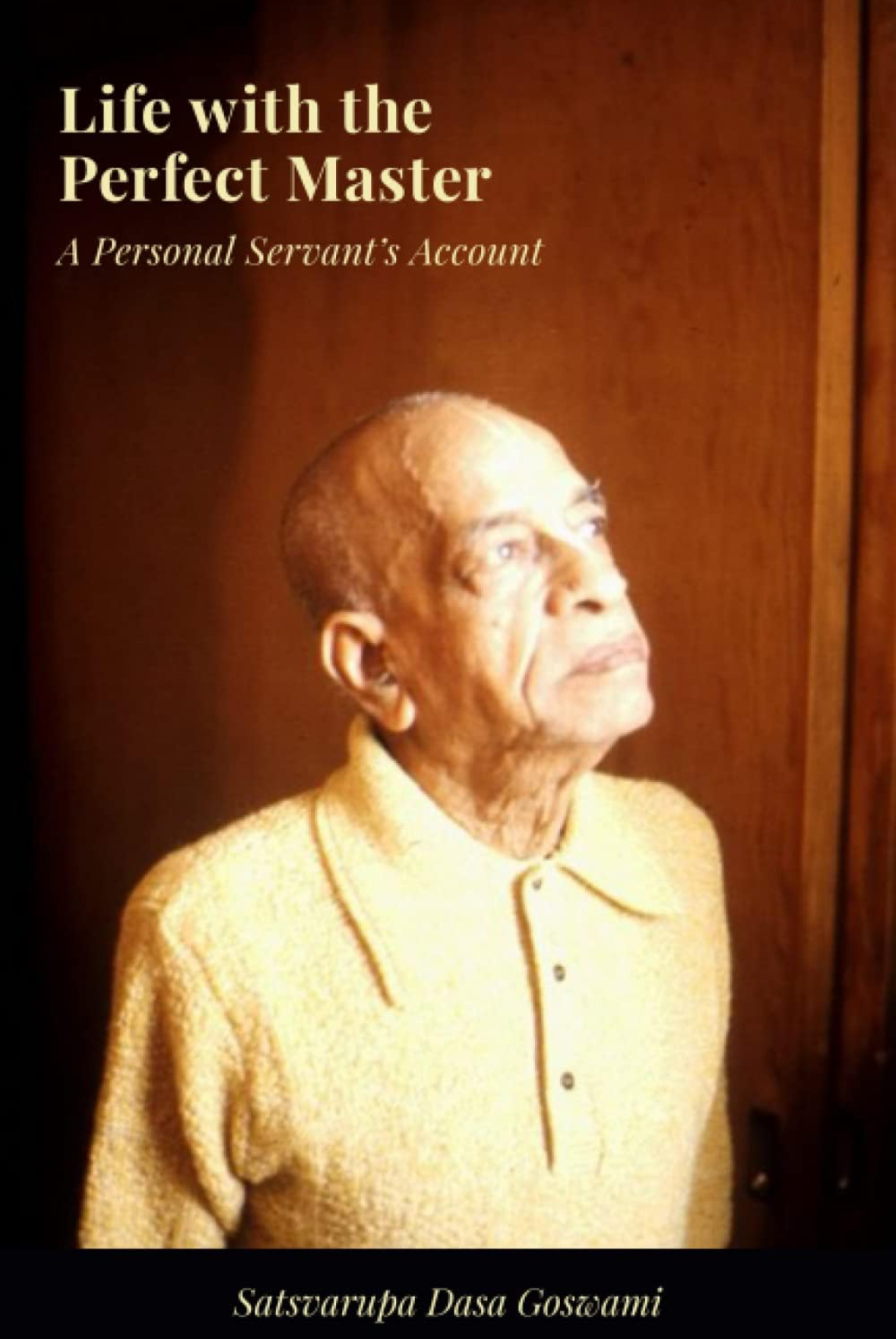
I have a personal story to tell. It is a about a time (January–July 1974) I spent as a personal servant and secretary of my spiritual master, His Divine Grace A.C. Bhaktivedanta Swami Prabhupäda, founder-äcärya of the International Society for Krishna Consciousness. Although I have written extensively about Çréla Prabhupäda, I’ve hesitated to give this account, for fear it would expose me as a poor disciple. But now I’m going ahead, confident that the truth will purify both my readers and myself.

First published by The Gītā-nāgarī Press/GN Press in serialized form in the magazine Among Friends between 1996 and 2001, Best Use of a Bad Bargain is collected here for the first time in this new edition. This volume also contains essays written by Satsvarūpa dāsa Goswami for the occasional periodical, Hope This Meets You in Good Health, between 1994 and 2002, published by the ISKCON Health and Welfare Ministry.

This book has two purposes: to arouse our transcendental feelings of separation from a great personality, Śrīla Prabhupāda, and to encourage all sincere seekers of the Absolute Truth to go forward like an army under the banner of His Divine Grace A.C. Bhaktivedanta Swami Prabhupāda and the Kṛṣṇa consciousness movement.
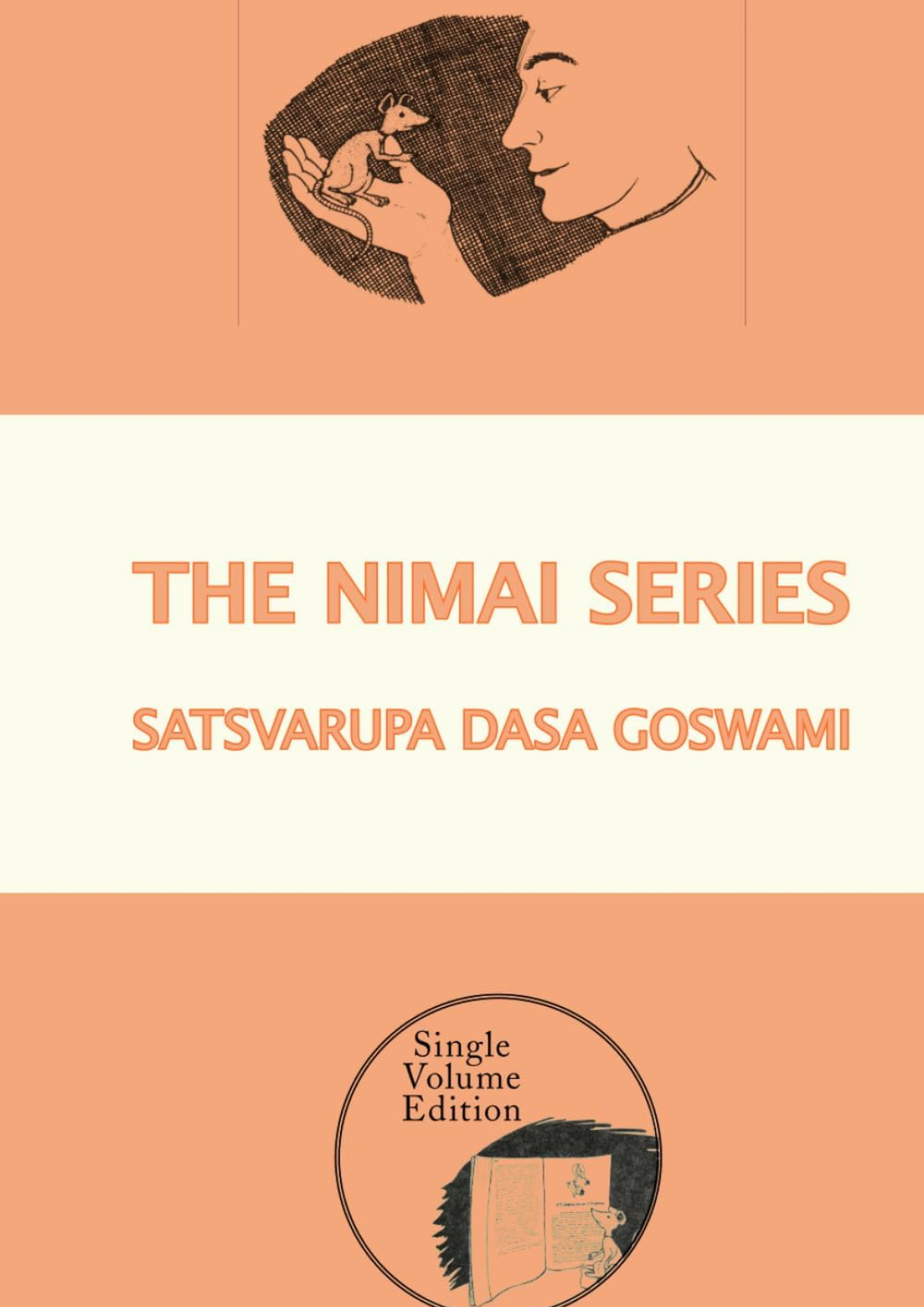
A single volume collection of the Nimai novels.
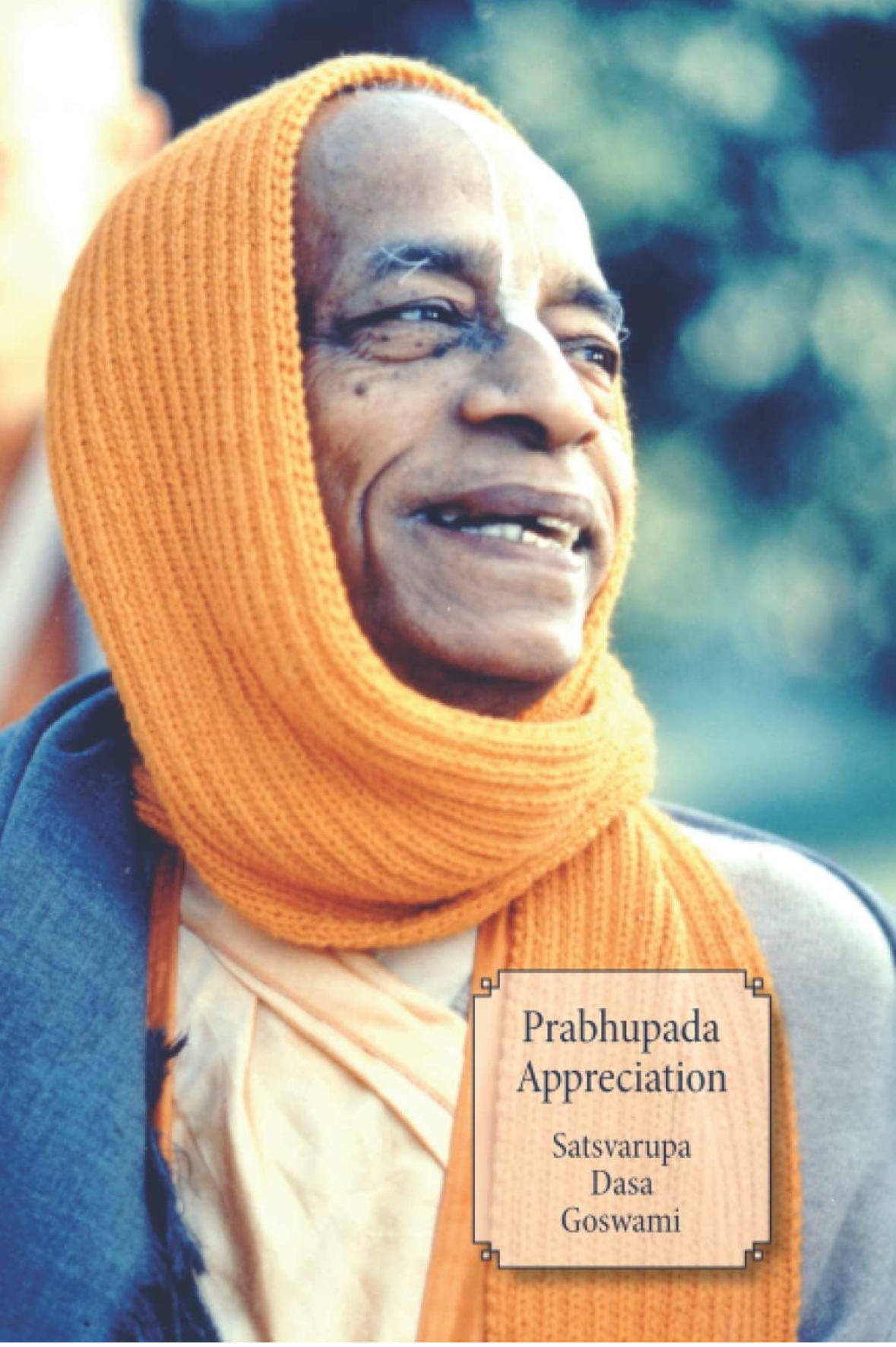
Śrīla Prabhupāda was in the disciplic succession from the Brahmā-Mādhva-Gauḍīya sampradāya, the Vaiṣṇavas who advocate pure devotion to God and who understand Kṛṣṇa as the Supreme Personality of Godhead. He always described himself as simply a messenger who carried the paramparā teachings of his spiritual master and Lord Kṛṣṇa.
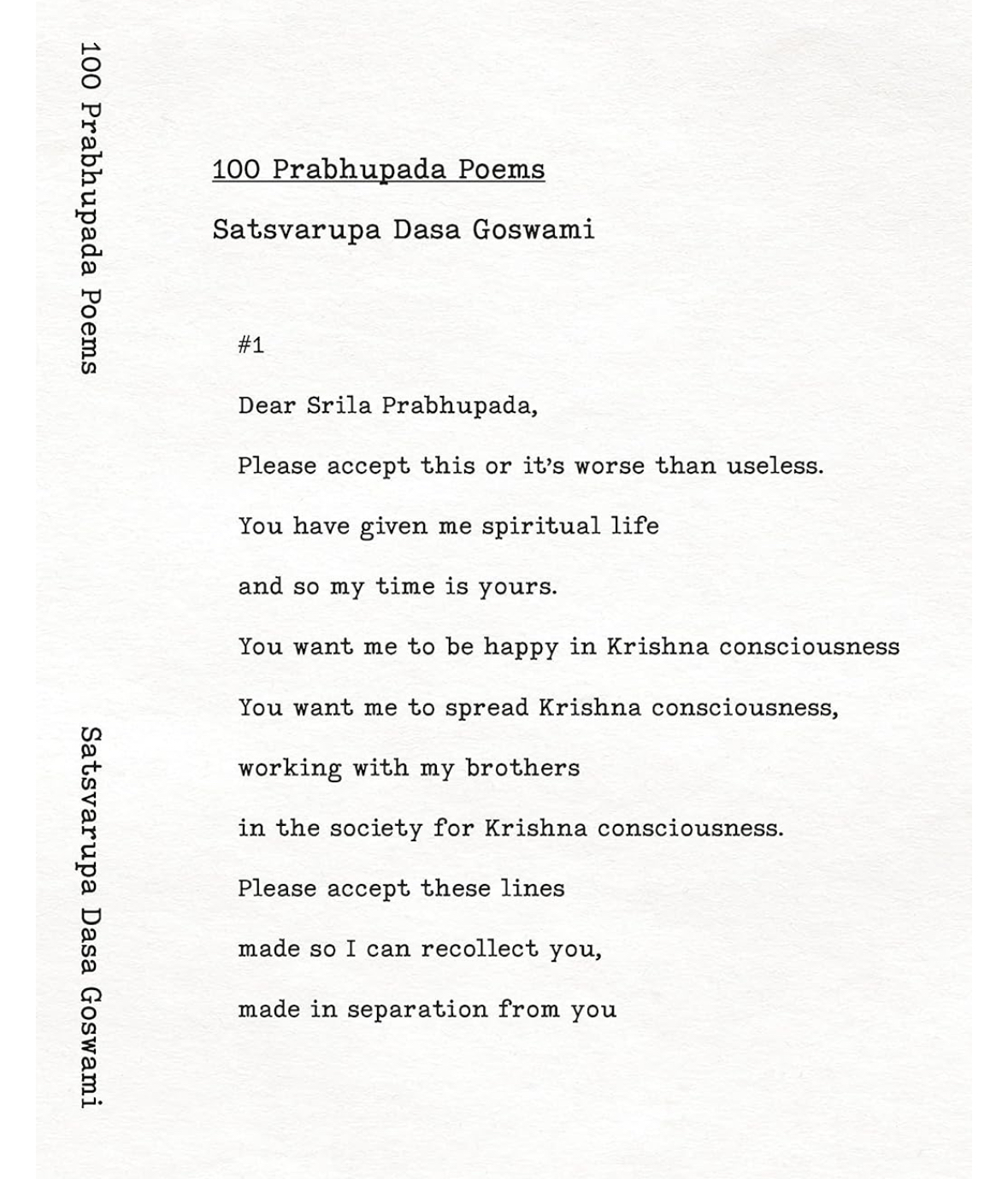
Dear Srila Prabhupada,
Please accept this or it’s worse than useless.
You have given me spiritual life
and so my time is yours.
You want me to be happy in Krishna consciousness
You want me to spread Krishna consciousness,
This collection of Satsvarūpa dāsa Goswami’s writings is comprised of essays that were originally published in Back to Godhead magazine between 1966 and 1978, and compiled in 1979 by Gita Nagari Press as the volume A Handbook for Kṛṣṇa Consciousness.
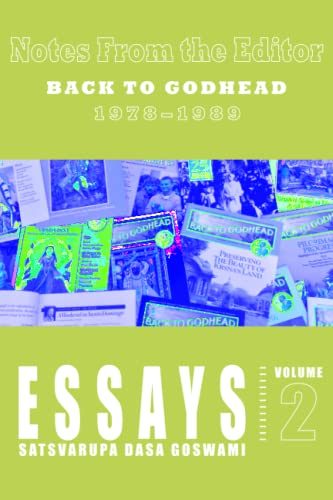
This second volume of Satsvarūpa dāsa Goswami’s Back to Godhead essays encompasses the last 11 years of his 20-year tenure as Editor-in-Chief of Back to Godhead magazine. The essays in this book consist mostly of SDG’s ‘Notes from the Editor’ column, which was typically featured towards the end of each issue starting in 1978 and running until Mahārāja retired from his duties as editor in 1989.
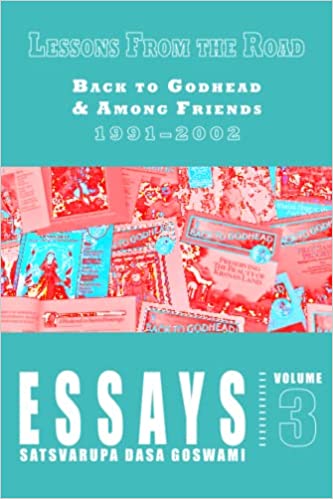
This collection of Satsvarupa dasa Goswami’s writings is comprised of essays that were originally published in Back to Godhead magazine between 1991 and 2002, picking up where Volume 2 leaves off. The volume is supplemented by essays about devotional service from issues of Satsvarupa dasa Goswami’s magazine, Among Friends, published in the 1990s.

“This is a different kind of book, written in my old age, observing Kṛṣṇa consciousness and assessing myself. I believe it fits under the category of ‘Literature in pursuance of the Vedic version.’ It is autobiography, from a Western-raised man, who has been transformed into a devotee of Kṛṣṇa by Śrīla Prabhupāda.”
 The Best I Could Do
I want to study this evolution of my art, my writing. I want to see what changed from the book In Search of the Grand Metaphor to the next book, The Last Days of the Year.
 a Hare Krishna Man
It’s world enlightenment day
And devotees are giving out books
By milk of kindness, read one page
And your life can become perfect.
 Calling Out to Srila Prabhupada: Poems and Prayers
O Prabhupāda, whose purports are wonderfully clear, having been gathered from what was taught by the previous ācāryas and made all new; O Prabhupāda, who is always sober to expose the material illusion and blissful in knowledge of Kṛṣṇa, may we carefully read your Bhaktivedanta purports.
I use free-writing in my devotional service as part of my sādhana. It is a way for me to enter those realms of myself where only honesty matters; free-writing enables me to reach deeper levels of realization by my repeated attempt to “tell the truth quickly.” Free-writing takes me past polished prose. It takes me past literary effect. It takes me past the need to present something and allows me to just get down and say it. From the viewpoint of a writer, this dropping of all pretense is desirable.
 Geaglum Free Write
This edition of Satsvarūpa dāsa Goswami’s 1996 timed book, Geaglum Free Write Diary, is published as part of a legacy project to restore Satsvarūpa Mahārāja’s writings to ‘in print’ status and make them globally available for current and future readers.