

What
Meeting of Disciples and friends of SDG
Where
The Veterans of Foreign Wars Hall – 845 Hudson Avenue – Stuyvesant Falls, New York 12173
There is plenty of parking near the Hall. The facility is just a few minutes’ walk from SDG’s home at 909 Albany Ave.
Schedule
10:00 – 10:30 A.M. Kirtana
10:30 – 11:15 A.M. Presentation by Satsvarupa Maharaja
11:15 – 12:30 P.M. Book Table
12:30 – 1:15 P.M. Arati and kirtana
1:15 — 2:15 P.M. Prasadam FeastContact
Baladeva Vidyabhusana at [email protected] or (518) 754-1108
Krsna dasi at [email protected] or (518) 822-7636SDG: “I request as many devotees as possible to attend so we can feel the family spirit strongly. I become very satisfied when we are all gathered together.”
*******
Śrī Caitanya-caritāmṛta, Madhya-līlā 20.124–125: “O great learned devotee, although there are many faults in this material world, there is one good opportunity—the association with devotees. Such association brings about great happiness. . . . .”
Srila Prabhupāda: “Therefore, our Society is association. If we keep good association, then we don’t touch the darkness. What is the association? There is a song, sat-saṅga chāḍi’ kainu asate vilāsa, te-kāraṇe lāgila mora karma-bandha-phāṅsa (Gaurā Pahū, verse 3). Sat-saṅga. Sat-saṅga means association with the devotees. So the one poet, Vaiṣṇava poet, is regretting that, ‘I did not keep association with the devotees, and I wanted to enjoy life with the nondevotees. Therefore I’m being entangled in the fruitive activities.’ Karma bandha phāṅsa. Entanglement.” [Conversation with David Wynne, July 9, 1973, London]
We need to expand our team of proofreaders as we aim to increase the rate of republication of Satsvarūpa Mahārāja’s books as well as new books that he writes.
This includes a need for fluent bilingual Spanish and English speakers to proofread Spanish translations (we currently have around 20 Spanish translations waiting to be proofread).
Anyone interested in this particular service should contact Manohara dāsa at [email protected]
If you would like to help, please contact Kṛṣṇa-bhajana dāsa at [email protected] or [email protected] and we will find you a service that utilizes your talents.
It is not very simple to improve chanting. Therefore, like any good thing, it has to be worked at. Prabhupāda once said that good trees that bear certain nuts take a long time in fructifying. So similarly, a good thing may take a while to achieve.
******
Complete concentration is necessary. Otherwise, your rounds are done, but they aren’t done well. You’re just trying to get the job done, like a factory worker. You get the credit that “I chanted my rounds,” but there will be far more credit if you chant with the right quality. Attentive doesn’t mean only that you don’t fall asleep or that you don’t leave off a “Hare,” but it means being attentive to how Kṛṣṇa may reveal within your heart more understanding of the holy name. But you have to concentrate.
******
Anything that you want to do well, you have to think about it, and you have to put other things out of your mind in order to do it. That’s very basic definition of concentration. Concentrated is only one thing, nothing diluted, nothing impure—just the essence. So, when you concentrate on anything, it’s like that—one thing. The karmīs concentrate so that they get the most out of sense gratification. Any worker has to concentrate to do something right. So, a yogī, a bhakti-yogī, has to concentrate also with all his senses and his mind. We actually chant japa just a couple of hours, but it should be done like that—with concentration. Everybody knows this, but we have to do it.
******
It’s an easy process. It’s not a hard process, it’s an easy process—you just have to chant and hear. You don’t have to sit in a certain place and control your breath and give up food. But it’s an easy process for somebody who’s not very austere—meaning the average soul in the Kali-yuga—but it’s also the topmost process. So if this easy process, if you can’t do this even, then literally there’s no hope for you. What other hope is there if you can’t chant?
******
Kṛṣṇa doesn’t say that if we chant Hare Kṛṣṇa we won’t have trouble. But He says if we chant Hare Kṛṣṇa and then think of Kṛṣṇa at the time of death, we may never have to come back again. Even Queen Kuntī, who always thought of Kṛṣṇa, had so many difficulties.
******
Prabhupāda says we should chant at least loud enough that we can hear our own sound vibration. The process is to chant and hear. If you just chant in your mind then there is no hearing in the proper sense.
******
So don’t think it a contradiction that we say, “If you become pure, then you will be able to chant.” But then we say, “Chant and then you will become pure.” Ceto-darpaṇa-mārjanam. Chanting will purify you, but you can’t just leave everything the way it is. That’s called committing sins on the strength of chanting. Although very impure, Jagāi and Mādhāi were given the holy name, but then they had to promise, “Now no more do your sinful activities.” This cleansing process works, but don’t add dirt at the same time. Just like a fire produces heat, but if at the same time I am throwing water on it, then I can’t blame the fire. “This fire is falsely advertised as producing heat. It doesn’t work.” This process will work, but don’t defeat it by your impure activity. Chanting has to be done within a whole devotional life—not as a professional performance or a part-time performance—to receive the real effect.
******
If you just try to let go of your different plans and material desires and let the chanting work, so many realizations will come, and you will feel very attached to the holy name and to this process.
******
During japa time, don’t talk and converse and socialize. There are other times for that.
pp. 43-45
When all the Vaisnavas from Bengal
went to Jagannatha Puri, by chance they
arrived on the day when Lord Jagannatha
performs His pastimes in the
water. Boarding a boat in Narendra-sarovara,
Lord Govinda, the vijaya-vigraha Deity from
the temple, performed His water pastimes
with all the devotees.
The next morning the Lord
began His all-encompassing
sankirtana. He formed seven
groups and in each group
was a powerful dancer. Four parties
were then distributed in four directions,
and in the middle of them the Lord
began to dance. When the congregational
chanting began all the residents
of Jagannatha Puri came running.
Everyone became astonished, and they agreed
that never before had such kirtana been
performed and ecstatic love of Godhead
exhibited. When the dancing was going on,
Lord Caitanya performed a miracle.
He stood in the middle of the dancers
and all the dancers in all directions
personally saw that Sri Caitanya Mahaprabhu
was looking at them. Everyone who saw
Lord Caitanya could understand that He
was performing a miracle, but they did not
know how it was that He could
see all four sides.
The ocean of bliss increased
and everyone present forgot
his body, mind and home.
Lord Nityananda found a way to end
the kirtana, and He gradually stopped
all the dancers. As long as the devotees
remained with Sri Caitanya Mahaprabhu,
the pastime of sankirtana was performed
with great jubilation every day. While chanting
my quiet japa, I saw Lord Caitanya dancing
in my mind’s eye, and I was astonished
how everyone could see Him. I chanted in
bliss and imagined I was with
Lord Caitanya in Nilacala.
The Singh family has left, and
our house is quiet and empty.
For two and a half days, every room
was filled with fun, joking and
laughter. Our routine is
solitary again, but we just heard
that Jayadvaita Maharaja will come next
Sunday for Janmastami, and we will
hold a celebration at Stuyvesant
Falls. Once again there will be
many guests, and we will be
plunged into a social scene.
At 5:30 P.M . the Singhs phoned
us from New York. The rainstorms
had cancelled their flight to D.C. with
connections to Nashville. They had to
settle for a 9:30 P.M . direct flight to
Nashville (which was delayed until
10:45). I felt sorry that
they were so sincere and self-
sacrificing in coming to visit us, but
they had to get caught up in the travel delays.
Similarly, Saci-suta’s family is stuck in
the rain in the Cape Cod vacation
in tents on the beach.
I’m back in Bhajana-rahasya.
The text tells how the Gita-
govinda describes how Radha in a
sulky mood forces Syamasundara
to please His beloved by bowing at
Her lotus feet, and His peacock-
feathered crown falls to
the ground. This is done by the will
of Sri Krishna who is the emperor
of the amorous sports. Radha
appears as His equal or superior
out of love only. I write this to
music to enhance the mood.
Melody makes the pastime artistic
and jolly, and
I enjoy it dovetailed
in Their service. The
rasa is so rare and sweet
and I dare to hear it
out of a desire to
enter radha-dasya
with Prabhupada’s permission.
It was a long-standing rule that Sri
Caitanya Mahaprabhu would lie down after lunch
and Govinda would come to massage
His legs. Then Govinda would honor
the remnants of food left by Lord Caitanya.
This time when the Lord lay down, He covered
the entire doorway and Govinda could not enter
the room. Govinda repeatedly asked the Lord
to turn on one side so he could pass and enter
the room, but the Lord said, “I don’t
have the strength to move My body.” Finally the Lord said,
“Do it or don’t do it. It depends on your mind.”
Then Govinda spread the Lord’s wrapper over His body
and entered the room by crossing over the Lord.
Govinda massaged as usual and all the Lord’s
fatigue went away. The Lord slept nicely
for about forty-five minutes and then His sleep broke.
When He saw Govinda sitting by His side
He became somewhat angry: “Why have you been
sitting here for so long today?” Govinda replied
in his mind: “My duty is to serve, even if I
have to commit offenses or go to hell.”
There was nowhere to go. How could he leave?
When he thought of crossing over the Lord’s
body, he considered it a great offense. These
are some of the finer points
of etiquette in devotional service. Only one
who has received the mercy of Lord Caitanya
can understand these principles.
While I chanted my japa I
considered these principles
and examined my consciousness whether
I am following them.
My chanting was swift and mindful.
The poet prays that birth after birth
he may attain the position of being
a maidservant of Radharani. In the
Caitanya-caritamrta it is stated,
“Without the guidance of the sakhis no one
can enter these pastimes. One who worships Krishna
following in their footsteps can attain the service of
Radha-Krishna. There is no other means to attain
this goal.” I consider these verses
and am inspired to follow. But how can
I attain it? Only by following Lord
Caitanya’s sankirtana movement.
Radha holds a jasmine flower and Their
two bodies are flanked with pink roses
in vases. I honored Them with melody
and it’s pleasant worship. I don’t have to go
on pilgrimage to honor Them
because They have come to my home.
They are kind and beautiful near to me and I
try not to commit offenses such as pointing my
feet to Them. I try to follow Govinda’s principle of not
behaving toward Them for my sense gratification.
Yet They are very pleasing and give solace to me in
accepting a simple puja.
pp. 3-9
This is the sea
where Lord Caitanya swooned.
This is the sand
where He ran at high speed
mistaking the sand dunes
for Govardhan Hill.
This is the wind
that carried His cries.
And all day and night
the wind is moaning,
the sea-sound is washing.
Five of us, our first afternoon here, went to the beach and sang kirtan, sitting on the sand, playing kartals. As I read from Caitanya-caritamrita, a man came by and tried to sell us coral necklaces. Then another man approached, blowing a conchshell. When he saw us, he called, “Haribol! Hare Krsna!” He recited a Bhagavatam sloka: narayanam namaskrtya, and I thought he was a Gaudiya Vaisnava. But when he got closer, he began making a sales talk, with a pouch of conches. He said he had only one Laksmi conch, with an opening on the left-hand side. Baladeva said we had no money, and the man said, “Just looking. Never mind money!” But when we repeated that we didn’t want to buy, he abruptly left. Another coral-necklace salesman had joined us at the same time, and when he saw we wouldn’t buy, he got up, spat red pan juice and walked off. No Gaudiya Vaisnavas like I thought. Or maybe I just didn’t recognize them.
Our visit is in January;
we thought it would be warm,
but the mornings are cold.
A man selling conches on the beach,
another selling coral;
we don’t want such things.
Don’t they know
we have come to be near
Lord Gauranga?
Sitting under a banyan tree (the local residents call it a kalpa-vrksa) at the entrance to Gundica temple. We “non-Hindus” cannot enter the temple.
Today I also feel a “cannot enter” mood in terms of pure devotional service. I cannot enter the taste of the holy name, and I cannot fully enter the mellow of studying Srila Prabhupada’s books. I cannot enter the realm of Vaisnava poetry-writing, and I cannot break through my reluctance to preach. (Kept thinking we should do harinama in front of Simha-dvara, but we don’t.)
Srila Prabhupada writes,
“Don’t be sorry,
that you cannot enter the temple.”
I am sorry, but
it’s not the fault
of the Puri panditas—
I can’t chant.
There are quiet gardens here, where Lord Jagannath rests during the Ratha-yatra. An old guard is counting piles of coins. He doesn’t mind if I sit by the gate, as long as I don’t attempt to go further. Similarly, if I try to enter further into the taste for devotional service, there will be an outcry from my mind and senses. The mind will burst into tears. The senses will send forth their police to club me and push me back, for fear I may disturb the sense gratification.
Sign over Gaudiya Math temple in Puri: “This is not ISKCON temple.”
We went to the roof of the library and got a good view of the Jagannath temple. Beside the temple is a big house for kitchens—752 stoves. The self-appointed guide rattles off figures. The offerings are two times a day; fifty-six items. He says that Lord Jagannath smells the offering and then it is distributed asprasad. “Do you understand?” he asks. The temple was built in the twelfth century … four gates … names of different kings. The same guide became angry with us later. Although we gave a big donation to the library-keeper, the guide wanted a separate cut. But we didn’t give. Drove off on rickshaws into the crowd. Sad faces, his and mine.
Reading the Caitanya-caritamrita chapter “The Glories of Haridasa Thakur” (Antya-lila, Chapter 3). Prabhupada encourages us to follow Haridasa Thakur but not to imitate him. Haridasa Thakur practiced a very simple bhajan. He lived in a cottage in a solitary forest, sat before the tulasi plant, and chanted the holy name of the Lord 300,000 times a day. Citing Haridas’s example, Prabhupada recommends how Krsna consciousness can be practiced without difficulty. But he warns against imitation:
Throughout the entire day and night, he would chant the sixteen names of the Hare Krsna maha-mantra. One should not, however, imitate Haridas Thakur, for no one else can chant the Hare Krsna maha-mantra 300,000 times a day. Such chanting is for the mukta-purusa, or liberated soul. We can follow his example, however, by chanting sixteen rounds of the Hare Krsna maha-mantra on beads every day and offering respect to the tulasi plant…. Therefore we request the members of the Hare Krsna movement to follow Haridasa Thakur’s example rigidly.
Haridas Thakur converted a prostitute by his constant chanting. When she surrendered to him, he recommended “Chant the Hare Krsna mantra continuously and render service to the tulasi plant.” In his purport to this verse, Srila Prabhupada also recommends continuous chanting (Antya-lila 3.137):
In our Krsna consciousness movement we are teaching our followers to chant the Hare Krsna mantra continuously on beads. Even those who are not accustomed to this practice are advised to chant at least sixteen rounds on their beads so that they may be trained. Otherwise, Sri Caitanya Mahaprabhu recommended:
trnad api sunicena
taror api sahisnuna
amanina manadena
kirtaniyah sada harih
. . . Sada means “always.” Haridas Thakur says, nirantara nama lao: “Chant the Hare Krsna mantra without stopping.”
“Don’t imitate Haridas” and “Always chant” seem like contradictory instructions. How may we please Srila Prabhupada? There are other puports in which Prabhupada makes it very clear that we should not attempt to go to a solitary place and chant a big number of rounds like Haridas Thakur. Srila Bhaktisiddhanta Sarasvati Thakur also has described this as a cheating process, whereby one imitates Haridas Thakur and tries to get fame as a great devotee. If we attempt this, we will fall prey to sleep and lust, and our bhajan will become nonsense. Therefore, we take solace that Prabhupada has recommended only a bare minimum of sixteen rounds daily. But when Prabhupada encourages all devotees to chant always. it awakens a flicker of hope within us that maybe one day we may learn to always chant Hare Krsna.
Since we’ve come here, there is a diminishing half moon, but in the morning. by 6:45, a golden sun. Prabhupada says, “Don’t be sorry they bar us from the temple.” But we are sorry we don’t chant the name of Jagannath in love, because then we would be always blissful: brahma-bhutah prasannatma na socati na kanksati.
pp. 12-21
In a few minutes, a devotee will bring in cooked food on a small plate and put it on the altar. That is for offering to Prabhupada with prayers: “My dear Lord Krsna, I request You to help me actually make an offering of devotion—just as You request in the Bhagavad-gita, with love.” The food is offered by prayer to Prabhupada, and he offers it to Krsna in parampara. And then when I sit to eat, I will recite the prayer for taking and honoring prasadam. I offer thanks to Krsna for giving such nice food. I turn on a tape of Prabhupada lecturing, so I may listen to him while I honor the holy repast.
But when I actually eat, an animal takes over, ravishing in sense delight and eating more than required. Communion with the Lord is relegated to “Thanks for the chow, God!” Then after your forgetful meal, when the belly is expanded, you want to return to sublime prayer-thoughts? I have to laugh (or should I cry?).
I hope to grow out of this. In the meantime, at least “the animal” is eating prasadam, sattvic food offered to Krsna with prayers, and the physical strength he derives is used in the service of the Lord. It could be much worse.
Raghunatha Gosvami usually received all his instructions directly from Svarupa Damodara. But once Svarupa Damodara told Lord Caitanya that Raghunatha also wanted to hear something from Him. So Lord Caitanya gave Raghunatha advice in capsule form: Don’t mix with nondevotees—those attached to women, or those who are simply nondevotees. Lord Caitanya also said, don’t dress luxuriously and don’t eat palatable foods. On hearing these instructions, Raghunatha Gosvdmi was very grateful and said, “You have saved me from the blazing forest fire of great material opulence.” Srila Prabhupada said similarly, commenting on Lord Rsabhadeva’s teaching: a householder should not over-endeavor for material opulence, but should live in a way that gives him the fullest opportunity for chanting and hearing.
What are we to make of this today? We know we should give some association to nondevotees, by preaching. And we may have to associate with karmis at our work. Still, the Vaisnava siddhanta rings like a temple bell throughout the scriptures: “Don’t associate with the asat, the avaisnavas.” So we must take it to heart. And that means learning to cherish friendships in the society of devotees.
Who are devotees? Those who have heard and continue to hear from the bona fide spiritual master regarding topics of Krsna. Those who like to chant the holy names of God; who accept and believe that the spirit survives the death of the body; who understand that life doesn’t come from dull matter, or “by chance,” but life comes from the supreme life of the Personality of Godhead. You can talk with devotees about eternal life and they don’t frown or smirk and say, “What are you talking about? Are you crazy?”
Of course, it’s most painful when we are disappointed in our friendships with devotees, but that doesn’t mean we should switch over to living with the asat and the avaisnava. Try again. Find friends of Lord Krsna. Realize your own shortcomings and enter the association of devotees without a fault-finding attitude. Aspire to follow Raghunatha Bhatta, of whom it was said, “He would not listen to blasphemy of a Vaisnava, nor would he listen to talk of a Vaisnava’s misbehavior. He knew only that everyone was engaged in Krsna’s service; he did not understand anything else” (Cc. Antya 13.133).
Is the instruction to avoid nondevotees too narrow-minded? That is not what the scriptures say. Consider a tiny sampling on this theme:
“Sri Caitanya Mahaprabhu asked, ‘Of all kinds of distress, what is the most painful?’ Ramananda Raya replied, `Apart from separation from the devotee of Krsna, I know of no unbearable unhappiness’ ” (Cc. Madhya 8.248).
“…Whether one wants to merge into the Lord’s existence or wants to associate with the Personality of Godhead, one should render service to the mahatmas. For those who are not interested in such activities, who associate with people fond of women and sex, the path to hell is wide open . . . ” (Bhag. 5.5.2)
asat-sanga-tyaga, —ei vaisnava-acara
stri-sangi — eka asadhu, ‘krsnabhakta’ ara“A Vaisnava should always aivoid the association of ordinary people. Common people are very much materially attached, especially to women. Vaisnavas should also avoid the association of those who are not devotees of Lord Krsna” (Cc. Madhya 22.87).
We are still trying to fully comprehend and appreciate what Srila Prabhupada did for us. We know he saved us from maya and pointed us in the direction of eternal devotional service to Lord Krsna. We love him for the function which he performed in Vaisnava parampara. He emphasized that he was not a special person but that he was carrying the message of Krsna. Scholars also sometimes say that Prabhupada was not an original thinker, because he repeated the tradition rather than giving his own teachings of the Absolute Truth. But everyone is a unique individual, and Srila Prabhupada is also. Therefore we appreciate him not only as a functionary, but as an individual.
It is natural that we want to establish his glories. As stated in the Bhaktivedanta purport, “A spiritual master always represents himself as the humblest servitor of the Personality of Godhead, but the disciple must look upon him as the manifested representation of Godhead” (Cc. 1.45, purport).
The Krsna consciousness movement which has spread around the world in the twentieth century is filled with particular loyalty to Srila Prabhupada and with attachment to his vision. He emphasized that devotees of Lord Caitanya should not keep transcendental knowledge to themselves, but should spread the teachings to others. He emphasized the printing and distributing of books, as he learned from his Guru Maharaja. He wanted large Ratha-yatra festivals of Lord Jagannatha in cities throughout the world. These are all strictly parampara activities for Vaisnavas, and yet Srila Prabhupada chose (or we may say he was chosen by Lord Krsna) to introduce particular methods. And ISKCON particularly chooses to carry out the parampara from Srila Prabhupada.
Religion is taught according to time and place and persons and so it can be differently adjusted according to great acaryas. The followers of the Krsna consciousness movement honor, worship and obey those adjustments performed by our Founder-Acarya. By doing so we feel protected, and we become fixed in our humble position as servants of the acarya. We also continue to study Prabhupada’s books so that we may be fixed in his central teachings.
pp. 32-38
In order to save money we arrived in Trinidad late at night. The customs men here were very thorough, even though we were the last ones on the queue. The agent was a Trinidadian of Indian descent, and he became interested in our devotional paraphernalia.
“Have you got a Bhagavad-gita?” he asked. When he saw the Gita in its zippered case he said, “like a Bible!”
“Have you read the Bhagavad-gita?” I asked. “No. I can’t read Hindi,” he said.
He asked to see the danda at close quarters. When Madhu told him it was a symbol for the “high, priest” the agent said, “I won’t touch it. If it’s religious, I’ll just look at it.”
Madhu told him that I was the high priest connected to the danda. When the agent looked at me to confirm this I replied, “I am just a low priest. We’re both priests.” And so it went, as we identified karatalas and Vaisnava tilaka and explained why a priest would want to use two microcassette recorders. When we asked him to visit the temple he replied, “If God will it, right?”
We stayed at a nearby ISKCON preaching center where we had planned to sleep in a little late. But as we arrived we heard live sessions of Trinidad pan music coming from two different buildings adjoining the preaching center.
“They’re practicing for de carnival which is for de next two weeks,” said Rajarsi. It was amazing how the two bands produced such loud, rapid melodies right near each other. They were very fired-up by the upcoming carnival and were practicing to perfection. But between the pan music, the heavy car traffic, and my old complaint, we found very little rest on our first night. As I lay awake, Spanish phrases and rhythms of Santo Dominican speech passed through my head, palabra, afortunado, mejor, etc., as well as fond memories of the submissiveness and attention during lectures of the Dominican devotees. I also recalled the pleasure of speaking philosophy through a translator, and how the pause after each sentence affords one a wonderful opportunity to think before speaking.
When we rose at about 5:00 A.M., my main concern was to get more rest during the day so that I would be fit for the next day’s observance of Bhaimi Ekadasi.
We set out at sunrise to drive to the ISKCON temple in South Trinidad, an hour from the preaching center. Once outside the congested city, one can appreciate how flat the land is, and the sky and air are very clear and fresh, even with morning clouds on the horizon.
“So this is your first visit to Trinidad?” I asked Madhu and Rksaraja.
“Yes.”
“There is a game you can play,” I said. “As you look at all the different names on signs and stores, see if you can spot the Sanskrit. There, see? ‘Persad Stop and Shop.’ So that’s probably derived from prasa—dam.” Soon we saw signs for “Chankar’s Beer and Wine,” “Johnny Mahavir Auto Mart,” “B. Narine Barbecue.”
But none of the men in the car took me up on my invitation to play games. Either they were more interested in their japa or silent for other reasons.
“See that?” I said, “Roti Highway Stand.” The rotis are popular even with the native Trinidadians. Isn’t that right, Bala Krsna?”
Bala Krsna, who was driving, said, “Yes. Everyone.”
After a while, when I saw no one was interested in my game, I thought, “This isn’t very important,” and so I tried chanting more seriously.
But I couldn’t resist commenting when I saw the tall towers of the Divine Life Hindu temple.
I asked Bala Krsna, “It’s still not finished, is it?”
Bala Krsna explained that the temple construction began eight years ago, but people have lost faith in it and there have been personal squabbles and accusations of leaders taking money from the building project. The unfinished temple was a grand symbol of Hindu disunity. We partly took it as proof of the invalidity of hodgepodge philosophies, but also as an ominous sign. ISKCON in Trinidad has also been plagued by divisiveness among its own members.
O holy name, I have nothing to say aside from chanting; O holy name, I’m counting the quota; O holy name, this is namabhasa, or worse; O holy name, at least I am not in illusion that I am at the highest stage; O holy name, unless You wish to embrace me, this day’s japa is simply work; O holy name, I am ready to counterattack anyone who insults You; O holy name, I know You are here; O holy name, I have been speaking of You to the devotees and guests; O holy name, Lord Caitanya several times avoided big crowds and chanted alone all morning, as in Amlitala, Vrndavana, and in the afternoon, when He allowed people to see Him, He spoke on the holy name; O holy name, please give me a drop of Your mercy; O holy name, this Ekadasi makes me aware how poor my chanting is; O holy name, I seem to be condemned to the lower stage; O holy name, even now as I chant towards sixty-four rounds quota, I cannot pray. O holy name, it gets better as the day goes by and we keep on chanting; O holy name, I’m eager for more rounds; O holy name, I would have quit long ago if we were chanting “rose-rose” or “Mr. John”; O holy name, my teeth are falling out but I don’t care; O holy name, I want to pronounce better, but I don’t seem to know how to chant with reverence and attention to Your presence; O holy name, please educate me in the ways of chanting; O holy name, nothing beats the actual experience of chanting; O holy name, even the hibiscus are looking better; O holy name, Srila Prabhupada said that just as the moon seems to follow us as we walk down the street, so the holy name of Krsna can follow us everywhere.
O holy name, please maintain our bodies and protect us while we chant; 0 holy name, I should stop petitioning You for my personal benefit and start praying, begging as Bhaktivinoda Thakura does for the humility to distribute the holy name; O holy name, You know my best intention—to become fully absorbed in the sound of Krsna’s name, and then I can preach without the painful gap between theory and realization; O holy name, I’m going back to work.
Because I am not much practiced at it, staying up all night was still difficult. At 10:00 P.M. I told Madhu I was getting waves of nausea. But afterwards, I felt better. Twelve of us crowded into the little room and sang selections from Songs of the Vaisnava Acaryas.
Observing the all-night vow: mosquitoes and barking dogs endure with us.
Up all night,
we discover Bhakta Dennis plays harmonium well.
Two women join, high voices in kirtana.
‘Round midnight
singing “Prayers to the Six Gosvamis,”
forgetting all pains.
pp. 12-17

I can write to You directly. You are real, and I am real, and You invite communication. And I can write to You directly because I have practiced doing it. It is not over my head but a bona fide process. The devotee prays to his Lord. Even a child can do it. (I have a picture on my desk of a small child praying with folded palms.). We talk to You by reciting famous prayers and putting our hearts in the mood in which the prayers were composed. The most famous popular prayer taught to children is, “Now I lay me down to sleep. I pray the Lord my soul to keep. And if I die before I wake, I pray the Lord my soul to take.” A child can sincerely recite this with faith in the eternal soul and the well-wishing eternal Lord. A wise scholar could make that prayer near the end of his life, when it is more likely he might not make it through the night.
I can also talk to You in familiar terms with thoughts of spontaneous composition. Nowadays I crave Your friendship, awareness that I am not alone but that You are in my heart. I pray to You not in Your four-armed form but in Your form of Śyāmasundara, two-armed, beautiful, blackish in hue and carrying a flute. It does seem absurd in one sense that I can reach you from such a great distance, seeing that my devotion is so tepid and You are so brimming with delight in reciprocation with Your dear devotees in Vraja. But I contend it is bona fide. Many great prayers have been written to You as Śyāmasundara, and they are meant to encourage us to approach You in this form. Lord Caitanya recommended that we approach You in harināma, but He referred to You as Gopījanavallabha, Kṛṣṇa, the Lord of the gopīs. He wants us to approach You in that form, not in the form of Lord Nārāyaṇa. Raghunātha dāsa Gosvāmī, the prodigy of Svarūpa Dāmodara, recommended that we not worship You as Nārāyaṇa in Vaikuṇṭha but as Kṛṣṇa in Vraja.
I wish I had more attraction for You in Bhauma Vṛndāvana. They are now proposing we take a fourteen-hour flight to Delhi to reach Vṛndāvana. How difficult that will be for me! And how out of place I feel in Bhauma Vṛndāvana. But there are things I like there too, and as I become more familiar with it, I might feel less self-conscious. Please help me in this.
But I can write to You while outside of physical residence in Vṛndāvana. I have Rādhā-Govinda now upon a marble altar with an ornate wooden background. They are Your forms. They stand before me beautifully dressed and ornamented, just as Rādhā and Kṛṣṇa appear in Goloka Vṛndāvana.
******
I have a headache, and it is difficult to write to You. I cannot compose myself like the child praying in a picture on my desk. At least I can look upon Rādhā and Govinda, Who are now standing on Their new marble and decorated wood altar. They are very graceful and composed. They are standing together as a young bride and groom.
But I cannot write to You by digging into my mind for words of supplication. We have stopped reading the Govinda-līlāmṛta because it seemed to become too flowery. We are now reading Śrī Śikṣāṣṭaka, with the commentaries of Bhaktivinoda Ṭhākura and Bhaktisiddhānta Sarasvatī Gosvāmī Mahārāja. We have only begun it. It is good to stay always immersed in Kṛṣṇa conscious literature. When I write to You and Śrīmatī Rādhārāṇī, it is personal. I reach to You from afar, and yet I come close. I ask You to forgive me and to be real to me.
You two have the rarest love for one another, and Rādhā teaches us how to love You. But we cannot imitate Her love, Lord Caitanya adopted Her mood and demonstrated transforming ecstasies for You. He showed this in the Gambhīrā at Jagannātha Purī and shared it with Svarūpa Dāmodara and Rāmānanda Raya. They would recite verses and sing songs together, and Caitanya Mahāprabhu would extemporaneously speak like a madman, as if He were Rādhārāṇī Herself. Sometimes He saw Kṛṣṇa in a vision, and sometimes His body transformed into contorted shapes. Once he ran after the sand dunes (cātaka parvata), mistaking them for Govardhan Hill, and once He dove into the ocean taking it for Yamunā. On that occasion, He floated unconscious in the water, and His body was carried all the way down to Konark (the temple of the sun god) and was caught in a fisherman’s net.
For six years, Lord Caitanya traveled and preached throughout India, to the southernmost portion, to Bengal and Vṛndāvana, and He converted everyone He met into Vaiṣṇavas with His saṅkīrtana and learned discourses. He had talks with Sārvabhauma Bhaṭṭācārya and Prakāśānanda Sarasvatī and defeated their impersonalism. He conversed with Rūpa Gosvāmī, Sanātana Gosvāmī, and had very elevated talks with Rāmānanda Raya. All these were recorded by Prabhupāda in his early book, The Teachings of Lord Caitanya. Prabhupāda later translated and wrote commentaries on the entire Caitanya- caritāmṛta “for my friends and devotees, who like to read my books and who requested that I translate the great Caitanya caritāmṛta into English.” This is a great gift to the world.
When I write to You, I call upon You in that instant. I cannot sustain it, but I leave a trail of words evoking my period of sincerity. I really mean to reach You when I write. I behold You in my mind and try to embrace You in words, which You Yourself allow me. These are rare, comforting and elevating moments for me, and I hope they are inspiring to those who read them. It may be a presumption on my part, but I think not. I think You encourage my attempts to speak to You. I get this impression from the prayers in Śrīmad Bhāgavatam and where Prabhupāda has written about prayers made by ordinary devotees. He encourages them to go ahead in their “broken language” and open their hearts and praise the Lord. And so, I do so, attempting devotion, attempting to come within the circle of Your friends and devotees. Please do not kick me away but allow me to call out to You from my poverty to Your magnanimity.
pp. 93-96
Śrīla Prabhupāda and the Vedic śāstras both stress śravaṇam, hearing. By hearing the word “milk,” one can immediately gain all the other qualities of milk which one could normally gain only through the other senses. This is the special potency of hearing. In the same way, by hearing about Kṛṣṇa and devotional service, one can know Kṛṣṇa and begin to serve Him. The Śrīmad-Bhāgavatam states that as soon as one hears the message of the Bhāgavatam, by culture of knowledge, the Supreme Lord is established in his heart.”1
Although hearing includes reading, Vedic knowledge is traditionally received through the faculty of the ear. Prabhupāda often used words like “submissive aural reception,” “ability to hear,” “sound vibration” and “receiving the message through the ear.” Prabhupāda also stated in one purport that hearing is more important than thinking in this age because “one’s thinking may become disturbed by mental agitation, but if one is concentrated on hearing, he will be forced to associate with the sound vibration of Kṛṣṇa.”2
In America, Śrīla Prabhupāda took great care to tape record himself. Prabhupāda wrote a letter to Tīrtha Mahārāja describing this:
I may cite herewith one incident which happened yesterday evening. I have prepared some tape record of my personal kirtan. When one of this tape record was played the audience became practically charmed by that, although not a single word of my language was understandable by them. So, I am confident of the statement of Srila Haridas Thakur that the transcendental sound of Lord Caitanya’s harinama can do good even to the birds and the beasts.3
Prabhupāda saw the use of tape recorders as an example of Rūpa Gosvāmī’s yukta-vairāgya, using the material energy for the service of the Lord, although sometimes his early visitors doubted him for possessing such a “material” amenity as a tape recorder.4
He often used the analogy of a tape recorder to explain Kṛṣṇa and His separated material energy. The voice on the tape is simultaneously one with the person and yet different; it is the speaker but removed from him. In this way, we can appreciate that Śrīla Prabhupāda is present in the absolute sense in his recorded speeches and bhajanas.
There are special advantages to hearing Prabhupāda on tape. One can imbibe his preaching while engaged in other activities, such as taking prasādam or cooking. One can also become transported to the historical time and place where Prabhupāda was speaking, hearing the same universal Kṛṣṇa conscious philosophy he presents in his books, with the added benefit of hearing him apply it to time and circumstance. On the old tapes, you can hear the street noises of 2nd Avenue in the background; on the Vṛndāvana tapes, the peacocks. You can also hear Prabhupāda’s conviction.
Sometimes devotees complain that they cannot understand Prabhupāda’s thick Bengali-Scottish-English accent, or they become distracted by the various background noises. But one should really overcome these difficulties and hear Prabhupāda preach. He actually speaks quite clearly, and one can come to relish his accent and phraseology.
Prabhupāda himself stressed the importance of hearing from him. He did not consider it enough that his disciples had his books to read if he was available speaking personally. Even when he was speaking in Hindi, a language few of his disciples understood, he expected them to listen attentively. The sound vibration was purifying.5
The Vedas also recommend constant and repeated hearing. The ears will hear something, and if not kṛṣṇa-kathā, then they will seek out the sound vibration of prajalpa.
The message should be heard attentively, and if spoken by a realized soul, it will act on the dormant heart of the conditioned soul. And by continuously hearing, one can attain the perfect stage of self-realization.6
Śrīla Prabhupāda did not lecture only for his disciples. He did it as preaching. Anywhere he went in the world, he gave lectures, paṇḍāl programs, or meetings in his room. Although he was present in his books, he made himself personally present to be heard. He also trained his disciples to lecture. Lecturing was one of his main ways to serve Kṛṣṇa. After finishing one late-night preaching marathon, Prabhupāda once remarked, “Keep me talking—that is my life. Don’t let me stop talking.”
The task of recording Śrīla Prabhupāda’s speeches lacked central coordination until the BBT organized it in 1972, and even then, with changes of secretaries and equipment (and for the lack of technical expertise), the quality of the recordings varied.
1 Prabhupāda, SB Canto 1 Part 1, 1.1.2 Purport, pp. 52-53.
2 His Divine Grace A. C. Bhaktivedanta Swami Prabhupāda, Śrīmad-Bhāgavatam Third Canto-Part Three (Los Angeles, CA: Bhaktivedanta Book Trust, 1978), [hereafter Prabhupāda, SB Canto 3 Part 3], 3.24.35 Purport, p. 343.
3 Vaiṣṇava Institute, Letters From Śrīla Prabhupāda Vol. I, Letter to Sripad Teertha Maharaja, February 4th, 1975, 66-2-1, p. 94.
4 Śrīla Prabhupāda explains this point in Nectar of Devotion, p. 116:
“We are using many machines for the advancement of our present Kṛṣṇa consciousness movement, machines like typewriters, dictaphones, tape recorders, microphones and airplanes. Sometimes people ask us, ‘Why are you utilizing material products if you condemn the advancement of material civilization?’ But actually, we do not condemn. We simply ask people to do whatever they are doing in Kṛṣṇa consciousness.”
5 Satsvarūpa dāsa Goswami, Prabhupāda Nectar Volume 4 (Philadelphia, PA: The Gītā-nāgarī Press, 1984), [hereafter SDG, Prabhupāda Nectar vol. 2], #22, p. 64.
6 His Divine Grace A. C. Bhaktivedanta Swami Prabhupāda, Śrīmad-Bhāgavatam First Canto-Part Three (Los Angeles, CA: Bhaktivedanta Book Trust, 1978), [hereafter Prabhupāda, SB Canto 1 Part 3], 1.13.14, Purport, p. 20. See also Prabhupāda, SB Canto 3 Part 3, 3.19.38, p. 88.
pp. 32-34
Reading a little in the Namamrta with some feeling. And I think about taste. Could I discuss such a thing with R.S.? Say, “You know our philosophy has all the answers. Steve Galeburg said to me he didn’t want all pat answers to everything . . . ” Say I believe and accept and live in Kma conscious teachings, but what do I feel? Or say I used to feel this more keenly and was more willing to tell the world with hopes of “converting” them to Krsna consciousness, or at least I had faith that even if they didn’t join us and become devotees, people would become greatly benefited just to hear Hare Krsna chanting or to take prasadam. Where is that fervor? Gone with the old days of the Boston temple? Did it exist even then? I was always one who preferred to stay indoors and read . . .
You couldn’t very well discuss these things with R.S.. As soon as you say, “Our philosophy has all the answers” he’d laugh. He can take on strong attacks to faith because he’s so philosophical, sees and analyzes in that light. Things come back to brahma-sabda as the best proof and so Krsna consciousness is the best knowledge. Epistemology.
Here we are. Leave at 4:30 A.M. M is waiting for a mechanic to come, and he’s got washers and bolts, big ones, and they’ll tighten the parts under the van. Hope that will be good enough until the company sends us new parts in the mail. Sure hope we don’t break down on route to New York City or Philly. It’s my van, Steven Guarino; although I don’t drive, I’m the owner.
Don’t want it that way, to be accountable. M. says don’t worry, it will go all right. Whatever you own can get you into trouble but you need to have things …
If R.S. asks me what are you writing I’ll say, “I haven’t finished my memoirs with Srila Prabhupada. I’m writing comments on the letters he wrote me. Did one volume years ago and only recently continued it. It’s like a history of ISKCON for me in those years.”
But I’m not actually writing that. I could tell him, as his wife also hears, “I write poems. You know, of daily experience. I just did a first draft of one the other day which could be a series to continue during these weeks of May, where I said I have drifted away from inner core of ISKCON.”
No, I’d never say that.
Poems. He once said he’d be willing to talk with me about a poem I wrote. He meant he’d be a teacher or critic. I didn’t want that. I can’t stand that.
And so I’ll have to think of a few luncheon topics, otherwise it will flow of its own as I ask him about his grown-up children, the one who was discharged from the Navy. They may ask me why I wrote what I did about their daughter in Litany. I’m counting on their not having read it, but maybe someone showed it to them.
I write of the past but the present too. Well, May apples was my happy choice. I opened a dictionary at random and immediately turned right to the page where May apple appeared. Those yellowish apples are edible but no one eats them. They grow along the banks of the Tuscarora Creek at Gita Nagari. I’m not there and can’t be. They don’t know why. It’s because I can’t be myself there; too much has changed. I have to move on but can always go back and visit.
Hare Krsna until you die. If Gour Govinda Swami can die, I can too. That’s the logic. It’s like saying that Socrates is mortal; Socrates is a man, therefore all men are mortal. But Socrates said he was immortal. You know what I mean. Don’t say “die” then. Say as the ISKCON World Review did, “ISKCON leader passing on.” Passes to where? That’s unknown. But as that Swami passed on, you will too. He went suddenly while discussing Krsna’s pastimes as Lord Jagannatha in Dvaraka. Clutched at his heart. Asked them to chant Hare Krsna. They did. In fifteen minutes he was gone, in Mayapura, on the disappearance day of Bhaktisiddhanta Sarasvati.
You have a little story of bare facts too. Your father, it says on his death certificate, died of a heart attack in Philadelphia in 1989 (I think). Mother is now eighty-five. They were both twenty-nine years old when I was born on December 5, 1939.
I was surprised to hear a Godbrother telling me what the astrologer said he was going through. I thought he was above that. He said, “Don’t trust anything Srila Prabhupada didn’t specifically tell us by 1977.” Well he didn’t teach astrology; only at the end of his life did he consult. And those predictions didn’t come true, they said he would live longer.
I say don’t bother with it. Keep your resolve not to get a horoscope done. I’ve stopped listening to jazz, and no horoscope, no women dallying and no serious interest in Christianity or any writer. If only instead I could be “into” prayer or hari-nama, or preaching sankirtana. At least I’ve got this writing.
May apples. Crab apples. May fly. Tsetse fly. No, no kidding. They are May apples, seasonally raw woods’ herbage, not so pretty, shy plant that hides its waxy white flower under a broad waxy green leaf, and later that flower becomes the fruit. You know when they come it’s full spring. May at Gita Nagari. But I’ll be in the cities mostly, NYC, Philly and then suburbs of Baltimore and then Boston. Won’t see much of spring apples but I’ll be thinking of them. And maybe when you see white blossoming trees. I know in Philly suburbs, around Mt. Airy, it’s spectacular—pink blossoms in the trees of many yards, maybe in the temple yard too. All these years Saudamani and her husband there.
(1/2 hour (afternoon), May 6, 1996, indoors at Samika Rsi’s house, 50 degrees, rainy day)
pp. 39-43
Let’s have a late morning extended workout. Nowadays for me, extended can mean a half hour. I have lost the ability or stamina or desire to go an hour, which used to be my regular workout. Why keep going and pushing? It doesn’t seem to make sense—I do a half hour and then think, “Okay, that’s enough. I’ve said it and now let me go do something else.” It is partly the physical side, afraid of pushing. But a lack of certain confidence that the one-hour push will bring some extra profit. I’m not sure whether this is good or bad. I’ve never shaken off the worry whether the writing enterprise is worth it, especially the way I go in free-writing since Shack Notes. Oh, maybe I am near the end of a five year roll, I say to myself. But I am so far in this direction I can’t conceive of switching to say, writing a careful essay with rewrites, or writing less personally and sticking to some Krsna conscious topic. I am addicted and believe in this direction of writing what I feel as I sit down to write. Of course, I am capable of other things occasionally as a special performance. For a book like Canakya, I did it as duty to prove I could still write a straight book. Other straight-appearing writing comes from my lectures and seminars which are prepared for the audience. Yes, for me, writing means you be yourself as much as possible.
You, you, you
I’m in love with you, you, you.
That’s a song a guy is singing to his girl, but it could also be a song by a man looking in the mirror at himself.
The way of Lord Caitanya, that’s it. The important topic: “Why don’t I have a deep and close devotion for Lord Caitanya?” I was thinking of it in terms of my lack of culture. I never knew about Lord Caitanya until I was 26 years old, whereas I heard of Christ from the earliest age. I cannot read the story of Lord Caitanya with deep familiarity, identifying with Him. Yet the culture is Bengali, which is something I’ve been deeply involved in for 29 years, but not going back all the way back to my childhood. As for the story of Jesus, I’ve lapsed in that worship for 29 years, and for at least six years before that I was not a practicing Catholic. As for the childhood stuff, although I went through the sacraments, I was never under the guidance of learned or saintly persons. I don’t know what to make of this feeling. It comes when I read and want to feel more devotion for Lord Caitanya. I ask myself how to increase? Someone might say, “Get into book distribution,” or “Get more into chanting Hare Krsna, because sankirtana and chanting the holy names are the ways to worship Him,” or “Do more practical work for Srila Prabhupada‘s mission and you’ll get the mercy of Gaura-Nitai.” Yeah, I know that. Also one could read some of the supplementary books by His followers like Narottama dasa Thakura’s Prarthana, etc.
Anyway, I’m going ahead in Caitanya-caritamrta, and that is a very good place to be. I hope to keep it up in this retreat three times a day and then take some Cc. volumes with me to India and keep on with it all the way. You’ll be going to Mayapur, but I don’t know if that will actually help you to come closer to Lord Caitanya. Coming closer to today’s Bengalis and even visiting temples in Navadvipa doesn’t seem to inspire me. I get culture shock, affected adversely by the foreignness and the physical stress and austerity. Prefer to stay in a Western place in semi-solitude and read Cc. from there. But here too I get the feeling of falling short. So I will go to Mayapur and chant. Hear the glories of His holy name, “Hare Krsna.”
I asked a similar question to the twin pujaris in Mayapur. One said there is no way you can call down the mercy of the dhama; it just comes on you when it wants to, so be satisfied with whatever you have. The other said something about actually living in the dhama, which is how he is immersed in the mercy.
I read some important proofs of the position of Lord Caitanya as Sri Krsna. The krsna-varnam verse proves, and verses by Rupa and Jiva, as well as the activities of Lord Caitanya. Still the atheists don’t accept it.
Whatever little concentration and devotion I’ve gained in this retreat I tend to minimize. But when I suddenly see it, I treasure it. When I get threatened by an interruption … Just to hear one of the devotees in this house play a tape out loud disturbs me while I’m writing, and creates the urgency, “Oh, I was thinking of something important. I was on the trail and this thing is interrupting me.” I just went out to tell them to stop playing the tape, but it’s Madhu monitoring the Prabhupada lectures for the tape excerpt work I’ve asked him to do. Can’t tell him to stop that. So keep going, don’t stop, and don’t get disturbed.
You don’t want to juggle with words. You want to be a good man and be worthy. God may bless you with the inspiration, and when “it” doesn’t come, you speak what you can. This Cc. section is proof, and this is very important and religious. It appeals to the intellect. But I also need more than proofs. I need to have my heart touched by Gaura’s mercy, by just a little bit of it. I want Him to become the figure I worship the way a confirmed Christian worships Christ. Maybe they also feel that falling short. I was reading the modern author Frederick Beuchner, he does a good job propagating the devotion to Gospels. He does it in a nonassuming way with modern references, but with faith in scripture, very convincing for doubters. His loyalty seems quite fixed. I want that loyalty and a vision for Lord Caitanya clear in focus. But I may not deserve it.
Who is Lord Caitanya? He is the combined form of Radha and Krsna. But who are Radha and Krsna? They are the primeval Supreme Lord in His Vraja potency. All this is explanation from within Vedic literature. One outside this is not convinced. And we are not convinced of arguments and revelations from Bible, Koran, and Buddhism.
Srila Prabhupada challenged the man, “Do you follow Buddha?”
“No,” he said.
“No, you just talk but you don’t follow,” said Prabhupada. “You should follow Buddha or Christ or Krsna, they are not so very different from one another. But you should become a follower of one. Don’t just talk in a speculative, comparative way.”
So I have made my decision to follow Lord Caitanya and Srila Prabhupada. But I’m asking now for more affection and feeling, more in the heart, and I wonder if there is something which I can actually do. No sense asking myself something I won’t do.
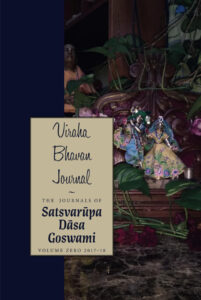
Viraha Bhavan Journal (2017–2018) was written by Satsvarūpa Mahārāja following a brief hiatus in writing activity, and was originally intended to be volume 1 in a series of published journals. However, following its completion and publication, Mahārāja again stopped writing books, subsequently focusing only on what became his current online journal, which began in August of 2018.

At first, I took it hard that I would have to live surrounded by the firemen, and without my own solitude. After all, for decades I had lived in my own house with my own books and my own friends. I was also now a crippled person who couldn’t walk, living among men who did active duties. But when Baladeva explained it to me, how it was not so bad living continually with other firemen and living in the firehouse with its limited facilities, I came to partially accept it and to accept the other men. I came to accept my new situation. I would live continually in the firehouse and mostly not go outside. I would not lead such a solitary life but associate with the other firemen.
Let me write sweet prose.
Let me write not for my own benefit
but for the pleasure of Their Lordships.
Let me please Kṛṣṇa,
that’s my only wish.
May Kṛṣṇa be pleased with me,
that’s my only hope and desire.
May Kṛṣṇa give me His blessings:
Kṛṣṇa Kṛṣṇa Kṛṣṇa Kṛṣṇa Kṛṣṇa he
Rāma Rāghava Rāma Rāghava
Rāma Rāghava rakṣa mām.
You mentioned that your pathway has become filled with stumbling blocks, but there are no stumbling blocks. I can kick out all those stumbling blocks immediately, provided you accept my guidance. With one stroke of my kick, I can kick out all stumbling blocks. —Letter by Śrīla Prabhupāda, December 9, 1972.
The Writing Sessions are my heart and soul. I’m trying my best to keep up with them. I am working with a few devotees, and they are far ahead of me. I wander in the wilderness of old age. I make my Writing Sessions as best I can. Every day I try to come up with a new subject. Today I am thinking of my parents. But I don’t think of them deeply. They are long gone from my life. Śrīla Prabhupāda wrote a poem when he was a sannyāsī, and he said now all my friends and relatives are gone. They are just a list of names now. I am like that too. I am a sannyāsī with a few friends. I love the books of Śrīla Prabhupāda. I try to keep up with them. I read as much as I can and then listen to his bhajanas.
The metaphor is song. Explain it. Yes, particulars may not seem interesting or profound to readers who want structured books.
Wait a minute. Don’t pander to readers or concepts of Art. But Kṛṣṇa conscious criteria are important and must be followed. So, if your little splayed-out life-thoughts are all Kṛṣṇa conscious, then it’s no problem.
I am near the end of my days. But I do like the company of like-minded souls, especially those who are Kṛṣṇa conscious. Yes! I am prone to Kṛṣṇa consciousness. I have been a disciple of Bhaktivedanta Swami Prabhupāda for maybe almost sixty years. Sometimes I fail him. But I always bounce back and fall at his feet. It is a terrible thing that I sometimes do not have the highest love for him. It is a terrible thing. Actually, however, I never fall away from him. He always comes and catches me and brings me back to his loving arms.

This edition of Satsvarūpa dāsa Goswami’s 1996 timed book, Upstate: Room to Write, is published as part of a legacy project to restore Satsvarūpa Mahārāja’s writings to ‘in print’ status and make them globally available for current and future readers.
A factual record of the reform and change in ISKCON guru system of mid ’80s.

Readers will find, in the Appendix of this book, scans of a cover letter written by Satsvarūpa Mahārāja to the GN Press typist at the time, along with some of the original handwritten pages of June Bug. Together, these help to illustrate the process used by Mahārāja when writing his books during this period. These were timed books, in the sense that a distinct time period was allotted for the writing, during SDG’s travels as a visiting sannyāsī
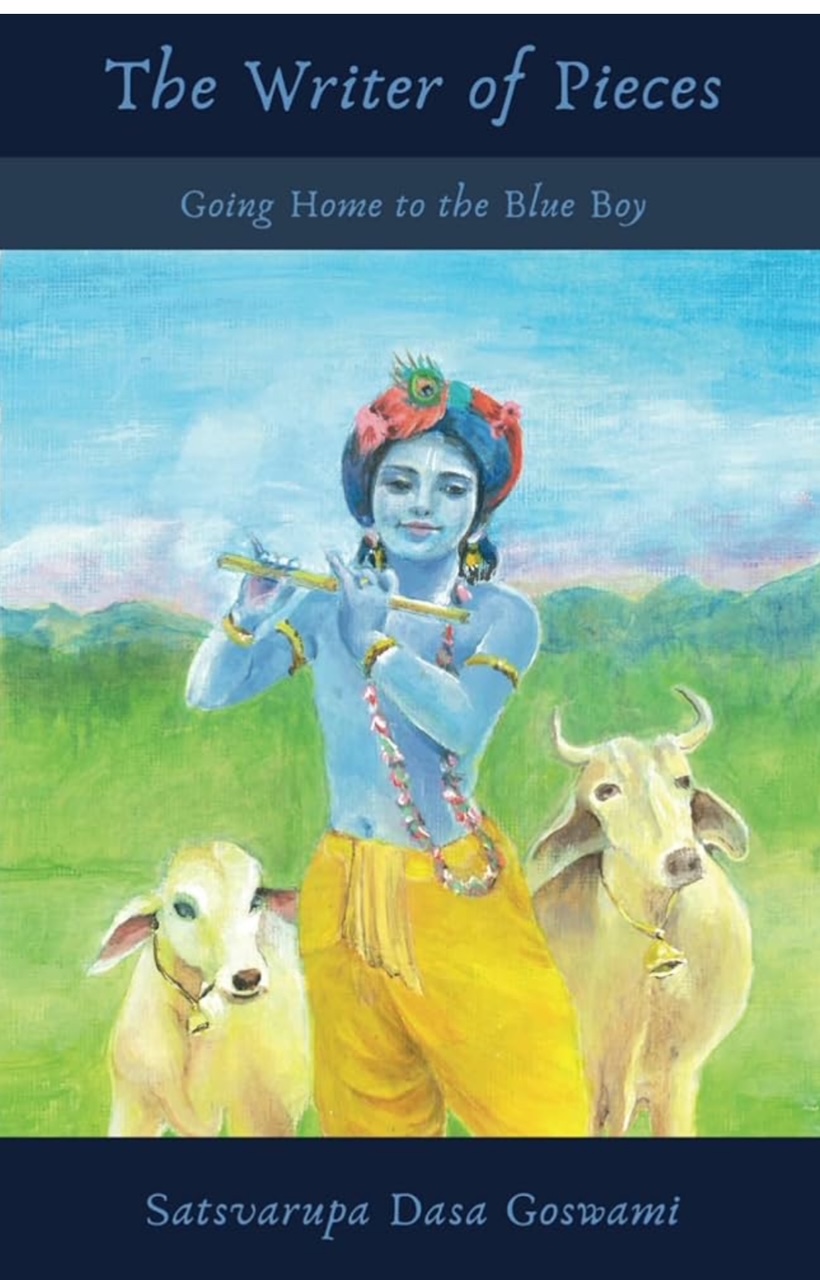
Don’t take my pieces away from me. I need them dearly. My pieces are my prayers to Kṛṣṇa. He wants me to have them, this is my way to love Him. Never take my pieces away.

Many planks and sticks, unable to stay together, are carried away by the force of a river’s waves. Similarly, although we are intimately related with friends and family members, we are unable to stay together because of our varied past deeds and the waves of time.
To Śrīla Prabhupāda, who encouraged his devotees (including me) To write articles and books about Kṛṣṇa Consciousness.
I wrote him personally and asked if it was alright for his disciples to write books, Since he, our spiritual master, was already doing that. He wrote back and said that it was certainly alright For us to produce books.
I have a personal story to tell. It is a about a time (January–July 1974) I spent as a personal servant and secretary of my spiritual master, His Divine Grace A.C. Bhaktivedanta Swami Prabhupäda, founder-äcärya of the International Society for Krishna Consciousness. Although I have written extensively about Çréla Prabhupäda, I’ve hesitated to give this account, for fear it would expose me as a poor disciple. But now I’m going ahead, confident that the truth will purify both my readers and myself.

First published by The Gītā-nāgarī Press/GN Press in serialized form in the magazine Among Friends between 1996 and 2001, Best Use of a Bad Bargain is collected here for the first time in this new edition. This volume also contains essays written by Satsvarūpa dāsa Goswami for the occasional periodical, Hope This Meets You in Good Health, between 1994 and 2002, published by the ISKCON Health and Welfare Ministry.

This book has two purposes: to arouse our transcendental feelings of separation from a great personality, Śrīla Prabhupāda, and to encourage all sincere seekers of the Absolute Truth to go forward like an army under the banner of His Divine Grace A.C. Bhaktivedanta Swami Prabhupāda and the Kṛṣṇa consciousness movement.
A single volume collection of the Nimai novels.
Śrīla Prabhupāda was in the disciplic succession from the Brahmā-Mādhva-Gauḍīya sampradāya, the Vaiṣṇavas who advocate pure devotion to God and who understand Kṛṣṇa as the Supreme Personality of Godhead. He always described himself as simply a messenger who carried the paramparā teachings of his spiritual master and Lord Kṛṣṇa.
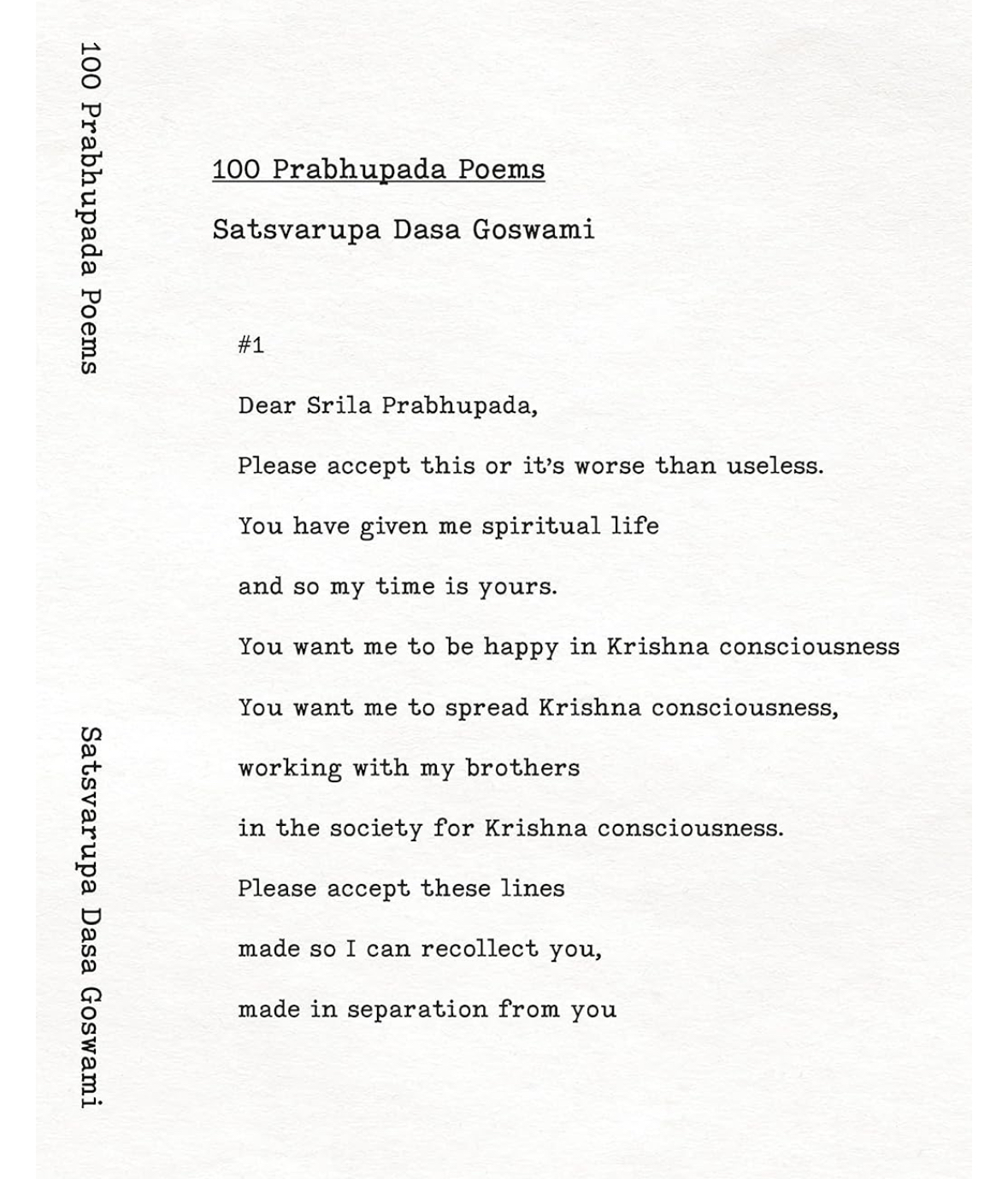
Dear Srila Prabhupada,
Please accept this or it’s worse than useless.
You have given me spiritual life
and so my time is yours.
You want me to be happy in Krishna consciousness
You want me to spread Krishna consciousness,
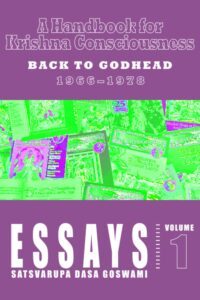
This collection of Satsvarūpa dāsa Goswami’s writings is comprised of essays that were originally published in Back to Godhead magazine between 1966 and 1978, and compiled in 1979 by Gita Nagari Press as the volume A Handbook for Kṛṣṇa Consciousness.

This second volume of Satsvarūpa dāsa Goswami’s Back to Godhead essays encompasses the last 11 years of his 20-year tenure as Editor-in-Chief of Back to Godhead magazine. The essays in this book consist mostly of SDG’s ‘Notes from the Editor’ column, which was typically featured towards the end of each issue starting in 1978 and running until Mahārāja retired from his duties as editor in 1989.
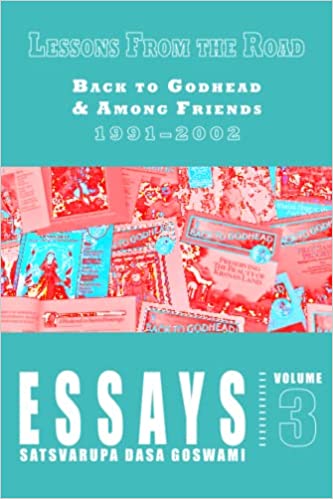
This collection of Satsvarupa dasa Goswami’s writings is comprised of essays that were originally published in Back to Godhead magazine between 1991 and 2002, picking up where Volume 2 leaves off. The volume is supplemented by essays about devotional service from issues of Satsvarupa dasa Goswami’s magazine, Among Friends, published in the 1990s.

“This is a different kind of book, written in my old age, observing Kṛṣṇa consciousness and assessing myself. I believe it fits under the category of ‘Literature in pursuance of the Vedic version.’ It is autobiography, from a Western-raised man, who has been transformed into a devotee of Kṛṣṇa by Śrīla Prabhupāda.”
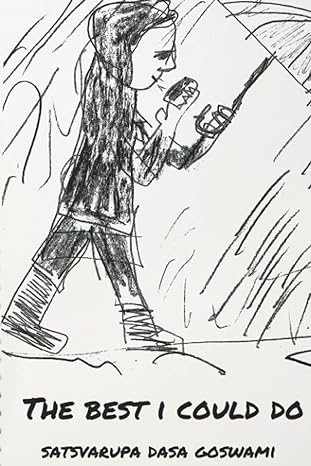 The Best I Could Do
I want to study this evolution of my art, my writing. I want to see what changed from the book In Search of the Grand Metaphor to the next book, The Last Days of the Year.
 a Hare Krishna Man
It’s world enlightenment day
And devotees are giving out books
By milk of kindness, read one page
And your life can become perfect.
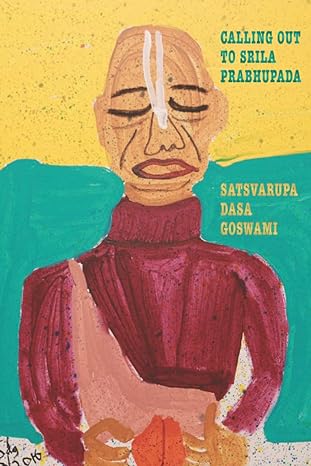 Calling Out to Srila Prabhupada: Poems and Prayers
O Prabhupāda, whose purports are wonderfully clear, having been gathered from what was taught by the previous ācāryas and made all new; O Prabhupāda, who is always sober to expose the material illusion and blissful in knowledge of Kṛṣṇa, may we carefully read your Bhaktivedanta purports.
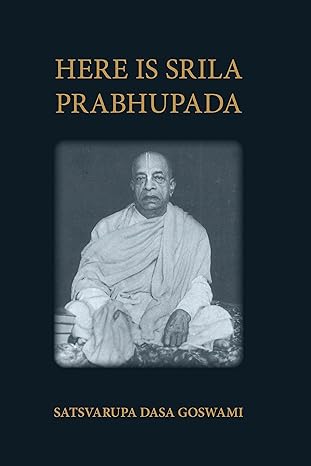
I use free-writing in my devotional service as part of my sādhana. It is a way for me to enter those realms of myself where only honesty matters; free-writing enables me to reach deeper levels of realization by my repeated attempt to “tell the truth quickly.” Free-writing takes me past polished prose. It takes me past literary effect. It takes me past the need to present something and allows me to just get down and say it. From the viewpoint of a writer, this dropping of all pretense is desirable.
 Geaglum Free Write
This edition of Satsvarūpa dāsa Goswami’s 1996 timed book, Geaglum Free Write Diary, is published as part of a legacy project to restore Satsvarūpa Mahārāja’s writings to ‘in print’ status and make them globally available for current and future readers.