

We are still expanding our team of proofreaders as we aim to increase the rate of republication of Satsvarūpa Mahārāja’s books as well as new books that he writes.
As many of you know, during the July 4th festival just held, a total of 18 new and re-edited and published books were present, and we hope to present a similar number at Satsvarupa Maharaja’s Vyasa-puja observance this December.
Our call for proofreaders includes a need for fluent bilingual Spanish and English speakers to proofread Spanish translations (we currently have around 20 Spanish translations waiting to be proofread). Anyone interested in this particular service should contact Manohara dāsa at [email protected]
If you would like to help, please contact Kṛṣṇa-bhajana dāsa at [email protected] or [email protected] and we will find you a service that utilizes your talents.
There are ten offenses in chanting Hare Kṛṣṇa. They involve not only the time when we sit down to chant japa, but our whole devotional life. These offenses—disobeying the orders of the spiritual master, committing deliberate sins on the strength of chanting, blaspheming the devotee—have to do with more than correct pronunciation of the names of the Lord. So whether we can carry out the orders of the spiritual master is our test. By the time you sit down to chant, it’s already determined by your service attitude—you’ve either already committed the offenses, or you haven’t. Offenseless chanting and following the spiritual master’s orders are interdependent.
By chanting carefully, you get the strength to follow the orders of your spiritual master, as you associate with Kṛṣṇa’s name. But we know that if you associate without offense, it is much more effective. Following the four rules and living in devotional service assures you of avoiding the ten offenses.
The chanting of Hare Kṛṣṇa has the power to eradicate all sins, but if you become an offender to the holy names of the Lord, then you have no chance of being delivered.
******
THE FIRST OFFENSE is to blaspheme those persons who have actually dedicated their lives to spreading the glories of the Lord, the Supreme Personality of Godhead. This is called vaiṣṇava-aparādha. We usually think first of the guru, guru-aparādha, but this offense refers to all devotees, even the so-called little devotees with whom we are living.
Devotee means anyone who is actually surrendered to the teachings of God. You cannot indulge in faultfinding or criticizing such a person. One who has dedicated his life to the service of God is not to be considered an ordinary person. And not only should you refrain from blaspheming him, but you should keep his company. When mentioning those things favorable for devotional service, Rūpa Gosvāmī states, saṅga-tyāgāt sato vṛtteḥ ṣaḍbhir bhaktiḥ prasidhyati: One should avoid the company of the nondevotee and keep company with the devotee and value his association.
We have been speaking about the community of devotees. So I am one devotee; each of us is one individual. We have to honor all devotees. Whoever chants Hare Kṛṣṇa has to be mentally honored. Whoever is initiated and is following the rules and regulations, you offer him obeisances. Whoever is actually an advanced devotee, you offer him service. Although one is himself a devotee—he’s taken initiation, he’s chanting hari-nāma—he must think of himself as a servant of the devotees and hold the devotees in reverence.
You cannot chant the holy name and still speak offensively, act offensively, think offensively about others who are chanting the glories of the holy name. The relationships may be different, but in none of these relationships is there neglect of a genuine devotee of God. And if you do neglect, then you will be in difficulty, you cannot chant with the pure effect. You cannot chant on your beads and at the same time be blasphemous or neglectful of the devotees of the Lord. That is like trying to build a fire while throwing water on it. The potency of Hare Kṛṣṇa mantra is always absolute. But if at the same time you commit such a great offense, it is like that—throwing water on the fire. You will make a great havoc of your devotional life.
All over the world devotees of God are working, in different religions, as followers of Mohammed or Jesus, and the Kṛṣṇa conscious devotees should not blaspheme these persons. Anyone who is actually a devotee of God is dear to God. They shouldn’t be blasphemed.
It is also an offense to the holy name when there is criticism between disciples of different gurus (whether disciples of Prabhupāda toward the other disciples or toward the other gurus), or between the gurus or between the disciples of the same guru. They are all preaching, they have all received bona fide initiation, they are all following. So for myself, I should worship my guru exclusively, but respect all other bona fide devotees and spiritual masters in a humble way and try to improve my own Kṛṣṇa consciousness in relation to my spiritual master. And everyone should uphold the principles of initiation, worship their spiritual master with the right understanding and the right siddhānta, and not blaspheme any of the devotees of the Lord.
If we chant Hare Kṛṣṇa but don’t avoid this offense and the other offenses, then for us it is hopeless. The chanting is so purifying that all other discrepancies and offenses will be washed away. But if in the chanting you are full of offenses, then what can save you?
pp 138-42
Now I am going to tell the most dangerous episode that happened to me the whole time we were in the mountains. Or maybe it’s the second-most dangerous, if you count the time I thought of killing a creature to eat its meat. Before I tell it, I want to give a little preface.
Whether you are lost in the mountains or living in civilization, maintaining your spiritual life is a struggle for survival. Wherever you are, you have to guard against insults to the pure devotee and doubts in God or Krsna, and you have to avoid sex agitation and maintain control of the tongue and mind. You have to be always on the alert. And eventually you have to attain a higher taste for spiritual life. The science of bhakti-yoga gives all protection if you practice it thoroughly. People sometimes think that bhakti is easy and sentimental, only singing and dancing in the temple. They think because it lacks austere meditation that it’s just for women and children, not philosophers. Prabhupada writes on this:
… Although nondevotees declare that the path of bhakti, or devotional service, is very easy, they cannot practice it. If the path of bhakti is so easy, as the nondevotee class of men proclaim, then why do they take up the difficult path? Actually the path of bhakti is not easy. The so-called path of bhakti practiced by unauthorized persons without knowledge of bhakti may be easy, but when it is practiced factually according to the rules and regulations, the speculative scholars and philosophers fall away from the path.
—Bhagavad-gita 7.3, purport
So the reason I fell into danger is clear and simple: I wasn’t careful, and so I fell into doubts again. I mean doubts in my initiating spiritual master, Gauracandra dasa Swami. What happened is I read a letter which Gurudeva had left sitting on his bunk. It was a crazy hate letter criticizing him personally and even criticizing the whole Movement. It wasn’t constructive, but based on a misunderstanding that because we say Krsna consciousness is very difficult and only a few people can attain it, we’re snobs. I should have put the letter down and not bothered about it. It wasn’t even my business to pick it up and read it in the first place, but as I told you, I’m very nosy.
The personal accusations against my Gurudeva stuck in my mind, and the mind started to work on them. I’m not going to commit new offenses by writing all the details here, but I began to agree with some of the accusations. I began finding faults.
As I understand it now, my fault-finding tendency, and all the trouble I got into, was the destructive power of the uncontrolled mind. I know I have to take the blame for my wrong actions, but if there’s to be some benefit from hearing of my activities, I think it’s to learn what can happen to you if you can’t control your mind. This is described in many places in the scriptures. For example, in the Fifth Canto of the Srimad-Bhagavatam, 8ukadeva Gosvami explains that the great devotee Rsabhadeva was very careful in controlling his mind. Maharaja Pariksit, who was hearing the whole narration of Bhagavatam, asked 8ukadeva why Rsabhadeva didn’t use his mind to bring about mystic effects. Here is Sukadeva Gosvami’s reply:
My dear King, you have spoken correctly. However, after capturing animals, a cunning hunter does not put faith in them, for they might run away. Similarly, those who are advanced in spiritual life do not put faith in the mind. Indeed, they always remain vigilant and watch the mind’s action.
All the learned scholars have given their opinion. The mind is by nature very restless, and one should not make friends with it. If we placed full confidence in the mind, it may cheat us at any moment. Even Lord Siva became agitated upon seeing the Mohini form of Lord Krsna, and Saubhari Muni also fell down from the mature stage of yogic perfection.
An unchaste woman is very easily carried away by paramours, and it sometimes happens that her husband is violently killed by her paramours. If the yogi gives his mind a chance and does not restrain it, his mind will give facility to enemies like lust, anger and greed, and they will doubtlessly kill the yogi.
The mind is the root cause of lust, anger, pride, greed, lamentation, illusion and fear. Combined, these constitute bondage to fruitive activity. What learned man would put faith in the mind?
—Srimad-Bhagavatam 5.6.2-5
I sometimes think of the expression, “My mind ran with it.” It’s like we’re in a football game, and maya is the quarterback. She throws a long pass, the mind catches the football and thinks that it has to run with it. So after reading that crazy letter, my mind started running with the idea that my spiritual master is an ordinary man. I ran and didn’t try to check myself, although I could have. You can always look at things from two different sides. It was always possible to think of the previous life of my spiritual master before he met Prabhupada, and to consider that he had imperfections and shortcomings. You can do that, but on the other hand, the scriptures warn us not to. Rupa Gosvami states in Upadesamrta,
A devotee should not be seen from a materialistic point of view. One should overlook a devotee’s having a body born in a low family, a body with a bad complexion, a deformed body, or a diseased or infirm body.
You’re supposed to see a devotee just like the waters of the Ganges, which during the rainy season are full of bubbles, foam, and mud, but are not polluted. But I had caught maya’s football and I was running.
I suddenly got the idea that I should leave. I was by myself chopping wood in the forest and my mind said to me, “Why don’t you just leave?” Our problem was that we were stuck in the mountains, but why not just leave? What I actually was telling myself was, “Leave Gurudeva.” He had always said that we wouldn’t be able to get anywhere on our own and that we should just wait until someone found us. But I thought, “That may be his idea, but it’s not mine. I could probably just walk right out of here and find civilization within a few days.” I was so impetuous that I didn’t even want to discuss this idea with Gurudeva, but just carry it out at once. When a person rebels from his spiritual authority or is fed up with living in a temple, he usually thinks like that: “I’ll leave.” If you’re living in a temple or monastery and you want to assert your independence and reject your authorities’ hold on you, you leave. I wasn’t thinking in such a gross way, that I wanted to bloop from spiritual life. But that was part of it. By dwelling on the accusations that my spiritual master was an ordinary man, I began to second-guess him and resent him. I had a better idea than to stay lost in the mountains. I would get out and find the way.
Without any further preparation, I began to walk away. I chose what I thought was the eastern direction. Partly I thought that I was going to take a little exploratory hike just in case I did want to find my way out in the future. Partly, I thought that I would do myself and Gurudeva a favor and walk to civilization. I’d come back with people and rescue Gurudeva with a plane or helicopter. Still another part of me, the wild uncontrollable part, was walking away in order to disobey the order of the spiritual master.
pp 561-64
Surat
28 December, 1970My Dear Satsvarupa,
Please accept my blessings. I am in due receipt of your letter dated December 23rd, 1970, along with a press letter. I am very glad that Advaita has come back to his position, but I am very much concerned that there is a Mayavadi Sannyasi among yourselves. According to Caitanya Mahaprabhu, anything spoken by the Mayavadis very, very dangerous. If the Sannyasi who has come to our shelter becomes clean shaved and keeps a sikha with beads on his neck and chants Hare Krsna Mantra 16 rounds at least and changes his dress, then he can be allowed to stay with us. Until six months pass he cannot lecture in the meetings. On these conditions, he can render us service in the matter of Sanskrit composition, otherwise there is no need of him. Please take immediate steps in this connection and let me know what you have done in this matter.
The $28,000 plus $800 contributed by Sai may not be touched for any other purpose until you hear from me. Dai Nippon’s debt regarding BTG should be liquidated by the Department of BTG. Why the debt should be cleared with a contribution which Krsna has sent for another purpose? I can understand that from London the payment is not regularly coming from the very beginning, so in order to counteract this anomaly I shall be sending someone out of the four important members to check out the condition of London. Most probably Hamsaduta will very soon go there.
At present I am at Surat, which is very nice city in India. People are very responsive and we are getting practically every day a Life Member. There is an important meeting in Calcutta on the sixth of January so I may be going there on the 5th of January, 1971. I am writing you this letter in great haste on account of being concerned about a Mayavadi Sannyasi being present among you. Therefore if he completely surrenders to our principles and lives as other newcomers live, then he can be allowed. Otherwise there is no need of his staying with us.
My next letter will follow very soon. You can offer my thanks to Advaita. The dummy Bhagavad-gita sent by him is approved by me. If it is possible it may be improved further.
Your ever well-wisher,
A. C. Bhaktivedanta Swami
******
Prabhupāda wrote this and the previous letter from Surat, and now we know of the wonderful reception Prabhupāda and his disciples received there. This letter was the first we had heard of it.
Prabhupāda says he is writing in such haste because of the Māyāvādī sannyāsī who had moved into the Boston temple. I don’t remember how he managed to join our camp, but he was deputed to work with Pradyumna. It was unusual to have an Indian man among our American boys and girls. We didn’t give him any special treatment—he was simply another person living in the temple. Prabhupāda said he should become cleanly shaven. He had a beard and he didn’t follow our philosophy, but he kept a low profile and a humble demeanor, and he seemed to like and accept what we were doing. He used to blow a small conchshell during our āratis, and I still remember the shrill sound it made.
When this man had moved in, l had told him that his staying was contingent on Srila Prabhupāda giving him permission. I certainly didn’t want to avoid telling Prabhupāda that such a person was living in his temple. It surprised me that Prabhupāda had become concerned enough to write a letter “in great haste.”
This letter was handed to me during prasādam one day. I shared it with the few devotees who were present, then showed it to the Māyāvādī sannyāsī. Māyāvādī is a derogatory word, a choice word used by Lord Caitanya and his followers. Inadvertently, although they say they follow Brahman, they follow maya. Therefore we call them Māyāvādīs. I don’t know what that sannyāsī thought of seeing that word in print in relation to himself, but he said he was willing to meet Prabhupāda’s conditions. He shaved off his beard and hair and began to chant japa. I think he had nowhere else to go. He never agreed to abandon his philosophy, but he never spoke about it either. Instead he simply followed the Kṛṣṇa conscious practices like any other devotee.
If we look ahead in the letters, we’ll see that there are two more references to this sannyāsī. I wrote back to tell Prabhupāda that the sannyāsī had complied with his order, but in the next letter Prabhupāda writes, “What action you have taken on the Mayavadi Sannyasi?” He hadn’t yet received my letter and it was still on his mind.
Later, the sannyāsī moved to New York and was living outside the temple the next time Prabhupāda visited. He and another man came to see Prabhupāda, and Prabhupāda denounced his philosophy. The sannyāsī did not take this well and began arguing, even shouting at Prabhupāda. Then the sannyāsī claimed he had been assaulted in one of our temples. He called the police and filed a legal case. It was ugly and even a little frightening, but nothing came of it in the end.
Our allowing this person to stay in Boston came on the heels of Brahmānanda and the other sannyāsīs spreading Māyāvādī philosophy in Prabhupāda’s name. Perhaps that’s why Prabhupāda was so worried about him being in the temple.
In this letter Prabhupāda also addresses a donation given by Sai. Sai gave “$28,000 plus $800.” Of course, this Sai was the self-styled guru who was living in Hawaii and who had become Prabhupāda’s disciple. His followers said he was Brahman realized. He was also charismatic, and people tended to accept him as a spiritual guide. He had become attracted to the devotees in Hawaii when he had heard them chanting Hare Kṛṣṇa. He began to chant Hare Kṛṣṇa with his followers, and Prabhupāda had encouraged them in their chanting even though they didn’t follow our philosophy.
After that, Sai had a conversion experience and decided to surrender to Prabhupāda, bringing his followers with him. An old Back to Godhead magazine shows him having his head shaved and boarding an airplane. Some of his followers joined the Hawaii temple, others joined in California, and a few came to Boston. Along with followers, he brought money into ISKCON. Everyone wanted a part of it, and we in Boston were looking forward to using our portion to get out of debt. Prabhupāda did not approve, but suggested ways in which Sai’s money should be spent.
The men who came to Boston from Sai’s group were mainly artists. One of them came to work on BTG. Later, Prabhupāda initiated two of these men as Pusta Kṛṣṇa and Sudāmā.
For ISKCON in those days, $28,000 was an amazing amount of money. If we thought we could use it to save us from our poor management, we were wrong. Prabhupāda could not understand how BTG could be in debt at all. After all, we were printing magazines that were then being sold. If we had been managing things properly and collecting the sales money, we wouldn’t have been having any difficulty maintaining BTG.
Of course, by the time Prabhupāda wrote this letter, he had been told that the London devotees were not sending in their remittances, which was causing BTG financial problems. Therefore, Prabhupāda says he will send someone out of “the four important members.” By this he is referring to one of the four GBC members who were with him in Surat.
At the end of his letter, Prabhupāda again mentions the Māyāvādī sannyāsī and lists the conditions for him to stay in the temple. I took his words seriously: “. . . anything spoken by the Mayavadis is very, very dangerous.” What was I going to do? We were alerted by Prabhupāda’s letter, and we were careful not to take his association or to allow him to give classes. He was never able to become an ordinary devotee, because everyone watched him so carefully.
pp 163-66
I have been thinking of the line in Bhagavad-gītā 10.9 where Kṛṣṇa describes His devotees: “And they derive great satisfaction and bliss from always enlightening one another and conversing about Me.” It occurred to me that I don’t take part in conversing about Kṛṣṇa with devotees. Of course, I take part in reading aloud for two-and-a-half hours from Śrīla Prabhupāda’s books, and I think that is certainly strong sat-saṅga, but I don’t discuss and enquire about Kṛṣṇa, especially among my peers. I live a solitary life with a few disciples in an āśrama. I have been criticized for not associating more with my Godbrothers. They even said my not mixing more with senior devotees was the cause of my fall down with a woman. I think the cause was lust. Anyway, after I was punished, and I sincerely repented to the Lord and Prabhupāda—and after I studied the Bhagavad-gītā verse and purport, api cet su-durācāro, etc., I returned to my solitary ways. I call it “aloneness” (a congenial spiritual path). It is different from the loneliness which is an unhappiness. I discussed this with Haridāsa dāsa from Maryland, and he referred me to a biography on Narottama dāsa Ṭhākura, written by Śītalā dāsī (the wife of Hari Śauri). She mentions Lokanātha Gosvāmī, a great devotee of Lord Caitanya, and states that he liked to keep to himself. That encouraged me, as long as I have a very few confidential friends.
Who will read all my helpful, friendly books? No-one will read them all, but among them there is something to attract everyone/anyone. Thanks to my book production team, the books will be available after I am gone.
Write of something besides yourself. The books teaching “spiritual journal keeping” are invariably written by Christians. They contain helpful hands, how to write as prayer to God, but they are too much Christian-centered and concentrated on the Word in the Bible. I can Kṛṣṇa-ize their God-consciousness.
Hari Śauri’s five volumes as Prabhupāda’s servant are an invaluable resource. They contain profuse lectures by Śrīla Prabhupāda (a little too much for me), and his many accounts of Prabhupāda’s activities are fascinating. They placed his Diaries on Vedabase and they are a part of the permanent library of books about Prabhupāda.
The most important thing I wrote about in this morning’s Stream of Consciousness is my aloneness. I can write about it some more in the future. I don’t think it is unhealthy, especially as long as I participate in group readings of Prabhupāda’s books, and I keep on hearing his lectures and interviews with his disciples.
I may write more about aloneness. It is not Prabhupāda’s message as he handed me the daṇḍa, “Preach! Preach! Preach!” I have done much preaching in ISKCON. I have traveled far and wide. And I am still preaching. I read today’s SOC to a confidential disciple and he said, “I am so sorry that you think you are not preaching” and he enumerated the ways that I am still preaching. That gave me more confidence. Regarding my physical limitations (especially not being able to walk), my doctor told me that I am lucky that I like to do the things that I am still able to do, sitting in my chair, such as reading and writing and answering correspondence. Yes, I am lucky. And I am not a bhajanānandī.
Kṛṣṇa is trying to place Arjuna in pure consciousness. We have discussed this for so many days, that we are not this dull body. If we miss this understanding then we may have to take a lower body.
You’ll be glad to hear that once begun (this yoga process), you are guaranteed to have a human body in the next life. Any yoga will continue. Prabhupāda quotes a śloka spoken by Nārada to Vyāsadeva (the śloka says that if you take to Kṛṣṇa consciousness you will not be the loser). Yoga connects one to the spiritual level. Understand Kṛṣṇa philosophy. This exists all over the world. Don’t take (Kṛṣṇa philosophy) as sectarian.
Discrimination is the best part of valor. Prabhupāda says to his audience, “If you have read the whole Bhagavad-gītā, and I hope some of you have read the whole Bhagavad-gītā …”
In your country you have very rich families like Ford and Rockefeller. I do not know their activities, but in India there are many rich family (and they are still pious). Prabhupāda describes how he wrote to a very rich family in India, the Singhanias. He proposed to them that he wants to build a nice Rādhā-Kṛṣṇa temple in Manhattan and he asked for their assistance. The family man of the Singhanias wrote back, “Yes, I can help you if I get currency exchange.” Prabhupāda says the Singhanias have a temple (Dvārakādhīśa). They have property and they pay rent to the Deity. (If we are able to get money) “we shall let you know how to spend” (for Kṛṣṇa). In the Singhania family, if one of the brothers is absent from paying respects to the Deity in the morning, then he is fined. He has to pay 10 dollars or 10 rupees to the pūjārī. Life should be molded that you are always thinking of Kṛṣṇa. He gives the example of a married woman who falls in love with another man. She goes about her household duties very attentively but she is always thinking, “When will I be able to meet with my lover again.” When there is ecstasy (one thinks like that) the impression always remains. We are holding this class. It is culture. The impression will remain. Our aim should be not to fail. Anyone who knows about the birth and activities of Kṛṣṇa he goes back to Godhead and doesn’t return. (Just by coming to these classes and giving your aural reception) you’ll be free from material attachment. Prabhupāda mentions again about the two kinds of people, the miser (kṛpaṇa) and the liberal person (brāhmaṇa).
He mentions Cāṇakya Paṇḍita and says in New Delhi there is a section called Cāṇakya Purī where all the embassies are located. He said he had to study the Cāṇakya-ślokas in his M.A. class. He then recites the śloka and gives a rough translation in English: “This body is destined to be destroyed. But a man can use his human form of life for the highest cause. He is most intelligent.”
Two men are working, one is expert and the other spends all day and can’t repair the machine. Prabhupāda gives his own example and says sometimes the tape recorder breaks down and he cannot fix it. He calls in Karl and he quickly fixes it. In material life after you work eight hours you are tired of it. But in spiritual life you have to work twenty-four hours. You won’t feel fatigue. He gives his own example and says he is always doing something reading or writing, something or writing. He feels disgusted when he has to go to sleep. He says to the audience that they can ask “Mr. Paul” if this is not accurate (about Prabhupāda’s activities). He mentions the Six Gosvāmīs of Vṛndāvana who slept only one and a half hours out of twenty-four. One becomes fearless and blissful. These are the symptoms.
pp 1-12
We are tray’ling in the footsteps
Of those who’ve gone before
And we’ll all be reunited
On a new and sunlit shore
Oh, when the saints go marching in,
Oh, when the saints go marching in
Lord how I want to be in that number
When the saints go marching in
And when the sun begins to shine
And when the sun begins to shine
Lord, how I want to be in that number
When the sun begins to shine
Oh, when the trumpet sounds its call
Oh, when the trumpet sounds its call
Lord, how I want to be in that number
When the trumpet sounds its call
Some say this world of trouble
Is the only one we need
But I’m waiting for that morning
When the new world is revealed
Oh, when the saints go marching in,
Oh, when the saints go marching in
Lord how I want to be in that number
When the saints go marching in
(Traditional)
What’s evil? I don’t know.
I’m a pseudo intellectual he said, not
a genius.
Can’t write on Brazil or
psychology but
don’t put yourself down.
There’s a lot to be said on this
theme of madness. He didn’t know
what spiritual search meant
except you keep searching and
driving yourself to heights and
explorations, looking for peace
in God.
But not in the ordinary places.
He screeches sometimes like
an animal in the zoo.
Is that evil?
Is a tiger evil? The lamb?
The one who made them both?
“I can’t take it anymore!” she said
and wanted it turned off wanted
to run away from the zoo
from the jazz sound
to a quiet bench where they could
play with their three-year-old daughter
who is bound for death.
Now, when Citraketu’s other
wives killed Harsa-soka, was that evil?
Is it a relative thing?
We can say, “They were just envious and
later they repented.”
But sheer evil and torture
at the moment it is done—is there
a Satan? An executioner
who takes pleasure?
Let him play, it is not
wrong. It is just his energy.
This is devotional service.
If one outshines another it is
for Krsna’s pleasure, that’s all.
Please hear the genius of a
man made mad by God-sent
music.
Crying, crying, crying because
the world is full of sadness,
crazy, full of misery.
No more embraces or kisses or
visits. I can’t take it.
Let the body rest.
The immunities are down.
He loses a day of his life
in pain. Why should
this be?
Don’t prepare for your
lectures. Just go and speak
what comes. Don’t worry.
Everything is going
to be all right. It will
turn out the way it was meant
to be.
Do you believe me and
the beauty of players who love to make music
together just for the joy and
celebration?
Dr. Grip pen. Cheap watch. Pine desk. Objects
of this world. Let each
take his own space and give us
what he can. And applaud them
if you will.
Hare Krsna is the thing in it all
as far as I see.
I’m emeritus. I hear Krsna now
in all places—in the lines of Ecology pads
and in between.
Don’t be evil. Don’t be afraid.
They don’t know exactly what they’re doing,
but they’re trying and crying and praying. Do
you understand that?
Yes, I think I do. Until they’re exhausted dead,
they give it their best.
Is that what you mean?
They say it’s good to love
yourself but don’t be proud.
I can do it.
My poems, John’s, McCoy’s
playing, softly as in
a morning sunrise—
she can listen
with her daughter but it’s too much
beat for them. They want
something softly. Is that it?
The Bach mathematics.
I want the joy,
the pleasing and
walking daily.
Maybe I don’t, don’t
have to prod
so much.
What’s wrong with you that a
good Coca-Cola wouldn’t
cure?
Can you be okay painting and
sculpting? Give your little
lecture and smile?
I think you’ll be all right
without all the histrionics.
Oh, it hurts my ears she
says but I say it’s
what we want to rid anxiety.
I have a strategy. Just
talk nice to them. And don’t
tell them you’d rather be
alone with your neutered
cat.
And count your beads, your
neutered japa up to
twelve a day, getting better.
If you could see me
now so indecisive
you’d say this guy
needs quite a bit
of work
to make up his
mind. But why not
just dovetail whatever
weakness you have
and serve Krsna
without making a big
deal of your “anarthas“?
Important is the spiritual
weakness not the mental.
Were you a bad boy?
Did you fall in love?
When you were in the
Navy, did the group
showers embarrass you?
Did you ever jump
overboard? I want
to know if in the
core of your being
you have faith in God,
know He’s there,
believe in Him?
Ever see Him in His white
Christ robes or His playful
Krsna attire?
Did He ever speak, “Get
off your butt, Sats, you only have
a few years”?
Yes or no:
Are you gay? Sad?
Mad? Rhythmic?
Do you think you are more visual
than verbal?
Tie a red ribbon around any
wound you’ve received. Sit
through a Robert Bly reading.
Go to hell and back and
hold on. Believe all you thought
is somehow true.
The wise one is a sage on
a mountain or sankirtana devotee
serving his spiritual master.
He or she doesn’t think they’re God
or that happiness is found
in this material world.
“Your Grace, what was our position
before we fell
from the spiritual world?”
He said we have an outer coating and
an inner coating.
It’s that question you can’t
answer or maybe you can. ”
Your Grace, what about
the butchering in Bangladesh?”
The wise one has the answers
from the spiritual plane.
Chant Hare Krsna and
everything will be all right.
There’s always fighting
in this world and so
the only solution is to get out.
“Do you think it’s safe to
travel alone, young lady?”
asked the wise one.
She said, “Yes, these are
modern times.”
He asked, “What was the
competition doing and how could
we stop them?” They are angry,
all we can do is provide good association.
Whose wise man are you talking about?
Sounds like you have
got them mixed up. The ones on
camels from the East, the Buddha
under the bodhi tree.
The one who arrived in the airport and said,
“I have come to teach you what you have forgotten.” “Which is?”
“That is God.”
“Haribol!!”
The wise one doesn’t
leave his guru. The wiseacre,
the wise ass
roams into concocted fields
and says lives are all wasted and
deaths too, and says that’s the secret of
life.
And people proclaim him the wise one,
with cigarette dangling and
glass of wine and his tawdry books
selling like hotcakes.
He says there’s no one wise and that’s
his wisdom.
You don’t have to tell every
word about you and little
yellow pimple.
He goes up and down the scales
not afraid, not afraid
outside the pen.
The fat unshorn sheep,
the little April lambs,
all to be killed.
No wonder some writers
see it that way but
the God conscious believe
there’s some loving order, some
Law in operation, and admit it’s
way beyond them, not
wrong to be humble
and behave in laws.
Now I am wandering outside
along the long perimeter
wonder whether I was ever within it.
Stick up for yourself, they say, and don’t
mind to confront. I am a
shortie, I am a guy who bloomed late.
And now I’m in the
ranks and files of the
Indian congregation movement
of Hare Krsna, Hare Krsna
schisms.
We walk in blues we
have our good food offered
to God brass statues don’t
do enough praying,
or japa or tapas or
preach.
But stay in your groove,
your house of good will
please Lord, you asked I
want to be a fellow
with a big sikha
and a little ego whom You
recognize because I won’t
have faultfinding toward
my brothers.
I’ll be watching them go by,
hear what they say
and smile.
I love you wish I could say
Lord unknown and that
You love me protect me more
than I know.
He improvises and I trail
along behind.
I stand up for my allegiance,
hand over left breast in
salute to the Supreme.
Emeritus stands by the side
as parade passes and a tear
drops down my cheek, recalling
Swamiji and some
battles I fought for him.
Oh, will there be a time for me
to travel
again like older fellows
who tell their followers
they are best?
It doesn’t seem so.
At least I won’t have long-standing anger
and poison anyone. I hope.
Don’t become a pure Christian. Say,
“catholic,” with a small
“c” and read the poem books of
Vallejo if you think they’ll
help.
But.. . in khaki saffron
I want to be buried in honor,
no bad rumors or
holy miracle tales either, just
he went and wrote some books
that may be helpful.
He said, “The most important
was Srila Prabhumda-lilamrta,”
but I’m not sure
of that. The Poor Man and
the entire oeuvre fills a cute and long
bookcase.
I won’t say when I meet
You, “I’m a snail, been under a
rock. You must have thought I was
dead.”
No, I won’t fidget and panic if I’m caught
in car traffic.
Just turn on Sonny and
Monk? “More Than You Know,”
and a new bhajana, a lecture
by our master
and take those deep breaths
from the calm diaphragm.
In this way I’ll make myself
a new man.
More than you know.
Please help my
inner smile.
pp 125-30
In my last year of college, I took a course taught by Professor Don Wolf, a specialist in the great British poet, John Milton. We studied Paradise Lost. I was happy to possess a beautiful volume of the book, and kept it in a plastic cover. Professor Wolf asked each student to memorize a sizable section from the epic and speak in front of the class. I chose a speech by Satan. I took pleasure in trying to give a relaxed, urbane version of the devil speaking.
Milton was a religious thinker and his purpose in writing Paradise Lost was to “justify the ways of God to man.” But somehow, his humanlike portrait of Satan came off more successfully than God, Adam, or the angels and saintly persons. I also remember some of the students in our class protesting when Adam said that he wanted to have children in order to help in the gardening work in Paradise. The students thought this showed an exploitative motive of Adam as father. But Professor Wolf was always sympathetic to Milton and he tried to explain to us why Adam’s desire for “extra hands” in the garden was not exploitative.
I think the religious significance of the poem went over our heads. We were mostly concerned with trying to figure out the meanings so that we would be able to get good grades on the final exam. At the end of the semester, Professor Wolf again asked each of us to speak in front of the class and to tell personal things. I said, “After I graduate, I intend to go on and get a master’s degree. And if worst comes to worst, I will get a Ph.D.” That was my prepared comic line, and it went over okay.
******
In 1966 when I read Prabhupāda’s booklet Easy Journey to Other Planets, I was pleased to note his reference to Milton. Prabhupāda writes, “The living of a miserable life in the material world by dint of the soul’s choice, is nicely illustrated by Milton in Paradise Lost. Similarly, by choice, the soul can regain paradise and return home, back to Godhead.” Unfortunately, we did not read the book for any spiritual significance. I read it because it was a classic and it was supposed to be cultural. Anyone who is a scholar in English literature must know it well. Occasionally, I received a glimpse of appreciation for the stately eloquence of Milton’s blank verse:
Of man’s first disobedience and the fruit
Of that forbidden tree, whose mortal taste
Brought death into the world and all our woe,
With loss of Eden, till one greater Man
Restore us and regain the blissful seat,
Sing heav’nly Muse, that on the secret top
Of Oreb, or of Sinai, didst inspire
That shepherd, who first taught the chosen seed,
In the beginning how the heavens and earth
Rose out of Chaos;
… And chiefly thou, O Spirit, that doest prefer
Before all temples th’ upright heart and pure,
Instruct me, for thou know’st; thou from the first
Wast present, and with mighty wings outspread
Dove-like sat’st brooding on the vast abyss,
And mad’st it pregnant: what in me is dark
O illumine, what is low raise and support;
That to the height of this great argument
I may assert eternal Providence,
And justify the ways of God to men.
I found no religious inspiration while reading the great religious epic of English literature. Or if I did, I have completely forgotten it. The English department at Brooklyn College had no intention of preaching God consciousness. They saw such studies as sectarian religion. In fact, no department in any university is prepared to teach the science of God in a nonsectarian way. Prabhupāda personally delivered this challenge to the students at the Massachusetts Institute of Technology when he lectured there— “Where is the department that teaches the science of the spirit soul?”—but it may also be delivered to every university in the world. And if one doesn’t learn the science of the soul and the science of God, then his human life is wasted. So at the end of my fourth year of college, I had nothing to show in terms of self-realization, or knowledge of the science of God.
I suspected that Professor Wolf was religious himself, but he kept it carefully hidden. He loved Milton, but he taught him in an academic way as required by the syllabus. Milton himself was concerned with politics and sectarian religious beliefs. Our book was filled with footnotes to explain Milton’s attacks on contemporaries, especially the Papists, supporters of the Catholic Church. In the same way, Dante’s Inferno is filled with footnotes to explain which enemies of the Church he was referring to when he placed them in different sections of hell. Except for these footnotes, everyone has forgotten the particulars of the religious-political squabbles from the days of Milton or Dante.
I wanted to be a sincere student of a great cultural work, even a religious work. Therefore, I enrolled in the course for Paradise Lost. But I lacked sincerity or any real drive to inquire about spiritual knowledge, and there was no one on the faculty of English literature who was teaching God consciousness. Milton’s whole purpose was God consciousness, but it did not move us that way. We saw him as one of the big guns, the top greats in English literature, that’s all. We were students or aspiring scholars, and so we knew we had to appreciate him.
My remark to the fellow students, “If worst comes to worst, I’ll get a PhD,” turned out to be something that never happened. The U.S. Navy stood in my way. I had to enter for two years of active service immediately after graduating with the Bachelor of Arts. I often think that if I had been allowed to pursue my studies for Master’s and Ph.D. degrees, I would have had less chance of becoming interested in Kṛṣṇa consciousness. So, it seemed like the frustration of my desired career turned out to be the blessings of Providence.
pp 121-23
Sweet Lord of sixty-four unlimited qualities, if only You would enter my writing. I hear Lord Caitanya once wrote in a manuscript Gadādhara Paṇḍita was copying of Bhagavad-gītā. And I hear You came and wrote a verse in Jāyādeva’s Gītā-Govinda while he was bathing in the river. You could do it with me also, if not directly, then according to Your desire. Until then, I am happy to serve as Your footstool, as a writer on a low level.
******
A hundred and eighty ISKCON devotees left for a fourteen-mile parikrama around Govardhana today. I am staying back. The sun is blazing. I’m not going out even for a short walk. I’ll go to the roof and free-write.
******
Bhaktin Gopī is walking across the field. She is coming here to cook. They say the temple is deserted. The devotees won’t be back until around 3:00 P.M. They have scheduled me to give a talk on Prabhupāda’s pastimes at 4:00 P.M.
I am growing determined to write this book. Got to find its inner quality. When I first planned it, I was seeking the quiet and concentration of the writing retreat in Vrndāvana, with no other duties and no interruptions. I am still hoping for some of that, but it’s not in my control. I have been advised that there are too many senior devotees present for me to duck out of sight for a week. And we may have to leave for Bombay as early as mid-November.
The yellow-and-white butterflies have been with me since I arrived in August. They flutter from bush to bush.
******
If I can get out of the way, then could I write of Vrndāvana life? There’s that story of a yogi who was meditating. Alexander the Great came up to him and said, “So you are a yogi. I am Alexander the Great, conqueror from the Greek Empire. What do you desire?” The yogi answered, “I am trying to meditate. Please step out of my light.” Am I myself casting an unwanted shadow on my own path? People and events are acting like Alexander to the yogi of my writing self. “Please step aside and let me write.”
******
If Śrī Kṛṣṇa were beautiful but not strong, He would be incomplete. Who would protect us? Without Kṛṣṇa and Balarāma, the pastimes would end in disaster when the demons attacked. Saṅkhacūḍa ran away with all the gopīs. Sometimes it so happens in the world that merrymaking is intruded on by murderers. Peaceful sages cannot meditate when Dvivida Gorilla comes and pollutes their bhajana-kutīras. Yogis are killed and eaten by Rākṣasas. Rāvaṇa plots to kidnap Sītā-devī. But Kṛṣṇa is baliya.
“When Kṛṣṇa killed Aristasura, some of the gopīs said, ‘My dear friends, just see how Kṛṣṇa has killed Aristasura! Although he was stronger than a mountain, Kṛṣṇa plucked him up just like a piece of cotton and threw him away without any difficulty” (NOD, Chap. 21, p. 159).
As defined by Parāśara Muni, strength is one of the six chief opulences of Bhāgavan. There are many strong men, but He who has unlimited power is Bhāgavan. Kṛṣṇa is so powerful that He does not have to personally maintain the universes but maintains them through His expansions and energies. “Sometimes we see a picture of Atlas holding the globe on his shoulders; he seems to be very tired, holding this great earthly planet. Such an image should not be entertained in connection with Kṛṣṇa’s upholding this created universe” (Bg. 9.5, purport).
Kṛṣṇa can do anything. Any one of His senses can perform the function of another. He can impregnate by His glance; He can accept food simply by hearing His devotees’ prayers; He can kill armies of demons by expanding Himself as Nrsiṁhadeva with hundreds of arms and claws. But He prefers to play in Vrndāvana with His elder guardians, boyhood friends, and the beautiful gopīs. When strength is required, then simply by His will, everything is performed so perfectly that one cannot imagine how it is being done.
If Kṛṣṇa kicks a demon or punches Kamsa or Kamsa’s washerman, that is for sport and for the pleasure of His devotees. Kṛṣṇa is many-faceted. We have already heard that He is pleasing and beautiful to behold. His body is delicate to the touch. But those who are opposed to Kṛṣṇa experience His hard side. He sticks His hot, iron-like fist into the horse-demon’s mouth.
In Vrndāvana, Kṛṣṇa appears as a young boy, yet Lord Brahmā, the creator of the universe, admits, “There is so much difference between Your body and mine that I cannot estimate the potency of Your body.” When Kṛṣṇa was only six years old, He crushed the hundred-headed serpent, Kaliya, who had poisoned the Yamunā. Just by Kṛṣṇa’s jumping into the Yamunā to fight with Kaliya, the river overflooded its banks as if something very large had fallen into it. “This exhibition of Kṛṣṇa’s strength is not at all uncommon because He is the reservoir of all strength” (Kṛṣṇa, Chap. 16, p. 120).
Kṛṣṇa’s strength is spiritual. If He were only another strong man of this material world, then eventually He would slacken with age and be replaced by a younger, more powerful man. Kṛṣṇa is not like that. He is eternally the prowess of all powerful men (tejas tejasvināṁ aham). In Bhagavad-gītā, Kṛṣṇa declares, “I am the strength of the strong.” Śrīla Prabhupāda writes,
“When Kṛṣṇa was present on earth, no one could surpass Him in strength. Even in His childhood He lifted Govardhana Hill. No one can surpass Him in cheating, no one can surpass Him in splendor, no one can surpass Him in victory, no one can surpass Him in enterprise, and no one can surpass Him in strength” (Bg. 10.36, purport).
May Kṛṣṇa protect us. We are weak in every way. The strongest among us is a plaything against the power of māyā. We try to control the mind, but it’s like trying to control the wind. We want to be renunciates, but we have a weakness for the opposite sex. We want to defeat the demons, but sometimes they defeat us. In all circumstances, we have no recourse but to seek shelter in all-powerful, all-good Kṛṣṇa. The demigods know this well, and whenever a demon like Hiraṇyakaśipu or Hiraṇyākṣa appears, they pray to the Lord to please come and destroy the evil force. Kṛṣṇa complies with their prayers, appearing in the world to rescue the devotees and destroy the demons.
In Kali-yuga, it often appears that the devotees are hopelessly outnumbered and in no position to fight. But even when they lack physical strength, a devotee can have recourse to the ultimate power. Śrīla Prabhupāda writes, “There are two kinds of strength—daiva and puruṣākāra. Daiva refers to the strength achieved from the Transcendence, and puruṣākāra refers to the strength organized by one’s own intelligence and power. Transcendental power is always superior to the power of the materialist. . . . We should fight our enemy to the best of our ability, but for victory we must depend on the mercy of the Supreme Personality of Godhead” (Bhāg. 9.10.20, purport).
In this age of quarrel, Lord Caitanya advises that we fight with the divine weapons of harināma-saṇkīrtana. “Think of me and fight,” Kṛṣṇa tells Arjuna. Śrīla Prabhupāda has encouraged us, “Go on chanting. Be tolerant. You will be victorious. There is no other way.”
“O my dear devotees of Lord Kṛṣṇa, may the left hand of Kṛṣṇa, which has lifted Govardhana Hill like a ball, save you from all dangers.”
pp 309-12
28 April, 1970
My Dear Satsvarupa,
Please accept my blessings. I am in due receipt of your letter dated 24th April, 1970.
Yes, publish the Bengali poem which I am sending herewith. Get it transliterated by Pradyumna. The meaning is as follows:
My Dear Lord Kṛṣṇa, You are so kind upon this useless soul, but I do not know why You have brought me here. Now You can do whatever You like with me.
But I can guess that You have got some business here, otherwise why should You call me here which is demoniac.
Most of the population here is covered by ignorance and passion modes of nature, and I do not know how they will be able to understand the transcendental message of Vasudeva.
But I know Your causeless mercy can make everything possible because You are the most expert mystic.
Therefore, I am simply praying for Your mercy so that I can be able to convince them about Your message.
******
In his letter to me, Prabhupāda encloses a Bengali poem which he has written. He asks me to get it transliterated by Pradyumna, and he gives me the meaning line by line. Prabhupāda sent the poem to himself while he was on the Jaladuta, and he dated it 18 September, 1965. I wrote to Prabhupāda for permission to print the poem in Back to Godhead magazine. As the BTG editor, I was happy to receive Prabhupāda’s Bengali poem, and I gave it to Pradyumna, who was excited to get Prabhupāda’s order to translate Markine Bhagavata Dharma. In my memoir of 1970 (ISKCON in the 1970s: Diaries), I wrote how when BTG magazine first began, poetry was very popular with the devotees. Prabhupāda read the monthly BTGs as they came out. Thus he read this Bengali poem. He regularly saw our poems and even sometimes read them aloud. He would sometimes point out the ones he liked, and that encouraged us. My memoir describes the history of publishing poetry in BTG.
Then poetry in ISKCON faded out. I don’t know why. Gradually devotees began to look on poetry as decadent. We had so many more important things to do now, and natural personal expression was not so much encouraged. We were trying to build a society with people who would conform to a particular way of living. Poetry became a luxury, something not as productive as planting crops or chanting on the street. During such a push for social development, the value of poetry tends to be questioned.
Years later, in the early 1980s, when I finally published a slim volume of poems, one of my Godbrothers told me that he wasn’t criticizing the poetry in my book, but was shocked that I had dared to publish it at all. He said poetry was a sign of decadence in our society, a sign that the poet is lazy or has too much free time.
I guess it’s obvious that I still believe in the value of poetry. It is one of the qualities of a devotee (kavi) to sing to Kṛṣṇa in his or her own voice, calling out, praying, praising. Perhaps this idea is still revolutionary in ISKCON, but it is part of our sampradaya. In 1966 the devotees spoke openly about poetry as part of our Kṛṣṇa conscious duty to write and express ourselves. Nowadays, devotees don’t discuss it at all. In 1970, we discovered that Prabhupāda was a poet who wrote from his heart, praising Kṛṣṇa and crying out to Him for His mercy.
I loved discovering Prabhupāda’s poem. My duties at the Boston temple were often difficult. I had to get quotes on book printing and make all kinds of decisions on printing issues that were really beyond my grasp. I was not a businessman but a literary man, and to discover that Prabhupāda was a poet excited me. I knew immediately that his poem was written under unusual circumstances, because the sign-off was in English and mentioned Boston’s Commonwealth Pier. That meant he had written it in the day he arrived in the U.S. This was very personal material.
Volume 3 of My Letters from Śrīla Prabhupāda is titled I Am Never Displeased with Any Member. In addition to what I have already reported in this particular book, Volume 3 tells at length about the crisis that took place when four of the new sannyāsīs began preaching a deviant philosophy. They said the disciples had misunderstood Prabhupāda and minimized him. They said we should accept that Prabhupāda is God Himself. For preaching deviously, Prabhupāda expelled the four sannyāsīs and ordered them to travel on their own and do independent preaching. I have told this story before, and how the newly-assigned GBC committee rescued ISKCON from this crisis and stopped the devious preaching or its spread like poison throughout the ranks.
The total correspondence, lasting approximately ten years, between Prabhupāda and all of his disciples, is a grand history and of a grand mission. And the pure devotee of Kṛṣṇa who is behind it all is A.C. Bhaktivedanta Swami Prabhupāda.

Viraha Bhavan Journal (2017–2018) was written by Satsvarūpa Mahārāja following a brief hiatus in writing activity, and was originally intended to be volume 1 in a series of published journals. However, following its completion and publication, Mahārāja again stopped writing books, subsequently focusing only on what became his current online journal, which began in August of 2018.

At first, I took it hard that I would have to live surrounded by the firemen, and without my own solitude. After all, for decades I had lived in my own house with my own books and my own friends. I was also now a crippled person who couldn’t walk, living among men who did active duties. But when Baladeva explained it to me, how it was not so bad living continually with other firemen and living in the firehouse with its limited facilities, I came to partially accept it and to accept the other men. I came to accept my new situation. I would live continually in the firehouse and mostly not go outside. I would not lead such a solitary life but associate with the other firemen.

Let me write sweet prose.
Let me write not for my own benefit
but for the pleasure of Their Lordships.
Let me please Kṛṣṇa,
that’s my only wish.
May Kṛṣṇa be pleased with me,
that’s my only hope and desire.
May Kṛṣṇa give me His blessings:
Kṛṣṇa Kṛṣṇa Kṛṣṇa Kṛṣṇa Kṛṣṇa he
Rāma Rāghava Rāma Rāghava
Rāma Rāghava rakṣa mām.

You mentioned that your pathway has become filled with stumbling blocks, but there are no stumbling blocks. I can kick out all those stumbling blocks immediately, provided you accept my guidance. With one stroke of my kick, I can kick out all stumbling blocks. —Letter by Śrīla Prabhupāda, December 9, 1972.

The Writing Sessions are my heart and soul. I’m trying my best to keep up with them. I am working with a few devotees, and they are far ahead of me. I wander in the wilderness of old age. I make my Writing Sessions as best I can. Every day I try to come up with a new subject. Today I am thinking of my parents. But I don’t think of them deeply. They are long gone from my life. Śrīla Prabhupāda wrote a poem when he was a sannyāsī, and he said now all my friends and relatives are gone. They are just a list of names now. I am like that too. I am a sannyāsī with a few friends. I love the books of Śrīla Prabhupāda. I try to keep up with them. I read as much as I can and then listen to his bhajanas.
The metaphor is song. Explain it. Yes, particulars may not seem interesting or profound to readers who want structured books.
Wait a minute. Don’t pander to readers or concepts of Art. But Kṛṣṇa conscious criteria are important and must be followed. So, if your little splayed-out life-thoughts are all Kṛṣṇa conscious, then it’s no problem.
I am near the end of my days. But I do like the company of like-minded souls, especially those who are Kṛṣṇa conscious. Yes! I am prone to Kṛṣṇa consciousness. I have been a disciple of Bhaktivedanta Swami Prabhupāda for maybe almost sixty years. Sometimes I fail him. But I always bounce back and fall at his feet. It is a terrible thing that I sometimes do not have the highest love for him. It is a terrible thing. Actually, however, I never fall away from him. He always comes and catches me and brings me back to his loving arms.

This edition of Satsvarūpa dāsa Goswami’s 1996 timed book, Upstate: Room to Write, is published as part of a legacy project to restore Satsvarūpa Mahārāja’s writings to ‘in print’ status and make them globally available for current and future readers.
A factual record of the reform and change in ISKCON guru system of mid ’80s.

Readers will find, in the Appendix of this book, scans of a cover letter written by Satsvarūpa Mahārāja to the GN Press typist at the time, along with some of the original handwritten pages of June Bug. Together, these help to illustrate the process used by Mahārāja when writing his books during this period. These were timed books, in the sense that a distinct time period was allotted for the writing, during SDG’s travels as a visiting sannyāsī
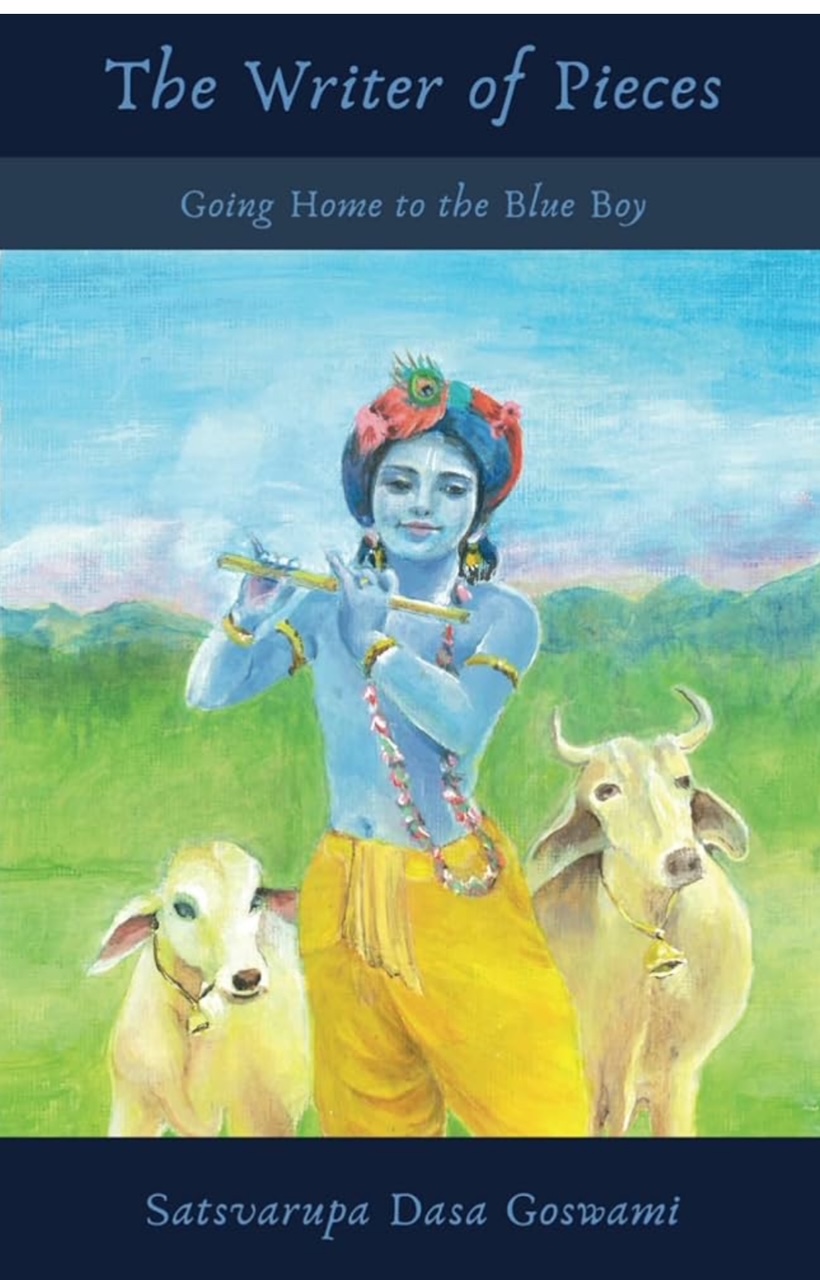
Don’t take my pieces away from me. I need them dearly. My pieces are my prayers to Kṛṣṇa. He wants me to have them, this is my way to love Him. Never take my pieces away.

Many planks and sticks, unable to stay together, are carried away by the force of a river’s waves. Similarly, although we are intimately related with friends and family members, we are unable to stay together because of our varied past deeds and the waves of time.
To Śrīla Prabhupāda, who encouraged his devotees (including me) To write articles and books about Kṛṣṇa Consciousness.
I wrote him personally and asked if it was alright for his disciples to write books, Since he, our spiritual master, was already doing that. He wrote back and said that it was certainly alright For us to produce books.
I have a personal story to tell. It is a about a time (January–July 1974) I spent as a personal servant and secretary of my spiritual master, His Divine Grace A.C. Bhaktivedanta Swami Prabhupäda, founder-äcärya of the International Society for Krishna Consciousness. Although I have written extensively about Çréla Prabhupäda, I’ve hesitated to give this account, for fear it would expose me as a poor disciple. But now I’m going ahead, confident that the truth will purify both my readers and myself.

First published by The Gītā-nāgarī Press/GN Press in serialized form in the magazine Among Friends between 1996 and 2001, Best Use of a Bad Bargain is collected here for the first time in this new edition. This volume also contains essays written by Satsvarūpa dāsa Goswami for the occasional periodical, Hope This Meets You in Good Health, between 1994 and 2002, published by the ISKCON Health and Welfare Ministry.

This book has two purposes: to arouse our transcendental feelings of separation from a great personality, Śrīla Prabhupāda, and to encourage all sincere seekers of the Absolute Truth to go forward like an army under the banner of His Divine Grace A.C. Bhaktivedanta Swami Prabhupāda and the Kṛṣṇa consciousness movement.

A single volume collection of the Nimai novels.
Śrīla Prabhupāda was in the disciplic succession from the Brahmā-Mādhva-Gauḍīya sampradāya, the Vaiṣṇavas who advocate pure devotion to God and who understand Kṛṣṇa as the Supreme Personality of Godhead. He always described himself as simply a messenger who carried the paramparā teachings of his spiritual master and Lord Kṛṣṇa.
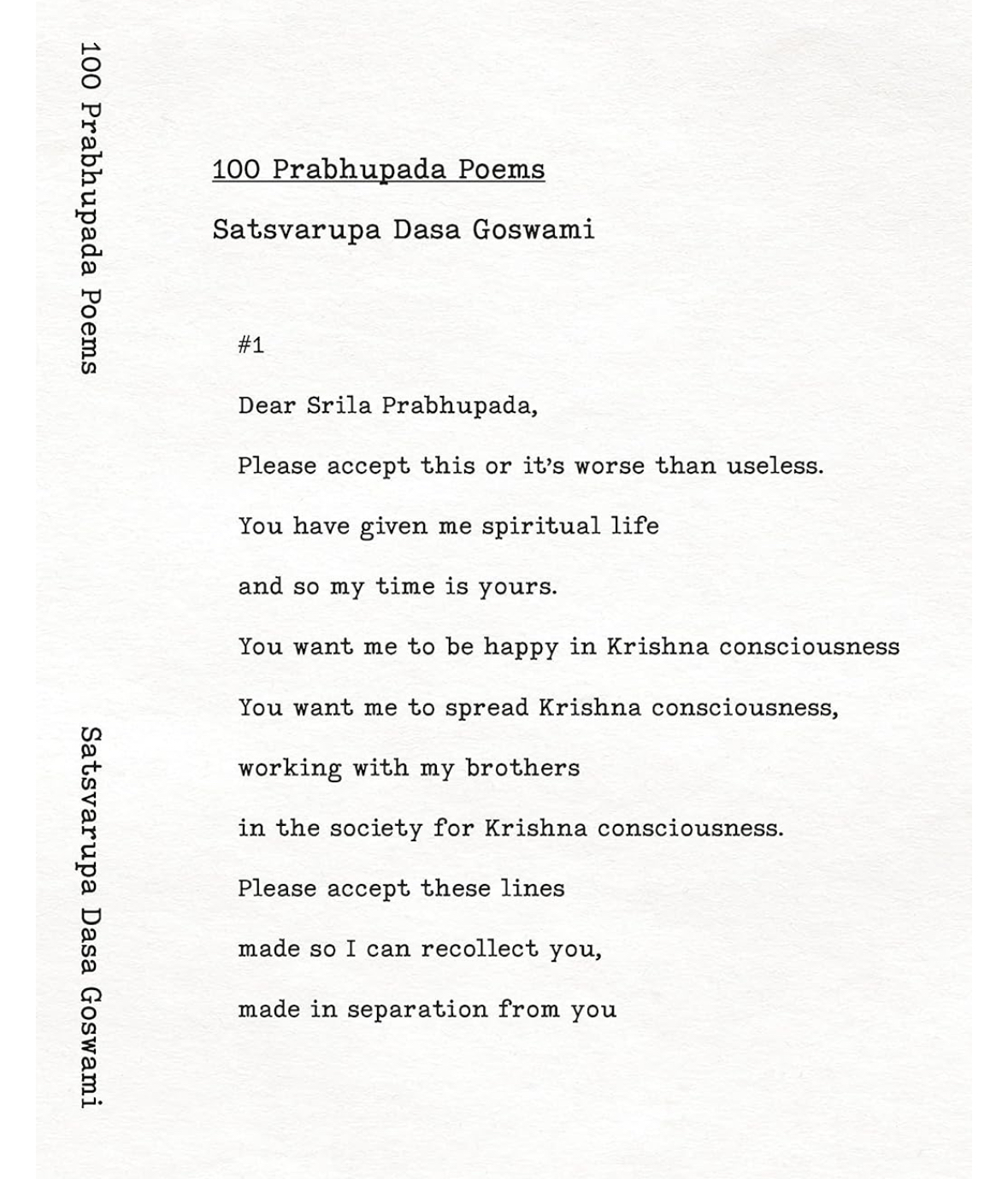
Dear Srila Prabhupada,
Please accept this or it’s worse than useless.
You have given me spiritual life
and so my time is yours.
You want me to be happy in Krishna consciousness
You want me to spread Krishna consciousness,
This collection of Satsvarūpa dāsa Goswami’s writings is comprised of essays that were originally published in Back to Godhead magazine between 1966 and 1978, and compiled in 1979 by Gita Nagari Press as the volume A Handbook for Kṛṣṇa Consciousness.

This second volume of Satsvarūpa dāsa Goswami’s Back to Godhead essays encompasses the last 11 years of his 20-year tenure as Editor-in-Chief of Back to Godhead magazine. The essays in this book consist mostly of SDG’s ‘Notes from the Editor’ column, which was typically featured towards the end of each issue starting in 1978 and running until Mahārāja retired from his duties as editor in 1989.

This collection of Satsvarupa dasa Goswami’s writings is comprised of essays that were originally published in Back to Godhead magazine between 1991 and 2002, picking up where Volume 2 leaves off. The volume is supplemented by essays about devotional service from issues of Satsvarupa dasa Goswami’s magazine, Among Friends, published in the 1990s.

“This is a different kind of book, written in my old age, observing Kṛṣṇa consciousness and assessing myself. I believe it fits under the category of ‘Literature in pursuance of the Vedic version.’ It is autobiography, from a Western-raised man, who has been transformed into a devotee of Kṛṣṇa by Śrīla Prabhupāda.”
 The Best I Could Do
I want to study this evolution of my art, my writing. I want to see what changed from the book In Search of the Grand Metaphor to the next book, The Last Days of the Year.
 a Hare Krishna Man
It’s world enlightenment day
And devotees are giving out books
By milk of kindness, read one page
And your life can become perfect.
 Calling Out to Srila Prabhupada: Poems and Prayers
O Prabhupāda, whose purports are wonderfully clear, having been gathered from what was taught by the previous ācāryas and made all new; O Prabhupāda, who is always sober to expose the material illusion and blissful in knowledge of Kṛṣṇa, may we carefully read your Bhaktivedanta purports.
I use free-writing in my devotional service as part of my sādhana. It is a way for me to enter those realms of myself where only honesty matters; free-writing enables me to reach deeper levels of realization by my repeated attempt to “tell the truth quickly.” Free-writing takes me past polished prose. It takes me past literary effect. It takes me past the need to present something and allows me to just get down and say it. From the viewpoint of a writer, this dropping of all pretense is desirable.
 Geaglum Free Write
This edition of Satsvarūpa dāsa Goswami’s 1996 timed book, Geaglum Free Write Diary, is published as part of a legacy project to restore Satsvarūpa Mahārāja’s writings to ‘in print’ status and make them globally available for current and future readers.