
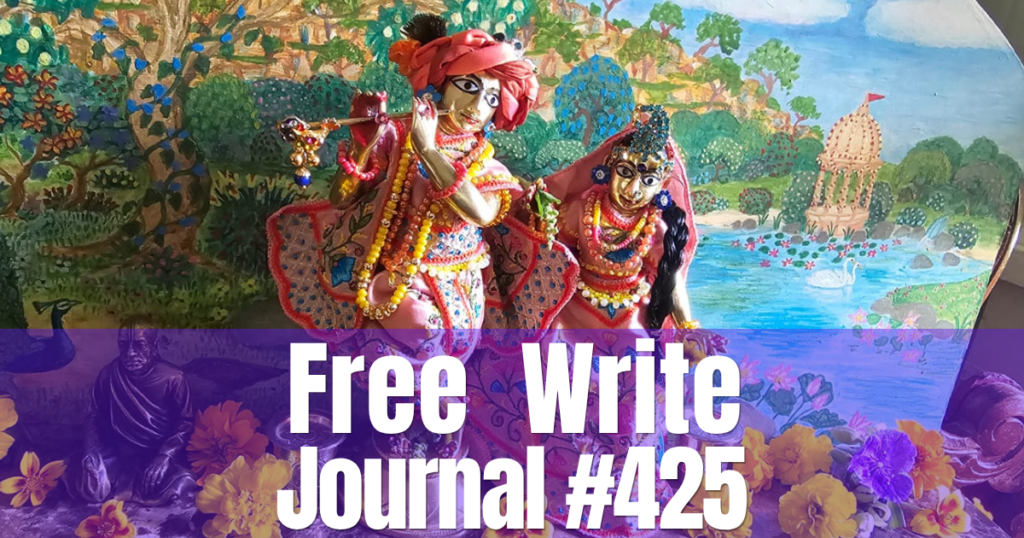
Disciples showed me their
plan to celebrate my birthday.
I appreciate.
But I don’t like terms
such as “world-wide celebration”
and reporting big book
distribution on that day
I prefer my followers to observe
a quiet day chanting,
and perhaps reading my
books about Srila Prabhupada.
Please no hype.
Disciples may privately cook a feast
and distribute the remnants.
Don’t disturb the harmonious
mood of the temples or
the gurus and their disciples.
Godbrothers, disciples, friends and well-wishers around the world are warmly invited to attend the 87th Vyasa-puja birthday celebration of His Holiness Satsvarupa Maharaja. Traditionally, devotees have gathered in Stuyvesant Falls, New York for this special annual event. Unlike in past years, this year’s event will be held completely online—there will be no in-person gathering. Guru Maharaja’s caretakers emphasize that Guru Maharaja wishes to spend the time peacefully, in a recuperative way, and not entertain visitors at all on that day. (Those who gather or drop by will be politely invited to leave.)
The date of the online event will be Saturday, December 5, 2026. Additional program details, including the online schedule of events and participation information, will be shared shortly.
Through the gift of technology, this year’s celebration presents a wonderful opportunity for devotees throughout the world to come together in honoring Guru Maharaja by attending the online Zoom program. Devotees, especially Guru Maharaja’s direct disciples are encouraged to celebrate privately or in small groups wherever you happen to be in the world. One can faithfully offer kirtana, heartfelt homages, and prasadam, beautifully expressing the spirit of Vyasa-puja in a uniquely personal way to please the spiritual master, as devotees such as Ramila Mataji of New Zealand do every year.
In addition, a printed Vyasa-puja book with homages from Godbrothers, disciples and friends will be put together and presented to Satsvarupa Maharaja on his birthday; any written expression of one’s connection with him is welcome and will be included in the book. The address for sending in an homage is
Deadline: November 21
All glories to Srila Satsvarupa dasa Goswami Maharaja!
your servants at SDG Tributes
We are still expanding our team of proofreaders as we aim to increase the rate of republication of Satsvarūpa Mahārāja’s books as well as new books that he writes. As many of you know, during the July 4th festival just held, a total of 18 new and re-edited and published books were present, and we hope to present a similar number at Satsvarupa Maharaja’s Vyasa-puja observance this December. Our call for proofreaders includes a need for fluent bilingual Spanish and English speakers to proofread Spanish translations (we currently have around 20 Spanish translations waiting to be proofread). Anyone interested in this particular service should contact Manohara dāsa at [email protected]
If you would like to help, please contact Kṛṣṇa-bhajana dāsa at [email protected] or [email protected] and we will find you a service that utilizes your talents.
The following year, the inhabitants of Kulīna-grāma again asked the Lord the same question. Hearing this question, Śrī Caitanya Mahāprabhu again taught them about the different types of Vaiṣṇavas.
Śrī Caitanya Mahāprabhu said, “A first-class Vaiṣṇava is he whose very presence makes others chant the holy name of Kṛṣṇa.”
Purport:
Śrīla Bhaktisiddhānta Sarasvatī Ṭhākura says that if an observer immediately remembers the holy name of Kṛṣṇa upon seeing a Vaiṣṇava, that Vaiṣṇava should be considered a mahā-bhāgavata, a first-class devotee. Such a Vaiṣṇava is always aware of his Kṛṣṇa conscious duty, and he is enlightened in self-realization. He is always in love with the Supreme Personality of Godhead, Kṛṣṇa, and this love is without adulteration. Because of this love, he is always awake to transcendental realization. Because he knows that Kṛṣṇa consciousness is the basis of knowledge and action, he sees everything connected with Kṛṣṇa. Such a person is able to chant the holy name of Kṛṣṇa perfectly. Such a mahā-bhāgavata Vaiṣṇava has the transcendental eyes to see who is sleeping under the spell of māyā, and he engages himself in awakening sleeping conditioned beings by spreading the knowledge of Kṛṣṇa consciousness. He opens eyes that are closed by forgetfulness of Kṛṣṇa. Thus the living entity is liberated from the dullness of material energy and is engaged fully in the service of the Lord.
—Cc. Madhya 16.73–74
If I simply say that Kṛṣṇa is God, it will not be appreciated. You will make so many protests, ‘Why should Kṛṣṇa be God?’ But actually, Kṛṣṇa is God. Ataḥ śrī-kṛṣṇa-nāmādi. Not only is Kṛṣṇa God, but His name is also God. Just like you are chanting Hare Kṛṣṇa, Kṛṣṇa’s name. Kṛṣṇa’s name, His form, Kṛṣṇa’s qualities, His pastimes and entourage are all Kṛṣṇa, but—ataḥ śrī-kṛṣṇa-nāmādi. Nāmādi means beginning from His name. We can understand Kṛṣṇa beginning from His name. When His name is perfectly chanted, then His form, His pastimes, qualities, and all other things in relation to Kṛṣṇa become revealed. Ataḥ śrī-kṛṣṇa-nāmādi na bhaved grāhyam indriyaiḥ. But these blunt senses cannot appreciate what is Kṛṣṇa. Then how will He be appreciated? Sevonmukhe hi jihvādau svayam eva sphuraty adaḥ—when we engage our tongue in Kṛṣṇa’s devotional service. Kṛṣṇa consciousness begins with the tongue, not the eyes—some rascals want to see Kṛṣṇa, but all they’ll see is their ‘guru mahārāja.’ Such rascals will thus see that so-called ‘Kṛṣṇa,’ but in order to see the real Kṛṣṇa one has to purify the eyes, purify the senses by engaging them (beginning with the tongue) in Kṛṣṇa’s service, not that I, or anyone or any scientist can ‘see’ and automatically become perfect.
—Śrīmad-Bhāgavatam class 1.16.6 Los Angeles
A gṛhastha, vānaprastha, sannyāsī, and brahmacārī should be very careful when associating with women. One is forbidden to sit down in a solitary place even with one’s mother, sister, or daughter. In our Kṛṣṇa consciousness movement it has been very difficult to disassociate ourselves from women in our society, especially in Western countries. We are therefore sometimes criticized, but nonetheless, we are trying to give everyone a chance to chant the Hare Kṛṣṇa maha-mantra and thus advance spiritually. If we stick to the principle of chanting the Hare Kṛṣṇa mahā-mantra offenselessly, then, by the grace of Haridāsa Ṭhākura, we may be saved from the allurement of women. However, if we are not very strict in chanting the Hare Kṛṣṇa mahā-mantra, we may at any time fall victim to women.
— Śrīmad-Bhāgavatam 5.6.3, purport
Today I took a tailspin—20 rounds only. What can be done? So many duties, meetings, real obligations in terms of extending myself to others and giving my time. I didn’t feel it was terribly wrong—but I am sorry to lose this numerical strength. Tomorrow is the monthly BTG meeting, and I’m likely to again fall short. Then off to the Caribbean—the same thing. Then, off to a writing marathon, where it may continue.
Therefore, I introduced speed in rounds, but that is hard also in these non-ideal surroundings. I miss walking down the solitary woodland paths at Gītā-nāgarī. Yet I must visit these other places and preach. Certain places are better for chanting, and when in those places, I should especially go after the numerical strength.
So, if I fail to maintain the quota regularly in upcoming days, I don’t think I’ll lose my resolution to return to it as soon as possible.
Every morning I meet half an hour with the disciples, chant two rounds, and read a selection about chanting. This morning we read that chanting will be tested at the time of death.
The tendency, as recorded here, is to think and work at chanting in terms of numbers, quota, speed per round, ability, and inability to keep the vow. But chanting the Lord’s names goes beyond that.
The body is temporary. The soul is eternal, with qualities of bliss and knowledge. Now he has forgotten himself due to the body. The body is the total effect of karma and the modes of nature. We have to endure the body’s changes and do our duty. Chant.
This morning we drove early from Philadelphia to New York City, and then flew 6 hours to Trinidad. Chanting japa while waiting in the customs line at Trinidad airport.
Traveling to unusual places, climates, schedules, is very difficult on the vow to chant steady, meditative rounds. I have lost exact count, although I am above 16 rounds. Tropics. Uncertain of my scheduled activities, and even uncertain of our place, staying at an Indian member’s house.
Part of the achievement at Gītā-nāgarī, it seemed, was that in a peaceful, idyllic, controlled setting you were able to keep up your count and also to enter into the pure relish of the holy name, without guilt—why am I relishing the holy name when I should be out preaching? At least for limited periods, as long as preaching and writing are going on, I could chant extra rounds without guilt. Rather, I told myself, what I need most is to be pure, so let me chant. The gains realized by chanting in a peaceful place—conviction that the name will protect me unto death, conviction that the name is Kṛṣṇa as He is to be realized at the end when all other work has to be wound up, conviction that a chanting “workshop” atmosphere improves this very important method of devotional service—all these gains would have to be realized also in a nonpeaceful atmosphere in order for them to take on their full worth.
You purposely entered the nonpeaceful atmosphere to preach. To preach means you have to tolerate the nonpeaceful—opposition, irregular hours, travel, counseling new people, business, etc. There is no avoiding the conclusion that if you seriously and regularly refuse to enter such nonpeaceful preaching opportunities, when they are actually prescribed duties, then you are bhajanānandī, which is not highly thought of by lovers of Kṛṣṇa like Bhaktisiddhānta Sarasvatī and Śrīla Prabhupāda. I don’t think I’m doing that. But here in this notebook I am encouraging an irrepressible yearning that has increased in me in the last year—to chant and realize Kṛṣṇa in His name, to go to the name as shelter. So, if ideal circumstances improve my japa, then take them as they arise, but never by turning down serious preaching duties or opportunities.
pp. 173-76
As an ācārya in paramparā, Śrīla Prabhupāda taught us about death in his books and lectures, and then he offered himself as an example. When Śrīla Prabhupāda arrived in the West, he was already at an advanced age. As the East Village Other remarked, he was “a man already past his three score and ten allotment.” He often told his disciples, “I am an old man, I may die at any moment.” Prabhupāda carried with him that urgency of limited time into his preaching. He said, “I am old man, and there has already been warning, but before I leave this body, I wish to see some of you very strong in Kṛṣṇa conscious understanding.” (Śrīla Prabhupāda-līlāmṛta)
Śrīla Prabhupāda received “warning” several times after leaving India. He suffered two heart attacks while crossing the Atlantic on board the Jaladuta, and then had a stroke in 1967 in New York. At that time, he taught his disciples that they should pray for him to stay in the world in order to finish his work. And when they did pray, Prabhupāda assured them that by their “sincere and ardent prayers,” his health was improving and he would continue to be able to chant and preach with them. (Letter, 67-6-2)
When in 1974 Śrīla Prabhupāda again became ill while in Vṛndāvana, he explained that his illness was caused by the fact that eighty percent of ISKCON’s leaders were not strictly following the rules and regulations; devotees were not even regularly rising by 4 a.m. in Vṛndāvana, where Prabhupāda was personally present. At that time, devotees began to hold around-the-clock kīrtanas, but hearing Prabhupāda’s statement about their own neglect was crushing and brought them back to the standard. (Śrīla Prabhupāda-līlāmṛta)
Prabhupāda taught about death especially in 1977. He showed how a Vaiṣṇava lives and dies in ideal conditions. He never stopped preaching and translating, saying that it was better to die on the battlefield like a warrior than to retire. He traveled to London in 1977 when he said he was just a “bundle of bones,” and planned to go to New York and Gītā-nāgari. But his health took a turn for the worse and he returned to Vṛndāvana. As his books were being produced in different languages, Prabhupāda said he was gaining life. But at other times, he stressed that it did not matter whether he stayed or left; he would continue serving Kṛṣṇa in any condition, like the threshing machine whose only business is to thresh wheat no matter whether it is in heaven or hell. (Śrīla Prabhupāda-līlāmṛta) Prabhupāda said, “What is the problem? We are talking about Kṛṣṇa so if all of a sudden I collapse, then what is the problem? Kṛṣṇa tvadīyapada-paṅkaja. Ordinary dying is kapha-vāta-pitta—choking. But if in the kīrtana you die, oh, it is successful. Not the injection and operation—that atmosphere. But in kṛṣṇa-kīrtana. That is glorious. Not oxygen, gas. Dying and so much trouble. Chant Hare Kṛṣṇa and let me die. Kṛṣṇa. Never be disturbed. Chant Hare Kṛṣṇa.” (Śrīla Prabhupāda-līlāmṛta)
Prabhupāda also taught ideal behavior by going to Vṛndāvana during his last days. Prabhupāda was in Vṛndāvana consciousness no matter where he traveled, but still, he set the example for his followers that if possible, they should die in Vṛndāvana. Anyone who executes service in Vṛndāvana goes back to Godhead at the time of death.
While in Vṛndāvana, he surrounded himself with kīrtana. His life had been dedicated to spreading the glories of the holy name, and at the end of his sojourn on earth, he wanted only to hear the kīrtana of the holy names. This was the mood of Mahārāja Parīkṣit: “Let the snake-bird—or whatever magical thing the brāhmaṇa created—bite me at once. I only desire that you all continue singing the deeds of Lord Viṣṇu.” (Śrīmad-Bhāgavatam 1.19.15)
Seeing Śrīla Prabhupāda in this way reminded the devotees of the passing of Bhīṣmadeva on the Battlefield of Kurukṣetra. Bhīṣmadeva had fought and governed as a great, powerful chief, and although he was always surrounded by opulence and women, he remained purely detached and renounced throughout his life, worshiping Kṛṣṇa. At the end of his life, which took place by his own will, Kṛṣṇa came before him and glorified him by having him instruct Yudhiṣṭhira Mahārāja in the science of government. Just as Bhīṣmadeva was surrounded by loving friends and disciples at the end, so friends and disciples gathered around Śrīla Prabhupāda; and Kṛṣṇa, in the form of the holy name, assured that he was going back to Godhead. Like Bhīṣmadeva, Prabhupāda controlled his departure and did not submit to medical manipulations.
Devotees who leave their bodies now and in the future have the benefit of learning from Śrīla Prabhupāda’s perfect example. Prabhupāda was “bold enough not to be afraid of death,” (Śrīmad-Bhāgavatam 2.1.15) and he perfectly fixed his mind on the lotus feet of Kṛṣṇa. Some devotees, like Gauri dāsī and Nākadi Prabhu, have followed in Prabhupāda’s footsteps.
As Śrīla Prabhupāda taught his disciples how to die, throughout his time in the West, he also expertly instructed his disciples how to love the spiritual master. One may wonder why I have arbitrarily combined Śrīla Prabhupāda’s lessons on dying with those he gave on love. I am doing this partly because Prabhupāda emphasized these two things in his last days. Also, they go together in Kṛṣṇa consciousness because death is transcended by love. Love and death are such important universal topics that every philosopher and spiritual leader has some obligation to discuss them. Love and death are not just something devotees study as sectarian doctrine; we have to hear the instructions given by such a great teacher as Śrīla Prabhupāda on these profound experiences. This was also a great lesson.
Just as Kṛṣṇa increased the love of the residents of Vṛndāvana through the līlā of Kāliya-Kṛṣṇa, Prabhupāda often placed himself in a position of dependence on his disciples and then acted in a way that brought out their feelings of love. This was especially true during his lengthy illness. But like Kṛṣṇa, who showed the Vrājavāsis His triumph over Kāliya, Prabhupāda revealed his true and sole dependence on Kṛṣṇa.
From when he first arrived in America, Śrīla Prabhupāda taught us how to love through different types of loving relationships. He taught us how to love the spiritual master by his personal dealings with us. He taught us how to love Kṛṣṇa by making his own loving exchanges with Kṛṣṇa so visible to us; he taught us to appreciate Kṛṣṇa’s love for us and to appreciate the love of the eternal associates for Kṛṣṇa. He also revealed to us his own love for all jīvas. (In 1966, he told me that if I loved him, he would love me.) He taught that love was not mechanical or official, but a real, heartfelt spiritual emotion. And in his very last days in Vṛndāvana in 1977, he encouraged his devotees to reciprocate with his own great capacity to love them:
Oh, your intense love for me! I am living for you! All over the world everything is going on. Money is coming and being spent, and I don’t have to worry. I am so much indebted, and I am taking so much service from you all. That is a bṛhat-mṛdaṅga. I am beating from this room and the sound goes ten thousand miles away. (Śrīla Prabhupāda-līlāmṛta)
pp. i-iii
When I began painting in the 1990s in my 50s, I had not heard of outsider art or art brut (a French word for “rough art”). I just painted for the fun of it, but with passion and as a therapeutic release from my migraine headache syndrome. Then someone put Raw Vision magazine into my hands. Under the title of the magazine, the logo reads “Outsider•Brut•Folk•Naive•Intuitive•Visionary.” I was fascinated by the contents. I discovered there was a worldwide network of self-taught artists and their followers, galleries dedicated to this school of art and spokespersons who championed it. I was especially inspired by the revolutionary writing of the French artist Jean Dubuffet. He proclaimed that the art of untrained individuals and even the insane had an authenticity that was greater than the professionals. I identified with the concept of outsider artist for two reasons: 1) I was a member of the Hare Krishna Movement, which was considered a marginal sect in the West, and 2) within ISKCON (the International Society for Krishna Consciousness) I was not a polished realist like the illustrators of Prabhupada’s books. I painted mostly Krishna conscious subjects, but they were primitive and childlike compared to Pariksit, Bharadraja, Murlidhara, Jadurani and the whole school of artists working for the Bhaktivedanta Book Trust. In Raw Vision and outsider art, I found kindred spirits who validated my work under the umbrella of a genuine movement of alienated artists and their followers who were accepted on their own terms as honest and visionary, although outside the cultural norms. I did not really consider myself as belonging to any school of art. I wasn’t imitating anyone. I wasn’t copying Dubuffet or Picasso. I was my own man, painting for pleasure and pursuing my spiritual path by rendering pictures of Radha-Krishna, Gaura-Nitai, Vaisnava sadhus, and pictures of my spiritual master, Srila Prabhupada, often with a self-portrait beside him. I did cows and birds and forests of Vrndavana, and sankirtana singers and dancers, and Lord Caitanya’s land of Navadvipa. I did Radharani with Her gopi friends, and Krishna and Balarama with Their cowherd boys. Sometimes I did rough-looking characters and captioned it, “Can I Become Initiated?”, “May I Have Some Prasadam?”, “May I Chant Hare Krishna?” I did many pictures of a man writing with a pen and captioned it with the title of one of my books like Every Day, Just Write–Volume 35. I did a man sitting writing at a desk in a shack reading Srimad-Bhagavatam. I did a man in rain gear and boots walking in the rain chanting with his bead bag, or a man walking briskly with a cane. Sometimes at the end of a session, I mixed all the colors of my palette and did a wild face, to which I added Vaisnava tilaka. If the face looked demoniac, I applied Shaivite tilaka or no tilaka at all. I rarely did pure abstract but favored creatures, human and animal and fantastic, and usually in a Krishna conscious setting.
In my peak productive period, for about five years in a cottage in Ireland, beginning at the beginning of the twenty-first century, I painted four and five canvases a day. My disciple-assistant, Baladeva dasa, kept me supplied with canvases, acrylic paints, brushes and “oil sticks,” and my next-door neighbor Caitanya-candrodaya would set up the canvases in the morning before going to work, and in the evening rinse out my used brushes for the day. Fifteen years later I am still painting in my own ashrama in upstate New York, but I am averaging two canvases a day now. I add graffiti and splotches of ink and paint in the background.
Some art brut painters don’t even think of themselves as artists. I think of myself as an artist, a very humble one, with no training and few technical skills. I love to paint; it gives me satisfaction, and I am getting validation that it is pleasing to others and they enjoy seeing and owning my paintings. I think I have my spiritual master’s permission, and in a small way it is pleasing to Krishna. Thus it is part of my devotional service to the Lord. I intend to keep it up.
pp. 83-86
If we practice an eye for an eye and a tooth for a tooth, soon the whole world will be blind and toothless.
—Mahatma Gandhi
TO BECOME COMPASSIONATE, WE FIRST HAVE TO LEARN how to tolerate. Srila Prabhupada gave the example of an apartment dweller’s right to live in his own apartment and equated the apartment with the body. It is criminal, he said, to take or destroy another person’s home. Similarly, it is criminal to deny a soul the right karma has bestowed upon it to live in a particular body.
Tolerance means we recognize that right even when it causes us inconvenience. In a talk in his garden in Los Angeles, Srila Prabhupada defined love to a group of college professors as not killing. They were discussing the difference between Krsna consciousness and Christianity, and one professor in particular was trying to emphasize the value of loving one’s fellow man as the highest expression of love of God. Prabhupada explained that first we must love God, because then our love will be “distributed”; by watering the root of a tree, we water the whole tree:
Prabhupada: . . . It is not your business to go to every department and pay tax. Pay to the treasury of the government; it will be distributed. This is intelligence. And if you say that “Why shall I pay to the treasury house? I shall pay the this department, that department, that department, that department,” you can go on, but it will never be sufficient, neither complete. So you may love humanity, but because you do not love Krsna, therefore you do not love the cows; you send them to slaughterhouse. So your love will remain defective. It will never be complete. And if you love Krsna, then you will love even the small ant. You will be not interested even to kill even an ant. That is real love.
Dr. Pore: I agree with you that we love very badly and we slaughter the animals.
Prabhupada: Yes. So badly love is not love.
Dr. Pore: But is the converse true, that we chant very well and that we can love Krsna even when we cannot love our fellow people?
Prabhupada: Oh, that . . . We are not . . . chanting . . . We are also working. It is not that we are simply sitting down and chanting. Because we are chanting, therefore we are loving everyone. That is a fact. These Hare Krsna chanters, they will never agree to kill any animal, even a plant, because they know everything is part and parcel of God. Why unnecessarily one should be killed? That is love.
Dr. Pore: Love means never killing?
Prabhupada: There are so many things. It is one of the items. . . . Do you kill your own son? Why? Because you love him.
—Garden Conversation, June 24, 1975, Los Angeles
Devotees learn tolerance by learning to love Krsna. By loving Krsna, they will automatically feel a respect for other living entities and not feel a need to kill them. As Srila Prabhupada says, one of the items of love is not killing. If we can show no other form of compassion, at least we can avoid killing.
Part of tolerance is to recognize that we are not supreme and that our rights over others are limited. “Everything animate or inanimate that is within the universe is controlled and owned by the Lord. One should therefore accept only those things necessary for himself, which are set aside as his quota, and one should not accept other things, knowing well to whom they belong.” (Isopanisad, Mantra 1)
Therefore, the root of tolerance is humility before God. We have each been given a quota by God, and we each have a right to that quota. Prabhupada equates tolerance with compassion. Tolerance means to accept any inconvenience imposed upon us; compassion means we accept the inconvenience when it is caused by other living entities and do not wish them harm. A Vaisnava tolerates such inconveniences simply for the benefit of others. When Maharaja Pariksit was cursed by Samika Rsi’s son, he chose not to counteract the curse but instead agreed to die. Srila Prabhupada writes:
It is said that the beauty of a tapasvi, or saintly person, is forgiveness. There are many instances in the spiritual history of the world in which many saintly persons, although unnecessarily harassed, did not take action, although they could have done so. Pariksit Maharaja, for example, was unnecessarily cursed by a brahmana boy, and this was very much regretted by the boy’s father, but Pariksit Maharaja accepted the curse and agreed to die within a week as the brahmana boy desired. Pariksit Maharaja was the emperor and was full in power both spiritually and materially, but out of compassion and out of respect for the brahmana community, he did not counteract the action of the brahmana boy but agreed to die within seven days. Because it was desired by Krsna that Pariksit Maharaja agree to the punishment so that the instruction of Srimad-Bhagavatam would thus be revealed to the world, Pariksit Maharaja was advised not to take action. A Vaisnava is personally tolerant for the benefit of others. When he does not show his prowess, this does not mean that he is lacking in strength; rather, it indicates that he is tolerant for the welfare of the entire human society.
—Bhag. 4.6.48, purport
pp. 245-48
In the bathroom, listening to Drāviḍa recite Bhagavad-gītā 2.66: “One who is not connected with the Supreme [in Kṛṣṇa consciousness] can have neither transcendental intelligence nor a steady mind, without which there is no possibility of peace. And how can there be any happiness without peace?” In the purport, Prabhupāda refers to Bhagavad-gītā 5.29:
“…that when one understands that Kṛṣṇa is the only enjoyer of all the good results of sacrifice and penance, that He is the proprietor of all universal manifestations, and that He is the real friend of all living entities, then only can one have real peace.”
If you’re not in Kṛṣṇa consciousness, you can’t have a final goal for the mind, and therefore you’re disturbed. We need a relationship with Kṛṣṇa. I liked hearing that peace is achieved in Kṛṣṇa consciousness. I want peace. I’m still sometimes disturbed by my falldown. That broke my relationship with Prabhupāda and Kṛṣṇa and took away my peace. Of course, the loss of reputation is also a cause for a lack of peace, but that’s a relatively superficial thing. Peace is deep, and knowing that Kṛṣṇa is the proprietor of everything, the object of all sacrifice and the well-wisher of all living entities. That’s the peace formula. The holy names are the easiest and most direct way to reestablish our relationship with Kṛṣṇa.
Sometimes we get the impression that Prabhupāda didn’t want us to be peaceful. He wanted us to take on anxieties for spreading the Kṛṣṇa consciousness movement. For decades, I took on those anxieties as GBC member and traveling guru. But I couldn’t keep it up. Just this morning I had to peacefully lie down and let a medicine “kick in” to reduce a headache. But I feel obliged to keep active, and therefore I have travels scheduled. But by my own inclination, I’m more content to spend a day in the yellow submarine writing, resting and drinking water every hour.
The temperature was down to 34 degrees, the lowest it’s been this fall, for our 5:30 visit to the beach. But it was not windy. At any rate, it seems we have enough warm clothing to allow us to endure it, even when it gets colder. The japa walk was pleasant, as was sitting in the car. We exchanged few words in conversation but chanted constantly. Today is a national holiday, Veterans Day, and more cars were parked, men in their pickup trucks reading newspapers and a woman walking her dog. I didn’t see any joggers. Baladeva and I are the first to arrive and the most steady attendees in the parking lot. No one else is there every day. We are attracted to the ideal environment for japa, despite inclement weather.
In the yellow submarine
there are holy pictures on the wall.
I can sit and chant on my beads
alone, but I’ve got friends on
the floors below.
If I get a headache
there is help nearby
and I rest back on
my La-Z-Boy chair
until it goes away.
I’m on the third floor above
the tumult, and I keep myself
engaged. It’s the best
bhajana-kutir in the world.
We have posted a schedule for the Vyasa-puja event on a prominent place on the website. I remember when I first began lecturing to disciples in 1978. I particularly recall speaking at the ISKCON skyscraper at 55th Street in Manhattan. I had over a hundred initiated disciples there, but I didn’t live there or visit so frequently. When I went, there would be an intense schedule of “darsanas” with different groups of disciples, the men’s sankirtana party, the women’s sankirtana party, the non-sankirtana group, etc. I would repeatedly speak on the theme of the guru-disciple relationship, trying to convince them of my eligibility to be a bona fide spiritual master in their lives. You could say I felt insecure about it, and that’s why I harped on the theme so much. I quoted from Bhaktisiddhanta Sarasvati’s essay “Humbler Than a Blade of Grass,” where he first presents a mockery of the guru worship, comparing the guru to an egotistic brute loaded with garlands who likes to sit and hear his own praises. (He spoke this before his disciples on the occasion of one of his Vyasa-puja celebrations.) But then he asserts that even if it appears to be an outrageous display of egocentrism, he must accept the duty humbly, because he has been so ordered by Sri Caitanya Mahaprabhu.
pp. 48-51
A song by Narottama dāsa Ṭhākura, translated by Prabhupāda to Hari-hari-biphale. He titles it “The Situation.”
Although I have come to this human form
my Lord, I have passed my life uselessly.
I did not care to serve Rādhā and Kṛṣṇa,
and I have swallowed poison carelessly.
Hare Kṛṣṇa comes straight from Kṛṣṇaloka,
But with the chanting I have no connection.
Day and night I’m burning in this dark world
Without working to make the correction.
******
He “offered” his bodily pain to all the suffering souls. He prayed that they may turn to Kṛṣṇa and asked that their sins be forgiven. (This “prayer” is not proper, but I meant well.) Kṛṣṇa is janārdana. He sees the good in a faulty prayer.
I talk of myself too much. I am old and can’t take part too much in a hearty kīrtana. My japa is unorthodox. Kṛṣṇa is bhāva-grāhī janārdana.
******
John Endler prefers that I write my pieces in free-writing. I did that at the beginning of this project, but now I have changed. I’m inclined to write more conservatively, taking from the śāstras and my own experience. John keeps insisting I do free-writing like I did in the poetry book Poetry, Volume One, to which John contributed little essays.
******
All day long headaches come and go. When they go, I attempt to write a piece. But then a headache comes back again. Tomorrow is April 1st. Baladeva has told me I must go on a “red flag” warning and stop taking so many medicines—and stop writing so much, do more resting—or else I will really be in trouble with migraines, etc. But it seems I can’t stop writing pieces and chanting my mantras over sixteen rounds. I may die at this rate, chanting extra and never stopping writing. I want to leave a spiritual legacy dedicated to Śrīla Prabhupāda.
A writer of pieces makes short vignettes glorifying the holy names. Kṛṣṇa is pleased with him (or her). The Lord takes the chanter to His bosom. The chanter is taken by Rādhā and Kṛṣṇa to the eternal abode.
Rādhārāṇī dominates Kṛṣṇa. Most devotees in Vṛndāvana prefer to chant, “Rādhe!” The people who live in Vṛndāvana chant and greet each other with the words, “Jaya Rādhe!” Śrīla Prabhupāda replied to them, “Hare Kṛṣṇa!”
******
“The essence of all revealed scriptures and all knowledge is present when one addresses the Lord and His energy by the Hare Kṛṣṇa mantra, for this transcendental vibration can completely liberate a conditioned soul and directly engage him in the service of the Lord.”
—Cc. Ādi 7.73, purport
******
“One may have other duties to perform under the direction of the spiritual master, but he must first abide by the spiritual master’s order to chant a certain number of rounds. In our Kṛṣṇa consciousness movement, we have recommended that the neophyte devotee should chant at least sixteen rounds. The chanting of sixteen rounds is essential.”
—Cc Madhya 22.113, purport
******
“Everyone begins his devotional service from the neophyte stage. But if one properly finishes chanting his prescribed number of rounds of hari-nāma, he is elevated step by step to the highest platform, uttama-adhikārī.”
The Nectar of Instruction, Text 5
******
“It is Caitanya Mahāprabhu’s mercy that He advises everyone—even caṇḍālas, mlecchas, and yavanas—to chant the holy name of the Lord. In other words, one who has taken to chanting the holy name has already received Lord Caitanya’s mercy. The Lord’s request to chant the holy name of Lord Kṛṣṇa is now extended to everyone in the world through the Kṛṣṇa consciousness movement. Whoever follows Lord Caitanya’s instructions will certainly be purified.”
—Cc. Madhya 16.187, purport
pp. 146-48
Many times, you have expressed to me your loyalty and devotion.
We met in 1978 when you were just a young bhakta. You were always enthusiastic, and a good dancer. You spread to others your love for my books. You would phone me just to tell me how much you loved my books, and your expression of this love was very sincere. And you preached to others about my books and were eager to distribute them along with Śrīla Prabhupāda’s. You were often in trouble with your ISKCON authorities, but I tried to defend you when it was possible. That was part of our rasa. Frequently you would simply phone me with nothing particular on your mind except to express your love for me. You often phoned me on Vaiṣṇava holidays and other holidays like Father’s Day and Christmas. Sometimes you would even sing to me at Christmas. You were a great crooner and knew many songs by heart. I used to request you to sing them to me, and you were willing to do so. This gave me much pleasure. You are getting older—is that why you do not sing to me anymore? You used to take love songs from Frank Sinatra and others and sing them to me with Kṛṣṇa conscious purports. I miss your singing and wish to hear you do it again.
I don’t remember you ever writing me a letter. Perhaps you could also start this practice now that Govinda’s is closed. I would love to hear from you on a more regular basis, so let’s start.
******
You are one of my superstar devotees. I remember first meeting you and how you were quiet and respectful. You always dressed sharply, as is appropriate for a senior businessman, and were quickly advancing in your field. While looking for a guru, you became attracted by my books and were helpful in distributing them. You would personally set up a nice display of my books and sell them at all the festivals and seminars. You are an expert salesman. I called on you to help with the book production, but you were delayed by having to pay off a million-dollar debt left by your father. You’re clear of that now and have put together and organized the most expert program for selling books in India, Your prabhu-datta-deśa. Currently you have produced fifty titles, and they are in a nice catalogue, and you’re selling them by the hundreds and thousands. You also personally go to the big festivals yourself, where you meet buyers from all over the world of ISKCON, like South Africa, U.K., Australia, et al.
I stayed at your house in Delhi, you drove us to Vṛndāvana, and regularly visited me when your job as a CEO brought you to America. I wish you wrote more letters and enlivened me by telling me of your activities.
I named your children Gopī and Gaurāṅga, and I am very happy to see how they are turning out in their devotional service. You are showing a nice example as parents since the children are doing so well. Gaurāṅga, eight years old, actually leads kīrtanas in the Krishna Balaram Mandir, and Gopī, your fifteen-year-old daughter, is learning Sanskrit, and she teaches Bhagavad-gītā classes to college students. The last time you were here you explained how your new house will have one floor dedicated to temple and preaching activities, another floor will be for book distribution, one floor for your mother-in-law, and then another floor for your whole family. So, you’re nicely fulfilling your gṛhastha duties. You are called upon on a regular basis to give classes in local temples and are always being asked to do service on other projects. But I’ve asked you to remain fixed and loyal to my book distribution, and you’re doing this despite the pleading of other devotees for your service. I appreciate you very much.
You distribute my books, mostly in India. You have a good feel for which of my books would most likely be appreciated in India. You have designed and printed a handsome catalogue, displaying a hand-picked selection of my books for the Indian market. You distribute my books at the temples throughout India, and also supply my disciple Dāmodara-rati in Australia with books for her to sell there.
You have been publishing my books in India for many years and have distributed many. You have done all this service single-handedly and you are GN Press’s star book publisher and distributor.
pp. 26-28
Walking in the park by 5:15 A.M. Some van parked near the forest and I walked past it a little fearful. The engine was running but I couldn’t see anyone there. Thought about how somebody could kill you and all they would get off my body was a Sony Dictaphone and a set of japa beads which would be useless to them. How valuable is my life anyway? I saw an interesting line by a poem by Milosz in which he’s recalling his youth and how a particular river was very nice but as he recalls it, he remembers all the garbage heaped on the bank. He said it is good to remember like that as a caution against trying to find an ideal place on earth. From the Krishna conscious point of view, we know there’s no ideal place because no place is eternal, full of bliss and knowledge. Also, many of the paradises we seek are kingdoms of God without God. Just know I’m on a knoll looking down at a powerful flow of water down a waterfall and into a small lake surrounded by rocks. It’s nature’s “violence” but thrilling. And you could be peaceful there sitting on a ledge. I see a raft also. But if it all produces a kind of raw sense grat and forgetfulness of Krishna of Vrindavan, what’s the use?
Look at it a while and turn my back. Start walking and chanting and taking this Upstate in search of a devotee writing life.
Squirrel running along a low wooden fence. Limp American flag on a pole with a silver ball on top. Outdoor barbecue stands. Only me in the park because it’s so early. Puff balls of dandelions. Leftover picnic litter from yesterday and here is the “Orenda Spring…a naturally carbonated, saline alkalized mineral water. This is a highly mineralized water and contains radium. Its continuous or excessive use may be harmful to your health.” It’s arranged like a shrine. You approach it and the water is pouring down out of a little rock-built shelter into a stone fountain. Just where the water is coming out the rock is red. It reminds me of the tongue of Krishna at Govardhana. But there’s no personal worship of God involved unless you already bring it with you.
Now into deeper forest areas where the floor is earth. Thick tree trunks of deciduous trees. All around, you see the tall columns reminding you of temple architecture. And the earth floor is covered with pine needles and other mulch. Valley, old rotting wood. Reminds you of a spot like this in Gita-nagari woods. But you can’t walk far because your foot hurts and anyway you’re soon at the edge of the deep woods and into another part of Saratoga Spa.
When I have physical pain, my world shrinks up to the body but this should be a training time to try to see beyond the body and don’t just feel the pain sensations. At least keep chanting as you limp along. Pain relief isn’t everything.
White birch trees. Pale golden palm weeds by the side of the road. Beautiful blue enamel sky with white wisps in front of it, painted by the Artist. Many shades of green in the leaves and grass. I’m on my sixteenth round and still a lot of the day is ahead.
Krishna’s love for the gopis is pure and their love for Him is purely transcendental. One can understand it only by following the path of the gopis. “One has to practice living in Vrindavan by hearing about the talks of the gopis with Krishna. However, one should not consider himself a gopi, for this is offensive.” (Cc. Madhya 8.205, purport)
The gopis find their greatest pleasure not by directly meeting with Krishna but in uniting Radha and Krishna.
I read some in Cc. although still drowsy, even after resting. Head bangs on the neck, like a big flower on a stem. Now I will write of other things although some may find the mixture jarring. It is my actual life to sometimes read esoteric passages in Srila Prabhupada’s books and then do something else. This is not necessarily offensive. It is my actual life.
It is quite cold in the morning, so much so that we wear gloves on our morning walks. But gradually the morning warms up and you may remove Srila Prabhupada’s knit cap and open a window. Be aware of these changes and don’t get left behind.
All right. Funny words and puns are always peeking out. But I don’t have to notice them. Try to find Krishna in the mess of this organization. That’s the best idea.
Novels, crafts, poems, plays, Cadillacs, peas, lunch for breakfast, gliders, turtles, mishes, mashes, and more turtles. Nothing is permanent in this world. The soul is permanent, however, and takes one body after another. This is the law. You stiff neck doesn’t change the law – you are eternal and the body will pass.
Blue Jay calls. My childhood pangs. The Red Maples bloom dark, dark wine in the end of May. Bloomers and pajamas are still in fashion in the cold.
He said it gets “chilly” here in winter, “but if you come then we will keep you warm.”
I told him I was writing two things at once. They are kind to feed and house us.
I won’t tell all the things that occur. There was, however, a contest he saw by which you were invited to write an essay, “What I would do on my first day in my cottage in Ireland.” The author of the prize-winning essay would be awarded a cottage in Ireland. How about that? And he brought me a flimsy walking stick, just like the one I used in Ireland. It would be better to have a traditionally shaped cane to lean on, when you sprain and strain in the New York forest of performing arts.
Be aware O’Hare
Airport isn’t the only
and money can come in
a window.
“A poem must rhyme,”
said a silly serious girl and
I lecture her on the history
of English poems but had no
time
or inclination
to tell her of T.S. Eliot and
Father Williams but said
poets got tired of the shackles
or rhyming and meter and
wanted to make poems more
like human speech.
Speaking to such an innocent, second generation Hare Krishna child, I myself questioned, “Why is it so important or valuable to approximate valuable speech?” But anyway, I much prefer the vers libre and so tried to convince her it is best this way.
Oh hey
Oh Harey
The airport got its name
and fame
when Tripurari and his troupers
did the change up there
like a bear
he growled his way
into his spiritual master’s heart
and I can’t condemn it
as they risked their lives.
But it could have been
honester is all we
may say.

Viraha Bhavan Journal (2017–2018) was written by Satsvarūpa Mahārāja following a brief hiatus in writing activity, and was originally intended to be volume 1 in a series of published journals. However, following its completion and publication, Mahārāja again stopped writing books, subsequently focusing only on what became his current online journal, which began in August of 2018.

At first, I took it hard that I would have to live surrounded by the firemen, and without my own solitude. After all, for decades I had lived in my own house with my own books and my own friends. I was also now a crippled person who couldn’t walk, living among men who did active duties. But when Baladeva explained it to me, how it was not so bad living continually with other firemen and living in the firehouse with its limited facilities, I came to partially accept it and to accept the other men. I came to accept my new situation. I would live continually in the firehouse and mostly not go outside. I would not lead such a solitary life but associate with the other firemen.
Let me write sweet prose.
Let me write not for my own benefit
but for the pleasure of Their Lordships.
Let me please Kṛṣṇa,
that’s my only wish.
May Kṛṣṇa be pleased with me,
that’s my only hope and desire.
May Kṛṣṇa give me His blessings:
Kṛṣṇa Kṛṣṇa Kṛṣṇa Kṛṣṇa Kṛṣṇa he
Rāma Rāghava Rāma Rāghava
Rāma Rāghava rakṣa mām.
You mentioned that your pathway has become filled with stumbling blocks, but there are no stumbling blocks. I can kick out all those stumbling blocks immediately, provided you accept my guidance. With one stroke of my kick, I can kick out all stumbling blocks. —Letter by Śrīla Prabhupāda, December 9, 1972.

The Writing Sessions are my heart and soul. I’m trying my best to keep up with them. I am working with a few devotees, and they are far ahead of me. I wander in the wilderness of old age. I make my Writing Sessions as best I can. Every day I try to come up with a new subject. Today I am thinking of my parents. But I don’t think of them deeply. They are long gone from my life. Śrīla Prabhupāda wrote a poem when he was a sannyāsī, and he said now all my friends and relatives are gone. They are just a list of names now. I am like that too. I am a sannyāsī with a few friends. I love the books of Śrīla Prabhupāda. I try to keep up with them. I read as much as I can and then listen to his bhajanas.
The metaphor is song. Explain it. Yes, particulars may not seem interesting or profound to readers who want structured books.
Wait a minute. Don’t pander to readers or concepts of Art. But Kṛṣṇa conscious criteria are important and must be followed. So, if your little splayed-out life-thoughts are all Kṛṣṇa conscious, then it’s no problem.
I am near the end of my days. But I do like the company of like-minded souls, especially those who are Kṛṣṇa conscious. Yes! I am prone to Kṛṣṇa consciousness. I have been a disciple of Bhaktivedanta Swami Prabhupāda for maybe almost sixty years. Sometimes I fail him. But I always bounce back and fall at his feet. It is a terrible thing that I sometimes do not have the highest love for him. It is a terrible thing. Actually, however, I never fall away from him. He always comes and catches me and brings me back to his loving arms.

This edition of Satsvarūpa dāsa Goswami’s 1996 timed book, Upstate: Room to Write, is published as part of a legacy project to restore Satsvarūpa Mahārāja’s writings to ‘in print’ status and make them globally available for current and future readers.
A factual record of the reform and change in ISKCON guru system of mid ’80s.

Readers will find, in the Appendix of this book, scans of a cover letter written by Satsvarūpa Mahārāja to the GN Press typist at the time, along with some of the original handwritten pages of June Bug. Together, these help to illustrate the process used by Mahārāja when writing his books during this period. These were timed books, in the sense that a distinct time period was allotted for the writing, during SDG’s travels as a visiting sannyāsī

Don’t take my pieces away from me. I need them dearly. My pieces are my prayers to Kṛṣṇa. He wants me to have them, this is my way to love Him. Never take my pieces away.

Many planks and sticks, unable to stay together, are carried away by the force of a river’s waves. Similarly, although we are intimately related with friends and family members, we are unable to stay together because of our varied past deeds and the waves of time.
To Śrīla Prabhupāda, who encouraged his devotees (including me) To write articles and books about Kṛṣṇa Consciousness.
I wrote him personally and asked if it was alright for his disciples to write books, Since he, our spiritual master, was already doing that. He wrote back and said that it was certainly alright For us to produce books.
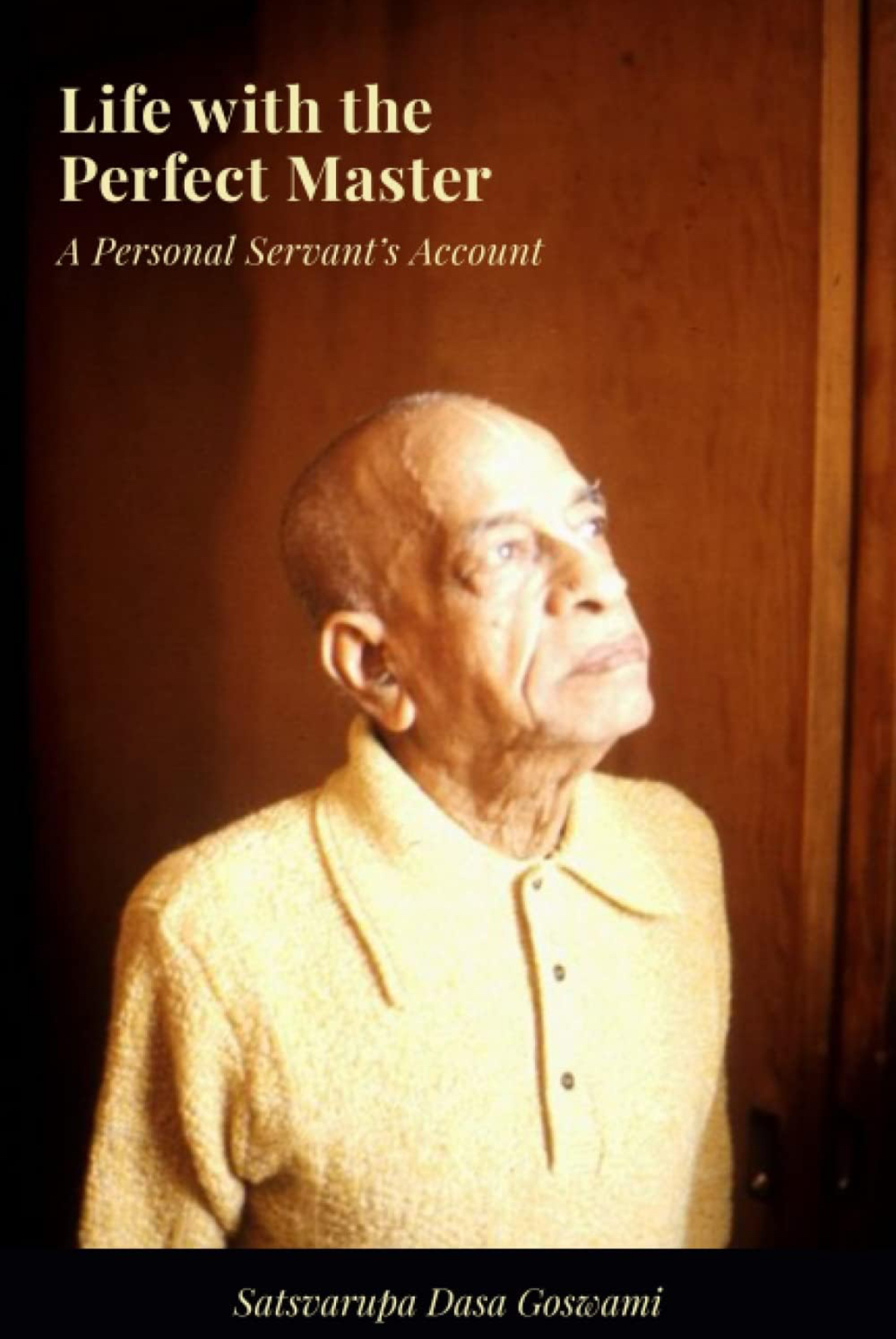
I have a personal story to tell. It is a about a time (January–July 1974) I spent as a personal servant and secretary of my spiritual master, His Divine Grace A.C. Bhaktivedanta Swami Prabhupäda, founder-äcärya of the International Society for Krishna Consciousness. Although I have written extensively about Çréla Prabhupäda, I’ve hesitated to give this account, for fear it would expose me as a poor disciple. But now I’m going ahead, confident that the truth will purify both my readers and myself.

First published by The Gītā-nāgarī Press/GN Press in serialized form in the magazine Among Friends between 1996 and 2001, Best Use of a Bad Bargain is collected here for the first time in this new edition. This volume also contains essays written by Satsvarūpa dāsa Goswami for the occasional periodical, Hope This Meets You in Good Health, between 1994 and 2002, published by the ISKCON Health and Welfare Ministry.

This book has two purposes: to arouse our transcendental feelings of separation from a great personality, Śrīla Prabhupāda, and to encourage all sincere seekers of the Absolute Truth to go forward like an army under the banner of His Divine Grace A.C. Bhaktivedanta Swami Prabhupāda and the Kṛṣṇa consciousness movement.

A single volume collection of the Nimai novels.
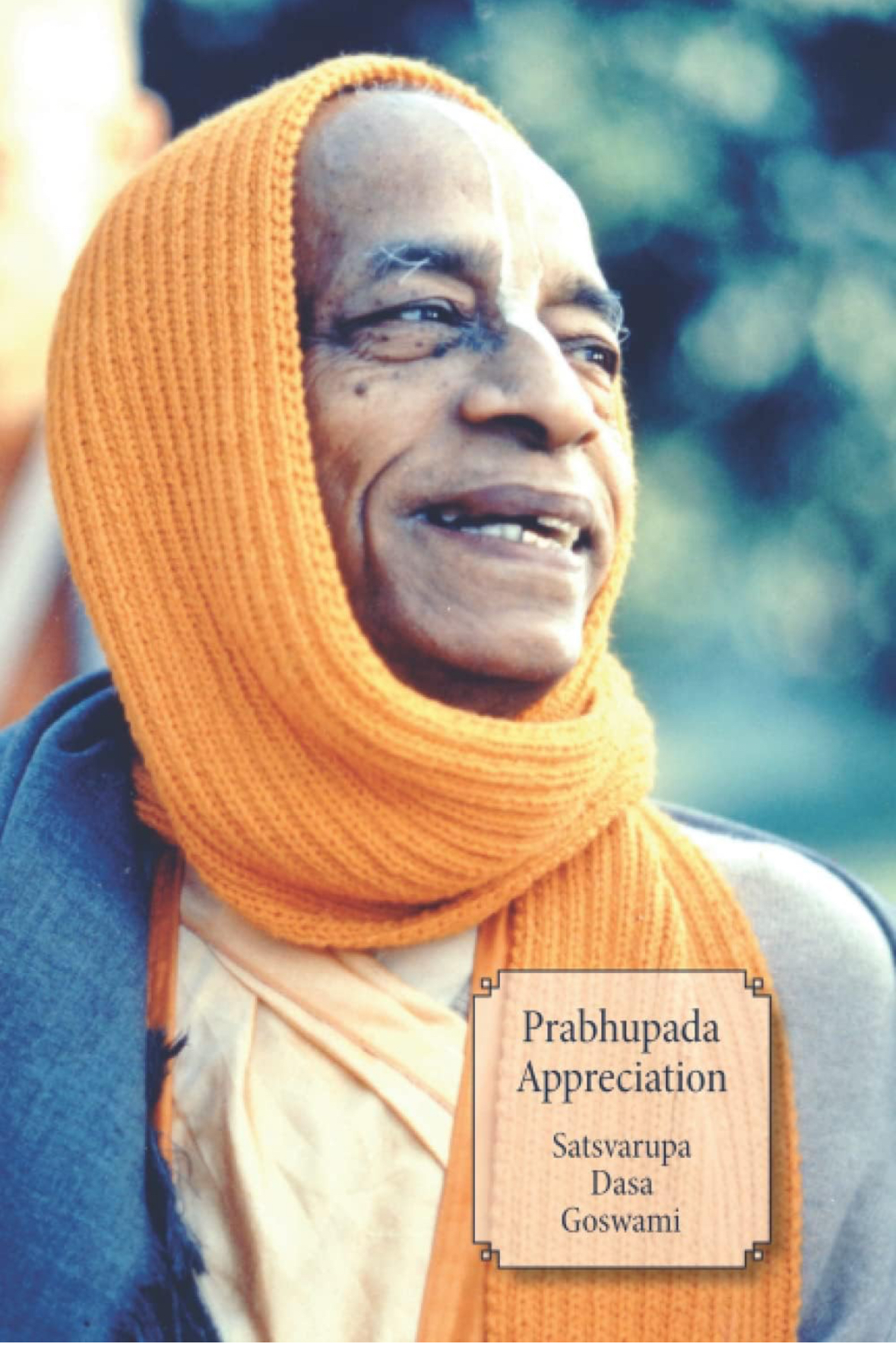
Śrīla Prabhupāda was in the disciplic succession from the Brahmā-Mādhva-Gauḍīya sampradāya, the Vaiṣṇavas who advocate pure devotion to God and who understand Kṛṣṇa as the Supreme Personality of Godhead. He always described himself as simply a messenger who carried the paramparā teachings of his spiritual master and Lord Kṛṣṇa.
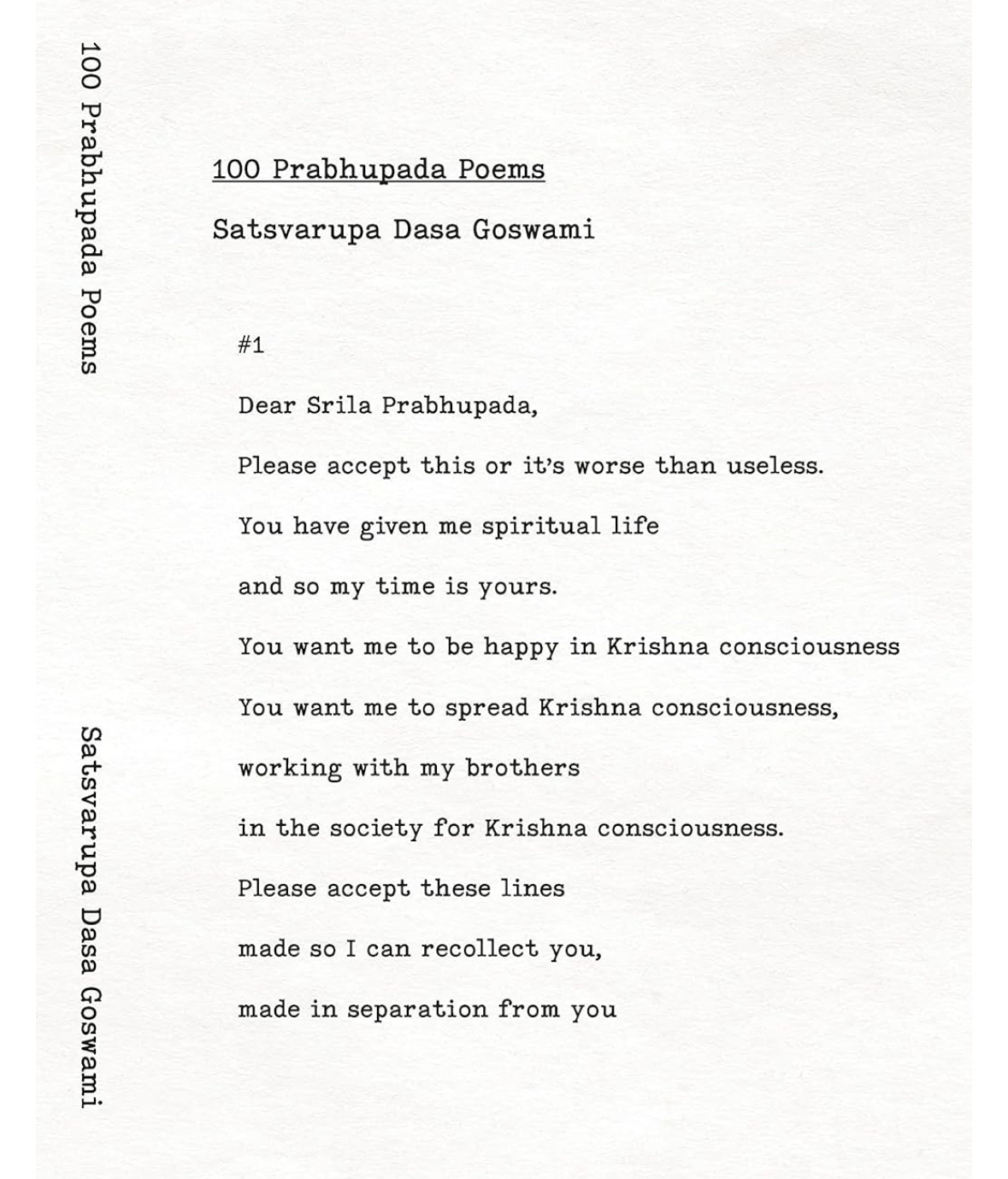
Dear Srila Prabhupada,
Please accept this or it’s worse than useless.
You have given me spiritual life
and so my time is yours.
You want me to be happy in Krishna consciousness
You want me to spread Krishna consciousness,
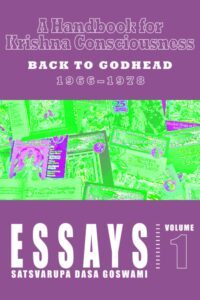
This collection of Satsvarūpa dāsa Goswami’s writings is comprised of essays that were originally published in Back to Godhead magazine between 1966 and 1978, and compiled in 1979 by Gita Nagari Press as the volume A Handbook for Kṛṣṇa Consciousness.

This second volume of Satsvarūpa dāsa Goswami’s Back to Godhead essays encompasses the last 11 years of his 20-year tenure as Editor-in-Chief of Back to Godhead magazine. The essays in this book consist mostly of SDG’s ‘Notes from the Editor’ column, which was typically featured towards the end of each issue starting in 1978 and running until Mahārāja retired from his duties as editor in 1989.

This collection of Satsvarupa dasa Goswami’s writings is comprised of essays that were originally published in Back to Godhead magazine between 1991 and 2002, picking up where Volume 2 leaves off. The volume is supplemented by essays about devotional service from issues of Satsvarupa dasa Goswami’s magazine, Among Friends, published in the 1990s.

“This is a different kind of book, written in my old age, observing Kṛṣṇa consciousness and assessing myself. I believe it fits under the category of ‘Literature in pursuance of the Vedic version.’ It is autobiography, from a Western-raised man, who has been transformed into a devotee of Kṛṣṇa by Śrīla Prabhupāda.”
 The Best I Could Do
I want to study this evolution of my art, my writing. I want to see what changed from the book In Search of the Grand Metaphor to the next book, The Last Days of the Year.
 a Hare Krishna Man
It’s world enlightenment day
And devotees are giving out books
By milk of kindness, read one page
And your life can become perfect.
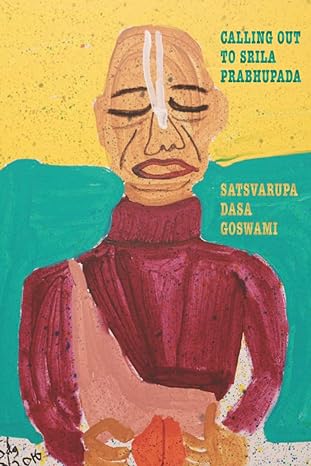 Calling Out to Srila Prabhupada: Poems and Prayers
O Prabhupāda, whose purports are wonderfully clear, having been gathered from what was taught by the previous ācāryas and made all new; O Prabhupāda, who is always sober to expose the material illusion and blissful in knowledge of Kṛṣṇa, may we carefully read your Bhaktivedanta purports.
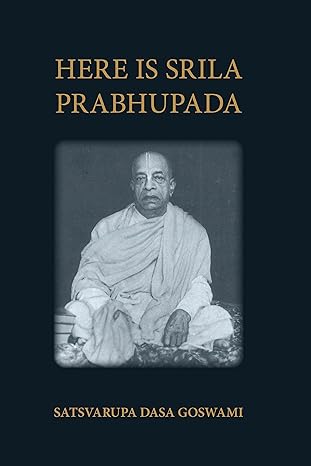
I use free-writing in my devotional service as part of my sādhana. It is a way for me to enter those realms of myself where only honesty matters; free-writing enables me to reach deeper levels of realization by my repeated attempt to “tell the truth quickly.” Free-writing takes me past polished prose. It takes me past literary effect. It takes me past the need to present something and allows me to just get down and say it. From the viewpoint of a writer, this dropping of all pretense is desirable.
 Geaglum Free Write
This edition of Satsvarūpa dāsa Goswami’s 1996 timed book, Geaglum Free Write Diary, is published as part of a legacy project to restore Satsvarūpa Mahārāja’s writings to ‘in print’ status and make them globally available for current and future readers.