

We need to expand our team of proofreaders as we aim to increase the rate of republication of Satsvarūpa Mahārāja’s books as well as new books that he writes.
This includes a need for fluent bilingual Spanish and English speakers to proofread Spanish translations (we currently have around 20 Spanish translations waiting to be proofread).
Anyone interested in this particular service should contact Manohara dāsa at [email protected]
If you would like to help, please contact Kṛṣṇa-bhajana dāsa at [email protected] or [email protected] and we will find you a service that utilizes your talents.
Sukadeva Gosvami continued: My dear king, the chanting of the holy name of the Lord is able to uproot even the reactions of the greatest sins. Therefore the chanting of the sankirtana movement is the most auspicious activity in the entire universe. Please try to understand this so that others will take it seriously.
—Bhag. 6.3.31
******
Just finished sixty-four rounds. Feeling okay. There is nothing else to say or do. It has taken all day and now I have a little over an hour “free time.” I’ll look through Namamrta and pick out something to read to the group tonight at 6 P.M. Hare Krsna.
******
Now. This day is here with a proposed sixty-four rounds. It is well spent. The 6 P.M. meetings are nice with each of us speaking some of the glories of the Names and how we feel. Last night I read that the Name is nondifferent than Krsna Himself, but this can only be realized in offenseless state. It’s done by practice; it’s done when Krsna shows His favor on you. We all beg for that favor.
******
I don’t think of myself as a lover of the Name or addicted to it, but glad we are taking this week-long vrata. At least do it once a year, and why not more than that? We picked right men to do it with, and I’m sure we could find others to do it with later.
******
Sri-krsna-caitanya prabhu nityananda. The basics that Prabhupada taught. He taught us to love the chanting. Get it from him and don’t dilute it or deviate even slightly. That is important.
******
The Lord is mighty
is kind
is creator God is
playful in Vrndavana.
You want to be an artist?
Apply to Him for permit
best try is to serve Him in
all arts twenty-four hours a day.
Prabhupada is teaching that.
When you hear Prabhupada in an enlightened,
receptive way, you see he is right and desirable
best teacher.
We want to love him
not serve out of fear
that we’ll be kicked out
of ISKCON unless we do.
Yeah, yeah
topples down
topless dance
he decried it
and meat-eating and
all sins like India’s rejecting
her own Vedic culture
and downfall of world in Kali
and power of holy name to
turn Kali into Satya.
******
Last night I said it’s time well spent for me to chant extra. Then I am not a hypocrite when I speak or write emphasizing the basic sadhana. I encouraged Manu that as father he had to set example to his children that he actually does his sadhana with devotion. Then I said, “And I am supposed to be a spiritual father”—so I too, even more so, can’t bluff or the “dependents” will see it. “He doesn’t chant himself.”
******
God saw I wanted to
chant and He allowed me.
So soldier mio, now it is almost time to start off the first round of a mere sixty-four. No big deal, all disciples of Bhaktisiddhanta Sarasvati used to chant that much or be considered fallen. But we do normally sixteen. This is taking us to new realms. Hope we can retain some of it when the vrata is over.
******
Top of the list priority
is chant japa and we have given
ourselves exclusive duty
to chant all day.
Chanters don’t bemoan.
I saw the moon on that
morning walk
and went on chanting.
Haiku didn’t stop me.
I go on chanting, jawing even
when I reach the lake and
the Pibbles Fishing Club.
Alone, this sacred place
of retreat with good men.
All-day chanting.
What more is there to say?
Go, Hare Krsna Hare Krsna
your rhumba and samba
your Pradyumna and Aniruddha your
dance out of the 1960s and ’90s
you
please,
shut up
and chant maha-mantra.
pp. 16-19
Prabhupada singing (Happening album):
hare krsna hare krsna, krsna krsna hare hare
hare rama hare rama, rama rama hare hare
Hare Krsna. I wrote myself a note before coming to the radio show today: “How can I be more Krsna consciousness and a better servant of Srila Prabhupada? How can I express it, or help it by this expression?”
Well, that’s a big question. How can I be more Krsna conscious? It is almost innocent of the inquirer to put forward such a question and think that I’m going to answer it. It’s like when people ask me questions based on the fact that they are limited living entities, but they assume that I have far greater access to the answer than they do. I don’t, though.
As I speak, I feel breathless as I look out the window at a huge bird out on the branch. I’d say by the size of it that it is a hawk, but I can make out the familiar markings of the ravens—all gray, black wings, a black head—he’s a big one!
All right, let me accept my question as earnest and answer it earnestly, although it humbles me, since I can’t really confer instant Krsna consciousness upon the questioner by my reply.
First, I have to analyze what my mentality was in even writing such a question down. I think it expresses a hope that the radio show would be vaulted up to a high level of discussion. Maybe I was trying to ensure that we wouldn’t talk about things that were details for insiders, “Satsvarupa lore,” but would be universal, substantial, and very personal. How can I be more Krsna conscious?
Inevitably, I think of Prabhupada handling this kind of question. He would usually say something standard and then drive it home. Or he might reply with unusual directness. For example, there was a question and answer session at New Vrindaban during the Bhagavata-dharma discourses. A man asked, “If Krsna wants us to be with Him, why does He make maya so strong?” Prabhupada replied, “Because your will is not strong.” That answer was disarming and unusual. It makes the devotees laugh and exclaim its truth when they hear the answer.
The more usual question, “How can I become more Krsna conscious?” might be answered like this: “Go on applying yourself to the process. Follow the rules and regulations. Avoid sinful activities. Chant Hare Krsna. The more you do this and serve the devotees, the more Krsna conscious you will become.” That answer calls for faith and full conviction in the effectiveness of the Krsna conscious process. That answer perhaps tells the inquirer nothing he doesn’t already know, but if the inquirer hears with submission, his spiritual master can jumpstart his enthusiasm to practice Krsna consciousness.
How can I become Krsna conscious? It’s a daydream question with a fantastic answer. But we keep at it anyway, practicing and practicing, and we become more Krsna conscious.
As I recall ways that Prabhupada might answer such a question, I say things like that too. You want to put Krsna on your mind? Then man-manah bhava mad-bhakto/mad-yaji mam namaskuru. You say you want to be more Krsna conscious? Do you know what it is to be Krsna conscious? What is your definition of Krsna consciousness? Krsna defines surrender as always thinking of Him, bowing down and worshiping Him, and always serving His devotees. Think only of Krsna and Krsna’s service. That is Krsna consciousness. When you are practicing that, then you can speak of becoming more Krsna conscious. More Krsna conscious means less materially conscious. All that should be left in life is Krsna’s service. Your mind should be absorbed in it. More Krsna conscious, less maya-conscious. Less consciousness of eating, sleeping, mating, and defending. More spiritual taste overwhelming the other taste.
I read a nice description by Prabhupada that although desire cannot be stopped, it has to be changed to spiritual desire. Such happy, full, spiritual desires don’t stop our desires; they transform their nature. He gave the analogy of a flowing river. In this analogy, the river represents material desire. When a flood occurs, the ocean overwhelms the river and what we really have is the ocean instead of the river. The ocean is spiritual desire. When we become overwhelmed with spiritual desire, the act of desiring doesn’t stop, but its nature is changed.
I can be more Krsna conscious by wanting to be more Krsna conscious, by praying for it, and by strongly desiring it.
What do you want? You can have whatever you want if you try for it. What does Christ say? “To those who knock, it shall be opened. For those who ask, it shall be given.” Are you asking for more Krsna consciousness? Are you ready to pay the price?
If you ask, “How can I become more Krsna conscious?” I can say, “No problem, you buy pure love of Krsna from the seller of Krsna consciousness. That’s how you get more of it. Do you have the price? Then buy more.” The price is simply your desire to have it. That’s another answer. How to become more Krsna conscious? By paying the price. By going for it. By having greed.
That answers the second part of the question, which was how can I become a better servant of Prabhupada. Find out what he wants you to do, then do it, and then try to improve it. What service does Prabhupada accept? What does it mean to be the servant? It means to be initiated by him or in parampara from him, you could say, and to take his orders and carry them out. That’s how you become his servant. That’s all you have to do, no matter where you are in the world. Take up his instructions. Make him your spiritual master. Hear from him as your teacher. Accept what he says and does. Do what he says to do. Associate with his other servants. It’s open to everyone.
There’s that remark a devotee made who later became Bhakti-caru Swami. “I love you, Prabhupada,” he said, and he felt such emotion while serving Prabhupada. Prabhupada answered, “Then you should love those who are serving me.” You will become a better servant, certainly.
It’s open to you. Behind the question shouldn’t be the hint that you’re already a good servant. You’re already working on it so hard that you can’t think of any way to improve. How could you become a better servant? Is it even possible? If that’s the question, you should know that you have a long way to go before you become good, better or best.
pp. 72-76
…… The Sunday afternoon kīrtanas in Tompkins Square Park had become legendary. They began in October 1966. We got permission from the Department of Parks to hold a kīrtana every Sunday for three hours in the afternoon. Some of the devotees would go there before Prabhupāda arrived. We set out a large oriental rug and a harmonium, sat down, and began chanting Hare Kṛṣṇa. Kīrtanānanda, who had been the first to wear a dhotī and shave his head, was no longer the only one. I remember I also dressed like that. In those days it was extremely innovative to walk in such a costume, but this was our way of life, our religion. We thought there was nothing more exciting than kīrtana, and we expected that other people would at least respond.
Several people gathered around us as we chanted. Then Śrīla Prabhupāda arrived with a few devotees. He walked the blocks from the temple to the park, which was about a ten-minute walk. Then he sat down and joined us. He played drum himself, and he chanted Hare Kṛṣṇa for at least an hour. The rhythms would rise and fall like the waves in the ocean, and we would rise and fall with them. He would lead, we would respond, and then he would lead again. Sometimes I would look up to him, sometimes at the crowd, which grew to many people, and the chanting never stopped. Śrīla Prabhupāda’s voice was strong. He kept the same tune, and we kept chanting as if we would never stop: Hare Kṛṣṇa Hare Kṛṣṇa, Kṛṣṇa Kṛṣṇa Hare Hare / Hare Rāma Hare Rāma, Rāma Rāma Hare Hare.
At least on a couple of occasions, Allen Ginsberg and his friends and other young people of that hip culture, as well as the non-hip immigrants and young children of Polish and Puerto Rican extract, joined in chanting Hare Kṛṣṇa.
After chanting for a long time, Śrīla Prabhupāda would get up and give a talk. He spoke in a voice that could hardly be heard except by the few people nearest him as he had no microphone. He introduced a few philosophical concepts about the chanting and then asked people to chant Hare Kṛṣṇa. The great majority of the people there couldn’t hear him or else had difficulty understanding his accent. After speaking briefly, Prabhupāda again led the kīrtana with his drum.
Later, Śrīla Prabhupāda often recalled how Brahmānanda and Acyutānanda were the first to dance at these Tompkins Square Park kīrtanas. Sometimes he would also ask the rest of us to dance. He once looked over at me and gestured with his head that I should dance. At first, I thought he must have been gesturing to someone behind me. I looked behind, then looked at him again, and Śrīla Prabhupāda repeated the gesture, which was undoubtedly meant for me. On his direct but unspoken order, I got up and danced. Tompkins Square Park was one of the few places where some of my old friends came and saw me. They seemed to be observing me sarcastically, but I didn’t care. I got up wearing my robes and danced with my hands in the air before all the people. When the kīrtana was over, we dispersed and walked back to the temple with Prabhupāda.
After our first kīrtana there, the New York Times had carried an article with a picture of us. Śrīla Prabhupāda took that as a milestone. Later, we also received coverage in the local newspaper, the East Village Other. We were on the front page with the headline: “Save Earth Now,” and a picture of Prabhupāda standing and speaking by a tree in Tompkins Square Park. Prabhupāda had us read this article to him aloud in his room, and he especially appreciated that the writer had said, “Most people say God is dead, but the Swami on the Lower East Side shows us that He’s very much alive.” Prabhupāda appreciated the newspaper writer’s recognition that we were alive and chanting. We had been chanting in the park the day the East Village Other newspaper article had appeared. After the kīrtana, a wave of interested people came back to the storefront. Prabhupāda spoke from the vyāsāsana, and he had us distribute cups of sweet rice to everyone who came. We felt Kṛṣṇa consciousness was a new movement with good potential for gaining a strong following among young people.
When Prabhupāda started Back to Godhead in November, he gave the editing to the most prominent literary devotees. In the back of my mind, I thought it would be nice if I was one of them, but I couldn’t claim to have the credentials they had. Hayagrīva was a college English professor and Rāyarāma was a professional writer for comic books. They both wanted to be editor, so Prabhupāda made them co-editors. Rāyarāma encouraged me to write.
Before Śrīla Prabhupāda started Back to Godhead, I mentioned to Hayagrīva that since I used to write out of false ego, I shouldn’t write any more. He said, “Oh, I am not doing that,” and he kind of laughed. “I am going to write like anything about Kṛṣṇa consciousness.” I thought the purest thing was not to write at all because it involved my false ego. Shortly afterwards, however, Prabhupāda began his magazine. I retained my propensity to write, so I began writing again—but without false ego. My first essays were “Experience of Karma Yoga.” I became a contributing writer for Back to Godhead.
As early as my teens I had been a disciplined writer. I could spend an entire day writing. I would revise material, write, type, try to form a story with a beginning, middle, and end. The discipline of writing, regulated habits, and attraction to a straightforward use of language—these were a kind of preparation Kṛṣṇa had given me so that one day I could write something for Kṛṣṇa.
I was loyal to Prabhupāda, and I was prepared to tell anyone that I was his disciple. Previously, I had been searching for my actual identity. Now I had not just philosophical understanding of my eternal identity, but I had an occupation to experience it. “What am I? Am I a writer?” Now I knew what I was.
pp. 76-80
I waited for light of day. Even now I can’t see well to write. Road sign: “Madrid.” I grew sleepy, and Narahari and I spoke intensely. He explained what he meant about honesty. He said it’s not enough for a writer in Krsna consciousness to be honest. He must also be responsible to give his readers exemplary Krsna consciousness as he has heard it in parampara. You may churn up a poison when you go to write, but don’t distribute that to readers. We also spoke of why we won’t go to Vrndavana this year.
We are high up on top of mountains. The invincible van has climbed here. It’s barely dawn and I see barren, powdery hills, dirt, and rock face. No trees. Some patches of land growing olives. They cut a highway through here. This barrenness reminds me of desert India. The road rolls on, the moronic white stripe feeds into the front of your head and you get sleepy. It’s not compatible with chanting, at least not for me. The gentle rocking, the rhythm, the warmth of the van . . . it’s good for hypnotic dream . . . but not for seeing and feeling hari-nama in mind’s eye.
“Madrid.” Red taillights of trucks are perfect jewels. The air seems dirty as if from cow dung fires. And so barren and brown before sunshine day comes. The road cuts through this. Narahari sits erect and alert. What does he hear, his Bhagavad-gita verses? Jalon—a viaduct.
Who cut the earth this way? The big-highway makers. They did a little, nature did the rest. She left it barren, rocky Spain. Dried out river bed. brown stone. Trees like evergreens rooted in rock soil. If this land is the bones of universal form, then He’s lying down, but He’s so vast you can’t even make out which part of the body is here. Highway sign: “Beware of falling rocks. Madrid 210 Km.” Now we are starting our descent, coasting with brake.
Monegrillas viaduct. Lighter-colored rock. Where is Don Quixote? There’s a massive rock hill, like the most gorgeous building or Sphinx, but not symmetrical. Where is Teresa of Ávila and her donkey? Where is the life of prayer and meditation—no attachments, not even to self. A vast outspread like the land Satan referred to Christ. “Get lost!” said Christ, “I’ll never worship you. This land is barren and neither can you give it to me. It is my Father’s.” A service zone is coming up. South of Zaragoza we are going.
“Zona de services”—we pull in for diesel.
Dirty old diesel tanks. The station is an outpost, only a few inches off the highway. I glance into the office and see a rack of paperback books with pornographic covers. Narahari gets out, and I hear the clock ticking on the van dashboard. Still no sunlight, only general lightness of blue dust mist. Like India, except for the sexy gal in tight jeans and mess-up blonde hair. Believe it or not, she strides out of the gas station office, gets into the driver seat of a full-sized trailer, starts it up and drives away.
We are far from the civilized genteel gardens of the South France Autoroute.
Cetina Garaba. That gas station was a heavy place. Narahari also noticed the porno books and videos on main display. And women hanging around, for what purpose? We are back on the road. Get diesel and flee. Flee from Satan. Boot him out.
Where is St. John of the Cross? Remember, he was imprisoned by a branch of his own church. In solitary confinement he prayed and composed his poetry, now adored all over the world, Dark Night of the Soul. He finally escaped when the guards were sleeping, lowered himself out the window by his monk’s belt, climbed the walls, sought and found asylum with Carmelite nuns. Got free to write his tomes.
Ariza. Bordalba. Madrid. I need to pee. Someone has cut away through these dry earth rocks. There are some adobes up here. Wherever they live in the world, those people who pray to God are fortunate. Otherwise, human life is wasted. You can’t make sense out of rocks and sky. Oh—there’s the billboard silhouette of the black bull. Uphill we go in our snappy all-weather van, passing a blue trailer truck, passing the white dashmarks down the middle of the van.
If I chanted now, I think I’d stay awake. All is light and no sign of man around, just barren brown with scrubby little dirt bushes. The humans crawl through on this road, like insects in cars and trucks through a huge anthill. Maybe there will eventually be sunshine.
Could the Vedic message reach this faraway place? Is there anybody here to receive it? Castilla y Leon. It’s not like Barcelona, where people roam the streets and sometimes take a book from a Hare Krsna devotee and watch and hear the harin?ma party go by. That’s why the cities are better for preaching. We are just passing through here en route to New Vraja-mandala.
Right now machine higher than ever, and more barren. Santa Maria de Huerta. I see an old fort or castle in the distance on a hum of hill. Nature’s profiles on rocks, better than Mt. Rushmore’s presidents’ faces. More mystery. Montuengo. Madrid. I don’t think Italy has got anything like this. But why should I be interested? I’m just noting all this to pass the time—and it commands me to do so. It’s God’s power and His material energy, Visvarupa. It comes from Him.
We stopped to break our fast with some fruits only. We’re close to the highway, next to a hotel and restaurant, which appear to be closed. Narahari said that we’re only one or two hours away from New Vraja-mandala, so if we like, instead of waiting, we can just take a little rest and then go in. I said let’s try for it, and if we happen to see any idyllic spot along the way we could stop. Otherwise, why stay out here in the barrenness?
pp. 86-89
Great devotees lament that they don’t love Krsna. A neophyte complains about the same thing. Syama Dhaka is the place where Indra came to beg forgiveness from Krsna. I should go there and beg forgiveness for my defiance. But do I see it?
This is also the place where the kadamba trees have leaves shaped like cups. Radha and Krsna meet in many places around Vraja, and Govardhana is one of Their favorite places. According to Raghunatha dasa Gosvami, Srimati Radharani described Govardhana as hari-dasa-varya, the best of all the servants of Lord Hari. Govardhana provides the Divine Couple with caves for Their pastimes, and Vrnda-devi stocks the caves so they will be pleasant and comfortable. Can we find leaf cups at Syama Dhaka today? I gather kadamba balls and save dust from this place. They will help me to return.
Rasa-sthali is the place where Lord Krsna performed His rasa-lila. There are tamala and kadamba trees here who witnessed the rasa dance. We prostrate ourselves at their roots and pray to one day see Krsna’s pastimes as they have seen them.
Pilgrims are allowed to express their devotional sentiments here. Nothing is restricted. On my mental parikrama, there is even more freedom. I don’t feel separation from Krsna. I can only offer obeisances. Come here, I will show you how. Place your head toward the roots and stretch your whole body out.
“Ow! That hurt! This ground is bumpy.”
My dear prince, I’m sorry. We neglected to put a blanket down first.
“Don’t make fun of me.”
What do you do with a man like that? He finally does as he’s told and gets down slowly as if he’s eighty years old. Begrudgingly, he gets into the position of full obeisances.
“Is this it?”
Yes, you’re doing fine. The guide casts warning looks around so no one laughs aloud.
“Now what do I do?”
Pray. Do you know how to pray?
“You mean what you do when you’re in trouble? Like, ‘Dear God, if You get me out of this, I won’t forget You. I’ll pray regularly and go to church and read the scriptures every day’?”
Yes, that’s okay for a start.
“Quiet in my mind, or out loud?”
As you like.
“Dear God, please let me become a gopi in the next life, or as soon as possible. All glories to Prabhupada.”
Having said that much, he slowly starts to rise, and when standing, carefully brushes every trace of soft sand off his knees and chest and picks off every fragment of leaf, grass, or twig from his sweater and shoes.
“You missed a spot on your forehead.”
“Don’t make fun of me. Where’s the water? I need a drink. When do we eat?”
Rasa-sthali: the rasa dance took place here. Anyone want to say anything?
“Could ‘you tell us the difference between the rsi-cari gopis, the fruti-cari gopis, and the nitya-siddha gopis? I would particularly like to hear how they shed both kinds of karma when they heard Krsna’s flute. At what point did they attain siddha-deha?”
I’d rather not get into that just now.
Dear trees of Rasa-sthali—then the mind goes off, right in mid-prayer, even within the course of a moment while I lie at the base of a tree. At least I made a physical connection with the earth at this place. I bent to the tree root, I felt the tree’s rough bark. The thought derails me, then returns, and I pick it up in my hand the way I used to control my Lionel model trains as a boy. Turning on the transformer—volume up, the train veers around the bend and the black locomotive crashes to the side, its pill-produced smoke billowing.
Dear trees . . . I
want to control my mind
my tongue
my words
my anger, belly,
genitals, legs,
toes. Just
give me your blessings
to transcend my cultural conditioning.
Nama om visnupadaya krsna-presthaya bhu-tale, srimate bhaktivedanta-svamin iti namine. Just that, just that, that’s all.
Does it really matter that we can’t control the mind? Are we expected to do it at every moment? Don’t try for the impossible. As Dom Chapman, a Benedictine spiritual director of the early 1900s said, “Pray as you can, not as you can’t!”
I’m not talking about the failure to be one hundred percent perfect. I’m talking about feeling like a dead leaf, dragging your carcass from kunda to kunda with nothing. Even that is all right, I guess. It’s certainly humbling. I just want to admit it, at least to myself.
It sure is cold out today. Every time I say something, frost issues from my mouth along with my words. Indigestion from too much cereal. Srila Prabhupada said that during the famine in India in the 1940s, people didn’t die of starvation but of overeating once they received food. He quoted statistics that stated that heart failure caused the most deaths in the U.S.A. and that overeating was the second biggest cause. His point was, “Don’t eat too much or too little. Eat just enough to keep body and soul together.” I don’t consider this thought off the point of parikrama. Anytime I can remember what he said, it is good.
The trees at Rasa-sthali are not ordinary, like the fir trees covered in old snow that I see here. The trees at Rasa-sthali are o/d—thousands of years old. I want to touch them with reverence again.
I have a favorite tree in Raman Reti. I go there and prostrate myself at its roots and pray. What do I pray for? Mostly I just recite exalted sentiments even though I don’t feel them: “Please bless me to attain devotion to my spiritual master and to his mission in this world. Please allow me to know who he is so I can serve him eternally.” Stuff like that. Prayers made at the roots of old trees.
pp. 126-127
All devotees will agree that Krsna responds with compassion when a devotee prays. What is it, then, that blocks us from being aware of His response? This question has a simple answer. We cannot hear Krsna because we have already decided what He should say. When we pray for ourselves, we are often reluctant to face the actual depth of our deficiencies and what it will take to fill them. When we pray for others, we are usually sure we know what is best for them. When our hope for ourselves or others is not fulfilled, we conclude that Krsna did not respond to our entreaty.
Therefore, prayer requires faith. It also requires knowledge. We need to understand that Krsna is the supreme controller, and we need to trust that He has our best interests in mind. Gajendra prays to Lord Visnu,
“Since an animal such as I has surrendered unto You . . . certainly You will release me from this dangerous position. Indeed, being extremely merciful, You incessantly try to deliver me.” (Bhag. 8.3.17)
In his purport to this verse, Srila Prabhupada emphasizes Kona’s power by quoting Bhagavad-gita 10.42: “But what need is there, Arjuna, for all this detailed knowledge? With a single fragment of Myself I pervade and support this universe.” Krsna is our very origin; no one is superior to Him. Therefore, only Krsna can deliver us from this material existence. “Indeed, He is always trying to deliver us. . . . He is within our hearts and is not at all inattentive. His only aim is to deliver us from material life. It is not that He becomes attentive to us only when we offer prayers to Him. Even before we offer our prayers, He incessantly tries to deliver us. He is never lazy in regard to our deliverance.” Srila Prabhupada goes on to say that it is we who constantly refuse to accept His instructions. “Nonetheless, He has not become angry. Therefore He is described here as adabhra-karuno, unlimitedly merciful in delivering us from this miserable material condition of life and taking us back home, back to Godhead.”
When we pray to Krsna, therefore, we should not present Him with the solutions to the questions we may be asking. Rather, we should present ourselves as dependent on His mercy. Krsna’s mercy is often revealed to us in ways we did not expect. Krsna can see our innermost hearts. Because He is the Supersoul, He knows past, present, and future. He knows what is best for our overall development in devotional service.
In practical terms, if we pray, “Please tell me what direction to take,” we can trust that the answer will come. It may come in a gentle way, in the form of a growing conviction that we should do one thing over another, or it may come in a less gentle way. We may find ourselves “forced” to move in a particular direction despite our natural resistance to it. Whatever happens is Krsna’s will, and even the willingness to acknowledge that can become a form of prayer. Such consciousness leads to a steady communion with God.
Prayer, therefore, can be defined as nondifferent from bhakti. Although vandanam is only one of the nine limbs of devotional service, each limb is absolute and as powerful as practicing all of the nine limbs together. Prayer is a flexible concept. It is the state of Krsna consciousness behind any activity we perform that helps us break through into emotion for Krsna. It is the activity that carries us past the mechanical into the feeling.
The one thing that blocks us from this more intense Krsna awareness is our unwillingness to see Krsna as ever-present and all-pervading in our lives and in our world. If we are open to Krsna’s presence in our creativity and in nature, for example, we will feel grateful to Him for His mercy. We will be able to see His compassionate response to our prayers, and we will give up our narrow-mindedness in deciding how we expected Him to act on our behalf. We will grow past our stereotypes of who Krsna is, and we will learn to see Him as a person. When we begin to accomplish that, we will not fail to see His compassionate nature directed toward us and all other beings.
Prayer, like attraction, should be both flowing and incessant. Queen Kunti prayed that her attraction to the Lord could flow like a river toward His lotus feet. In a 1973 lecture given in Los Angeles, Srila Prabhupada cites her prayer: “As the river flows down towards the seas, similarly my attraction will go down incessantly to touch Your lotus feet like the Ganges.” The Bhagavatam states that Krsna is saranya, “the only worthy personality to whom one can fully surrender . . . ” (Bhag. 3.25.11, purport) We can trust Him.
pp. 75-81
A devotee wrote in a letter that Begging
for the Nectar
was difficult to read
because I was so hard on myself.
What hope did it leave her?
She almost quit reading, then saw
that I felt better toward the end
and we both persisted.
She said she liked the poems best—
they contained my heart.
Well, that’s nice. Poems are
lines with double meanings, art, symbols
undefinable music
composed of everything I see and hear—a
baby chair in the backyard, broken now, and
in the high grass a broken stove, wooden shingles,
a spade, a plastic barrel,
and me murmuring Krsna’s name
almost inaudibly
at odd moments, the sound so delicate
between mind and heart,
the words in a holy book.
They were playing “I Remember April”
next door to the temple in T’dad
it’s a fast piece and I felt myself race
with it, this
forbidden music.
At least it was better than the usual
frumpy reggae, poor man’s rock
they play in the jute fields while wielding
saber-toothed sickles, hammers. Stumbling
I say, “Hey, Rafas!” and they all laugh
look at me and stop working.
They know it’s fast but I’m breathless
so they laugh again and sit down
to look at the
crazy man.
I recognize the tune and then it’s gone
like the splash of a frog
and I think of April and all the fluctuations
and punctuations—the flies-fads-tads
mosquitoes
while Madhu applies white cream
and laughs.
“April” was played with a trumpet I don’t
know whose rendition, something between
Bach’s and no man’s but someone was out there
playing it again and again
over the fence.
I was reading Prahlada but suddenly remembered
Paris, once, while I was in the Navy,
trying to get high but unsuccessful
and sitting on a bench under a row
of trees
wishing for liberation, the
Liberation, and I found Krsna
later and I do remember Aprils
spent chanting.
When I have to go uphill
I walk in a crouch and imagine I’m smaller
than I am. I poke my cane into the earth for support
and breathe hard.
Saw an owl—or a large bird I couldn’t quite make out
flying away into the gray dawn from over the stone
bridge as soon as I arrived. Neither of us
were afraid of the rough waterfall throwing
spray. I was not afraid
to pray or be myself
because Krsua was present in the creek-sound
and I could see through the green branches
while the water coursed over the rocks
green with moss.
This advice isn’t everything,
but it’s important:
Listen to others and don’t
think yourself the only
one, the most special,
sensitive soul
ever created.
Because even special souls
have odd moments
such as the time I met a bearded goat
in the woods—all he needed to fulfill the cliché
was a pipe pressed to his lips
like an old Irish leprechaun.
He had only one horn
and perhaps that made him less dangerous
but goats have been known to rush people.
Was I safe because I was a special, sensitive
soul?
And what about the rabbits
gamboling across pastures? What
is their defense against the sleek-running
fox?
Now I know they have their
own ways of learning
I’m happy to clear my head
and say
alone or with a group
we work together each doing
his own thing
like in a Krsna conscious community
shared ethos the binding force
to make us a family.
Although we live each in our world I
walked to the quay, still speaking
to the gathering
walking my way at
my speed—what did I think,
that I was some guru with whom
everyone had to agree?
Someone quoted Kierkegaard: “If
I win all men to God but lose myself then all
is lost!” Prabhupada said if we win ourselves
but save no one else … then?
Cat on wall, deer in front yard
sharing a world
and me—do I share a world with these people
walking me to the quay?
I say I want to be alone because
I don’t help the sun to rise but only want to
celebrate as it soars over the trees.
The sun, after all, is special in these gray parts.
Boats cross the water and I continue to speak
to those attending,
in payment for my lunch.
Out of affection for her they baked her a cake—
it was her birthday—but
the first guy who entered blew the surprise,
“Is there a party here?”
They ate the cake and left.
Large, limpid eyes, don’t be sad
we are a family, and then a child entered
crying. What had been done to her?
I tried to speak about Prabhupada’s disappearance
of joy and sorrow mixed, of what we feel in our
collective world when the child entered
bringing in the reality of a different sloka.

Viraha Bhavan Journal (2017–2018) was written by Satsvarūpa Mahārāja following a brief hiatus in writing activity, and was originally intended to be volume 1 in a series of published journals. However, following its completion and publication, Mahārāja again stopped writing books, subsequently focusing only on what became his current online journal, which began in August of 2018.

At first, I took it hard that I would have to live surrounded by the firemen, and without my own solitude. After all, for decades I had lived in my own house with my own books and my own friends. I was also now a crippled person who couldn’t walk, living among men who did active duties. But when Baladeva explained it to me, how it was not so bad living continually with other firemen and living in the firehouse with its limited facilities, I came to partially accept it and to accept the other men. I came to accept my new situation. I would live continually in the firehouse and mostly not go outside. I would not lead such a solitary life but associate with the other firemen.
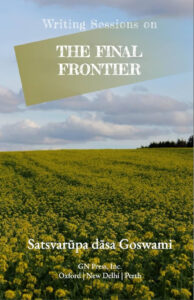
Let me write sweet prose.
Let me write not for my own benefit
but for the pleasure of Their Lordships.
Let me please Kṛṣṇa,
that’s my only wish.
May Kṛṣṇa be pleased with me,
that’s my only hope and desire.
May Kṛṣṇa give me His blessings:
Kṛṣṇa Kṛṣṇa Kṛṣṇa Kṛṣṇa Kṛṣṇa he
Rāma Rāghava Rāma Rāghava
Rāma Rāghava rakṣa mām.
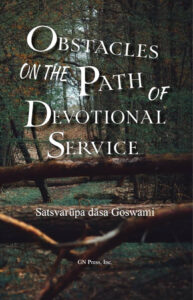
You mentioned that your pathway has become filled with stumbling blocks, but there are no stumbling blocks. I can kick out all those stumbling blocks immediately, provided you accept my guidance. With one stroke of my kick, I can kick out all stumbling blocks. —Letter by Śrīla Prabhupāda, December 9, 1972.
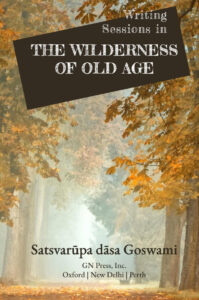
The Writing Sessions are my heart and soul. I’m trying my best to keep up with them. I am working with a few devotees, and they are far ahead of me. I wander in the wilderness of old age. I make my Writing Sessions as best I can. Every day I try to come up with a new subject. Today I am thinking of my parents. But I don’t think of them deeply. They are long gone from my life. Śrīla Prabhupāda wrote a poem when he was a sannyāsī, and he said now all my friends and relatives are gone. They are just a list of names now. I am like that too. I am a sannyāsī with a few friends. I love the books of Śrīla Prabhupāda. I try to keep up with them. I read as much as I can and then listen to his bhajanas.
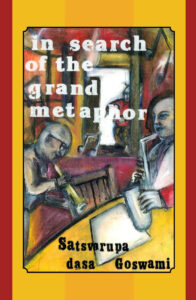
The metaphor is song. Explain it. Yes, particulars may not seem interesting or profound to readers who want structured books.
Wait a minute. Don’t pander to readers or concepts of Art. But Kṛṣṇa conscious criteria are important and must be followed. So, if your little splayed-out life-thoughts are all Kṛṣṇa conscious, then it’s no problem.
I am near the end of my days. But I do like the company of like-minded souls, especially those who are Kṛṣṇa conscious. Yes! I am prone to Kṛṣṇa consciousness. I have been a disciple of Bhaktivedanta Swami Prabhupāda for maybe almost sixty years. Sometimes I fail him. But I always bounce back and fall at his feet. It is a terrible thing that I sometimes do not have the highest love for him. It is a terrible thing. Actually, however, I never fall away from him. He always comes and catches me and brings me back to his loving arms.

This edition of Satsvarūpa dāsa Goswami’s 1996 timed book, Upstate: Room to Write, is published as part of a legacy project to restore Satsvarūpa Mahārāja’s writings to ‘in print’ status and make them globally available for current and future readers.
A factual record of the reform and change in ISKCON guru system of mid ’80s.

Readers will find, in the Appendix of this book, scans of a cover letter written by Satsvarūpa Mahārāja to the GN Press typist at the time, along with some of the original handwritten pages of June Bug. Together, these help to illustrate the process used by Mahārāja when writing his books during this period. These were timed books, in the sense that a distinct time period was allotted for the writing, during SDG’s travels as a visiting sannyāsī
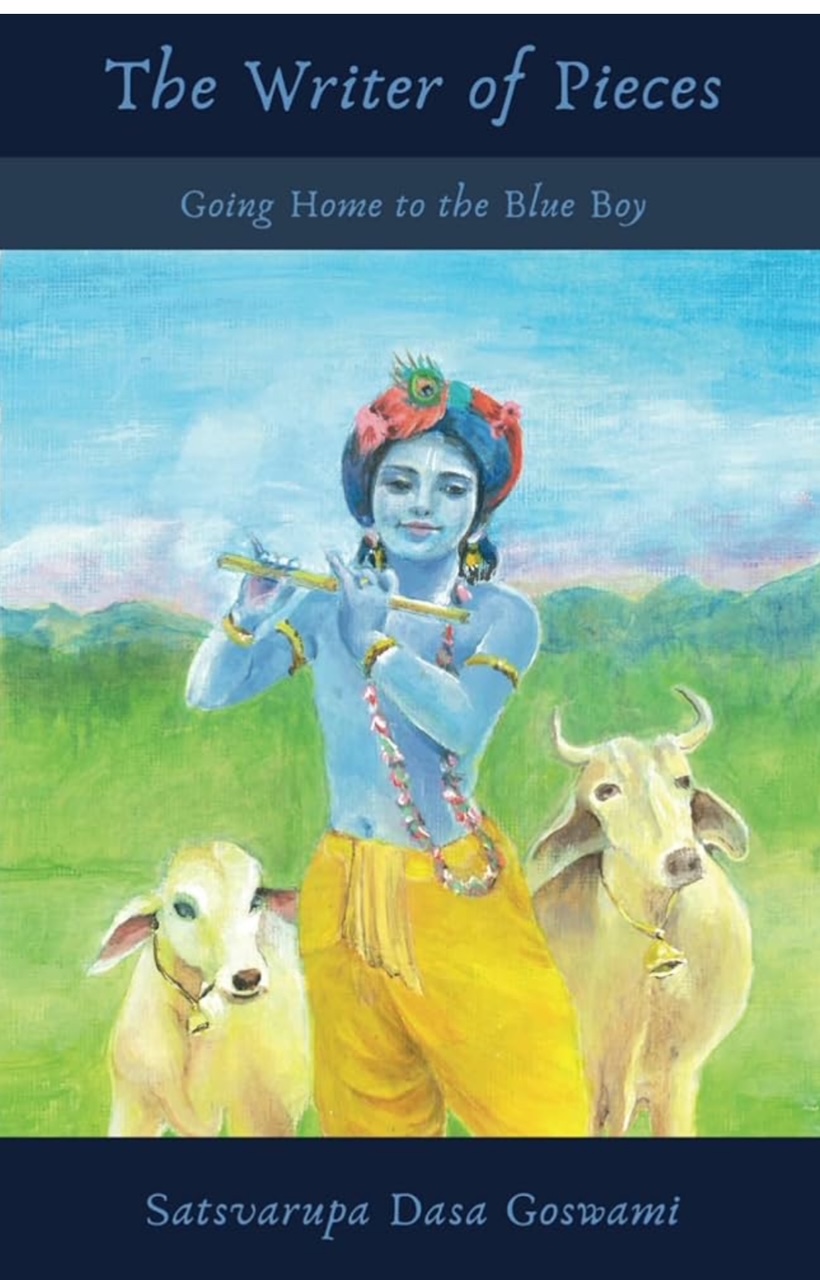
Don’t take my pieces away from me. I need them dearly. My pieces are my prayers to Kṛṣṇa. He wants me to have them, this is my way to love Him. Never take my pieces away.

Many planks and sticks, unable to stay together, are carried away by the force of a river’s waves. Similarly, although we are intimately related with friends and family members, we are unable to stay together because of our varied past deeds and the waves of time.
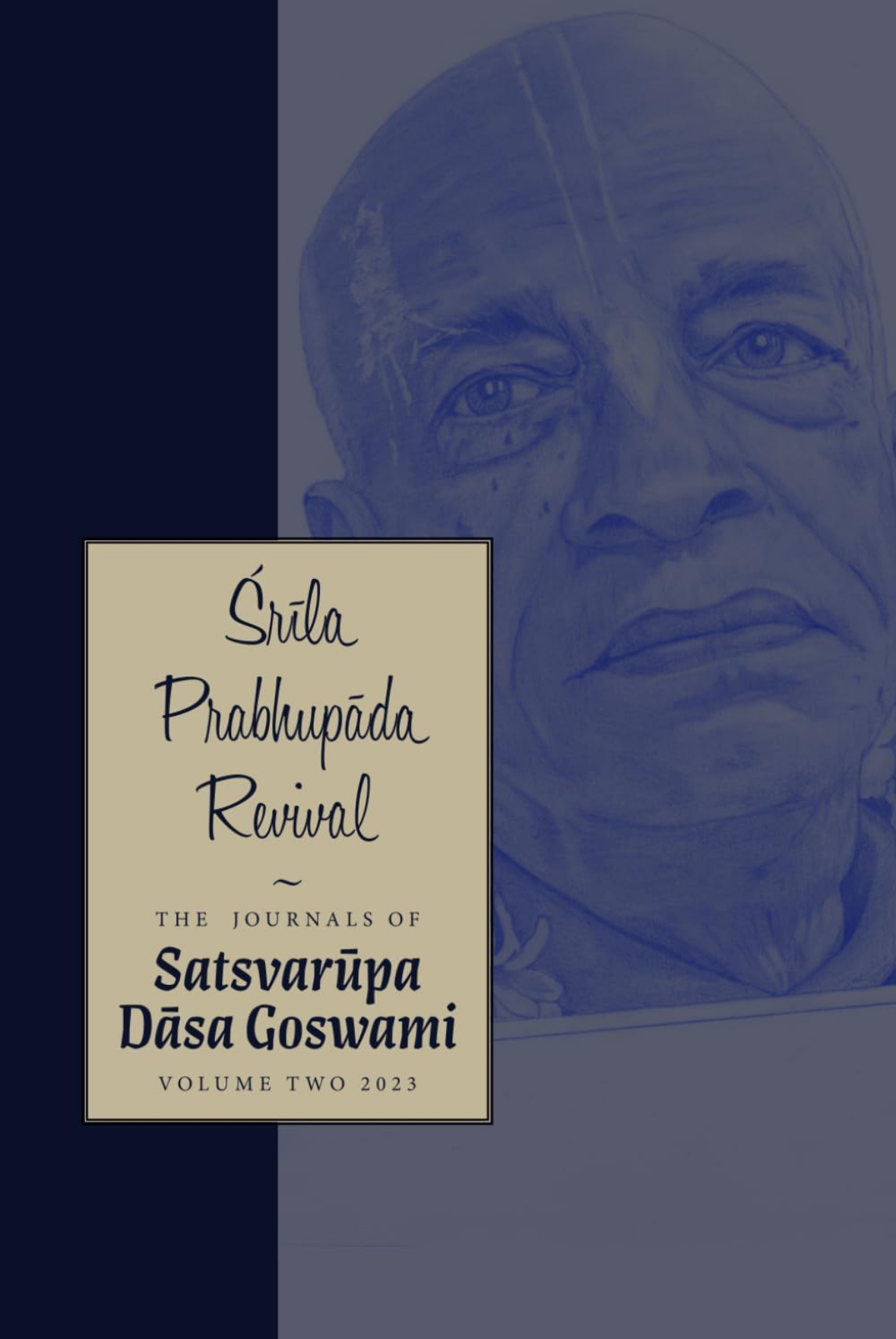
To Śrīla Prabhupāda, who encouraged his devotees (including me) To write articles and books about Kṛṣṇa Consciousness.
I wrote him personally and asked if it was alright for his disciples to write books, Since he, our spiritual master, was already doing that. He wrote back and said that it was certainly alright For us to produce books.
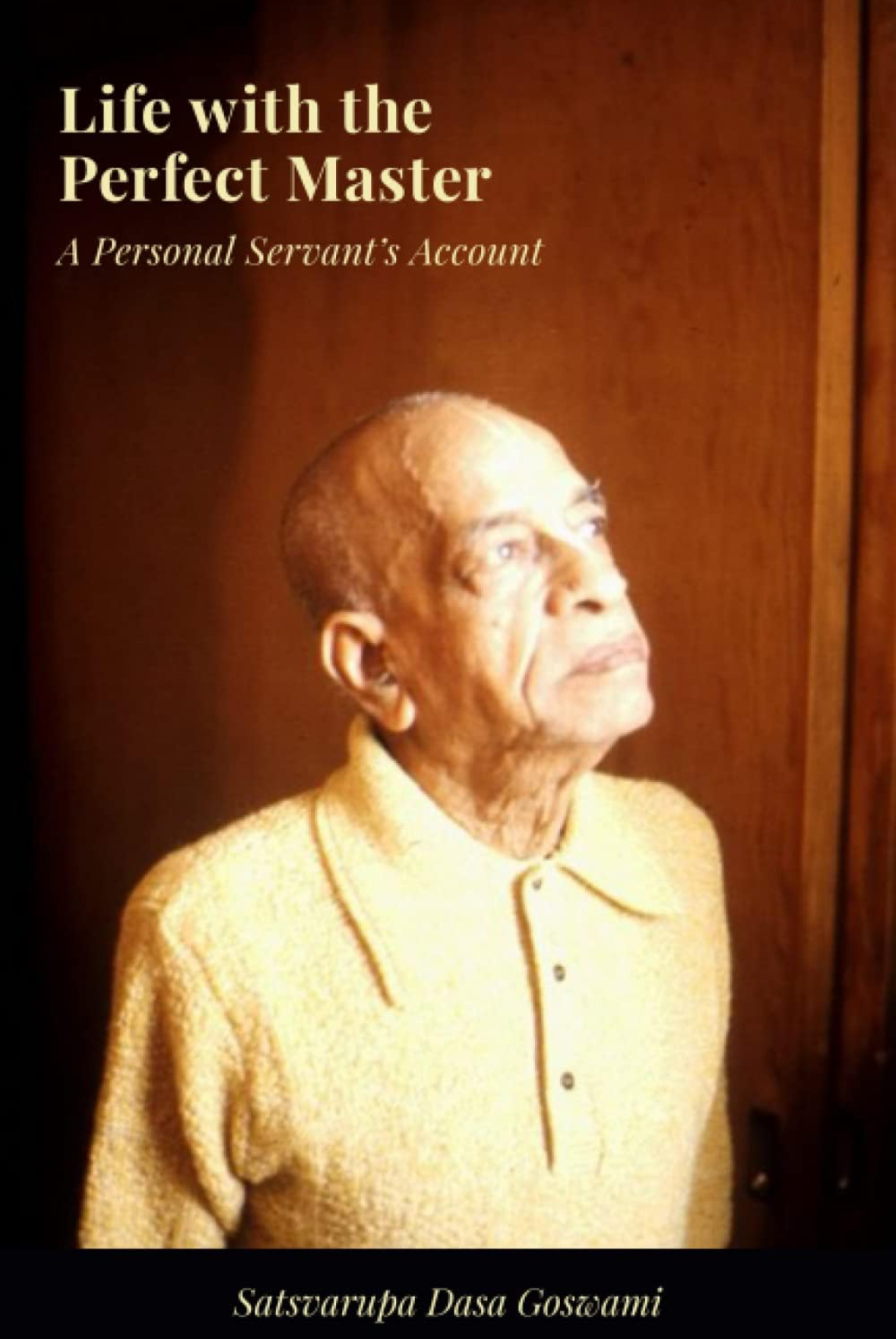
I have a personal story to tell. It is a about a time (January–July 1974) I spent as a personal servant and secretary of my spiritual master, His Divine Grace A.C. Bhaktivedanta Swami Prabhupäda, founder-äcärya of the International Society for Krishna Consciousness. Although I have written extensively about Çréla Prabhupäda, I’ve hesitated to give this account, for fear it would expose me as a poor disciple. But now I’m going ahead, confident that the truth will purify both my readers and myself.

First published by The Gītā-nāgarī Press/GN Press in serialized form in the magazine Among Friends between 1996 and 2001, Best Use of a Bad Bargain is collected here for the first time in this new edition. This volume also contains essays written by Satsvarūpa dāsa Goswami for the occasional periodical, Hope This Meets You in Good Health, between 1994 and 2002, published by the ISKCON Health and Welfare Ministry.

This book has two purposes: to arouse our transcendental feelings of separation from a great personality, Śrīla Prabhupāda, and to encourage all sincere seekers of the Absolute Truth to go forward like an army under the banner of His Divine Grace A.C. Bhaktivedanta Swami Prabhupāda and the Kṛṣṇa consciousness movement.
A single volume collection of the Nimai novels.
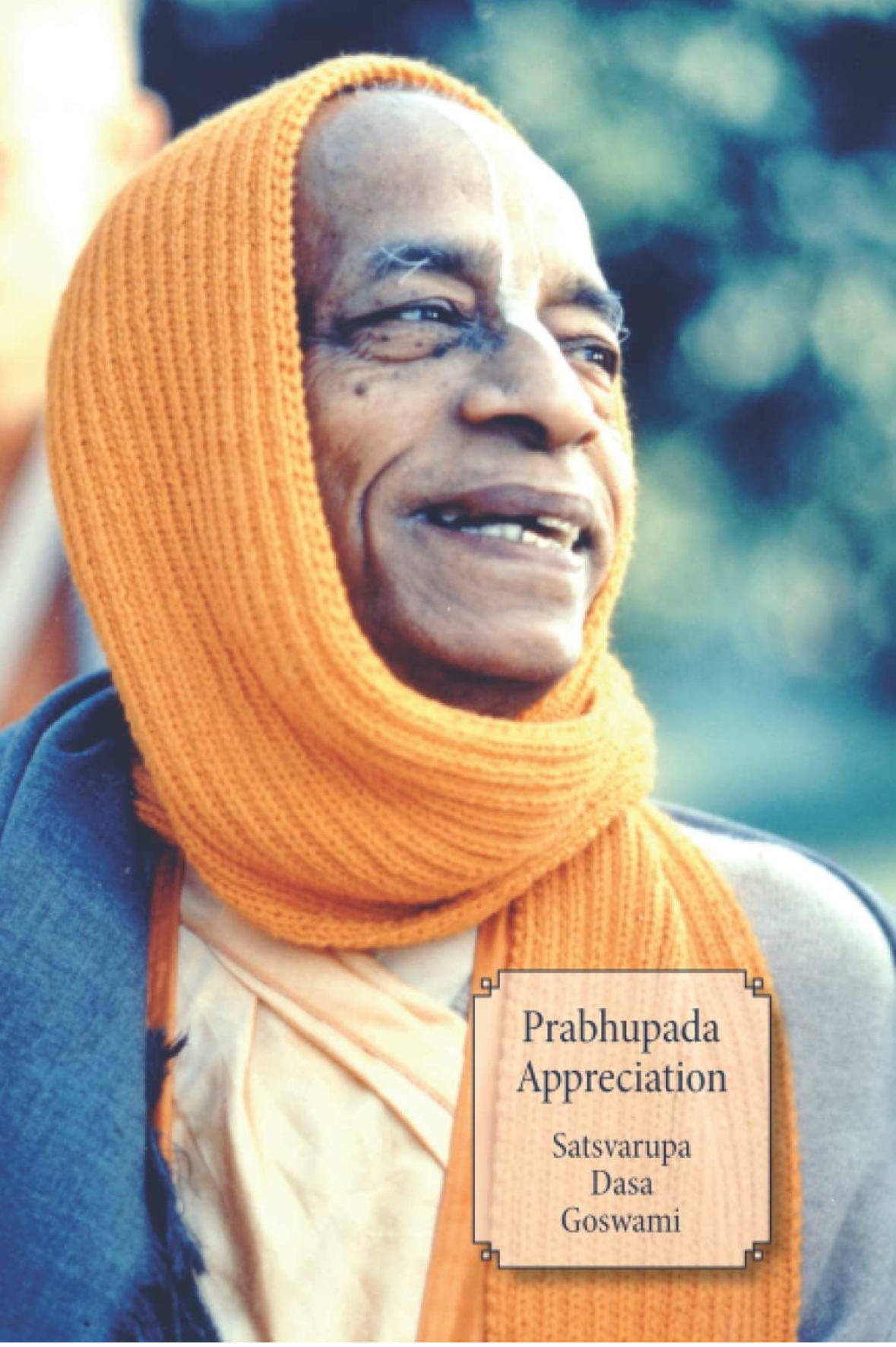
Śrīla Prabhupāda was in the disciplic succession from the Brahmā-Mādhva-Gauḍīya sampradāya, the Vaiṣṇavas who advocate pure devotion to God and who understand Kṛṣṇa as the Supreme Personality of Godhead. He always described himself as simply a messenger who carried the paramparā teachings of his spiritual master and Lord Kṛṣṇa.
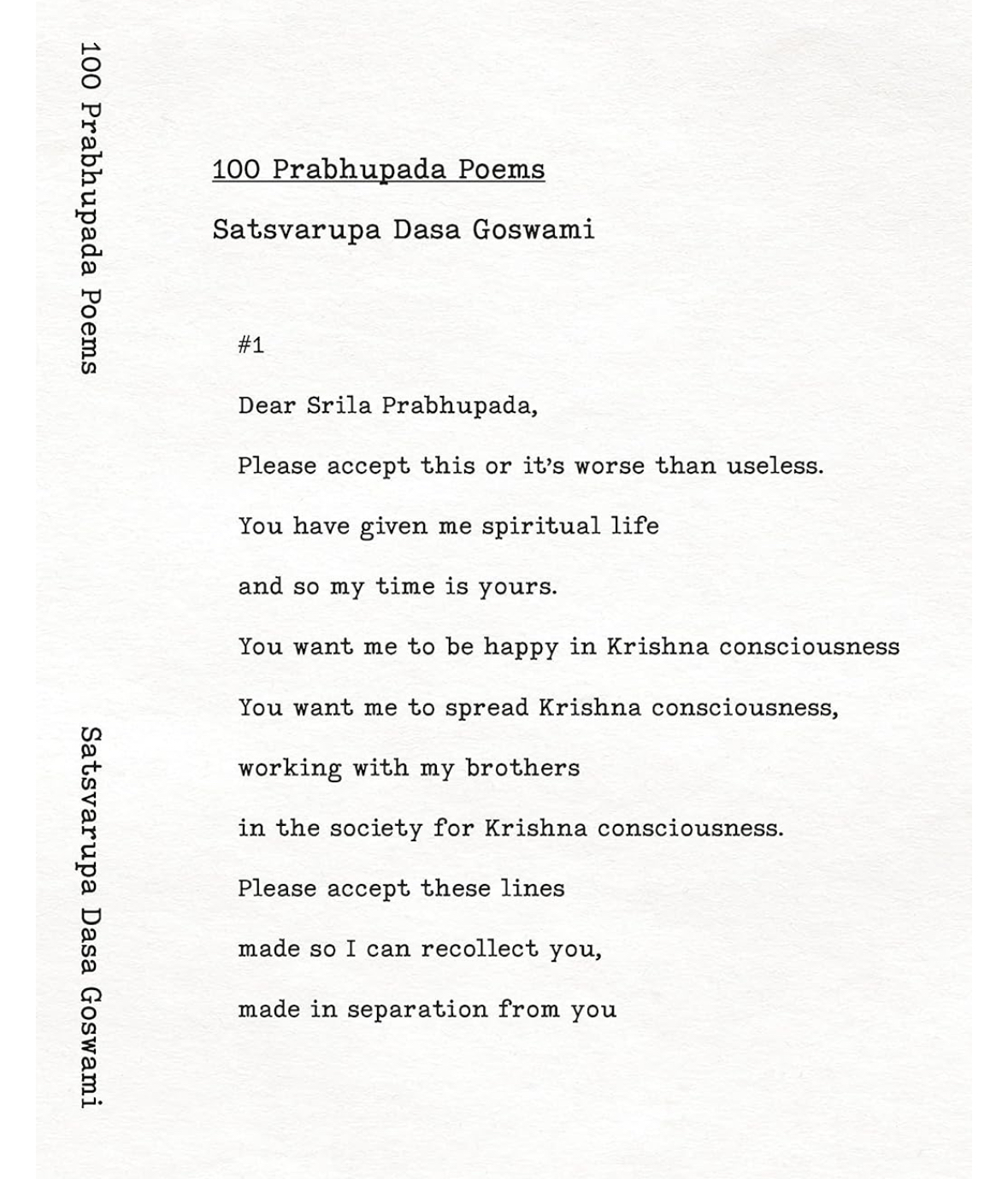
Dear Srila Prabhupada,
Please accept this or it’s worse than useless.
You have given me spiritual life
and so my time is yours.
You want me to be happy in Krishna consciousness
You want me to spread Krishna consciousness,
This collection of Satsvarūpa dāsa Goswami’s writings is comprised of essays that were originally published in Back to Godhead magazine between 1966 and 1978, and compiled in 1979 by Gita Nagari Press as the volume A Handbook for Kṛṣṇa Consciousness.

This second volume of Satsvarūpa dāsa Goswami’s Back to Godhead essays encompasses the last 11 years of his 20-year tenure as Editor-in-Chief of Back to Godhead magazine. The essays in this book consist mostly of SDG’s ‘Notes from the Editor’ column, which was typically featured towards the end of each issue starting in 1978 and running until Mahārāja retired from his duties as editor in 1989.

This collection of Satsvarupa dasa Goswami’s writings is comprised of essays that were originally published in Back to Godhead magazine between 1991 and 2002, picking up where Volume 2 leaves off. The volume is supplemented by essays about devotional service from issues of Satsvarupa dasa Goswami’s magazine, Among Friends, published in the 1990s.

“This is a different kind of book, written in my old age, observing Kṛṣṇa consciousness and assessing myself. I believe it fits under the category of ‘Literature in pursuance of the Vedic version.’ It is autobiography, from a Western-raised man, who has been transformed into a devotee of Kṛṣṇa by Śrīla Prabhupāda.”
 The Best I Could Do
I want to study this evolution of my art, my writing. I want to see what changed from the book In Search of the Grand Metaphor to the next book, The Last Days of the Year.
 a Hare Krishna Man
It’s world enlightenment day
And devotees are giving out books
By milk of kindness, read one page
And your life can become perfect.
 Calling Out to Srila Prabhupada: Poems and Prayers
O Prabhupāda, whose purports are wonderfully clear, having been gathered from what was taught by the previous ācāryas and made all new; O Prabhupāda, who is always sober to expose the material illusion and blissful in knowledge of Kṛṣṇa, may we carefully read your Bhaktivedanta purports.
I use free-writing in my devotional service as part of my sādhana. It is a way for me to enter those realms of myself where only honesty matters; free-writing enables me to reach deeper levels of realization by my repeated attempt to “tell the truth quickly.” Free-writing takes me past polished prose. It takes me past literary effect. It takes me past the need to present something and allows me to just get down and say it. From the viewpoint of a writer, this dropping of all pretense is desirable.
 Geaglum Free Write
This edition of Satsvarūpa dāsa Goswami’s 1996 timed book, Geaglum Free Write Diary, is published as part of a legacy project to restore Satsvarūpa Mahārāja’s writings to ‘in print’ status and make them globally available for current and future readers.