
We need to expand our team of proofreaders as we aim to increase the rate of republication of Satsvarūpa Mahārāja’s books as well as new books that he writes.
This includes a need for fluent bilingual Spanish and English speakers to proofread Spanish translations (we currently have around 20 Spanish translations waiting to be proofread).
Anyone interested in this particular service should contact Manohara dāsa at [email protected]
If you would like to help, please contact Kṛṣṇa-bhajana dāsa at [email protected] or [email protected] and we will find you a service that utilizes your talents.
It seems hopeless to stop the mind’s wandering, but at least let the other track (as in multiple-track tape recordings) contain the full, awake, articulated sound: Hare Kṛṣṇa, Hare Kṛṣṇa, Kṛṣṇa Kṛṣṇa, Hare Hare / Hare Rāma, Hare Rāma, Rāma Rāma, Hare Hare. Chant clearly, no matter what. Admitting the impossibility of stopping all impure thoughts, at least always keep the sound track clear. Then I know whenever I switch back to chanting, pure sound will be there. By a flick of the mental switch, I can be out of māyā into japa. But how to keep the dial locked on the pure sound?
******
This is the good struggle. I spit at the bad thought. Getting back on the track a few moments, my mind as well as my voice and jaws moving to worship the holy name, take shelter in the calling out the holy name—but then again slipping off on another track, either some devotional service, or some māyā not to be done. Is there a secret? I work my fingers over the beads, conscientiously chanting, saving my best time for the chanting, intellectually aware that chanting is the dharma for the age, preaching it as the essence of Kṛṣṇa consciousness, and aware of my poor chanting. Hope against hope: maybe tomorrow will be better. “O Kṛṣṇa, O Rāma, O energy of the Lord, Hare, please engage me in Your service.
******
But then I reached a plateau and I thought, “This is the vast intermediate zone. It stretches far and wide. It seems you can go no further than the intermediate zone. You have stopped committing the four sinful acts (previously you didn’t even know they were sinful), and you are bound by a strong vow to chant sixteen rounds daily. But after making a certain amount of significant progress, even after being initiated by a genuine spiritual master in paramparā, after chanting for years, you are still inching along in the vast stretches of the intermediate zone.”
******
So you have decided you can go no further? Is it modesty that prevents you from aspiring to pure love of God? No. You are afraid of giving up material life once and for all. “O my Lord, when will my eyes be decorated with tears of love flowing constantly when I chant Your name? When will my voice choke up, and when will the hairs of my body stand on end at the recitation of Your name?”
******
When will the day come when I chant the holy names and not just “my rounds”? Meditating on “the second round,” “the third round,” and “the fourth round” is to mix the pure sound of Kṛṣṇa’s name with the thought of an ordinary number. One, two, three, four, five, six, seven, eight, nine, ten, eleven, twelve, thirteen, fourteen, fifteen, sixteen. But these numbers are in themselves niyama-āgraha—following the rules without realization. “Now I’m on the second round,” “Oh, this is the third round”—what kind of chanting and hearing is this?
******
How often do you say, with foolish satisfaction, “I got my rounds done,” “I finished chanting,” or “I did my rounds.” But did you chant as Lord Caitanya prays? No, you were too busy trying to stay awake, trying to keep your mind on the right track. Where was time for crying at the feet of the holy name? You didn’t “finish chanting.” You haven’t even started! Chant humbly and pray, for forgiveness for your offensive chanting and for a chance to improve.
******
We can get out of the offenses in the intermediate zone by being very sorry to be there. Be troubled, be bothered by it. Then you can reform. Even in the material world, reform comes out of intolerance at injustice. The reformer of labor conditions or champion for human rights—he demands reform. He protests and goes on strike. He fights.
******
The holy name is the only way out of the material world. It is the specified mercy form of the Lord; if we neglect the holy name, we’re neglecting Kṛṣṇa Himself. How lamentable! If I do not take this mercy, I am worse than dead. I have knowingly drunk poison. I have spent my life uselessly. “Why did my attraction for that chanting never come about? Day and night my heart burns from the fire of the poison of worldliness, and I do not take the means to relieve it.” Am I just going to sit here and let this happen? The japa reformer fights against inattentive, offensive chanting.
pp. 26-29
One of the biggest issues at present [1986] is the understanding of diksa- siksa-gurus. Statements in Srila Prabhupada’s books are straightforward:
The initiating and instructing spiritual masters are equal and identical manifestations of Krsna, although they have different dealings. Their function is to guide the conditioned souls back to Godhead. —Cc. Adi 1.34, purport
We have also seen a similar statement by Bhaktivinoda Thakura in Harinama Cintamani:
There are two different kinds of gurus—initiator guru and instructor guru. Both are equally respectable. They can give unto a worthy person the treasure of the ultimate goal of life, very easily, if desired.—Harinama Cintamani Text 6.20
Clear as it is, it seems we have deviated from this siddhdnta and establish an undue prominence to the diksa-guru.
Godbrothers have written several essays on this subject with support from sastra. In one paper, a devotee asks the question, “Can the siksa-guru take us back to Godhead?” He replies, “The answer to that question is an unqualified YES, without a doubt.” He gives the following examples:
The list could go on forever. The siksa-guru can certainly deliver the conditioned soul back to Godhead.
One of the main differences between the two gurus is that a disciple is allowed to have many siksa-gurus but only one diksa-guru. Prabhupada writes that one who is initially the diksa-guru usually becomes one’s siksa-guru. But the functions of both gurus are often identical, involving the transmission of mantras and instructions in devotional service:
The initiating guru gives the Hare Krsna mantra. The instructing guru gives instructions on the Absolute Truth. All Vaisnavas are instructing gurus, and they all generate auspiciousness.—Harinama Cintamani 6.21
In ISKCON, since the disappearance of Prabhupada we have propagated a doctrine that the diksa-guru is the only guru. One of the rationalizations for this is that the diksa -guru, with initiation, acts on behalf of Krsna to take away the sins of the disciple. But Rupavilasa Prabhu offers evidence that “any sadhu or saintly person takes the sins of his disciples by his presence, by his instruction, by his touch, by his remembrance, by his having been seen, by allowing his feet to be washed, and by accepting a seat.” This is based on the Srimad-Bhagavatam 1.19.32-34, which ends with the statement, “The invulnerable sins of a person are forthwith vanquished in the presence of you saints. “(Translation from Srila Prabhupada’s original Srimad-Bhagavatam.)
A similar statement is made by Krsnadasa Kaviraja: “Diksa actually means initiating a disciple with transcendental knowledge by which he becomes free from all material contamination” (Cc. Madhya 4.111). Another example is Lord Caitanya’s initiation of the Buddhist teacher whom He met in His travels in South India. The initiation simply consisted of the Buddhist disciples chanting the Hare Krsna mantra into the ear of their guru, on the advice of Lord Caitanya. Describing the conversion of the Buddhists, Prabhupada writes, “Initiation means receiving the pure knowledge of spiritual consciousness” (Cc. Madhya 9.61, purport). Lord Caitanya also initiated a Sufi Pathana simply by inducing him to chant the holy name. Lord Caitanya then induced the Mohammedan’s followers to also chant. As described in Caitanya-caritamrta, “As they all began to chant, they were overwhelmed with ecstatic love. In this way Sri Caitanya Mahaprabhu indirectly initiated the saintly Mohammedan by advising him to chant the holy name of Krsna” (Cc. Madhya 18.203-207).
All bona fide preachers perform this kind of initiation, encouraging people to chant Hare Krsna, giving them instructions and engaging them in devotional service. In the light of these conclusions, another writer points out the grave error in the guru institution which has developed since Prabhupada’s departure:
In the wake of Snla Prabhupada’s departure, all his sincere disciples who were strictly following the process of Krsna consciousness were actually meant to be approached and seen as gurus, especially by new men. This was everyone’s legacy. It is their certain responsibility to try to deliver others. Let the new men coming to our movement determine for themselves who among the staunch devotees they meet is their spiritual master: siksa, diksa, etc. We have made a grave error in organizing the movement the way we have. Many persons have been gravely disrespected. Many have been discouraged by our erroneous behavior in Vaisnava relations. All are to be respected.
Bhurijana Prabhu has also written me about the importance of equating the siksa-guru with the diksa-guru:
Siksa- and diksa-guru are both equal manifestations of Krsna. In the purport to C.c. Adi text 57, Prabhupada states of Bilvamangala Thakura and his book Krsna Karnamrta, “In the beginning of that book he has offered his obeisances to his different gurus, and it is to be noted that he has adored them all equally” (instructing spiritual master, initiating spiritual master, and Krsna, who was also his instructing spiritual master). Krsnadasa Kaviraja also ends each chapter of the Caitanya-caritamrta by offering respects at the feet of several of his instructing gurus. In Cc. Adi 1.7, he mentions that all of the six Goswamis are his instructing gurus, and he puts forward his pleas for their mercy. Our movement had equated guru with diksa-guru, and in my opinion, this has caused many problems. Therefore, establishing the true philosophy of guru will be a major step toward the resolution of our difficulties.
Bhurijana feels that we should be cautious about too much apologizing, though it also has its place. Confidential meetings of Godbrothers is the best forum. We should go over the history of our movement from Prabhupada’s disappearance to the present, understand how we imitated Prabhupada and see the problems that that caused. The right understanding of siksa and diksa should be established. And all Godbrothers should be encouraged to act as spiritual masters.
pp. 73-80
I’m really here
practicing to be a devotee.
I don’t want to be with
AG and JK, listening to their poems
and getting disgusted. They can jabber,
they can dream, I will go the way
of Vaisnava saints and sages.
There’s a map of Bengal and the places
of Lord Caitanya’s pastimes in back
of Cc. volume, but I
am here at typewriter in Geaglum,
rain outside . . . slow down.
You will be able to speak in the
temple room this Sunday morn
on liberation of Sarvabhauma Bhattacarya.
Temple and Deity room are so
cold it feels like ice when you
touch Radha-Govinda. A
pujari’s bare feet.
How about a wood burning
stove in the Deity room?
I love Prabhupada when he’s speaking
and I can perceive
the kindness and homeliness,
in morning Cc. classes in NYC 1966
and New Vrndaban ’69 when he’s talking
from First Canto Bhag. Fifth Chapter
it’s really nice, him sitting on a
funky sort of vyasasana
Nara-Narayana dasa and others laughing when
he says, “Krsna consciousness is like
inoculation against the Hong Kong
flu of material life.”
I have to swallow
the fact that he is many-sided and
can get angry at his disciples. He
says, “Why are you asking that?
You’ve been a student for 10,000 years
and you’re asking that question?”
And he repeats again and again.
I am his cela, to hell with
those who make fun of me
as they did (or I imagined it)
when I raised my hands for the first time and danced
in Tompkins Square Park.
The laughable thing is my hesitation
not the dancing. They are right
to mock me when I look
fried. My guru is so
strong and forceful. If I accept him
and I’m confident—and if still they mock me—
then I simply don’t care.
I am blowing this on a Sunday morning
not a jazzman but
a small, faulty cela who is
actually happy and has something
to share.
Jack’s going nowhere, went to hell.
I am here and singing these songs
besot with ISKCON controversies.
I walk to shed
I’m selfish, I’m not selfish
I’m in between.
Talk about you instead?
I’m an agreeable person
willing to pose for a pencil sketch,
don’t mind if it’s a caricature,
showing me with a weak chin and so on
whereas if the cartoonist makes Indira Gandhi’s
nose too long, she can cut off
his head
(but she’s dead now)
Okay, drop me and go to Krsna.
He’s the Supreme Lord, He cuts through
in Bhagavad-gita. He is vibhu
and I am anu. He is infinite and I
am the opposite. Right now I am
acit, nirananda and non-sat.
Actually, I am Satsvarupa dasa.
Let go, get lettuces,
I got apples and pears both—
there are no other fruits for sale
except bananas and oranges
a few veggies also.
But it’s peaceful on the devotee-owned
land. Got no money
they don’t plant taters,
and I’m here to do the business
of the sage
the aloe gel for cuts.
I’m here to sing
to awaken the birds
to go on my own, yearning
for a letter from Croatia saying, “We
read your books and it’s funny but
they help us a lot, why don’t you
visit? We have a house on
the Adriatic Sea—you could
write there maybe.”
Yes, write for the purpose of
pleasing and serving Krsna.
She asked
is all right if you use the form
of Krsna in a fill-in-the-dots game,
and a game where the body disappears?
I said be cautious about that, the
Lord is not a plaything.
I was sober and noncommittal at
the same time. Is it all right if we use
a jug for fiction? Can we eat paranormals,
blue-green algae and chocolate fudge? We saw you
eatin’ a peanut butter sandwich
so can we too if it’s offered
first to Krsna?
I said don’t ask what you can get away
with but, “How can I be perfect?”
I said, “Thank you for your letter I
am shocked, amused, concerned and benighted
by the fact that you are in trouble.
I intend to come down there and
linger awhile with you and
read some sastra out loud, I
hope. If the airlines don’t smoke dope.”
I intend I said,
but there is too much mail,
got confused
lay down on the floor head aching,
got better.
She said yes I’m
much better but not my husband and
the miseries continue, if not one then another—
they move like an epidemic,
like paper money passed around,
disease is for mortals
birth, death and old age. So please
listen to the teachings of Lord Caitanya
please take a book,
it’s for your good please chant
the holy names but they don’t.
They say, “This is a Hindu trip,
political suicide to get near the Hare Krsnas.”
But we make them hear
chant Hare Krsna Hare Krsna, Krsna Krsna Hare Hare!
“Waiting for philosophy’s dreadful
murderer, Buddha!” That’s what JK
called him and he’s a worshiper, so-
called.
I got back from the shed just
now over the mud flats. Drew out
there two pictures of swans, it
delivered me,
Krsna allowed me.
As I was walking I heard first, then saw
the Army helicopter
high in the sky but coming down
lights blinking at 4 p.m.
And I saw puddles
in the woods contemplating.
It used to be summer and fall here
and I am different. I’m less . . .
“poetic” less “reflective,”
just work and walk in my purpose.
From those enfolded woods where I
was walking and chanting with my
dhoti bottoms lifted up
so as not to get muddied, I heard
first and then saw a white commercial van.
It went up towards Manu’s house
on the side of it was painted
“Supermarket.” And I wondered
what they could be delivering.
But in the shed I was more Krsna conscious,
made prayers and half promises,
read Bhagavad-gita
and the wisdom came pouring out on me in
two fifteen-minute reading sessions.
Krsna is covered by Yoga-maya
and reveals Himself
only to pure devotees.
pp. 41-44
We’ve pulled over at a bus stop on Czech highway for a few hours. The plan is to arrive in German farm tomorrow after their morning program. That means I’ll be expected to give a general talk to a Sunday audience which may be mostly devotees but some guests.
I don’t feel so vital about it. It’s like another border crossing; show your papers. Demonstrate you can speak a Krsna conscious lecture to people who may not be so eager to hear you. And I’m not so eager either, prefer the private world of spontaneous thoughts that come out in writing sessions or radio show. But I’m willing to make a good show of a lecturer if I can, by taking a verse, purport, and topic beforehand.
Go for something that Srila Prabhupada did and follow his footsteps. It ought to be satisfying to hear, give some general encouragement in basic Krsna consciousness. The talk I gave on “Krsna Meditation” at the Czech farm was like that. I gave a Sunday talk in Prague, how did that go? I spoke on nayam deho deha. I can’t recall now how I lectured and how it went over. But I think there were more guest than you could expect on the German farm.
And you have a stereotype that they are already programmed to hear a kind of European-zone preaching.
(We are so close to highway, a few feet, that a fast car makes our van shake in its wake.) Milkweeds and ordinary green taffle topweeds moving in a sunshiny breeze.
How do you go about choosing a Sunday lecture verse? I’m considering 1.2.17, śṛṇvatāṁ sva-kathāḥ kṛṣṇaḥ puṇya-śravaṇa-kīrtanaḥ. You could speak on verses before it and the one after. It would be real, traditional, expected of Satsvarupa, so why not? Read purport up to the first paragraph where it mentions that taste develops by service.
Srimad-Bhagavatam 1.2.15 says knot of karma (causing rebirth) has to be cut. It can be done by using the sword of giving people a chance to hear (not Islam preaching, “Accept this scripture or I cut off your head.”)
How does this hearing sever the knot of bondage? Because the Lord’s activities are transcendental and as you hear, you get spiritualized. But problem is lack of taste for this hearing, whether by Hare Krsna mantra or Srimad-Bhagavatam.
So 1.2.16 tells us that by service to the pure devotees we gain affinity to hear. Mahat sevam dvar muhar vimukte. Give practical down-to-ISKCON-earth application on these points. How serving Srila Prabhupada and Vaisnavas helps us develop taste. They have experience of it. Remind them. More service equals more hearing equals more service equals more hearing. It’s all part of one life in Krsna consciousness.
Srimad-Bhagavatam 1.2.17 says the Supreme Lord Himself cleanses the heart.
A main point I’d like to dwell on is developing taste. Lack of taste is due to jaundice. Lord Caitanya Mahaprabhu said it’s due to offenses.
Vaidhi means entering the discipline of regularly hearing, and also service should be done intelligently with the aim to increase Krsna consciousness. Know it comes from Srila Prabhupada.
Am I bluffing and that I don’t really know myself how this works? Not bluffing as long as you stick to texts and don’t claim this is all coming from your realization and you know it.
Here are text and a subject matter you can develop. Do a rough draft outline one time. Then do it again and then prepare some Post-its.
Took a little time to read some pages from Basho’s Narrow Road to the Interior. He was deeply into always visiting literary or military places, and with great respect for Buddhist monks and shrines also. Perhaps the thing that attracts me most, aside from his poetry and the way he writes things (“The swift and unaborted tone of Thasau’s narrow road to the interior”)—is the very fact that he’s a traveler and we’re also traveling. It tells about one place where they had thin, straw sleeping mats on the bare ground and no lamps but were grateful to close their tired eyes at night:
Suddenly a thunderous downpour and leaky roof aroused us, fleas and mosquitoes everywhere. Old infirmities tortured me throughout the long, sleepless night.
At first light, long before dawn, we packed our things and left, distracted, tired, but moving on. Sick and worried, we hired horses to ride to the town of Kori. I worried about my plans. With every pilgrimage one encounters the temporality of life. To lie along the road is destiny. Or so I told myself. I stiffened my will and, resolute, crossed Okido barrier in Date Province.
We read in the notes that Basho sometimes fabricated the extent of the austerities he underwent. More important for him was a certain literary effect he was creating. But that seemed strange. Why falsify the actual externals? The translator mentioned the “fictive touch” as they say, that they’re excusable because Basho was after something deeper, he wanted to stay in the pot for many literal readings of his adventure, emphasizing spiritual over autobiographical qualities in the book. He did not, however, exaggerate his poor health and the very real physical dangers of the journey. Even though his journey took place during Genroku, a time of relative peace under the Tokugawah Shogunate, travel was always dangerous.
Too tired to do radio show. I could go outside and walk and try it, but the flies are bombarding out there. It’s definitely pleasant-seeming here on the edge of a forest. We were in this exact spot three years ago on our return from Czech. We know many spots like this around the world, little familiarities—the nozzle-less shower in a rooftop flat in Delhi, a P-stop in Poland where there’s a stream, we passed it up this time . . . uphill in back woods at Gita-nagari where I tried to pray . . . and even back to Public School 8 when we went there three years ago, right into the playground and saw the rectangle printed on the brick wall for the strike zone when playing stickball . . . the driveway at 125 Caton Avenue. That was a bit weird and “too much” to go back to all that, better not do it again . . .
Think of Gaura-Nitai Deities around the world, and things you like to do . . . Water . . . an overnight in P-stop is okay too, a bit uneasy after all, since your tin can is vulnerable, so you sleep in Krsna’s protection . . . and locked in. Trust in civilization now in Germany. Police. Robbers. Hare Krsna monks.
In God we trust.
Got my lecture outlined. By serving the pure devotee, sraddha develops, and that leads gradually to vasudeva-katha ruci. In this way, the verse can be explained.
I’m writing this just to say goodnight friend. In the morning, we’ll be up writing and reading.
Vasudeva-katha ruci. May it come to you. Lord Krsna wants you to taste the nectar of His pastimes. But you have to overcome so much nonsense. What do the schol¬ars say? Who cares? To those who serve the pure devotee, affinity for hearing the message of Vasudeva develops.
No sooner did I write this tired, “Good night,” then the police arrived and knocked on my back door. Gosh! Two big-bearded Germans in tan uniforms. I let M. handle it. He went out and showed his papers. I opened the door and showed my passport and my face. But the flies were going crazy out there and I shut the door.
“On holiday?” they asked.
“No,” I said. “We are Hare Krsna monks.” They knew the location of the farm. It may seem funny to them that we’re staying here and not going on to the farm. But it’s late and we want to take rest. Hope they don’t come again, or anyone else.
pp. 60-64

I pray to You as the Supreme Enjoyer, the reservoir of all pleasure. I have recently been discovering that You enjoy
Yourself in ways inconceivable to we mortals. You enjoy in the adi-rasa, the mood of conjugal bliss, and that is why so-called conjugal bliss exists in Your parts and parcels, the conditioned living entities. Due to our misconception of ego (self), we think we are the enjoyers, and we imitate Your pastimes with the gopis in the spiritual world. Because we are not actual enjoyers but Your servants, we entangle ourselves when we try to usurp Your position, and our amorous affairs turn out to be illusory and temporary.
When I heard some of the details of Your amorous affairs with the gopis, I imprudently thought, “Oh, He is doing like we do.” And I made a great mistake. Then I came to realize I had better not even hear of Your intimate exchanges with thousands of gopis because I was bound to misunderstand. I cannot judge or even ascertain Your enjoying power. Whatever You do, it is perfect and pure. You only enjoy in conjugal affairs with the best of all spiritualists, who themselves are selfless, perfect and pure. Your exchange is the epitome of love of God in action. The gopis seek no sense gratification in their exchanges with You, and You dally with them out of Your own pure heart to please them and please Yourself in the spiritual energy.
At the end of the rasa dance description in the Tenth Canto of Srimad-Bhagavatam, Sukadeva Gosvami says the hearing of this pastime will vanquish the lust of the heart. So it is not forbidden that we hear of Your rasa dance. But we should do so only after fully understanding Your position from Bhagavad-gita and the nine cantos of Srimad-Bhagavatam. The rasa dance is for qualified listeners only. Those who take it as mundane sexual affairs between a boy and his girlfriends—or who take it as mythological or symbolic—commit a great offense. One has to deserve and then desire to hear the rasa dance. And one should hear it only from the lips of a pure devotee. Sometimes professional speakers hold Bhagawat Saptahas (seven-day readings of Srimad-Bhagavatam) and go at once to Your dealings with the gopis. They are wrongdoers and cause harm to those who hear them.
I want to relish all Your pastimes in Srimad-Bhagavatam, beginning from the First Canto, and I pray to You to give me taste to do so. We should hear of the gopis, but also of Maharaja Pariksit, Narada Muni, Prahlada Maharaja, and all the great personalities whose lives, prayers and teachings are given in Srimad-Bhagavatam. For the truly rasika devotee, it is all nectar.
I have just caught a headache, and my prayer sees a “STOP” sign up ahead. But I wish to say a few more things before I end. I wish to say I love You in all Your incarnations, including your saktyavesa avataras (empowered living beings). All Your Visnu forms are worth hearing about by me. You are not only the intimate lover of the gopis and the protector of all life—not only that great range of interests and occupations are Yours—but You are my God. I have a right and a responsibility to say, “You are mine.” This stage of thinking that “You are mine” is called mamata. It is technically an advanced stage of devotional service. But I think we neophytes may also claim it. Is it not true? Don’t You belong to me? I know I belong to You, and so I may dare to say the reverse is true—that You belong to me. If this is not true, then I am cut off from the most precious and essential connection of my life. You are my God, and I worship You as my controller and protector, as well as my best friend. Please guide me through the heart how to approach You in the safest and quickest way.
I am writing to You in the afternoon. I just had lunch with my friends, and there was lively conversation. Now we are alone. I look to You in my mind and heart. I find You there. You are a quiet, abiding presence. I cannot perceive You with the clarity and intensity of a great devotee, but I know I abide in You. When I call on Your names, You answer back. “Narada penetrates into the presence of the Lord by the transcendental chant.” You keep me alive in this body by Your will, and when my time comes, You will withdraw my life. You are completely in control. But since I am one in quality with You, You have given me a small amount of free will, just as You have unlimited free will. You never misuse Your will, but I am marginal; I am prone to act sometimes within the material energy and sometimes in the spiritual energy. My responsibility as a human being is to act for Your interests, and my own, and stay within the spiritual energy by engaging in devotional service. I pray for the intelligence to act as Your devotee.
Please inspire me to regularly hear about Your glories in books like Srimad-Bhagavatam and Brhad-bhagavatamrta. Reading them is like a hungry bhakta honoring a prasadam feast. And let me regularly take pleasure in seriously chanting Your holy names, Radha and Krsna. The chanting benefits us far beyond what we can actually estimate or appreciate. You have invested all Your potencies in Your holy names, and there are no hard and fast rules in chanting them.
I like to be alone with You and hear You talk to me in the quiet. And I like to recite the uttama slokas (perfectly composed verses) contained in sastra. For example, Srila Sanatana Gosvami begins his Brhad-bhagavatamrta with these two verses:
Text 1: “All glories to that inconceivable Lord who descended to bestow the gift of perfect love for His own lotus feet. He is an ocean filled with many kinds of sweetness, and He always bears the fragrance of fresh youth. In His form as Sri Caitanya, He has realized the last extreme of transcendental experience, the love residing externally in the gopis.”
Text 2: “All glories above all to the gopis, headed by Sri Radhika, who are famous as the Lord’s dearmost devotees. No one can even begin to properly describe the charm of their supreme affection for Sri Hari.”
When I consider the meaning of these verses, I feel complete and transcendental. I feel I have just been given the topmost knowledge in perfect utterance. And then I want to go on hearing more.
You are the object of my prayer. You are the Lord of all true religions. You are the most beautiful person. You are also the most powerful. You consider Your pure devotees to be even more merciful than Yourself, and You empower them to do great deeds on Your behalf. As we consider even a few of Your attractive, transcendental qualities, we become filled with appreciation of Your Lordship. And we are simply in awe over the benedictions You bestow on Your intimate devotees. You allow them to play with You, become Your mothers and fathers, be Your close friends, and ultimately Your parakiya lovers. You gift Your preachers with the ability to win thousands of conditioned souls to Your service and free them from the chains of samsara.
You so much like the life of the devotee that You personally assumed it Yourself as Sri Caitanya Mahaprabhu. In that golden form, You spread love of God and tasted its essence. That You could not do even in Your original form as Sri Krsna.
Please accept my praises and allow me to serve You. I am very tiny and insignificant, but You allow me to use words describing Your glories. I am grateful for this. It makes my speech chaste and gives others the chance to appreciate who You are. You are the dearmost person for all living entities, and we should always reciprocate with You in that way and make expressions of Your divine qualities. I pray to one day actually become dear to You and reach spontaneous devotional service. Then my spiritual master would be pleased with me, and my life would be complete.
pp. 12-16
We pare from our lives anything that is not Krsna conscious. Therefore, it is natural to remember those things that we did during our Krsna conscious practices and to forget the rest. Yet some of those other memories must remain because we want to make a truthful testament. We don’t want to be guilty of self-hagiography, or turning ourselves into ideal saints. We have seen a few such treatments written by Srila Prabhupada’s grand-disciples about their initiating gurus. Although it is true that Prabhupada’s disciples were all fortunate objects of his mercy, it is also true that most of them underwent conversion between the ages of sixteen and thirty. When we read that their guru showed spiritual tendencies since childhood and that his childhood was like no other childhood, we begin to wonder if it’s true. Aren’t they idealizing their spiritual master, trying to present him as a picture of perfection? Rather, their spiritual master might have been “rascal number one,” as Prabhupada puts it. He might have been more like Valmiki before he met his spiritual master. It’s nothing to be ashamed of.
I would like to tell you frankly how I feel about capturing the examples in my own life of less than perfection. I feel a sense of accomplishment when I can take a piece of the mosaic of my life and place it in the context of my present. I feel that sense of accomplishment, especially when I take a shattered piece, a painful piece, a piece that had no connection to Krsna consciousness. Of course, there is no shortage of such memories, and by letting them out one by one and then leaving them behind, I almost feel as if I am paving the way to the more pleasant memory that Prabhupada saved me, and that my life now is real.
Bay Terrace is one of the stops on the Staten Island Rapid Transit (SIRT) toward the south. Although I’m sure things have changed since I rode the train in the 1950s, the route is probably similar. The train began at St. George and traveled south toward the smaller towns and countryside until it reached the end of its line and turned north again.
I still remember looking at the scenery from the metal-screened windows. The train had hard, straw-thatched seats. They were probably plastic or fiberglass, but they looked like rattan chairs with crosswise stitching. Some of the chairs could be reversed, and at the end of the route, the conductor would walk down the aisle and swing them all around to face the other direction.
I lived in Great Kills, which although not one of the smallest towns, was still quite small. Going south, the train stopped at New Dorp and then a few more towns after that, then a tiny town called Bay Terrace, which was right before Great Kills. Bay Terrace was so small that the conductor would walk through the cars (the trains were often no more than two or three cars long), asking if anyone planned to get off at Bay Terrace. If not, he would speed right through it, provided there was no one waiting on the platform to board the train. Bay Terrace was the sticks.
Why does Bay Terrace come to mind? It just popped into my memory today, and with it the name of the first girl I ever dated. Her name was Alice Erickson. When I was about eleven or twelve, we went to a square dance together. By today’s standards, dating in those days was backward. The schools were strict and the young people were not promiscuous. I didn’t know anyone who took drugs. We had never even heard of marijuana. Alice Erickson was in my class. I don’t remember much about her except that she was bigger than I was—I was quite skinny—and that she invited me, probably by phone, to a dance.
Alice was a kind of no-account person. To this day I don’t know why she asked me to go, but it was thrilling to go to a dance with a girl. My parents were agreeable—in fact, they drove me to the dance—and it was at night! I hardly ever went out at night beyond my own yard or neighborhood.
I’m embarrassed by the antiqueness of this memory. Imagine talking to a person of the ’90s about square dancing or the foxtrot. Did we wear plaid shirts? Was there a fiddler? A caller?
Neither of us had hit puberty yet. I still remember standing on the floor like pieces on a checkerboard and the caller telling us how to dance: curtsy to the left, bow to the right. First go forward and then go back, then in and out. We were weaving and maneuvering around, sometimes dancing away from our partners and sometimes joining them again. Sometimes we would link arms at the elbow and sometimes swing each other by the hand. Our spirits were high and our faces flushed. We were happy to get through the steps with the music.
It was otherwise an uneventful evening. We didn’t end up hating each other when the evening got too long and I didn’t step all over her feet. I counted it as a triumph—I survived my first date. We didn’t follow it up by becoming friends. I never asked her out after that and she didn’t invite me to any more dances. I still don’t know why she invited me in the first place, but somehow my name came up and she reached out.
pp. 243-46
Who are you, Bhakta Bob?
“I am your own self. I come from the fields, a friendly scarecrow, a Frankenstein. I can speak this way or whatever way you wish. (I’m a puppet of your imagination.) But I do have a core of independent identity that has sprung up from you.”
What do you want to do in your Krsna conscious life?
“I don’t know. I need guidance. Maybe I shouldn’t get married. Maybe I should. Maybe to Pegeen, maybe to the bronze woman, Molly Malone, who wheels her wheelbarrow/ down streets broad and narrow/ crying “Cockles and mussels, alive, alive-o!’”
Do you uh . . . are you alive? Are you like the young Polish man I know? What was it like when we left you alone in Bohemia?
“You know, ask yourself.”
Bob, I can’t get rid of you. I mean, why do you even exist at all? Why don’t I just forget you?
“It’s too late to crumple me into a ball or shred me. The soul cannot be cut or dried.”
Do you have a soul?
“Do you?”
I asked you first.
“I don’t know. But you wish me to be a story figure, a person like Alice in Wonderland or Chota or Nimai, right? You want me to live in the hearts of readers in the great tradition of literary fiction. That can happen if you skillfully patch me together. Some Fergus, some Subala, some Parasurama, some Satsvarupa . . . But I don’t think you have the gumption or discipline, and neither do you believe it’s worth taking the time to ‘create’ me.”
Because in the end, you don’t really exist.
“That’s your fault. Would you say that Romeo and Juliet don’t exist? Are they not eternal young lovers? Do you think Chota doesn’t exist? They exist in a world of imagination and those who partake in it believe it and add it to their lives. We don’t even see the souls of those flesh and blood people whom we see and touch and smell every day. We only see their bodies. It’s possible you could see as much soul in a literary character as you do in a flesh and blood boss or wife or son. But you haven’t brought me out enough. I remain a kind of joke, a paper weight, a motto, a cut-out doll. I’m your ‘Bhakta Bob’ whom you play with and toss this way and that saying, „What shall I do with him next?’ If you give me more life and freedom, I could act in real ways and accomplish your purpose.”
Sorry about that…..
LJ got a letter in the big FedEx box of letters from a real live Bhakta Bob. I quickly scanned through the dozens of letters, looking at the upper left-hand part of the envelope for the name of the sender, and it flashed by: “Bhakta Rob.” What? There is one?
Bhakta Rob is real. He began his letter,
“I am currently writing to you from N.Y. I was very inspired . . . ” He has service in the Brooklyn temple where he lives. He’s thinking of getting married. He’s a member of a Krsna conscious rock band and they’re going on an international tour soon. He has been thinking a lot about japa and prayer. “My question is, is it best for me to avoid self-prayer and try to adopt and recite the mood of prayers I read by the acaryas, or ….. ”
Shall I steal from Bhakta Rob and give to Bhakta Bob?
“You don’t have to. I have my own life. Just see me for what I am.”
(He’s growing like a worm, like the flowers in the yard. He and I are friends, partners. Dinanatha dasa is also a little bit of Bhakta Bob. He’s Italian, but he wears a sweatshirt that says, “Team Partners.”)
In the mail, someone sent me a copy of Kafka’s The Blue Octavo Notebooks. She wrote: “Kafka is both captivating and disturbing. A bright light in too narrow and plain a room.” She was interested in the patchwork of poetry and prose, single sentences and rambling notes, journal entries and narrative, and “I thought the variety of expression might encourage you to continue with your free-form style.”
He’s another crazy man, not like me. I’m a perfectly sane devotee, a transcendentalist (not a speculator like Thoreau). I’m making fun here, but it’s true, I should take responsibility for the gift of Krsna consciousness and write nicely.
Hare Krsna Hare Krsna, Krsna Krsna Hare Hare/ Hare Rama Hare Rama, Rama Rama Hare Hare.
pp. 257-61
He went alone to sell his books. Institutional sales were brisk but then they stopped and he had to spend much time selling just a few volumes. There wasn’t enough time for one person to translate and write, to collect, to oversee the printing and proofreading, and to sell—at this rate he wouldn’t live long enough to finish the job.
Prabhupada’s first volume got prestigious reviews in India.
As we read the reviews tonight, Ganga dasa interjected, “The scholars in India gave nice reviews saying that Prabhupada’s book benefited mankind, but they couldn’t imagine that one day these books would be distributed by the millions!”
Bhaktivedanta Swami returned to his rooms at Radha-Damodara for intensive writing on Volume Two. He went through the same painstaking steps to get it printed in New Delhi. Finally, in 1964, he got a donation from Sumati Morarji which enabled him to also print Volume Three.
Three volumes—the First Canto—meant that he was now ready to go to America. He returned to Sumati Morarji. Her secretary reported to her, “The Swami from Vrndavana is back. He has published his books on your donation. He has a sponsor, and he wants to go to America. He wants you to send him on a Scindia Ship.”
“No,” she said. “You are too old. You are not healthy and it is too cold there. Americans are not cooperative.” She wanted him to stay in India and complete the Srimad-Bhagavatam. Why go to the States? Finish the job here.
But Swamiji insisted that she give him a ticket, and finally she agreed. “All right, get your P-form and I will make an arrangement to send you by our ship.”
. . . he was dangerously old and not in strong health. . . . in America it would be different. He would be no one, a foreigner. And there was no tradition of sadhus, no temples, no free asramas. But when he thought of the books he was bringing—transcendental knowledge in English—he became confident.
The black cargo ship, small and weathered, was moored at dockside. . . . Indian merchant sailors curiously eyed the elderly saffron-dressed sadhu as he spoke last words to his companion in a taxi and then left him and walked determinedly toward the boat.
—Srila Prabhupada-lilamrta, Vol. 1, pp. 287-89
Madhu closed the book and looked up beaming, “That’s fabulous!” Ganga dasa was smiling too. The best story, the very real and human story of Srila Prabhupada.
7:00 P.M.
Srila Prabhupada is sitting at a tea stall in New Delhi. He has his right hand on a stack of Back to Godhead magazines. He is holding one copy, offering it to a man who is about to sip a glass of tea. Prabhupada is surrounded by other tea-drinkers. He looks like a sadhu, a friend, a determined scholar, a saint. We didn’t know him then.
Now he is in the grimy little printing shop. Crumpled up pages litter the floor. Prabhupada has a proof in his hand, a large sheet of printed paper. He is looking at the printer who is explaining why he’s so slow. Prabhupada doesn’t accept his excuses. Prabhupada is expert in business. Some say a sannyasi should stay in Vrndavana and not move among the printers. But unless Prabhupada did this, Srimad-Bhagavatam would never have come out.
Srila Prabhupada is posing with Prime Minister Lal Bahadur Shastri in New Delhi, 1964. It’s just a brief moment, a cultural symbol of sadhu and ruler. Previously, Prabhupada had met with the Vice President, who had asked, “How can love of God actually solve man’s problems?” Prabhupada had gone home and written a long letter answering the leader’s questions.
Here is Srila Prabhupada looking stern, sitting in the sunshine outside his room in Chippiwada. He has his three completed volumes of Srimad-Bhagavatam in front of him. He is “no nonsense.”
Here is the photo of Prabhupada from the cover of the Scindia pamphlet, “India’s Message of Peace and Goodwill,” which he had printed up to accompany him on his trip to America. Prabhupada stares out from this pamphlet with an extremely grave look. We on the Lower East Side had never seen such a person. He seems to be beyond male and female, beyond happy and unhappy. He is staring right through the universe. He is staring right through me.
Here is Srila Prabhupada laughing that I am a nonsense. Here is Srila Prabhupada grave about ISKCON. He explains that we never should have deviated in any way. Did he ever deviate from the orders of his Guru Maharaja? Never. Why do we? The instructions are clear. Deviation means we are foolish rascals with desires other than service to guru. He means me.
Srila Prabhupada reprimands me. But that also means he claims me. He brings me close with an angry look: “You should not have done this. You are an old student. I expected you to uphold the standard. Why did you do wrong? Why now you still don’t understand? Do you want to help me spread Krsna consciousness?”
Yes, I do, Srila Prabhupada.
“Then do as I say. This is not good, this deviation.”
I always said I wanted his attention. So now I have his mercy. But I must rectify.

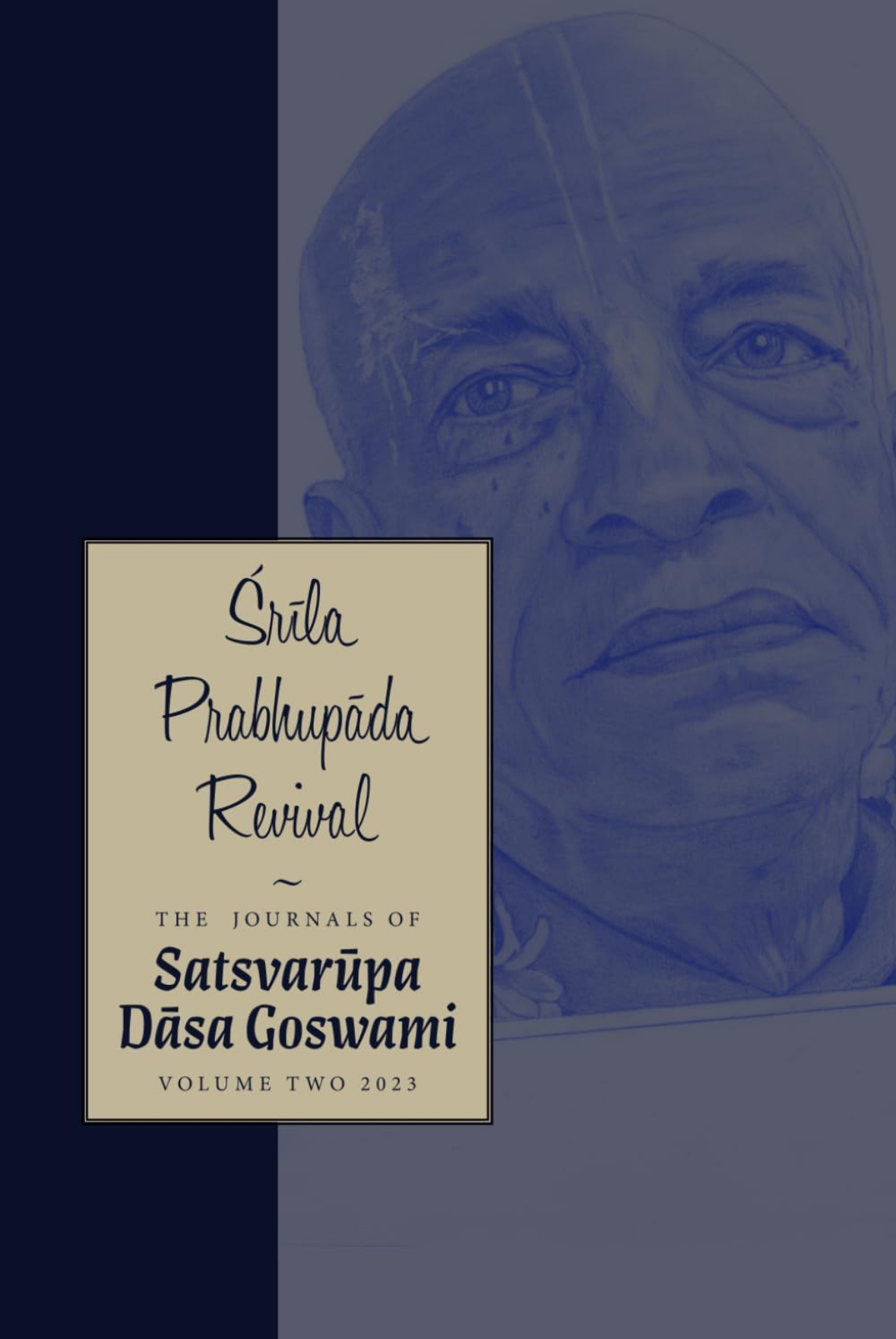
Viraha Bhavan Journal (2017–2018) was written by Satsvarūpa Mahārāja following a brief hiatus in writing activity, and was originally intended to be volume 1 in a series of published journals. However, following its completion and publication, Mahārāja again stopped writing books, subsequently focusing only on what became his current online journal, which began in August of 2018.

At first, I took it hard that I would have to live surrounded by the firemen, and without my own solitude. After all, for decades I had lived in my own house with my own books and my own friends. I was also now a crippled person who couldn’t walk, living among men who did active duties. But when Baladeva explained it to me, how it was not so bad living continually with other firemen and living in the firehouse with its limited facilities, I came to partially accept it and to accept the other men. I came to accept my new situation. I would live continually in the firehouse and mostly not go outside. I would not lead such a solitary life but associate with the other firemen.
Let me write sweet prose.
Let me write not for my own benefit
but for the pleasure of Their Lordships.
Let me please Kṛṣṇa,
that’s my only wish.
May Kṛṣṇa be pleased with me,
that’s my only hope and desire.
May Kṛṣṇa give me His blessings:
Kṛṣṇa Kṛṣṇa Kṛṣṇa Kṛṣṇa Kṛṣṇa he
Rāma Rāghava Rāma Rāghava
Rāma Rāghava rakṣa mām.
You mentioned that your pathway has become filled with stumbling blocks, but there are no stumbling blocks. I can kick out all those stumbling blocks immediately, provided you accept my guidance. With one stroke of my kick, I can kick out all stumbling blocks. —Letter by Śrīla Prabhupāda, December 9, 1972.
The Writing Sessions are my heart and soul. I’m trying my best to keep up with them. I am working with a few devotees, and they are far ahead of me. I wander in the wilderness of old age. I make my Writing Sessions as best I can. Every day I try to come up with a new subject. Today I am thinking of my parents. But I don’t think of them deeply. They are long gone from my life. Śrīla Prabhupāda wrote a poem when he was a sannyāsī, and he said now all my friends and relatives are gone. They are just a list of names now. I am like that too. I am a sannyāsī with a few friends. I love the books of Śrīla Prabhupāda. I try to keep up with them. I read as much as I can and then listen to his bhajanas.
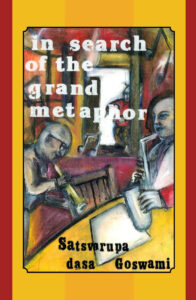
The metaphor is song. Explain it. Yes, particulars may not seem interesting or profound to readers who want structured books.
Wait a minute. Don’t pander to readers or concepts of Art. But Kṛṣṇa conscious criteria are important and must be followed. So, if your little splayed-out life-thoughts are all Kṛṣṇa conscious, then it’s no problem.
I am near the end of my days. But I do like the company of like-minded souls, especially those who are Kṛṣṇa conscious. Yes! I am prone to Kṛṣṇa consciousness. I have been a disciple of Bhaktivedanta Swami Prabhupāda for maybe almost sixty years. Sometimes I fail him. But I always bounce back and fall at his feet. It is a terrible thing that I sometimes do not have the highest love for him. It is a terrible thing. Actually, however, I never fall away from him. He always comes and catches me and brings me back to his loving arms.

This edition of Satsvarūpa dāsa Goswami’s 1996 timed book, Upstate: Room to Write, is published as part of a legacy project to restore Satsvarūpa Mahārāja’s writings to ‘in print’ status and make them globally available for current and future readers.
A factual record of the reform and change in ISKCON guru system of mid ’80s.

Readers will find, in the Appendix of this book, scans of a cover letter written by Satsvarūpa Mahārāja to the GN Press typist at the time, along with some of the original handwritten pages of June Bug. Together, these help to illustrate the process used by Mahārāja when writing his books during this period. These were timed books, in the sense that a distinct time period was allotted for the writing, during SDG’s travels as a visiting sannyāsī

Don’t take my pieces away from me. I need them dearly. My pieces are my prayers to Kṛṣṇa. He wants me to have them, this is my way to love Him. Never take my pieces away.

Many planks and sticks, unable to stay together, are carried away by the force of a river’s waves. Similarly, although we are intimately related with friends and family members, we are unable to stay together because of our varied past deeds and the waves of time.
To Śrīla Prabhupāda, who encouraged his devotees (including me) To write articles and books about Kṛṣṇa Consciousness.
I wrote him personally and asked if it was alright for his disciples to write books, Since he, our spiritual master, was already doing that. He wrote back and said that it was certainly alright For us to produce books.
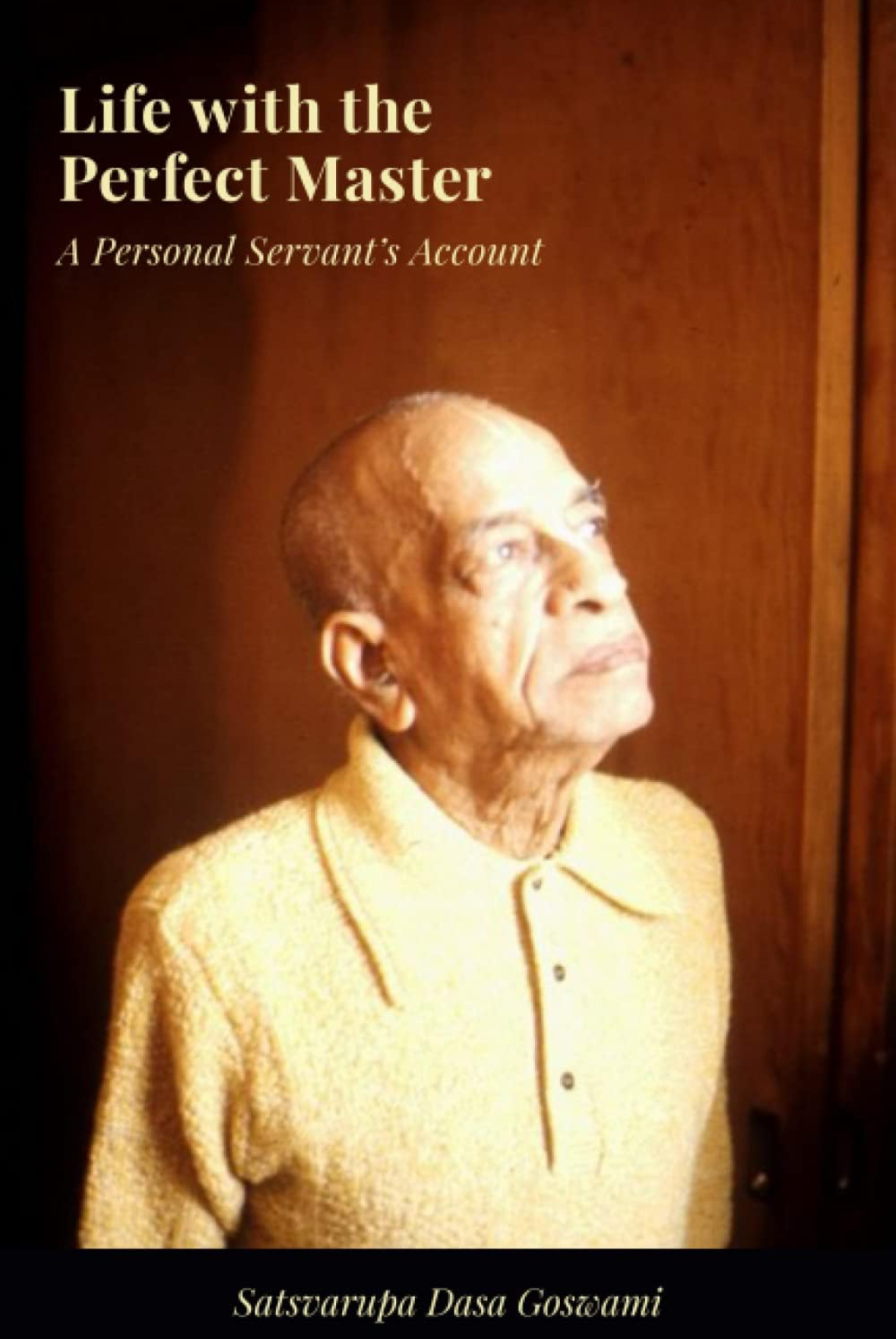
I have a personal story to tell. It is a about a time (January–July 1974) I spent as a personal servant and secretary of my spiritual master, His Divine Grace A.C. Bhaktivedanta Swami Prabhupäda, founder-äcärya of the International Society for Krishna Consciousness. Although I have written extensively about Çréla Prabhupäda, I’ve hesitated to give this account, for fear it would expose me as a poor disciple. But now I’m going ahead, confident that the truth will purify both my readers and myself.

First published by The Gītā-nāgarī Press/GN Press in serialized form in the magazine Among Friends between 1996 and 2001, Best Use of a Bad Bargain is collected here for the first time in this new edition. This volume also contains essays written by Satsvarūpa dāsa Goswami for the occasional periodical, Hope This Meets You in Good Health, between 1994 and 2002, published by the ISKCON Health and Welfare Ministry.

This book has two purposes: to arouse our transcendental feelings of separation from a great personality, Śrīla Prabhupāda, and to encourage all sincere seekers of the Absolute Truth to go forward like an army under the banner of His Divine Grace A.C. Bhaktivedanta Swami Prabhupāda and the Kṛṣṇa consciousness movement.
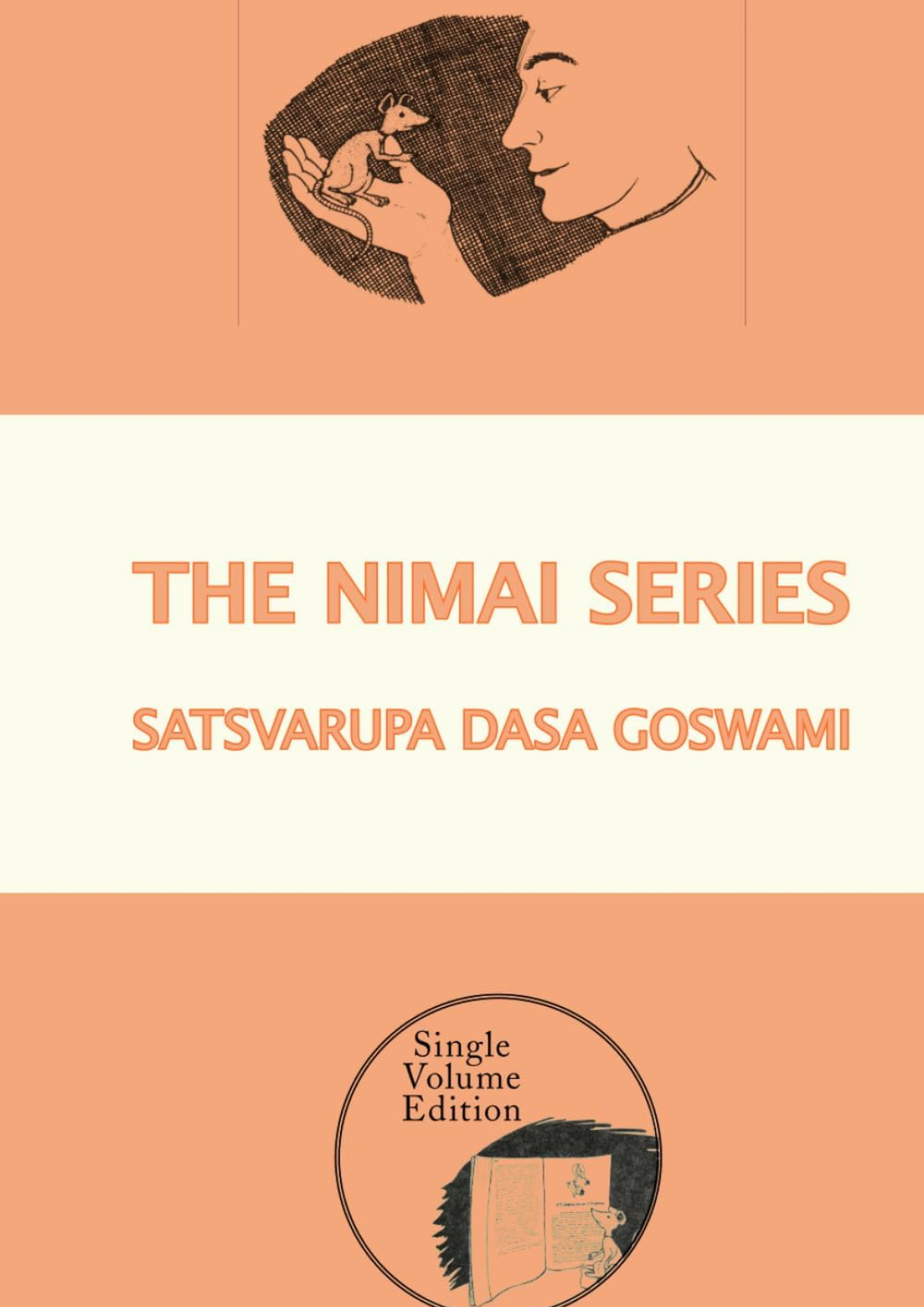
A single volume collection of the Nimai novels.
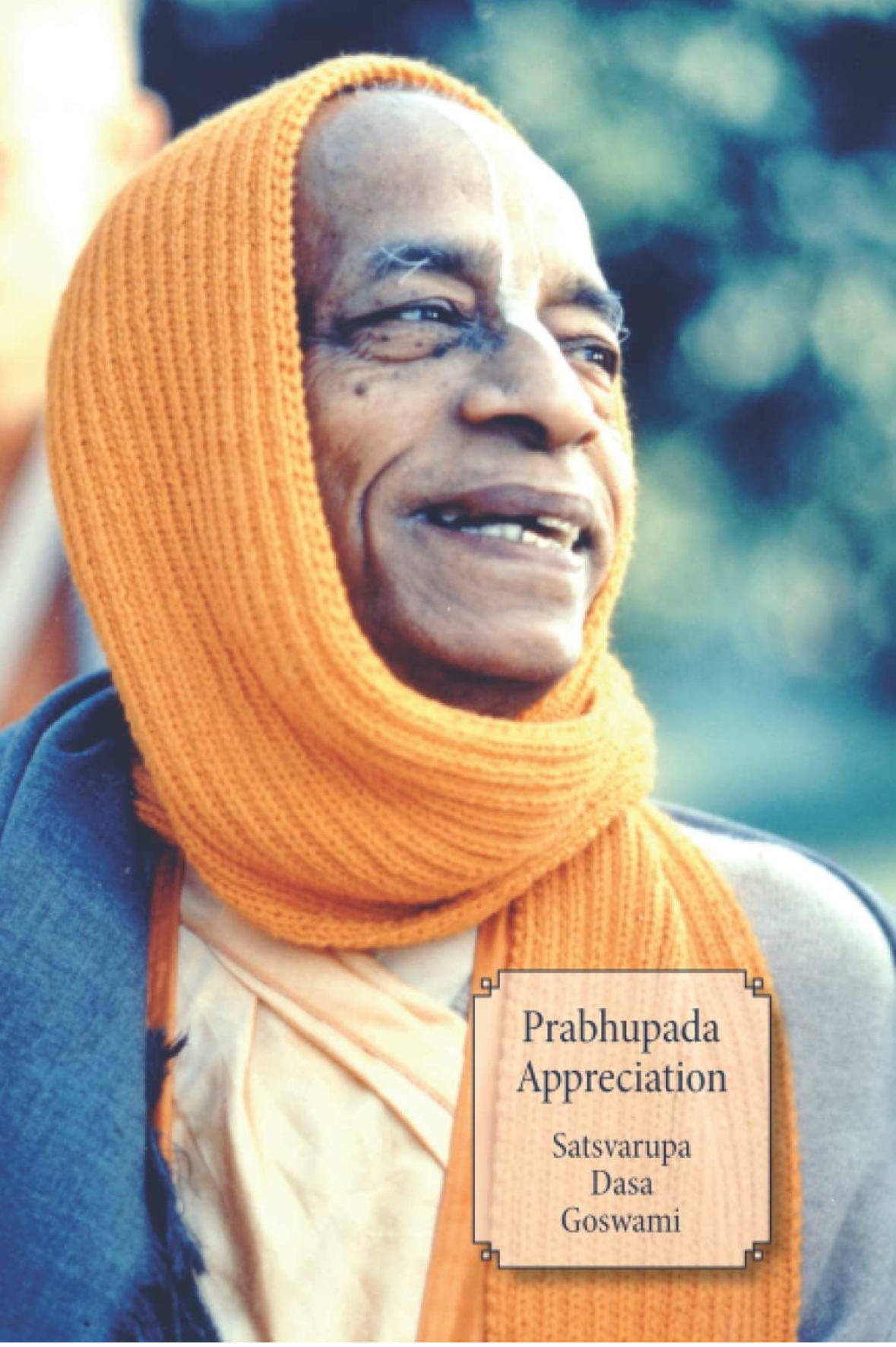
Śrīla Prabhupāda was in the disciplic succession from the Brahmā-Mādhva-Gauḍīya sampradāya, the Vaiṣṇavas who advocate pure devotion to God and who understand Kṛṣṇa as the Supreme Personality of Godhead. He always described himself as simply a messenger who carried the paramparā teachings of his spiritual master and Lord Kṛṣṇa.
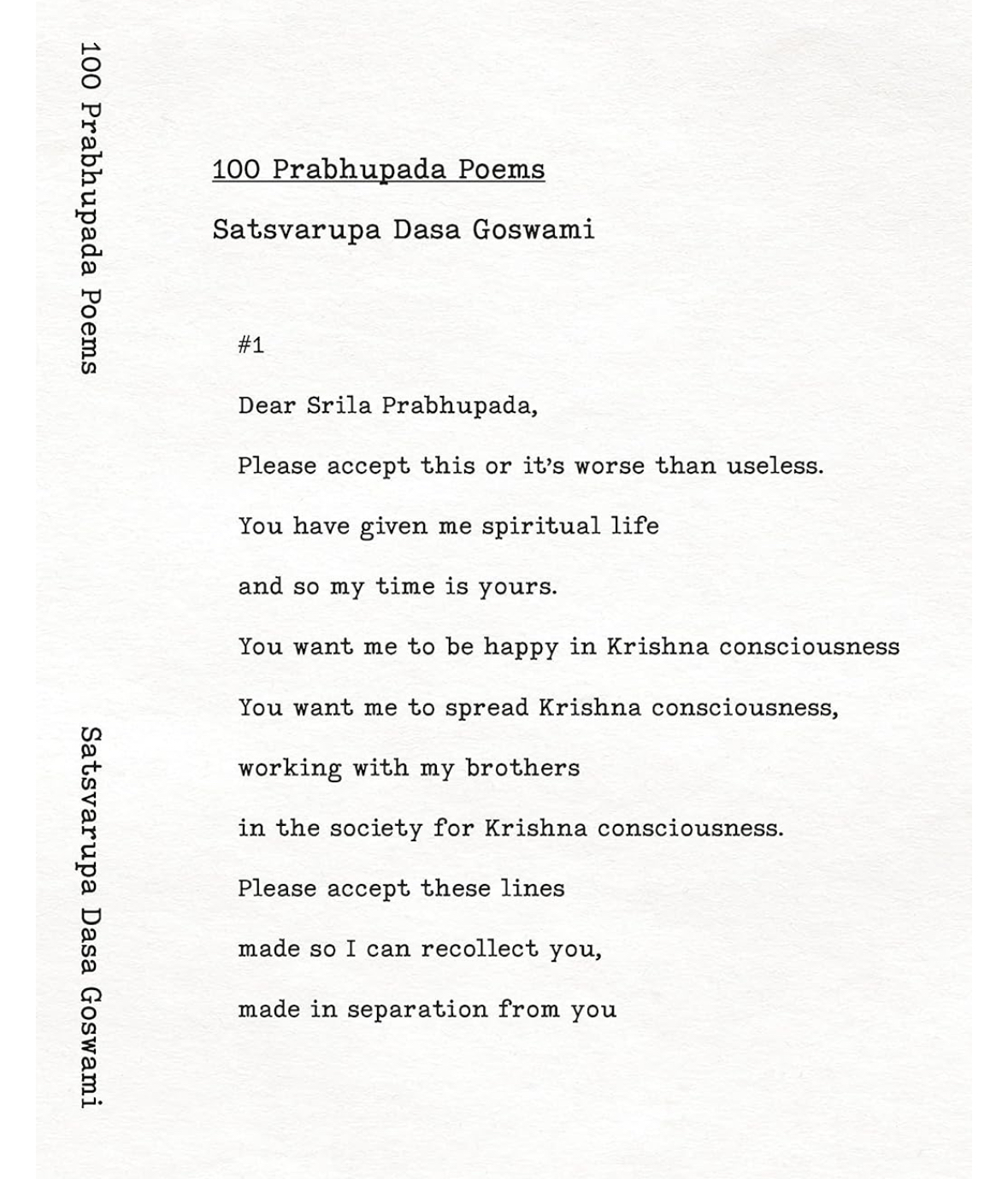
Dear Srila Prabhupada,
Please accept this or it’s worse than useless.
You have given me spiritual life
and so my time is yours.
You want me to be happy in Krishna consciousness
You want me to spread Krishna consciousness,
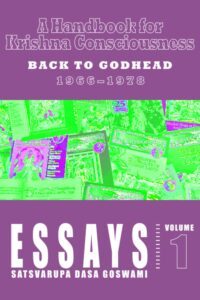
This collection of Satsvarūpa dāsa Goswami’s writings is comprised of essays that were originally published in Back to Godhead magazine between 1966 and 1978, and compiled in 1979 by Gita Nagari Press as the volume A Handbook for Kṛṣṇa Consciousness.

This second volume of Satsvarūpa dāsa Goswami’s Back to Godhead essays encompasses the last 11 years of his 20-year tenure as Editor-in-Chief of Back to Godhead magazine. The essays in this book consist mostly of SDG’s ‘Notes from the Editor’ column, which was typically featured towards the end of each issue starting in 1978 and running until Mahārāja retired from his duties as editor in 1989.
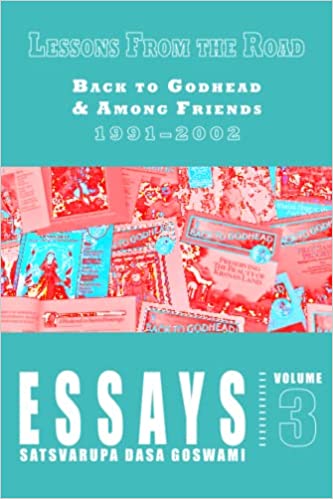
This collection of Satsvarupa dasa Goswami’s writings is comprised of essays that were originally published in Back to Godhead magazine between 1991 and 2002, picking up where Volume 2 leaves off. The volume is supplemented by essays about devotional service from issues of Satsvarupa dasa Goswami’s magazine, Among Friends, published in the 1990s.

“This is a different kind of book, written in my old age, observing Kṛṣṇa consciousness and assessing myself. I believe it fits under the category of ‘Literature in pursuance of the Vedic version.’ It is autobiography, from a Western-raised man, who has been transformed into a devotee of Kṛṣṇa by Śrīla Prabhupāda.”
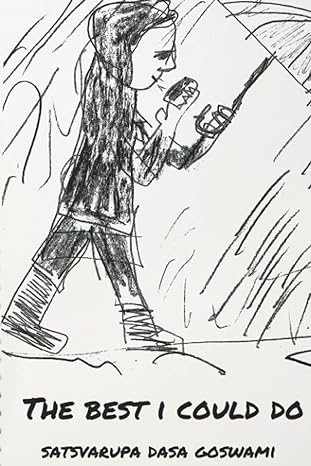 The Best I Could Do
I want to study this evolution of my art, my writing. I want to see what changed from the book In Search of the Grand Metaphor to the next book, The Last Days of the Year.
 a Hare Krishna Man
It’s world enlightenment day
And devotees are giving out books
By milk of kindness, read one page
And your life can become perfect.
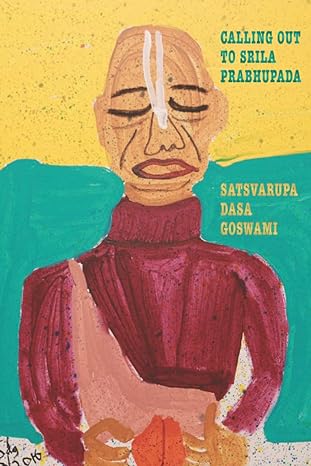 Calling Out to Srila Prabhupada: Poems and Prayers
O Prabhupāda, whose purports are wonderfully clear, having been gathered from what was taught by the previous ācāryas and made all new; O Prabhupāda, who is always sober to expose the material illusion and blissful in knowledge of Kṛṣṇa, may we carefully read your Bhaktivedanta purports.
I use free-writing in my devotional service as part of my sādhana. It is a way for me to enter those realms of myself where only honesty matters; free-writing enables me to reach deeper levels of realization by my repeated attempt to “tell the truth quickly.” Free-writing takes me past polished prose. It takes me past literary effect. It takes me past the need to present something and allows me to just get down and say it. From the viewpoint of a writer, this dropping of all pretense is desirable.
 Geaglum Free Write
This edition of Satsvarūpa dāsa Goswami’s 1996 timed book, Geaglum Free Write Diary, is published as part of a legacy project to restore Satsvarūpa Mahārāja’s writings to ‘in print’ status and make them globally available for current and future readers.