
We need to expand our team of proofreaders as we aim to increase the rate of republication of Satsvarūpa Mahārāja’s books as well as new books that he writes.
This includes a need for fluent bilingual Spanish and English speakers to proofread Spanish translations (we currently have around 20 Spanish translations waiting to be proofread).
Anyone interested in this particular service should contact Manohara dāsa at [email protected]
If you would like to help, please contact Kṛṣṇa-bhajana dāsa at [email protected] or [email protected] and we will find you a service that utilizes your talents.
The spiritual master knows the science of chanting. He is like a doctor to the ailing disciple and prescribes this chanting Hare Krsna so that the disciple can return to his normal health. By health we don’t mean bodily health, but the eternal state of health. The devotee can again attain his eternal spiritual body and be with Krsna in the spiritual world. That can be done by this chanting. So at this stage you have to have full faith in the order of the spiritual master and chant Hare Krsna, whether you are feeling ecstasy or whatever.
******
Understand that Krsna is His name and that He has come to you in His name as a great kindness: “O my Lord, You have so kindly made approach to You easy by Your holy name.” And then go to that person, Nama Prabhu, whom you have offended, who is the only one who can save you, and ask forgiveness—by chanting. “There is nothing in the fourteen worlds but the chanting of Hare Krsna,” says Bhaktivinoda Thakura. Admitting I am chanting poorly—please consider me fallen before You—I beg to be reformed by chanting Hare Krsna.
******
Devotional service in the Krsna consciousness movement affords us many facilities to serve Krsna aside from the chanting of the holy names. This fact doesn’t diminish the glory of the holy name, but enhances it, because the chanting is a key part of the whole devotional way of life. I had read about Christian monks who practiced solitary prayer, but they had no prasadam or Deity worship or lively krsna kirtana. Nor did they have the benefit of such great, nectarean acaryas of the mellows of love of God like Sukadeva Gosvami, the six Gosvamis, and Srila Prabhupada. For the Christian monks the practice of chanting was a clinging to the name in a world they rather impersonally viewed as all illusion.
******
We also must utterly depend on the holy name, but at the same time our restless natures can be purified by the soothing rays of darsana of Their Lordships, Sri Sri Radha-Damodara, Sri Sri Radha-Govinda, Sri Sri Gaura-Nitai, and Lord Jagannatha. As Bhaktivinoda Thakura writes, “By taking the Lord’s prasadam our senses are controlled . . . whenever I take the remnants of prasadam I experience a new life.” Similarly, Srila Prabhupada has said we require both diet and medicine: the medicine is chanting Hare Krsna, and the diet is prasadam. And the perfection of the eyes is to see the Deity, and the perfection of the head is to bow before the Deity of the Lord.
******
We are fully engaging our body, mind, and senses in our pure devotional service. Srila Prabhupada writes in The Nectar of Devotion:
In the Skanda Purana it is said that those who are attached to ritualistic activities, the four orders of social life and the four orders of spiritual life are considered devotees. But when devotees are actually engaged in service to the Lord directly, these must be bhagavatas, pure devotees.
******
Srila Prabhupada has also informed us in The Nectar of Devotion that the chance to engage in devotional service is beyond liberation: “A person who is constantly engaged in chanting the holy name and who feels transcendental pleasure, being engaged in devotional service, is never given just mukti.” (Adi Purana)
******
It is a cause for real rejoicing that Srila Prabhupada has given us the full spiritual life in which to chant Hare Krsna. Dressed as a Vaisnava, with only devotees as friends, we chant. With expert guidance of a bona fide spiritual master, we chant Hare Krsna. While living in the temple (Vaikuntha), we chant. While traveling in a van on sankirtana, we chant Hare Krsna. Before and after seeing the Deity, while taking caranamrta, worshiping Tulasi, hearing Srimad-Bhagavatam (the topmost science of God), we chant Hare Krsna Hare Krsna Krsna Krsna Hare Hare/Hare Rama Hare Rama Rama Rama Hare Hare. And we are chanting the supreme name of God—KRSNA. Thousands of other names of God equal only one name of Krsna.
******
All glories to Srila Prabhupada! All glories to the sankirtana movement! We do not have to chant alone in desperate doubt. We have the support of enormous armies in fighting off the demons. We are not chanting in a world of void. We have been given the full manifestation of spiritual reality in which to prosecute the dharma of the age.
******
Then, rise tiny spirit soul, in gratefulness, security, and protection—and chant, chant, chant. Hare Krsna Hare Krsna Krsna Krsna Hare Hare/Hare Rama Hare Rama Rama Rama Hare Hare.
pp. 35-39
Maybe you shouldn’t strain yourself right now. As for artistic theory, you’re somewhat on your own. Just be careful to always keep it in the realm of service. Don’t do anything detrimental to your Krsna consciousness (or anyone else’s). That’s all the preaching I have on that.
I’ve got a headache and I’m not able to work, so
please tell me about Krsna .… Didn’t Krsna have a headache once too?
No, you don’t understand. Krsna said He had a headache. One of the ISKCON artists once painted that lila, portraying Ksna as actually feeling pain. Prabhupãda corrected her. Actually, Krsna wanted to prove the love of the Vraja gopis so that all other devotees could see their bhava as topmost. You know the story. Krsna said He had a headache, and when His servants asked how it could be cured He said He needed the dust from the feet of the Vaisnavas. His servants then went to some of the most prominent Vaisnavas and asked them for their foot dust. The great devotees were afraid to give dust. They thought they would go to hell. When the Lord then told His servants to ask the gopis, the gopis immediately offered the dust from their feet. “Here! Take it at once so Krsna may be relieved of His headache.”
The servants were amazed after seeing the response of other Vaisnavas, so they asked, “Don’t you know you could go to hell for putting the dust of your feet on God’s head?”
The gopis replied, “Then we will go to hell, but let Krsna feel not the least inconvenience. Give Him this foot dust.”
Is there a connection between that foot dust and the candana we use for tilaka?
Maybe.
I don’t know how much more time we can pass in this way with both of us feeling so weak.
We’ll be back tomorrow. I’ve lost the thread today.
…. Issa wrote a haiku to a snail, something like, “Go ahead, little fellow, Mt. Fuji is ahead.” Or the Puranic account of the sparrow trying to empty the ocean.
Progress. I want to make it, but I don’t know what else to do. Time is limited. All I can do is make repeated attempts, like the artist who drew “a thousand views of Mt. Fuji.” Another poem, another page, another lecture, another day, more rounds. I know nothing more than this.
“I’m going backwards,” someone said yesterday. He was afraid, maybe due to offenses.
Progress means diminishing sense gratification, minimizing eating, sleeping, mating, and defending, feeling free of attachment, fear, and anger, developing attraction to the holy name. How to move forward? “The first shall be last and the last shall be first.” Those who push themselves forward will be humiliated and then make progress. The murderer makes progress when he is killed by the state. The sincere devotee who is attached to money makes progress when Krsna removes his money and leaves him with no other shelter.
Is old age progress? How can a snail expect to scale the highest mountain? How can a dwarf jump up to the moon? You know all these things, Lord, and I must wait for You to signal when and how I can make progress in bhakti. When You make it clear, as when the deckhands wave that our turn has come to board the ferry, I pray my engine won’t stall but that I’ll go instantly forward. Oh, preach to me.
pp. 14-18
The first section in Śaraṇāgati is titled “Dainya,” humility. This section closely follows a section in the Third Canto of Śrīmad-Bhāgavatam where the human embryo prays to God:
He is unlimited, but He is perceived in the repentant heart. . . . I am separated from the Supreme Lord because of my being in this material body . . . although I am essentially spiritual. . . . My dear Lord, by Your causeless mercy I am awakened to consciousness, although I am only ten months old. . . . there is no way to express my gratitude but to pray with folded hands. . . . Therefore, without being agitated anymore, I shall deliver myself from the darkness of nescience with the help of my friend, clear consciousness. Simply by keeping the lotus feet of Lord Viṣṇu in my mind, I shall be saved from entering the womb of many mothers for repeated birth and death.
—Bhag. 3.31.13-14, 18, 21
The unborn child sees the Lord in his heart and promises to always remember Him. He suffers terribly and doesn’t want to experience another birth. But as soon as he is born, he is in the hands of people who know neither his physical nor his spiritual needs.
Bhaktivinoda Thakura describes an entire life in the first song, stanzas 4-7:
“As a fondled son in the laps of my relatives, I passed my time smiling and laughing. My parents’ affection helped me to forget the pangs of birth, and I thought the world was very nice.
“Day by day I grew and soon began playing with other boys. Shortly my power of understanding emerged. I read and studied my lessons incessantly.
“Traveling from place to place, proud of my education, I grew wealthy and maintained my family with undivided attention. O Lord Hari, I forgot You!
“Now in old age, Bhaktivinode is sad. He weeps. I failed to worship You, O Lord, and instead, passed my life in vain. What will be my fate now?”
Under the spell of māyā, most people don’t think of these activities as a waste of time but as the goal of life. Bhaktivinode Thakura’s life appears successful—he has affectionate parents, a nice world view, a taste for his studies and the competitive edge, wealth, the ability to travel, devotion to his family. “Why is he complaining?” the materialist wants to know.
“O Lord Hari, I forgot You!”
He is speaking through the eyes of scripture. A human life is wasted without God consciousness. It becomes no better than the life of an animal (śrama eva hi kevalam). Even a half-intelligent person can taste the bitterness of his or her own experiences. And when old age approaches, what is left? “What will be my fate now?”
If, therefore, the living entity again associates with the path of unrighteousness, influenced by sensually minded people engaged in the pursuit of sexual enjoyment and the gratification of the palate, he again goes to hell as before.
—Bhag. 3.31.32
In youth, the life of scholarship increases our hopes. We didn’t know anything as children, but then we discovered books, writers, philosophers, poets, psychologists, political scientists, the physicists, art, culture ….
. . . “Confidently, I spent my time in the pleasures of mundane learning and never worshiped Your lotus feet, O Lord . . . . Reading on and on, my hopes grew, for I considered material knowledge to be life’s true path” (Śaraṇāgati , 1.2.12).
Knowledge-acquiring becomes a passion when the student tries to glean all he can from books and teachers. The rewards may not be as intense as those gained by other pursuits, but learning produces prestige, power, and pride. It also produces intellectual snobbery.
Eventually, the scholar (jñānī) finds that material knowledge cannot answer the crucial questions: “Who am I? What is the cause of creation? Why is there so much suffering and how can it be overcome?” And what can knowledge do to stop death? The scholar meets contradictions and differing opinions wherever he turns.
As stated in the Mahābhārata, “Dry arguments cannot give us the truth, and neither can the philosophers, because they always differ.” This differing nature of the world’s teachers is an illusion created by māyā for the purpose of further bewildering the Godless thinkers. This is described in the Haṁsa-guhya prayers of the Śrīmad-Bhāgavatam:
Let me offer my respectful obeisances unto the all-pervading Supreme Personality of Godhead, who possesses unlimited transcendental qualities. Acting from within the cores of hearts of all philosophers, who propagate various views, He causes them to forget their own souls while sometimes agreeing and sometimes disagreeing among themselves. Thus He creates within this material world a situation in which they are unable to come to a conclusion. I offer my obeisances unto Him.
—Bhag. 6.4.31
Bhaktivinoda Thakura concludes that material knowledge makes a man an ass. His future is bleaker than that of an ordinary man; he is more entangled and confused. The Īśopaniṣad declares,
“Those who engage in the culture of nescient activities shall enter into the darkest region of ignorance. Worse still are those engaged in the culture of so-called knowledge” (Mantra Nine).
In his purport to this mantra, Śrīla Prabhupāda states:
“Advancement of learning by a godless people is as dangerous as a valuable jewel on the hood of a cobra. The cobra decorated with such a valuable jewel is more dangerous than one which is not decorated. . . . In Hari-bhakti-sudhodaya, the advancement of education by a godless people is compared to decorations on a dead body.”
I was thinking about this writing this morning. I made a resolution to keep writing, but I realized that at any moment, my peace and ease could be violently torn away. I felt this in a small way today while walking and listening to tapes. I made a gesture with my hand and it caught the wire that leads to the Walkman. Suddenly the earplugs were jerked out of my ears. It didn’t hurt, but it was sudden, accidental—the sound was gone. It produced a mental shock as I humbly returned the earplugs to my ears.
That was just a small inconvenience—not even serious—but with the same suddenness, I could lose my life. I try to write with that in mind. Every moment is special, and when you pass the fifty-year mark, every moment becomes more precious. I still haven’t been able to write a profound epic, but at least I am able to stop and breathe prayers and to remind myself that I am writing as one who is about to die for those who are also about to die. Don’t waste time. We are all looking for earnestness. We are all looking for that feeling that will connect us to Kṛṣṇa.
pp. 4-10
We’re in rush-hour traffic coming into the Bronx at 230th Street. Stop and start. M. is driving the car, Kirtana Rasa is chanting japa in the front seat and I’m in the back with packages. “It’s A Woman Thing” says the billboard for Virginia Slims cigarettes. I wanted to write; it took mental effort to get out the notebook. But I can’t think of much to say except what I see-dirty city trees in bloom, the long crawl of traffic ahead, my tendency to exaggerate, to worry … Imagine if things went wrong. I want to go within to tell you something Krsna conscious but that’s not possible. Kool. Art. Yankee Stadium.
******
Relax, man. At Queens apartment I spent morning and afternoon answering last mail. Agni dasa came by and gave me a massage. M. phoned British Airways and asked if their flight tomorrow morning was leaving on time. “Of course,” she replied. “Sometimes we even leave early.” “Tragi-comic gifts” of Alice Walker’s poetry says New York Times on back of her book. Kirtana Rasa, who drove us here, stopped only briefly at the apartment and then drove off. “Escape from New York,” he said. “There was a movie by that name.” Nandimukhi said the skyline of buildings is like fists raised against the sky. It becomes daunting to preach here. They are duty-bound.
Now will you be able to roll along? Forget the performance and be genuine in some way.
Hare Krsna. I was born in Queens in this lifetime. Guess what? A mail package won’t come to me until a month from now. I tell you, man, in June, the month of the Sacred Heart of Jesus in Eire, or in mostly Northern Ireland, in a house overlooking the island and the lakes …
Can I prove to the government of Ireland immigration department that (1) Stephen Guarino and Satsvarupa dasa Goswami are the same person, and (2) he is an author of books? M. says it will be easy because Irish are lax about that sort of thing and will give no trouble to an American who wants to claim residency in the Emerald Isle. Who am I? Can I prove? Also, I own the van, although I don’t drive it.
******
In the vase on the window sill, purple pholx and goldenrod. Outside, people were lounging on front step—women in T-shirts, kids rollerskating, many “minority races,” Muslim, Oriental, black, Indian, Carib, plain vanilla, Hare Krsna in this one looking out.
Four big suitcases all tied up and ready to go. I asked him, M., how we plan to carry them to the ticket counter. We may resort to hiring a red cap. How much do you pay them? Pholx, goldenrod. Escape from New York.
Answered last batch of mail, but I wasn’t up to any early morning writing or reading in Srila Prabhupada’s books. Think as you travel, how you may shape this June or let it flow in a shape provided by time and events. We are not the doers. Material energy works, or Krsna works in the case of His devotees. You may also do something. You may pray for mercy and guidance. Especially as you get swallowed up in the mouth of the whale (time, death, where do we go next?).
Write and be alive in Krsna consciousness one way or another today.
******
We’re going on that Concorde flight. That’s because we purchased round-trip British Airways tickets in Bombay and since they wouldn’t sign our tickets from NYC to Dublin over to Aer Lingus, they gave us the royal treatment, so-called: Concorde to London and from there, Aer Lingus to Dublin. Embarrassing to ride in our khadi cloth and beggars’ demeanor in such a high-speed luxury airship? I don’t think so. Just accept it and don’t mind what others may think.
Today is the last day of May (said the counter
lady to the people next to us).
“It’s hard to believe,” the elderly woman replied.
You will be in England and then Ireland … you have a chance to write there. Pray to Krsna even if it hurts. Ask Him to help you advance in spiritual life.
See your lack of advancement.
The British Airways man cannot print out our boarding passes from London to Dublin. He said, “You’ll have to check in again in London.” But Madhu is pressing him to do it, to find a way, to make the machine work. much like any jet interior, but seats are only two across. Port hole windows are smaller. Concorde magazine twice uses the word “Discrete” (their spelling) to describe the interior decoration in the cabin and the quality of services in the waiting lounge. I like “discreet”.
Last look at World Trade building.
“When will you return?” asked Hari-kirtana, who drove us to the airport. (Twice the speed of sound! Altitude: 57,000 feet.)
“Next spring.”
In the unlikely event …
The Queen of England rode in one of these here things at least three times.
Flying at 340 mph, I’d like to pass, but the aisles are blocked with food service. M. is filling out documents for my entry into Ireland and my application for residence there. I may have to show them when passing through immigration in London. The application says I’m a “religious writer” and Manu dasa, “director of ISKCON Dublin,” is inviting me to go there to reside and pursue my religious writing career. I am single. I am known as both Satsvarupa dasa Goswami and as Stephen Guarino. We are applying for one-year residency. If I don’t get it, I don’t care. I could always return to the U.S. and live in someone’s house or apartment and write there. But Madhu has his new van and we think it’s better for independence to wander around the E.E.C. countries.
Anyway, I hope it goes well. Real question is what to write. I don’t think I can write all of June just on this theme that I want to reside in Ireland etc. But that’s an interesting starter.
pp. 32-35
On Thursday morning, only three days before Gaura-Furnina, the sannyasi spoke on vande sri krsna-caitanya-nityanandau sahoditau (Cc. Adi 1.2). Since the temple Deities were Gaura-Nitai, he told stories of Srila Prabhupada visiting ISKCON Gaura-Nitai temples in Caracas, Miami, and Atlanta.
“Srila Prabhupada said on his arrival there,
You are very fortunate. These two Prabhus, Lord Caitanya Mahaprabhu and Lord Nityananda, are with us tonight. . . . Parama-koruna pahu duijana . . . He is so kind. So take shelter of Sri Caitanya Mahaprabhu and be happy.”
Krsnadasa Kaviraja Gosvami says the first wonder is that the two Lords appear simultaneously. The second wonder is that They dispel the darkness within the core of the heart. In the question period after the lecture, Dhama dasa, who was translating, asked, “If we worship Radha and Krsna as They are in Vaikuntha, how will that ever develop into the spontaneous stage of Vrndavana?”
The visiting sannyasi replied that awe and reverence (the Vaikuntha mood) toward Radha and Krsna was prescribed by Srila Prabhupada for our temple Deity worship. This refers to punctuality, gorgeous dress and food, saying prayers, cleanliness, bowing down, etc. It’s good for us. We cannot imitate Sanatana Gosvami and put the Krsna murti in a tree and give Him only stale capatis. Be confident that the way Srila Prabhupada taught us to worship Radha-Krsna is the most direct way to attain Goloka Vrndavana. In Nectar of Devotion and KRSNA book, we hear of the spontaneous mood of Krsna’s madhurya pastimes. Eventually, by devotional service, we will enter vraja-bhakti, not Vaikuntha.
Someone asked, “You said that we should only hear about Krsna from Srila Prabhupada and not from mundane scholars. But what about hearing about Radha and Krsna from Vaisnavas besides Prabhupada?”
The sannyasi replied that hearing from others was risky. No one is as wise and experienced as Srila Prabhupada in preaching to Westerners. “The stakes are high and we shouldn’t gamble,” said the sannyasi but Dhama dasa couldn’t comprehend the idiom, “stakes are high.”
“It’s like in gambling. If you bet a high sum of money, then if you lose, you go way down.”
“Oh!”
“If you mistake Radha-Krsna for ordinary boy and girl and imitate Them, you will lose everything.”
The farmer next to the temple has a high-powered hose attached to his tractor. He parks the tractor, aims the pipe, and a hundred-foot-long arc of white water gushes out high over his plowed and seeded field. The earth and olive seeds within soak it up. The hose slowly arcs from left to right. The farmer stands and watches. Whoever passes watches the power in the arc of water, its spray underneath, the darkening of the earth from dry tan to wet brown.
…… In the question and answer session, he picked up each slip of paper and read it. Without his eyeglasses, he could see only a smudge of lines. If he were an airline pilot, he wouldn’t be able to read any gauges. Soon you have to retire if you get something like a brain cyst, as one man here has, who is not even old. Life is no joke. One thinks,
If that happens to me, that I must drop all other activities and be consumed by disease or face the end quickly by another way, I hope I can ‘retire’ in the sannyasa sense of the word and simply chant like Bhaktivinoda Thakura in his very last days when he stopped outer communication and entered samadhi. But be realistic, how can you expect the same last stage as a great saint?” So until then, be busy, friends, with your good work. And be sure your work is connected to Krsna and guru and is the best effort.
The visiting sannyasi answered a question, “How can we keep friendships amid quarrels and problems?” He replied that we should consider the devotee as a person in a solitary room early in the morning. He does his sadhana for a few hours and then opens the door and faces the world. He has gained inner strength to face the problems. He is an atmarama (to some degree) and can be charitable. Such persons, who first perform their own sadhana, can then lead others and communicate or absorb the shocks of life together.
Someone asked about prayer. The sannyasi wished he had a life of prayer, but he answered anyway from the general tradition. He said, “Chanting is the best prayer, two and a half hours a day at least.”
Someone asked, “In the Bhagavad-gita, Krsna says His devotee will never perish. What does this mean exactly?” The sannyasi said it doesn’t mean that a devotee never loses a battle to the demons. But finally, the demon dies and the devotee dies. The demon is then vanquished and the devotee’s good acts make him triumph over death. Srila Prabhupada once compared ISKCON devotees to Jatayu, who was defeated and killed by Ravana but who was brought back to Godhead by Lord Rama.
During Friday night, while the sannyasi tried to sleep, he sometimes woke and heard noises. He heard voices outside on the road and passing cars. He heard a door creaking open and shut. He heard someone clear his throat and he knew that was his assistant, Narahari, returned from India. Finally, the visiting sannyasi fell into desired sleep. lie thought, “I hope I’m well enough to go on harinama Saturday night because they are expecting me to go.”
pp. 61-66
The cantankerous typewriter has been set up for my use. If it gets too cantankerous, I can always go back to the pen.
There is no way to get at the truths of Krsna consciousness. They descend from the Lord and the ragatmika devotees as blessings. Visvanatha Cakravarti Thakura appeared in this world to tell us the intimate pastimes of Radha and Krsna which were not disclosed in Srimad-Bhagavatam (although whatever he said was based on the Bhagavatam). Visvanatha Cakravarti is both a recipient of mercy and a giver of mercy. Each of us can be like that, at least to a small degree. We have already received the Hare Krsna mantra from His Divine Grace, and we have already received transcendental knowledge from the Bhaktivedanta purports. We are already recipients of mercy; we are now bound to give mercy to others.
O Lord of the universe, O soul of the universe, kindly deliver us from the fiery brahmastra of the enemy which is hurtling toward us. Kindly break our tie of affection for our material kinsmen. Let our devotion to You flow like the Ganges in monsoon unto the Bay of Bengal.
This van is like an asana. I want to write something Krsna conscious, but I don’t want to be artificial. When I see a tree swaying in the wind, if it does not remind me of a gopi dancing for the pleasure of Krsna, then I should not claim that it does. O Lord of my heart, please teach me. Let the teachings of Krsna consciousness attract this conditioned soul and please allow me to participate in the sankirtana movement.
O Lord of the universe, who plays the flute in the Sarad season and attracts the gopis to join him, and who, when the gopis are assembled tells them, “Go home now”—may that Lord give me a drop of mercy by revealing the nature of the holy names. I am chanting and I think it is the best occupation. But You know that it is also a sleepy desert for me. I beg for water, for the inspiration to chant in the mood of service. I beg to be able to go out from here and preach as one who loves to tell the glories of harer nama. This is my request, written in the Renault van on an Italian typewriter keyboard, while listening to the rain on the roof. All glories to Prabhupada.
“Some bear only the burden, others appreciate the true worth of things” (Nama-bhajana, Bhaktivinoda Thakura).
Sitting on the windowsill, averaging 8:40 sec-onds. Not bad, considering that stereotype of “good rounds” in popular ISKCON. But my mind went quickly through my pre-Krsna conscious past in this lifetime, combining persons and events fancifully as we do in a dream, like an unconscious playwright . . . Was that a flicker of remorse for all the time wasted? Was that a beginning of compassion for all the people I knew, for my mother and father? But if I was thinking something noble, was it because I am “supposed” to? Is this a Western mental disease—that we always play games and then catch ourselves at playing games? Is there no end to it, no genuine moment before it is all destroyed?
I think this disease comes from the advertising industry and from low-class comedians. Comedians in our own families—cynical older sisters and strong-armed fathers who consider any deviancy from the norm as wimpish.
This conditioning cripples me when I try to range deep inside simply with the maha-mantra. If you were born in Bengal or the Vrndavana area, it might be different. But I have seen some strange cases from those areas too. It’s Kali-yuga. Where there are no good trees, a castor tree is a big tree.
Krsna, did You once hear my chanting, or does my rasping voice disturb Your play?
Srila Prabhupada in the Radha-Damodara court¬yard, walking away from his veranda rooms. Those historic rooms! It is about 1971. Malati dasi is there, and Syamasundara, Rsi-kumara (with a blanket wrapped around him and chanting japa), Subala Swami with a cane like Prabhupada’s. Prabhupada is looking down at four-year-old Sarasvati, who is looking off somewhere—to her future?
Srila Prabhupada in the sunlight, his foot stepping on an inscribed marble plaque, his cane . . . I cannot see you, Srila Prabhupada, but still I see your figure in photo, that same rust-colored sweater, the candana on your forehead, the reddish socks, bead-bag, orange marigold garland. Your hair is gray at the back of your head and your complexion is dark and golden.
Your disciples want to care for you, they are look¬ing to your needs. But are we ready to surrender to your heavy order to work and sweat it out in Vrndavana as a manager of cement construction? Can we stay celibate? Can we stay in your movement?
Still, we share the desire to care for you tenderly, to watch where you step, to bring you water to drink, to cook, to ask about Krsna in Vraja. It’s cold there now. You are looking down . . . I am no better than the others. This photo helps me to remember that.
Subala, I too want to be a babaji in Vraja. I know what you meant. But Prabhupada wanted us to work under his direction. It must have been hard for you back then during the construction of Krsna-Balarama Mandira. Now his followers have more room to serve in our own ways—now that the Krsna-Balarama Mandira has been built and Prabhupada has returned to his nitya-lila. We are left with his order to love him by cooperating together. There is room for everyone now. Together we can keep Prabhupada’s movement vital.
pp. 163-66
“Today no poem” says a little
Chinese laundryman inside
my brain. Who is he to shut down
on me like that?
I want in.
I knock on the door some more.
Maya Angelou, sixty-year-old
black lady poet of whom James Baldwin said,
“Sister Maya has been there and back”—I looked at
her poems for a warmup and a Kerouac page, but he
had written an ambitious portrait of a Sunday
on MacDougal
Street in Greenwich Village. I wanted something
quiet and indoors
because that’s where I am—and Krsna conscious.
Well you’re not gonna find it in
Maya Kerouac.
If you find the opposite, will it drive
you running to the Bhagavatam?
Just find yourself, what you want, and
the words will come. I want you—
I want you, freedom. I want
love of God as my reality, at least the way you
can look up at the moon. You can’t
possess it but at least you see it and
you’re enchanted. Or now the blue dawn
of late April full of Italian birds in
this neighborhood. I’m sorry I don’t know them
the way I knew the birds in Pennsylvania,
but I’m glad I’m here out of reach.
Out of reach of the long arm
of the law
the institution,
the botheration.
Tell it man, go ahead.
I just want you—solitude, love of
being alone on a schedule of my own,
busy all day and precious lines coming out
arriving at Krsna consciousness by the quiet method,
desperate for it, asking quietly . . .
Then giving up that pose and
just reading and writing.
When the Yaksas tried to scare
Dhruva Maharaja, the sages assembled and said,
“Don’t fear these tigers and lions running
at you and trunks of bodies falling from
the sky. The ocean’s roar is an illusion—
chant the holy names and you’ll be free.”
Dhruva did it.
Hear it and apply. I want that.
There’s a new edition of Prabhupada’s book,
The Path of Perfection, with Bharadvaja’s painting
on the cover, Krsna speaking to Uddhava.
I wonder who Krsna is looking at
as He turns His face to the side,
not at Uddhava who is on one knee
with folded palms before the Lord.
I’m looking to enter this “chronicle
of an historic series of talks by Srila Prabhupada”
about yoga, bhakti-yoga.
Another nice thing—plan to go to Mayapur.
The blue sky lightening.
Anticipation of breakfast, which I take
in a restrained amount. Chyavan Prash and bananas,
hot milk, a little cereal.
The red pen and all colors of pens.
To know I have been up early
and wrote and read with rest ahead.
For Krsna there’s no anxiety. We
make trouble for ourselves. He can
get us out if we only turn to Him.
Stop being envious and avaricious.
Work against the void and Mayavadi doctrines
that make people believe there’s no God.
You live with God and that’s
the proof.
First prove it to yourself.
In four days we’ll travel
to Mexico in our blue Olds,
to Puerto Rico in our hat . . .
No really, in our really white
Renault Master van, our truly
hidden purpose bulging out,
all day Monday Nara will pack and
Tuesday cook for three days on the road—I
can’t chew tough bread crusts but
if you dip ’em into hot tea I do
okay. Two hours daily I enter Vaikuntha
in reading. Tepid japa. No matter, the
holy name is kind even to offenders.
Say the truth—we want to get away.
Days like this, even if I’m shy and
too uptight to express it, are very nice and
liberating in their own way. It’s the best
I can be Krsna conscious right now
so I’m not knocking it. I’ll read
what the Bhagavad-gita says
and what Srila Prabhupada spoke on ayur
harati vai pumsam, any Srimad-Bhagavatam
lecture he
gave ending, “Thank you very much.” I’ll
pray to be with him knowing I’m
always a fool before my spiritual master—
and before you too.
pp. 157-61
Here Mother Yasoda churned butter and washed pots. (I remember Madhu washing pots at our hand pump in Vrndavana. When he was finished, they would all shine silvery, and he stacked them dripping wet.) Mother Yasoda had many servants, yet she liked to do certain duties herself. While churning butter “she sang the childhood pastimes of Krsna and enjoyed thinking of her son.”
Can we think in the vatsalya mood? There have been sentimental paintings, yes, and they clutter the markets at Loi Bazaar—a too chubby Bombay-cinema version of child Krsna and His ma—the artists’ conceptions colored by their own limitations. Perhaps they paint in ways they know will sell, but they do not really capture Krsna. Baby Krsna steals the hearts of those in the vatsalya mood, and every bhakta worth his name bows down to Him. “To this Supreme Lord, Sri Damodara, whose belly is bound not with ropes but with His mother’s pure love, I offer my obeisances.” (Sri Damodarastaka, Verse 2)
Breathing a sigh from my nostrils as if I’m a tired workhorse. It’s 3:45 P.M. and I’m still feeling all right. That sigh is my measure of how far I have come against how far I have to go. Everyone I know sighs from time to time in the midst of their work, and then they move on. “Are you sighing for Killarney?” my mother used to say. In those days, I was sighing all right, wondering where I was going and trying to decipher the meaning of life.
Thank you, Srila Prabhupada, for saving me and so many other boys and girls. Now when we sigh, it’s because we want to attain bhakti. We may even skirt the borders of bhakti-yoga and sigh for past lives or for “what might have been” or other illusion, although we pay little attention to such sighing. We sigh to serve you. We recall your kindness with a sigh. The old days with Prabhupada, the future . . . the spiritual Killarney, Vraja, the old sod to which we aspire. Sighing for Vrndavana at Yasoda-kunda. When will that day be mine?
Srila Prabhupada calls these the “three functional Deities” of Gaudiya Vaisnavas. The original Deities left Vrndavana when the Muslims destroyed the temples. On Their way to Jaipur, They stopped here.
I want to stop here too. I don’t want to go farther than Krsna went. When we reach the ultimate, we are satisfied; svamin krtartho ‘smi varam na yace. When we discuss prayojana only theoretically (loving Gopinatha as the goal), then we may go on to something else. That going on is not to something higher. Actually, in that case, our going on means we never reached the goal.
Hold on to this minute:
if you had wings
if you had an imagination,
could you go higher than God?
But it all comes from Him.
Pray for Krsna’s
descending mercy.
Please stick me here
as an atom at Your lotus feet.
Loving Your infinity.
Roaming the
universes, we are stuck
in birth, old age and death.
O Madana-mohana, O guru
teaching us,
please let us awaken to our attraction
for you. Krsna,
You are our Lord. O Govinda,
please give us Your service.
Let us work at abhidheya day and night.
O Gopinatha, Lord of the gopis, player of the flute,
O You who steals our precious hearts,
please detain us, stop us, give us a
glimpse of the goal.
When I first went to Swamiji’s room and bought his Srimad-Bhagavatam, he asked me to sit down. “I can’t,” I said, “I have to go to work.” He smiled and let me go, and I returned to ask for shelter soon enough. Then he went off—first to San Francisco, then India.
Let’s stop here or go on, but I don’t want to miss You, my Lord. I don’t have more important things to do. I don’t have a better book to write than the one You want, filled with faithfulness to You. Please indicate to me where You want me to go, what You want me to say. Hari, guru, Vaisnava, Bhagavata, and Gita—all glories to these.
I do and I don’t remember. Time runs clockwise around my Seiko watch, set five minutes fast. It glows in the dark and gets me up early enough. Don’t answer mail, no phone, no pony express or fax. Just light from lamps to write my prayer: “Prabhupada, please see that I always serve you. Please see that I always remember and appreciate the way you argued, your certainty. You have made me live. You have given me the truth of Krsna consciousness.”
Kids are walking on Brislin Road. The sky is darkening. The flying-saucer hum of the highway is building—Hummmm . . .We yatris are also humming. We stand as a group, an angelic choir, with our palms pressed together in namaskara, our minds humming with activity. Maybe tonight another yatri (not me) will speak his day’s impressions and then you’ll see for yourself. As the civil surgeon in Calcutta said to the judge, “Your honor, I have examined many patients, and in my opinion, everyone is more or less crazy.

Viraha Bhavan Journal (2017–2018) was written by Satsvarūpa Mahārāja following a brief hiatus in writing activity, and was originally intended to be volume 1 in a series of published journals. However, following its completion and publication, Mahārāja again stopped writing books, subsequently focusing only on what became his current online journal, which began in August of 2018.

At first, I took it hard that I would have to live surrounded by the firemen, and without my own solitude. After all, for decades I had lived in my own house with my own books and my own friends. I was also now a crippled person who couldn’t walk, living among men who did active duties. But when Baladeva explained it to me, how it was not so bad living continually with other firemen and living in the firehouse with its limited facilities, I came to partially accept it and to accept the other men. I came to accept my new situation. I would live continually in the firehouse and mostly not go outside. I would not lead such a solitary life but associate with the other firemen.
Let me write sweet prose.
Let me write not for my own benefit
but for the pleasure of Their Lordships.
Let me please Kṛṣṇa,
that’s my only wish.
May Kṛṣṇa be pleased with me,
that’s my only hope and desire.
May Kṛṣṇa give me His blessings:
Kṛṣṇa Kṛṣṇa Kṛṣṇa Kṛṣṇa Kṛṣṇa he
Rāma Rāghava Rāma Rāghava
Rāma Rāghava rakṣa mām.
You mentioned that your pathway has become filled with stumbling blocks, but there are no stumbling blocks. I can kick out all those stumbling blocks immediately, provided you accept my guidance. With one stroke of my kick, I can kick out all stumbling blocks. —Letter by Śrīla Prabhupāda, December 9, 1972.
The Writing Sessions are my heart and soul. I’m trying my best to keep up with them. I am working with a few devotees, and they are far ahead of me. I wander in the wilderness of old age. I make my Writing Sessions as best I can. Every day I try to come up with a new subject. Today I am thinking of my parents. But I don’t think of them deeply. They are long gone from my life. Śrīla Prabhupāda wrote a poem when he was a sannyāsī, and he said now all my friends and relatives are gone. They are just a list of names now. I am like that too. I am a sannyāsī with a few friends. I love the books of Śrīla Prabhupāda. I try to keep up with them. I read as much as I can and then listen to his bhajanas.
The metaphor is song. Explain it. Yes, particulars may not seem interesting or profound to readers who want structured books.
Wait a minute. Don’t pander to readers or concepts of Art. But Kṛṣṇa conscious criteria are important and must be followed. So, if your little splayed-out life-thoughts are all Kṛṣṇa conscious, then it’s no problem.
I am near the end of my days. But I do like the company of like-minded souls, especially those who are Kṛṣṇa conscious. Yes! I am prone to Kṛṣṇa consciousness. I have been a disciple of Bhaktivedanta Swami Prabhupāda for maybe almost sixty years. Sometimes I fail him. But I always bounce back and fall at his feet. It is a terrible thing that I sometimes do not have the highest love for him. It is a terrible thing. Actually, however, I never fall away from him. He always comes and catches me and brings me back to his loving arms.

This edition of Satsvarūpa dāsa Goswami’s 1996 timed book, Upstate: Room to Write, is published as part of a legacy project to restore Satsvarūpa Mahārāja’s writings to ‘in print’ status and make them globally available for current and future readers.
A factual record of the reform and change in ISKCON guru system of mid ’80s.

Readers will find, in the Appendix of this book, scans of a cover letter written by Satsvarūpa Mahārāja to the GN Press typist at the time, along with some of the original handwritten pages of June Bug. Together, these help to illustrate the process used by Mahārāja when writing his books during this period. These were timed books, in the sense that a distinct time period was allotted for the writing, during SDG’s travels as a visiting sannyāsī
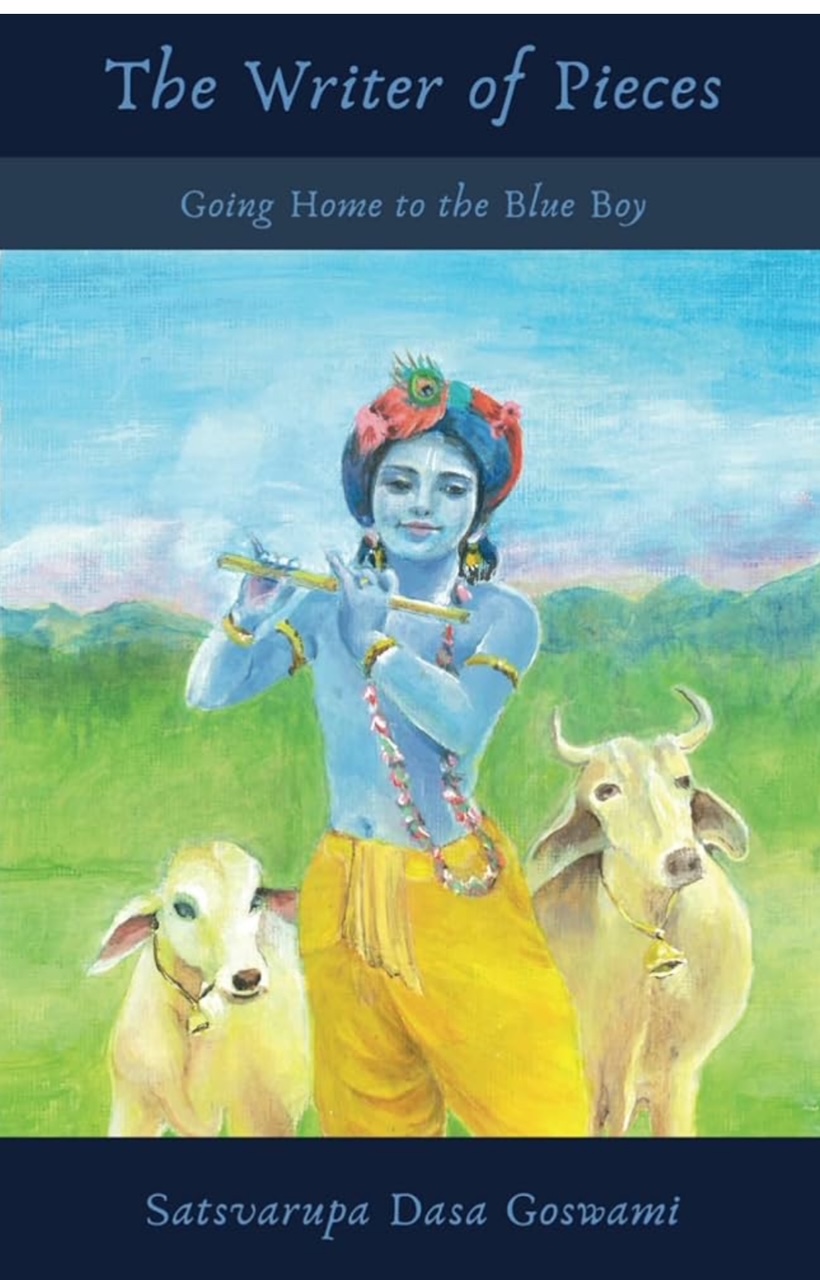
Don’t take my pieces away from me. I need them dearly. My pieces are my prayers to Kṛṣṇa. He wants me to have them, this is my way to love Him. Never take my pieces away.

Many planks and sticks, unable to stay together, are carried away by the force of a river’s waves. Similarly, although we are intimately related with friends and family members, we are unable to stay together because of our varied past deeds and the waves of time.
To Śrīla Prabhupāda, who encouraged his devotees (including me) To write articles and books about Kṛṣṇa Consciousness.
I wrote him personally and asked if it was alright for his disciples to write books, Since he, our spiritual master, was already doing that. He wrote back and said that it was certainly alright For us to produce books.
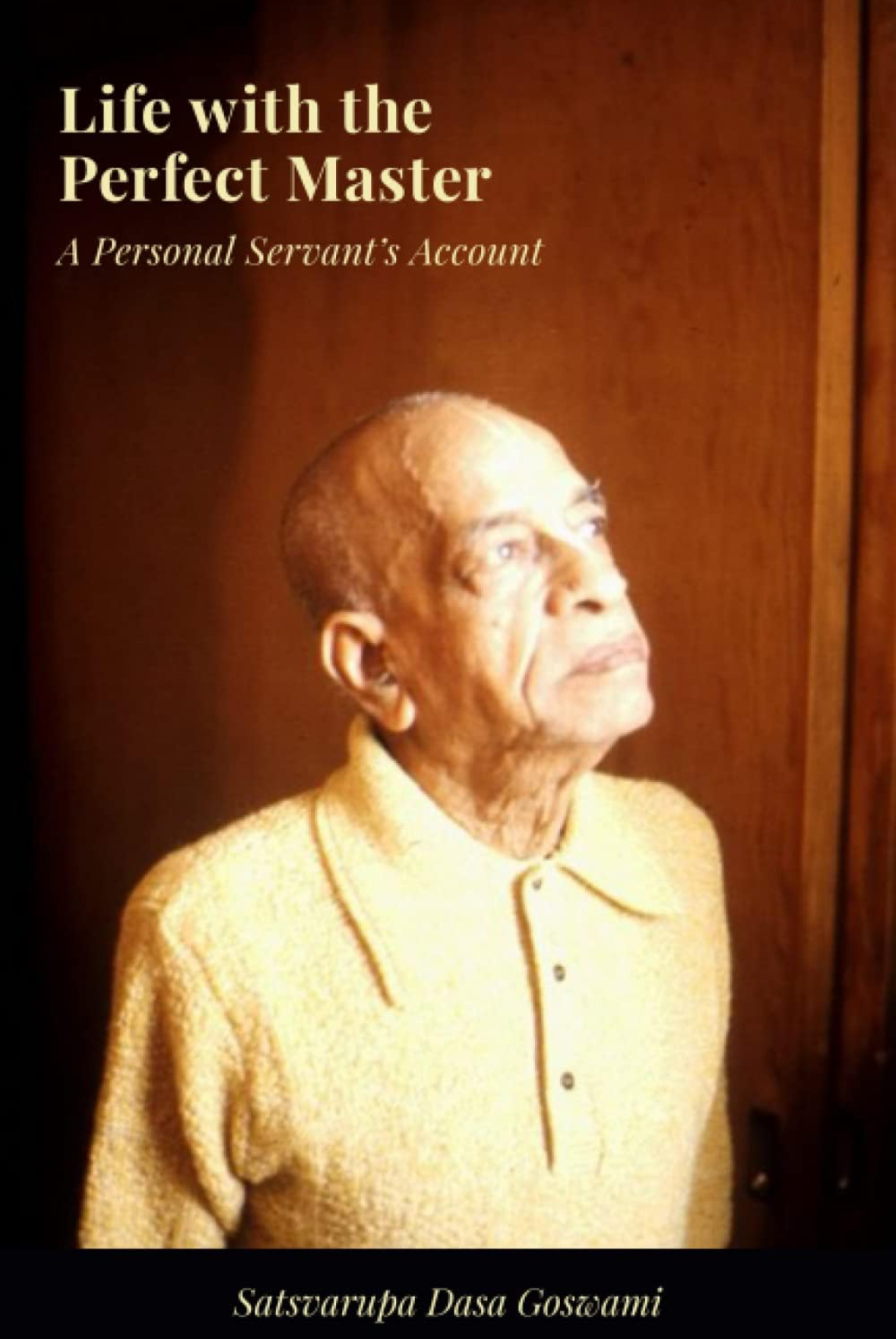
I have a personal story to tell. It is a about a time (January–July 1974) I spent as a personal servant and secretary of my spiritual master, His Divine Grace A.C. Bhaktivedanta Swami Prabhupäda, founder-äcärya of the International Society for Krishna Consciousness. Although I have written extensively about Çréla Prabhupäda, I’ve hesitated to give this account, for fear it would expose me as a poor disciple. But now I’m going ahead, confident that the truth will purify both my readers and myself.

First published by The Gītā-nāgarī Press/GN Press in serialized form in the magazine Among Friends between 1996 and 2001, Best Use of a Bad Bargain is collected here for the first time in this new edition. This volume also contains essays written by Satsvarūpa dāsa Goswami for the occasional periodical, Hope This Meets You in Good Health, between 1994 and 2002, published by the ISKCON Health and Welfare Ministry.

This book has two purposes: to arouse our transcendental feelings of separation from a great personality, Śrīla Prabhupāda, and to encourage all sincere seekers of the Absolute Truth to go forward like an army under the banner of His Divine Grace A.C. Bhaktivedanta Swami Prabhupāda and the Kṛṣṇa consciousness movement.
A single volume collection of the Nimai novels.
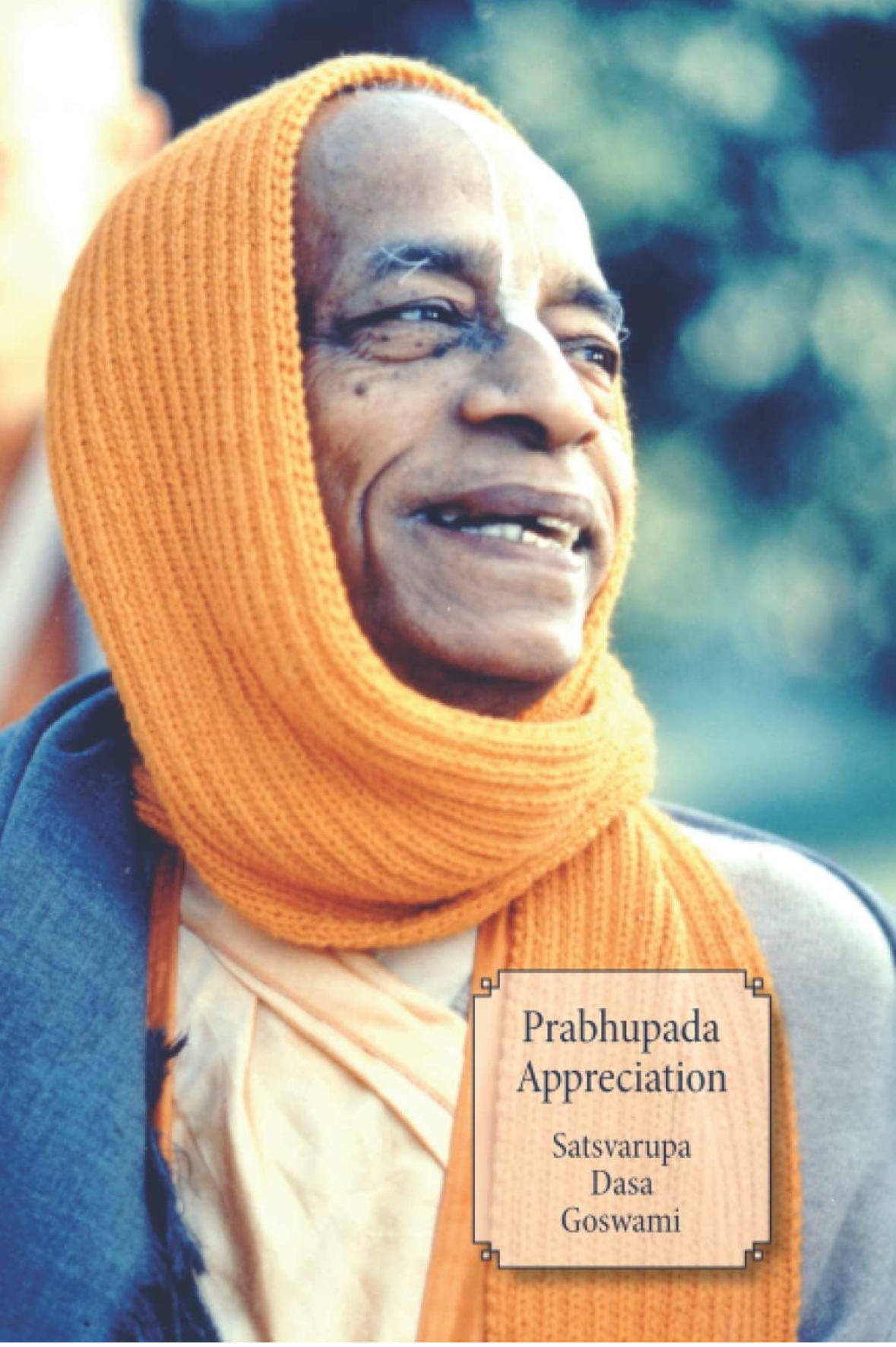
Śrīla Prabhupāda was in the disciplic succession from the Brahmā-Mādhva-Gauḍīya sampradāya, the Vaiṣṇavas who advocate pure devotion to God and who understand Kṛṣṇa as the Supreme Personality of Godhead. He always described himself as simply a messenger who carried the paramparā teachings of his spiritual master and Lord Kṛṣṇa.
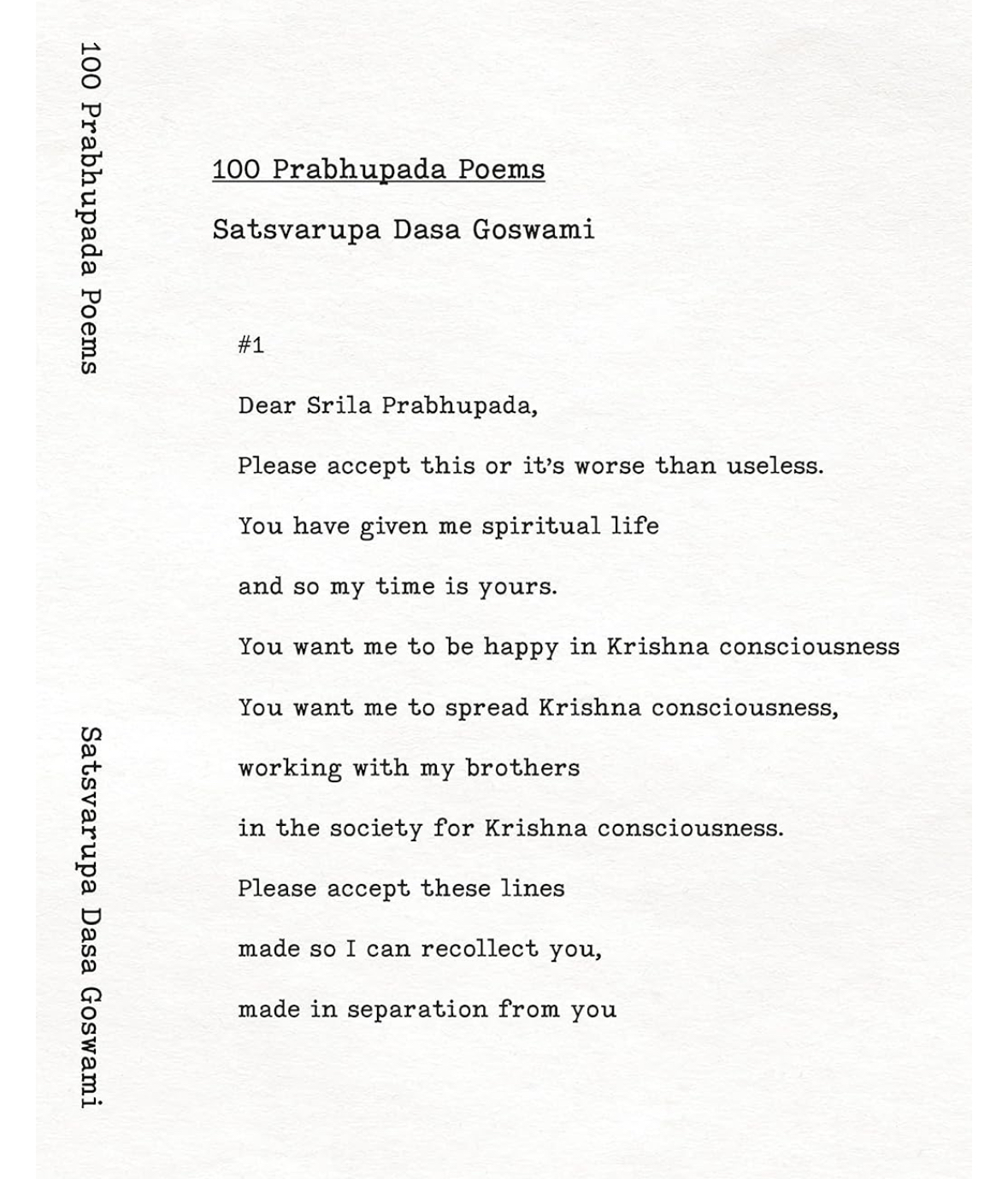
Dear Srila Prabhupada,
Please accept this or it’s worse than useless.
You have given me spiritual life
and so my time is yours.
You want me to be happy in Krishna consciousness
You want me to spread Krishna consciousness,
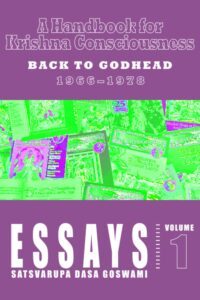
This collection of Satsvarūpa dāsa Goswami’s writings is comprised of essays that were originally published in Back to Godhead magazine between 1966 and 1978, and compiled in 1979 by Gita Nagari Press as the volume A Handbook for Kṛṣṇa Consciousness.

This second volume of Satsvarūpa dāsa Goswami’s Back to Godhead essays encompasses the last 11 years of his 20-year tenure as Editor-in-Chief of Back to Godhead magazine. The essays in this book consist mostly of SDG’s ‘Notes from the Editor’ column, which was typically featured towards the end of each issue starting in 1978 and running until Mahārāja retired from his duties as editor in 1989.
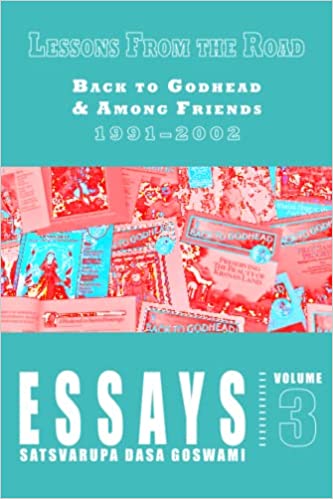
This collection of Satsvarupa dasa Goswami’s writings is comprised of essays that were originally published in Back to Godhead magazine between 1991 and 2002, picking up where Volume 2 leaves off. The volume is supplemented by essays about devotional service from issues of Satsvarupa dasa Goswami’s magazine, Among Friends, published in the 1990s.

“This is a different kind of book, written in my old age, observing Kṛṣṇa consciousness and assessing myself. I believe it fits under the category of ‘Literature in pursuance of the Vedic version.’ It is autobiography, from a Western-raised man, who has been transformed into a devotee of Kṛṣṇa by Śrīla Prabhupāda.”
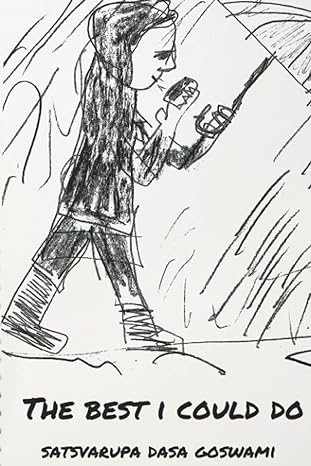 The Best I Could Do
I want to study this evolution of my art, my writing. I want to see what changed from the book In Search of the Grand Metaphor to the next book, The Last Days of the Year.
 a Hare Krishna Man
It’s world enlightenment day
And devotees are giving out books
By milk of kindness, read one page
And your life can become perfect.
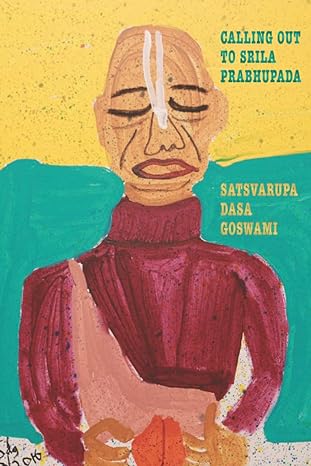 Calling Out to Srila Prabhupada: Poems and Prayers
O Prabhupāda, whose purports are wonderfully clear, having been gathered from what was taught by the previous ācāryas and made all new; O Prabhupāda, who is always sober to expose the material illusion and blissful in knowledge of Kṛṣṇa, may we carefully read your Bhaktivedanta purports.
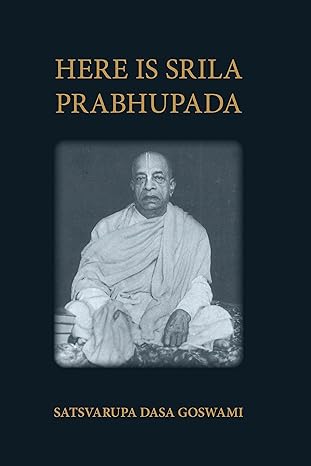
I use free-writing in my devotional service as part of my sādhana. It is a way for me to enter those realms of myself where only honesty matters; free-writing enables me to reach deeper levels of realization by my repeated attempt to “tell the truth quickly.” Free-writing takes me past polished prose. It takes me past literary effect. It takes me past the need to present something and allows me to just get down and say it. From the viewpoint of a writer, this dropping of all pretense is desirable.
 Geaglum Free Write
This edition of Satsvarūpa dāsa Goswami’s 1996 timed book, Geaglum Free Write Diary, is published as part of a legacy project to restore Satsvarūpa Mahārāja’s writings to ‘in print’ status and make them globally available for current and future readers.