
What
Meeting of Disciples and friends of SDG
Where
The Veterans of Foreign Wars Hall – 845 Hudson Avenue – Stuyvesant Falls, New York 12173
There is plenty of parking near the Hall. The facility is just a few minutes’ walk from SDG’s home at 909 Albany Ave.
Schedule
10:00 – 10:30 A.M. Kirtana
10:30 – 11:15 A.M. Presentation by Satsvarupa Maharaja
11:15 – 12:30 P.M. Book Table
12:30 – 1:15 P.M. Arati and kirtana
1:15 — 2:15 P.M. Prasadam FeastContact
Baladeva Vidyabhusana at [email protected] or (518) 754-1108
Krsna dasi at [email protected] or (518) 822-7636SDG: “I request as many devotees as possible to attend so we can feel the family spirit strongly. I become very satisfied when we are all gathered together.”
*******
Śrī Caitanya-caritāmṛta, Madhya-līlā 20.124–125: “O great learned devotee, although there are many faults in this material world, there is one good opportunity—the association with devotees. Such association brings about great happiness. . . . .”
Srila Prabhupāda: “Therefore, our Society is association. If we keep good association, then we don’t touch the darkness. What is the association? There is a song, sat-saṅga chāḍi’ kainu asate vilāsa, te-kāraṇe lāgila mora karma-bandha-phāṅsa (Gaurā Pahū, verse 3). Sat-saṅga. Sat-saṅga means association with the devotees. So the one poet, Vaiṣṇava poet, is regretting that, ‘I did not keep association with the devotees, and I wanted to enjoy life with the nondevotees. Therefore I’m being entangled in the fruitive activities.’ Karma bandha phāṅsa. Entanglement.” [Conversation with David Wynne, July 9, 1973, London]
We need to expand our team of proofreaders as we aim to increase the rate of republication of Satsvarūpa Mahārāja’s books as well as new books that he writes.
This includes a need for fluent bilingual Spanish and English speakers to proofread Spanish translations (we currently have around 20 Spanish translations waiting to be proofread).
Anyone interested in this particular service should contact Manohara dāsa at [email protected]
If you would like to help, please contact Kṛṣṇa-bhajana dāsa at [email protected] or [email protected] and we will find you a service that utilizes your talents.
You just have to be aware of the importance of chanting. Whatever the leaders preach, the others will talk about and follow. But, you cannot artificially preach or introduce anything to someone else unless you first introduce it to yourself. First examine your own chanting, then you can convey your realization to the others. It is not like some legislation—if you want something to enter people’s hearts, it has to enter your heart first.
******
As you chant Hare Krsna, your dormant love of God will come out, just as butter comes out when we churn milk. Butter is already there in milk, but it has to be brought out by the process of churning. So your love of God is there, it just has to be brought out by your chanting.
******
Chanting Hare Krsna japa should be done by moving the tongue and lips, reciting audibly, and pronouncing the words. At least our sixteen rounds should be chanted in this way. Beyond this, if one can chant Hare Krsna at other times, it is good. Such chanting aloud should not be considered external. The sound vibration is part of the internal or spiritual energy. Not that because we chant aloud it is external, whereas quiet or silent or meditative chanting is internal. Lord Caitanya savored the external congregational chanting of kirtana, and even the japa is done aloud. Prabhupada once said if we try to chant in the mind, then without chanting aloud we may have to listen to the mind’s nonsense. So to overcome the devious mind we chant aloud. It is all right to recite the translation, but not that it should be done regularly after each mantra. Don’t concoct.
******
But how can I become determined to chant Hare Krsna? I have read Lord Caitanya’s prayer where He states that He has no attraction for the holy name. So I think certainly this is my position also, except I cannot even make it into a wonderful prayer of lamentation as did Lord Caitanya.
******
Whatever progress I have made in my chanting is due to Krsna’s mercy on me. We gain benefit by watching others chant with great absorption. The words should be chanted with clear utterance, and the whole body should be concentrated on the chanting. We can’t expect to do other things while chanting Hare Krsna. It is not such a thing that you can negligently chant and at the same time drive a car, dial a telephone, read a newspaper, etc.
******
We should not minimize the hearing. What are we hearing? Krsna’s name. Hearing oneself calling on Krsna’s name is really not different from addressing Krsna. It should not be that we are repeating the name dully, or unconsciously. So let your consciousness be that you think of calling on Krsna’s name while you actually recite that name. This is called attentive chanting.
******
As far as whether Krsna hears you—yes, Krsna hears you directly, but I do not think that Prabhupada is left out of that direct hearing. Brahmananda Maharaja calls this “Prabhupada consciousness.” That is, that when we chant as well as do any other service, we think I am doing this because it has been given to me by Prabhupada. So we are thanking Prabhupada as we chant. I know myself when I chant Hare Kona mantra and sometimes feel myself grow inattentive, I spontaneously call out, “Prabhupada!” This spontaneous call shows that I am thinking of the chanting in terms of my spiritual master who gave it to me. The chanting always goes through the spiritual master. At what point would we like to become so advanced that we now kick aside the spiritual master? At least I would not like to reap such advancement.
******
“Devahati shows us the process for understanding transcendental subject matters. It is not by challenge but by submission. The entire bhakti process is a process of submission. That is also Caitanya Mahaprabhu’s teaching.
trnad api sunicena
taror api sahisnuna
amanina manadena
kirtaniyah sada hari…If one is interested in advancing in chanting Hare Krsna, Caitanya Mahaprabhu advises that one should be humbler than the grass and more tolerant than the trees. One should not be very proud of his intelligence but should give all respects to others. In this way one can chant Hare Krsna offenselessly.”
—Teachings of Lord Kapila
Dear Prabhupada and dear Lord Krsna,
Thank you for bringing me to the sacred dhama, Vrndavana. I’m sure to become more Krsna conscious here if I can refrain from committing offenses. My japa is poor, however. I am mostly inattentive and without taste. That is due to offenses and a hard heart. I hope this environment will change me for the better. I wish to do as You desire. I will give up my own plans and follow Yours.
All glories to the holy names. I beg for Your mercy. Let me work at chanting, and polish the mirror of the mind.
Dear Lord Kṛṣṇa, dear Prabhupāda,
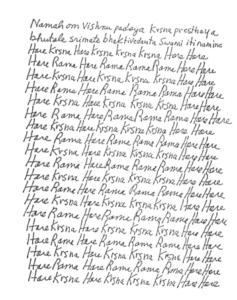
It’s a sensual pleasure to see the mahā-mantra flashing on the page in blue and red, sinking into the page in ink tones. Let my sensual faculties be absorbed in the beauty and potency of Your names in pen on page, and of course, in sound uttered by my tongue and heard by my ear—and please let my mind be absorbed in these names, which are as good as Your form, fame, presence, just as in the spiritual world. But I cannot chant with material senses. Please help me to hear and speak the spiritual sounds. I’ve no hope it seems, to achieve it. And so, I fall into lethargy and skepticism (mandāḥ sumanda-matayo). Please help me.
pp. 34-39
When I was a boy living at 125 Katan Avenue in our little Cape Cod house, we sometimes went blackberry picking at a place you could reach by walking down Katan Avenue and up a hill that had no housing development on it. There was a small wood there, although it was more like an overgrown field of brush and weeds, and plenty of blackberry bushes. I would bring my mother’s aluminum pots and pick and pick and pick. My fingers would be stained from the juice and pricked by the thorns until the whole bucket was filled and brought home to my mother. Those were happy days.
Someone once said that Thoreau had such good intelligence that he should be managing the nation, not managing a group to pick blackberries. Thoreau preferred to stay out of politics, though, and I can attest that blackberry picking is good fun.
I also read a poem once describing the suffering conditions the writer experienced on his rounds as a male nurse in a hospital ward. In the midst of his poem, he suddenly tells of a character in a Chekhov story who says he has achieved happiness because he was finally able to grow gooseberries on his own land. Another character in the story laments that people who think like this are suffocating the world. How can they possibly be happy amid so much suffering? Shouldn’t we all be doing something to alleviate world suffering?
In Krsna consciousness we pick blackberries and offer them to Krsna. Just to see the devotees honoring them as the Lord’s prasadam is wonderful. That’s Krsna conscious community life and it can alleviate the world’s misery because Krsna is in the center and His mercy is available to anyone who will take it. We can’t all be militant peacemakers as this poet suggests we become. We can’t just go out and spread the teachings, give out books, and call our duty complete. To be effective and to attract people, we need recreation, agriculture, and cow protection—culture. As long as we live in this world, we should take the opportunity to pick blackberries, and we shouldn’t be ashamed of our juice-stained fingers as if they prove we should be doing more.
The Lord told Brahma to tell the demigods that their wives (sura-striyah) should take birth in the families of cowherd people in Vrndavana. Thus they would have the privilege of joining in Krsna’s pastimes. Srila Prabhupada explains that if we are pure devotees at the end of our lives, we will take birth in the universe where Krsna is currently exhibiting His eternal lila and be trained for service in Goloka Vrndavana.
Do you remember that teaching?
Oh, yes.
Well, here it is again, right in the early verses of the Tenth Canto. It’s not something to debate or doubt. The material scientists can’t understand it, and we are also free to accept it or not.
When will we be able to join Krsna’s pastimes? We have to want it very badly, greedily, transcendentally. It takes lifetimes of devotional service. Better, therefore, to move along and not hang back doubting whether Krsna even exists or asking questions like, “How is it possible?” We are filled with Western material prejudice and that is our misfortune.
I remember hearing Prabhupada tell us about this training we would receive. I also remember joking about it in the sankirtana van on the way to the Boston Common. Lilavati said she would like to go back to Goloka Vrndavana for a feast or two with Krsna, play with Him awhile, and then return to this world to preach on His behalf. We’d heard that the highest aspiration of a devotee was to preach in Lord Caitanya’s movement in this world. We had heard it was even better than desiring to stay in Goloka. How superficial was our understanding! Our choice was not between staying in Goloka (as if that were within our grasp) and being a perpetual preaching-traveler, a Narada Muni. Our choice was between practicing vaidhi-bhakti and falling back into the material pool. Maya was not completely convinced that we wanted no more part of the material world, and she was always ready to test us to see whether we had actually come to disturb Krsna. If we are disruptive to the society of devotees in this world, how can we ever expect to fit in to the harmony of the spiritual world?
Still, the philosophy is there. If we become pure in this lifetime, we can go to be with Krsna somewhere in the material manifestation in our next life.
Lord Brahma told the demigods that Sankarsana would appear first as Krsna’s older brother, Balarama. Yogamaya or Visnumaya, the Lord’s potency, would also appear and bewilder persons like Kariisa into thinking he could kill Krsna. (That’s Mahamaya. Visnumaya would act as Yogamaya and make Yasoda and other intimate servants of the Lord think that they are His mother or friend or lover.)
In this way, Lord Brahma pacified Mother Earth by assuring her that Krsna would remove the burden she felt from the demons.
Does this news pacify me? Are my doubts and fears dispelled? I would like to respond as Arjuna did at the end of the Bhagavad-gita: “Yes, my Lord, my illusion is now gone. I am unafraid and prepared to act on Your order. I accept all that You have said. You are the Supreme Personality of Godhead.”
I remember hearing about Krsna from the Swami and concluding, “He is the most relishable form of God.” Krsna is the best. Even then it began to dawn on me that He wasn’t a myth or the God of the Hindus, and I began to have faith that this Vraja boy could be all that they say He is and all that He says He is. Mattah parataram nanyat: “O conqueror of wealth, there is no truth superior to Me. Everything rests upon Me, as pearls are strung on a thread.” (Bg. 7.7)
pp. 126-29
I like to look at pictures of the acaryas—Krsnadasa Kaviraja crouching as he writes, Srila Rupa Gosvami also crouching as he composes his Sanskrit poems. Srila Jiva Gosvami wore a white kaupina, his right hand raised in blessing. They lived simple lives. Their material amenities were reduced almost to nil. I keep thinking, “We have the nicest saints.”
Lord Krsna says,
” . . . without saintly persons for whom I am the only destination, I do not desire to enjoy My transcendental bliss and My supreme opulences.” (Bhag. 9.4.64)
The sky is a mild blue, the temperature in the high forties. It is Saturday. I am supposed to go to Krsnadasa Kaviraja’s bhajana-kutir. It will take concentration.
I have been there before. I touched the railing on the outside door, peered inside at the worn objects. I wasn’t sure which articles were actually used by Kaviraja Gosvami and which have been added since his disappearance. We have been raised on reading his Caitanya-caritamrta. I want to pray to him that I may come to love his book. Please, Kaviraja Gosvami, bring me to your lotus feet, chapter by chapter. Let me join you in the prayer you make at the end of each chapter:
Praying at the lotus feet of Sri Rupa and Sri Raghunatha, always desiring their mercy, I, Krsnadasa, narrate Sri Caitanya-caritamrta, following in their footsteps.
He is writing beside a flowing stream full of white lotuses. He wrote beside a potted tulasi plant. He kept a water pot beside him. He wrote on rectangular pages. He didn’t use a desk and lamp, but crouched on a mat, beside a tree. His body was marked with Vaisnava tilaka. He was old and ill, but felt a miraculous ability to write.
I infer that ‘I have written’ is a false understanding, for my body is like a wooden doll. . . . I am always exhausted by five kinds of disease. I may die at any time of the day or night. . . . It is because I have offered my prayers unto the lotus feet of all of you that whatever I have written about Sri Caitanya Mahaprabhu has been possible. (Cc. Antya 20.92-101)
“When one remembers Sri Caitanya Mahaprabhu everything becomes easy, and when one forgets Him everything seems hard.”
I would like to stay overnight at Radha-kunda and dream of this place. If I could just be a simple devotee chanting a lakh of rounds a day. If I could remain undisturbed through heat and cold. If I could be fastidious about what I eat. If I could just tolerate others’ opinions. If I could bathe in the kunda every day and realize that it is nondifferent from Radha and Krsna. If I could commune with the eternal saints here, with Raghunatha dasa Gosvami and Krsnadasa Kaviraja. Even if I could dream of something more modest, of praying and praying, of realizing that Prabhupada is always with me, blessing me. If I could dream of serving him day and night without cessation. If I could stay at Radha-kunda for just one night and pray to eventually attain all these things.
But if I desire simply to survive the parikrama experience, that desire will also come true. ‘Where else should I be at this exact moment in time other than at Radha-kunda?
Tonight while drinking milk, I heard Srila Prabhupada say that our bodies change throughout life, but death is the final change. Then we receive another body. He challenged, ‘Why don’t they think about these things?” It occurred to me that I don’t think about them much either. Sometimes it seems better to be so absorbed in service that you forget death. But we are growing older. I have always been a little older than most ISKCON devotees, because I was twenty-six when I joined. I started out older and I have continued to be so.
“Why don’t they think about these things?”
I don’t know. I just know I can’t think too deeply about them either, especially when it turns to considering the next life. I feel like a child who cannot reach up to the teacher’s desk, or who cannot understand the big words in the textbooks. I have no idea what it means to take a next life, and what I do know of it unnerves me. I dream of it. Yes, it’s something I find difficult to face with my conscious mind, so I face it with the unconscious mind in my sleep. My dream scenarios often involve wandering, returning to unpleasant situations I remember from this lifetime, trying to escape predicaments, and failure. They are parables of samsara. I don’t want to go through birth and growing up again, but neither do I have what it takes to return to eternal Vraja after this life. I am left to pray the best prayer: to take birth in the association of pure Vaisnavas.
Of course, if I could snap awake in this lifetime and become completely serious, that would be different, but even then I wouldn’t be looking for salvation (liberation). I would become serious to chant Hare Krsna and to serve Krsna, to remember Him and to cast off all gross and subtle sense gratification.
Radha-kunda is a good place to think these things out. Rasa is beyond logic and argumentation, and Radha-kunda represents the highest rasa. The gopis don’t discuss death and rebirth unless it enhances their love for Krsna.
pp. 162-66
Tomorrow the two visitors leave. It is good to hear Raya dasa’s kirtan. Better than watching hours of baseball. There was nothing spiritual in that, and it hurt your eyes. Better today to opt for some more kirtan, even if it is a little bit boring, and cancel the game. And maybe you can talk with Caitanya, since it is his last day, even though he is so reticent.
You also got an e-mail from a disciple in Ireland asking you to phone him in Los Angeles on October 12. On October 29 the video man comes for an hour or so for my memories of Srila Prabhupada. Pump them out. I’d rather hold my books to the camera and summarize each one. Tell him I have written more about Prabhupada than anyone. But what he wants is fresh recall, as if I’d never written a word.
Shyamasundar’s video memories were probably the best so far. He was pouring out memories—he had to stop several times for tears and being unable to speak out of affection for Prabhupada. Sometimes he’d burst into laughter at the charm of Prabhupada and the blunders of the early days. He was terrific. I could not imitate that. Just register some accurate data, especially from 1966-1968, tell how I needed special attention from Swamiji just before I would surrender and take initiation.
When you were in his room, having returned some typing, the phone rang. Swamiji picked it up, and it was someone making arrangements for the marriage of Mukunda and Janaki. He put the phone down and then told me about the marriage and invited me to come. He asked specifically, “Could you come?” “Yes,” I said, “I could.” This is what I needed, to be personally invited. Then I left, and he said, “If you love me, I will love you.” There was a similar incident when I had to stay late at work and missed the grand congregation at lunch in his room. I phoned and said, “This is Steve. Do you remember me? I can’t come to lunch today, but will you save something for me?” “Yes,” he said. I went there and he was alone. I bowed down to him. I’ll tell the interviewer how this boy had to be hauled in gently with special attention, call him in from where he was sitting on the curb and tell him about the Sunday feasts, which he had been too timid to attend, thinking that they were just for insiders. When I missed the first initiation, I was at once regretful, and definitely wanted to get initiated as soon as possible. I asked him if I could be initiated. “Yes, you can, and the next one is Radhastami.”
I look forward to no visitors
when I can lounge in or out of uniform,
and rest in the afternoon, don’t
have to schedule dates
time to myself. Don’t have to worry
how they are doing
and stretch myself in conversations
chewing the rag, worried they are not
having a good time.
It’ll be a break to be
your own man.
Oh I dreamt I could become
a great writer in a different
style. That could only happen
with more time.
Whew. Last night was their last night. In the bhakti-sastri class, Govinda asked us to draw pictures of a moment in which we were experiencing the higher taste in Krishna consciousness. I drew a picture of Bittersweet Swami facing the viewer and smiling. He was running along the surf on a sunny beach, just by the surf on the morning after he first attended the temple. He was celebrating his release from bad habits. Caitanya drew a well-constructed image of himself from the back, with a little sikha, cleaning a big stack of pots and pans and at a large kitchen sink and singing Hare Krsna mantra, an apparently demeaning task, but he was experiencing bliss.
Keli drew a picture from childhood experience when he first attended a party with adult devotees, and they had kirtan and delicious scones. On the way back home, he said a cute kid thing, “These are my people.” He really liked it. Magdalene drew a picture from her Catholic convent days. She drew a big blue cross of Jesus and a little cross which had a brown interior and a blue outer border. She said the first time she joined the convent, the nun told her to go alone inside a room and chant the rosary for an hour. Magdalene didn’t like it at first, and she didn’t want to surrender to God. This was represented in the drawing by the brown interior. But gradually she became humble, and she felt like butterflies and angels, and her crucifix grew borders of the blue colors of Jesus. Raya dasa drew a picture of the three domes of the Krishna-Balarama Mandir in Vrndavana and the sound of the Hare Krsna twenty-four-hour kirtan pouring out. Nanda drew a picture of himself restringing his broken beads. He said it was hard work but blissful to be fixing his favorite japa-mala.
How does a transcendentalist speak? What is his language, and how does he sit? Govinda said we should not take this in a simplistic way. He is equipoised, his language is controlled, his senses are like the tortoise’s limbs; he withdraws them unless he wishes to use them. The Krsna consciousness movement is a team, and the Founder-Acarya wants us to continue it. That will be a test to show how much we love him. Where does Mexico fit in? I hope he will accept it as a loving offering where his loving devotees are worshiping him.
pp. 171-76
I am free-writing. It is similar to japa. Both depend on their own processes. Let’s explore a comparison of writing to japa. In japa, you focus on hearing the clearly pronounced name and you look for a break from your confused mind. (The mind is confused by so many currents of thought that it feels like a telephone wire buzzing with hundreds of phone calls at once.) You look for a break wherein you can pray from your actual condition: “Krsna, please help me. Please engage me in Your service!”
And free-writing? It is a process to keep moving quickly over thoughts, selecting ones that are charged with emotion and using them to form prayers. Lately, this “mantra” for writing keeps occurring to me: “Help yourself.” It’s a cue—write something that will help you in Krsna consciousness. “Help yourself” starts with your actual state and goes to serving the Lord’s associates, making prayers to superiors, being friends with peers, and giving parampara instructions and examples to newcomers and younger devotees. It is communication.
Neither japa nor writing can be pursued artificially. I have to concentrate on what I need, what I actually am—the process values honesty. No rituals, no feigned emotions or imagination (kalpana).
Pen jumps up to shout, “Haribol!” Bows down to make pranamas at the mere thought of the name “Gauranga! Lord Caitanya!” Pen does hijinks of kirtana ecstasy. Goes to work with determination like any nine-to-five hard-effort karmi. Delights, solaces . . . Holds a key and uses all the keys it can find to try opening the doors—where is greed? Where is greed for greed? When can I find some service to hearing about Radha and Krsna?
Japa is a continual ride, the ultimate ride, the last word in solace (even for one thrown into prison with no books or for one gone blind—solace for the dying who have no time to write more books and who have no concentration or need for anything else). Japa is peace. Like free-writing, japa flows with whatever we have, with whatever we are. It doesn’t wait for a perfect stage before beginning. It doesn’t erase what it just did and go back to start again. If a bead or round is defective, then on to the next one and the next. Japa and writing take you past the material world.
Japa is my hope. Japa is my frustration. It is my embarrassment. It is my distracted performance and my lack of realization. I have been chanting japa for thirty years. I’m still a beginner. Japa humbles me and fills me with enthusiasm at the challenge. It is hopelessly beyond me; I cannot master it. I want to learn how to surrender to the name and let the name teach me how to chant. I love it. I appreciate the theistic brilliance of the Lord for introducing harer nama as the yuga-dharma for this sinful age. Kalau tad dhari-kirtanat.
Yesterday, Madhu and I shaved up like recruits, new bhaktas. Shaved up and chanted sixty-four rounds. Madhu said his sixty-four were a “token.” He meant they were a sincere gesture, a tapasya. He wanted to show Krsna that he cared, but as far as the performance of the japa, it was, he says, austerity all the way.
I put scotch tape on the corners of my valuable paperback books like Hari-nama-cintamani so they don’t get dog-eared. Some books I cover with paper. These measures are means to achieve longevity. During the temporary existence, why let your books get dog-eared? The message of Bhaktivinoda Thakura is eternal, and I am sanatana also, a servant of Krsna.
“God is eternal, and His instructions and followers are also eternal…..The more one glorifies Krsna, the more enthusiastic he becomes in glorifying, glorifying, glorifying. . . . this Hare Krsna maha-mantra can be chanted twenty-four hours daily, and one will still feel fresh and enthusiastic. . . . It is a spiritual sound that comes from the spiritual world” (Teachings of Lord Kapila, p. 208).
Yes, you have millions and trillions of “miles” to go before reaching the goal of direct service in Vraja. Life after life you can increase your greed in chanting. So why not learn to chant as well as you can right now so that you will do better with it in the next life? It doesn’t get lost from one life to the next. It’s not like your bodily organs that finally break down until the soul has to move out of the body. Chanting can go with you to the next life. Learn how to cry for Krsna. You will be needing that ability for the next life.
Just before going out for my walk, I spent a few minutes reading Entering the Life of Prayer and Japa Reform Notebook. The particular sections I picked—or maybe the mood I was in—made me think that they were imperfect. I felt sorry about that. Someone once told me that I ought to publish an apology for all the imperfect things I have written, the gropings, the focus on myself. That apology would mean apologizing for being an imperfect, groping person. How can you publish a repudiation or retraction of your own self? But anyway I do—I declare that I write imperfectly. I say things that later turn out not to be true. This is not the standard of the Vaisnava writers.
But actually I am happy, not happy that I write imperfectly, but happy that despite all my inadequacies, and despite the obstacles in the material world, Krsna sent Prabhupada. I am allowed to serve Srila Prabhupada. Prabhupada is so kind that any small service we attempt—even if there will always be others who don’t approve of it—he will accept it in the spirit it was rendered. There are so many different people serving Prabhupada, and some will find value in what another devotee is doing. We want to work toward perfection, toward improvement of ourselves. Unless we were imperfect, how could we improve?
I am especially grateful for the career Prabhupada has given me and all the different services he has encouraged me to do in ISKCON from the beginning. He has always given me a variety of adventure and responsibility, and a great sense of working in an important mission, his mission. He has always given me hope. Now he is making the goal clearer to me, more brilliant and sweet. At the same time, he has given me the vision of myself that I am just a beginner, a fumbler, I make so many mistakes. There is no end to the work that has to be done on myself; it doesn’t seem so likely that I will finish it all up in this lifetime. He has taught me to pray for faith and he has given me faith right from 1966.
pp. 23-27
Vrndavana is glorious because it is Radha and Krsna’s playground. Srila Prabhupada was eager to bring his Western disciples here, so he constructed the Krishna-Balaram Mandir. He wanted us to live here carefully, avoiding offenses, chanting, hearing, and becoming purified by the spiritual atmosphere.
Then he wanted us to go out and preach.
From hundreds of yards away I see a monkey walking on all fours across the gurukula roof. If they came to this roof, it would be too distracting. That’s another opulence of the San Colony—no monkeys.
Yes, I know, this is surface stuff. I should know better. But I cannot expect to be one of those vairagi mendicants, mentioned by Prabodhananda Sarasvati, in this lifetime. They wear only torn cloth and wander homeless in Vraja, always crying in gopi-bhava. That form of worship is not even recommended by our spiritual master. At least I aspire to read verses like this:
I think the ultimate goal of life is to attain even a small amount of love for the land of Vrndavana, which is opulent with the splendid pastimes of Sri Radha-Murali-manohara’s lotus feet (Vrndavana-mahimamrta, Sataka 4.65).
“O Sri Vrndavana, I am now very fortunate. I have become: the object of your very, very great mercy. You have given me the right to reside within your boundaries, a right that is prayed for by Lord Brahma, Sukadeva Gosvami, Sanaka Kumara, and other great souls. This gift gives me hope that someday I will directly serve the splendid, charming, eternally youthful, eternally amorous fair and dark Divine Couple’ (Vrndavana-mahimeimrta, Sataka 4.80).
It’s humid. I can’t get inspiring dictation from my own skin and right now, the sight of four young Vrajavasi boys loitering along the path doesn’t direct me to Krsna consciousness. Pray for mercy. You say you are what you are, but you pray, “Dear Lord, please forgive me and improve me.” Prabodhananda Sarasvati prays directly to Sri Vrndavana:
“. . . If you have granted me residence within your boundaries . . . then why do you now hesitate to allow me to serve the great souls that live within you?” (Vrndavana-mahimamrta, Sataka 4.81).
I can also pray to Vrndavana-dhama by Srila Prabhupada’s mercy: Let me beg for attachment to the dhama; let me travel to its holy sites. Let me one day aspire to live here all the time.
Recently, I read references to retiring to Vrndavana in your fifties as a vanaprastha (Prahlada recommended it to his father as “the best thing” he had learned.) But I am not a vanaprastha.
Srila Prabhupada once said to one of his disciples,
Preach while you are young. When you are old, retire to Vrndavana and chant Hare Krsna. . . . But you cannot retire unless you have preached sufficiently. The mind will agitate. If you have preached, you can retire and chant Hare Krsna—so preach as much as possible (Srila Prabhupada-lilamrta, Vol. 5, p. 94).
What is young? What is a devotee’s retirement age? It varies. Retiring in the spiritual sense is for the very advanced. Mahanidhi Swami makes the point that Srila Prabhupada approves our living in Vrndavana if we continue preaching here (as I might do by writing—or if I could improve myself, as befits one who accepts disciples).
Although Srila Prabhupada rejected Subala’s idea for solitary bhajana, he did accept that one could continue living in Vrndavana provided he preached vigorously. Srila Prabhupada told Subala:
Better we spend our whole life and die just to make one person Krsna conscious. That is our line, to become so absorbed in preaching Krsna consciousness, whether in Vrndavana or anywhere. (Appreciating Sri Vrndavana-dhama, p. 247).
That is a good point—that one may also preach in Vrndavana. When a brother hears that someone is residing it Vrndavana he says, “Oh, but Srila Prabhupada wanted us to preach.” The six Gosvamis came here just to preach.
Thoughts on a humid afternoon.
A person in Vrndavana bows down. He is proud, foolish, bu he worships the dhama and the holy name. His writing is bhajana.
A bird like the whippoorwill . . . Now I will quit writing, he says, but no, go on.
I am a little nuts, and this isn’t a perfect pen. In Vrndavana, in Vrndavana. I keep saying it like a magic formula. I keep begging. But what do I want? I think I will be satisfied if I can write a pleasing, flowing record of my experiences.
Commendable, commendable.
I am not being sarcastic, but why not go deeper?
The writing should be the by-product of my prayer.
Okay, okay.
And you ought to know by now that writing is your dharma, so stop criticizing yourself for it. You may desire to go deeper, but writing isn’t exactly a “by-product.” It is your head on Thy earth and all parts of your body in dandavats.
My prayers to Vrndavana are for simple things like, “Please, let me chant with attention and love in the morning. Or let me feel unworthy that I cannot do it—but not in a neurotic way. Let me cry. Let me improve. Teach me how to chant.”
Yes, Lord, I would like to write sweet love songs to You, but am not qualified. So what does a guy do who wants to write in. Vrndavana, who has come to Vrndavana just to write? He car, write Prabhupada’s biography and purports to the “Prayers of King Kulasekhara,” and he can do this—the simple days and nights in a house of old bricks and cement in Raman Reti. It is the best situation I have ever had in Vrndavana, and I thank You for it.
I am just stressing and digging a little here to look for more. My wish-blessing: may you continue to hear in good consciousness. May Prabhupada’s words penetrate your thick skull and your dry heart.
O Vrndavana-dhama, I need to quiet down.
Certainly the trees will see you come and go from Vrndavana. They don’t write books trying to average a hundred pages a week, and they don’t make photocopies so it doesn’t get lost.
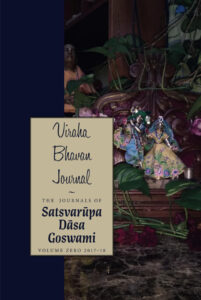
Viraha Bhavan Journal (2017–2018) was written by Satsvarūpa Mahārāja following a brief hiatus in writing activity, and was originally intended to be volume 1 in a series of published journals. However, following its completion and publication, Mahārāja again stopped writing books, subsequently focusing only on what became his current online journal, which began in August of 2018.

At first, I took it hard that I would have to live surrounded by the firemen, and without my own solitude. After all, for decades I had lived in my own house with my own books and my own friends. I was also now a crippled person who couldn’t walk, living among men who did active duties. But when Baladeva explained it to me, how it was not so bad living continually with other firemen and living in the firehouse with its limited facilities, I came to partially accept it and to accept the other men. I came to accept my new situation. I would live continually in the firehouse and mostly not go outside. I would not lead such a solitary life but associate with the other firemen.
Let me write sweet prose.
Let me write not for my own benefit
but for the pleasure of Their Lordships.
Let me please Kṛṣṇa,
that’s my only wish.
May Kṛṣṇa be pleased with me,
that’s my only hope and desire.
May Kṛṣṇa give me His blessings:
Kṛṣṇa Kṛṣṇa Kṛṣṇa Kṛṣṇa Kṛṣṇa he
Rāma Rāghava Rāma Rāghava
Rāma Rāghava rakṣa mām.
You mentioned that your pathway has become filled with stumbling blocks, but there are no stumbling blocks. I can kick out all those stumbling blocks immediately, provided you accept my guidance. With one stroke of my kick, I can kick out all stumbling blocks. —Letter by Śrīla Prabhupāda, December 9, 1972.
The Writing Sessions are my heart and soul. I’m trying my best to keep up with them. I am working with a few devotees, and they are far ahead of me. I wander in the wilderness of old age. I make my Writing Sessions as best I can. Every day I try to come up with a new subject. Today I am thinking of my parents. But I don’t think of them deeply. They are long gone from my life. Śrīla Prabhupāda wrote a poem when he was a sannyāsī, and he said now all my friends and relatives are gone. They are just a list of names now. I am like that too. I am a sannyāsī with a few friends. I love the books of Śrīla Prabhupāda. I try to keep up with them. I read as much as I can and then listen to his bhajanas.
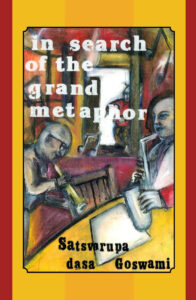
The metaphor is song. Explain it. Yes, particulars may not seem interesting or profound to readers who want structured books.
Wait a minute. Don’t pander to readers or concepts of Art. But Kṛṣṇa conscious criteria are important and must be followed. So, if your little splayed-out life-thoughts are all Kṛṣṇa conscious, then it’s no problem.
I am near the end of my days. But I do like the company of like-minded souls, especially those who are Kṛṣṇa conscious. Yes! I am prone to Kṛṣṇa consciousness. I have been a disciple of Bhaktivedanta Swami Prabhupāda for maybe almost sixty years. Sometimes I fail him. But I always bounce back and fall at his feet. It is a terrible thing that I sometimes do not have the highest love for him. It is a terrible thing. Actually, however, I never fall away from him. He always comes and catches me and brings me back to his loving arms.

This edition of Satsvarūpa dāsa Goswami’s 1996 timed book, Upstate: Room to Write, is published as part of a legacy project to restore Satsvarūpa Mahārāja’s writings to ‘in print’ status and make them globally available for current and future readers.
A factual record of the reform and change in ISKCON guru system of mid ’80s.

Readers will find, in the Appendix of this book, scans of a cover letter written by Satsvarūpa Mahārāja to the GN Press typist at the time, along with some of the original handwritten pages of June Bug. Together, these help to illustrate the process used by Mahārāja when writing his books during this period. These were timed books, in the sense that a distinct time period was allotted for the writing, during SDG’s travels as a visiting sannyāsī
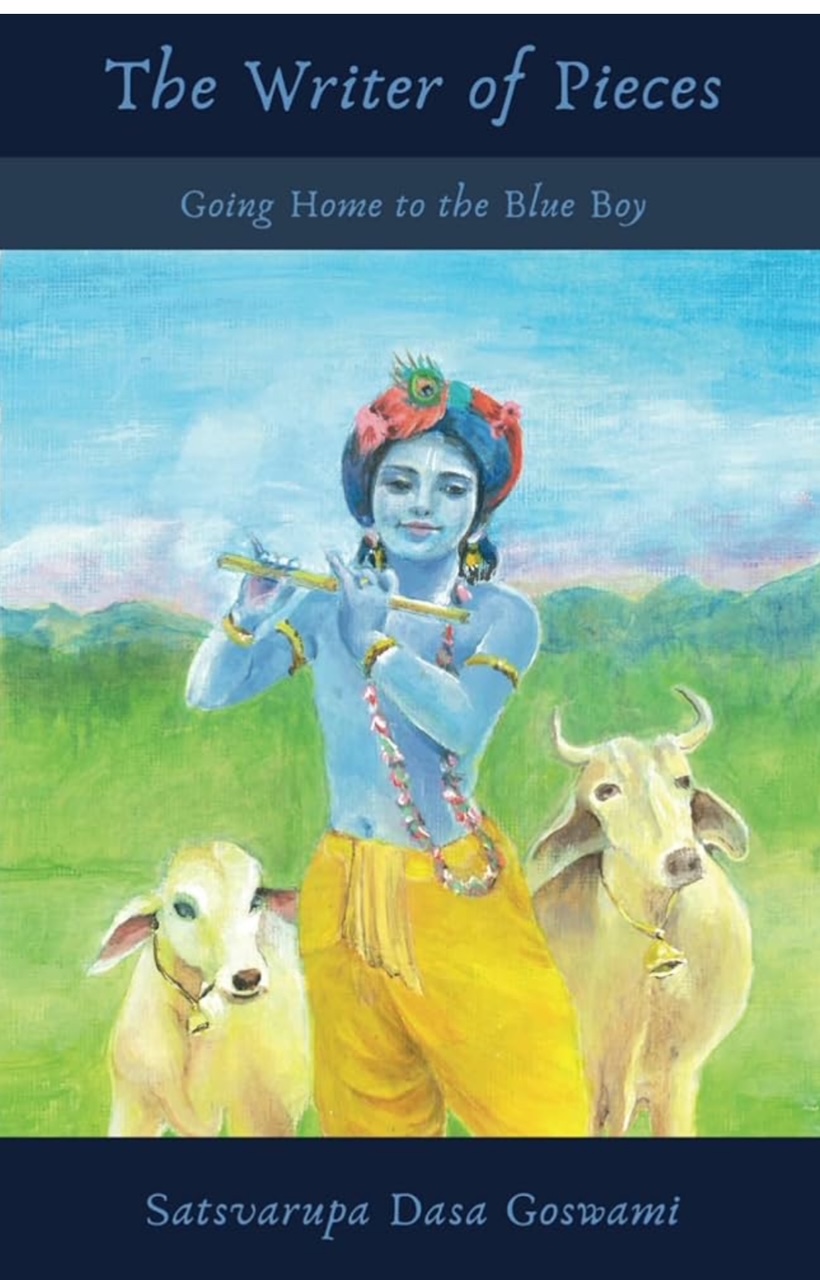
Don’t take my pieces away from me. I need them dearly. My pieces are my prayers to Kṛṣṇa. He wants me to have them, this is my way to love Him. Never take my pieces away.

Many planks and sticks, unable to stay together, are carried away by the force of a river’s waves. Similarly, although we are intimately related with friends and family members, we are unable to stay together because of our varied past deeds and the waves of time.
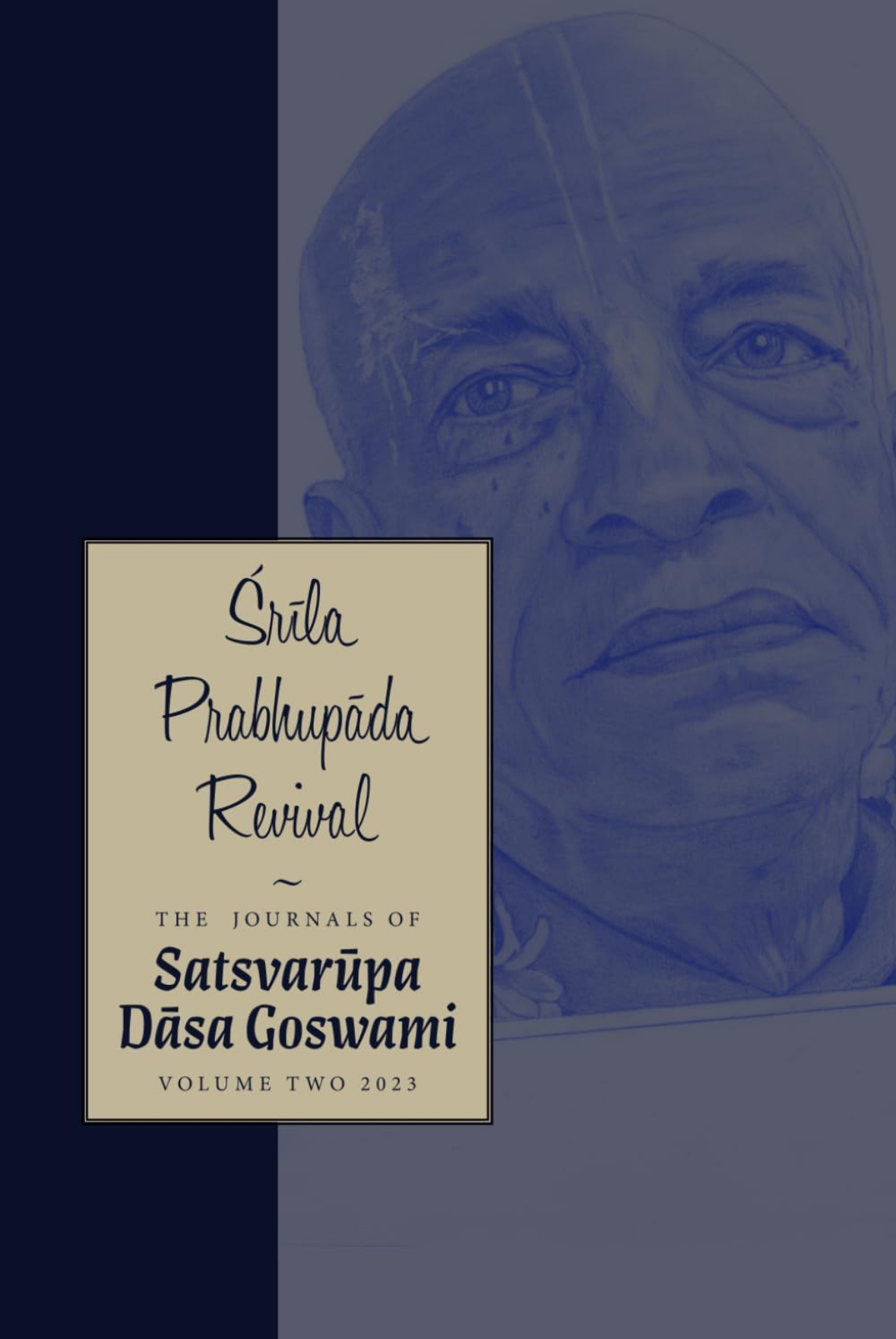
To Śrīla Prabhupāda, who encouraged his devotees (including me) To write articles and books about Kṛṣṇa Consciousness.
I wrote him personally and asked if it was alright for his disciples to write books, Since he, our spiritual master, was already doing that. He wrote back and said that it was certainly alright For us to produce books.
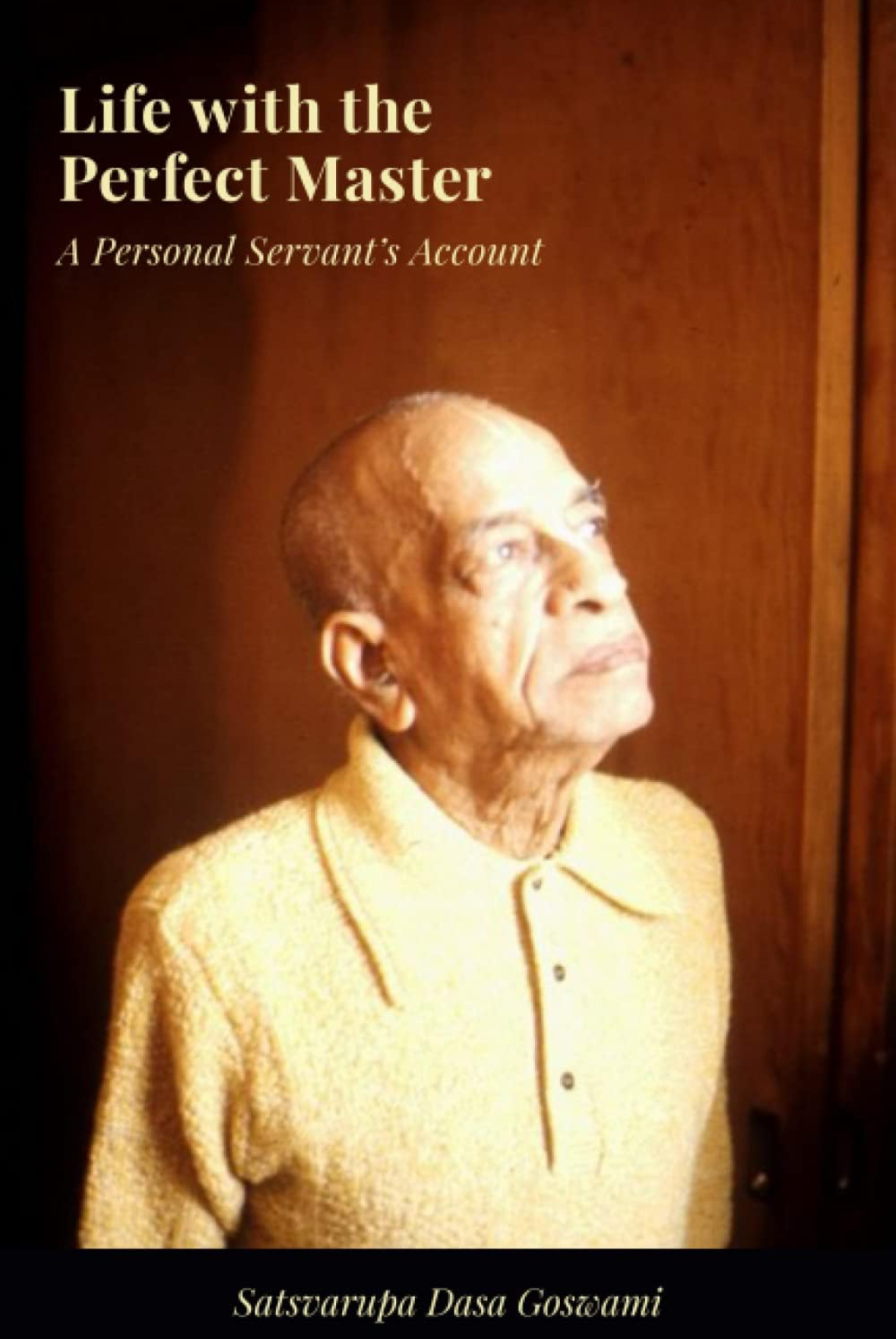
I have a personal story to tell. It is a about a time (January–July 1974) I spent as a personal servant and secretary of my spiritual master, His Divine Grace A.C. Bhaktivedanta Swami Prabhupäda, founder-äcärya of the International Society for Krishna Consciousness. Although I have written extensively about Çréla Prabhupäda, I’ve hesitated to give this account, for fear it would expose me as a poor disciple. But now I’m going ahead, confident that the truth will purify both my readers and myself.

First published by The Gītā-nāgarī Press/GN Press in serialized form in the magazine Among Friends between 1996 and 2001, Best Use of a Bad Bargain is collected here for the first time in this new edition. This volume also contains essays written by Satsvarūpa dāsa Goswami for the occasional periodical, Hope This Meets You in Good Health, between 1994 and 2002, published by the ISKCON Health and Welfare Ministry.

This book has two purposes: to arouse our transcendental feelings of separation from a great personality, Śrīla Prabhupāda, and to encourage all sincere seekers of the Absolute Truth to go forward like an army under the banner of His Divine Grace A.C. Bhaktivedanta Swami Prabhupāda and the Kṛṣṇa consciousness movement.
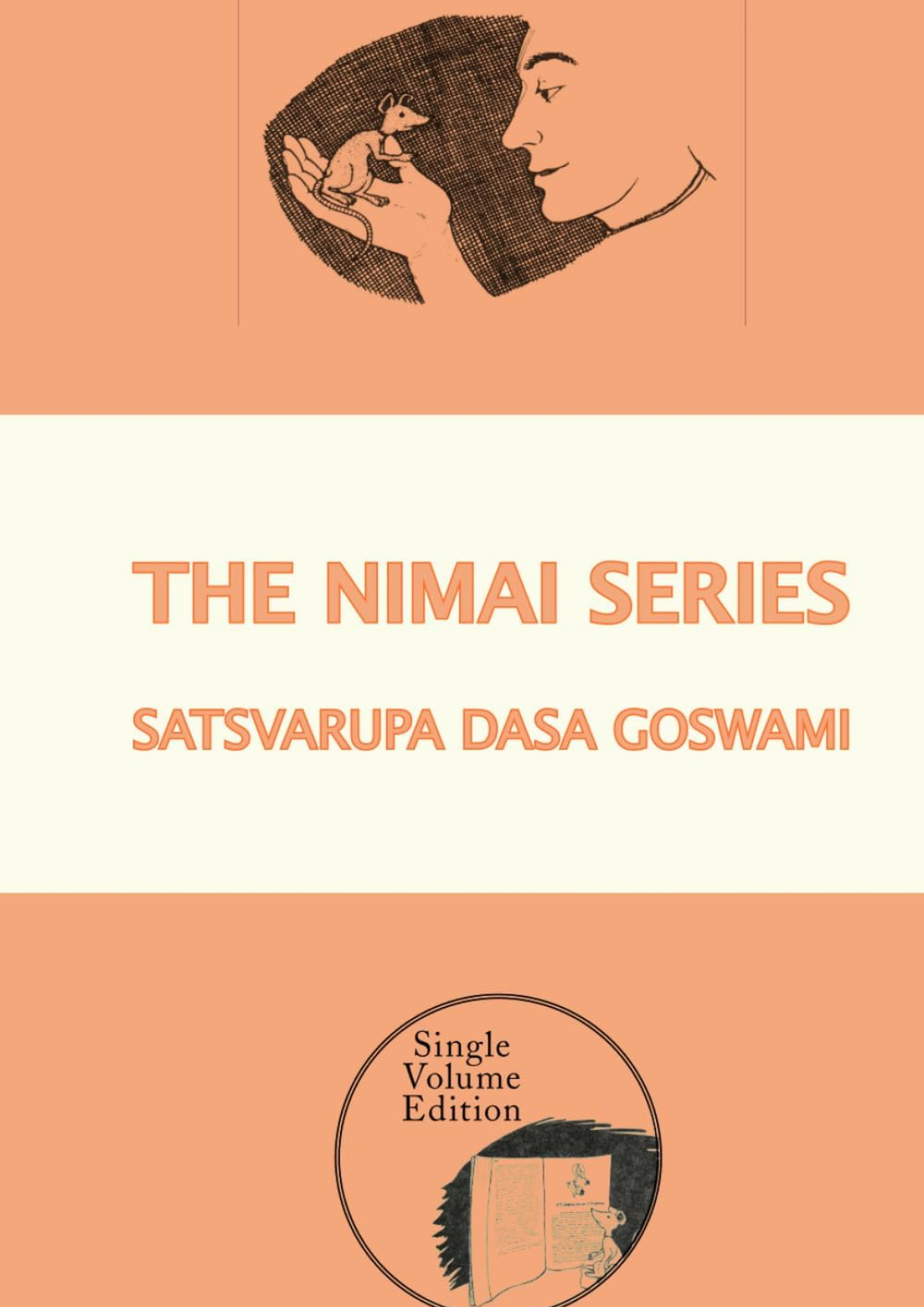
A single volume collection of the Nimai novels.
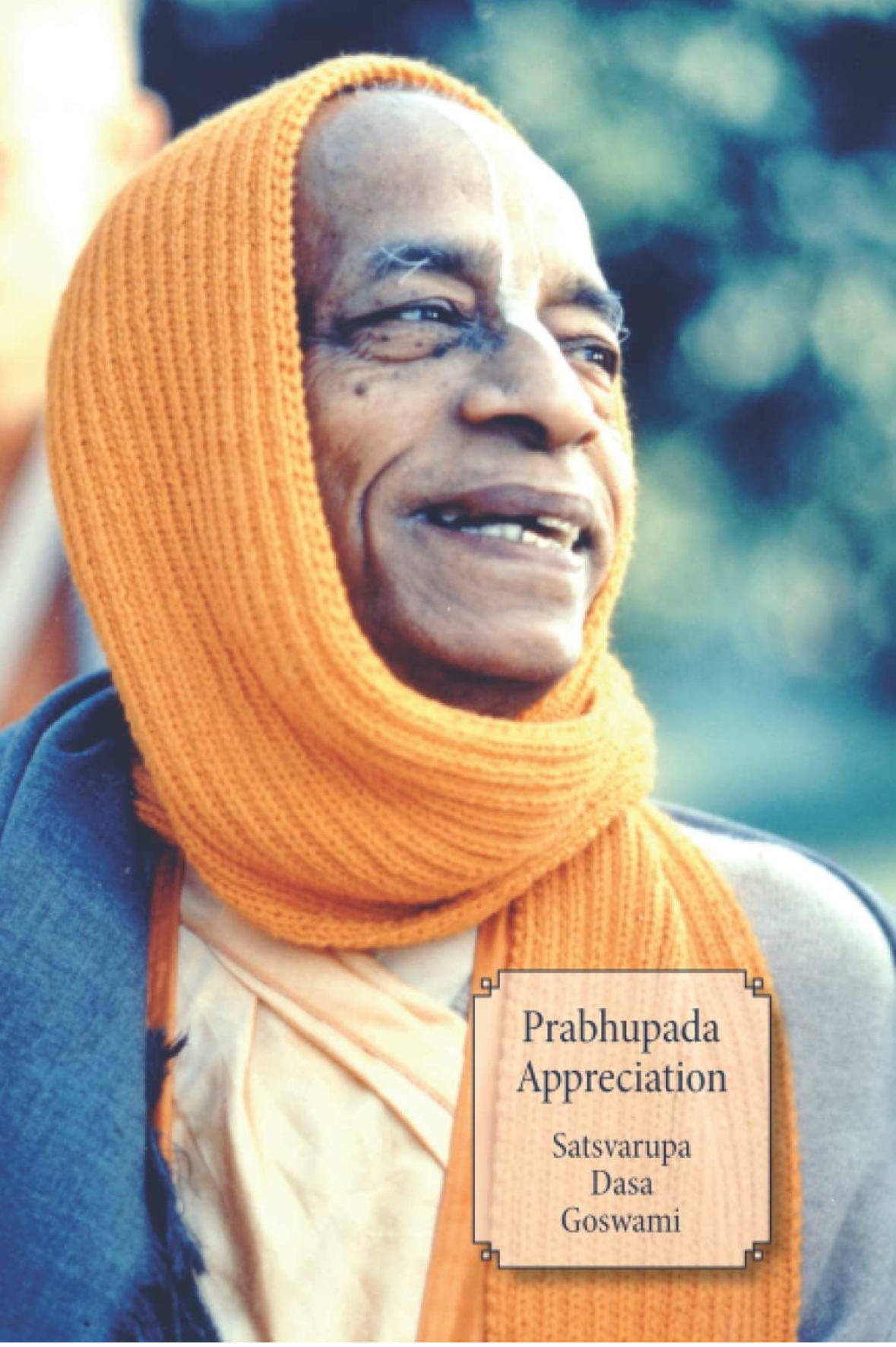
Śrīla Prabhupāda was in the disciplic succession from the Brahmā-Mādhva-Gauḍīya sampradāya, the Vaiṣṇavas who advocate pure devotion to God and who understand Kṛṣṇa as the Supreme Personality of Godhead. He always described himself as simply a messenger who carried the paramparā teachings of his spiritual master and Lord Kṛṣṇa.
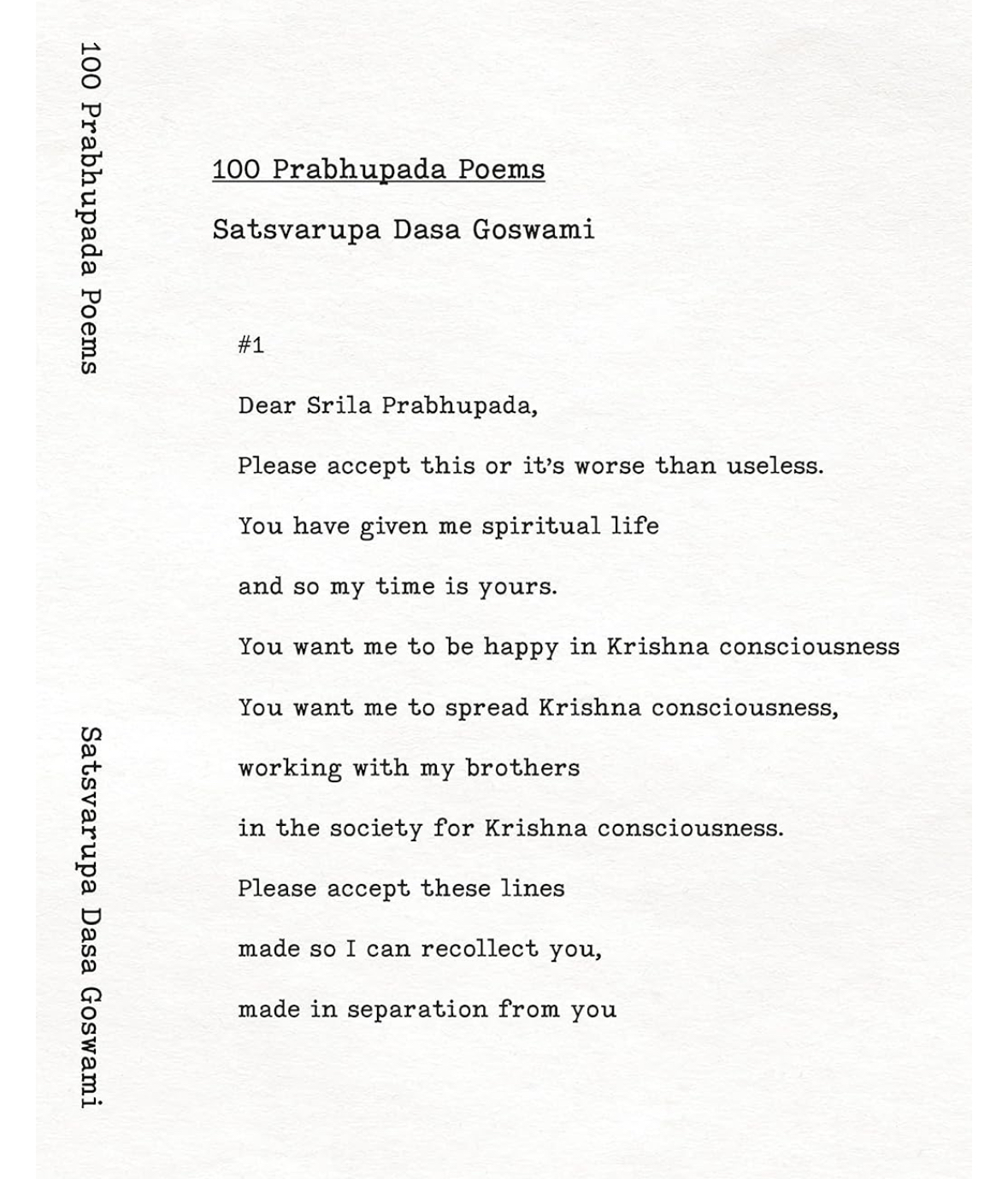
Dear Srila Prabhupada,
Please accept this or it’s worse than useless.
You have given me spiritual life
and so my time is yours.
You want me to be happy in Krishna consciousness
You want me to spread Krishna consciousness,
This collection of Satsvarūpa dāsa Goswami’s writings is comprised of essays that were originally published in Back to Godhead magazine between 1966 and 1978, and compiled in 1979 by Gita Nagari Press as the volume A Handbook for Kṛṣṇa Consciousness.

This second volume of Satsvarūpa dāsa Goswami’s Back to Godhead essays encompasses the last 11 years of his 20-year tenure as Editor-in-Chief of Back to Godhead magazine. The essays in this book consist mostly of SDG’s ‘Notes from the Editor’ column, which was typically featured towards the end of each issue starting in 1978 and running until Mahārāja retired from his duties as editor in 1989.

This collection of Satsvarupa dasa Goswami’s writings is comprised of essays that were originally published in Back to Godhead magazine between 1991 and 2002, picking up where Volume 2 leaves off. The volume is supplemented by essays about devotional service from issues of Satsvarupa dasa Goswami’s magazine, Among Friends, published in the 1990s.

“This is a different kind of book, written in my old age, observing Kṛṣṇa consciousness and assessing myself. I believe it fits under the category of ‘Literature in pursuance of the Vedic version.’ It is autobiography, from a Western-raised man, who has been transformed into a devotee of Kṛṣṇa by Śrīla Prabhupāda.”
 The Best I Could Do
I want to study this evolution of my art, my writing. I want to see what changed from the book In Search of the Grand Metaphor to the next book, The Last Days of the Year.
 a Hare Krishna Man
It’s world enlightenment day
And devotees are giving out books
By milk of kindness, read one page
And your life can become perfect.
 Calling Out to Srila Prabhupada: Poems and Prayers
O Prabhupāda, whose purports are wonderfully clear, having been gathered from what was taught by the previous ācāryas and made all new; O Prabhupāda, who is always sober to expose the material illusion and blissful in knowledge of Kṛṣṇa, may we carefully read your Bhaktivedanta purports.
I use free-writing in my devotional service as part of my sādhana. It is a way for me to enter those realms of myself where only honesty matters; free-writing enables me to reach deeper levels of realization by my repeated attempt to “tell the truth quickly.” Free-writing takes me past polished prose. It takes me past literary effect. It takes me past the need to present something and allows me to just get down and say it. From the viewpoint of a writer, this dropping of all pretense is desirable.
 Geaglum Free Write
This edition of Satsvarūpa dāsa Goswami’s 1996 timed book, Geaglum Free Write Diary, is published as part of a legacy project to restore Satsvarūpa Mahārāja’s writings to ‘in print’ status and make them globally available for current and future readers.