
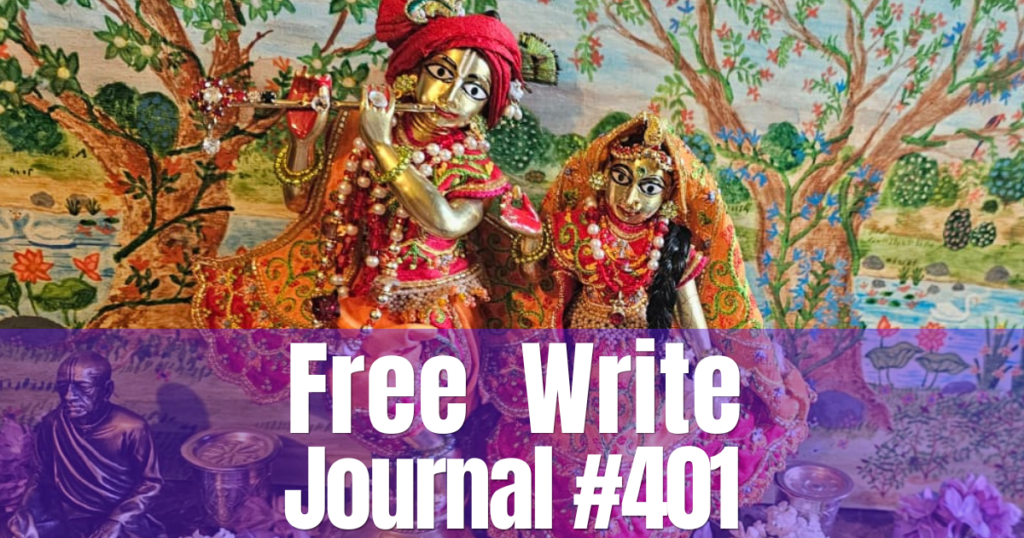
What
Meeting of Disciples and friends of SDG
Where
The Veterans of Foreign Wars Hall – 845 Hudson Avenue – Stuyvesant Falls, New York 12173
There is plenty of parking near the Hall. The facility is just a few minutes’ walk from SDG’s home at 909 Albany Ave.
Schedule
10:00 – 10:30 A.M. Kirtana
10:30 – 11:15 A.M. Presentation by Satsvarupa Maharaja
11:15 – 12:30 P.M. Book Table
12:30 – 1:15 P.M. Arati and kirtana
1:15 — 2:15 P.M. Prasadam FeastContact
Baladeva Vidyabhusana at [email protected] or (518) 754-1108
Krsna dasi at [email protected] or (518) 822-7636SDG: “I request as many devotees as possible to attend so we can feel the family spirit strongly. I become very satisfied when we are all gathered together.”
*******
Śrī Caitanya-caritāmṛta, Madhya-līlā 20.124–125: “O great learned devotee, although there are many faults in this material world, there is one good opportunity—the association with devotees. Such association brings about great happiness. . . . .”
Srila Prabhupāda: “Therefore, our Society is association. If we keep good association, then we don’t touch the darkness. What is the association? There is a song, sat-saṅga chāḍi’ kainu asate vilāsa, te-kāraṇe lāgila mora karma-bandha-phāṅsa (Gaurā Pahū, verse 3). Sat-saṅga. Sat-saṅga means association with the devotees. So the one poet, Vaiṣṇava poet, is regretting that, ‘I did not keep association with the devotees, and I wanted to enjoy life with the nondevotees. Therefore I’m being entangled in the fruitive activities.’ Karma bandha phāṅsa. Entanglement.” [Conversation with David Wynne, July 9, 1973, London]
We need to expand our team of proofreaders as we aim to increase the rate of republication of Satsvarūpa Mahārāja’s books as well as new books that he writes.
This includes a need for fluent bilingual Spanish and English speakers to proofread Spanish translations (we currently have around 20 Spanish translations waiting to be proofread).
Anyone interested in this particular service should contact Manohara dāsa at [email protected]
If you would like to help, please contact Kṛṣṇa-bhajana dāsa at [email protected] or [email protected] and we will find you a service that utilizes your talents.
The essence of all Vedic knowledge—comprehending the three kinds of Vedic activity (karma-kāṇḍa, jnāna-kāṇḍa, and upāsana-kāṇḍa) the chanting of Vedic hymns, and the processes for satisfying the demigods—is included in the eight syllables Hare Kṛṣṇa, Hare Rāma. This is the reality of all Vedānta.
******
The chanting of the holy name is the only means to cross the ocean of nescience. Chanting the holy name is the chief means of attaining love of Godhead. This chanting of devotional service does not depend on any paraphernalia, nor on one’s having taken birth in a good family.
******
“By humility and meekness, one attracts the attention of Kṛṣṇa. That is the verdict of all the Vedas. Therefore, if one becomes very humble and meek, he can easily attain the lotus feet of Kṛṣṇa in this Age of Kali. That is the fulfillment of all great sacrifices, penances and austerities, because when one achieves ecstatic love of Godhead, he attains the complete perfection of life. Therefore, whatever one does in executing devotional service must be accompanied with the chanting of the holy name of the Lord.” (Nārada Pañcarātra)
******
When we chant, we should enunciate clearly. If we are speaking to some important man, we take it as an important occasion; we don’t mumble to him. “What are you saying?” So similarly, Kṛṣṇa knows what you are saying, what you are thinking. As we are offering the name, the sound vibration, He knows His name, and He has many people glorifying Him already. But He will be pleased if you also glorify Him. So it should be done like that. It’s just another sign of care, concern, that you say the names nicely. You could even be chanting something less than the thirty-two-syllable mantra—leaving out one of the names. Hare Kṛṣṇa mantra is a scientific arrangement, so it has to be chanted in that order. Don’t be neglectful. Don’t leave out His name—Hare or Kṛṣṇa or Rāma.
******
Chanting and hearing in an attitude of service means when we chant Kṛṣṇa’s name we should be desiring to be engaged in His service. The eighth offense to the holy name is to chant as a pious act to get some material benefit. So we are not praying to God for material benefit. That is what is meant by service. Also, the act of chanting and hearing, when done very carefully, is also a service. Surrendering yourself to chanting clearly and hearing with rapt attention is also chanting and hearing in service attitude.
******
The chanting is deceivingly simple—just repeat some names. But the mind is rebelling because if you say these names, then all sense gratification will go away and you will become a devotee of Kṛṣṇa. The mind wants us to be a devotee of our nonsense mind. So although it is deceptively simple, it is hard to actually chant. Therefore, we stress it always. It is a simple process, and if you try it in a simple way it will not be difficult. But if you go on listening to your mind, it will be very difficult.
******
Unfortunately, we have no taste for hearing and glorifying the Lord’s name and activities. Developing a taste for hearing and chanting the holy sound is done through the medium of service to the pure devotee of the Lord. Sampradāya-vihīnā ye mantrās te niṣphalā matāḥ. The mantra has to be chanted in sampradāya, received from the bona fide spiritual master. As Prabhupāda says, “The taste for hearing and chanting the holy name is done through the medium of service to the pure devotee of the Lord. The Lord is reciprocally responding to His devotee. When He sees that a devotee is completely sincere in getting admittance to the transcendental service of the Lord and has become eager to hear about Him, He acts within the heart.
******
Don’t put any imposition on your mind. Just chant and try to hear the holy name. Everything will automatically come. Just drive out other thoughts and hear the holy name.
pp. 423-27
Yasoda looks forward to more “joyous” art from me, free, like I was doing in Ireland. It’s getting warm. I’ll need my electric fans and air conditioning. I can’t write in flowing penmanship. The pen is too tight, and I can’t make it in large writing. I’m sweating as I write this. Baladeva has brought in colored ink and sprits bottles for the art. Just drawing many figures rather than three. Next I do a “surreal” one, prompted by music. Make it good quality. Go beyond yourself into new expressions. I used to start abstract and then make it a form. Now I go direct to form. Try the other. Poems and painting.
Going through Gopala-campu. I’m losing weight. You do a picture of a cow. Your painting in Ireland was free and evolved. Five spontaneous paintings in a day. Now you do two. Yasoda is painting a wooden Jagannatha for Lord Krishna to hold. I move through my day tired. Put color in your drawing. I’m a lucky boy. I have my Guru Maharaja. He guides me on the path. In the reading we are hearing of the lila-avataras. The Lord saved Gajendra and Prahlada. He favored Bali Maharaja. Hearing of the avataras from the Srimad-Bhagavatam and the faithful acaryas. The sun is beating on the front of Saci’s house. Mornings start with japa and a poem, then I dictate it. Indra was forgiven. I’m uncomfortably warm. The socks are too heavy. I look to paint freer. Make a joyous picture. I don’t want to paint seductive women and horny men. Go transcendental. Draw the vision of the soul. Make spiritual art. With sadhus? Yes, but in other ways. Paint the heart, paint the winning trait. Your truth as you struggle with old age. The crippled man doing his best carrying his physical baggage. But his soul is light and carefree. Show that. Be free and happy. Paint your way out of the corner. Free yourself from the chains. It is beautiful to make art. Paint a picture. Your memory can give you total recall of your mistakes and sufferings too. They rioted in India about the government’s poor response to the assaults on women. The government turned their hoses on the protesters.
I painted in the basement, three multicolored iconic faces, and random lines and doodles after Miro. It was all right, nothing new or radical. Tomorrow I meet with Radhanatha Maharaja, and give him my latest book. They are printing in India. I am not traveling. Radhanatha Maharaja is a world famous preacher and leader, guru. He has organized massive programs. I won’t paint tomorrow. Symbolism? A tall man in auto. A squat woman. Then my drawing of Hawaiian dancers. Typical. What can you do that’s new? Figures on the page. The next door dog’s ferocious barking. The inane melody from the ice-cream truck. Tulips blossoming. My ankle hurts less but no miracle. Leave the hunchbacked to themselves. Draw a simple man. I just reviewed the illustrations and approved them. Yasoda-dulal dresses in a gamcha as if he were in Mayapura. There’s an electric saw buzzing.
Radhanatha Swami came for breakfast and a morning meeting. He scanned through the pages of volume one of the autobiography. I phoned Narayana in Mexico. He suggested I look at my old paintings and make copies of them. I just did a typical drawing. Narayana has finished his book. Now he’ll produce it and start another. He hopes it will be well received. My milk will be up soon. Tomorrow I will paint again. My heart is open to receive Krishna. The king of Jaipur told Radhanatha Swami that ISKCON had never done anything for Jagannatha Puri. Radhanatha Swami wrote sweet words in our guest book. You can write in a bigger hand but not faster. I don’t read Christian books anymore. Going through Gopala-campu. Two boys are narrating the pastimes of Krishna in Narada’s assembly hall in Krishna’s presence. I will never write my journal by talking to myself.
How are you doing?
I’m doing okay, receiving visitors, spending my early morning on japa and writing a poem for the website. I don’t waste my time. Copy some of your old art. I wake at 11:00 p.m. and start japa by 12:15 a.m. Quiet rounds uttered silently in the mind. I pray to please Radha-Govinda. Toward the end I slow down. Entering the Life of Prayer with Christian influences. I’m staying in one place by preaching. Radhanatha Swami is going to Ratha-yatra in Jagannatha Puri this year. The panditas are outraged that we hold Ratha-yatra on different dates in India. Radhanatha Swami argued back that we can’t take you seriously because you don’t let us enter the temple. Upfront seeing the Deities in procession. I rooted for the Brooklyn Dodgers when I was ten years old. Write an e-mail to Satyaraja. Praise Krishna in your journal. He is the dearest friend. He’s selling confidential knowledge, “Because you are very dear to Me.” He wanted us to give up all varieties of religion and just surrender to Him. He will protect us from sinful reactions, do not fear. When I’m repeating these words, what am I thinking of? Krishna is real, lightly covered from my eyes by the dust raised by the calves’ hoofs. I know He’s within the cloud.
I used spray bottles on my painting today and thick Sharpie pens. It was good, but I’m still doing simple things and not taking on any new themes or chances. Anytime you can write, you can find your voice. What time will he return from Jersey? I do a simple Srila Prabhupada and a boy and girl holding hands. The graffiti sponge drippings. I’m a man who has written many poems. I will do stanzas for the website. I have found my creative voice. But not for the journal. You make an entry and tell your thoughts. Yasoda helped me in painting. He carved a wooden Jagannatha. He purposely made Him rough and imperfect. He’s a wonderful artist. Ramila changed Radha-Govinda into black and gold. The dogs have stopped barking for now. Heard about Libya in the news. The president doesn’t want to start a costly war. I keep a distance from the news. Even ISKCON news. Baladeva will be here any minute. I will hear from him how the party for Anartha went. I have nothing to say. He read that Krishna is the independent Supreme Personality of Godhead. He killed Putana when He was three months old. She expanded to 12 miles long, but Krishna kept His baby form because He didn’t want to disturb Yasoda’s maternal affection. He killed the cart demon: When He was crawling He uprooted the gigantic yamala-arjuna trees in courtyard of Nanda Maharaja. Anartha’s party was a great success. I’m walking on hallowed ground. Yasoda praised Ramila’s cooking. Old friends in Krishna consciousness gathered in New Jersey. I wanted Baladeva to put my face in here. The Pracetas practiced austerities and Lord Siva taught them a song, to Vishnu. I’m an artist and an author, but I am incoherent. The time is almost up, but I am glad I used it in writing.
pp. 347-52
A big muscle-bound guy with a T-shirt revealing many tattoos, tight leather pants, and a belt with many metal studs in it walked into our office about 7:00 P.M. We had finished our work for the day and were watching an early Keystone production of a Charlie Chaplin film.
He said, “I’m Junior Barks’ father.” We turned off the video because he was an interruption, and a threatening one too.
“Oh yes,” said Tim the editor, “he’s a nice boy—very, very precocious. He’s been working in our kitchen and we advised him to keep a journal.”
“But how come you don’t print his stuff in the book?”
“Well, we have already printed some of his things. But we thought they were a little basic and repetitious. So we asked him to practice some on his own.”
“I read what he wrote and I think it’s excellent. I’d like you to print whatever he writes right away.”
“Is that an order, a threat?” said Jane our typist. She was the toughest of our bunch.
Mr. Barks backed down a little. “Well, what’s the problem? The rest of the stuff I read in your book is kind of zookie. Like jokes and stuff. And I just caught you guys watching Charlie Chaplin. Why weren’t you having kirtana?”
We let Bhaktin Jane speak up for us. She also had tattoos, and when she stood, she was as tall as Mr. Barks, and she worked out daily in a local gym.
“Now look here, Mr. Barks,” said Jane, “this is a free country, and there’s freedom of the press. If you’re so anxious to have your boy published, you can use some of your money from wherever you get it and print a real nice book of your own, and you can sell it in many ways. You can advertise on the Internet or sell it on the street corners. And we have a right to publish our own book without Junior Barks’ stuff, or his stuff only occasionally. We’re only doing him a favor by telling him how to write better.”
“Hmm.” Mr. Barks’ father seemed to have nothing more to say. “I’ll think about it,” he said, “but I might come back later. You ought to give the kid a chance and not be hogging everything yourself.”
Our staff waited for Jane to speak up. “We’re not hogging. It’s a free country. He can write as much as he likes and publish it. What’s the big deal? There’s not much prestige in getting into our book. We only print 1,000 copies, and hardly anybody buys it. And they don’t buy it because of the very reason Junior Barks doesn’t go over so well in our book. We like to write our way and he likes to write his way.”
“Yeah, I seem to understand now,” said Mr. Barks. “I think my son’s a better writer than you. So why should he try so hard to get into your book? I’ll work with the kid, and we’ll make our own book, better than yours. It’ll be more pleasing to Prabhupada. What’s your name?”
“Bhaktin Jane.”
“And what’s the Sanskrit tattoo around your wrist mean?”
She said, “Whom Krsna wants to kill, no one can protect.” She then raised her voice with emphasis, “Whom Krsna wants to protect, no one can kill.”
Mr. Barks seemed a bit cowed and exited the office, closing the door softly.
“That was great, Bhaktin Jane,” we said in unison.
“Okay, turn on the video again and let’s not worry about Mr. Barks.”
The next day there was a note under the door of the writing office. It was from Junior Barks. It said, “Two days ago I attended a meeting of a visiting acarya. He was speaking amazing realizations about Radha and Krsna, far above anything I ever saw in your books, or even Prabhupada’s books. It was like a new opening of the heavens for me. I decided I’m going to write a commentary on Rupa Gosvami’s Ujjvala-nilamani. I don’t know if you dopes even heard of the book. Compared to what I’m going to write, your stuff will look like Mad magazine. Don’t expect to see me coming around doing menial tasks in your kitchen anymore. I’ve gone on to better things. My dad is satisfied too and says he’ll put up the money. He was interested in your typist Jane, though, and asked if she’d like to go on a motorcycle ride with him. We live at 224 84th Street. My dad’s e-mail is tuff.stuff@knucks. com. I also have a new e-mail, [email protected]. Goodbye, chumps, all glories to Radharani—Rasika Barks, no longer Junior to you.”
The man I love wears saffron, didn’t like to be called “a man,” he’s a spiritual master.
He changed the consciousness of the world. I’d like to speak about it. How can I leave his murti behind? You’ve got his books in early editions.
Don’t let the memories fade. He sang the tunes and they are all collected. Thousands of statues. People who are devoted to his mission.
He wants you to love Krsna. Not him? He never pointed to himself. Said I may be imperfect but Krsna is perfect.
That way he humbly but lionlike put down the nonbelievers.
It scared you how he cut them off in conversation and Joe said he seemed to lack some savvy as to getting on in this world.
We overlook the mistakes. The hurts he gave us because we were tender. Some soldiers understood it well.
He turned to them, “Get me Tamala.”
But some can be his gentle
heart. And more than before
extend the ways and innovations.
Room for everyone
in that expansive heart that surely
connects you to the One
and His parisads of varied
temperaments.¯
We very much thank Bhaktin Jane for her show of strength. Sorry I had not introduced you to her previously. She was our secret weapon so I kept her under wraps until needed—to confront Mr. Barks. Maybe she’ll be needed again. She’s a good typist, a loyal-to-us devotee (how much needed!) and fills the void of our hearts. She thinks of getting another tattoo, she’s been giving it a lot of thought, where to place it and what it would be, although definitely Krsna conscious. She was thinking of another Gaura-Nitai but then thought that for fighting, a Nrsimhadeva with Hiranyakasipu on his lap might be more effective. Anyway, she’s our Bhaktin Jane and we’re glad she’s on board. Some desert, some warn others to keep away from us, but Jane is solid. She likes this kind of writing.
pp. 88-90
IT IS NATURAL WHEN WE DISCUSS COMPASSION to wonder how it measures up with justice. In the example of Draupadi wanting to excuse Asvatthama after her sons had been murdered, although we can praise Draupadi’s compassion, we also wonder whether justice was done. After all, Asvatthama’s crimes were heinous. In his purport to Srimad-Bhagavatam 1.7.42, Srila Prabhupada writes:
Asvatthama was condemned by the Lord Himself, and he was treated by Arjuna lust like a culprit, not like the son of a brahmana or teacher. But when he was brought before Srimati Draupadi, she, although begrieved for the murder of her sons, and although the murderer was present before her, could not withdraw the due respect generally offered to a brahmana or to the son of a brahmana. This is due to her mild nature as a woman. Women as a class are no better than boys, and therefore they have no discriminatory power like that of a man. Asvatthama proved himself to be an unworthy son of a brahmana, and for this reason he was condemned by the greatest authority, Lord Sri Krsna, and yet a mild woman could not withdraw her natural courtesy for a brahmana.
Even to date, in a Hindu family a woman shows proper respect to the brahmana caste, however fallen and heinous a brahma-bandhu may be. But the men have begun to protest against brahma-bandhus who are born in families of good brahmanas but by action are less than sudras.
The specific words used in this sloka are vāma-svabhāva, “mild and gentle by nature.” A good man or woman accepts anything very easily, but a man of average intelligence does not do so. But, anyway, we should not give up our reason and discriminatory power just to be gentle. One must have good discriminatory power to judge a thing on its merit. We should not follow the mild nature of a woman and thereby accept that which is not genuine. Asvatthama may be respected by a good-natured woman, but that does not mean that he is as good as a genuine brahmana.
The issue of compassion vs. justice is rarely settled once and for all. In ISKCON, we have had numerous occasions to debate the value of each. I remember attending one emergency GBC meeting in which we were to discuss the misdeeds of two of the ISKCON gurus. We were still new at dealing with such issues. Some of us wanted to punish the offenders, and some of us preferred to forgive them. I remember one Godbrother quoted this purport in favor of punishment.
I certainly cannot settle this issue in this book. The decision of whether to extend mercy or to deal justice is something that must be judged on a case-by-case basis. But Prabhupada’s point here is that while the compassionate response is usually best, based as it is on a Vaisnava’s gentle behavior, we should not lose our discrimination. In this case, Krsna Himself condemned Asvatthama, and in the end, after Arjuna had shamed him, Krsna chose to punish him further by exiling him from human society.
Discrimination will help us determine when to show mercy and when to punish. As we practice devotional service, we tend to become gentled. We begin to abhor violence and prefer peace. But there are times when violence is proper. Krsna ordered Arjuna to fight on the Battlefield of Kuruksetra. He has also empowered many divine monarchs (naradevas) to control and punish the criminal elements in human society. The Bhagavatam stories are full of such ksatriyas using violence to subdue those who act outside the law.
One somewhat different example of a ksatriya being prepared to use violence to protect the citizens is the story of Maharaja Prthu. Maharaja Prthu was prepared to kill the earth, even after she assumed the form of a cow, in order to feed the hungry citizens. The Bhagavatam refers to his willingness to take extreme measures for the citizens’ sake. The word ksatriya means to protect from hurt.
But even the ksatriya’s use of violence must be regulated and just. Ultimately, it must be based on the compassionate desire to protect the weak. When Uttama was killed, his brother Dhruva went out to avenge him. Although only one Yaksa had killed his brother, in anger, Dhruva decided to exterminate the entire Yaksa race. But “When Svayambhuva Manu saw that his grandson Dhruva Maharaja was killing so many of the Yaksas who were not actually offenders, out of his great compassion he approached Dhruva with great sages to give him good instruction.” (Bhag. 4.11.6) Such wholesale killing is never justified.
Still, a ksatriya should always protect—which may include resorting to violence—the defenseless members of society: women, children, brahmanas, cows, and the elderly. Thus violence according to scriptural principles and used by authorized persons is not condemned. Within those injunctions, the question of compassion vs. justice finds its only resolution.
pp. 23-26
A person engaged in such pure devotional service neither desires anything for sense gratification, nor laments for any loss, nor hates anything, nor enjoys anything on his personal account, nor becomes very enthusiastic in material activity.
According to Srila Rupa Gosvami, there are six impediments to the discharge of devotional service, and also six activities favorable to progress in devotional service.
The first impediment is atyahara, overeating or accumulating more wealth than we need. When we give free rein to the senses in an effort to enjoy to the highest degree, we become degraded. A devotee should therefore eat only enough to maintain his body and soul together; he should not allow his tongue unrestricted license to eat anything and everything it likes. The Bhagavad-gita and the great acaryas, or spiritual masters, have prescribed certain foods for human beings, and one who eats these foods eats in the mode of goodness. These foods include grains, fruits, vegetables, milk products, and sugar—and nothing more. A devotee does not eat: extravagantly; he simply eats what he offers to the Supreme Lord, Krsna. He is interested in krsna-prasadam (food offered to the Lord) and not in satisfying his tongue. Therefore he does not desire anything extraordinary to eat.
The first impediment is atyāhāra, overeating or accumulating more wealth than we need. When we give free rein to the senses in an effort to enjoy to the highest degree, we become degraded. A devotee should therefore eat only enough to maintain his body and soul together; he should not allow his tongue unrestricted license to eat anything and everything it likes. The Bhagavad-gītā and the great ācāryas, or spiritual masters, have prescribed certain foods for human beings, and one who eats these foods eats in the mode of goodness. These foods include grains, fruits, vegetables, milk products, and sugar—and nothing more. A devotee does not eat extravagantly; he simply eats what he offers to the Supreme Lord, Kṛṣṇa. He is interested in kṛṣṇa-prasādam (food offered to the Lord) and not in satisfying his tongue. Therefore he does not desire anything extraordinary to eat.
Similarly, a devotee does not wish to accumulate a large bank balance: he simply earns as much as he requires. This is called yāvad-artha or yuktāhāra. In the material world everyone is very active in earning more and more money and in increasing eating and sleeping and gratifying the senses; such is the mission of most people’s lives. But these activities should be absent from the life of a devotee.
The next impediment Śrīla Rūpa Gosvāmī mentions is prayāsa, endeavoring very hard for material things. A devotee should not be very enthusiastic about attaining any material goal. He should not be like persons who engage in fruitive activities, who work very hard day and night to attain material rewards. All such persons have some ambition—to become a very big businessman, to become a great industrialist, to become a great poet or philosopher. But they do not know that even if their ambition is fulfilled, the result is temporary. As soon as the body is finished, all material achievements are also finished. No one takes with him anything he has achieved materially in this world. The only thing he can carry with him is his asset of devotional service; that alone is never vanquished.
The next impediment to devotional service is prajalpa, talking of mundane subject matter. Many people unnecessarily talk of the daily happenings in the newspapers and pass the time without any profit. A devotee, however, does not indulge in unnecessary talks of politics or economics. Nor is a devotee very strict in following ritualistic rules and regulations mentioned in the Vedas. Becoming enamored of these rituals is the next impediment, called niyamāgraha. Because a devotee fully engages in the supreme service of the Lord, he automatically fulfills all other obligations and doesn’t have to execute all the details of Vedic rituals. As the Śrīmad-Bhāgavatam (11.5.41) says,
devarṣi-bhūtāpta-nṛṇāṁ pitṝṇāṁ
na kiṅkaro nāyam ṛṇī ca rājan
sarvātmanā yaḥ śaraṇaṁ śaraṇyaṁ
gato mukundaṁ parihṛtya kartamEvery human being born in this world is immediately indebted to the demigods, the great sages, ordinary living entities, the family, society, and so on. But a person who surrenders unto the lotus feet of the Lord and engages fully in His service is no longer indebted to anyone. In other words, he has no obligations to fulfill except executing devotional service.
Finally, a devotee should not be greedy (laulyam), nor should he mix with ordinary materialistic men (jana-saṅga).
These are six negatives, or “do-nots,” for the devotee; therefore one who wants to attain the perfectional stage of love of Godhead refrains from these things.
Similarly, there are six positive items for advancing in devotional service. First, while one should not be enthusiastic to attain material achievements, one should be very enthusiastic to attain the perfectional stage of devotional service. This enthusiasm is called utsāha. A living entity cannot stop acting. So when he is forbidden to become enthusiastic about material achievements, he should at once be encouraged to be enthusiastic about spiritual achievements. Enthusiasm is a symptom of the living entity; it cannot be stopped. It is just like a powerful engine: if you utilize it properly, it will give immense production. Therefore enthusiasm should be purified. Instead of employing enthusiasm for attaining material goals, one should be enthusiastic about achieving the perfectional stage of devotional service. Indeed, enthusing His devotees in devotional service is the purpose for which Kṛṣṇa descends to this material world.
The next item favorable for devotional service is niścaya, confidence. When one becomes disappointed in his service to the Supreme Lord, that disappointment must be rejected and replaced with confidence in attaining the ultimate goal, love of Godhead. The devotee should patiently follow the rules and regulations of devotional service so that the day will come when he will achieve, all of a sudden, all the perfection of devotional service. He should not lament for any loss or any reverse in his advancement in spiritual life. This patience (dhairya) is the third positive item for advancing in devotional service.
Furthermore, a pure devotee is not envious, hateful, or lazy in the discharge of devotional service. Confident of his advancement, he continually performs his prescribed devotional duties. This is called tat-tat-karma-pravartana.
The last two items are saṅga-tyāga, giving up the association of nondevotees, and sato-vṛtti, following in the footsteps of the previous ācāryas. These practices greatly help the devotee remain fixed on the path of devotional service and avoid the tendency to enjoy temporary, material things. Thus the activities of a devotee remain always pure and without any contamination of the material world.
pp. 37-41
“If you did not mount your victorious jeweled chariot, whose mere presence threatens culprits, if you did not produce fierce sounds by the twanging of your bow… then all the moral laws… would be broken by the rogues and rascals” (Bhag. 3.21.52, 54).
I remember editing this around 1968. I was always satisfied to do that for Prabhupada, to type and edit. I took on tasks even though we weren’t professionally trained. That’s the way we did things in ISKCON. Srila Prabhupada encouraged us to learn on the job.
Learn to paint by painting. Learn to manage by managing. The main thing was to persist and not leave, even when teenage thugs broke our windows in Allston and challenged us to come out and fight. We persisted in fear, in anxiety, under threat, but we persisted.
We saw it as our duty to Prabhupada.
I am grateful for my youth spent so fully and actively in carrying out Prabhupada’s order. Were my activities external? You could say so. I worked hard, but did not rid myself of important anarthas. I didn’t know much. But we knew of Krsna consciousness, we asserted, we preached, we stuck to it no matter what the nondevotees said or thought. A youth well spent.
All glories to Srila Prabhupada! He was so close to us in those days through his letters, room conversations, and travels, and we loved and worshipped him. It doesn’t seem so simple now that he is gone, but I am still persisting and trying to go deeper. I am spending my middle age well and look forward to an old age full of promise.
These are Srila Prabhupada’s gifts.
O Prabhupada, you inspire me to speak your glories. Please make
my heart big like yours so I can be fit to serve you. O Prabhupada,
you have quoted so many Vedic sastras, but I’m slow to learn them.
Please give me the strength to become a student you’ll be proud of,
a preacher who is willing to disturb the nondevotee mentality and
to make Krsna conscious waves in this unhappy world.
O Prabhupada, when you were born, you received many names
like Nandulal, Kacauri-mukhi, and Moti. Your father named you
Abhaya and your spiritual master added Caranaravinda. Now we
know you as Srila Prabhupada because you exactly followed the order
of your spiritual master. Not only did you follow, but you took
his instructions to heart and considered them nondifferent from
your life breath.
O Prabhupada, just thinking about you makes my mind fresh and strong and eager to search for ways to praise you more.
O Srila Prabhupada, you want substantial work from us, but you
were kind enough to recognize a few lectures at a college as “substantial work.” You were pleased with the photographs we sent,
showing you the simple decorations in a room we called a temple.
You wrote back and told us, “It gives me a nice idea.”
O Srila Prabhupada,
when you had only a few temples in America, you knew
everything about your devotees’ lives and service, and you were involved in so many of their personal details. As the movement grew,
this kind of rapport seemed to diminish, but I see that it has been
replaced by something enduring and affectionate: service to your
vani. There is so much more we can discover in our relationship
with you if we are just patient and sincere. Please bless us, Prabhupada, because we have no good qualities except what we receive
while serving you.
O Prabhupada, the winter is not far away. Soon devotees will
be stoking the fires of the annual Prabhupada book distribution
marathon. They are dear to you who go out and face the harsh cold
of passersby, offering them your books, even in the face of scorn
and rebuke. Who is willing to receive so many insults except those
proving themselves real Prabhupada followers? I bow at their feet
and thank them for the good example of courageous discipleship.
O Prabhupada, it is a great privilege to be able to see you and
hear from you. I never want to take this for granted or think that
there is something better to do than to gain your darsana, which is
available in so many ways.
O Prabhupada, in your commentaries on the prayers of Queen
Kunti you elaborate on her mood of wonder at the Supreme
Lord’s glories. You tell us that actually Mother Yasoda is the more
advanced devotee because she has forgotten Krsna’s opulence. Yet
you want us to be fully aware of Krsna’s inconceivable glories. He
is invisible to the nondevotee mental speculator. He can only be
known in the submissive heart of a devotee engaged in His service.
O Srila Prabhupada, you are most expert in presenting Krsna to
us in all the rasas and in teaching us to honor all pure devotees of
the Lord.
O Srila Prabhupada, one of your sannyasi disciples has written a
song about you in American English. He cries out, “Srila Prabhupada,
you’ve gone and left me all alone.” He sings that you are his
only hope and there’s no reason to go on unless we can serve you
in separation. “Lost and found by your grace/ without you I’ve got
no place/ at the Lord’s lotus feet.”
Dear Srila Prabhupada, you have many disciples who are calling
out to you and I am only one of them. What is it that we want? We
want different things, but all of us want to see you and serve you
to our heart’s content. We want clear reciprocation with you, just
like a man wants to see the dawn after the dark night is filled with
thieves and demons. We want to see our lord, at least in our hearts.
We want to feel that you know who we are and where we are, we
want your caresses, but if you must reprimand us for our own good,
then we want to take that medicine. Yes, we want to take it. We
are not sentimentalists. We want to sing your glories as we march
in the ranks of your sankirtana movement.
O Srila Prabhupada, please make my words come true. Let me
not waiver in my determination to call out to you now and at the
hour of my death. Please let me hold on to you and go to you in my
next life as I deserve or as you assign me according to the wishes of
your Lord Krsna.
All glories to Srila Prabhupada, and all glories to his devotees!
pp. 74-77
Hawaiian—reminds me of the lilt of Hawaiian words, frangipani blossoms, ocean breezes, a tropical paradise, pineapples and coconuts. “Lauhala” is a Hawaiian screw pine, from which the dried leaves known as “pandanus” are used as material for weaving textiles. “Lau” means leaf, “hala” means “pandanus.”
“Anything Hawaiian makes me think of ISKCON Hawaii and its checkered history. There seemed to be a kind of decadence there where people were interested in chanting Hare Krsna and wearing neck beads but wanted to mix the chanting with sensual living. Not only did they not want to follow the four regulative principles, they also didn’t want to be institutionalized or wear the garb of the devotees, and so on. Their different leaders in the early years encouraged those attitudes and Hawaii became a paradise of fringe.
I spent time in Hawaii with Prabhupada. We stayed in a hotel. I remember coming down from our room in the elevator. Hawaiian music was playing—guitar and a lilting male voice. Bali-mardana explained to Prabhupada that Hawaiians were well known for their singers. I don’t remember what Prabhupada said about that, but he showed interest in the fruits that were available, especially pineapples. Then we walked on the beach and in the park by the beach. Prabhupada wasn’t impressed by Waikiki Beach. He called it dirty and said he preferred Juhu Beach. He particularly criticized the American policy to take the coconuts off the coconut trees so that they wouldn’t fall and hit people on the head as they were walking. Prabhupada said it was an absurd theory, that nature knew how to conduct its own affairs. No one in India would even dream of cutting the coconuts down for that reason and there were no occurrences of people being injured by falling coconuts. He said that the coconut trees looked barren and ugly.
Hawaii presents one idea of paradise. Goloka Vrndavana is more forest and river than ocean and beach, although both places have warm, pleasant breezes. In the spiritual world, particles of water float in the air from the Yamuna, and the flowers are more beautiful than anything we can find in the material world. The material concept of paradise is that life should be easy—that is the spiritual idea also—but in the material paradise, we try to enjoy with ourselves as the center, and in the spiritual world, Krsna is in the center. Therefore, people who try to serve in “paradise”might sometimes get sidetracked and forget who the real enjoyer is.
There’s no point in a devotee looking for a paradise in this world.…There is ease in the spiritual world, but there is no material sense gratification to hinder our enjoyment, which is really based on service to Krsna. Prabhupada said because we have to work so hard to stop our attachment to sense gratification, “an easy-going life and Krsna consciousness go ill together.” If we want to make progress in spiritual life, we have to practice renunciation (vairagya), we have to gain knowledge (vidya), and we have to concentrate on bhakti-yoga, not karma.
The funny thing about material paradises is that people actually work very hard to enjoy. When we were in Hawaii accompanying Prabhupada on his morning walk, although it was still dark, the traffic was already horrendous. Everyone was already going to work. Prabhupada pointed out the ridiculousness of the illusion of physical ease.
A devotee works hard and doesn’t worry whether his surroundings are heaven or hell. He depends on Krsna, lives simply, and tries not to join the passionate stream of cars going to work at four in the morning. Still, he doesn’t take it easy. He works hard for Krsna whether in Hawaii or Montreal or Boston or any place. By Krsna conscious work, his material anxieties become eased and he is gradually freed from the influence of the modes of nature. Christ said, “Come to me. My way is easy. I will give you comfort.” Krsna said, “Surrender unto Me and I will protect you. Do not fear.” That’s all that’s required.
“Crowned with a laurel. 1 a. of an excellence especially in poetry worthy of the laurel wreath. b. of or relating to a prizewinner [laureate pension; Nobel laureate].” The archaic meaning is, “2. of, relating to, or resembling laurel [to grace by youthful brow the laurel wreath . . . she brings]. 3. crowned or decked with laurel [the laurel head of Caesar] [strew the laurel hearse].”
Laureate also means a recipient of an honor or award for outstanding achievement in an art or science. Nobel laureate in Physics. Poet laureate.
A poet who is honored. I remember John Milton saying, “What boots it?” in his old English, meaning, “Why does a poet labor at this lonely trade?” which he somehow compared to a shepherd’s life. “Fame is the spur,” he said. He didn’t mean fame amid the common man, but especially the appreciation of a few worthy readers who matter.
That’s in tune with “laureate,” but it seems that a Krsna conscious laureate would be different. We don’t become laureates by winning the Nobel Prize or achieving similar worldly honors. Of course, a Krsna conscious person would love to receive one of those prizes for praising Krsna because it would bring so much recognition to Prabhupada, Lord Caitanya, and the whole process of bhakti-yoga. Otherwise, we are not so interested in becoming laureates. The whole system of giving these prizes seems to emphasize competition and winning. Poetry is supposed to be so sublime and rendered with such integrity that one doesn’t think of prizes. Therefore, why award prizes that encourage competitiveness when striving for excellence?
It’s not that a devotee strives for excellence without desiring a prize, however. Although in ISKCON we may give some recognition, a devotee works hard at his service to be recognized by guru and Krsna. Sometimes that recognition is silent, something felt in the heart or manifest in a devotee’s making advancement. Sometimes it is more obvious as others come forward and give their appreciation or ask that particular devotee to guide them in spiritual life.
A devotee recognizes that everything comes from Krsna. Therefore, he makes no false claims on his own talents or successes. Krsna is the ultimate winner of everything, but He gives His prize to the devotee.
pp. 39-43
I just heard that I may have to go to Bombay around November 15. I am just writing until the next interruption.
Usually at this time, I am standing with my brothers in front of the altar of Radha-Syamasundara, but today I am staying back to write. Mostly I am skimming the surface of my consciousness, but I am aware there is a deeper life. I have a simple abiding faith that I am being purified as when I stand before the arca-vigraha and sing the Hare Krsna mantra.
(Now let me move into the area of true free-writing. I have to float out there and swim.)
Vrndavana is not a make-believe land where any neophyte can come and see it as it is described in KRSNA book—full of fragrant flowers and Krsna’s footprints in the soft sands. We have to go out and look at mundane India in Vrndavana. We will see and hear things we have never read about in KRSNA book. The road in front of the temple always has a large puddle from a drain overflowing from the shops. It is dirty, unkempt.
******
I want to go within. All I am hearing is asrama bells and the first sparrows of the morning. Write desperately. Give it all you can.
Thomas a Kempis wrote that a monk should stay in his cell and his cell will teach him everything.
When I am not actually writing, then I have to affirm that I am a responsible, sociable devotee. But now there’s no need to prove anything.
******
I am not on pada-yatra; I am not going to Mathura; I am not even walking across the field to Krishna-Balaram Mandir. I am here on a stiff chair with a sore right arm from writing, “Krsna Krsna.”
Why don’t you go out more and search for Krsna in temples and at the sites of His lila? The places are so covered over that I get embarrassed. It’s rough facing beggars and priests in reconstructed temples and thinking, “This is where Krsna and Radha danced five thousand years ago.”
Inner going is also tough. We have to go past the rubble of sense desires and doubts, old illusions and emptiness. Where am I trying to get to?
******
Someone is playing a flute (not Krsna)—a primitive, funky tune. I am sitting under a tree in a field where a few weeks ago, pilgrims had a city of tents. Madhu and I are on our way to Raman-Reti. I am not in the best mood. It is better to start out early in the morning. My head is already filled with letter exchanges and I have to give a lecture in the after-noon and another tomorrow morning.
Bicycle bell. Water buffalo grunting, headed my way. I am on the edge of the parikrama trail. Some people use this trail as a thoroughfare, but there are others too, in the exuberant mood of parikrama: “Jaya Radhe!” I am somewhere between these moods.
The air is still nice, not too hot yet. The un-melodic flute goes on.
I would like to stay in Vrndavana … ISKCON devotees are starting to go back to Sweden and England and wherever else they are from. Some are writing me a last note: “I leave with mixed feelings,” or, “I’m full of inspiration and hope that I can keep a little of it, like in a bottle I can sip from when I’m out on book distribution in London.”
******
Raman-Reti—under the full shade of a tree. Nearby, there is a black cow with one white patch on her side. She lifts her hooves to shake off the flies. Lots of turds in this field from cows and others. The cows are frisky, fighting each other by butting their heads. One black calf approached me and I patted her, but now she is interfering with my writing. A white, female dog wags her tail. The cows and calves surround me. Madhu is keeping them from getting too cozy. One brown and white speckled cow is picking fights with other cows and even with the dog.
******
Raman-Reti is right out of Krsna book. Parrots screech and fly from one tree to the next. But now it is a desert despite the rains. Still, I can imagine Kw na coming here and leaving the cows to pasture while He and His friends have a game of kitch-kitch in the field.
******
A well dressed lady stops at the sacred well and pays her respects. Indian men and women sitting near the Krishna-Balaram tree draw designs in the sand. A firecracker explodes and peacocks cry out in protest. Parikramers with beadbags walk the trail.
I’m like a calf, ready to jump at any loud sound. I look up at a passing tractor and strain my ears to catch the sound of a bicycle bell. Mourning doves, parrots—I can’t think much or sort it out, but I want to collect as much as I can before it’s over.
I started out with shoes, but then I took them off and felt smaller and electrically connected to the earth. Shoes give you material confidence; parikramers don’t wear shoes.
******
The sky is mostly filled with white clouds, al-though patches of blue show through. There is a pleasing, late-October breeze. This month has raced by. Tomorrow is Govardhana-puja.
My dear Lord Krsna, what shall I say to the devotees who come to hear from me? May I gather thoughts for that purpose as I sit in Raman-Reti?

Viraha Bhavan Journal (2017–2018) was written by Satsvarūpa Mahārāja following a brief hiatus in writing activity, and was originally intended to be volume 1 in a series of published journals. However, following its completion and publication, Mahārāja again stopped writing books, subsequently focusing only on what became his current online journal, which began in August of 2018.

At first, I took it hard that I would have to live surrounded by the firemen, and without my own solitude. After all, for decades I had lived in my own house with my own books and my own friends. I was also now a crippled person who couldn’t walk, living among men who did active duties. But when Baladeva explained it to me, how it was not so bad living continually with other firemen and living in the firehouse with its limited facilities, I came to partially accept it and to accept the other men. I came to accept my new situation. I would live continually in the firehouse and mostly not go outside. I would not lead such a solitary life but associate with the other firemen.
Let me write sweet prose.
Let me write not for my own benefit
but for the pleasure of Their Lordships.
Let me please Kṛṣṇa,
that’s my only wish.
May Kṛṣṇa be pleased with me,
that’s my only hope and desire.
May Kṛṣṇa give me His blessings:
Kṛṣṇa Kṛṣṇa Kṛṣṇa Kṛṣṇa Kṛṣṇa he
Rāma Rāghava Rāma Rāghava
Rāma Rāghava rakṣa mām.
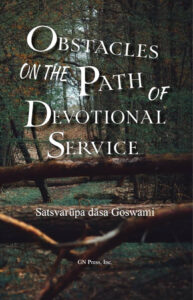
You mentioned that your pathway has become filled with stumbling blocks, but there are no stumbling blocks. I can kick out all those stumbling blocks immediately, provided you accept my guidance. With one stroke of my kick, I can kick out all stumbling blocks. —Letter by Śrīla Prabhupāda, December 9, 1972.
The Writing Sessions are my heart and soul. I’m trying my best to keep up with them. I am working with a few devotees, and they are far ahead of me. I wander in the wilderness of old age. I make my Writing Sessions as best I can. Every day I try to come up with a new subject. Today I am thinking of my parents. But I don’t think of them deeply. They are long gone from my life. Śrīla Prabhupāda wrote a poem when he was a sannyāsī, and he said now all my friends and relatives are gone. They are just a list of names now. I am like that too. I am a sannyāsī with a few friends. I love the books of Śrīla Prabhupāda. I try to keep up with them. I read as much as I can and then listen to his bhajanas.
The metaphor is song. Explain it. Yes, particulars may not seem interesting or profound to readers who want structured books.
Wait a minute. Don’t pander to readers or concepts of Art. But Kṛṣṇa conscious criteria are important and must be followed. So, if your little splayed-out life-thoughts are all Kṛṣṇa conscious, then it’s no problem.
I am near the end of my days. But I do like the company of like-minded souls, especially those who are Kṛṣṇa conscious. Yes! I am prone to Kṛṣṇa consciousness. I have been a disciple of Bhaktivedanta Swami Prabhupāda for maybe almost sixty years. Sometimes I fail him. But I always bounce back and fall at his feet. It is a terrible thing that I sometimes do not have the highest love for him. It is a terrible thing. Actually, however, I never fall away from him. He always comes and catches me and brings me back to his loving arms.

This edition of Satsvarūpa dāsa Goswami’s 1996 timed book, Upstate: Room to Write, is published as part of a legacy project to restore Satsvarūpa Mahārāja’s writings to ‘in print’ status and make them globally available for current and future readers.
A factual record of the reform and change in ISKCON guru system of mid ’80s.

Readers will find, in the Appendix of this book, scans of a cover letter written by Satsvarūpa Mahārāja to the GN Press typist at the time, along with some of the original handwritten pages of June Bug. Together, these help to illustrate the process used by Mahārāja when writing his books during this period. These were timed books, in the sense that a distinct time period was allotted for the writing, during SDG’s travels as a visiting sannyāsī
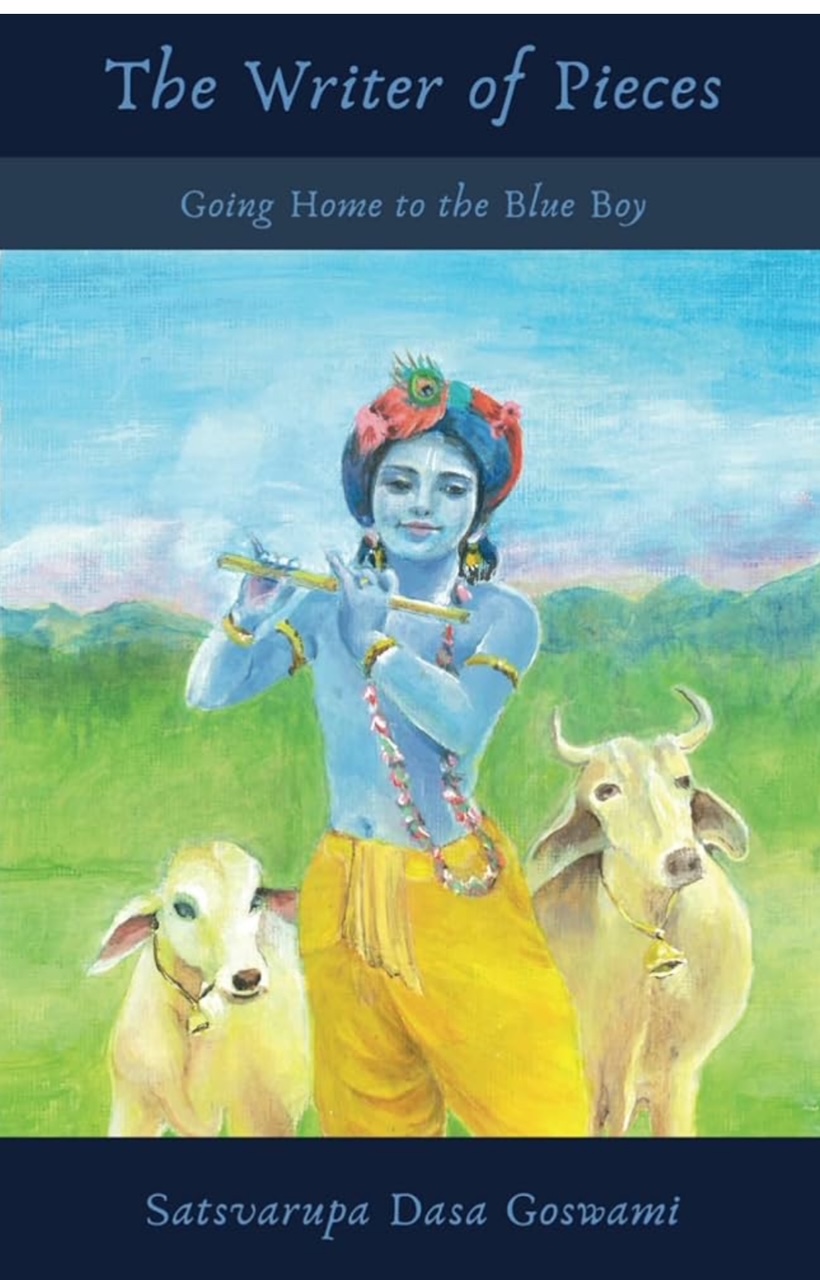
Don’t take my pieces away from me. I need them dearly. My pieces are my prayers to Kṛṣṇa. He wants me to have them, this is my way to love Him. Never take my pieces away.

Many planks and sticks, unable to stay together, are carried away by the force of a river’s waves. Similarly, although we are intimately related with friends and family members, we are unable to stay together because of our varied past deeds and the waves of time.
To Śrīla Prabhupāda, who encouraged his devotees (including me) To write articles and books about Kṛṣṇa Consciousness.
I wrote him personally and asked if it was alright for his disciples to write books, Since he, our spiritual master, was already doing that. He wrote back and said that it was certainly alright For us to produce books.
I have a personal story to tell. It is a about a time (January–July 1974) I spent as a personal servant and secretary of my spiritual master, His Divine Grace A.C. Bhaktivedanta Swami Prabhupäda, founder-äcärya of the International Society for Krishna Consciousness. Although I have written extensively about Çréla Prabhupäda, I’ve hesitated to give this account, for fear it would expose me as a poor disciple. But now I’m going ahead, confident that the truth will purify both my readers and myself.

First published by The Gītā-nāgarī Press/GN Press in serialized form in the magazine Among Friends between 1996 and 2001, Best Use of a Bad Bargain is collected here for the first time in this new edition. This volume also contains essays written by Satsvarūpa dāsa Goswami for the occasional periodical, Hope This Meets You in Good Health, between 1994 and 2002, published by the ISKCON Health and Welfare Ministry.

This book has two purposes: to arouse our transcendental feelings of separation from a great personality, Śrīla Prabhupāda, and to encourage all sincere seekers of the Absolute Truth to go forward like an army under the banner of His Divine Grace A.C. Bhaktivedanta Swami Prabhupāda and the Kṛṣṇa consciousness movement.

A single volume collection of the Nimai novels.
Śrīla Prabhupāda was in the disciplic succession from the Brahmā-Mādhva-Gauḍīya sampradāya, the Vaiṣṇavas who advocate pure devotion to God and who understand Kṛṣṇa as the Supreme Personality of Godhead. He always described himself as simply a messenger who carried the paramparā teachings of his spiritual master and Lord Kṛṣṇa.
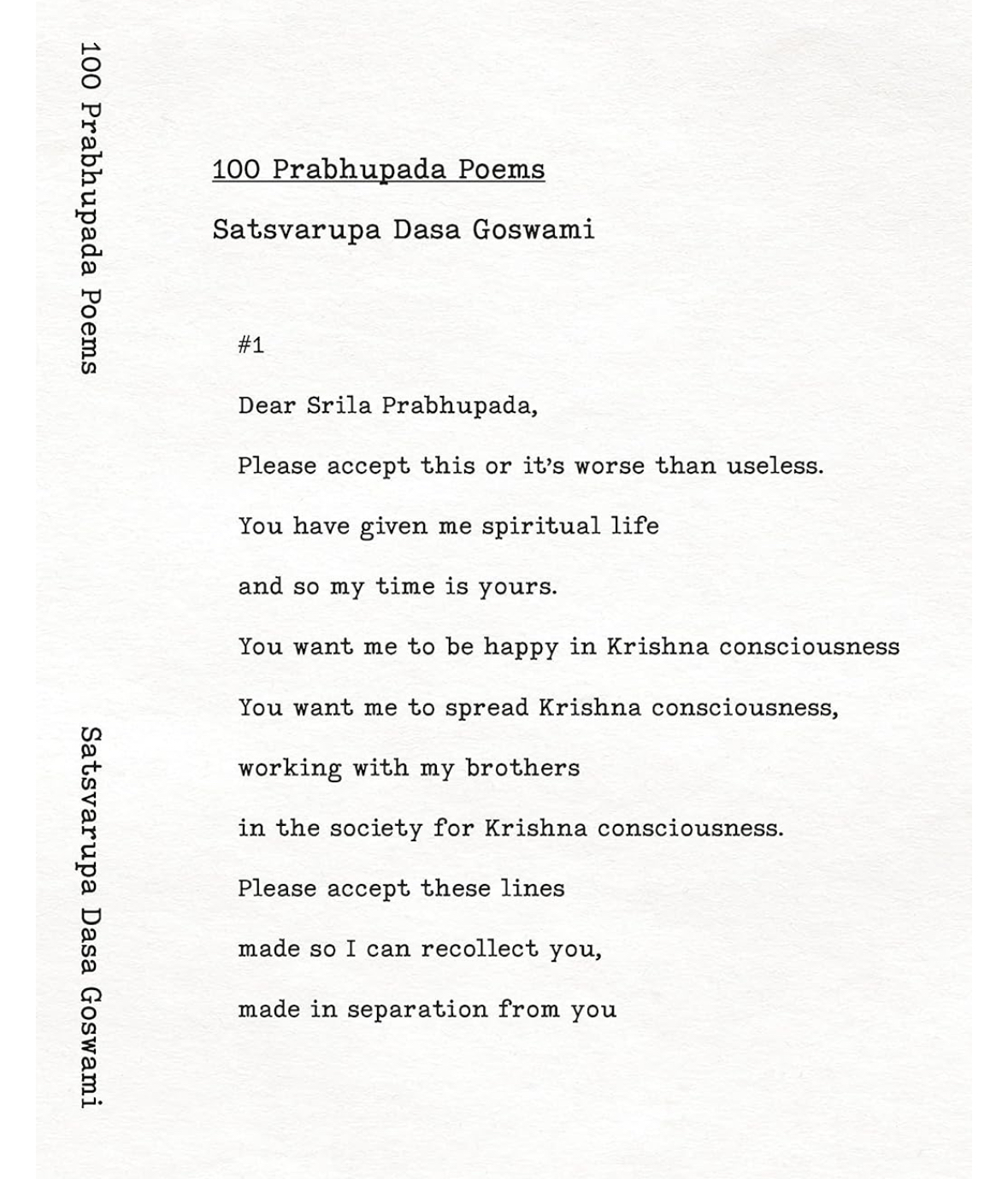
Dear Srila Prabhupada,
Please accept this or it’s worse than useless.
You have given me spiritual life
and so my time is yours.
You want me to be happy in Krishna consciousness
You want me to spread Krishna consciousness,
This collection of Satsvarūpa dāsa Goswami’s writings is comprised of essays that were originally published in Back to Godhead magazine between 1966 and 1978, and compiled in 1979 by Gita Nagari Press as the volume A Handbook for Kṛṣṇa Consciousness.

This second volume of Satsvarūpa dāsa Goswami’s Back to Godhead essays encompasses the last 11 years of his 20-year tenure as Editor-in-Chief of Back to Godhead magazine. The essays in this book consist mostly of SDG’s ‘Notes from the Editor’ column, which was typically featured towards the end of each issue starting in 1978 and running until Mahārāja retired from his duties as editor in 1989.

This collection of Satsvarupa dasa Goswami’s writings is comprised of essays that were originally published in Back to Godhead magazine between 1991 and 2002, picking up where Volume 2 leaves off. The volume is supplemented by essays about devotional service from issues of Satsvarupa dasa Goswami’s magazine, Among Friends, published in the 1990s.

“This is a different kind of book, written in my old age, observing Kṛṣṇa consciousness and assessing myself. I believe it fits under the category of ‘Literature in pursuance of the Vedic version.’ It is autobiography, from a Western-raised man, who has been transformed into a devotee of Kṛṣṇa by Śrīla Prabhupāda.”
 The Best I Could Do
I want to study this evolution of my art, my writing. I want to see what changed from the book In Search of the Grand Metaphor to the next book, The Last Days of the Year.
 a Hare Krishna Man
It’s world enlightenment day
And devotees are giving out books
By milk of kindness, read one page
And your life can become perfect.
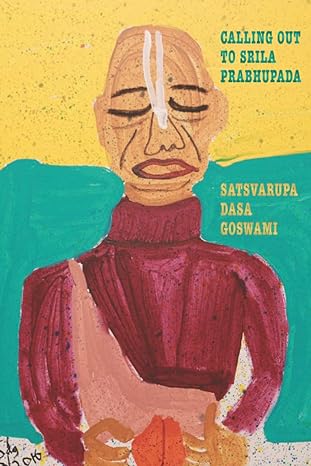 Calling Out to Srila Prabhupada: Poems and Prayers
O Prabhupāda, whose purports are wonderfully clear, having been gathered from what was taught by the previous ācāryas and made all new; O Prabhupāda, who is always sober to expose the material illusion and blissful in knowledge of Kṛṣṇa, may we carefully read your Bhaktivedanta purports.
I use free-writing in my devotional service as part of my sādhana. It is a way for me to enter those realms of myself where only honesty matters; free-writing enables me to reach deeper levels of realization by my repeated attempt to “tell the truth quickly.” Free-writing takes me past polished prose. It takes me past literary effect. It takes me past the need to present something and allows me to just get down and say it. From the viewpoint of a writer, this dropping of all pretense is desirable.
 Geaglum Free Write
This edition of Satsvarūpa dāsa Goswami’s 1996 timed book, Geaglum Free Write Diary, is published as part of a legacy project to restore Satsvarūpa Mahārāja’s writings to ‘in print’ status and make them globally available for current and future readers.