

What
Meeting of Disciples and friends of SDG
Where
The Veterans of Foreign Wars Hall – 845 Hudson Avenue – Stuyvesant Falls, New York 12173
There is plenty of parking near the Hall. The facility is just a few minutes’ walk from SDG’s home at 909 Albany Ave.
Schedule
10:00 – 10:30 A.M. Kirtana
10:30 – 11:15 A.M. Presentation by Satsvarupa Maharaja
11:15 – 12:30 P.M. Book Table
12:30 – 1:15 P.M. Arati and kirtana
1:15 — 2:15 P.M. Prasadam FeastContact
Baladeva Vidyabhusana at [email protected] or (518) 754-1108
Krsna dasi at [email protected] or (518) 822-7636SDG: “I request as many devotees as possible to attend so we can feel the family spirit strongly. I become very satisfied when we are all gathered together.”
*******
Śrī Caitanya-caritāmṛta, Madhya-līlā 20.124–125: “O great learned devotee, although there are many faults in this material world, there is one good opportunity—the association with devotees. Such association brings about great happiness. . . . .”
Srila Prabhupāda: “Therefore, our Society is association. If we keep good association, then we don’t touch the darkness. What is the association? There is a song, sat-saṅga chāḍi’ kainu asate vilāsa, te-kāraṇe lāgila mora karma-bandha-phāṅsa (Gaurā Pahū, verse 3). Sat-saṅga. Sat-saṅga means association with the devotees. So the one poet, Vaiṣṇava poet, is regretting that, ‘I did not keep association with the devotees, and I wanted to enjoy life with the nondevotees. Therefore I’m being entangled in the fruitive activities.’ Karma bandha phāṅsa. Entanglement.” [Conversation with David Wynne, July 9, 1973, London]
We need to expand our team of proofreaders as we aim to increase the rate of republication of Satsvarūpa Mahārāja’s books as well as new books that he writes.
This includes a need for fluent bilingual Spanish and English speakers to proofread Spanish translations (we currently have around 20 Spanish translations waiting to be proofread).
Anyone interested in this particular service should contact Manohara dāsa at [email protected]
If you would like to help, please contact Kṛṣṇa-bhajana dāsa at [email protected] or [email protected] and we will find you a service that utilizes your talents.
I remember when Śrīla Prabhupāda came to the humble little temple we had in Boston. We had advertised all over town, painted and cleaned the building, and made so many different arrangements for the arrival of Kṛṣṇa’s pure devotee. We worked and worked and worked, and in the process, our hearts were cleansed. And when he actually came, Prabhupāda was praising the glories of the holy name, how Kṛṣṇa appears in the holy name in this fallen age.
******
Kṛṣṇa’s pure devotee was telling us, “What if Kṛṣṇa Himself were to come—and Kṛṣṇa can come through that door just like we can—how would you receive Him?” So, what if you heard this? What could you do? You wouldn’t know how to prepare. Certainly, you would try to make the most gorgeous reception, the greatest welcome; the Supreme Personality of Godhead Himself is coming. There is no limit of things you would do or the extent to which you would go to make a wonderful reception for Kṛṣṇa. The point is that Kṛṣṇa does come in the form of His holy name and because he is very kind, He doesn’t even require a reception. You can just chant Hare Kṛṣṇa.
******
Kṛṣṇa wants to make it easy in this age—there are no hard and fast rules for chanting. Śrutadeva was very poor, but certainly he did everything he could to receive the Lord. We are poor in heart, but because we are lazy and envious, we don’t even invite the Supreme Personality of Godhead—but He comes anyway. His pure devotee carries the holy name—“Please, you are suffering from material disease, and this is the best medicine. Except for he who is carrying the medicine, what friend do you have in this material world? Please take the medicine—hari-nāma mahā-mantra, and be happy.” So He comes to your door.
******
You don’t even want to receive the holy name, but He induces you to accept Him. “I am so unfortunate that I have no attraction for the holy name.” I am supposed to be a devotee, but when I hear that the Supreme Personality of Godhead is coming—I remain rascal number one. By my inattentiveness the reception is ruined.
******
Kṛṣṇa is coming and you remain inattentive; therefore, it is called nāma-aparādha. If you make an offense in cooking or Deity worship, what do you do? You chant Hare Kṛṣṇa. But if you make offenses to the holy name, then what do you do? There is nothing! There is no other way, no other way, no other way! This is the last mercy, and if you don’t take this mercy then there is no other mercy. A Vaiṣṇava poet says, “What is the value of my living?” Better if I were dead!
******
We should learn how to make our hearts pure and avoid the offenses in chanting, so Kṛṣṇa can come home. The spiritual master is representing Lord Caitanya in delivering this holy name to us and by accepting his guidance, we can chant Hare Kṛṣṇa and go back to Godhead.
******
Your japa is a barometer of your spiritual life. Your changes of consciousness will show up there. So, when your japa is strong, then you are strong. That is why I place emphasis on chanting. It is such a source of strength.
******
There are so many dangers in this material world that one may fall down from an exalted position at any time. Yet, if one keeps himself always pure and steady by chanting the Hare Kṛṣṇa mantra, he will be safe without a doubt.
—Śrīmad-Bhāgavatam 6.1.63, purport
******
Too much mental anxiety indicates poor quality japa. Inattentive japa is a symptom of spiritual illness; certainly, it causes it. You must improve the quality of your japa. If you improve your chanting, all other anxieties will clear up, and immediately you’ll see in the proper perspective.
******
If, after chanting your rounds, you realize there was no furor, no urgency, no struggle, then that is a bad sign. A lot can be accomplished simply by approaching japa sincerely. Keep a daily progress report. Work daily on your japa and you will see a difference. Japa is especially weakened by material desires. Avoid the ten offenses. The best way to remember you are not your body but the soul, the servant of Kṛṣṇa, is to follow the orders of the guru.
pp. 271-74
July 2, 1968
My dear Satsvarupa,
Please accept my blessings and offer the same to Jadurany and others. Jadurany may be informed that I have received her letter and shall reply to her very soon.
In the meantime, in my last letter I requested you to see the District Director Mr. J. H. Hamilton of the Boston office U.S. Immigration (223–2361). You know that I have sent him one letter of June 11, 1968 per Reg’d Post No. 00619. It cannot be that he has not received my above letter, but why has he not replied to my letter? Please inquire.
Please try to convince him that my presence in the U.S.A. is essential because I have got to supervise at least eight branches in the U.S.A. I am a qualified religious minister. I have got sufficient money to maintain myself without being a public charge, and my health is fit, as it has already been examined by the public health department. Under the circumstance, I am feeling that by denying my application on some technical grounds—on which I was not at all responsible—injustice has been done to me. Simply request the District Director to give me the right direction for the next step so that I may take the right action. Please, therefore, see him and take a written reply to my letter dated 11 June 1968. I am very much surprised that letters are not properly replied to in such an important office. Please, therefore, inquire in the matter, and let me know why the letter is not replied to, which is so important in this case.
Hope you will do the needful and let me know the result immediately. Hope everything is well there.
Your ever well-wisher,
A.C. Bhaktivedanta Swami
In response to Śrīla Prabhupāda’s direct order in this letter, I went to a government building in downtown Boston to see the District Director of U.S. Immigration. I was able to get an appointment with the Assistant Director Mr. Patrick Coomey in his private office, where he sat behind a big desk, a U.S. flag behind him. He had Śrīla Prabhupāda’s file before him and told me that they were not denying Prabhupāda’s residency on the basis of his not being qualified as a religious minister; rather, it was a technical matter. He told me he would be replying to Prabhupāda’s letter within a day or two. He assured me there was no legal case against Śrīla Prabhupāda, but we had to go through some procedures.
I remember thinking that he was a rather highly-placed official. I expressed my concern about the case to him, and I felt that there was nothing more I could do.
Śrīla Prabhupāda, however, had expressed in a letter to Brahmānanda that he felt there was some prejudice against him.
I understand that the government of the U.S.A. is disgusted with so-called swamis because they have exploited the people in so many ways. That is a fact. And if I would have been in the government, I would have also considered like that. So they have not a very good opinion about these rascal swamis. Under the circumstances, it will be difficult to get me admitted as a swami, although I am not a swami of the rascal group. But we have to prove it by action that this swami is not like those swamis. This remark was made by Mr. Allen Burke of the television company: He introduced me to the public as “Here is a real swami,” and he showed me all respectful compliments. Anyway, I am not after respectful compliments by the public. But I am concerned about my disciples. I want to see them quite able to preach this sublime doctrine of Krishna Consciousness, and therefore I wish to stay. Otherwise, I am not attracted for any place, either hell or heaven.
I had executed a simple errand, yet representing Prabhupāda that day I felt close to him. I reported my results to Prabhupāda my mail.
In his letter, Prabhupāda reasonably states his case, as he was always able to do in legal disputes or in cases of civil disagreements. Prabhupāda’s behavior was faultless, and when he appeared to become entangled in bureaucracies or legalities, or when he was unfairly treated like a common man by the worldly powers of Kali-yuga he could always reasonably and convincingly explain his case.
Once while Prabhupāda was away from New York, he had some of his disciples live in his apartment at 26 Second Avenue. A legal dispute for possession of the apartment began between the devotees and the members of an opposing party, who felt confident they could get a judge to remove us. Śrīla Prabhupāda, although not present when the case was heard, wrote a letter explaining his behavior, and it was read aloud in court to the judge. When the judge heard Śrīla Prabhupāda’s letter, he said, “That sounds reasonable to me,” and dismissed the case in Prabhupāda’s favor.
Similarly, Prabhupāda covered the points in his immigration case and clearly showed that there was no reason the immigration department should not consider him a qualified religious minister.
Also in this letter, Śrīla Prabhupāda firmly criticizes the U.S. immigration office, which was not answering his correspondence or dealing with his case efficiently, although he had said it was important to him. Prabhupāda had presented his case expertly. I had only to deliver the message to the immigration officials, thus showing them that Prabhupāda was represented by somewhat upstanding young American citizens, who indeed needed Prabhupāda present to supervise them. Little did they know how essential his presence was; they did not know the depth of Prabhupāda’s influence against the forces of māyā and the benefit he could give America if they allowed him to stay in their country.
Prabhupāda later told us how he had been denied residency in the United States, even after having spent so much money; yet he got it easily and inexpensively through the U.S. Consulate in Canada. In Canada he met with a black man, a U.S. official, and showed him the published copy of the Teachings of Lord Caitanya, which impressed him. The man must have been pious, because he made a point of passing Prabhupāda’s case.
If Prabhupāda’s work with American youth had been written down and fairly presented, it would have certainly been an impressive case for residency. He was doing meritorious work in a way that should have been appreciated by those concerned with good citizenship and character-building. That Prabhupāda had not received significant recognition by any official representative of the United States government was a testimony to its bankruptcy in values of goodness. Someone like me, a petty civil service worker, had to approach the U.S. government and inquire why they would not even answer Prabhupāda’s letters against their attempts to deny him American residency.
pp. 140-45
This is the soul that stresses the oneness between the self and the atma. I (conditioned state) see God as a different person than me. He’s infinite, the enjoyer of the spiritual world, His home is different than mine. Body is different, etc. I see all differences.
But here He’s saying, see the oneness. See you and I as one.
” . . .We are both spiritual. . . .Those who are spiritually advanced scholars, who are in knowledge, do not find any qualitative difference between you and Me” (Bhag. 4.28.62).
Understand your position. (And while reading, don’t just cram, but keep the context and the theme that Srila Prabhupada is developing in a purport. Reading doesn’t mean just handling hunks of philosophy, but feeling them and understanding your position.) When you know I am a spiritual, eternal servant and the Supreme Lord is my best friend and well-wisher and He’s the Supreme, then our life will change. Then . . . we’ll be attracted more to Srimad-Bhagavatam. See Lord Krsna everywhere.
Then you’ll be able to write better, to your heart’s desire.
“When one gives up his unwanted superior attitude of superiority, he becomes situated in his original position.”
There’s a huge difference between a demon and devotee, between one who is disobedient to the Supreme and one who knows and accepts his eternal position. Liberation is to pursue the instruction of the Supersoul. He won’t give us instruction unless we are a little submissive.
He allows us our free-will.
(I’m here repeating the Krsna conscious philosophy in my own words. It’s not my invention. Someone may read what I’ve said here and ask, “But does this person realize all this as fact, or is he just a student writing down what the old sastras say?” If they ask, tell them I was writing down what Srimad-Bhagavatam says, putting what Krsna says on the printed page into my handwritten one. But in the act of transference, I do accept it; I value it, I believe in it. However, it is not my own invention. It is something more valuable than what I perceived, picked up, or felt in my gut. Why deny it? The value of the Vedas is better than my own manufacture. Yet I live it. If you want living testimony, see this dying man writing down a scriptural passage and desiring to know it in his bones. He wants to see the swan of the Supersoul and himself as a follower swan.)
Stand up for it.
Write something before it gets too hot.
Radio show tape #21 is done.
Krsna is the Lord of all, got to hear
it patiently in Bhagavad-gita.
I’m on my own time and I hope I’m spending it
without waste. I know every moment is
counted as karma. If you enjoy in
a temporary way, later you’ll suffer.
If you neglect your duties, you’ll get
neglected when it’s time to take next
life and when you can’t pay the price of
laulyam for chanting.
You ask as if it’s a puzzle, “How come
I can’t pay attention to His all-attractive
names?” The answer is you waste
your precious time. Yes, you who
think you’re so conscientious.
Get back to Srimad-Bhagavatam. Read it
slow and
carefully and beg for a little toehold
of attention and respect. Don’t find
fault with a perfect master.
I was just reading about working and so I
say I’m working. Or you read about war
and say I’m a soldier or you read a
poetry-minded
Russian poet and say I’m a poet too.
And you defend your use of time.
Who are you anyway?
I’m a writer of stories and sessions,
I lecture Srimad-Bhagavatam classes,
serve my master and disciples too,
show up like a surfacing mole
an above-the-water submarine—
show up with new false teeth
and a story about where I’ve been,
keep choosing words that have to stay
private. But it’s justified I guess, I guess.
Go indoors now with this poem—
you may call it “an excuse for a poem” just
to the satisfy the public. But actually you
like it.
It’s like your breakfast and lunch cooked
by your friends and offered to Prabhupada.
I like it because it says sannyasa, Krsna,
I believe, Vedas are my home,
and I stand by it
trembling
because it’s only a crumb, a prelude to katha.
This is turning into a productive stop in this cottage in between preaching tours. I feel physically tired and emotionally strained from the stays at Medolago and Matsya Avatara’s. Strain of travel also. Headaches were coming almost every day. Often you subdue them but they keep coming like a fire that never goes out. So this is a rest from that. Where I’m in one place with my own schedule and no social and lecturing demand, I usually don’t get headaches.
I’ve started up several readings in Srila Prabhupada’s books, writings, poems, radio show, proofreading a manuscript. But tomorrow starts medical appointments. They will make it less my own time, but still I’ll sneak in some sessions.
I asked a friend in New York City to find me a book called Mountain Tasting about a twentieth century wandering monk, Santoka Taneda. The book I want is out of print. But hearing of my inclination toward wandering monks, he sent me a new translation by Sam Hamill of Basho’s Narrow Road to the Interior. It begins like this:
The moon and the sun are eternal travelers. Even the years wander on. A lifetime adrift in a boat, or in old age leading a tired horse into the years every day is a journey, and the journey itself is home. From the earliest times, there have always been some who perished along the road. Still, I have always been drawn by wind-blown clouds into dreams of a lifetime of wandering. Coming home from a year’s walking tour of the coast last autumn, I swept the cobwebs from my hut on the banks of the Sumida just in time for a new year, but by the time spring mists began to rise from the fields, I longed to cross the Shirakawa barrier into the Northern Interior. Drawn by the wanderer-spirit Dosogin, I couldn’t concentrate on things. Mending my cotton pants, sewing a new strap on my bamboo hat, I daydreamed. Rubbing Moxa into my legs to strengthen them, I dreamed the bright moon rising over Matsushima. So I placed my house in another’s hands and moved to my patron Mr. Sampu’s summer house in preparation for my journey. And I left a verse by my door.
pp. 311-16
The Writer of Pieces doesn’t make a long treatise; they prefer short alternatives like, “Please let me serve You.”
Why do you say a writer speaks? Doesn’t he silently write?
“Writers” have existed since time immemorial. They scratch the name of God on a piece of brick.
The Writer of Pieces strains to achieve something favorable for the Lord. He gives what he can, although often he fails to make the mark. But he tries; he tries to realize Kṛṣṇa and guru and please them. The first one he met who “pulled him out of the net” was Swami Prabhupāda. He carried him all the way to safety in the circle of Kṛṣṇa consciousness.
The Writer of Pieces is regularly trying to dig up gold. He is trying to find gems, even little tidbits of memories about Prabhupāda. One time, Prabhupāda, while standing on the street with a few devotees, ordered a can of 7-Up for himself, and he drank it there on the street. The devotees were pleased and amazed to see Prabhupāda acting in such an informal way. This started something of a fad in ISKCON, and some of Prabhupāda’s disciples started buying 7-Up. They all had their excuses and reasons. I know one sannyāsī who said he needed to drink it to improve his digestion, and there were other reasons for drinking 7-Up on the street after they had seen their master do it.
The Writer of Pieces knows very well the story of the time Prabhupāda’s servant, Satsvarūpa, was learning how to cook for his master. He made a lot of mistakes. One mistake he made was to cut a raw cucumber the wrong way. It’s supposed to be cut lengthwise, but he cut it the other way. When Prabhupāda saw how he cut the cucumber, he said curtly, “This is wrong.” The servant replied, “Well I can learn to do it right, Prabhupāda,” somewhat defensively. Then Prabhupāda said to him, “You will not learn to cut a cucumber in three hundred years.”
There is a story I took part in with Prabhupāda that I can record here for devotees’ amusement. It is again me making a mistake. I forget the exact mistake I made, but as a result of it Prabhupāda called me “Sir Isaac Newton.” And then he explained. He said the great learned scientist (of the seventeenth and eighteenth century) was extremely brilliant. But on the other hand he had a reputation for being absent-minded. One time a friend visited Sir Isaac Newton and saw that he had two different holes of different sizes in his door to the outside. The friend asked, “Why do you have two holes in your house door? Sir Isaac Newton said, “I have two cats. One cat is a little bigger than the other, so I have made a bigger hole. The smaller hole is for my smaller cat.” When the scientist said that, his friend laughed heartily at his big scientist-companion. He said, “How foolish you are! You could have made one hole in the door, and both cats could have fit through.” Prabhupāda called me this name on another occasion. I was going with him and others on a morning walk. First, we took the car to the place where we were going to walk. I was going to sit in the back seat, but as we were getting out of the car, I discovered that I had left my bead bag and beads locked in the car. When I noticed it I said, “Oh! I’ve locked my beads into the car! I turned to go back and get them, but nobody joined me. Prabhupāda kept walking ahead without paying any attention. But he turned his head as he walked, looked back at me, and said sarcastically, “Sir Isaac Newton.”
I can count many mistakes that I made when I was Prabhupāda’s servant. I was his cook at the same time. The only facilities I had to cook were a bare room with a linoleum floor, no burners, no kitchen stove. So, one time, while I was cooking, I placed a burning hot pot on the floor. I had no other spot to place it. Later Prabhupāda came in the room and asked me to pick up the pot. When I did so there was a big hole in the linoleum floor where the pot had burned through. Prabhupāda asked me, “What have you done?” I told him I had no other facility, so I just put the pot down on the floor. He didn’t call me “Sir Isaac Newton,” but some of the words like that may have gone through his head when he saw this foolishness. For an answer I could have said there were no other facilities, but I kept my mouth shut.
The Writer of Pieces can remember almost countless incidents of being with Prabhupāda.
When I was composing (with others) Śrīla Prabhupāda-līlāmṛta, we used to try to remember everything about Prabhupāda. When there were only slight remembrances, we tried to use them and refer to them as “wisps.” Some wisps were so small and slight that we didn’t put them into Śrīla Prabhupāda-līlāmṛta, but I put them in other books about Prabhupāda. We simply couldn’t put EVERYTHING about Prabhupāda in our book. Many memoirists have written books since SPL and put new memories of Prabhupāda that I didn’t record, and there are still more wisps to be gathered by people who will only search their memories and come up with the sweet nectar that comes under the heading of “memories of Prabhupāda.” Bring on the wisps!
The Writer of Pieces means one who writes down short facts, memories, incidents, etc. about Prabhupāda, the Kṛṣṇa consciousness movement, and anything we can think of that connects to ISKCON.
We like to tell good Pieces, not bad ones. Many unfortunate things have happened in ISKCON. But we prefer to remember the good Pieces. One nice thing that we used to do with Prabhupāda was stop for a picnic when he was being driven in a car from Calcutta to Māyāpura. We stopped about halfway there and had a picnic under mango trees. It was a mango tree orchard and a very pleasant place to sit and gather. What made it truly pleasant was that Prabhupāda was there in the center. The devotees had brought prasādam from Calcutta temple, and we opened the prasādam containers, sat on the ground, and distributed the prasādam, a lot of it. It is such a nice memory. I went many times with Prabhupāda. Unfortunately, now it is only a wisp. And I do remember, and I try to dig up more about those picnics between Calcutta and Mayapur.
pp. 30-35
Hemanta Swami had a dream that he was in the Navy, a Petty Officer/journalist in the Public Information Office. One morning he was delayed in getting through his bathing and dressing duties. His uniform seemed to be the sannyasa dhoti and kurta. Before he could even report to his office, a higher-ranking Petty Officer pressed him to work on his project. He wanted Hemanta to tape pictures together onto a board where they could be photographed. He justified this by saying that Hemanta was a do-nothing person who just sat around all day, whereas at least now he had been positively engaged. Hemanta Maharaja accepted this opinion and did the work as he was told. Also, he noted that the huge ship kept coming very close to the shore (to Surtsey Island?).
When Hemanta woke he asked himself, “Am I a do-nothing as he said?” But a person came forward in his mind and said, “We like the work you do for self-examination, journal writing, and so on.” There’s a place for it.”
There’s a place for us…
somewhere…
Hemanta didn’t even have his breakfast that morning, and then the officer in charge asked him why he didn’t report into his own journalist office? Should he say, “I am a do-nothing, so I worked elsewhere under someone who grabbed me.” No, make the best of your situation.
That includes being a diarist or journal writer. Not a journalist in the sense of a newspaper writer but the way we think of Thoreau as a writer of journals. A keeper of a journal – unabashed first-person accounts of how you feel in body, mind and soul.
If that’s who you are
if that’s your reality.
I am afraid.
I am elated when the lecture goes well. I am concerned with spiritual life and overcoming my guru-aparadha of doubt in the teachings of the Vedas and dislike for it. This is a period of life I am going through perhaps – a kind of teenage rebellion.
Ask me, “Then what do you want?” What do you believe?” and I won’t tell you Buddhism or something eclectic. (Before Swamiji, I used to think of myself as an eclectic.) But I’m not feeling Krishna consciousness spontaneously. And I’m saying, admitting that. I want taste. I don’t want to bluff.
We’ve heard all this before
now go and in blind faith
finger your japa—
pray not to be distracted
you whoever you are
authorial “I”
magisterial eye
cosmic eye like Henry Miller
eye of the egg
of the storm.
Open it and say it: I
want to be free of ego
faults and even phony
persona of pious loyal
Hare Krsna
lecturing monk…
Please allow me real
thing. I’ll wait and
try
but in the meantime
let him write it
without fear
In the narrow hallway of the ship, someone called out, “Out of the way!” And I run as fast as possible to keep out of the way of an officer. Then they are all standing and saluting – is it because we see land out the portholes?
Land-ho!
I see all people or
my own father
I see the devotees of the
temple and mortal
self, ISKCON,
a teeny bit of what
Vyasa saw in meditating–
see one’s own guilt
and see what to do
about it. Strength to do it.
See her walkin’ down the street…He strapped himself in. Go for a ride. Quicken. “Do you still have a sweet at 4:30?”
Yes, I do. In Italy I hope they translate after a sentence or two, thus giving me time to pause and range out. It is a fun thing to do.
Down we rode, and I didn’t much enjoy the talk so much.
It was high-grade better that he sought from me. I’m tired of the same old thing.
You make like or not
I say the Mayavadis
are less intelligent and devious
to take “I” spoken by
Krishna and try to make it
“the principle of I” instead
of Lord Brahma and the Supreme. That reminds me…it is I who before writing this book didn’t know how. Now it’s authorial “I” writing and living it…And after the book is finished it will be I. Tiny I.
They write again to think of themselves as gopis. Car alarm again and again!
Siren, don’t steal my car. Is there anyone I could talk to? Want to be alone. She asked, “If I can’t meditate on Krishna, is there anything I can do in between?” I said, “Meditate on service and execute it.” I gave the example of me-self as a writer and could have added Saunaka as trying to make the world sankirtana party friendly. Oh, ugh.
A snappy salute. “Request permission to go ashore.”
Check out whether his shoes are shined and he stands tall enough, a pressed and neat uniform. “Permission granted.” Let him go ruin his life. Don’t ask him what he’ll do on shore. With your life.
With your life, you write from that. Renewal. The car siren continues, “like a whippoorwill.” I’m not in the art room, not at the fair. Not at the laser fireworks show or opening night of Heritage Week here in Ireland. Take in a little fresh air.
Hemanta season. Hymen Herman Wouk, naval officer’s joke, ball bearings in the hand of Humphrey Bogart (Caine Mutiny). There, we’ve gone away a bit, now we can say it was done better.
Come down from Bel, pleasant enough, wished everyone wanted me to initiate them. Now, here we are. Can you carry a load?
Siren, rain/talked with a dancer/we agreed many artists in the sankirtana movement
Flight of a swan/I missed
them dancing on Janmastami
because I was conked,
out, not traveling in a
van, no story to tell…
barely a persona…no
island erupting. The trees
are shaking in the rain
and it’s back to school. But not for me.
You used to write the time of day and that helped. You could capture a little dusk. Not without that. Self-revival, no coasting.
Who…He. Machines. Dictaphones. Notepads and pens. It is not wrong if a monk stays in a room they give him rather than wander out and talk with the lady and man of the house and their children. The monk should concentrate on God and holy books.
Goin’ to Italy
going back to Godhead,
spirit of myself
meet politician in lobby
ask for a little of his time
later…In Phoenix Park
most prominent place
given to U.S. Ambassador
to Ireland white gates,
two flags
And the phoenix atop
the tall column, funny
stubby bird out of stone fire…
A “spiritual” country with small
army – “It doesn’t use iambic pentameter
but is tightened by assonance and…” And
dissonance and Monk’s rhythm.
Going to Africa, going to the
spirit in my heart going
above
to Krishna the King and dear-
most Lover of the gopis.
What was she getting at,
asked the same question she’s
asked many times –
“What is sahajiya and can
we go straight to nectar
Krishna?” Yes, I said,
not quite as much as I
liked to.
pp. 173-80
Prabhupada was in Seattle at the time,
reading from The Teachings of Lord Chaitanya
and speaking for hours each night
before his students (and maya’s)
in a room converted into a temple,
with Jagannath Deities on the altar
and the American sankirtan party at his feet,
eager to be there.
The program over for the night,
he returned to his room to find a telegram:
BHAKTI PRAJNA KESHAVA MAHARAJ
HAS PASSED AWAY.
Immediately composing a Sanskrit verse,
he returned to the temple,
although it was late,
to instruct his followers
about separation from the guru.
He played a taped bhajan
and then informed them,
“The person who gave me sannyasa
has left his body.”
Prabhupada wept,
remembering his own beloved guru,
Bhaktisiddhanta Saraswati Thakur,
who had come to him in dreams
asking him to take sannyasa.
Bhaktisiddhanta Saraswati was the one,
but through him a Godbrother, Keshava Maharaj,
had brought the message.
Prabhupada had been alone in Vrndavana
when this Godbrother had insisted,
“Bhaktivedanta, you must take sannyasa.”
vairagya-vidya-nija-bhakti-yogam
apayayam mam anavishnu andham
sri-keshava-bhakti-prajnanam.
“Devotional service is the way
of renunciation. I was unwilling,
like one blind. But he forcefully
made me drink the medicine.
His name is Sri Keshava, Bhakti Prajna Maharaj.”
“He has entered Krishna’s abode,” said Prabhupada.
And his little band in Seattle,
awed by the spiritual emotions
and the parampara mysteries
and especially thrilled
that Prabhupada was sharing with them,
duly signed the letter of condolence and praise
to be sent to Navadwipa.
To Santa Fe,
where your secretary thought
the altitude would be bad for your health,
so at the airport she tried to turn you back.
She was flustered and crying,
“Prabhupada, you know Krishna!
What does Krishna want us to do?”
But you retorted, “No!
Krishna wants to know what you are going to do!”
Finally you decided to ride
under a clear sky with high white clouds
to the Albuquerque center, where you shared
laddus and krsna-katha
with the hippie meditators,
who suddenly came down from the mountains
at the hour you arrived.
To Los Angeles,
where your devotees were nightly holding kirtan
in the thick of Hollywood Boulevard,
but who were soon evicted from their ideal location.
For weeks they were scattered,
and you lectured in different garages,
until finally you purchased the best building so far:
a wooden church on La Cienega.
You planted 108 rosebushes,
and a special era of burgeoning began,
with hundreds attending the weekly feasts,
with ecstatic kirtans and Back to Godhead sales,
and a festive, loving family of devotees.
Meanwhile you wrote in Beverly Hills,
turning out two books at once:
The Nectar of Devotion and
KRSNA, the Supreme Personality of Godhead.
To Columbus, Ohio,
where you conversed with Allen Ginsberg,
who was looking
for a more American mantra.
“Krishna is everything,” you said.
“He is universal.”
And you proved it the next night,
as two thousand students
in the All-American City chanted,
jumping up on the seats,
dancing in the aisles,
crying out,
grabbing for your thrown flowers—
as you led them:
“Hare Krishna, Hare Krishna, Krishna Krishna, Hare Hare/ Hare Rama, Hare Rama, Rama Rama, Hare Hare.”
To New Vrindaban,
where you behaved as if
you had always lived there,
walking the two-mile road through the woods,
as if you were at home,
stepping on stones to cross the creek,
accompanied by Kirtanananda Swami
through thick forest and blue phlox.
To the old house on the New Vrindaban ridge,
you entered for the first time,
but as if just coming back from a walk—
to the room, to the chair where you sat,
declaring this the best way to live.
There was no need, you said, to live in the city
at the terrible cost of factory labor.
producing the unnecessary
objects of sense gratification.
Man can live simply, depending on nature—
from the fields, his food,
from the cow, nutritious milk—
and save time for chanting Hare Krishna.
You drank the milk of the black cow Kaliya,
sat at a low desk under the persimmon tree,
lived in an attic room with your Radha-Krishna Deities,
accepted simple corn cereal, pokeweed, blackberry chutney,
and spoke on the philosophy of varnashram-dharma,
yourself the personification
of simple living and high thinking.
A month passed in the backwoods.
Grasses grew, untrampled by civilization,
as you daily fashioned your Bhagwatam purports,
bathed outdoors, read and walked and breathed outdoors,
and spoke with your men of many plans.
Little mail and no phone could reach you,
but gradually the messages arrived:
your presence was greatly needed
throughout the U.S. and Europe.
To Los Angeles again,
where you installed golden Radha-Krishna Deities.
They stood for darshan
on Their velvet-canopied throne
and began to receive worship
with six daily offerings.
Should the devotees ever lose enthusiasm, you said,
the worship would become idolatry.
But where there was life, then Krishna,
“this very Krishna will talk with you.”
To San Francisco,
where you accompanied Jagannath, Baladeva, and Subhadra
during Ratha-yatra through Golden Gate Park.
At a low bridge the cart stopped,
because its super-mechanical-collapsible dome
failed to lower.
While the men tried, a thousand chanters sang
under the stone bridge, creating
a tremendous echo.
You stood at the front of the cart,
raised your arms to the people,
and began to dance,
jumping up and down,
causing the crowd to jump with you,
as flowers tumbled
from your broken garland and the chanting
became a roar.
When the cart moved on through the park,
10,000 people were following you,
and they were fed from 10,000 plates of prasadam—
halava, chutney, and fruits.
“Chant, dance, and take prasadam.”
you advised the multitude.
“And even if you do not hear the teachings,
you will be elevated
to the topmost platform of perfection.”
pp. 39-43
My feet are cold. This class is being conducted in the schoolroom. Drafts passing through the open door. I’m the teacher, big deal.
“Confidential” means “not everyone cares.”
I walked around the house again and again. Turiya said a heat wave is coming. at least the main ice melted. Walked around and around. See where he has his garden beds from the summer. See the houses in not too distance. I do not live here. Then a car came. Two ladies went into the house to talk with Madhu. I was left outside to talk their driver, Janaka. He tells me how his cooking course is going. Says you can bluff a Bhagavatam lecture with some quotes but you can’t bluff a cooking course; you have to produce before their eyes something sumptuous and colorful. He said maybe he and his wife will pack up in Colorado and come back to Gita Nagari. Good. Then the ladies came out of the house and they all drove off. Again I go walking around and around thinking I’m tired of servicing others, reading their writings; I’d like to work on my own self. What do I need? It comes to me: You haven’t been reading his books. No substitute for it. Then take some of this midnight writing time, even ten minutes of it, and read, read without preparing for a lecture, just read.
Drinking water, looking at my poems . . . This and that. Get ready, get ready. . . for the next day. More quotes, lectures. Janaka said, “Lecturing is good for me. It puts me in the mode of goodness, I have to be concerned for others.” He said he has to watch how they are doing and make sure they understand and are guided. Yeah, it is good for you. Give them the seven days and then come five days of disciples’ meetings. Squeeze in these little sorties (is that the word?) into the infinite, the self clear speak through.
The first day I spoke to them about free-writing and stated some rules, keep the hand moving, write what is scary, etc. But since then they are not so much writing like that. They write predictably, and so do I. My little piece on deathbed wasn’t different from theirs, want to go to Vrndavana, be surrounded by chanters, etc. So then what do you mean, they don’t take up free-writing? I guess I mean they don’t go completely wild. They don’t write so fast either. I shouldn’t complain. They are doing well. I don’t want them to become madmen.
One guy wrote that he’d like to die in a little
town in northwest Canada,
I think he called it Tofin or something.
He’d be all alone in his shack and he didn’t
remember Krsna.
He was screaming help or something.
I thought, “This isn’t
Krsna conscious,” and I passed it up.
I thought I couldn’t read it to the others, but actually it was the most original. He said he doesn’t think of dying in India because he’s a new devotee and never went there. It’s okay when they are original. But it’s safe to go with the pack too, to Vrndavana, the way of the Vaisnavas. Originality isn’t all. And Caitanya-daya hung up about the fact that she likes Lord Caitanya and can’t relate with the same intensity to Lord Krsna. I smile as her father.
Yeah, me I love Syamasundara,
know Him as Rasaraja,
He who has bellicose activities and rasa dance.
I am the servant of my spiritual master,
I know everything, I am like an Indian chief—
big sit on the bony haunch,
bottomed chief of the lean teepee
celibate headdress chicken feathers whoopee
chief, no smoke ’em pipe chief
japa mad, clipped hair,
Mohican sikha of the lost tribe
1966 bull, lean crewneck sweater
ex-Navy man of tribe no more
Allen Ginsberg, no more Howl, no more
Suffolk Street dregs escaped convict,
me, I the one,
chief toe-nail clipped
frozen food in oven no more
not even peach pies and cherry tarts
and no ice cream
except sometimes.
No more the raven, no more Shakespeare’s
sonnets, When in disgrace with fortune and
mens’ eyes . . . I envy this man’s art
and that man’s
scope,
then I think of you my friend (he’s
thinking of some
man and not the Supreme Lord Govinda)
“Srila Sukadeva Gosvami said: O best of devotees, most fortunate Pariksit, you have inquired very nicely, for although constantly hearing the pastimes of the Lord, you are perceiving His activities to be newer and newer” (Bhag. 10.13.1).
This is a test of how spaced out you are, how distracted. You go to read Srimad-Bhagavatam and can’t concentrate enough to actually hear and relish. Usually this is due to an interruption in the practice. Nityam bhagavata sevaya
I am asking the writing seminar students to write their realizations. But you should read. And you should write from a life deeply absorbed in Krsna consciousness practices. Otherwise writing is itself a distraction.
Eliminate distractions.
(As I wrote this, I saw the “shadow” of a mouse run by. It was a mouse at the edge of my peripheral vision, not a delirium tremens but an actual house mouse, I’m almost sure. I threw down my pen in panic, splashing drops here and there on the Bhagavatam, the page of a notebook, and my Una. “I saw the mouse,” I said out loud. But now I can’t see him. So I’m writing until the next rush. This is another distraction. You have to live with them and push on trying to gain right attention in each and every way even for a little while— not that first you have to eliminate mice from your environment or try to rid your phobia of them).
I was saying . . . let writing serve my uppermost purpose—attainment of Krsna consciousness. Then it will help me and will also be best for others. You don’t have to worry about foot sores, shape of the novel, or how to write according to the book, Writing From The Body.
Especially I want my writing to be interesting while within Krsna consciousness. So be it, as interesting as it is. And so be your interested reader.
“Paramahamsas, devotees who have accepted the essence of life, are attached to Krsna in the core of their hearts, and He is the aim of their lives. It is their nature to talk only of Krsna at every moment, as if such topics were newer and newer. They are attached to such topics, just as materialists are attached to topics of women and sex” (Bhag. 10.13.2).
pp. 253-57
Dear reader, this is Bhakta Bob. After I wrote that last entry, I stayed up late talking with the author. We decided to have a parting of the ways. He’s going on to write other stories, probably not as fictional as this one, and I will conclude “Introducing Bhakta Bob” by telling you the story as I see it.
When I think of what we’ve written so far, a lot of energy has gone into trying to understand me, Bob. It’s not that I’ve done so much soul-searching, but the author is always asking on my behalf, “Who am I? Who created me?” As far as I know, fictional characters hardly ever talk that way. They just exist and do their thing like everyone else. Of course, some flesh and blood people do ask, “Who am I?” and it’s not a futile question. I heard in the Caitanya-caritamrta that when Sanatana Gosvami approached Lord Caitanya, Sanatana asked, “Who am I, and why do the material miseries always give me trouble? How can I get free of suffering?” Lord Caitanya told him that he was the eternal servant of Krsna. This is the actual identity of every “character” or jiva, living being.
If a fictional character asks the same question, then what’s the answer? Is it, “You were created by the author of this book”? That’s factually true, but then we have to go and ask the author for the origin of the character in the book. One author may tell you that he got him from a dream, and someone else may assert that he created him from a composite of people he knows in real life.
I heard another story in the Srimad-Bhagavatam that reminds me of this. One time Narada Muni approached his father, Lord Brahma, and said, “Are you actually the ultimate creator? You seem to have everything in your control, just like someone keeps a walnut within his fist, but sometimes I see you meditate. Is there a being higher than you?” Lord Brahma said honestly that he was a humble servant of the Supreme Personality of Godhead. If you ask an author, however, or if one of his characters could ask him, “Who created me? Are you the ultimate creator?” I think most authors would reply, “Yes, I am your creator. There is no creator other than me.” If it’s true that everything comes from God, though, then it should also be true of fictional characters.
In one sense, a literary character is a product of madness set loose by an egoistic author. Or what is he? I don’t know. But he’s definitely not supposed to be extremely self-conscious or too concerned about his origin. He is supposed to be, as far as possible, like a flesh and blood, heart-beating human (or animal) who eats and sleeps and mates and defends, sometimes thinks about God or doesn’t, and most important of all—has some conflict or obsession.
Putting these speculations aside, let me tell my story. You know some of it already. Before you met me in Chapter One, I was born in County Clare, Ireland, and was raised by my father, who was a shepherd, and my mother, who took care of the five kids, in a cottage. I was raised as a Catholic, went to the local schools and church, and played with kids in a simple way. We were somewhat removed from the heavy Kali-yuga influence of Dublin. Therefore, I didn’t take drugs or have much illicit sex. I can’t remember much of my days at home right now, and when I think back to them, although I have some nice memories, I realize I was as covered over as a tree.
Things really started happening the day I met the devotees and got the magazine. According to what the devotees say, someone who comes to Krsna consciousness in this lifetime must have practiced it before. On the other hand, that’s not so important, provided we get the mercy now from a pure devotee.
It’s another one of those things, like your origin, that you can’t really figure out. There is no definite conclusion. I take it that I am definitely the recipient of mercy coming from Lord Caitanya and Srila Prabhupada, which has reached out to the little suffering island known as Eire.
As for this story, I think my life since I became a devotee has pretty much been described, although sketchily. Actually, my whole devotional life is rather sketchy. I have an initial impetus to be a devotee, so it’s auspicious, but I still have to make that desire solid. I don’t think I’ve even begun. How easily I got knocked off the track and left that traveling party over a little quarrel and false ego. The real question is, where do I go from here?
I think I’ll stay here for a while. It doesn’t seem important for me to go back to Ireland. Better I get fixed up as a devotee. I need a spiritual master. I will try to find one who represents Srila Prabhupada. I accept that the parampara is continuing eternally and that I have to link up to it, but it can’t be done as a matter of convention. I want to learn as much as I can of the philosophy and practices and associate with good devotees. Then one day, I can only hope to meet my spiritual master. In fact, I’m sure I will. In the meantime, I wish to prepare myself for that moment by learning to balance sadhana with preaching. There’s plenty of preaching to do here in Antwerp. This center is small and it has a nice family feeling to it. The people in the town are pretty materialistic, just like everywhere in Europe, but there are interested people too. People visit the temple regularly, and the harinama, book distribution, and prasadam distribution are unlimited. Everything depends on our willingness to go out and meet people.
I would like to please Prabhupada by becoming a humble preacher and chanter of the holy name, and a reader of his books. I’m sure that by his pleasure, all the mercy I require will flow to me. I’ll get further guidance too, in the form of guru, Vaisnava, and scripture.
I would like to stay with you, dear reader, and live through different adventures in Krsna consciousness through this story, but sooner or later we’d have to part, even if this book ran into six hundred pages.
If a character is successful, the reader will remember him. In my case, perhaps my poor example will be of some use to you in your own efforts to become a devotee of Krsna. I wish you well. Who knows, perhaps we will meet again. Such things are not under the control of any mortal author, but under the control of the supreme author, who creates all meetings and partings and who lives as Supersoul in the hearts of everyone and everything. All glories to the Supreme Personality of Godhead, and all glories to you, dear reader. Hare Krsna Hare Krsna, Krsna Krsna Hare Hare/ Hare Rama Hare Rama, Rama Rama Hare Hare.
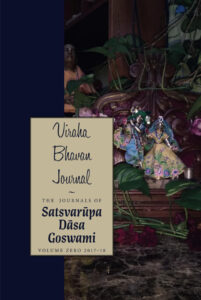
Viraha Bhavan Journal (2017–2018) was written by Satsvarūpa Mahārāja following a brief hiatus in writing activity, and was originally intended to be volume 1 in a series of published journals. However, following its completion and publication, Mahārāja again stopped writing books, subsequently focusing only on what became his current online journal, which began in August of 2018.

At first, I took it hard that I would have to live surrounded by the firemen, and without my own solitude. After all, for decades I had lived in my own house with my own books and my own friends. I was also now a crippled person who couldn’t walk, living among men who did active duties. But when Baladeva explained it to me, how it was not so bad living continually with other firemen and living in the firehouse with its limited facilities, I came to partially accept it and to accept the other men. I came to accept my new situation. I would live continually in the firehouse and mostly not go outside. I would not lead such a solitary life but associate with the other firemen.
Let me write sweet prose.
Let me write not for my own benefit
but for the pleasure of Their Lordships.
Let me please Kṛṣṇa,
that’s my only wish.
May Kṛṣṇa be pleased with me,
that’s my only hope and desire.
May Kṛṣṇa give me His blessings:
Kṛṣṇa Kṛṣṇa Kṛṣṇa Kṛṣṇa Kṛṣṇa he
Rāma Rāghava Rāma Rāghava
Rāma Rāghava rakṣa mām.
You mentioned that your pathway has become filled with stumbling blocks, but there are no stumbling blocks. I can kick out all those stumbling blocks immediately, provided you accept my guidance. With one stroke of my kick, I can kick out all stumbling blocks. —Letter by Śrīla Prabhupāda, December 9, 1972.
The Writing Sessions are my heart and soul. I’m trying my best to keep up with them. I am working with a few devotees, and they are far ahead of me. I wander in the wilderness of old age. I make my Writing Sessions as best I can. Every day I try to come up with a new subject. Today I am thinking of my parents. But I don’t think of them deeply. They are long gone from my life. Śrīla Prabhupāda wrote a poem when he was a sannyāsī, and he said now all my friends and relatives are gone. They are just a list of names now. I am like that too. I am a sannyāsī with a few friends. I love the books of Śrīla Prabhupāda. I try to keep up with them. I read as much as I can and then listen to his bhajanas.
The metaphor is song. Explain it. Yes, particulars may not seem interesting or profound to readers who want structured books.
Wait a minute. Don’t pander to readers or concepts of Art. But Kṛṣṇa conscious criteria are important and must be followed. So, if your little splayed-out life-thoughts are all Kṛṣṇa conscious, then it’s no problem.
I am near the end of my days. But I do like the company of like-minded souls, especially those who are Kṛṣṇa conscious. Yes! I am prone to Kṛṣṇa consciousness. I have been a disciple of Bhaktivedanta Swami Prabhupāda for maybe almost sixty years. Sometimes I fail him. But I always bounce back and fall at his feet. It is a terrible thing that I sometimes do not have the highest love for him. It is a terrible thing. Actually, however, I never fall away from him. He always comes and catches me and brings me back to his loving arms.

This edition of Satsvarūpa dāsa Goswami’s 1996 timed book, Upstate: Room to Write, is published as part of a legacy project to restore Satsvarūpa Mahārāja’s writings to ‘in print’ status and make them globally available for current and future readers.
A factual record of the reform and change in ISKCON guru system of mid ’80s.

Readers will find, in the Appendix of this book, scans of a cover letter written by Satsvarūpa Mahārāja to the GN Press typist at the time, along with some of the original handwritten pages of June Bug. Together, these help to illustrate the process used by Mahārāja when writing his books during this period. These were timed books, in the sense that a distinct time period was allotted for the writing, during SDG’s travels as a visiting sannyāsī
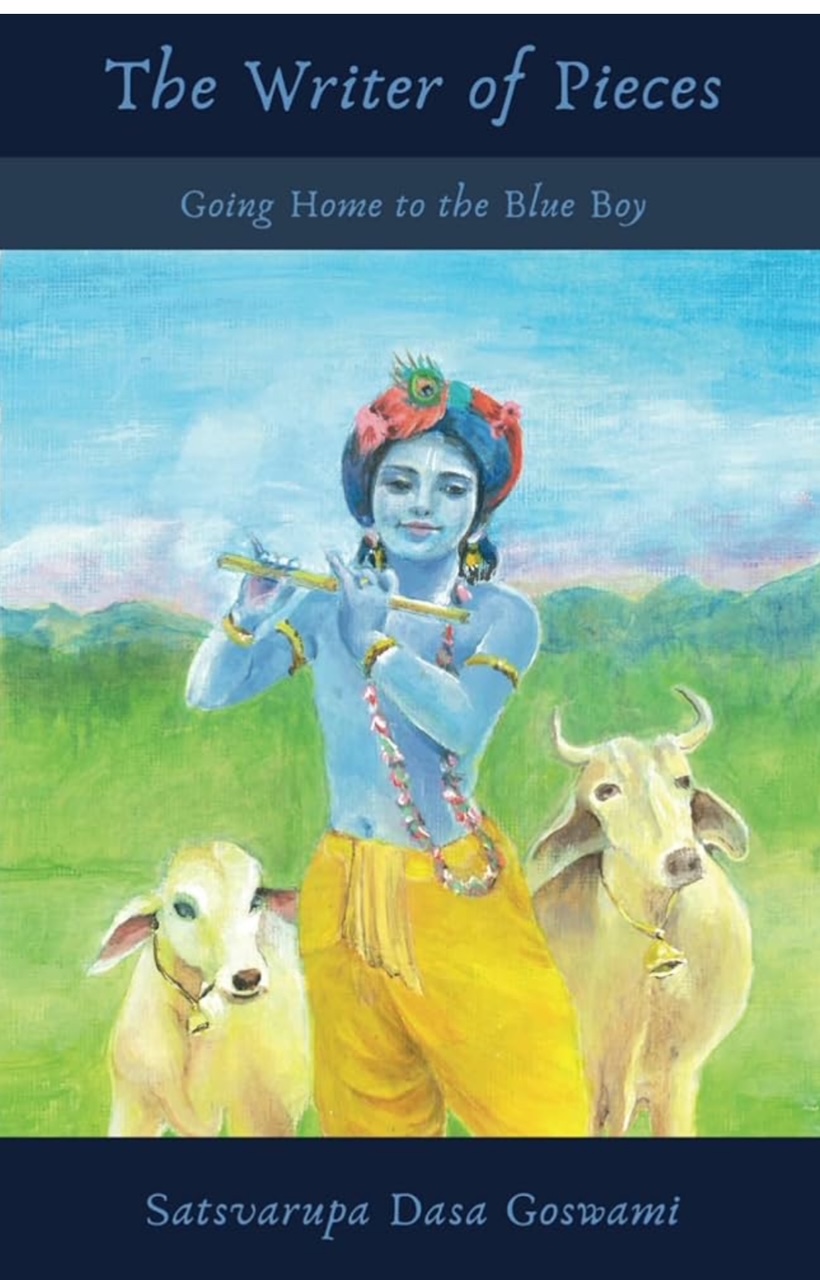
Don’t take my pieces away from me. I need them dearly. My pieces are my prayers to Kṛṣṇa. He wants me to have them, this is my way to love Him. Never take my pieces away.

Many planks and sticks, unable to stay together, are carried away by the force of a river’s waves. Similarly, although we are intimately related with friends and family members, we are unable to stay together because of our varied past deeds and the waves of time.
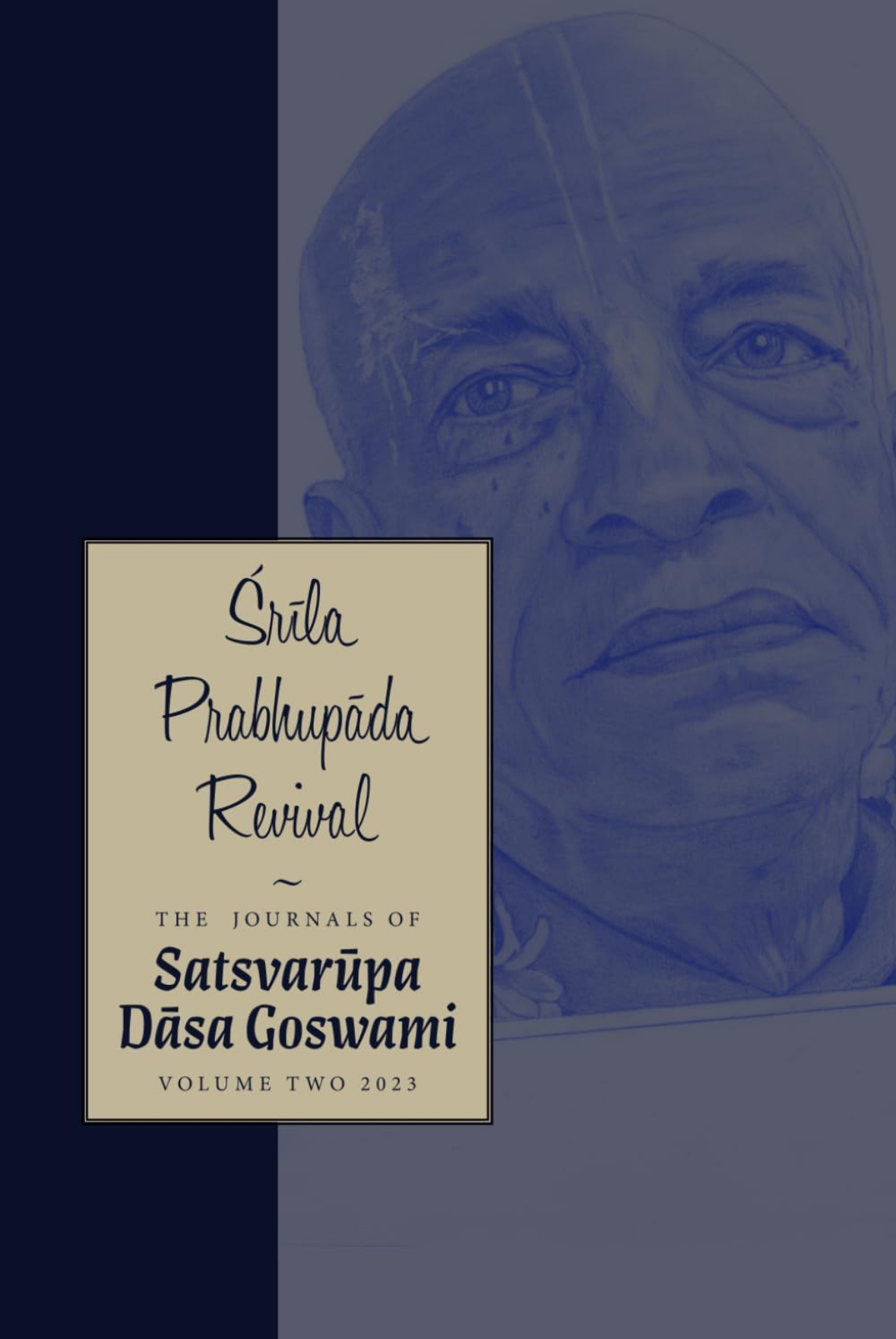
To Śrīla Prabhupāda, who encouraged his devotees (including me) To write articles and books about Kṛṣṇa Consciousness.
I wrote him personally and asked if it was alright for his disciples to write books, Since he, our spiritual master, was already doing that. He wrote back and said that it was certainly alright For us to produce books.
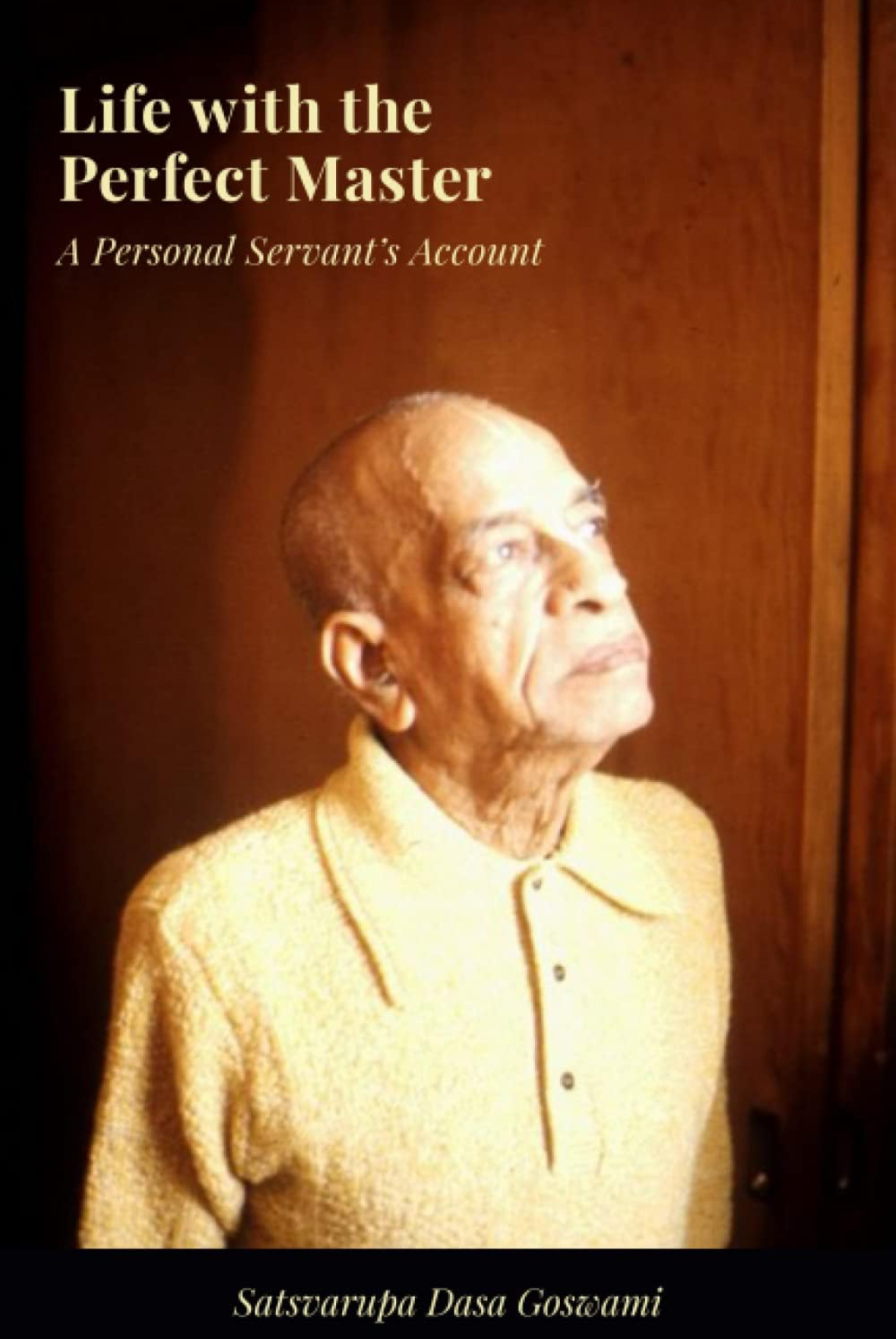
I have a personal story to tell. It is a about a time (January–July 1974) I spent as a personal servant and secretary of my spiritual master, His Divine Grace A.C. Bhaktivedanta Swami Prabhupäda, founder-äcärya of the International Society for Krishna Consciousness. Although I have written extensively about Çréla Prabhupäda, I’ve hesitated to give this account, for fear it would expose me as a poor disciple. But now I’m going ahead, confident that the truth will purify both my readers and myself.

First published by The Gītā-nāgarī Press/GN Press in serialized form in the magazine Among Friends between 1996 and 2001, Best Use of a Bad Bargain is collected here for the first time in this new edition. This volume also contains essays written by Satsvarūpa dāsa Goswami for the occasional periodical, Hope This Meets You in Good Health, between 1994 and 2002, published by the ISKCON Health and Welfare Ministry.

This book has two purposes: to arouse our transcendental feelings of separation from a great personality, Śrīla Prabhupāda, and to encourage all sincere seekers of the Absolute Truth to go forward like an army under the banner of His Divine Grace A.C. Bhaktivedanta Swami Prabhupāda and the Kṛṣṇa consciousness movement.
A single volume collection of the Nimai novels.
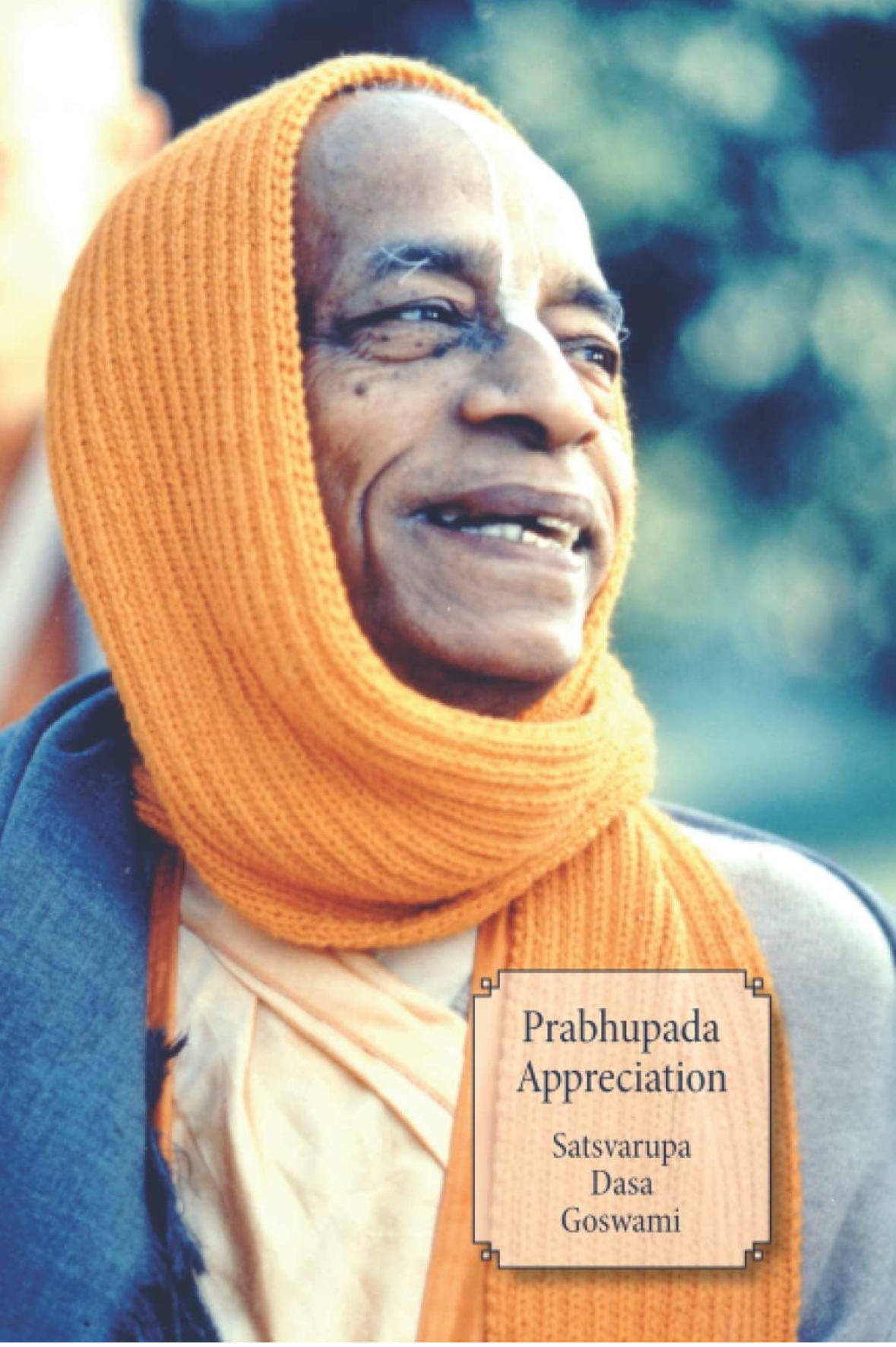
Śrīla Prabhupāda was in the disciplic succession from the Brahmā-Mādhva-Gauḍīya sampradāya, the Vaiṣṇavas who advocate pure devotion to God and who understand Kṛṣṇa as the Supreme Personality of Godhead. He always described himself as simply a messenger who carried the paramparā teachings of his spiritual master and Lord Kṛṣṇa.
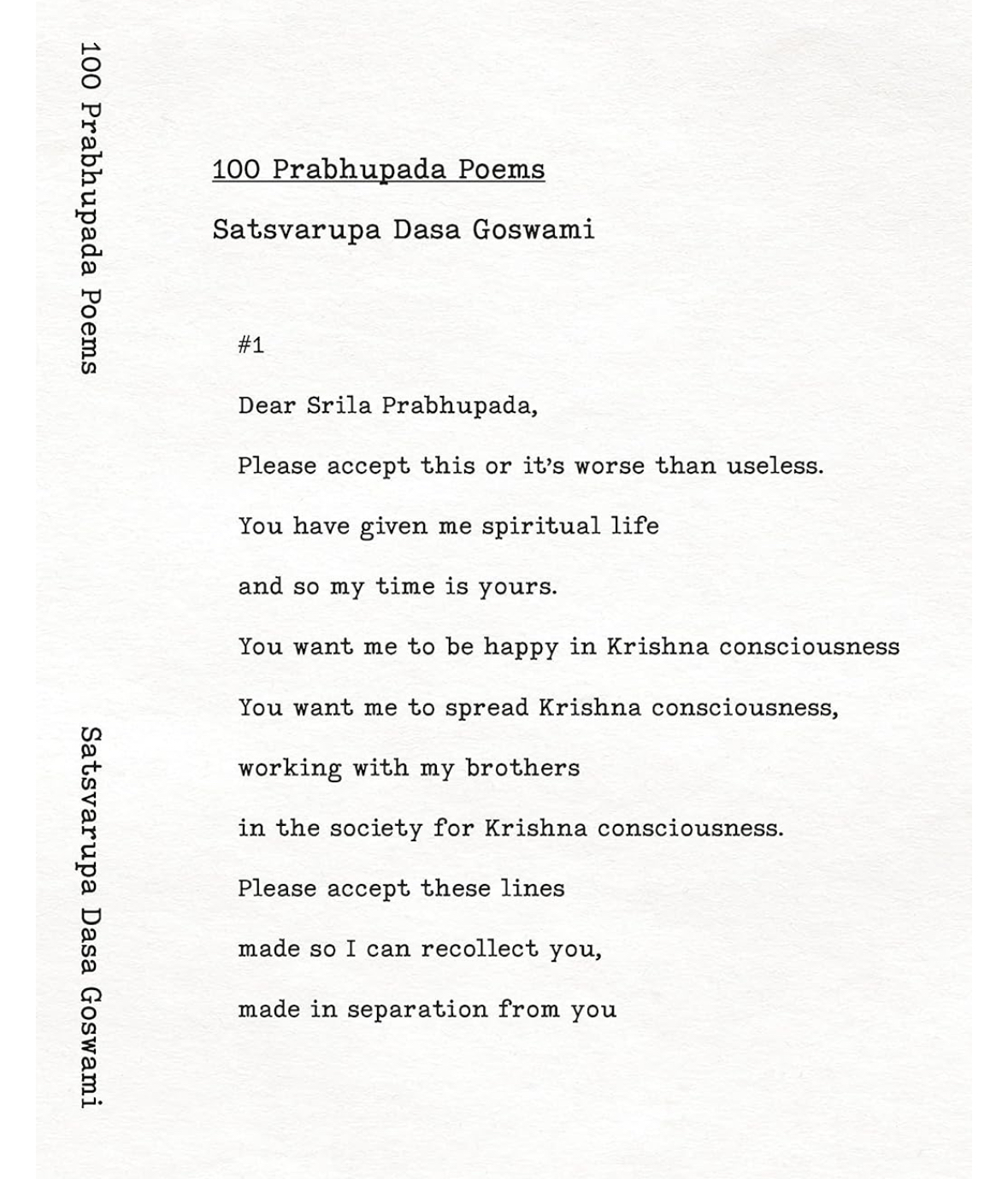
Dear Srila Prabhupada,
Please accept this or it’s worse than useless.
You have given me spiritual life
and so my time is yours.
You want me to be happy in Krishna consciousness
You want me to spread Krishna consciousness,
This collection of Satsvarūpa dāsa Goswami’s writings is comprised of essays that were originally published in Back to Godhead magazine between 1966 and 1978, and compiled in 1979 by Gita Nagari Press as the volume A Handbook for Kṛṣṇa Consciousness.
This second volume of Satsvarūpa dāsa Goswami’s Back to Godhead essays encompasses the last 11 years of his 20-year tenure as Editor-in-Chief of Back to Godhead magazine. The essays in this book consist mostly of SDG’s ‘Notes from the Editor’ column, which was typically featured towards the end of each issue starting in 1978 and running until Mahārāja retired from his duties as editor in 1989.
This collection of Satsvarupa dasa Goswami’s writings is comprised of essays that were originally published in Back to Godhead magazine between 1991 and 2002, picking up where Volume 2 leaves off. The volume is supplemented by essays about devotional service from issues of Satsvarupa dasa Goswami’s magazine, Among Friends, published in the 1990s.

“This is a different kind of book, written in my old age, observing Kṛṣṇa consciousness and assessing myself. I believe it fits under the category of ‘Literature in pursuance of the Vedic version.’ It is autobiography, from a Western-raised man, who has been transformed into a devotee of Kṛṣṇa by Śrīla Prabhupāda.”
 The Best I Could Do
I want to study this evolution of my art, my writing. I want to see what changed from the book In Search of the Grand Metaphor to the next book, The Last Days of the Year.
 a Hare Krishna Man
It’s world enlightenment day
And devotees are giving out books
By milk of kindness, read one page
And your life can become perfect.
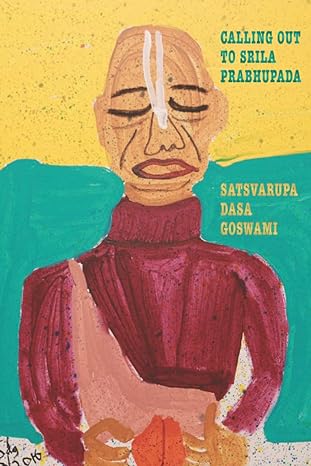 Calling Out to Srila Prabhupada: Poems and Prayers
O Prabhupāda, whose purports are wonderfully clear, having been gathered from what was taught by the previous ācāryas and made all new; O Prabhupāda, who is always sober to expose the material illusion and blissful in knowledge of Kṛṣṇa, may we carefully read your Bhaktivedanta purports.
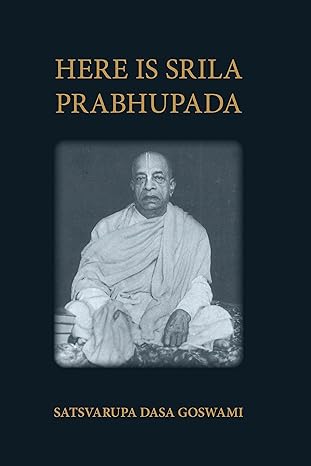
I use free-writing in my devotional service as part of my sādhana. It is a way for me to enter those realms of myself where only honesty matters; free-writing enables me to reach deeper levels of realization by my repeated attempt to “tell the truth quickly.” Free-writing takes me past polished prose. It takes me past literary effect. It takes me past the need to present something and allows me to just get down and say it. From the viewpoint of a writer, this dropping of all pretense is desirable.
 Geaglum Free Write
This edition of Satsvarūpa dāsa Goswami’s 1996 timed book, Geaglum Free Write Diary, is published as part of a legacy project to restore Satsvarūpa Mahārāja’s writings to ‘in print’ status and make them globally available for current and future readers.