
Finally back again with the health report. Please encourage me to continue. Satsvarupa Maharaja went through a long period—2 months—hosting visitors, important phone calls, writing letters, and he also did a lot of intense reading and editing of new books before the final deadlines leading up to the July 4 book festival.
This week he had a Parkinson’s breakdown—a rash of bad dreams to the point of being nervous about trying to go to bed at night or take a nap before breakfast, etc. He was more disoriented during the “sundown syndrome,” which lasts all night. (You might Google what that means.) And some of his answers to letters had to be reviewed by him before sending the answers out.
SDG Maharaja suffers from extensive arthritis through his back and shoulders, but carries on like a trooper. It seems like he will be able to pull out if everyone cooperates and also prays for him. The bottom line is full rest this month before the festival on July 4. I really think he will pull it off without a permanent reversal. In any case, he refuses to give in—the most important factor is his persistence in daily writing. This is the real test of how he’s doing.
Thank you very much,
Baladeva
What
Meeting of Disciples and friends of SDG
Where
The Veterans of Foreign Wars Hall – 845 Hudson Avenue – Stuyvesant Falls, New York 12173
There is plenty of parking near the Hall. The facility is just a few minutes’ walk from SDG’s home at 909 Albany Ave.
Schedule
10:00 – 10:30 A.M. Kirtana
10:30 – 11:15 A.M. Presentation by Satsvarupa Maharaja
11:15 – 12:30 P.M. Book Table
12:30 – 1:15 P.M. Arati and kirtana
1:15 — 2:15 P.M. Prasadam FeastContact
Baladeva Vidyabhusana at [email protected] or (518) 754-1108
Krsna dasi at [email protected] or (518) 822-7636SDG: “I request as many devotees as possible to attend so we can feel the family spirit strongly. I become very satisfied when we are all gathered together.”
*******
Śrī Caitanya-caritāmṛta, Madhya-līlā 20.124–125: “O great learned devotee, although there are many faults in this material world, there is one good opportunity—the association with devotees. Such association brings about great happiness. . . . .”
Srila Prabhupāda: “Therefore, our Society is association. If we keep good association, then we don’t touch the darkness. What is the association? There is a song, sat-saṅga chāḍi’ kainu asate vilāsa, te-kāraṇe lāgila mora karma-bandha-phāṅsa (Gaurā Pahū, verse 3). Sat-saṅga. Sat-saṅga means association with the devotees. So the one poet, Vaiṣṇava poet, is regretting that, ‘I did not keep association with the devotees, and I wanted to enjoy life with the nondevotees. Therefore I’m being entangled in the fruitive activities.’ Karma bandha phāṅsa. Entanglement.” [Conversation with David Wynne, July 9, 1973, London]
We need to expand our team of proofreaders as we aim to increase the rate of republication of Satsvarūpa Mahārāja’s books as well as new books that he writes.
This includes a need for fluent bilingual Spanish and English speakers to proofread Spanish translations (we currently have around 20 Spanish translations waiting to be proofread).
Anyone interested in this particular service should contact Manohara dāsa at [email protected]
If you would like to help, please contact Kṛṣṇa-bhajana dāsa at [email protected] or [email protected] and we will find you a service that utilizes your talents.
Śrīla Prabhupāda wrote to Śivānanda, December 4, 1968: “Regarding your first question, is it offensive to think of Krsna’s pastimes while chanting, I think you should know that it is not offensive, but rather it is required. One must try for the point when he simply hears Krsna and immediately all of Krsna, His Pastimes, His Form, His Quality, are in his thoughts of Krsna. This is our process. When we are full in Krsna then where can there be any chance for maya in us? So this is our duty to always remember Krsna’s pastimes. One who cannot remember Krsna, let him always hear Hare Krsna, and then when he has perfected this art, then always he will remember Krsna, His Activities, His Qualities, etc.”
******
Then to me on April 10, 1969, he wrote: “Regarding your question, hearing the vibration of Hare Krsna automatically reminds one of Krsna’s Pastimes. So, both of them arise simultaneously in the mind when one is sincerely chanting. So, you cannot make any distinction between listening to the sound and thinking of the Pastimes. But the process is to hear, and then Krsna’s Pastimes, Form, Qualities, etc. will automatically come to mind: That is very nice.”
******
From these two letters Prabhupāda says that the first step is to simply hear and then from that, naturally the spontaneous stage will come, when one thinks of the pastimes of Kṛṣṇa. This is indicated when he says, “One who cannot remember Krsna, let him always hear Hare Krsna, and then when he has perfected this art, then always he will remember Krsna.” And in the second letter Prabhupāda says that we cannot make a distinction between listening to the sound and thinking of the pastimes, “but the process is to hear, and then Krsna’s Pastimes, Form, Qualities, etc., will automatically come to mind.” This is similar to Kṛṣṇa’s statement in the Twelfth Chapter of the Gītā that one should always think of Him spontaneously, but if he cannot, then he should follow the rules and regulations. Don’t artificially impose thinking of Kṛṣṇa on your mind while chanting. Hear, and thoughts of Kṛṣṇa will come.
******
At the time of death, one is certainly bewildered because his bodily functions are in disorder. At that time, even one who throughout his life has practiced chanting the holy name of the lord may not be able to chant the Hare Kṛṣṇa mantra very distinctly. Nevertheless, such a person receives all the benefits of chanting the holy name. While the body is fit, therefore, why should we not chant the holy names of the Lord loudly and distinctly? In conclusion, one who chants the holy name of the Lord constantly is guaranteed to return home, back to Godhead without a doubt.
—Śrīmad-Bhāgavatam 6.2.48, purport
******
For strong chanting, chant louder; that will make you strong. If you extend a little more energy in your chanting, in your articulation and emphasis, you will more easily capture the rambling mind.
******
If we stay fixed in following Kṛṣṇa consciousness and chanting at least sixteen rounds, then by that full participation in devotional service we should not become very disturbed. We should not come to the point where we are unable to do any devotional service and have to stop all activities and chant all day sixty-four rounds, etc. But if despite ourselves we come to this point, then such chanting is good.
******
Regarding your question, there is no such requirement that japa should be silently and chanting should be done differently. Loudly or silently, everything is all right. There is no such restriction. Only thing is that we should chant very attentively, hearing the vibration very distinctly.
—Śrīla Prabhupāda Letter to Satsvarūpa, March 8, 1969
******
Kṛṣṇa consciousness is dependent on chanting Hare Kṛṣṇa. If the rounds are good, the consciousness will reflect them, the intelligence will reflect them also. The chanting of Hare Kṛṣṇa is very important.
******
Japa is an important part of devotional life. If your japa is not up to standard, this is serious. You must reform. That is, out of your regret may come success. Prabhupāda used to say failure is the pillar of success. Assess yourself, and try to improve your chanting of Hare Kṛṣṇa.
pp. 130-37
By the mercy of the Lord, the devotee knows perfectly well about the Lord’s dealings. Indeed, he can talk face to face with the Lord:
Sri Gopalaji then smiled and said: “My dear brahmana, just listen to Me. I shall walk behind you, and in this way I shall go with you.”
. . . As such, the Deity can act exactly as the Lord did in His original form as Krsna. Lord Krsna was talking to the young brahmana just to test his knowledge about the arca-vigraha. In other words, those who have understood the science of Krsna. Krsna’s name, form, quality and so forth, can also talk with the Deity. To an ordinary person, however, the Deity will appear to be made of stone, wood, or some other material. In the higher sense, since all spiritual elements ultimately emanate from the supreme spiritual entity, nothing is really material. Being omnipotent, omnipresent and omniscient, Krsna can deal with His devotees in any form without difficulty. By the mercy of the Lord, the devotee knows perfectly well about the Lord’s dealings. Indeed, he can talk face to face with the Lord.
—C.c., Madhya 5.97
Pure devotees realize dealings with the Lord on the transcendental plane, but because the devotees are still in the material world, they think that these are dreams. The Lord, however, talks with the ad-vanced devotee, and the advanced devotee also sees Him. It is all factual; it is not a dream.
—C.c. , Antya 3.35, purport
This is the system of receiving instructions from the Supersoul. Externally He is not to be seen, but internally He speaks to the devotee. That is confirmed in Bhagavad-gita—the Lord dictates from within to one who is sincerely engaged in His service, and the Lord acts in such a way that such a person can ultimately attain the supreme goal of life. When Brahma was born, there was no one to instruct him; therefore the Supreme Lord Himself instructed Brahma, in Vedic knowledge through Brahma’s heart. In Srimad-Bhagavatam 2.4.22, Sukadeva Gosvami confirms that the gayatri-mantra was first imparted within the heart of Brahma by the Supreme. Sukadeva Gosvami prayed to the Lord to help him speak Srimad-Bhagavatam before Maharaja Pariksit.
—Teachings of Lord Caitanya, 1974 ed., pp. 343-44
The vigraha, The Deity of Krsna, appears by Krsna’s mercy. Because Krsna is alaksya, invisible, He becomes visible to give us the facility to see Him. It is not that Krsna is stone, wood, or metal. Krsna’s vigraha is always Krsna, but because we cannot see anything beyond material elements like wood, stone, and metal, He appears in a form made of these elements. But He is neither wood, metal, nor stone. When we associate with the Deity, we associate with Krsna personally. Because Krsna is invisible, He very kindly takes a form that is visible to us. This is Krsna’s mercy. Do not think, “Oh, here is a stone Krsna,” Krsna is everything, and therefore Krsna is stone also, but He is not the kind of stone that cannot act. Even in the form of stone or metal, Krsna can act as Krsna, and one who worships the Deity will perceive that. Svayam eva sphuraty adah. The Deity, although apparently stone, may speak with a devotee. There are many instances in which this has happened.
—Teachings of Queen Kunti, 1978 ed., p. 18
Srila Rupa Gosvami has therefore said that by affection and love for the Supreme Personality of Godhead, devotees can express their mind to Him with their words. Others, however, cannot do this, as confirmed in Bhagavad-gita: bhaktya mam abhijanati yavan yas casmi tattvatah
—Bhag. 10.2.36, purport
O My mother, My devotees always see the smiling face of My form, with eyes like the rising morning sun. They like to see my various transcendental forms, which are all benevolent, and they also talk favorably with Me.
. . . It is the duty of the spiritual master to teach how to decorate the Deity in the temple, how to cleanse the Deity and how to worship the Deity. There are different procedures and rules and regulations which are followed in temples of Visnu, and devotees go there and spiritually enjoy the form because all of the Deities are benevolent. The devotees express their minds before the Deity, and in many instances the Deity also gives answers. But one must be a very elevated devotee in order to be able to speak with the Supreme Lord. Sometimes the Lord informs the devotee through dreams. These exchanges of feelings between the Deity and the devotee are not understandable by atheists, but actually the devotee enjoys them. Kapila Muni is explaining how the devotees see the decorated body and face of the Deity and how they speak with Him in devotional service.
—Bhag. 3.25.35, purport
pp. 4-9
The visiting sannyasi took part in an informal symposium of devotees arranged by the editor of Back to Godhead. The editor wanted them all to talk about Community and hoped he could use it in his magazine.
During that meeting, the visiting sannyasi mentioned that he sometimes wrote poetry. Another member remarked, “I think a sannyasi has to do a lot more than write poetry if we are going to develop true community in our movement.” This remark drew several assents, “Yeah,” “Right.” All this was later published in the magazine and it made our sannyasi feel ashamed and guilty. And chagrined. In a separate incident, he heard third or fourth hand, that during the annual meeting of the ultimate directors of the movement, someone said in passing, “We’ve got so much work to do for Srila Prabhupada in spreading Krsna consciousness. But it’s not going to happen if our sannyasis are sitting around writing poetry and the householders are completely bewildered with family duties.” That also killed his joyful spirit.
As a result of this the sannyasi stopped writing his poems for a while. It had been an occasional practice over the years but had recently flared up into a post-middle age steady fire. He didn’t agree that poetry writing was idle but felt too emotional about it to articulate this with anyone. Besides, they made him feel guilty about it. He started writing again but kept the poems to himself and kept even the practice of writing a secret. He also tried to show a profile in various ways, of one tangibly engaged in acceptable duties of sannyasa preaching.
The sannyasi had several problems connected with the writing of poetry. He was frustrated because he had so little time to write or even think in that way. Another problem was that whenever he expressed himself he found he was filled with worldly allusions and images whereas a Vaisnava poet ought to write about Krsna directly.
As for not being appreciated, the visiting sannyasi didn’t so much mind that except for the implication by others that he was not pleasing Srila Prabhupada. So when he found statements in Srila Prabhupada’s writings which supported his poem writing, he took it as solace. He found such support not only in direct references encouraging disciples to write and pray but in many other places. For example he took courage from a 1967 letter by Srila Prabhupada encouraging Murari dasa to go on playing his guitar in the kirtana and there’s no need to learn to play sitar—”the best part of valor is to utilize properly whatever talents and qualifications we have got for the service of the Lord.”
The visiting sannyasi confided all this to his companion and brahmacari assistant, Narahari dasa. Narahari sympathized deeply and encouraged his friend to go on writing poems if it inspired him in Krsna consciousness. He agreed that the sannyasi shouldn’t advertise this practice. Together they plotted how they would take time so that the sannyasi could write. The trip to Spain would not be so conducive to that, but afterwards, maybe they’d go somewhere …
I spoke this morning with the visiting sannyasi about putting his poetry in this story I’m writing. I got permission to use as much poetry as I like. That means I’ll select some things. I won’t change his words, but edit the poems in the sense of selecting what lines I think are appropriate for my purposes. So from here on in this narrative you will see his poem lines appearing.
It’s a pain—long hours rattling in the back
of the Renault, sunshine of Cote d’Azur
and I’m helpless.
Write what words come and they
don’t come from the pure place
What to speak of words direct from Krsnaloka,
mine don’t even come
from a clearwater place on the earth.
You know those water bottle people?
I’ve drunk them in a dozen countries; they
all advertise the same: “Our water filters
through volcanic ash . . . comes from the
Atlantic Ocean skies . . . deep in the
unspoiled wilderness . . . a Coral island, etc.”
Well my words come down through
stacks of 45 RPM records
dropping one after another on the phonograph,
Allen Freed’s top hits, Fats Domino,
Cardinals, Drifters, rhythm and blues . . .
My layers include Eisenhower as President
(we didn’t own a T.V. but watched it
through the display window of the T.V. store . . . )
Korean War, Dad and the firehouse . . .
Wadded tissues, peed on snow, girls,
and drinking liquor and beer on Staten Island . .
Holy moly! said Captain Marvel.
Shazaam and nitrogen glycerin to you.
“Hey Stevie, the Dole Company is looking for you.
They want to put fruit in a can.”
Down it filters, but . . .
there is a way to scrape it all and just
throw it out. I am not a follower
of Prabhupada for nothing.
That was all maya, a dream.
Do you remember your dreams of forty years ago?
Of course not. So why remember the
waking dreams? Why even try for it?
There’s no need. You can gradually let them go.
But will Krsna sustain me?
The life of Bhagavatam?
Yes believe it. Great sages walk on
this ground, bathe in rivers.
You can enter one river and
come up in another two thousand miles away.
You can have a lot of fun and satisfying
your sense in the service of the Lord.
But don’t expect to bring with you your
old record collection, bed of childhood and adolescence,
father’s smelly cigar butts, picture of naked woman
you found in his drawer and the ones
in your drawer, or mother’s statue of
Christ the Little King or your dog or
sister, yeah goodbye to her cynical wit
always cutting me down . . .
You can enter this solid ground where
you met Srila Prabhupada and became his sisya.
It’s not Indian or even New Yorker,
but sankirtana of Lord Caitanya,
historically true and transcendental.
Just do it if you will,
come to me pure, go to Spain
pure words filtered down through
better than volcanic ash, layers of pure sky
and pure winds . . . from Vaikuntha.
Through your broken speech,
babyish, repeating
what you’ve heard,
Krsna is God,
Radha is God’s
maha-mantra is God
guru is Prabhupada
Prabhupada is God’s
I am his eternal servant
going to Spain to preach bhagavata-dharma.
pp. 307-11
S.B. 1.2.27
Those who are in the modes of passion and ignorance worship the forefathers, other living beings and the demigods who are in charge of cosmic activities, for they are urged by a desire to be materially benefited with women, wealth, power and progeny.
Srila Prabhupada straightens us out. He allows no nonsense in the name of devotional service. Someone may want to eat as much as possible and sanction that desire because “it’s krsna-prasadam,” but in his purport to this verse, Prabhupada stops that:
“We should never desire to increase the depth of material enjoyment. Material enjoyment should be accepted only up to the point of the bare necessities of life and not more or less than that. To accept more material enjoyment means to bind oneself more and more to the miseries of material existence.”
We shouldn’t be looking through the Krsna conscious rules for a license to enjoy sense pleasure. If you need a little more than the minimum, become a responsible grhastha and regulate your sense gratification. If you are a brahmacari or a sannyasi, however, then sense control is especially appropriate. Lord Caitanya’s advice to Raghunatha dasa Gosvami may be too severe to be taken literally, and in fact Prabhu -pada specifically said not to imitate Raghunatha because we will lose whatever gains we have made. We can follow the spirit though. Don’t increase the enjoying propensity. Don’t eat luxurious foods, don’t dress in fine clothes, control the tongue, belly, and genitals, don’t mix with women or men who enjoy women. Always chant Hare Krsna and remember Krsna.
All this is similar to why we speak against demigod worship. Demigod worship centers on increasing sense enjoyment. That’s what the worshiper prays for and what the demigods bestow. The Bhagavad-gita states that those who worship the demigods have their intelligence stolen by material desires. Better to serve the Supreme Lord and His pure devotees and accept whatever comes as Krsna’s mercy.
Women, wealth, power, and aristocratic birth—I don’t feel particularly hampered by these things, but maybe I am. As a sannyasi and guru, I have access to women and wealth: “Here, Guruji, I heard you needed money to print your latest book,” “I heard you needed a new van,” “Here is guru-daksina so you can travel around the world and deliver the fallen souls.” Isn’t this dangerous?
And power. Just to be able to get whatever I want on a daily basis. All I have to do is ask and someone will arrange it. I could feel my power. I could humble a politician or a doctor (if he’s a Hindu, of course. In the West, we are the ones who have to be humble). I could think of myself as powerful in this religious movement. Isn’t this dangerous?
It’s natural to ask myself whether I’m guilty of these excesses. It’s also natural to try to find the balance between real renunciation and false renunciation. We can’t spend our lives doubting our motives or assuming we are cheaters.
I have been feeling undernourished and weak. Most devotees, when they see our Nature Cure meals, think we are not getting enough grains or bulk. We tell them they are ignorant of hygenic laws because they continue to eat past the first belch. The author of Practical Nature Cure coined the phrase, “Dietetic righteousness.” He means it in a favorable sense, but it could also become a source of pride.
Then why are we weak? Perhaps we need to eat more regularly, as Prabhupada did—rice, dal, capatis, and sabji. And a sweet is not forbidden. If in order to digest all that in my old and weak system I require an Ayurvedic churna or two, no harm. These are not the symptoms of deepening sense gratification.
The point of this discussion is that it’s a mistake to decry demigod worship, claim we are Vaisnavas, and then retain material desires. We will miss the real benefit of worshiping Visnu and then we won’t be able to please Him.
In his purport, Prabhupada puts this statement in italics: “One should work hard and worship the Supreme Lord by the fruits of one’s hard labor for existence, and that should be the motto of life.” We may be surprised by such a down-to-earth motto. Work. Use the rewards of your work to please God.
Don’t drop out to go live in a cave, but live in the world for Krsna. Forget about demigod worship and lighten your sense gratification.
How much sense gratification is “the bare necessity”? Sounds austere. Bare needs could mean eating a drop of something and otherwise fasting. Then we’d be so skinny and weak we wouldn’t be able to pick up a book bag. For a book distributor, the bare necessity could mean whatever it takes to keep his energy up all day. The bare necessity for a farmer means enough so that he can work hard in the field all day. He won’t be able to do that on a finger-drop of buttermilk every other day.
A plain sun coming up. I remember Petite Somme and Madhu and I driving there. It sure would be nice to get it together and write this A Poor Man Reads The Bhagavatam anywhere in the world.
What are my concerns? Krsna isn’t real to me is one lament or theme. I want to improve that.
Let’s make a list of things I’d like to put into my book.
pp. 4-9
Bill Clinton’s fiftieth birthday—had a party at Madison Square Garden in this election year. But no matter how long one lives or remains in political office, he has to die. And one doesn’t know where one will go in the next life. I should be personally concerned to broadcast this truth. K.C., K.C. . . . people take it as a sectarian religion and dismiss basic, universal truths such as transmigration as “Hindu beliefs.” But devotees don’t get discouraged by this. They preach, enthusiastic at the prospects of pleasing the Lord by their actions and assured of their own purification. We have no choice but to serve Him in this way, and we become happy by doing so. Our only unhappiness is like Prahlada Maharaja’s, to see that the fools and rascals are bewildered by mays and not taking shelter of Krsna.
But sometimes devotees don’t act in this ideal way. So I must struggle to maintain the actual platform of a devotee. And my writing reflects that struggle. In Back to Godhead magazine we editors once said we shouldn’t always present the devotees as smiling faces. We should show that we are really people, have ups and downs in our attempts to follow the highest ideals of KC. But I think the policy remains to present the smiling faces.
Nowadays there is more admittance of the need for “education” of devotees, and conferences are held to teach how to distribute books and how to do many other important things. I submit my writing as part of the educational movement. I want to speak of honesty not by always being the Perfect Teacher, but by being honest on the page. Some can’t understand this. But I must go ahead and pursue it. It’s a kind of art, a profession, and a confession.
Vasudeva and Devaki pray to the Supreme Lord. I’m reading their prayers in the third chapter of Tenth Canto. I’m feeling more confident that I’ll be able to give classes. The main thing is to read regularly. Then you’ll be able to make outlines quickly for lectures. You’ll have many topics at your fingertips. This is approaching Janmastami. After that I’ll get back to my reading of Cc. where I left off.
Black ink.
I propose you be a good fellow. Don’t feel bad but keep yourself engaged. Krsna the holy mantras of His names you will resound with devotion.
A little pang grows in me, the desire to pray, the feeling of lack, being bereft, lack of love. Please kindle it in me and teach me the way to go. I will be able to speak of the holy names to devotees. They especially like me to address that topic because we all know it’s important and that we don’t do it ideally.
O holy name. But I can’t be the grossest hypocrite. I need to improve my chanting. To feel a little taste, at least the need to improve and of course to be at least fixed in the minimum vow of sixteen rounds—this is required for speaking on hari-nama. Similarly I need to speak of serving and of thinking of Krsna and of preaching. My preaching can then be a cause of making me honest enough to recommend it to others.
Sri Krsna. Pariksit became perfect only by hearing and Sukadeva attained perfection by speaking. Prahlada by remembering, Laksmi by serving his lotus feet, Prthu Maharaja by worship, Akrura by vandanam, Arjuna by friendship and Bali Maharaja by giving everything.
I and you got to do it.
Leave this world, be like it’s said in SB—iha yasya harer dasye—be free of modes although in this world. Be of a different category. Chant Hare Krsna. O Lord, O Lord, O Lord, he says he says he says.
May Krsna grant me peace and activity of Krsna consciousness.
Days dwindle, activities dwindle, I also find it hard to relate to the official programs of ISKCON but I do burn with inner flame of service to guru—feel quite apart from material world and nondevotees, seek the essence in my quiet way. Let me offer obeisances to great devotees and all devotees.
I can’t expect to go back to Godhead in this lifetime. One has to be one hundred percent purely in attachment to Krsna’s will. This is a concern to me, but in honesty I can’t rouse myself to a higher platform. I struggle to maintain what faith I have. Struggle—admit it to others. At least situate yourself in eternal position of servant to guru. Go on serving him. “Haribol! Haribol!” said the animals in the fable. “Krsna’s Island Opens Up” said the newspaper headline—thus the names of God are vibrated.
pp. 212-16
Dear friends,
I’ve become addicted to writing to you. I think it’s a good thing. I know that I could just as well be silent and the world would be no different. But I have this urge to not let time go by without having tried to talk with you. It seems like an addition to my existence to say something, and that’s because of the gift we have of Krsna consciousness.
I hope that Krsna will be pleased that we are speaking among ourselves, trying to help each other. Krsna says in Bhagavad-gita that He’s pleased with His devotees who are characterized by their liking to enlighten one another. Therefore we have assurance from Krsna.
But I want to make sure that Krsna is the basis of my letter-writing; otherwise, it will be as in-significant as many love letters or business correspondence or notes between friends which, after the people die, are put in a trunk and forgotten.
Someone here asked me how we can remember Krsna more. It seems to me that the more we hear about Krsna’s activities, the more we can naturally think of Him. If we don’t hear about Krsna’s pastimes, we will tend to think of Him as that vague person, God—He who knows everything, He who hears our prayers, He who helps and protects us. Of course, these are eternal qualities of God and we may pray in a personal way to that omnipotent being, to that indwelling guide. This mystical prayer is common to many religions. At this mystical level we all pray to the same aspect of God and can develop a personal relationship with Him.
But there is something better than that in Krsna consciousness. In Krsna consciousness we become attracted to Krsna, the original personal form of the Supreme Lord. In His personal form, Krsna takes pleasure in His devotees. Prabhupada gives the example of a judge who is not so much himself in court but who, at home, is relaxed and takes pleasure in being with his family. God as the indwelling guide, as a friend of the conditioned souls, He is not expressing Himself in terms of His own pleasure potency and delight when He’s relating with pious people. But when somebody really wants to please Krsna, Krsna eventually reveals Himself as the Supreme Personality.
We’re very fortunate to have had contact with Srila Prabhupada, who is very dear to Krsna and who has told us about pure devotional service. If we take up devotional service, Prabhupada assures us we can have our own individual relationship with Krsna. Krsna is always with His pure associates. Our own gurudeva is surely one of those associates and the one whom we want to follow to please Krsna. When someone asks me how we can think of Krsna, I say we should hear as much as we can from the rasa-sastras about Krsna in Vrndavana, how Krsna is happy, and what He is really like. Then we will naturally start thinking about Him. And we should chant His holy name. We should chant as well as hear and think about Krsna.
Krsna sometimes sends persons who are eternally participating in His pastimes, and they tell us what it is like to be with Krsna. They share their visions and even their devotions. For example, Srila Vyasadeva, the great sage who compiled the Vedas, is actually Krsna in His literary incarnation. By studying the Vedas, we receive the actual revelation of God’s form and pastimes. Just so we know what devotional service is, Krsna came as His own devotee in the form of Lord Caitanya. All the inner moods of devotion are recounted in Caitanya-caritamrta. If we want to think about Krsna, we may read Caitanya-caritamrta and Krsna book and think about what is written there. True, devotional life is not all found in books. As Prabhupada himself says, book knowledge is theoretical; Deity worship is practical. Descriptions of Krsna in Vrndavana are not theory, but for us, Krsna’s pastimes are something we can only read in books. Yet if we read sastra submissively, we can enter the spiritual world through its pages; they are not ordinary books.
Until we come to the stage of spontaneous attraction to Krsna, we have to use our bodies and minds in Krsna’s service. That is what Prabhupada means by practical service. In Deity worship there are so many practical considerations, such as cooking for Krsna, dressing Krsna, bathing Krsna. These activities focus our lives on Krsna. By vibrating Krsna’s name, serving Krsna, and remembering Krsna’s pastimes, our whole life becomes absorbed in remembrance of Krsna.
Prabhupada has given us the open secret to preach Krsna consciousness to others as a way of pleasing Krsna. And when we please Krsna, He will reveal Himself more and more. Because we’re followers of Frabhupada, we can never become too delinquent in telling others about Krsna. Prabhupada will remind us.
I think talking about this should be an integral part of our relationship. In honoring the best in each of us and honoring our desire to serve Prabhupada, we can ask each other, “How are you doing?” Do you know that famous question King Dasaratha asked the sage Visvamitra when they met—is everything going well in your endeavor to conquer the repetition of birth and death? The king asked Visvamitra that because he knew it was the sage’s concern. Just as you would ask a businessman, “How’s business?” Or a mother, “How are your children?” so you ask a Krsna conscious person how he is doing in his attempt to overcome repeated birth and death. And you would ask a devotee of Prabhupada, “How are you doing in your attempt to serve the sankirtana movement?”
This question is raised between us not in an accusing way to make us feel guilty. We can answer honestly, knowing that we love each other. I know you’re trying to do something. So you say, “Well I haven’t been doing so well lately,” but then you share with me some activity you are doing. Maybe it’s small and you’re a little bashful about it, but it is something that gives you pleasure, someone you’re cultivating, or an instance when you were able to speak about Krsna. And I can encourage you. Then you can inquire how I’m doing. This will help us because we take pleasure by imbibing Krsna consciousness and distributing it.
pp. 24-27
Sometimes when I discuss outside events, I feel my concentration on study threatened. I fear the rarefied consciousness I have entered when I do a lot of studying will be dismantled just by thinking of the mad house of civilization.
Is it morally inferior to remove myself from the world? The solution (if there is one) is to study and write as concentratedly as I can, gain strength, work in the world to help people practice Kṛṣṇa consciousness. That is Śrīla Prabhupāda’s perfect resolution, to simultaneously work for God and for all living beings. That’s what he referred to as “the highest welfare work.”
If those who propagate religion are shallow, worldly, without spiritual realization, without regulated sādhana, then their work in the world is farce. ISKCON’s preaching is valid because its members are sincere. What are they sincere about? They are sincere about glorifying God and serving Him. In this age, chanting the holy names is the prescribed method of God realization. Because people need a scientific approach, bhakti-yoga is scientific.
******
The subject matter in Śrīla Prabhupāda’s books is deep, inspiring, and urgent. It calls the soul to give up false arguments and bhaja govinda, worship Govinda. We read and feel the currents of Kṛṣṇa consciousness running through us. Prabhupāda described it like that: when a devotee is linked to Kṛṣṇa in bhakti, then the spiritual current flows through him.
When this supernatural energy [of unlimited Kṛṣṇa] is reposed in us, all our thoughts and feelings, our physical body, our mind, our knowledge, and so on, are energized by it. Every endeavor then simply merges into this flow of energy, and we become like a lotus growing from the mud—in the world but uncontaminated by it.
Renunciation Through Wisdom, p.225
Śravaṇaṁ is the first item in bhakti; therefore, reading can connect us to the unlimited flow, to Kṛṣṇa Himself. Śṛṇvatāṁ sva-kathāḥ kṛṣṇaḥ, punya-śravaṇa-kīrtanaḥ. Reading is itself pious activity, and when we do it, Kṛṣṇa personally cleans the dirty things remaining in our hearts.
******
Nivṛtta-tarṣair upagīyamānād … Individual ślokas in their original Sanskrit have a special potency the English can’t convey. It seems too late in life for me to memorize more ślokas, but at least I can meet them more, be with them (and not forget the ones I have memorized).
For example, here is a śloka I have never memorized, yet it’s familiar to me because I have heard Prabhupāda recite it. Whenever I hear it, I allow it to absorb into my mind, and I feel its rhythm, sound, and meaning:
athāpi te deva padāmbhuja-dvaya-
prasāda-leśānugṛhīta eva hi
jānāti tattvaṁ bhagavan-mahimno
na cānya eko ‘pi ciram vicinvanMy Lord, if one is favored by even a slight trace of the mercy of Your lotus feet, he can understand the greatness of Your personality. But those who speculate to understand the Supreme Personality of Godhead are unable to know You, even though they continue to study the Vedas for many years.
—Śrīmad-Bhāgavatam 10.14.29
It’s not just book study or active service. Kṛṣṇa and Kṛṣṇa’s devotees have to favor us. No one succeeds in Kṛṣṇa consciousness except one who is favored by the Lord.
My dear Lord, please favor me. Let me find You easily in the pages of my spiritual master’s books. It is not ordinary Vedic study. The Bhāgavatam can grant us favors. The verses and purports are cetan, and they can reveal Kṛṣṇa to us.
pp. 314-18
SDG singing and clapping:
hare krsna hare krsna krsna krsna hare hare
hare rama hare rama, rama rama hare hare
Haribol. I thought of speaking about something Prabhupada said it a lecture. He was speaking on a verse about how you have to rise above the modes of nature to practice Krsna consciousness. Then he said that in his presentation of Krsna consciousness, he didn’t make any compromises, but just taught what the sastras say. If people don’t like it, they can go elsewhere, but he can’t compromise. He is so strong in his faithful presentation, and aware that people’s whimsical nature may not be satisfied. Still, he wasn’t prepared to pander.
Of course, Prabhupada’s uncompromising nature is much of what attracted us to him. It’s not that everyone who came to spiritual life was a perfect connoisseur of spiritual topics or such a penetrating truth-seeker that he couldn’t be cheated. But Prabhupada made us feel safe. Prabhupada himself said that many of us came to him out of sentimentality. Of course, that was still good, but if we didn’t become serious, we would fall away. His uncompromising nature helped us become serious and to get past whatever sentimental reasons made us seek him out in the first place.
Then Prabhupada said that to practice spiritual life, you have to rise above the modes, especially the modes of ignorance and passion Again, he was uncompromising. He said we wouldn’t be able to tell about spiritual life until we rose above those two modes. How can one practice spiritual life and at the same time, cultivate lust and greed Therefore he told his students from the beginning that we had to give up illicit sex, intoxication, meat-eating, and gambling.
I recently heard Prabhupada speaking with a representative of a Rosicrucian society in Paris. I say “speaking with,” but it was more like Prabhupada was piercing everything he said with his demanding logic On the point of giving up sinful activities, the Rosicrucians say that they don’t have any rules or regulations forbidding members to engage in any activity. He said that the Rosicrucians have been intelligent in not insisting on a pure life, because if you insist, a person will leave. His conviction was that after practicing the meditation, and steps in their order, a person would naturally give up sinful activity. At no point would they demand or even check up on how their followers were doing in their attempts to find purity.
Prabhupada demands that we rise above the modes. He doesn’t compromise on this point. Prabhupada’s presentation covers everything. It’s so scientific and deep, and he holds the process out, just waiting for someone to take it up seriously. Prabhupada gave us the process of sravanam kirtanam. Srnvatam sva-katha krsnah, or ceto-darpana-marjanam—chanting and hearing about Krsna will clean our hearts. That is Prabhupada’s proposal.
******
SDG singing and clapping:
hare krsna hare krsna krsna krsna hare hare
hare rama hare rama, rama rama hare hare
I read a statement lately by a BTG editor in response to a devotee who had written in. The editor wrote, “The problem I find in your essay is that you don’t stick to one point, but you wander from point to point. Even if you make your essays short, there’s no harm in that, but you should bring up one point and then lead the reader by the hand, step by step. If you don’t do that—if he doesn’t know where he is at every moment under your guidance, then he’ll tend to get confused and lose interest.”
On the one hand, I agree with this point of view, but when I think about it more deeply, I don’t. The person he wrote to didn’t agree with it either. He said, “I’m forty-nine years old and I’ve been through what I’ve been through. I have my way, my nature of presenting something, and I can’t change it. That’s the way I speak. I like to speak on different things.”
The editor drew an image of the reader as a rather childlike person who needs the writer to hold his hand and take him through his points. I find that condescending. There are confused readers as much as there are confused writers. Still, most people don’t see themselves as confused or lost or childish. Most people don’t want to be led. They prefer to be inspired to follow. My own feeling is to trust that the reader has an active intelligence and can follow if he feels something is worth following.
A preacher wants to communicate, but he wants to do it as humanly as possible. Prabhupada was uncompromising; he didn’t care whether people’s superficial interests were satisfied or not. He spoke the truth, what was good for people, and what would actually delight them in their constitutional nature. And he wasn’t bored with his own presentation. He was always enthusiastic in his preaching. You can hear it in the early tapes. Prabhupada would be speaking enthusiastically and philosophically, and then suddenly pause as if seeing the blank faces of his audience, “Oh, of course, this is a very dry subject. People will think we are talking about God and it is so much philosophy.” Then he would chuckle, realizing that for a New York crowd to gather and not hear music or something more immediate, sensational or controversial, or attractive to the lower modes of nature was unusual. He couldn’t expect to be too popular.
He chuckled and he realized it, but he went forward anyway with his kirtana and his preaching. He did it because that’s what Krsna wanted. He wasn’t interested in pleasing the crowd. He wrote that pan one letter: “The kirtana is not to please a crowd. The lecture is for Krsna and for some sincere persons. No matter if nobody comes, you speak to the walls. We are Krsna dasa, we are guru dasa.

Viraha Bhavan Journal (2017–2018) was written by Satsvarūpa Mahārāja following a brief hiatus in writing activity, and was originally intended to be volume 1 in a series of published journals. However, following its completion and publication, Mahārāja again stopped writing books, subsequently focusing only on what became his current online journal, which began in August of 2018.

At first, I took it hard that I would have to live surrounded by the firemen, and without my own solitude. After all, for decades I had lived in my own house with my own books and my own friends. I was also now a crippled person who couldn’t walk, living among men who did active duties. But when Baladeva explained it to me, how it was not so bad living continually with other firemen and living in the firehouse with its limited facilities, I came to partially accept it and to accept the other men. I came to accept my new situation. I would live continually in the firehouse and mostly not go outside. I would not lead such a solitary life but associate with the other firemen.
Let me write sweet prose.
Let me write not for my own benefit
but for the pleasure of Their Lordships.
Let me please Kṛṣṇa,
that’s my only wish.
May Kṛṣṇa be pleased with me,
that’s my only hope and desire.
May Kṛṣṇa give me His blessings:
Kṛṣṇa Kṛṣṇa Kṛṣṇa Kṛṣṇa Kṛṣṇa he
Rāma Rāghava Rāma Rāghava
Rāma Rāghava rakṣa mām.
You mentioned that your pathway has become filled with stumbling blocks, but there are no stumbling blocks. I can kick out all those stumbling blocks immediately, provided you accept my guidance. With one stroke of my kick, I can kick out all stumbling blocks. —Letter by Śrīla Prabhupāda, December 9, 1972.
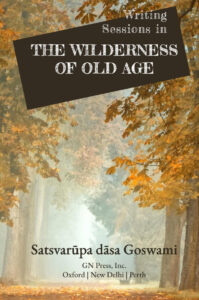
The Writing Sessions are my heart and soul. I’m trying my best to keep up with them. I am working with a few devotees, and they are far ahead of me. I wander in the wilderness of old age. I make my Writing Sessions as best I can. Every day I try to come up with a new subject. Today I am thinking of my parents. But I don’t think of them deeply. They are long gone from my life. Śrīla Prabhupāda wrote a poem when he was a sannyāsī, and he said now all my friends and relatives are gone. They are just a list of names now. I am like that too. I am a sannyāsī with a few friends. I love the books of Śrīla Prabhupāda. I try to keep up with them. I read as much as I can and then listen to his bhajanas.
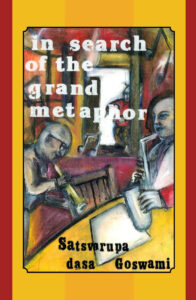
The metaphor is song. Explain it. Yes, particulars may not seem interesting or profound to readers who want structured books.
Wait a minute. Don’t pander to readers or concepts of Art. But Kṛṣṇa conscious criteria are important and must be followed. So, if your little splayed-out life-thoughts are all Kṛṣṇa conscious, then it’s no problem.
I am near the end of my days. But I do like the company of like-minded souls, especially those who are Kṛṣṇa conscious. Yes! I am prone to Kṛṣṇa consciousness. I have been a disciple of Bhaktivedanta Swami Prabhupāda for maybe almost sixty years. Sometimes I fail him. But I always bounce back and fall at his feet. It is a terrible thing that I sometimes do not have the highest love for him. It is a terrible thing. Actually, however, I never fall away from him. He always comes and catches me and brings me back to his loving arms.

This edition of Satsvarūpa dāsa Goswami’s 1996 timed book, Upstate: Room to Write, is published as part of a legacy project to restore Satsvarūpa Mahārāja’s writings to ‘in print’ status and make them globally available for current and future readers.
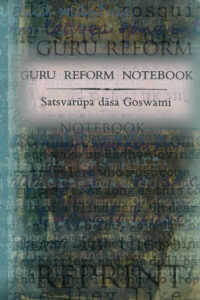
A factual record of the reform and change in ISKCON guru system of mid ’80s.

Readers will find, in the Appendix of this book, scans of a cover letter written by Satsvarūpa Mahārāja to the GN Press typist at the time, along with some of the original handwritten pages of June Bug. Together, these help to illustrate the process used by Mahārāja when writing his books during this period. These were timed books, in the sense that a distinct time period was allotted for the writing, during SDG’s travels as a visiting sannyāsī
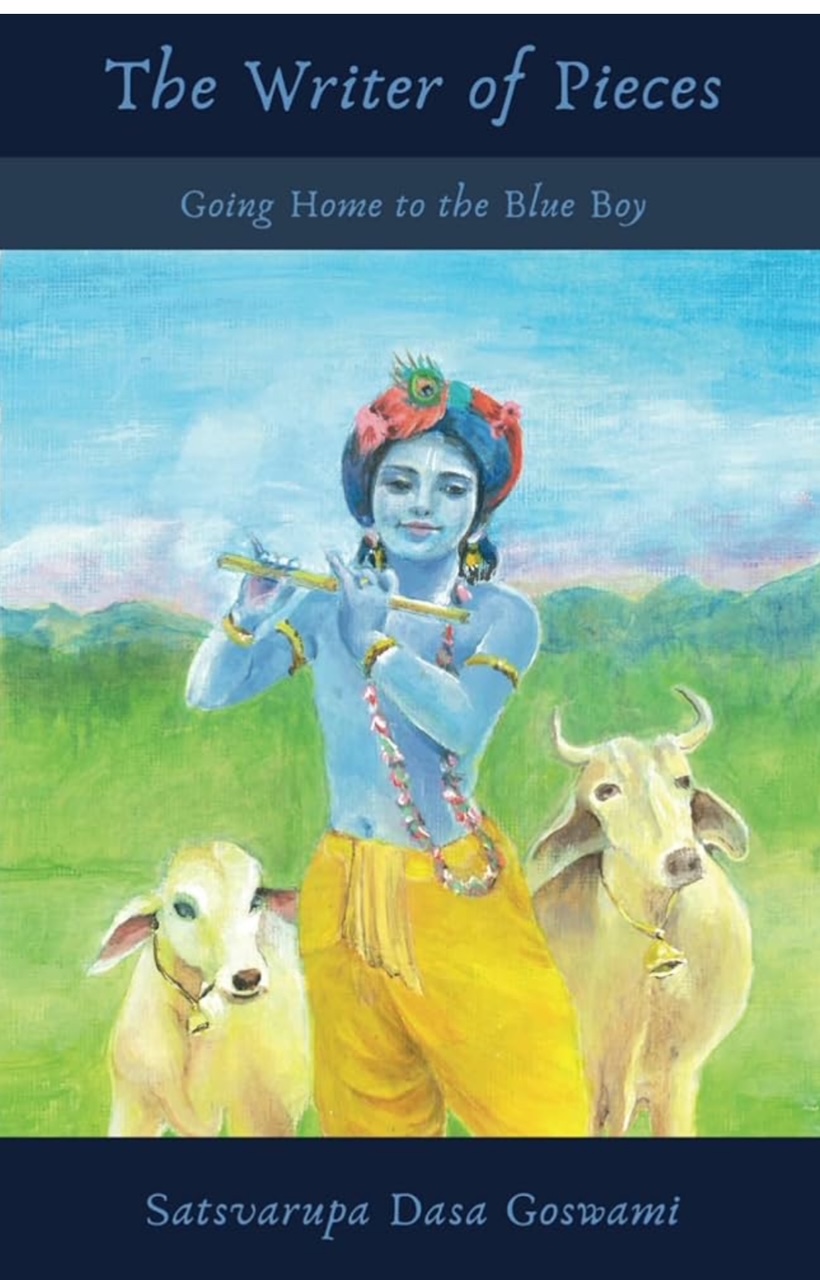
Don’t take my pieces away from me. I need them dearly. My pieces are my prayers to Kṛṣṇa. He wants me to have them, this is my way to love Him. Never take my pieces away.

Many planks and sticks, unable to stay together, are carried away by the force of a river’s waves. Similarly, although we are intimately related with friends and family members, we are unable to stay together because of our varied past deeds and the waves of time.
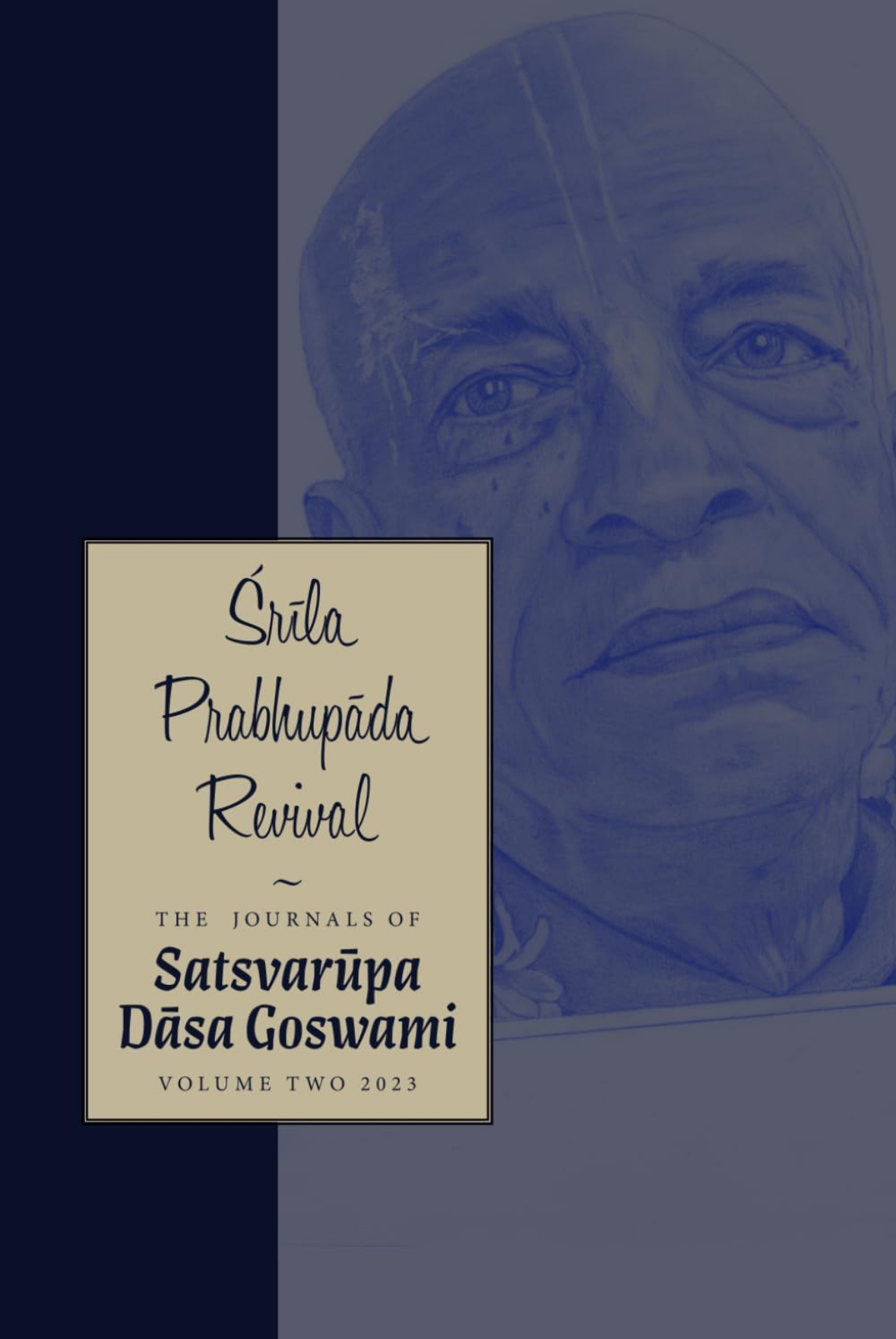
To Śrīla Prabhupāda, who encouraged his devotees (including me) To write articles and books about Kṛṣṇa Consciousness.
I wrote him personally and asked if it was alright for his disciples to write books, Since he, our spiritual master, was already doing that. He wrote back and said that it was certainly alright For us to produce books.
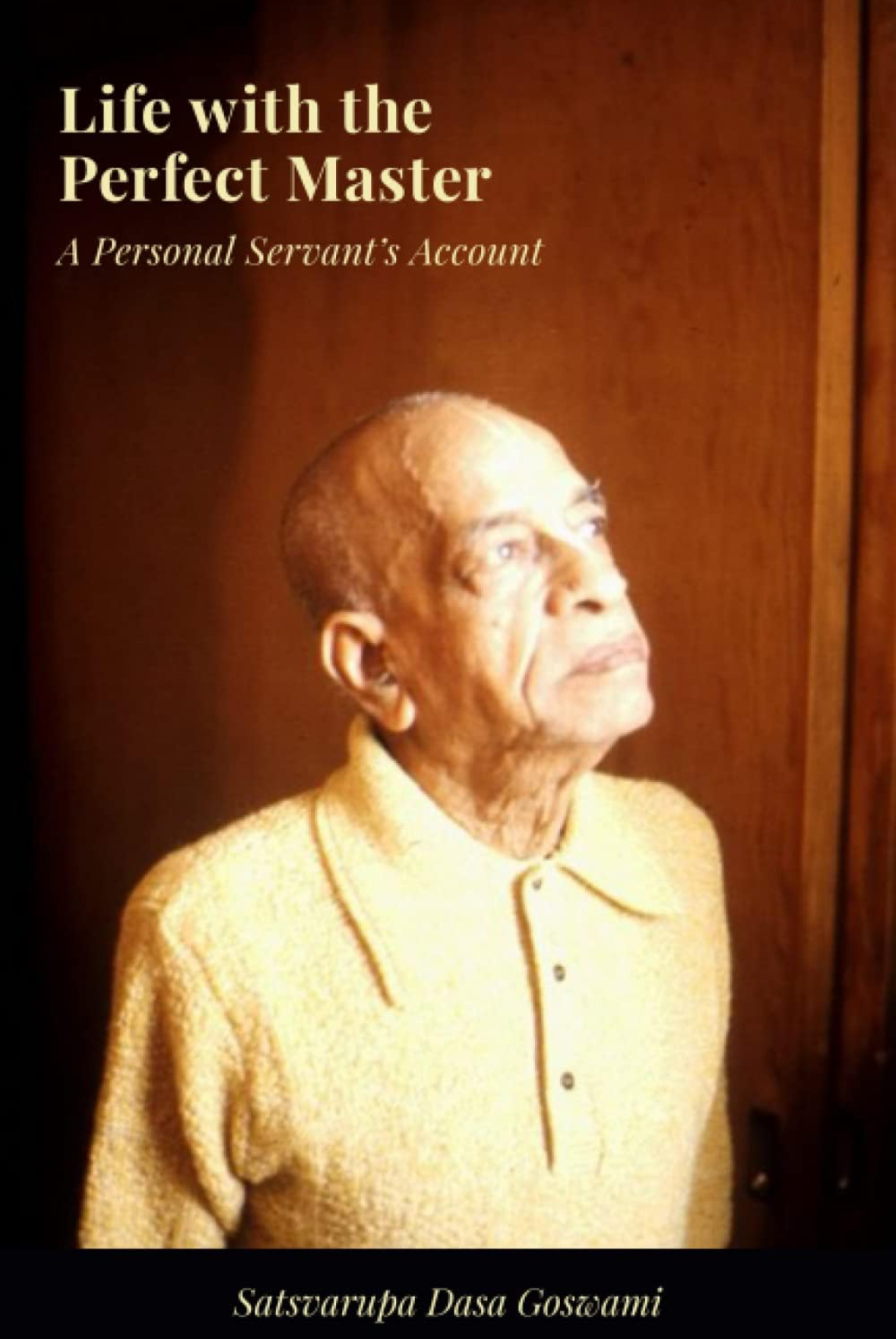
I have a personal story to tell. It is a about a time (January–July 1974) I spent as a personal servant and secretary of my spiritual master, His Divine Grace A.C. Bhaktivedanta Swami Prabhupäda, founder-äcärya of the International Society for Krishna Consciousness. Although I have written extensively about Çréla Prabhupäda, I’ve hesitated to give this account, for fear it would expose me as a poor disciple. But now I’m going ahead, confident that the truth will purify both my readers and myself.

First published by The Gītā-nāgarī Press/GN Press in serialized form in the magazine Among Friends between 1996 and 2001, Best Use of a Bad Bargain is collected here for the first time in this new edition. This volume also contains essays written by Satsvarūpa dāsa Goswami for the occasional periodical, Hope This Meets You in Good Health, between 1994 and 2002, published by the ISKCON Health and Welfare Ministry.

This book has two purposes: to arouse our transcendental feelings of separation from a great personality, Śrīla Prabhupāda, and to encourage all sincere seekers of the Absolute Truth to go forward like an army under the banner of His Divine Grace A.C. Bhaktivedanta Swami Prabhupāda and the Kṛṣṇa consciousness movement.
A single volume collection of the Nimai novels.
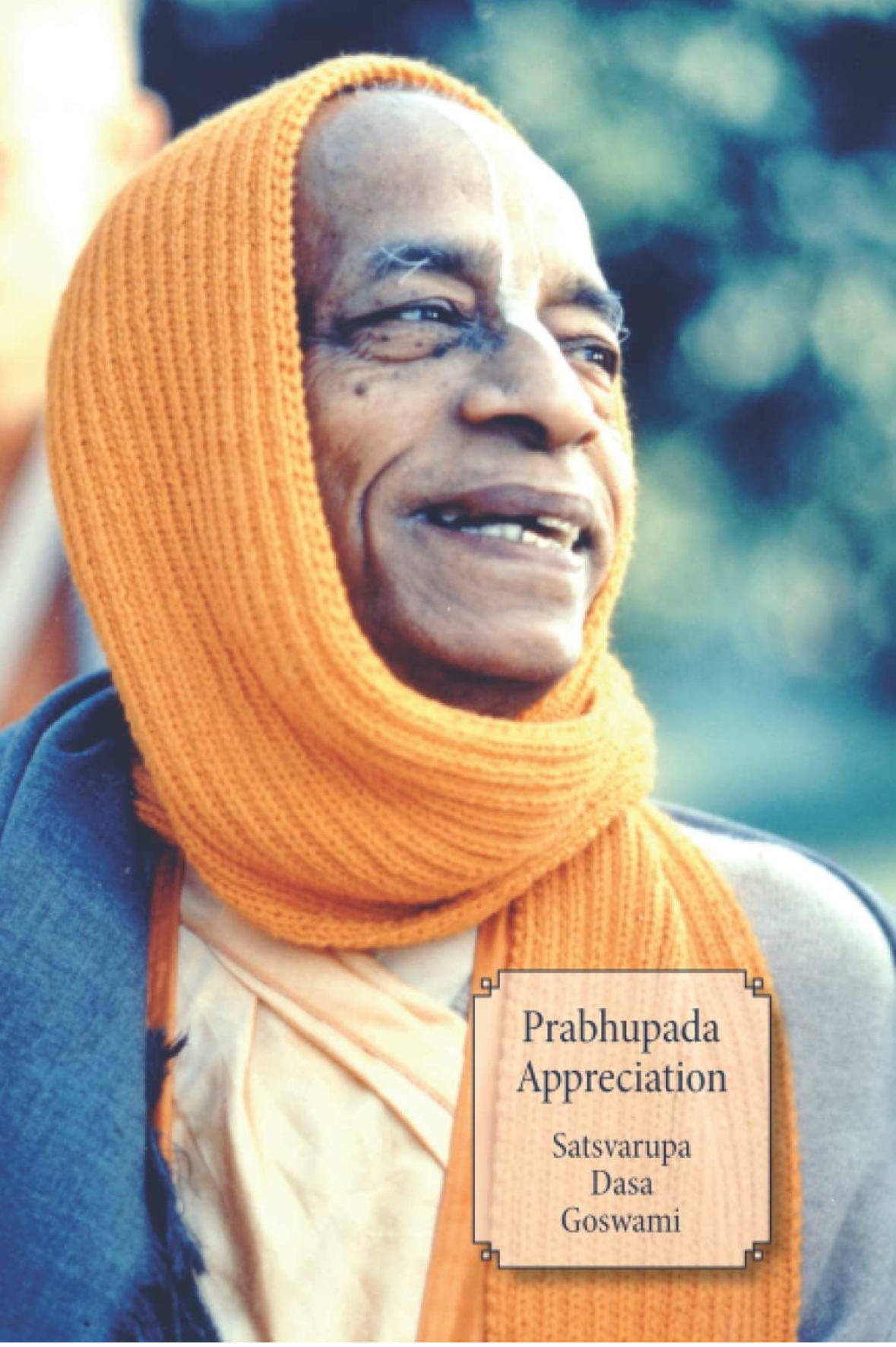
Śrīla Prabhupāda was in the disciplic succession from the Brahmā-Mādhva-Gauḍīya sampradāya, the Vaiṣṇavas who advocate pure devotion to God and who understand Kṛṣṇa as the Supreme Personality of Godhead. He always described himself as simply a messenger who carried the paramparā teachings of his spiritual master and Lord Kṛṣṇa.
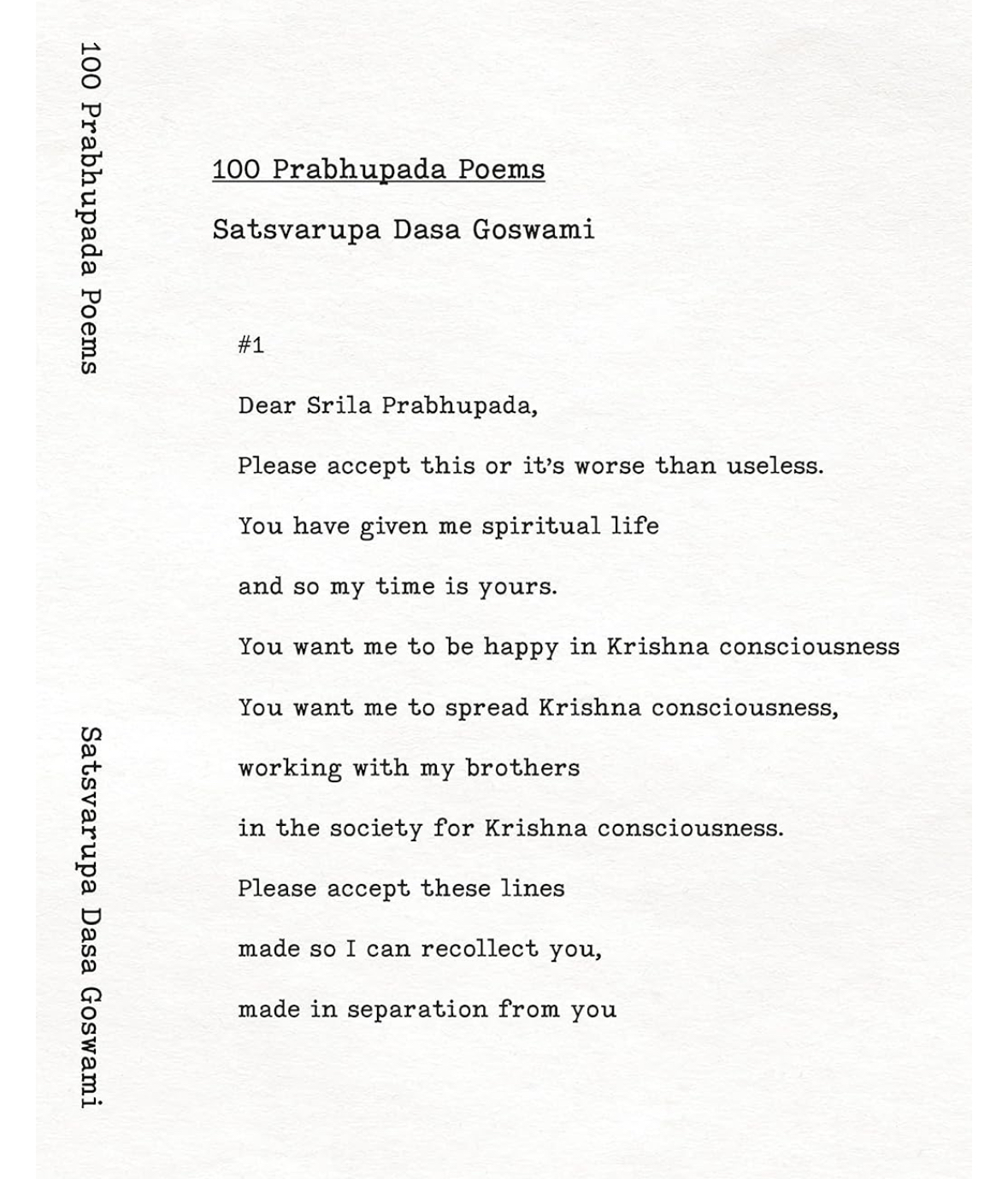
Dear Srila Prabhupada,
Please accept this or it’s worse than useless.
You have given me spiritual life
and so my time is yours.
You want me to be happy in Krishna consciousness
You want me to spread Krishna consciousness,
This collection of Satsvarūpa dāsa Goswami’s writings is comprised of essays that were originally published in Back to Godhead magazine between 1966 and 1978, and compiled in 1979 by Gita Nagari Press as the volume A Handbook for Kṛṣṇa Consciousness.

This second volume of Satsvarūpa dāsa Goswami’s Back to Godhead essays encompasses the last 11 years of his 20-year tenure as Editor-in-Chief of Back to Godhead magazine. The essays in this book consist mostly of SDG’s ‘Notes from the Editor’ column, which was typically featured towards the end of each issue starting in 1978 and running until Mahārāja retired from his duties as editor in 1989.

This collection of Satsvarupa dasa Goswami’s writings is comprised of essays that were originally published in Back to Godhead magazine between 1991 and 2002, picking up where Volume 2 leaves off. The volume is supplemented by essays about devotional service from issues of Satsvarupa dasa Goswami’s magazine, Among Friends, published in the 1990s.

“This is a different kind of book, written in my old age, observing Kṛṣṇa consciousness and assessing myself. I believe it fits under the category of ‘Literature in pursuance of the Vedic version.’ It is autobiography, from a Western-raised man, who has been transformed into a devotee of Kṛṣṇa by Śrīla Prabhupāda.”
 The Best I Could Do
I want to study this evolution of my art, my writing. I want to see what changed from the book In Search of the Grand Metaphor to the next book, The Last Days of the Year.
 a Hare Krishna Man
It’s world enlightenment day
And devotees are giving out books
By milk of kindness, read one page
And your life can become perfect.
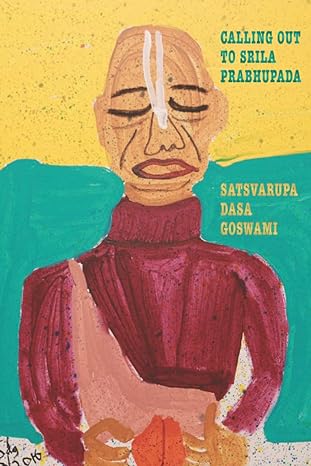 Calling Out to Srila Prabhupada: Poems and Prayers
O Prabhupāda, whose purports are wonderfully clear, having been gathered from what was taught by the previous ācāryas and made all new; O Prabhupāda, who is always sober to expose the material illusion and blissful in knowledge of Kṛṣṇa, may we carefully read your Bhaktivedanta purports.
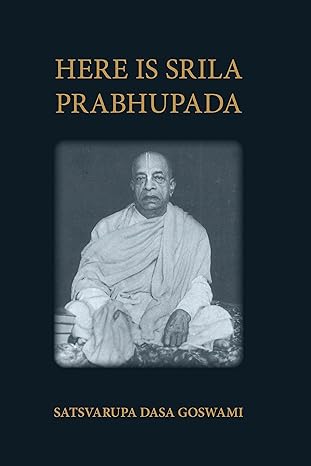
I use free-writing in my devotional service as part of my sādhana. It is a way for me to enter those realms of myself where only honesty matters; free-writing enables me to reach deeper levels of realization by my repeated attempt to “tell the truth quickly.” Free-writing takes me past polished prose. It takes me past literary effect. It takes me past the need to present something and allows me to just get down and say it. From the viewpoint of a writer, this dropping of all pretense is desirable.
 Geaglum Free Write
This edition of Satsvarūpa dāsa Goswami’s 1996 timed book, Geaglum Free Write Diary, is published as part of a legacy project to restore Satsvarūpa Mahārāja’s writings to ‘in print’ status and make them globally available for current and future readers.