
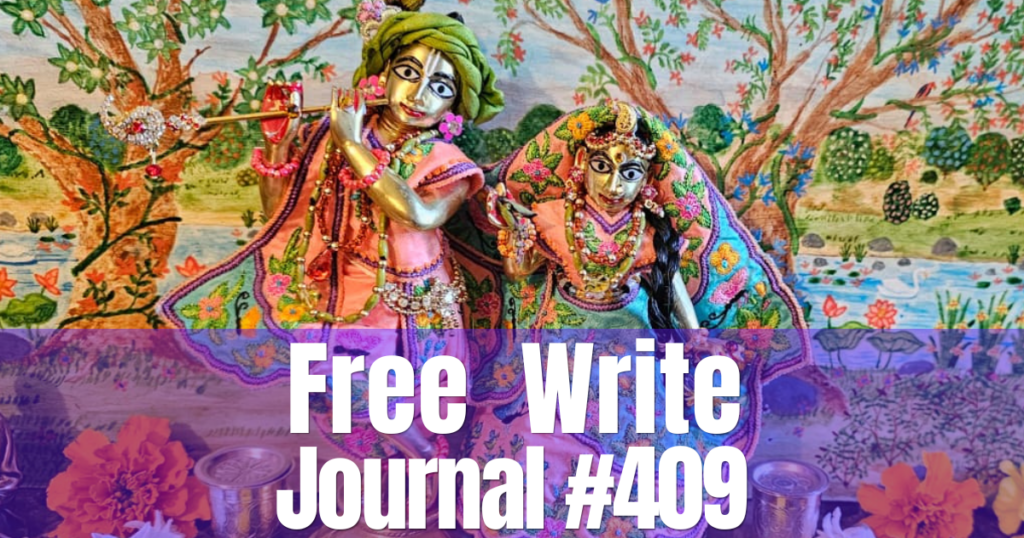
I would like to inform my disciples and friends that by Krsna’s grace, on July 4th I was able to present several new books recently published by GN Press. Among them I want to point out to you California Search for Gold, Volumes 1 and 2: Restoring Commitment to the Holy Names.
This book tells of my attempt and ultimate success at chanting the holy names for 16 rounds. It is an important book for you to read and see how I recovered from my inability to keep the 16 rounds due to headaches and other problems in my health. Please read this book. Thank you.
—SDG
We are still expanding our team of proofreaders as we aim to increase the rate of republication of Satsvarūpa Mahārāja’s books as well as new books that he writes.
As many of you know, during the July 4th festival just held, a total of 18 new and re-edited and published books were present, and we hope to present a similar number at Satsvarupa Maharaja’s Vyasa-puja observance this December.
Our call for proofreaders includes a need for fluent bilingual Spanish and English speakers to proofread Spanish translations (we currently have around 20 Spanish translations waiting to be proofread). Anyone interested in this particular service should contact Manohara dāsa at [email protected]
If you would like to help, please contact Kṛṣṇa-bhajana dāsa at [email protected] or [email protected] and we will find you a service that utilizes your talents.
We can follow Ajāmila to the extent of chanting helplessly. One of the symptoms of surrender is to consider oneself very fallen and in need of Kṛṣṇa’s help. You must call out like that—“Hare Kṛṣṇa!”
******
Lord Caitanya was so kindly aware of the position of the struggling devotee trying to come to the platform of pure devotion. He compassionately revealed this in His own prayer, “O my Lord, you have so kindly appeared in Your holy name, and in these names You have invested all Your energies, but yet I am so unfortunate that I have no taste for chanting this Hare Kṛṣṇa.”
******
Narottama dāsa Ṭhākura also expressed this lamentation of the devotee who wants to engage in Kṛṣṇa consciousness but who cannot taste the nectar of devotional service due to his material attachments. Narottama says, “What good is my life? I know with my mind and intellect and even within my heart that this chanting is everything, but I don’t like to chant. I don’t like to associate with the devotees, and I don’t like to take part in this saṅkīrtana movement. I must be cursed. What is the sense of being alive?” He does not want material life, but he cannot taste the holy name. This is not our permanent despair, but it produces that helpless condition. We don’t chant for any material or even spiritual benefit in terms of liberation, but we know that this chanting is everything—except we just can’t taste it. By surrendering in this way to the holy name—that is helplessness.
******
In the Caitanya-caritāmṛta, Lord Caitanya asked for a secluded place to chant, like the place of Haridāsa Ṭhākura. In the purport, however, Prabhupāda says it is not for the members of ISKCON to drop off the regular activities and practice bhajana in seclusion. Also, Bhaktisiddhānta Sarasvatī said that one who tries to do this is actually just cheating and is trying to gain some adoration as a great devotee. He said that one may, out of some motive, go alone and try to chant Hare Kṛṣṇa and claim he is on the topmost platform, but actually in his mind he will be thinking of sex life, fame, profit, and adoration.
******
Should we think of Kṛṣṇa’s forms and pastimes while chanting japa? We should not do anything artificial. As Prabhupāda has said, the chanting is not an artificial imposition on the mind. Prabhupāda has recommended that if we just hear the chanting, then the time will come when simultaneously we will think of the form of Kṛṣṇa. To concentrate on the sound may seem routine. Of course, that is only our neophyte stage.
******
The mood for chanting is advised in Lord Caitanya’s prayer that we should consider ourselves lower than the straw in the street and should pray to the Lord to please fix us as one of the atoms at His lotus feet. Even more than desiring to see Kṛṣṇa, we should pray that Kṛṣṇa will be able to see us in such a way that we will be pleasing to Him.
******
In your chanting cry out, just as a child cries out for the mother that, “Kṛṣṇa, I am chanting Your name, but still I am so fallen I do not taste it. Please engage me in the service of Your holy name and situate me in the sweet taste of devotional service unto Your Lordship and Your holy name.”
pp. 137-41
Śrīla Prabhupāda said that ISKCON was his body. The formation of ISKCON is very much a part of Prabhupāda’s overall mission, and it should be appreciated just as much as we appreciate other aspects of Śrīla Prabhupāda.
We may think that the first signs of ISKCON appeared with the formation of the League of Devotees in Jhansi. But it actually begins before that. Śrīla Prabhupāda inherited by paramparā many concepts about a living society of devotees.
In Vedic history, the entire human society was a kind of Kṛṣṇa consciousness movement with varṇas and āśramas cooperating peacefully. And within that larger society, sages lived together in hermitages or āśramas, chanting, hearing, and meditating more than one would expect to find in the general society.
But with the gradual loss of religious potency in Kali-yuga, the population has come under the influence of intoxication, meat-eating, illicit sex, and gambling. Therefore, to give people shelter and to allow them to practice the teachings of Lord Caitanya in the association of other devotees, it became necessary to organize a subculture, or a society of Vaiṣṇavas. Lord Caitanya stressed avoiding the association of the nondevotees. When asked for His definition of a Vaiṣṇava, Lord Caitanya replied, “asat-saṅga-tyāga…”: a Vaiṣṇava is one who avoids the association of the nondevotees (Caitanya-caritāmṛta, Madhya 22.87). And in Upadeśāmṛta, Rūpa Gosvāmī also states that one should associate with devotees and avoid nondevotees (Upadeśāmṛta, 2).
Bhaktivinoda Ṭhākura, in the Śrī Śrī Godruma Kalpāṭavī, describes the system of Nāma Haṭṭa preaching wherein devotees, although pursuing their occupational duties in the world, would come together regularly for hearing and chanting. He drew the analogy of a marketplace wherein those seeking the holy names would have to pay with their faith (śraddhā) in the names. And he predicted the formation of a Kṛṣṇa conscious society: “Although there is still no pure society of Vaiṣṇavas to be had, yet Lord Caitanya’s prophetic words will in a few days come true. I am sure. Why not? Nothing is absolutely pure in the beginning. From imperfection, purity would come about.”
Śrīla Bhaktisiddhānta Sarasvatī Ṭhākura, the son of Bhaktivinoda Ṭhākura, reestablished the Śrī Viśva-vaiṣṇava-rājā-sabhā in 1919, which later became known as the Gauḍīya Maṭh. This was a temple and āśrama combined, where renounced men could live together and worship the Deity. The Gauḍīya Maṭh spread Kṛṣṇa consciousness by encouraging people to practice bhakti-yoga in their homes and by book printing and distribution, lectures, and regular programs for the public at the temple.
…Śrīla Bhaktisiddhānta Sarasvatī Ṭhākura, in relating the history of the Viśva-vaiṣṇava-rājā-sabhā, the society of the foremost devotees established by Śrīla Jīva Gosvāmī, explained that the sabhā was sometimes manifested by the presence of a mahā-bhāgavata and sometimes unmanifest in the unfortunate times, but was always present in the śikṣa of the mahājanas like Śrīla Bhaktivinoda Ṭhākura, who revitalized it in the late 19th century. This sabhā then became a revolutionary world movement in the latter 20th century by the heroic efforts of His Divine Grace A.C. Bhaktivedanta Swami Prabhupāda, the Founder-Acārya of the International Society for Krishna Consciousness.1
As a gṛhastha, Śrīla Prabhupāda encouraged people to practice Kṛṣṇa consciousness in their homes, but he also desired to establish a society of devotees. After the disappearance of his spiritual master, the Gauḍīya Maṭh broke up and Prabhupāda was forced by circumstance to work within the still-existing māths of his Godbrothers. But he wanted to do more. He did extensive preaching to people in their homes and wrote his monograph, “Perfection at Home.” On Sunday he would visit people like Dr. P. Banerjee, a member of the National Museum of New Delhi, who would gather twenty or thirty elderly guests at his home for sat-saṅga. He also preached actively in Kanpur, staying at various homes and lecturing. Whenever he would get an invitation, he would go to hold kīrtana and to discuss kṛṣṇa-kathā (Śrīla Prabhupāda-līlāmṛta, vol.1, pp. 240-241).
He also wrote letters, mainly to government officials, expressing his desire to form a living society of devotees. “I want to train up forty educated youths to learn this science of transcendental knowledge and just prepare them for going to foreign countries… for missionary work…” (Śrīla Prabhupāda-līlāmṛta, vol.1, p. 180). This idea was also expressed in his essay about “Gītā-nāgarī,” a simple village-style community of devotees based on the principles of Kṛṣṇa consciousness.
In 1953, Prabhupāda registered the League of Devotees in Lucknow.
His intentions were clearly not insular but were directed towards “creating centers for spiritual development all over the world”… thus establishing the League as “An International Organization for spiritual development through education, culture also by recruiting members from all nations, creeds, and castes.”
—Śrīla Prabhupāda-līlāmṛta, vol.1, p. 155)
And the League would publish a monthly magazine, Back to Godhead.
In his prospectus for the League, Śrīla Prabhupāda outlined a schedule of attendance at ārati and kīrtana, regulative chanting of rounds on japa beads, strict adherence to cleanliness and the regulative principles, and regular study of the śāstra. There was provision made for the prasādam meals of the inner members and rules for dīkṣā. Scripture classes were held in the morning and the evening (Letter, 55-1).
Later, after coming to America, Prabhupāda began to assess whether a society of devotees would be possible in New York. He had plans but it required money and manpower to execute them. He also knew that occasional lectures were not enough. He needed a temple and residence for those who would come to join him.
Finally, Prabhupāda settled in at 26 Second Avenue and began holding his twice weekly classes and kīrtanas. Hippies and seekers began to attend and he began building a congregation, but he envisioned bigger things. As Mr. Ruben, a subway conductor who had met Prabhupāda on a Manhattan park bench in 1965, had noted: “He seemed to know that he would have temples filled up with devotees, ‘There are temples and books,’ he said. ‘They are existing, they are there, but the time is separating us from them’” (Śrīla Prabhupāda-līlāmṛta, vol.2, p. 133).
There are indications that Śrīla Prabhupāda did not expect that all potential devotees would live in an ISKCON center. He encouraged Kṛṣṇa conscious family life: a husband should accept the burden of providing for his family and husband, wife and children should follow the regulative principles, chant Hare Kṛṣṇa, and preach whenever possible. He said, “If one can mold his family life in this way, there is no need to change from family life to renounced life” (Bhagavad-gītā 13.8-12, purport).
There are also various purports where Prabhupāda states that it is not necessary to give up one’s separate residence to live in a temple. His mission was to engage everyone in the chanting of the holy name and the avoidance of sinful life. This would automatically lead to association within ISKCON. Devotees who were practicing spiritual life would naturally want to associate with like-minded people, and thus the subculture of devotees would spread throughout the mundane society. (There are different purports discussing this point. Among them is this one: “Without the association of devotees, one cannot advance in Kṛṣṇa consciousness. Therefore, we have established the International Society for Krishna Consciousness. Factually, whoever lives in this society automatically develops Kṛṣṇa consciousness” (Śrīmad-Bhāgavatam 4.12.37, purport). For other instructions on this point, see purports to Śrīmad-Bhāgavatam 4.9.11, 4.12.48, and the Concluding Words of Caitanya-caritāmrta.) In the Caitanya-caritāmṛta, Mādhya 4.79, Śrīla Prabhupāda writes, “The Kṛṣṇa conscious devotee must always desire to remain in the society of devotees…. They cannot go outside the Kṛṣṇa conscious society or the movement.” In another purport, Śrīla Prabhupāda writes:
This is the sublime mission of the International Society for Krishna Consciousness. Many people come and inquire whether they have to give up family life to join the society, but that is not our mission. One may remain comfortably in his residence. We simply request everyone to chant the mahā-mantra … (Śrīmad-Bhāgavatam 5.5.3, purport – Śrīmad-Bhāgavatam 7.7.38)
[1] Rūpa Vilāsa Dāsa (Robert D. MacNaughton), A Ray of Vishnu: The Biography of a Śaktyāveśa Avatāra Śrī Śrīmad Bhaktisiddhānta Sarasvatī Gosvāmī Mahārāja Prabhupāda (Washington, MS: New Jaipur Press, 1988).
pp. 26-38
Devotees who have regularly listened to Prabhupada’s speeches have often remarked that Prabhupada is a wonderful speaker. Although he always repeats what he has heard from previous acaryas, his expressions are original and poetic. When we tune into Prabhupada’s speech and when we take excerpts from it, as I have often done, we find complete poetic statements. The poems that I have “discovered” here are left almost just as he spoke them. In some cases I have skipped from one part of his lecture to another and brought the sentences together without using the el¬lipsis points. Occasionally I have changed a word. But this is Prabhupada almost verbatim, in free-verse form. Although the method of discovery may seem easy enough, I went through many lectures, and selected only what I felt was the most striking and presentable. I hope that it will be pleasing to his followers.
Srimad-Bhagavatam (7.9.12) Montreal, August 1968
God is God, always God!
Just like Krsna,
in the womb of His mother, He’s God,
in the lap of His mother, He’s God,
while He’s playing with His boyfriends
as cowherd boy, He’s God,
while He’s dancing with His girlfriends,
He’s God,
while He’s fighting in Kuruksetra,
He’s God,
while He’s married, He’s God,
while He’s speaking, He’s God,
that is God.
He’s the origin of Brahma, He’s
the fountainhead of Siva, He’s
the fountainhead of Visnu,
therefore He’s the origin.
So our prayer should be to
the Supreme Person,
“Govindam adi-purusam
tam aham bhajami”
We are going alone.
This is retirement.
Without waiting for anyone.
Alone, simply depending on Krsna.
This is the process of renouncement.
Not to make arrangement in the family,
“Now I am retiring.
You send me money
and I shall maintain myself.”
No. No dependence,
simply depend on Krsna.
Therefore it is said, ekanta-matir apa:
actually Krsna saves us.
So why should we depend on others?
December 9, 1968
By Krsna’s arrangement
we came in contact,
‘tho I was born in one family,
and my Guru Maharaja
was born somewhere else.
Who knew
that I would come
to his protection?
Who knew
that I would come to America?
Who knew
that you American boys will come to me?
These are all Krsna’s arrangements.
We cannot understand
how these things are taking place.
January 5, 1973
Krsna goes every day to the
forest of Vrndavana and
there some demon comes and
the cowherd boys say,
“There is Krsna,
we don’t care
for this demon.”
And the demon is killed.
And they come home
and narrate the story:
“Oh, my dear mother,
Krsna did this wonderful thing.”
The mother is also
very appreciative:
“Oh, how our Krsna is so nice.
He can do wonderful.
He must be some demigod.”
Like that, gossiping.
So actually this is life,
this Vrndavana is actual life.
January 5, 1973
What is this life, working so hard day
and night, discovering so many
things! Don’t you know, as soon as
the water supply is stopped everything
stops?
The electricity will stop,
the electric train will stop,
the lift will stop, the light will stop.
And there will be havoc.
So this artificial life
is not actual life.
There will be a time
when for hundreds of years
there will be no rain.
You have to wait for that time.
That time is coming at
the end of Kali-yuga
when for hundreds of years
there will be no rain.
Everything on earth
will be burned into ashes.
Then the sunshine will be twelve times hotter
This is stated in the Bhagavatam.
Everything will be burned into ashes.
And then there will be torrents of rain.
These descriptions are there.
Radhastami 1968
Don’t take Radharani
as an ordinary woman
like your wife or sister.
She’s the pleasure potency!
And the birth of Radharani
was not from the womb
of any human being.
She was found by Her father
in the field while he was plowing;
he saw one little, nice child
and he had no children
so he caught it
and presented to the queen:
“Oh, here we have got
a very nice child.”
“How you got?”
“In the field. Just see.”
Radharani’s janma is like that.
September 5, 1973
Anyone who comes before Radha
to serve Krsna,
Oh, She becomes so pleased. She
immediately recommends,
“Krsna, Oh, here is a devotee, he
is better than Me.”
This is Radharani.
I may not be a devotee. I
may be most fallen rascal.
But if I try to reach Krsna
through Radharani, then
my business is successful.
We should worship Radharani first.
You just put one flower
in the hands-of Radharani
“My mother Radharani, jagan-mata,
if You kindly take this flower
and offer it to Krsna.”
Radharani will say,
“Oh, you have brought a flower?”
So you should offer puspanjali
and pray to Radharani
“Kindly be merciful
and tell about me to Your Krsna.”
September 5, 1973
The Mayavadi sannyasis say,
Namo narayana:
“Everyone has become Narayana.”
Everyone is God, but
the rascal God is now
in the hospital under
surgical operation, a
guruji god.
They have no shame—
“Even I am god
I cannot cure my bodily pains, so
what kind of god I am?”
They also say,
“Why you are finding out God?
Don’t you see so many gods
are loitering in the street?”
So God has become a tiny thing for them.
But our God is different.
yas tu nārāyaṇaṁ devaṁ
brahma-rudrādi-daivataiḥ
samatvenaiva vīkṣeta
sa pāṣaṇḍī bhaved dhruvam
Our Narayana is exalted.
We cannot even compare Him
with Lord Brahma and Lord Siva,
so what to speak of these rascals.
Come to the guru.
But nobody comes to the guru,
therefore guru has to come
to U.S.A. to canvass.
This is the position.
Nobody went to me in India,
but I had to come here to
canvass you.
Because it is Kali-yuga.
An intelligent man knows
“My life is meant for spiritual realization.
I must find out a guru.”
But nobody knows it,
so Caitanya Mahaprabhu taught preaching.
These rascals are so fallen
they will never search out guru,
so guru comes to canvass.
December 8, 1973
Krsna is wonderful.
Either I talk or you talk.
Sweetmeat is sweet,
either you give or I give.
But a scientist will not
try to understand
that Krsna has given us metal
and given us the intelligence
so that now we have prepared a nice airship.
And Krsna has given us
the sky to fly.
Appreciate like that.
Then you are Krsna conscious.
If there was no sky,
where would you fly?
And if there was no metal,
how could you manufacture?
If you have no intelligence,
how could you do it?
So everything is given by Krsna,
and you are denying Him.
How fool you are, you see?
Srimad-Bhagavatam (1.15.45) Los Angeles, December 23,1973
You do not create any enemy,
but your neighbor is your
enemy, your friend will be
enemy, your brother will be
enemy, your son will be
enemy—this is adhibautika.
Somebody’s dog,
you have seen.
One is passing on the road,
and the dog is so faithful,
he becomes your enemy,
Ruff! Ruff! Ruff!—
“Why are you passing here?”
The mosquito will be your enemy;
the bugs will be enemies;
the insects will be enemies.
You may go on killing with spray,
but so many, many enemies,
so many troubles
are being created.
Who has created them?
The Nature.
To give you disturbance.
Nature will create,
yet you are thinking,
“We are very happy;
we are very happy
in this material life.”
pp. 379-81
Afternoon daydream: Swami Jim was quite awake, having finished sixteen rounds, and waiting for the half hour to pass before dinner. Somehow he thought of returning to 125 Katan Avenue. He reentered the building, and as he did so, neighbors saw him and called the police. He said he used to live there but they said, “You no longer live there so your entry is illegal.” Shortly after that the other three members of his childhood family—his mother, father, and sister also, one by one, illegally reentered the building. They were all gathered together in the police car and brought into jail and put in a common cell. A good part of this, thought Swami Jim, is that we can finally get together and maybe straighten things out. I may be having a very idealistic daydream, but it would be hellish to be back with them. But no, he decided, I shall control this daydream. We would have all transformed into the better part of ourselves. Just like I am a much better, transformed person than I was when I lived at 125 Katan Avenue. At that time I was a selfish, egoistic young kid, always pitying myself and thinking my parents were torturing me for the generation gap and that I was meant to be something better and that my father was a great bully, my sister was a great tease and never encouraged me, and that my mother was a very narrow-minded Catholic, although she had a little stream of spirituality about her, which maybe helped me later.
In their daydream form, I see my father as a heroic, decent fellow. His morals are good, and I understand that they have helped me to keep good morals now and that I can also go farther in good morals and be an upstanding, authentic spiritualist. He also sees that I am not a good-for-nothing person, a bum or useless person who ran off the edge of the earth into a weird cult, but I am a genuine man, although not with the physical build as great as his. I’m trying sincerely to do good in the world, as much as a fireman would or an officer in the U.S. Navy. And he sees that we have a mutual love as father and son. We weep and embrace in a manly way. He also extends himself to his wife with love, and they cry. They both regret ill feeling they held toward each other…. She was not a very deep-thinking woman so she was also under his control in domestic matters and tried to hold the iron fist, the fascistic attitude toward the children and raising us without understanding our individual natures. Economically they were both fighting to come up from the economic lower class and wanted us to be decent Americans and make as much money as possible. Any stepping out of line in that regard brought great dislike from them towards the children. Their daughter had always fulfilled their desires nicely as far as I knew, up to the time I left. So their meeting was just a renewal of a continual love, but I was the lost child and now came back to my mother and thanked her very much for injecting some religiosity in me through her once-a-week Sunday attendance at church and her actual belief in the existence of Jesus and Mary and life after death in heaven, or if you miss out, life in hell. She believed in all the Catholic sacraments and the practice of Confession. I told her how ISKCON was really not so different from the Catholic Church, and this time I was able to pour it out sincerely enough and she was able to see me as a decent man who had even more knowledge about God and faith in God than she did. Or at least he was striving in that direction and was not a smoker, drinker, or womanizer. He was in his own way a kind of priest.
Big deal, just a self-wishing daydream to pass the time.
As we read in the Bhagavatam, your parents, your family are just a combination of straws in the ocean. They come together because of the similarity and past karma. They stay together briefly, and then are broken up by death and go on to their next bodies. Would you have the same parents in the next life?
But it’s important to treat people decently no matter who they are: “Honor thy mother and father.” It would be sinful in any language to be ungrateful to the family, in the family of humankind. So what did the priest do after he left the minor family? Did he actually show love to the greater family of humankind?
Or it is acceptable for a priest to just try to improve his own self in a cave or hermit place and pray in an intercessionary way to God for the improvement of everyone? Did he do anything like that? Or did he just bemoan his position and say, “I’ll take care of the small group of disciples”?
Is he growing distant from his counselor? If so, it’s because he’s keeping some secrets. Secret, secret, who’s got the secret? Maybe you think someone is becoming too much a controller and you don’t want to be under their thumb. So you don’t pass everything through them. Or some committee. Prabhupada said he used to pull on his mother’s hand and say, “May I go take urine?” She would say, “Yes, of course, why do you have to ask me?” Does a grown man have to ask permission for everything he does? Is there some tainted motive in it? Does he have to confess it? Has he agreed in taking a counselor that he’s taking a confessor, like in the priesthood? Can’t always be done inwardly or in private writing?
What’s on your mind? Did you just write it down, that a guru might initiate a girl because she’s pretty or a man because he has money? You just made that up as an example. It’s not even true. I don’t know men with money. But I know a pretty girl. And I know a board that wants to control our actions, especially the actions of Ollie, who years ago the palm reader diagnosed as “a great thief.”
What’s the best environment for prayer? You’re playing around with trying to pay more attention to the holy name. It’s good. It may not be the most serious thing, but you’re actually always thinking about it and working with it. And the quantity of sixteen rounds and time to say japa is fixed. Oh—time to say gayatri.
pp. 17-20
Akhanditotsavam—an uninterrupted festival is being celebrated in the spiritual world, where the Supreme Lord lives with His eternal servitors. These are the words. More words: “I believe.” More: “doubt.” Beneath a word and beyond words is conviction and emotion. Of course, words are not meaningless; they are signposts of the inner and outer realities. They can be fragrant, like flowers, or have hidden thorns. We use them in Krsna’s service, something we learned by hearing the words of the spiritual master. We don’t scorn language, but use it to discern the truth and to hear it spoken.
Not all words are true and not all are false. We can speak (or write) eternal and absolute words or not.
When Krsna speaks, however, that’s always real. His word is sacred.
He speaks so we can learn to be aware of Him and His abode. If His words are real and absolute, then He too is a real and absolute person in our lives. To simply understand this guarantees us the complete happiness found in the Lord’s abode. We say a devotee doesn’t want to become liberated or even to go to the spiritual world after this life; he wants only devotional service life after life. Yet we do want to leave this world to be with Krsna. I “know” the answer to this apparent contradiction, but I don’t know it fully.
“Unless received by this bona fide process of hearing from a spiritual master, the statement of an acarya or preceptor cannot be valid.” Maitreya: “This has been narrated by me as I heard from my predecessor spiritual master.” (Bhag. 3.19.32, and purport)
More words: hetu, cause. Sanskrit. Sheaffer. Baseball. Bat. Root. Good morning. Goat’s nipples (useless). Sheep shorn. Rid of bad things. Watching video. Madhu. Storm. Ranch. Reagan. Sinatra dead. Coffins. Ashes. Wrench. Muscle. Pain ahead. Bad guys do bad things. Saintly persons tolerate, think of God, forgive. One saintly person said, “Just because the demons are killing doesn’t mean I have to give up my principle of brahminical forgiveness.” He was about to kill them all, and desisted on the advice that he should be forgiving.
Powerful lessons. Words line up into sequences by inspiration from God. Fragments.
Suta Gosvami spoke at this point and said, “My dear brahmana, Ksatta [Vidura], the great devotee of the Lord achieved transcendental bliss by hearing the narration of the pastimes of the Supreme Personality of Godhead from the authoritative source of the sage Kausarava [Maitreya], and he was very pleased.
What to speak of hearing the pastimes of the Lord … People may take transcendental pleasure even in hearing of the works and deeds of the devotees, whose fame is immortal.”(Bhag. 3.19.33-34)
The devotee reminds us of Krsna by his words and deeds. “Hare Krsna, Hare Krsna.” He vibrates the name. He teaches Srimad-Bhagavatam. He lives and suffers for Krsna and Krsna consciousness, like Prahlada. He talks to the Lord, as did Dhruva and Maharaja Ambarisa. All devotees. If I do as they did in my own way, then I can become at least a small transmitter of Krsna’s glory, His kindness.
Now I feel my receptivity wearing thin and my mind becoming diverted. It’s amazing how quickly that happens. It’s not merely a lack of physical or mental energy; it’s a lack of devotion. I have a low fuel level. I stare at the words and they stare back at me. I can’t assemble them in my heart and understand their essence. I start to paraphrase like a schoolboy: A grateful soul renders service to the great master, the Personality of Godhead. And to quote:
“The Lord can be easily pleased by spotless devotees who resort exclusively to Him for protection, though the unrighteous man finds it difficult to propitiate Him.” (Bhag. 3.19.36)
“If one continues to hear Srimad-Bhagavatam, which is full of narratives of the pastimes of the Lord, at the end of his life one is sure to be transferred to the eternal, transcendental abode of the Lord.” (Bhag. 3.19.38, purport)
Yes, simply hear
from the right source.
Srila Prabhupada lecturing says perhaps we are the only group in the world who are teaching the science of God, the soul in the body, transmigration, and bhakti. The important thing is not merely that this is a sublime and interesting philosophy but that it’s true: we will die, we will have to suffer again, and there is no other remedy but Krsna consciousness. We have to give Krsna consciousness all our attention. Nothing else matters. This is why Srila Prabhupada was so heavy, so insistent, so determined to make people hear.ù
Get it?
Saunaka wants to hear more about Vidura’s inquiries of Maitreya, and he openly offers praise. So, get set for another round of discussions.
Yeah, so I’m not a sophisticated litterateur. I don’t like having to unscramble a poet’s line that doesn’t seem to make sense: “When will we learn, what should be clear as day / We cannot choose what we are free to love?” I’d rather have it clearly stated. Even when you do unscramble it, it’s usually not worth so much. Don’t be cheated again.
I prefer to write plain. Makes me think of that jazz piece, “Straight, No Chaser,” but I don’t want to write like Monk or Mulligan or go back to those days where I was looking for Sound. Those were the historic days of jazz, the ’50s and ’60s, when artists began to play free. My freedom arrived with Prabhupada, who brought the Cowherd Boy from Vmdavana. That’s no poet’s creation.
No, I don’t need to go back to those bop artist priests. I am chanting Hare Krsna and hearing that sound. Those old drums sound tired to me now, and the solos don’t move me as they used to because they’re only blood and spit and semen and grief and joy grounded in the body. Occasionally there’s an ecstatic search for God, but basically blind. No direction where to go except on drugs or off.
I don’t need Adrienne Rich, and she doesn’t need me. I am the preacher for everyone, didn’t you know? Ireland and Great Falls, Virginia—that’s my territory—and if you don’t believe me, if you’re a renegade from Lord Brahma’s party and you think I’m a fink, then do your own thing and I’ll do mine.
My thing is to declaim the whole show behind history and literature, but at the same time, I too have to pass the human tests. Rich says poets are invited to live in a world of music and perception, but she thinks they shouldn’t do that. She says they have to remain open to human suffering. They have to express it in their poetry.
We all share the questions, but we have different answers. I know I can’t hide from the world in the name of being a devotee; a devotee’s response to human suffering is to give Krsna consciousness. That’s the risk we take—in our lives and in our poetry.
Even hermits say they take human suffering with them into their contemplation and prayer. Activists may have a hard time with that, but I think I understand it.
The world is full of injustice. We are just about to end the twentieth century and what has changed? The poor are still exploited by the rich, the women are still exploited by men, and we have not broken any of the bonds of tyranny of which they speak. We cannot become free from those bonds without recognizing our innate God consciousness. We need that kind of education.
Oh, God. They’re sick of hearing it. All those religious fanatics who have spent just as much time as the rest of the world killing each other off. This world is so misled.
Swami, when I write nowadays
sheep bleat behind me
in the field. Do you still
accept me in the
millions of ways I fall short?
I want to please you and
give you this
poem
written by a person.
pp. 395-97
I feel that I’ve come to the end of Tachycardia. I’ve lost drive to write down my daily thoughts and little happenings. I know this will be a disappointment to the little band of readers of this website. But I just can’t force it without the inspiration. I can’t go on reporting such minute, personal affairs as the state of my urinary tract infection and enlarged prostate. Even the insertion of the śāstric sections from Caitanya-caritāmṛta and Śrīmad-Bhāgavatam is becoming too routine.
Maybe I can change the nature of the writings, but I’m not sure what I could do. If my readers will be patient and let me take a little vacation, I may be able to come up with something a little different, or at least renewed inspiration to go on. Please excuse me for a temporary silence.
Having written the above in complete candor, I find a desire to continue. I’m confident my readers will be satisfied to hear any sincere news from this humble scribe. Shall I just go on?
The nurse practitioner received the results of the CT scan, and the report was not bad. The infection is due to my retaining urine in the bladder after I pass. This creates a favorable environment for new infections to begin, even after I’ve knocked them out with a treatment of antibiotics. She recommends I take a new and different kind of antibiotic and make another try. The CT scan also revealed a few kidney stones in both kidneys. This will be dealt with August 4, when I visit the urologist. Tomorrow I see my regular doctor, Dr. Palekar, and confirm the antibiotic treatment. I’ll also propose to him an alternative herbal treatment called uva ursi.
I received a nice letter from Mālatī Prabhu. She agreed to meet with me at the Gītā-nagarī Ratha-yātrā. She enclosed a nice japa prayer by Jagattāriṇī Prabhu: “Dear Lord, these are my rounds, and they aren’t so good at the moment, but they are the best I can offer.” I thought that was a sweet sentiment, expressing one’s inability, but humbly offering the best one can do to Kṛṣṇa.
All right, here’s some more Caitanya-caritāmṛta. Certainly it’s nectar, and I needn’t think I should stop dispensing it.
King Pratāparudra sent a letter to Sārvabhauma Bhaṭṭācārya expressing again his desire to get an interview with Lord Caitanya. He said that if the devotees of the Lord could act on his behalf, then surely they could soften Lord Caitanya’s mood toward meeting the king. Anything is possible by the mercy of the devotees. The king then wrote that if he could not get an interview with Lord Caitanya, he was prepared to give up his kingdom and live as a wandering mendicant. Sārvabhauma Bhaṭṭācārya was astonished at the king’s devotion to Lord Caitanya and shared his message with the devotees, led by Lord Nityānanda. The devotees then went to see Lord Caitanya. But when they arrived in the Lord’s presence, they found themselves speechless. The Lord asked them to speak something, since they must have gathered for some purpose. Lord Nityānanda spoke up and said that the king was prepared to give up his kingdom if he could not meet with Lord Caitanya. Hearing this, the Lord was softened at heart, but externally He wished to speak some harsh words. He said, “I can understand that you all desire to take Me to Kaṭaka (the King’s residence) to see the king” (Cc. Madhya-līlā 12.23). Lord Caitanya said that people would blaspheme Him if He met with the king, and His devotee Dāmodara would chastise Him. He said He would meet with the king only if Dāmodara gave his permission. Lord Caitanya was acting on the actual position of a sannyāsī. If one finds a small fault in the behavior of a sannyāsī, it will be taken seriously by the public. If he is subject to criticism, then his preaching will not be fruitful. The Lord stated that He would see the king if Dāmodara Paṇḍita permitted it. In saying this, He was indicating the sometimes brash behavior of Dāmodara Paṇḍita, who used to openly criticize the Lord if He behaved in a way that was not strictly in line with sannyāsa behavior. Lord Caitanya was indirectly warning Dāmodara Paṇḍita to avoid criticizing Him any further. A disciple should never attempt to criticize the Lord or His representative, the spiritual master.
Dāmodara Paṇḍita replied that the Lord was fully independent, and He knows what is permissible and what is not permissible. Dāmodara Paṇḍita said that by the Lord’s own personal choice He would meet with the king, and Dāmodara would live to see it. Dāmodara said that the king was very attached to the Lord, and the Lord felt affection and love for him. Thus by virtue of the king’s affection, the Lord would touch Him. Although the Lord was independent, He was still dependent on the love and affection of His devotees.
Lord Nityānanda then suggested a way for the Lord to enable the king to continue living. If He could send one of His outer garments to the king, the king could live, hoping to see Him sometime in the future. The Lord accepted this proposal, and Nityānanda obtained an external garment that was used by the Lord by requesting it from Govinda. Thus Nityānanda Prabhu delivered the cloth into the care of Sārvabhauma Bhaṭṭācārya, who sent it to the king. When the king received the old cloth, he began to worship it exactly as he would worship the Lord personally. In his purport, Prabhupāda points out that anything in relation to the Lord, including His clothing and bedding, etc., are but other forms of the Supreme Personality of Godhead. Everything connected to the Lord is worshipable. For example, Kṛṣṇa’s place, Vṛndāvana, is also worshipable, and so is the paraphernalia in Vṛndāvana. Prabhupāda quotes a verse by Lord Śiva spoken in the Padma Purāṇa:
ārādhanānāṁ sarveṣāṁ
viṣṇor ārādhanaṁ param
tasmāt parataraṁ devi
tadīyānāṁ samarcanaṁ:“Oh Devī, the most exalted system of worship is the worship of Lord Viṣṇu. Greater than that is the worship of tadīya, or anything belonging to Viṣṇu” (Cc. Madhya-līlā 12.38, purport).
After returning from his service in South India, Rāmānanda Rāya asked the king to allow him to remain with Śrī Caitanya Mahāprabhu. The king immediately gave him permission and began to solicit Rāmānanda Rāya to arrange a meeting. He knew that Śrī Caitanya Mahāprabhu was very merciful to Rāmānanda Rāya and therefore he asked him to solicit a meeting without fail. Rāmānanda Rāya did inform Śrī Caitanya Mahāprabhu about the ecstatic love of the king. Whenever there was some opportunity, he repeatedly informed the Lord about the king. Rāmānanda Rāya was an expert diplomatic minister for the king. So by his describing the king’s love for Śrī Caitanya Mahāprabhu, he gradually softened the Lord’s mind. In his purport, Prabhupāda writes, “The conclusion is that diplomacy used for the service of the Lord is a form of devotional service” (Cc. Madhya-līlā 12.44, purport).
pp. 121-23
śrī-bhagavān uvāca
kālo ‘smi loka-kṣaya-kṛt pravṛddho
lokān samāhartum iha pravṛttaḥ
ṛte ‘pi tvāṁ na bhaviṣyanti sarve
ye ‘vasthitāḥ praty-anīkeṣu yodhāḥThe Supreme Personality of Godhead said: Time I am, the great destroyer of the worlds, and I have come here to destroy all people. With the exception of you [the Pāṇḍavas], all the soldiers here on both sides will be slain.
—Bhagavad-gītā 11.32
Tamāla Kṛṣṇa: They say, “Why …?” Many people I meet in the universities, they’re not involved with science very much. Their main dealings are with culture, literature, arts, philosophy, music. They say … This feels, “We have very wonderful, beautiful things to study, so why should we take up studying what you have to offer? There’s so much to study with what we’re doing. Why should we join your movement? Why should we give up studying such beautiful music and art and literature?”
Prabhupāda: Because you’ll like it. And there is beautiful sounds, you’ll hear it. The animals hear it.
Tamāla Kṛṣṇa: But you sing the same song all the time.
Prabhupāda: That’s all right. But do you hear it? As soon as you chant Hare Kṛṣṇa mantra, hundreds of persons, they’ll have to hear it. Ask them not to hear it. You go, you scientists, [indistinct] … don’t hear it. They hear it. That’s all.
Tamāla Kṛṣṇa: But your music is of one chanting, is very limited. Chanting …
Prabhupāda: First of all you finish this limited, then you go to unlimited. You have no experience of this limited, what to speak of the unlimited. Kṛṣṇa has described you mudhās, and you have taken. You are mudhās. You may try to take credit in so many ways, but our conclusion is following the footsteps of Kṛṣṇa. You are all mudhās.
Devotee: Just like some people may express God by chanting Hare Kṛṣṇa, but we can also express God through our musical talent.
Prabhupāda: We are doing. We are doing. We decorate God so nicely [indistinct]. We are doing art, painting, everything. They, cooking art, so many varieties of different that we are offering to Kṛṣṇa. There’s no scarcity of art, [indistinct].
Tamāla Kṛṣṇa: We are trying to attain the Supreme through our own music. We are doing that through our own music …
Prabhupāda: No. That is… That is another nonsense. We are trying to please the Supreme by the supreme music. Golokera prema-dhana hari-nāma-saṅkīrtana. These sounds are not mundane sounds. These are Vaikuṇṭha sounds. Nārada muni bājaya vīṇā rādhikā-ramaṇa nāme. It is brought by Nārada Muni. It is not manufactured here.
Tamāla Kṛṣṇa: Don’t you think that the great musicians like Bach, they were inspired by God to make this music?
Prabhupāda: But they [indistinct] do not believe in God. So that is another thing. But this music is like you are hearing music ten thousand miles away. Similarly, this music is being imported from Vaikuṇṭha, many millions and many millions of miles away. So this is not just music of this mundane sound. Otherwise, why you are not tired, repeating it for many, many days? Any mundane sound, we repeat it, you cannot prolong it. You cannot prolong it. But we are …, we have learned this only Hare Kṛṣṇa, and you can chant this. And you also hear it. You’re attracted.
Yasodānandana: You have said that variety is the mother of enjoyment. So we are enjoying many different songs.
Prabhupāda: Unless there is variety, how we are enjoying?
Yasodānandana: Yes. So therefore you only have one song. But we have many songs.
Prabhupāda: That’s all right. Who cares for you?
Yasodānandana: So many people.
Prabhupāda: No.
Tamāla Kṛṣṇa: But there are so many symphonies …
Prabhupāda: That is our credit. We have got one song, and we are attracting so many. You have got many songs, but you attract yourself only. That …
Devotee: When there is a symphony orchestra, ten thousand, twenty thousand people have come to hear.
Prabhupāda: But who takes it seriously?
Devotee: They all do.
Prabhupāda: They hear and go away. That’s all. Temporary, temporary.
Devotee: But then they will also buy the record and listen at home.
Prabhupāda: That’s all right, but our song, we are chanting always. Where is that song you have got? You have got to… Just like George Harrison. He has to give new records. Nobody cares for the old record. Although he is a big musician, then his business will stop if he says that “I have given one song, that’s all.” [laughter] Who will care for it? That is our credit.
Devotee: But they will say only a select few are interested in that Hare Kṛṣṇa song. Not so many people.
Prabhupāda: That’s all right. Not select few. We’re increasing the number, many thousands. Cannot say select few. Select few was beginning, because I was chanting Tompkinson Square. And now that it is not select few, and it will increase. But the song is the same. That is our credit.
When I was a little boy living in Queens and then Staten Island, our family had many visits from a good friend of my mother’s and her mother. The friend was named Jimmy Duncan. He was a single man, and he worked in the subways of New York City. He liked very much our Guarino family and was especially attached to my mother, as well as my aunts. He also had a sweet and generous attitude toward me and my sister. He used to visit us a few times a year from where he lived in New York City. When he came, he brought with him a huge cardboard carton, which he had tied up in cords. He used to gather toys and gifts and even bottles of liquor for the Guarino family. Although he had no blood relationship with my family, he held us dear. So, he would come to visit us and bring lots of gifts in a cardboard carton. He and my mother used to sing Irish songs. He especially drew his songs from Bing Crosby’s songbook of Irish songs. My mother and I used to join with him, matching his melodies and enjoying ourselves very much.
The opening lines of the love ballad reminded us of our own Irish connection to the family in Jimmy Duncan. And that is why we love to sing them along with him: “Did your mother come from Ireland, / ’Cause there’s something in you Irish? / Will you tell me where you get those Irish eyes?” We would sing repeatedly with Jimmy Duncan the ballad, “Did Your Mother Come from Ireland?” and the fight song, “It’s the Same Old Shillelagh.”
I know some these Irish American songs that my mother used to listen to when we were young, but I only know a few scraps of words to them. One song I know, which I sing mostly for the benefit of Anuradha, is the one about the Shillelagh. The Shillelagh is this big stick they used to use to defend themselves. The words to that song are, “Sure it’s the same old shillelagh me father brought from Ireland / And devil a man prouder than he, as he walked with it in his hand.” Another fragment from the Shillelagh song is how the father sometimes hits the son with the Shillelagh: “And many is the time he used it on me to make me understand / Oh it’s the old Irish Shillelagh from Ireland.”
pp. 63-66
What happens during our japa time is our own business. We don’t have to admit everything to each other. Neither do we want to hear everything about where someone else’s mind was wandering when they were on their own, trying to chant. But when we do talk, it’s a relief from our failure to be alone with the holy name. It’s almost like we’re saying, “I wasn’t able to do it, were you?”
Still, another side of us thinks that the period when we weren’t talking and when we were chanting is the best part of the day. It seems that there are two parts, like yin and yang, and that we can’t do without either of them.
~*~
Mathurā dāsa is a sincere devotee who works hard to serve his spiritual master. He was a rock musician and a truck driver before he joined the Kṛṣṇa consciousness movement. He has aspirations for attaining love of God, but said, “My spiritual life is a constant struggle with inattentive japa.” He is intelligent in his own way, and his faith is based ultimately on Śrīla Prabhupāda’s authority, which initially attracted Mathurā through Bhagavad-gītā As It Is. His intuition tells him that the chanting of the Hare Kṛṣṇa mantra can reveal all the secrets of love of God, so he is naturally interested and grateful for any impetus to improve.
Mathurā told me how he was attracted to the devotees for the first time. It was when he heard kīrtana at a rock festival. Then he decided to take up spiritual life, “Let me try serving God.” He took seriously to chanting. “I can still remember the exact spot where I sat on the floor with my eyes half closed, chanting my sixteen rounds straight through.” When he recalls those days, it seems that his japa was better then. He wasn’t thinking of other things, not walking around, not talking between rounds—simply chanting the Hare Kṛṣṇa mantra and begging Kṛṣṇa to please engage this sinful fool in His service. “Why can’t I chant like that now?”
I already answered that question by saying that the good old days have their own golden aura, but the days that are with us now are equally good, if not better. Anyway, even if our youths are over, we still have the present. We can’t just live on nostalgia, remembering ourselves as sincere seekers finally putting down our burdens of suffering and sense gratification to surrender to Kṛṣṇa’s lotus feet. We’re twenty years older. We are still plagued by anarthas we thought we had long since given up. Better to see the present reality than to stay stuck in the romance of the past. The real question isn’t, “Why can’t I chant like that now?” but, “How can I chant today?”
Or maybe it is worth going back in time and trying to see in essence what made our chanting so special then. We were just coming to Kṛṣṇa consciousness. We knew it was a life or death decision. We made the right decision, and Kṛṣṇa immediately reciprocated. Okay, but Kṛṣṇa is still ready—as ready as He always has been—to help us to go back to Godhead. I think it is possible for us to raise our voices once again with sincerity and ask Kṛṣṇa to please let us be engaged in His service. All it takes is sincere desire. Start today in a small way. “Just hear,” Prabhupāda says.
Mathurā likes to enter into the “translation” of the mahā-mantra: “Please engage me in Your service.” He asks himself if he takes it for granted that he is already engaged in Kṛṣṇa’s service since he has different services to perform for the preaching movement. “Is there more to being engaged in Kṛṣṇa’s service than bodily motions? What is devotion? Are there deeper levels of service? Should we aspire for more intimate service to Lord Kṛṣṇa and Śrīmatī Rādhārāṇī?”
This reminds me of a question I was asked by a nine-year-old gurukula girl. She asked, “Why do we pray, ‘Please engage me in Your service?’ Aren’t we already engaged in service?” I replied that we are fortunate to have any service from Kṛṣṇa, so we should pray to be allowed to continue it. Our service isn’t a job we have found by ourselves. Our service is special mercy given to us by Kṛṣṇa. Mathurā takes the question further by wanting to understand the inner meaning of service—service within service.
The essence of service as described in the Bhagavad-gītā is devotion. Kṛṣṇa says, “Give Me a leaf, a fruit, a flower,” but Prabhupāda informs us that the essence of that offering is bhakti. Kṛṣṇa doesn’t need any of the paraphernalia we offer Him. He is not hungry for food; He is hungry for devotion. He also hungers to make us happy, and He knows that we can only be happy by serving Him. Kṛṣṇa wants us to chant successfully.
The secret is to infuse our activities with devotion. The outer service of management—making phone calls, repairing vehicles, or even debating with the nondevotees—all these are also within the spiritual energy, provided we do them with devotion.
Another way to express it is through the word dharma. Paro- dharma means pure religion performed without separate motivation or interruption. Such religion will give us full satisfaction in Kṛṣṇa consciousness and will lead us to intimate service to Rādhā and Kṛṣṇa.
How to express that devotion in chanting? If we’re still struggling to pay attention when we chant, then our offering will be to make the effort to bring the mind back under the control of the higher self. Our chanting should be a calling out to Kṛṣṇa, “exactly like the cry of the child for the mother.” Mother Hara will respond to that cry, and the Lord will reveal Himself to His sincere devotee. Prabhupāda says, “There is no other method of God realization as effective in this age as the chanting of Hare Kṛṣṇa Hare Kṛṣṇa, Kṛṣṇa Kṛṣṇa Hare Hare / Hare Rāma Hare Rāma, Rāma Rāma Hare Hare.”
O Lord, O energy of the Lord, please give me that devotion so that I can actually be engaged in the service of chanting Your holy names purely, not mechanically. Please give me one drop of devotion.
~*~
Enough questions and answers for now. It’s dawn and the sky is streaked with multicolored clouds, some the color of Kṛṣṇa’s body (fresh rain clouds) hovering closer to the ground, and some long streaking clouds filled with the rosy color of dawn. And in between, the sky is a beautiful blue. Mourning doves are punctuating my mood this morning with their repeated phrase. The sheep are crying, and the silent cows are moving and chewing grass, tails swishing off the flies.

Viraha Bhavan Journal (2017–2018) was written by Satsvarūpa Mahārāja following a brief hiatus in writing activity, and was originally intended to be volume 1 in a series of published journals. However, following its completion and publication, Mahārāja again stopped writing books, subsequently focusing only on what became his current online journal, which began in August of 2018.

At first, I took it hard that I would have to live surrounded by the firemen, and without my own solitude. After all, for decades I had lived in my own house with my own books and my own friends. I was also now a crippled person who couldn’t walk, living among men who did active duties. But when Baladeva explained it to me, how it was not so bad living continually with other firemen and living in the firehouse with its limited facilities, I came to partially accept it and to accept the other men. I came to accept my new situation. I would live continually in the firehouse and mostly not go outside. I would not lead such a solitary life but associate with the other firemen.
Let me write sweet prose.
Let me write not for my own benefit
but for the pleasure of Their Lordships.
Let me please Kṛṣṇa,
that’s my only wish.
May Kṛṣṇa be pleased with me,
that’s my only hope and desire.
May Kṛṣṇa give me His blessings:
Kṛṣṇa Kṛṣṇa Kṛṣṇa Kṛṣṇa Kṛṣṇa he
Rāma Rāghava Rāma Rāghava
Rāma Rāghava rakṣa mām.
You mentioned that your pathway has become filled with stumbling blocks, but there are no stumbling blocks. I can kick out all those stumbling blocks immediately, provided you accept my guidance. With one stroke of my kick, I can kick out all stumbling blocks. —Letter by Śrīla Prabhupāda, December 9, 1972.

The Writing Sessions are my heart and soul. I’m trying my best to keep up with them. I am working with a few devotees, and they are far ahead of me. I wander in the wilderness of old age. I make my Writing Sessions as best I can. Every day I try to come up with a new subject. Today I am thinking of my parents. But I don’t think of them deeply. They are long gone from my life. Śrīla Prabhupāda wrote a poem when he was a sannyāsī, and he said now all my friends and relatives are gone. They are just a list of names now. I am like that too. I am a sannyāsī with a few friends. I love the books of Śrīla Prabhupāda. I try to keep up with them. I read as much as I can and then listen to his bhajanas.
The metaphor is song. Explain it. Yes, particulars may not seem interesting or profound to readers who want structured books.
Wait a minute. Don’t pander to readers or concepts of Art. But Kṛṣṇa conscious criteria are important and must be followed. So, if your little splayed-out life-thoughts are all Kṛṣṇa conscious, then it’s no problem.
I am near the end of my days. But I do like the company of like-minded souls, especially those who are Kṛṣṇa conscious. Yes! I am prone to Kṛṣṇa consciousness. I have been a disciple of Bhaktivedanta Swami Prabhupāda for maybe almost sixty years. Sometimes I fail him. But I always bounce back and fall at his feet. It is a terrible thing that I sometimes do not have the highest love for him. It is a terrible thing. Actually, however, I never fall away from him. He always comes and catches me and brings me back to his loving arms.

This edition of Satsvarūpa dāsa Goswami’s 1996 timed book, Upstate: Room to Write, is published as part of a legacy project to restore Satsvarūpa Mahārāja’s writings to ‘in print’ status and make them globally available for current and future readers.
A factual record of the reform and change in ISKCON guru system of mid ’80s.

Readers will find, in the Appendix of this book, scans of a cover letter written by Satsvarūpa Mahārāja to the GN Press typist at the time, along with some of the original handwritten pages of June Bug. Together, these help to illustrate the process used by Mahārāja when writing his books during this period. These were timed books, in the sense that a distinct time period was allotted for the writing, during SDG’s travels as a visiting sannyāsī
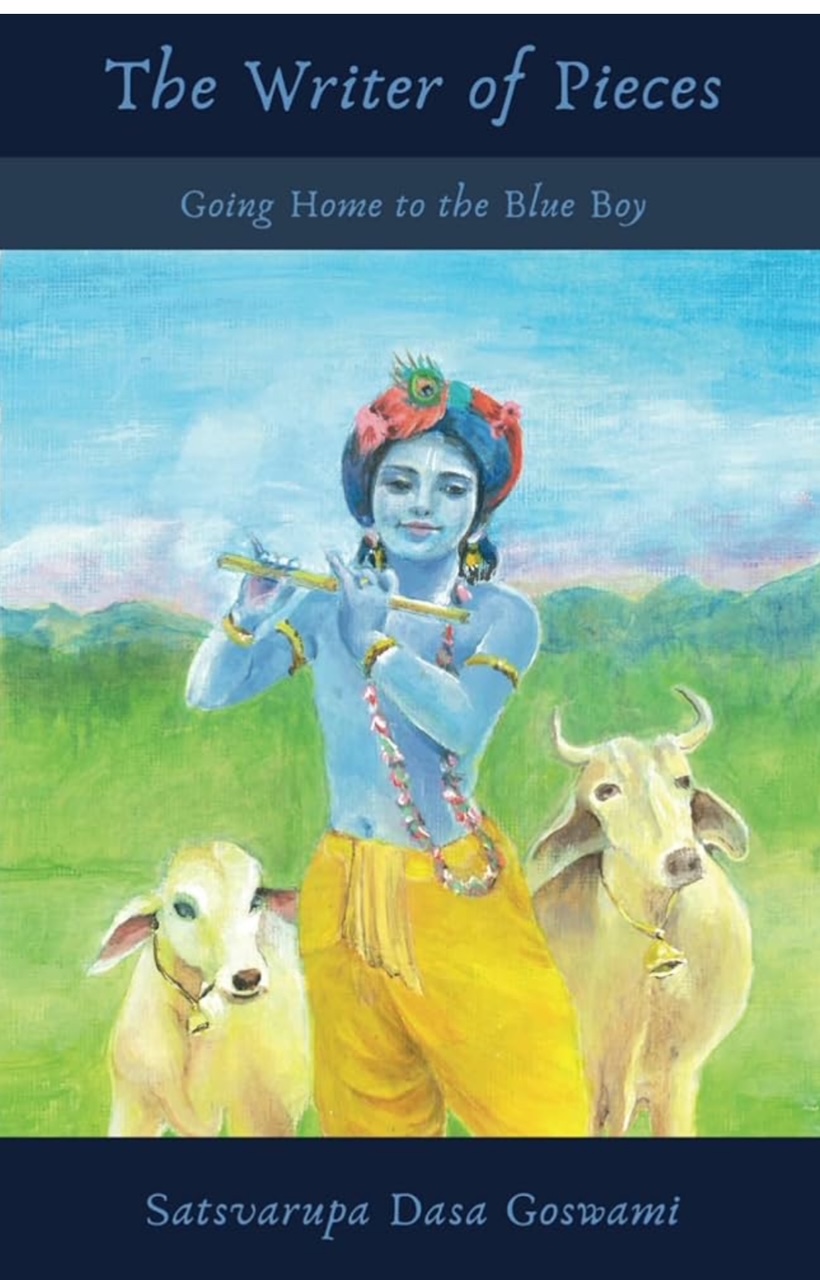
Don’t take my pieces away from me. I need them dearly. My pieces are my prayers to Kṛṣṇa. He wants me to have them, this is my way to love Him. Never take my pieces away.

Many planks and sticks, unable to stay together, are carried away by the force of a river’s waves. Similarly, although we are intimately related with friends and family members, we are unable to stay together because of our varied past deeds and the waves of time.
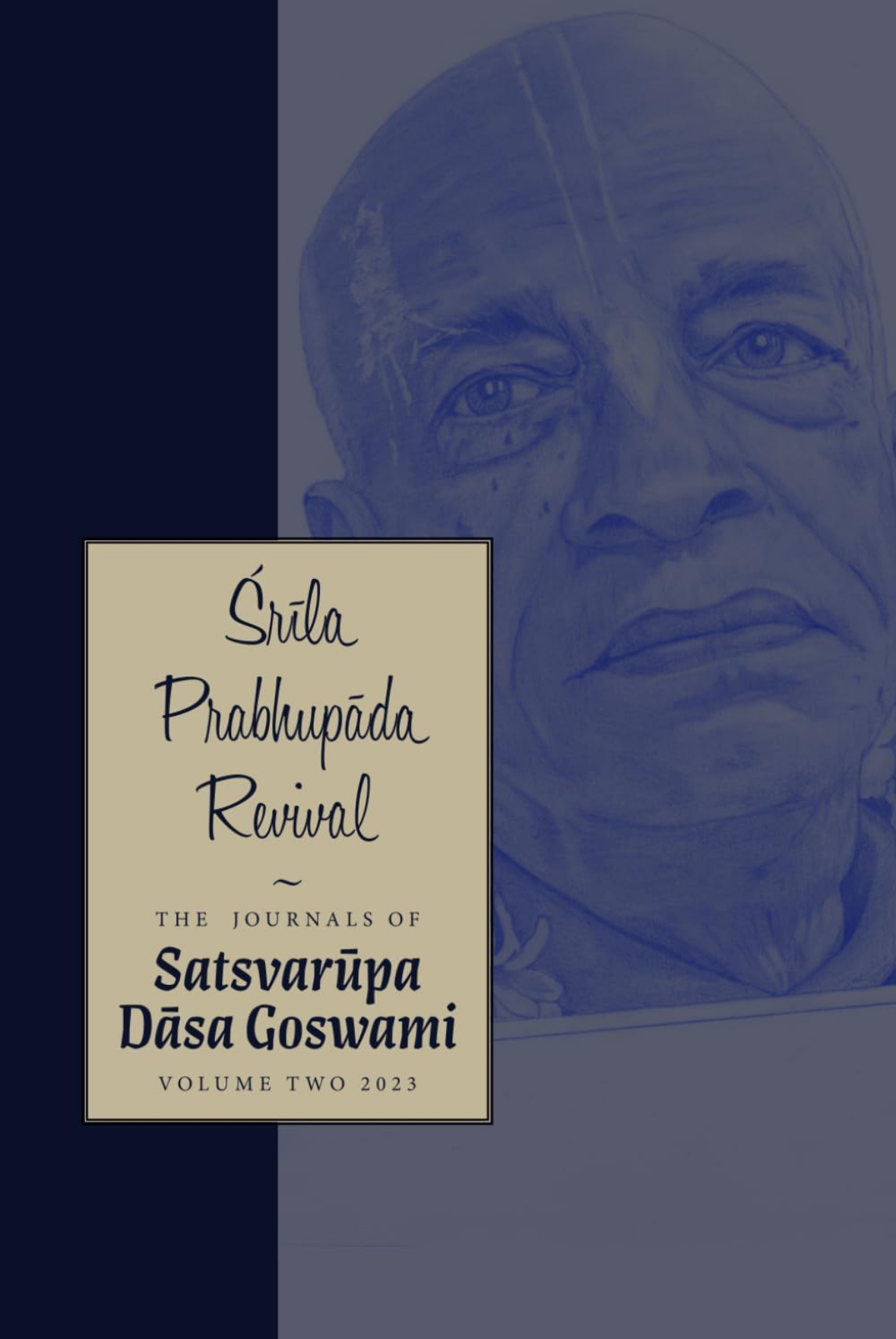
To Śrīla Prabhupāda, who encouraged his devotees (including me) To write articles and books about Kṛṣṇa Consciousness.
I wrote him personally and asked if it was alright for his disciples to write books, Since he, our spiritual master, was already doing that. He wrote back and said that it was certainly alright For us to produce books.
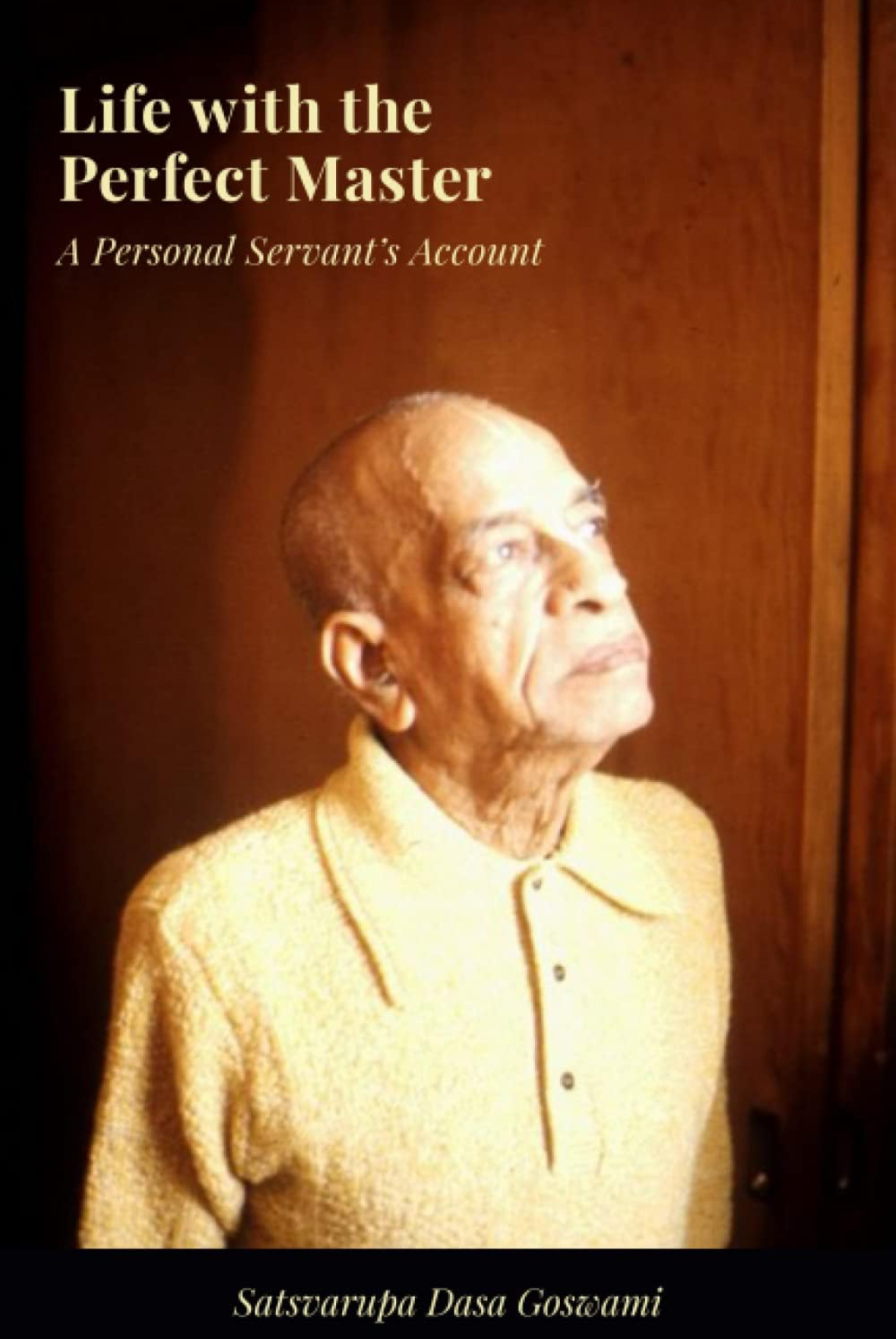
I have a personal story to tell. It is a about a time (January–July 1974) I spent as a personal servant and secretary of my spiritual master, His Divine Grace A.C. Bhaktivedanta Swami Prabhupäda, founder-äcärya of the International Society for Krishna Consciousness. Although I have written extensively about Çréla Prabhupäda, I’ve hesitated to give this account, for fear it would expose me as a poor disciple. But now I’m going ahead, confident that the truth will purify both my readers and myself.

First published by The Gītā-nāgarī Press/GN Press in serialized form in the magazine Among Friends between 1996 and 2001, Best Use of a Bad Bargain is collected here for the first time in this new edition. This volume also contains essays written by Satsvarūpa dāsa Goswami for the occasional periodical, Hope This Meets You in Good Health, between 1994 and 2002, published by the ISKCON Health and Welfare Ministry.

This book has two purposes: to arouse our transcendental feelings of separation from a great personality, Śrīla Prabhupāda, and to encourage all sincere seekers of the Absolute Truth to go forward like an army under the banner of His Divine Grace A.C. Bhaktivedanta Swami Prabhupāda and the Kṛṣṇa consciousness movement.
A single volume collection of the Nimai novels.
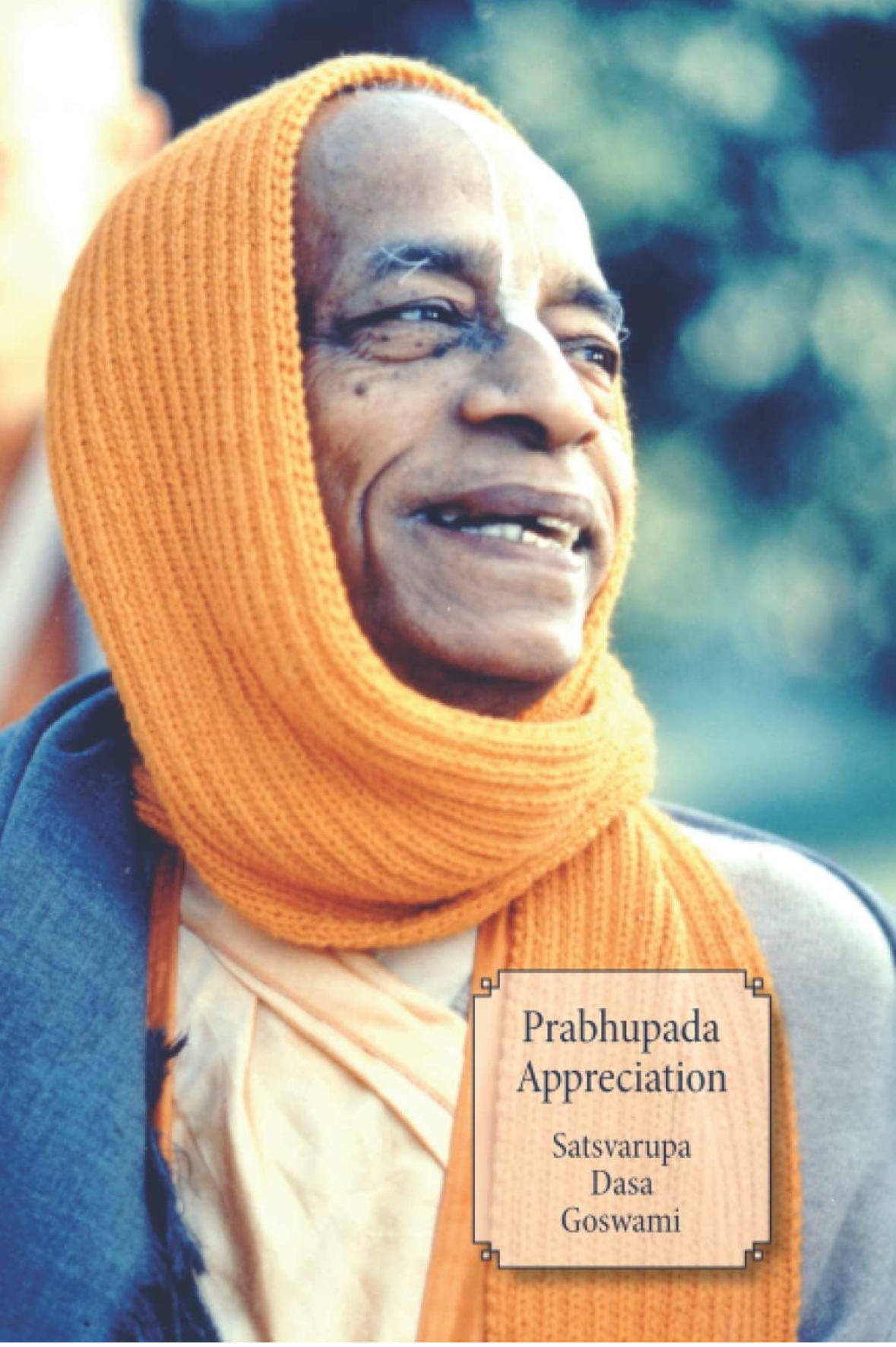
Śrīla Prabhupāda was in the disciplic succession from the Brahmā-Mādhva-Gauḍīya sampradāya, the Vaiṣṇavas who advocate pure devotion to God and who understand Kṛṣṇa as the Supreme Personality of Godhead. He always described himself as simply a messenger who carried the paramparā teachings of his spiritual master and Lord Kṛṣṇa.
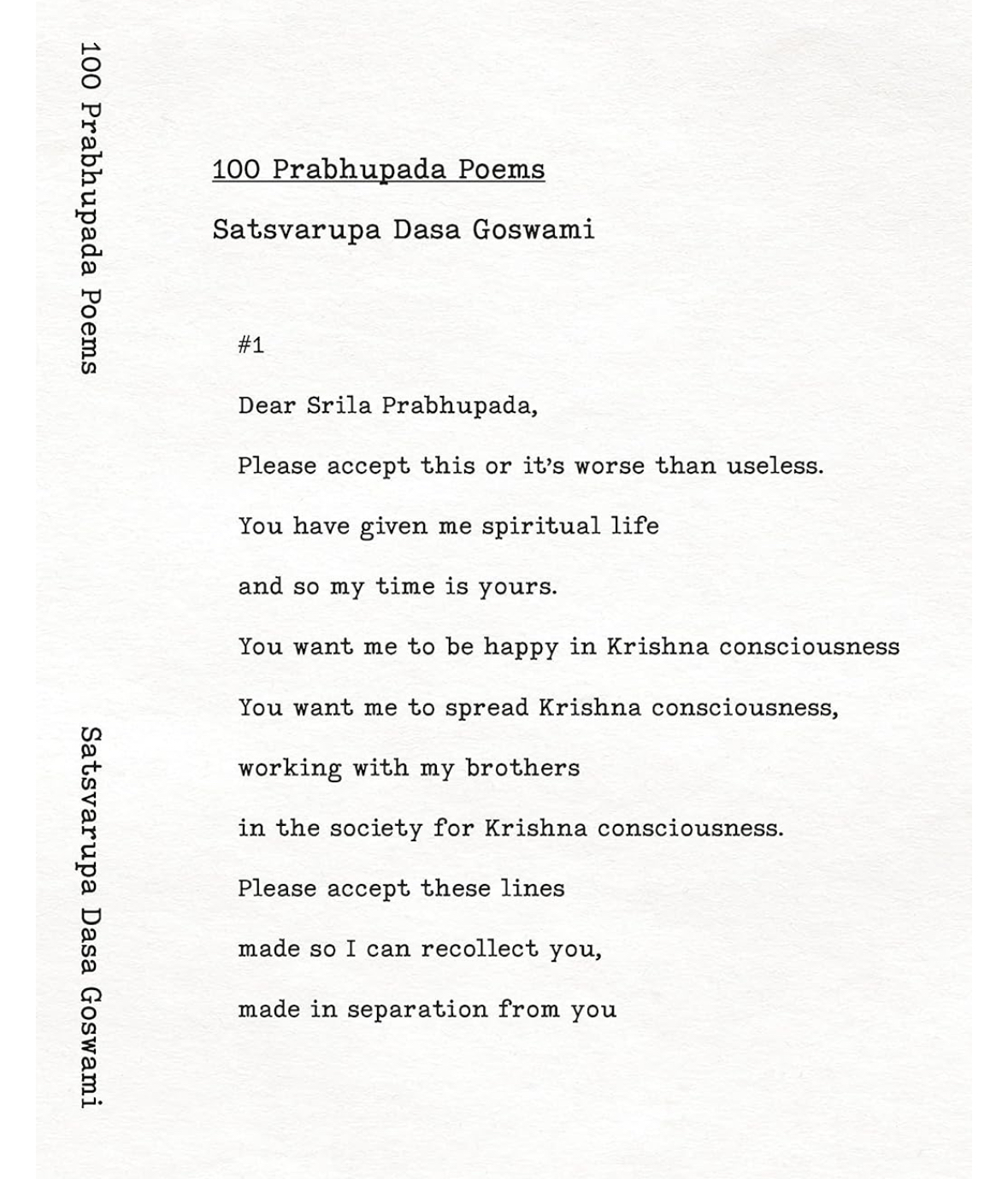
Dear Srila Prabhupada,
Please accept this or it’s worse than useless.
You have given me spiritual life
and so my time is yours.
You want me to be happy in Krishna consciousness
You want me to spread Krishna consciousness,
This collection of Satsvarūpa dāsa Goswami’s writings is comprised of essays that were originally published in Back to Godhead magazine between 1966 and 1978, and compiled in 1979 by Gita Nagari Press as the volume A Handbook for Kṛṣṇa Consciousness.

This second volume of Satsvarūpa dāsa Goswami’s Back to Godhead essays encompasses the last 11 years of his 20-year tenure as Editor-in-Chief of Back to Godhead magazine. The essays in this book consist mostly of SDG’s ‘Notes from the Editor’ column, which was typically featured towards the end of each issue starting in 1978 and running until Mahārāja retired from his duties as editor in 1989.

This collection of Satsvarupa dasa Goswami’s writings is comprised of essays that were originally published in Back to Godhead magazine between 1991 and 2002, picking up where Volume 2 leaves off. The volume is supplemented by essays about devotional service from issues of Satsvarupa dasa Goswami’s magazine, Among Friends, published in the 1990s.

“This is a different kind of book, written in my old age, observing Kṛṣṇa consciousness and assessing myself. I believe it fits under the category of ‘Literature in pursuance of the Vedic version.’ It is autobiography, from a Western-raised man, who has been transformed into a devotee of Kṛṣṇa by Śrīla Prabhupāda.”
 The Best I Could Do
I want to study this evolution of my art, my writing. I want to see what changed from the book In Search of the Grand Metaphor to the next book, The Last Days of the Year.
 a Hare Krishna Man
It’s world enlightenment day
And devotees are giving out books
By milk of kindness, read one page
And your life can become perfect.
 Calling Out to Srila Prabhupada: Poems and Prayers
O Prabhupāda, whose purports are wonderfully clear, having been gathered from what was taught by the previous ācāryas and made all new; O Prabhupāda, who is always sober to expose the material illusion and blissful in knowledge of Kṛṣṇa, may we carefully read your Bhaktivedanta purports.
I use free-writing in my devotional service as part of my sādhana. It is a way for me to enter those realms of myself where only honesty matters; free-writing enables me to reach deeper levels of realization by my repeated attempt to “tell the truth quickly.” Free-writing takes me past polished prose. It takes me past literary effect. It takes me past the need to present something and allows me to just get down and say it. From the viewpoint of a writer, this dropping of all pretense is desirable.
 Geaglum Free Write
This edition of Satsvarūpa dāsa Goswami’s 1996 timed book, Geaglum Free Write Diary, is published as part of a legacy project to restore Satsvarūpa Mahārāja’s writings to ‘in print’ status and make them globally available for current and future readers.