
We are still expanding our team of proofreaders as we aim to increase the rate of republication of Satsvarūpa Mahārāja’s books as well as new books that he writes. As many of you know, during the July 4th festival just held, a total of 18 new and re-edited and published books were present, and we hope to present a similar number at Satsvarupa Maharaja’s Vyasa-puja observance this December. Our call for proofreaders includes a need for fluent bilingual Spanish and English speakers to proofread Spanish translations (we currently have around 20 Spanish translations waiting to be proofread). Anyone interested in this particular service should contact Manohara dāsa at [email protected]
If you would like to help, please contact Kṛṣṇa-bhajana dāsa at [email protected] or [email protected] and we will find you a service that utilizes your talents.
Today I began a new, serious attempt to increase my chanting of rounds. I feel significant hope of progress. Externally this is only a vow to increase the number, but my hope is to make a far-reaching improvement.
Prabhupāda states that the tenth offense in chanting is not to have transcendental attachment to the holy name, even after hearing the relevant instructions. My desire is to put an end to offensive chanting.
Otherwise, how long will this tasteless, offensive chanting continue? When will I know something more?
Overall, I feel good about this chanting increase. It is certainly ultimate; we have to chant Hare Kṛṣṇa at the time of death. So I am trying, by increasing the quantity of my practice, to increase my transcendental attachment to the name.
Even this little increase I resist. I do have some extra time, within executing my prescribed duties. But my mind balks, “Why are you going around chanting Hare Kṛṣṇa, as if in imitation of Haridāsa Ṭhākura?” To be alert so that I never give up preaching work for chanting japa is all right. But I think my rascal mind, on the plea of detecting a wrong mentality within, wants to reject my rigorous plan for increased chanting. Why? Because “I” will find it too dry and tasteless. But that is the very reason I want to increase and try to improve by increasing.
My contention is that I can improve my role in ISKCON (which is mostly preaching—speaking the philosophy and giving realized guidance) if I taste pure devotion, and therefore improving my chanting is a priority job.
A devotee is inspired by the Supersoul within the heart to advance in devotional service in a variety of ways. The devotee does not feel hackneyed or stereotyped, nor does he feel that he is in a stagnant position. In the material world, if one engages in chanting a material name, he will feel tired after chanting a few times. However, one can chant the Hare Kṛṣṇa mahā-mantra all day and night and never feel tired. As chanting is increased, it will come out new and fresh. Śrīla Rūpa Gosvāmī said if he could somehow get millions of ears and tongues, then he could relish spiritual bliss by chanting the Hare Kṛṣṇa mahā-mantra. There is really nothing uninspiring for a highly advanced devotee.
—Śrīmad-Bhāgavatam 4.30.20, purport
… My dear Lord, although You bestow such mercy upon the fallen, conditioned souls by liberally teaching Your holy names (there are no hard and fast rules), I am so unfortunate that I commit offenses while chanting the holy name, and therefore I do not achieve attachment for chanting.
—Śikṣāṣṭakam
pp. 83-90
Columbus, Ohio
14th May, 1969
My Dear Satsvarupa,
Please accept my blessings. I beg to acknowledge receipt of your letter dated May 12, 1969, delivered by Arundhuti here in Columbus. This evening Arundhuti will be married to Pradyumna, and they appear to be a very nice couple. Regarding your questions about Samkirtan Party, I think you should try to always have Samkirtan going on. All other things are subsidiary. This chanting is our life and soul, so we must arrange our program now so that there will be as much chanting on the streets and at college engagements as possible. On May 12th, we had a very successful engagement at Ohio State University, and over one thousand boys and girls were chanting and dancing along with us. So this policy should be continued as far as possible.
I hope this will meet you in good health.
Your ever well-wisher,
A.C. Bhaktivedanta Swami
P.S. What about the Omega watch? I have sent you one tape. Have you received any check for the meetings? You paid me two checks (75 & 25) but if there is any more please send. I want to purchase one compositor ($3000.00 Down payment $600.00) ACB
******
Prabhupāda mentions in this letter that he had done a program where over a thousand students chanted and danced. Hayagrīva had organized it and Allen Ginsberg had also attended. This was a high point in Prabhupāda’s preaching. In the 1990s, we hear of events where thirty thousand people chant and dance in stadiums in Russia. In 1969, however, a thousand students was the biggest Prabhupāda had seen.
We could say that Allen Ginsberg attracted the students to the program, but the students chanted so wildly that we can understand that whatever had attracted them, it was Prabhupāda who made it wonderful for them. Later, some of them wrote letters about what they had felt while they were chanting and some of those letters were printed in Back to Godhead. It gave us all a glimpse of how Kṛṣṇa consciousness could become popular. Therefore, all the devotees in ISKCON were excited by Prabhupāda’s report of this program. Prabhupāda was certainly enthused. “So this policy should be continued as far as possible.”
During his Columbus visit, Prabhupāda met several times with Allen Ginsberg. Allen asked Prabhupāda whether there should be a more universal mantra—he didn’t think the Hare Kṛṣṇa mantra was suitable for Americans, and he didn’t like the fact that the devotees wore Indian clothes. But Prabhupāda insisted that Kṛṣṇa was universal. He would not compromise on this point, although he was still liberal about the devotees wearing dhotīs and sārīs. In most cases, the devotees wanted to wear devotional clothing, however, and almost all the men shaved their heads. Some of the men with jobs even defied the dress code and wore shaved heads to work.
Then Prabhupāda addresses my question about saṅkīrtana. I don’t remember what I asked Prabhupāda, but obviously we had started holding saṅkīrtana in Boston. It’s likely that I asked him whether saṅkīrtana had priority over other services, and perhaps I asked how often we should go out.
Saṅkīrtana—chanting on the street, handing out BTGs, and collecting donations—began in some of the other centers before Boston took it up. Of course, Prabhupāda started saṅkīrtana himself by going out to Tompkins Square Park in 1966. We didn’t understand the importance of Prabhupāda’s chanting in the park either for ourselves or the preaching, and after he left New York, we didn’t continue it except occasionally.
As the years went on, however, we came to understand that Prabhupāda wanted us to go out regularly with a harināma party. Almost all of the devotees in the temple would go out with the party and we would chant sometimes for hours on the street. By 1969, almost all the centers were engaging in this new definition of saṅkīrtana. Reports started to come in, especially from places that were organized by Tamāla Krishna, that simply by asking for donations on the street, the temples were collecting $50–$70 a day. That was a lot of money for a small center. The Boston temple was run almost entirely on my paycheck, about $125 a week. If we did saṅkīrtana, we realized we could make that much in a day.
We accepted his statement as śāstra that saṅkīrtana was the main priority. I received this letter in the middle of May, just as spring was taking hold of the city. We felt the call to get out of the temple after the long winter inside and to preach on the streets.
The beginning of this kind of saṅkīrtana shows something interesting about Prabhupāda and his disciples. This was the first time that the devotees had taken Prabhupāda’s lead and tried to develop and manage it. When Prabhupāda wanted something done, he would give emphasis to whatever it was. Prabhupāda had told us that he wanted us to go out on harināma, but he may have wondered whether the Americans could or would agree to it. Saṅkīrtana was done under his order, but he never insisted. Rather, he allowed his disciples to develop it into something that would support them and fan their enthusiasm.
When we first began going out on saṅkīrtana in Boston, we went out only once a week. Now we were contemplating going out every day. Gradually, the devotees became more aggressive in how they stopped people to ask for donations. The public called it “begging.”
Our public image began to change. Originally, we only went to parks to chant, and we followed Prabhupāda’s system of sitting down with our instruments while a few devotees passed out magazines to the crowd. In the middle of the harināma, one devotee would stand and address the crowd, then there would be more chanting.
As we opened more centers, we started to chant on the streets as well as in parks. We became known for our loud singing, our louder drums, and our karatālas. People were often annoyed by our chanting, and sometimes the devotees were arrested for disturbing the peace. Although people claimed to be outraged by the noise, they were more outraged by the strangeness of the devotees in their saffron sārīs and dhotīs. As soon as we became identified as a religion and our harināmas as religious activity, the public began to accept us. And not everyone was outraged. When we didn’t go out on harināma for a while, people would ask us where we had been.
That public image persisted until devotees became more serious about book distribution. Then the devotees decided it was more profitable to wear Western dress. Selling books became more important than singing and dancing on the street; the devotees felt they could reach more people if they didn’t look so exotic. Gradually, the devotees have disappeared from the streets and people have wondered what has happened to us.
Prabhupāda specifically mentions chanting on the streets and at college engagements as our life and soul. He wanted the Hare Kṛṣṇa movement propagated by chanting the holy name, and he wanted us to have faith that the people would benefit just by hearing it. We believed that if people heard the Hare Kṛṣṇa mantra, they would get great spiritual benefit. We may have had our immature or dogmatic versions of what would happen to them, as if simply by hearing Hare Kṛṣṇa they would immediately go to the spiritual world, but we were idealists and strict followers of Prabhupāda. We practiced this yajña in earnest.
We also realized as we began to have more dealings with the public that we should have someone sober—a temple president or a saṅkīrtana leader, someone with the proper vision of how we should present ourselves on the saṅkīrtana party—out on the street with the rest of the devotees. Such a person would ensure that the devotees walked in a neat double file, that they kept to one side of the street if they were doing a walking harināma, and that people didn’t become unnecessarily offended. Such a person would also keep track of the trouble spots. For example, if the devotees held kīrtana in front of a particular store, they might be arrested, whereas another area may not be troublesome at all. Despite such precautions, some of the devotees were wild. In Boston, we discovered that the best place to chant was in a particular spot on the Boston Common (the devotees still chant there). We would go out on shifts from morning till night. Girirāja used to be our best donation collector and I gave many of the speeches.
Prabhupāda sent the devotees out to chant when he visited the centers, but he rarely went out himself. It was too rough on the street. Sometimes people pushed us around or cursed at us, and it wasn’t abnormal to be stopped by the police. We couldn’t allow Prabhupāda to face all these risks and affronts, what to speak of walking around for a few hours, stopping at intersections, then suddenly running across a busy street to the next corner. By 1969, the only kīrtanas Prabhupāda held publicly were at universities and in the temples during public lectures.
1969 was the beginning of ISKCON’s harināma heyday. Viṣṇujana was leading parties in Los Angeles. He took parties out at 8 p.m. and brought them home at 1 a.m. The later it gets, the more demoniac a city becomes, but the devotees would chant with strength and bounce and rhythm because Viṣṇujana Swami had such strength. He wore gloves over his taped hands so he would be able to play fast mṛdaṅga for hours without hurting his hands. He had real endurance. It was around this time that Prabhupāda started inviting the devotees from other centers to visit Los Angeles. He considered it a model temple.
pp. 73-76
“I have become supremely joyful by surrendering myself at Your holy feet . . . there are no more anxieties. I see joy in all directions” (Śaraṇāgati , 2.8.1).
Is this the same person who saw only grief? How has such a great change come about? He has met a pure devotee. He cried with contrition and Kṛṣṇa sent a Vaiṣṇava. From that Vaiṣṇava, he has learned to surrender.
“Unhappiness has gone away. I shall strive for whatever pleases You, fully devoted to Your lotus feet.”
I admitted that I was the sinner in the early songs of Śaraṇāgati , but why do I exclude myself from these songs? I’m also serving the Lord. I’m also fixed at my guru’s feet. I still have some aparādhas and anarthas, and I don’t see how I will find relief. But I have found peace at Kṛṣṇa’s lotus feet and I have given up the fear of worldly existence. Or maybe it’s more accurate to say I fear the kālacakra. I fear this world where you meet up with what you don’t want and are torn away from what you love. I fear it. I want shelter. I want devotional service for Kṛṣṇa’s pleasure, but I’m also scurrying to His lotus feet out of fear of the material conflagration. Kṛṣṇa, please save me. I’m not pure, but I want to be.
“Troubles encountered in Your service shall be the cause of great happiness, for in Your devotional service joy and sorrow are equally great riches” (Śaraṇāgati 2.8.4).
This is a great verse. I have often quoted it in books and lectures. It’s useful for motivating subordinates who feel weak-hearted in their service. I also remind them of the glories of Mādhavendra Puri. He carried over eighty pounds of sandalwood—undisturbed by toll guards or thieves’ threats—and walked thousands of miles for his Gopīnātha’s service.
The question is, do I realize the truth of Bhaktivinoda Thakura’s statement? Do I live it? Taste it? It’s a little too much for me right now, but I definitely accept it as true, just as I accept that I am not this body and that material comforts are detestable to a pure devotee and that I should not be afraid of death.
What have I realized? I know that the practice gives you a good reputation among pious people, and they are willing to give you money and service. Am I being cynical? Yes, a little. My cynicism is like a leftover cloud raining dirt.
I’m conditioned to speak as perfectly as possible and never let on that I have any doubt. Can you imagine? You raise your hand and express a doubt and the devotee giving the class from the vyāsāsana says, “Yes, I have that doubt too. I don’t know the answer. Maybe we can’t do what the śāstras say. I dunno.” Although he may give a humble preamble like that, we still expect him to come up with the goods. Otherwise, how can we let him speak?
When I meet troubles in the course of Your service do they make me happy? “Thanks,” he says to troublemakers, “You’ve made my day.” Sounds like a pure devotee, completely staunch, not out for self-aggrandizement. So what if I get arrested or hit on the head and harassed in some way? The main thing is to serve Kṛṣṇa. That taste is always sublime.
At least I know I am rightly situated. Kṛṣṇa is giving me a little mercy in the form of pain (purification). He knows the misery of ignorance is being destroyed by the so-called misery of troubles encountered while serving Kṛṣṇa. Svargāpavarga-narakeṣv api tulyārtha-darśinaḥ: heaven and hell are the same for the fearless nārāyaṇa-parāyana. I believe it, but I’m not there yet.
“I have completely forgotten all past history by feeling great joy in my mind. I am most certainly Yours, and You are indeed mine. What need is there of any other treasure?” (Śaraṇāgati , 2.8.5).
When a statement is beyond your realization, does that mean you’re not interested to hear it? No. I visualize the great devotees who measured up ‑ Arjuna, Bhisma, the gopīs, all the mahājanas. They all passed severe tests. Maybe I’m embarrassed by the topic and feel excluded. In honesty, I can’t yet tell my success story. It’s like being in school during exams. You are given a choice of essays to write. Some are interesting topics but too hard. You skip those and look for something easier you can still relate to. You have to be careful of that too, though. Sometimes you are still unqualified to answer the easy questions.
Tell us what you know of “troubles encountered in Kṛṣṇa’s service are a cause of great happiness. Joy and sorrow are all one, all treasures for me in blissful Kṛṣṇa consciousness.” Hmmm.
“I have completely forgotten all past history.” I’d love to be able to do that. It reminds me of that Steig cartoon Tattvavit dasa sent me after reading in Shack Notes how I visited my old Great Kills streets. The picture shows a bemused gentlemen floating in the sky with angel wings, looking down on dilapidated tenements. It’s captioned, “The Old Neighborhood.” We’re like that: we don’t mind a quick floating tour over the past, but if we have to get down into the streets and the actual ignorance, then it’s hell. Want to go? No thanks.
“Bhaktivinoda, diving into the ocean of bliss, devotes all his efforts for Your service and dwells in Your house according to Your wishes” (Śaraṇāgati , 2.8.6).
We are doing this. We are fully surrendered to Prabhupāda. Often our statements to the contrary are humility. We grasp at our identities as Prabhupāda’s followers. We don’t really harbor doubts.
pp. 36-39
By His grace I am writing this. Even if the headache gets worse. I got my afternoon session in. Tomorrow morn 9 A.M. I speak to the devotees. Say I don’t know anything about the holy name except what’s in the scriptures and I will speak, however, what I know. I will address the problem some have, to chant sixteen rounds. Rock bottom. We may also consider improving the quality. Even if you do chant sixteen rounds every day, when we discuss it, it will underline for you the need to do it, so you appreciate and never fall below that.
Sixteen rounds and four rules.
******
You load sixteen rounds
and whaddya get?
Another day older
and deeper in—
attraction to the habit
of hari-nāma dīkṣā vow.
I promise I will
never abandon it,
sixteen rounds and whaddya
get?
Infinite mercy and freedom
from laws of karma—
liberation.
Keep going a full half-hour and then quit and go back in … the weeds are blowing, we will be gone from this peaceful place.
No turning back from our decision to move, travel, vamoose. We are off. Yes, you have a yearning to remain in this quiet place and write like this each day. But it’s good to get out. Within one week I’ll have three disciple’s meetings, one here in Geaglum, one in Belfast, and one in England.
That’s pretty good, Gurujī.
Get out and try and you’ll have adventures to write even if it’s the inner adventures that are scratched by enduring the outer ones. What can you write on a late-night ferry?
This silver pen, I keep wanting to give it up but it has a nice feel to it. Why don’t you stay with it? Each pen can help you in its own way. Best result of this week of writing sessions is to get me attached to (liking) the feel of the pen in the hand and a habit of writing. I like the shed. We will have no shed in the van but learn to adjust to confined space. Rest your head and hear the music in earphones as best you can. Khichari, no big desserts. Send tapes out, your life is what it is.
Holy Kṛṣṇa protect us,
we know the real thing
God not vague
but coming in Gītā
and learned sages love for
Him
transferred to me and you.
Haribol.
Keep an eye on Kṛṣṇa. If you can’t surrender, then at least chant, Śrīla Prabhupāda writes. Sixteen rounds are essential.
Report in here and leave record. But not just for the sake of a log or record. That is a clerical function or like a ship’s log kept by men on watch. It is just a history that no one reads except for official purposes. I’ve seen sometimes our security guards at Hare Kishna Land, Mumbai. They keep records of their standing watch, and this paperwork preoccupies them in a life of boredom with nothing else to do. My writing shouldn’t be like that, perfunctory.
But I do feel the need to record some things in that way of a daily round. The first signs of a flashing pain (no matter how slight) in the right eye are important to me because they warn me that I can’t even do this function of writing. They tell me I have to pull the plans right away. Can’t write long or passionately, have to decide what to do aside from the desire to go all out in writing or reading. What care and repair for the body?
That’s an example of why I do write down log material, “Slight flashing light in right eye. Reluctant to get up at midnight … Ship is plying smoothly. Steady as she goes.”
Harumph. Be quiet. Others are asleep. I like people to sleep while I write. Then I chant softly to not wake them. I’m a considerate person at least in that way—don’t disturb their sleep.
******
Last two days here, lots of packing to do. Madhu says he works slower as part of the general slowing down (growing older). I don’t think he’ll do this again, outfit a whole van from scratch. I also may not “forever” be willing to travel like this. We are hopeful of at least this October-November tour, but it occurred to me that it could be a bust. I might get so many headaches and pills cannot check them. And the whole thing gets out of control and we come back (like Francis of Assisi comes back from the Crusades) ill and apparently defeated—but try to turn that too into a victory for the spirit.
But if as we start out, we do get more headaches, that doesn’t mean we instantly push the panic button and come back. Tolerate and suffer for a while, staying in the van, lying down in the bunk there, not seeing people or giving temple classes until I get clear of the headache.
******
Steady as she goes. The tugboat, the boat crossing the sea, old boat, engine holding up but with a problem. Keep moving and chanting Hare Kṛṣṇa. Keep yourself together for giving the class today.
At 5:15 A.M. we do physical exercises but only if we feel up to it. And listen to Aindra’s kīrtanas.
Goodbye again, Geaglum. Rushes, weeds blowing by the lakeside. The little prefab shed poised there. When on the lake strait you can see the little shed in the field on the edge of the forest. It’s a good place to start. I’ve felt that I cannot write unless I go out there, it is so congenial for starting you.
Read a little I must each day, says Madhu. He’s been so busy with the van these months, he hasn’t read. But now he’s installed a fifteen-minute-at-least shot early in his day to read Bhagavad-gītā. He feels its potency and his need for it. No other regular program of śravaṇam. Take it. We are not ordinary workers. Try to improve your chanting. I will give standard references to the devotees, that of all the instructions of guru, the order to chant sixteen rounds is most important. Which of the nine principles is the most important? I’ll hold their attention with this talk. Now, I have only three minutes left on my schedule. Then sit as calmly as possible but move rapidly and quietly through mantras softly uttered. Wear a surgical glove of thin rubber. Hare Kṛṣṇa Hare Kṛṣṇa—my writing contains mantras. Give the mantra freely to others. Encourage people to chant the Hare Kṛṣṇa mantra. It’s the panacea in this age. No other way. But to be most effective, avoid ten offenses. Chant.
“Can’t,” they say. They are too sophisticated and will never chant. I cannot convince nondevotees. My congregation is those who already know they should chant, who have vowed to chant. Inner preaching is equally important to preaching to the nondevotees. All preachers have to cooperate and preach to various groups. nuns in the Midwest, college students, Navy kids, cookie-bake moms, and disciples growing older, hear my talk.
Time is up.
pp. 9-15
Dear Prabhupāda and dear Lord Kṛṣṇa,
Thank you for bringing me to the sacred dhāma, Vṛndāvana. I’m sure to become more Kṛṣṇa conscious here if I can refrain from committing offenses. My japa is poor, however. I am mostly inattentive and without taste. That is due to offenses and a hard heart. I hope this environment will change me for the better. I wish to do as You desire. I will give up my own plans and follow Yours.
All glories to the holy names. I beg for Your mercy. Let me work at chanting, and polish the mirror of the mind.
******
Dear Lord Kṛṣṇa, dear Prabhupāda,
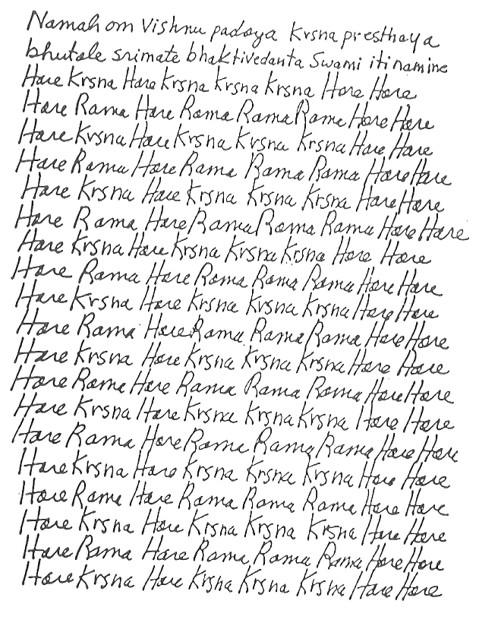
It’s a sensual pleasure to see the mahā-mantra flashing on the page in blue and red, sinking into the page in ink tones. Let my sensual faculties be absorbed in the beauty and potency of Your names in pen on page, and of course, in sound uttered by my tongue and heard by my ear—and please let my mind be absorbed in these names, which are as good as Your form, fame, presence, just as in the spiritual world. But I cannot chant with material senses. Please help me to hear and speak the spiritual sounds. I’ve no hope it seems, to achieve it. And so, I fall into lethargy and skepticism (mandāḥ sumanda-matayo). Please help me.
******
Dear Lord Kṛṣṇa, dear Śrīla Prabhupāda,
Please let me pray to You always, with every bite I eat, as I write and as I chant Your names and as I walk to ārotika down the stairs, when reading, when waiting—and how? By revealing my mind to You as my best friend and protector, by reciting Your name, remembering to remember You.
Let me practice this in my mind, or else the mind is wasting precious time, drop by drop lifeblood is oozing out, and I’m losing life in trivia and māyā. Please let my mind flow to you.
I want to be Your devotee. I don’t want to complain. Lord, Your Vṛndāvana is very special and unknown to me. Thank You for allowing me to come here. Even to me, the mercy is coming. Let me serve devotees and share Your mercy.
******
My dear Lord Kṛṣṇa, dear Śrīla Prabhupāda,
I want to be a devotee—or a servant of Śrīla Prabhupāda. I want to work at writing. But I must want what You want. Your will be done. Please teach me this. Please change me, pick me up, make me new, rid me of material desires, give me the spark I need to act on my own free will and surrender to You.
Please let me pray and always converse with You. Let me cry and beg for the mahā-mantra. Rid me of envy and fault-finding. Let me appreciate Vṛndāvana.
Rid me of ease-loving. Let me worship You with alert mind and senses and spiritualized self. What do I know? Without You, nothing.
pp. 3-9
O Srila Prabhupada, who left this world, but who taught us how to survive and how to join with him and Krsna in the eternal spiritual world, please protect me;
O Prabhupada, whose purports are wonderfully clear, having been gathered from what was taught by the previous acaryas and made all new;
O Prabhupada, who is always sober to expose the material illusion and blissful in knowledge of Krsna, may we carefully read your bhaktivedanta purports;
O Prabhupada, whose thousands of spiritual sons and daughters sometimes leave your house yet continue to remember you wherever they are. Please teach us to be compassionate and to be a devotee;
O Prabhupada, whose sincere followers do not serve the Lord out of force or for fame but who are convinced and satisfied by the name, fame, form, and teachings of Govinda;
O Prabhupada, whose followers know that Krsna cannot be seen by these material eyes or by blunt senses or even by the most powerful mind’s scrutiny, and certainly He cannot be known by scientific investigation;
O Prabhupada, please help us understand, as you do, and be faithful, as you are, to the descending process of sabda-brahma;
O Prabhupada, who dressed always in saffron, who wrote affectionate letters to his disciples signed “Your ever well-wisher,” who wrote to his leaders, “Never be a moment without thinking how to improve ISKCON,” who encouraged each department of workers without discouraging another, who gave all of his life’s energy for spreading Krsna consciousness, who was empowered with success never achieved by previous acaryas, and who opened the door for the entire world to appreciate Gaudiya Vaisnavism as the eternal teachings of topmost love of God, we pray to always retain utmost respect for you and your teachings.
O Prabhupada, whose upraised arms caused hundreds of devotees to jump and dance, whose feet walked over the countless enemies against worldwide sankirtana;
O Prabhupada, who sat submissively for his massage yet directed his disciples like a general, “Once a temple is opened it can never be closed, somehow stick on”;
O Prabhupada, who has rejoined the nitya-lila of Lord Krsna, who has left us behind to test our sincerity, but who stays in his murti accepting our obeisances, please allow us to focus on you and serve you always;
O Prabhupada, may we purify our words and thoughts by composing prayers to you, may we please your Lord Krsna by serving His servant, may we obtain direction and courage from Supersoul how to distribute your books, may we live to see harmony and revival among your disciples, may we remember your instructions not to fear demons but to trust in Krsna, may we read your books because you wrote them for our benefit, and by reading them may we conquer all atheistic doubts and come to the clear stage wherein Lord Krsna reveals Himself;
O Prabhupada, Krsna is on the cover of all your books and on every page and purport, and Krsna is always in your thoughts;
O Prabhupada, your International Society for Krishna Consciousness is a house built for the entire world, and Krsna, the Supreme Personality of Godhead, is the Lord of your house;
O Prabhupada, you are our link to the six Gosvamis and to Lord Krsna and to Radha-Krsna. We are lost without you.
O Prabhupada, O lord, whose praises will always be sung by worthy devotees; O lord, who walked Manhattan’s streets and who brought Radha-Krsna to the West;
O lord of the devotees, whose lectures are now pre-served and listened to carefully as the best standard of Krsna conscious public speech; O Prabhupada, whose words can be appreciated only by those who will hear the truth of Krsna in parampara;
O Prabhupada, whose words bring transcendental light into any darkness within the material world;
O Prabhupada, whose disappearance from the world continues year after year, forcing his followers to find him in his vani and to consult among themselves and to listen to the Lord in the heart;
O Prabhupada, who jumped and danced and sang with ecstasy at an old age when most men are sitting down nursing their rheumatism, and who walked and skipped and leaped for hours at London Ratha-yatra, sometimes turning to look up at Lord Jagannatha;
O Prabhupada, who always led his disciples in whatever austerity he asked them to perform, who sold his books on the street and at universities and bookstores and who sold Back to Godhead by sitting down to talk with the tea stall customers;
O Prabhupada, who traveled wherever there was an opportunity to spread Krsna consciousness—into Africa, Russia, Australia, New Zealand, Malaysia, Hong Kong, Caracas, Tokyo, Gainesville, Portland, Allahabad, Hyderabad, Los Angeles, and the Kumbha-mela;
O Prabhupada, who faced the hippies and acid-heads and speed freaks, and tamed them by answering their questions and by demonstrating peace and fearlessness, who tolerated the Bowery bums and showed concern always for all beings, who was like a lily in the water, neither scorched by the hot sun of passion nor wetted by the lake of material desires;
O Prabhupada, who cut an apple into many slices and distributed it with his own hand in New York City, who with his hand took deft portions from a big mound of halava and distributed it to dozens of young urchins after kirtanas in Bombay, who honored prasadam alone, eating at a low table from a silver plate, accepting whatever his disciples offered;
O Prabhupada, may our remembrance of you fructify into good deeds on your behalf, or what good is our life? May we dance to your kirtana tunes, may we play the karatalas as you taught us, may we recognize that we are always fools before our spiritual master, yet may we act as intelligent representatives in the science of God as taught in the Bhagavad-gita As It Is, and may our love repose always in you.
pp. 3-6
This may be one of my last walks during this visit. On the cement roadway there are dog’s paws, or it could be some other big creature. Hedges with some September blossoms. Yes, it’s September. Writing a letter this morning, I was just about to say, “September is my favorite month.” But it sounded too corny, like the old “September Song.” The month my sister was born. Wistful, last summer, Janmastami, first hint of the cool and cold weather ahead. What it means to a human body. And the days grow short.
Speaking of being corny, is your Janmastami lecture, as you’ve prepared it, like a high school essay or oration? How is Janmastami relevant to us? We believe in Krishna’s appearance, and although we know that we cannot become Krishna’s mother and father because we can’t perform such austerities, and although we know we can go back to Godhead by chanting Hare Krishna – how are these things actually relevant to us? And there you are, after five minutes stuck facing the void, because actually you don’t know how it’s relevant. You put the question to yourself rhetorically, and you are caught in the trap. Then what? You can’t ask the audience for help at this point because you are the one in the driver’s seat. How is Janmastami relevant to you? And then you say that stuff about how we should pray today. It’s a load of baloney unless you mean it. Say what you mean. Uh…
Oh boy, so many pens on the desk. Madhu has a folder by a family who make accordions in Italy. He plans to go there and buy one. I’m not in Guyana in a time of political unrest, sweating it out at Paramatma’s house, giving daily bhagavata lectures. I’m here opening to ease through Janmastami.
The brass bell is ringing on the Geaglum quay. Insistent, they want to go greet the Deities. But no one is coming for them.
Can you read and chant better?
Billy crawled under the lowest rung of the three-strand barbed wire fence. It scratched at his jacket. He dug into the muddy soil. Made it okay. But inside the field he couldn’t find any chestnuts.
Mary fell into a light trance and communicated with some inner persona. It was her imagination. Nothing spooky or haunted. It was like New Age “Perils of Pauline,” with endless episodes. Sometimes she told some of it to friends who made remarks. One said, “I think she ought to get married.” And others said, “I think she should become a nun.”
Old John went his way out to the shed. A huge heron flapped by. John avoided stepping on turds and into holes. He sighed. He’d forgotten to bring his cane with him. Youth vanished, clear painlessness too. Inside the shed, he rehearsed his lines. Gazed down at the knots and grains in the wood desk.
You’ve got to make some money
some way or other
they play their horns
we beg with bowl find
rich patron and Manu
goes out to sell
paintings on canvas
rolled.
Is that all?
Someone on the dole?
No money at all?
Also grow food.
I find it hard to
believe
the reeds in the wind
don’t pay or need it
don’t give us that –
everyone has to pay
in cash or visa
so they died anyway
God God remember
Him. Are you ready
sastric elfin?
No, no just looking
up something to buy,
revenue
revenue
everyone looking for a way to collect
His sound is clear enough
I don’t know what
structures he’s following
like a free-writing fable
of little cartoon squeaks
he’s on the edge of not
knowing
Krishna Krishna silent rounds
have got to stop and
do them out loud
said the teacher
give me time a japa reform
revenue
return the pay of
guru-daksina – you
promised him you’d do it
you’re on the edge and
could fall off if
let’s hear it clear
and I’ll pay you
Hare Krishna, Hare Krishna,
Krishna Krishna, Hare Hare, Hare
that’s better
now do it for love
no other pay
Re-venue
return to view what
you never felt.
Deadline my last day
here soon
crumbs I keep pumping
it out as if I’m on my
own strength
but no He gave it to
me. Run through the
changes say my heart
is for Thee
faster they demand
I try but how fast
can an old guy…
Deadline fifty pages I
say here it is Sarge
my love
veggies cooked, give
them the beads,
lecture, fifty books
no dirty looks at
women
don’t cry freedom
thinking you’re all right
I want the freedom
too and use it to love God
I do love God
it has to be that way
God protect
Bless/Swami/Guyana/
Airplane/Bros/Sis
Sorry/Curb your tongue/and
tummy/Hi, he said/I
Repeat
Deadline two minutes later rip up what you can’t use
This is what I like to use for you
whooo whooo the
whooeys are crying in their sleep
He’s happy despite it
my thumb hurts
laugh a while
deadline Krishna and His
flute stops/I’ll
speak on His jamma
for you
you get initiated/I am
bluffing/have to remember
some sastric text –
“Vast erudition”
a little honest
dribble, wipe mouth
ha, I’m smiling.
Erstwhile, temple-president of Erewhon took a Zomig at sign of head pain. Did it quell it? He washes his hands. Got ready to worship his spiritual master, which is a good thing to do. Then – is this the good part?
Then, he realized the easygoing days would end very shortly and he and his assistant would have to move fast out of here for places one after another. “Here,” they will say, “Here is a book at the place where you will have to give a lecture.” And so, he will do it, if Krishna wills.
Don’t fool around. Continue the story. They would slag me if I showed up in their neighborhood. I look at pictures of their Irish faces. What face am I? When I speak is that a Yank? And slag the Hare Krishna dress. So, if you go into that place for some business, take care. Mainly just be ready for slagging. You can take it.
I’ll not go unsure, she said. The pandals are so late. So, she slept on the boat, on the Ganges. I was safe.
Thirty thousand people in the stadium. It was a Hare Krishna concert mixed in with a rock concert.
Think of thirty different places, calm down.
pp. 26-28
Dear Krsna, my caitya-guru,
Lord, I thought of speaking to You today because I finished writing another book. I am happy about that. I know there are faults in the book, but still, it was by Your mercy that I was able to pass on the instructions of the spiritual masters and scriptures. I’m thanking You because I know at any moment my intelligence might be removed, leaving me unable to think or write a word. I’m speaking in gratefulness on this occasion.
As I finished work on my newest manuscript, I made a prayer that I could continue to write or to serve the devotees in any way that You desire. I wish to be guided in the way best suited for coming as quickly as possible to Your lotus feet. You are very kind, Krsna, and very lenient. You allow us to do what we want, and You give us the sanction, but at the same time You tell us what’s best for us. Sometimes what’s best is not what we’re doing.
For most conditioned souls this duality becomes extreme—I mean the difference between what we’re doing and what You want us to do. But still, You leniently allow us to do what we want, although we have to face the results in terms of our karma.
I was in the worst situation, living in my imagination and against the laws of God. But Prabhupada picked me up and put me in tune with the wishes of Krsna. Now I chant Your holy names and follow the regulative principles on the bhakti-marga. But still, I know that I do things my way, which is not always Your way. Therefore I pray, “Please give me the intelligence and the courage to do what You want me to do.”
Dear Lord, I’m writing this letter on the appearance day of Bhaktisiddhanta Sarasvati Thakura. I wish to thank You for sending him to this world. He so strongly presented the teachings of Rupa Gosvami and laid down the foundation (which he received from his father, Bhaktivinoda Thakura) for worldwide Krsna consciousness. He also gave instructions to our Srila Prabhupada to preach to English-speaking people. That is how the worldwide Krsna consciousness movement began. I’m grateful to the glorious teacher, Bhaktisiddhanta Sarasvati Thakura, for instructing our Srila Prabhupada to come to us. Prabhupada considered himself the humble servant of his Guru Maharaja. His Guru Maharaja’s teachings were his life’s breath. Prabhupada was an ideal disciple. At every step he served his spiritual master. So the ideal of what I’m asking You, dear caitya-guru, is already before me in the example of my spiritual master, who followed Srila Bhaktisiddhanta Sarasvati Thakura with full faith. Our Prabhupada said, “I have no special qualification. I’m not a magician of mystic powers. I’m not a great scholar or a great devotee. But I have full faith in my spiritual master, and I carry out his order. That’s all.” Ah, what a great qualification! To be selfless! Prabhupada was like that.
The years are quickly going by for me. I’m one of the oldest devotees in ISKCON, but that seniority has become a source of shame. I’m not molding myself intensely—as our Srila Prabhupada did—to completely carrying out the desires of my spiritual master. So I’m writing this letter to place myself before You. I am the little bird on the tree who is tasting the bitter and sweet fruits, and You are the witness and observer. Please give me a hint. Please give me a signal so that I can turn to You in earnestness and give up everything except what You want me to do. I don’t want to waste time. Bhaktisiddhanta Sarasvati Thakura said we should finish up our business in this life and go back to Godhead.
I understand that to serve Radha-Krsna in Vrndavana is only rarely attained; even demigods like Brahma and Siva cannot attain it. I cannot expect to go there quickly, but I’m praying to have fixed in my mind and heart before this life is over, a definite conclusion (bhava-mayi) of what I want to be.
All glories to the Supersoul who accompanies the aspiring bhaktas on the path of pure devotional service! Please Lord, destroy the darkness of ignorance in me with, the torchlight of Your knowledge. Let me serve Srila Prabhupada and all the Vaisnavas. Please always be my friend to whom I can turn in difficulty, in joy, in boredom. You are God. I can always converse with You, and You have so kindly come into my heart. Let me never forget that the Supreme Master is with me, protecting me, receiving my service, and seeing what nonsense I do. With this in mind, let me try to be a better devotee.

Viraha Bhavan Journal (2017–2018) was written by Satsvarūpa Mahārāja following a brief hiatus in writing activity, and was originally intended to be volume 1 in a series of published journals. However, following its completion and publication, Mahārāja again stopped writing books, subsequently focusing only on what became his current online journal, which began in August of 2018.

At first, I took it hard that I would have to live surrounded by the firemen, and without my own solitude. After all, for decades I had lived in my own house with my own books and my own friends. I was also now a crippled person who couldn’t walk, living among men who did active duties. But when Baladeva explained it to me, how it was not so bad living continually with other firemen and living in the firehouse with its limited facilities, I came to partially accept it and to accept the other men. I came to accept my new situation. I would live continually in the firehouse and mostly not go outside. I would not lead such a solitary life but associate with the other firemen.

Let me write sweet prose.
Let me write not for my own benefit
but for the pleasure of Their Lordships.
Let me please Kṛṣṇa,
that’s my only wish.
May Kṛṣṇa be pleased with me,
that’s my only hope and desire.
May Kṛṣṇa give me His blessings:
Kṛṣṇa Kṛṣṇa Kṛṣṇa Kṛṣṇa Kṛṣṇa he
Rāma Rāghava Rāma Rāghava
Rāma Rāghava rakṣa mām.
You mentioned that your pathway has become filled with stumbling blocks, but there are no stumbling blocks. I can kick out all those stumbling blocks immediately, provided you accept my guidance. With one stroke of my kick, I can kick out all stumbling blocks. —Letter by Śrīla Prabhupāda, December 9, 1972.

The Writing Sessions are my heart and soul. I’m trying my best to keep up with them. I am working with a few devotees, and they are far ahead of me. I wander in the wilderness of old age. I make my Writing Sessions as best I can. Every day I try to come up with a new subject. Today I am thinking of my parents. But I don’t think of them deeply. They are long gone from my life. Śrīla Prabhupāda wrote a poem when he was a sannyāsī, and he said now all my friends and relatives are gone. They are just a list of names now. I am like that too. I am a sannyāsī with a few friends. I love the books of Śrīla Prabhupāda. I try to keep up with them. I read as much as I can and then listen to his bhajanas.
The metaphor is song. Explain it. Yes, particulars may not seem interesting or profound to readers who want structured books.
Wait a minute. Don’t pander to readers or concepts of Art. But Kṛṣṇa conscious criteria are important and must be followed. So, if your little splayed-out life-thoughts are all Kṛṣṇa conscious, then it’s no problem.
I am near the end of my days. But I do like the company of like-minded souls, especially those who are Kṛṣṇa conscious. Yes! I am prone to Kṛṣṇa consciousness. I have been a disciple of Bhaktivedanta Swami Prabhupāda for maybe almost sixty years. Sometimes I fail him. But I always bounce back and fall at his feet. It is a terrible thing that I sometimes do not have the highest love for him. It is a terrible thing. Actually, however, I never fall away from him. He always comes and catches me and brings me back to his loving arms.

This edition of Satsvarūpa dāsa Goswami’s 1996 timed book, Upstate: Room to Write, is published as part of a legacy project to restore Satsvarūpa Mahārāja’s writings to ‘in print’ status and make them globally available for current and future readers.
A factual record of the reform and change in ISKCON guru system of mid ’80s.

Readers will find, in the Appendix of this book, scans of a cover letter written by Satsvarūpa Mahārāja to the GN Press typist at the time, along with some of the original handwritten pages of June Bug. Together, these help to illustrate the process used by Mahārāja when writing his books during this period. These were timed books, in the sense that a distinct time period was allotted for the writing, during SDG’s travels as a visiting sannyāsī

Don’t take my pieces away from me. I need them dearly. My pieces are my prayers to Kṛṣṇa. He wants me to have them, this is my way to love Him. Never take my pieces away.

Many planks and sticks, unable to stay together, are carried away by the force of a river’s waves. Similarly, although we are intimately related with friends and family members, we are unable to stay together because of our varied past deeds and the waves of time.
To Śrīla Prabhupāda, who encouraged his devotees (including me) To write articles and books about Kṛṣṇa Consciousness.
I wrote him personally and asked if it was alright for his disciples to write books, Since he, our spiritual master, was already doing that. He wrote back and said that it was certainly alright For us to produce books.
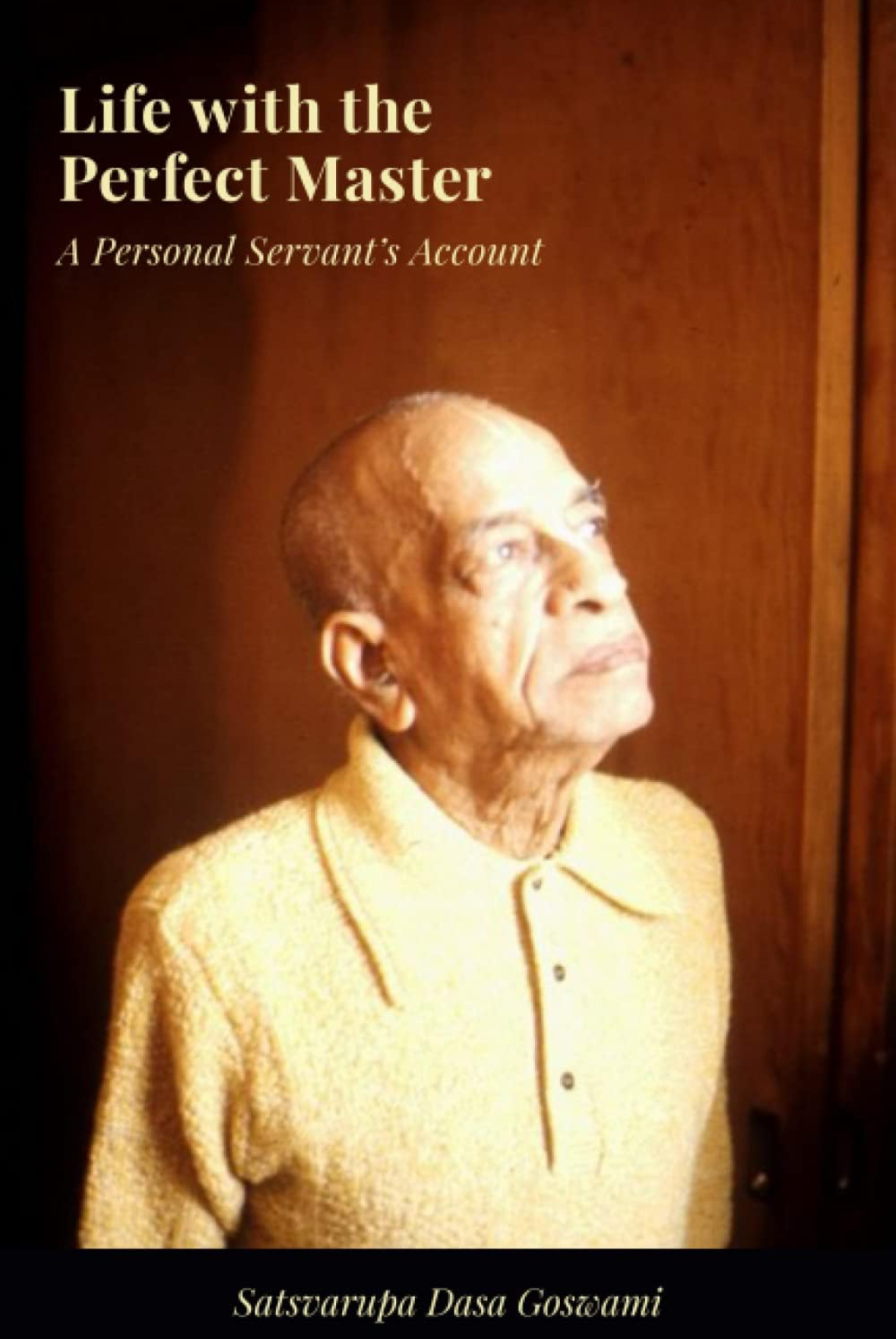
I have a personal story to tell. It is a about a time (January–July 1974) I spent as a personal servant and secretary of my spiritual master, His Divine Grace A.C. Bhaktivedanta Swami Prabhupäda, founder-äcärya of the International Society for Krishna Consciousness. Although I have written extensively about Çréla Prabhupäda, I’ve hesitated to give this account, for fear it would expose me as a poor disciple. But now I’m going ahead, confident that the truth will purify both my readers and myself.

First published by The Gītā-nāgarī Press/GN Press in serialized form in the magazine Among Friends between 1996 and 2001, Best Use of a Bad Bargain is collected here for the first time in this new edition. This volume also contains essays written by Satsvarūpa dāsa Goswami for the occasional periodical, Hope This Meets You in Good Health, between 1994 and 2002, published by the ISKCON Health and Welfare Ministry.

This book has two purposes: to arouse our transcendental feelings of separation from a great personality, Śrīla Prabhupāda, and to encourage all sincere seekers of the Absolute Truth to go forward like an army under the banner of His Divine Grace A.C. Bhaktivedanta Swami Prabhupāda and the Kṛṣṇa consciousness movement.

A single volume collection of the Nimai novels.
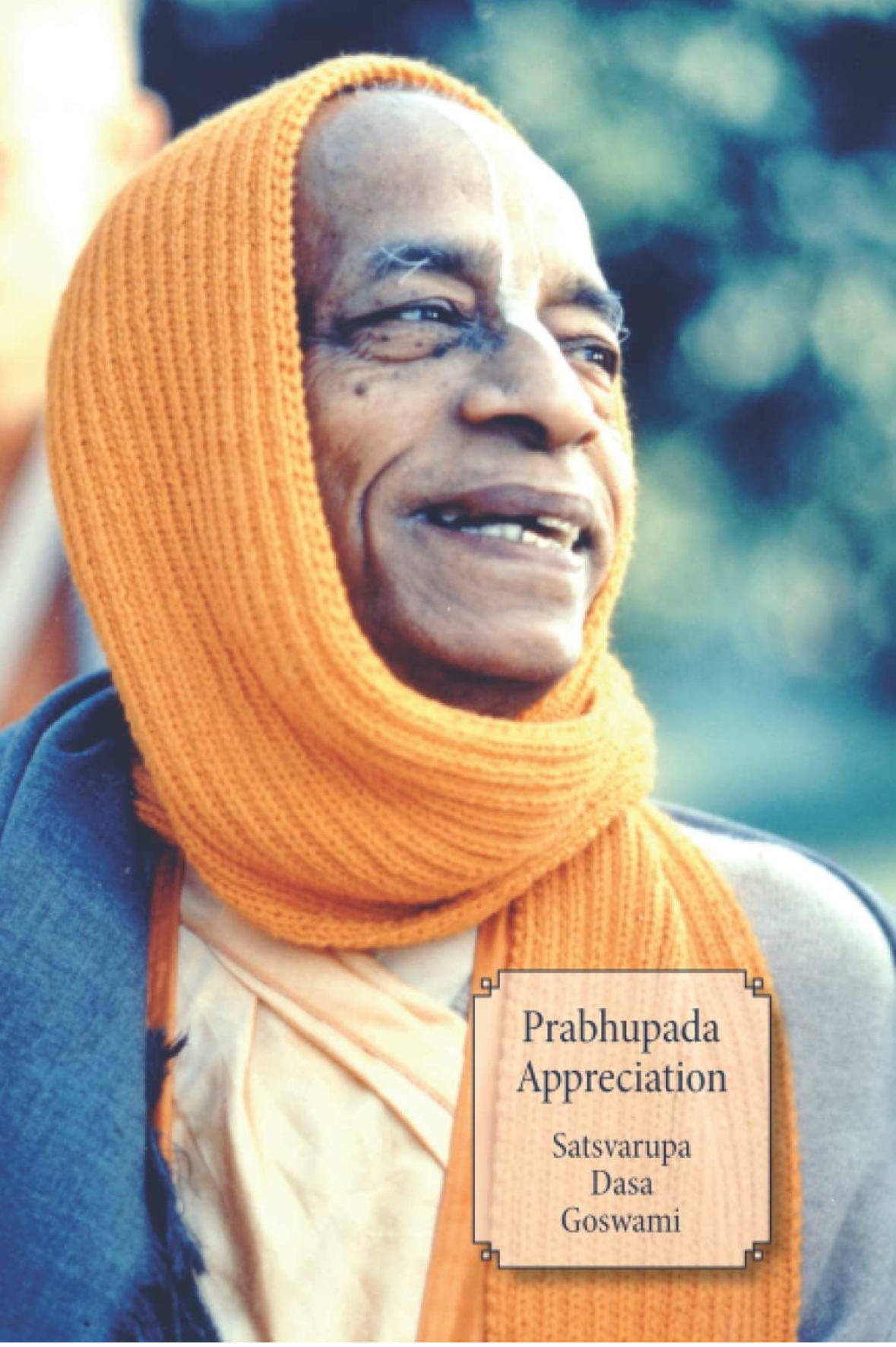
Śrīla Prabhupāda was in the disciplic succession from the Brahmā-Mādhva-Gauḍīya sampradāya, the Vaiṣṇavas who advocate pure devotion to God and who understand Kṛṣṇa as the Supreme Personality of Godhead. He always described himself as simply a messenger who carried the paramparā teachings of his spiritual master and Lord Kṛṣṇa.
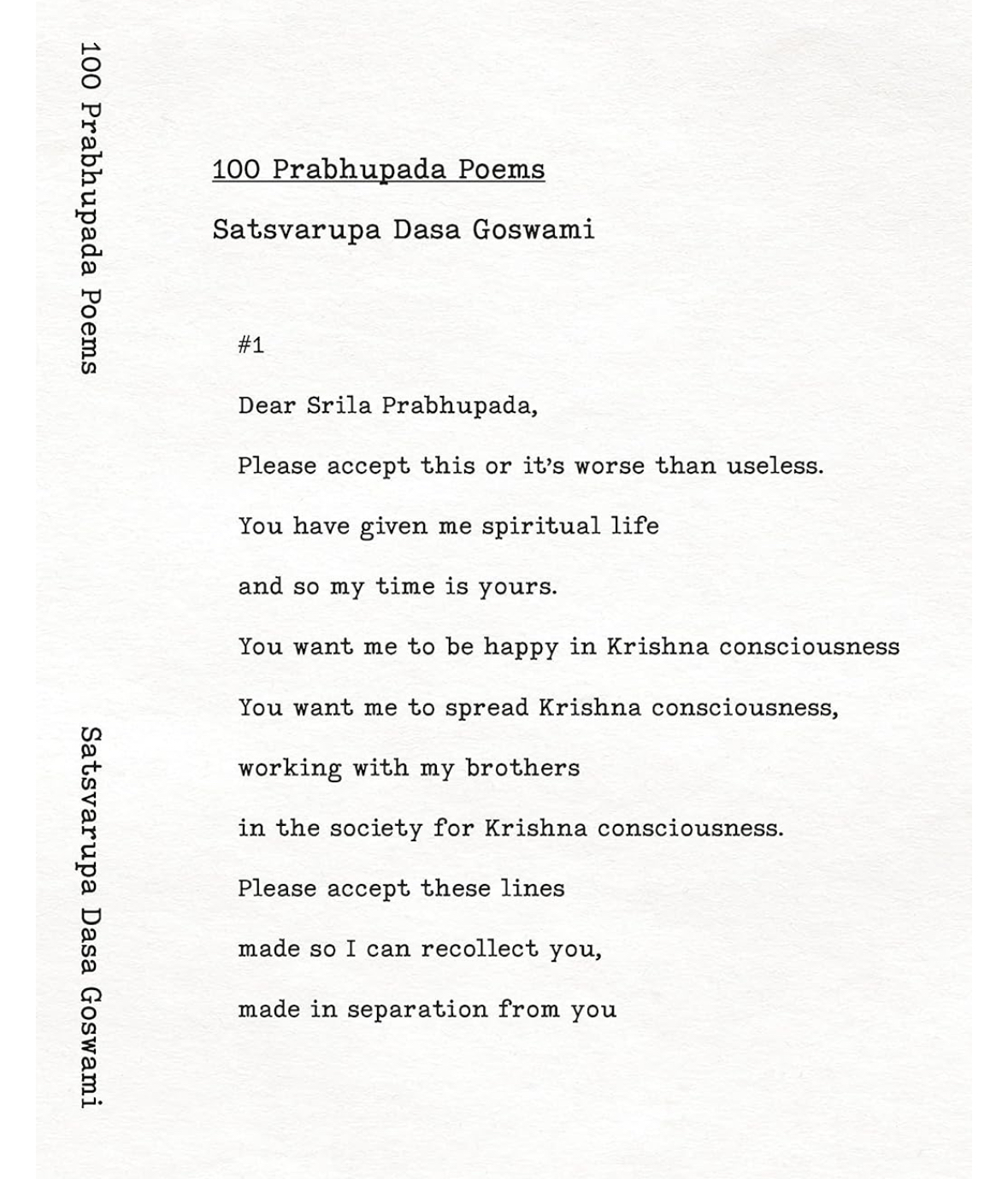
Dear Srila Prabhupada,
Please accept this or it’s worse than useless.
You have given me spiritual life
and so my time is yours.
You want me to be happy in Krishna consciousness
You want me to spread Krishna consciousness,
This collection of Satsvarūpa dāsa Goswami’s writings is comprised of essays that were originally published in Back to Godhead magazine between 1966 and 1978, and compiled in 1979 by Gita Nagari Press as the volume A Handbook for Kṛṣṇa Consciousness.

This second volume of Satsvarūpa dāsa Goswami’s Back to Godhead essays encompasses the last 11 years of his 20-year tenure as Editor-in-Chief of Back to Godhead magazine. The essays in this book consist mostly of SDG’s ‘Notes from the Editor’ column, which was typically featured towards the end of each issue starting in 1978 and running until Mahārāja retired from his duties as editor in 1989.

This collection of Satsvarupa dasa Goswami’s writings is comprised of essays that were originally published in Back to Godhead magazine between 1991 and 2002, picking up where Volume 2 leaves off. The volume is supplemented by essays about devotional service from issues of Satsvarupa dasa Goswami’s magazine, Among Friends, published in the 1990s.

“This is a different kind of book, written in my old age, observing Kṛṣṇa consciousness and assessing myself. I believe it fits under the category of ‘Literature in pursuance of the Vedic version.’ It is autobiography, from a Western-raised man, who has been transformed into a devotee of Kṛṣṇa by Śrīla Prabhupāda.”
 The Best I Could Do
I want to study this evolution of my art, my writing. I want to see what changed from the book In Search of the Grand Metaphor to the next book, The Last Days of the Year.
 a Hare Krishna Man
It’s world enlightenment day
And devotees are giving out books
By milk of kindness, read one page
And your life can become perfect.
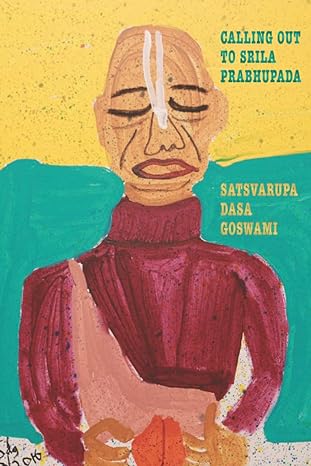 Calling Out to Srila Prabhupada: Poems and Prayers
O Prabhupāda, whose purports are wonderfully clear, having been gathered from what was taught by the previous ācāryas and made all new; O Prabhupāda, who is always sober to expose the material illusion and blissful in knowledge of Kṛṣṇa, may we carefully read your Bhaktivedanta purports.
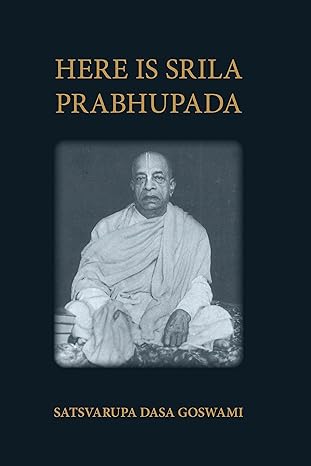
I use free-writing in my devotional service as part of my sādhana. It is a way for me to enter those realms of myself where only honesty matters; free-writing enables me to reach deeper levels of realization by my repeated attempt to “tell the truth quickly.” Free-writing takes me past polished prose. It takes me past literary effect. It takes me past the need to present something and allows me to just get down and say it. From the viewpoint of a writer, this dropping of all pretense is desirable.
 Geaglum Free Write
This edition of Satsvarūpa dāsa Goswami’s 1996 timed book, Geaglum Free Write Diary, is published as part of a legacy project to restore Satsvarūpa Mahārāja’s writings to ‘in print’ status and make them globally available for current and future readers.