

We are still expanding our team of proofreaders as we aim to increase the rate of republication of Satsvarūpa Mahārāja’s books as well as new books that he writes. As many of you know, during the July 4th festival just held, a total of 18 new and re-edited and published books were present, and we hope to present a similar number at Satsvarupa Maharaja’s Vyasa-puja observance this December. Our call for proofreaders includes a need for fluent bilingual Spanish and English speakers to proofread Spanish translations (we currently have around 20 Spanish translations waiting to be proofread). Anyone interested in this particular service should contact Manohara dāsa at [email protected]
If you would like to help, please contact Kṛṣṇa-bhajana dāsa at [email protected] or [email protected] and we will find you a service that utilizes your talents.
There are ten offenses in chanting Hare Kṛṣṇa. They involve not only the time when we sit down to chant japa, but our whole devotional life. These offenses—disobeying the orders of the spiritual master, committing deliberate sins on the strength of chanting, blaspheming the devotee—have to do with more than correct pronunciation of the names of the Lord. So whether we can carry out the orders of the spiritual master is our test. By the time you sit down to chant, it’s already determined by your service attitude—you’ve either already committed the offenses, or you haven’t. Offenseless chanting and following the spiritual master’s orders are interdependent.
By chanting carefully, you get the strength to follow the orders of your spiritual master, as you associate with Kṛṣṇa’s name. But we know that if you associate without offense, it is much more effective. Following the four rules and living in devotional service assures you of avoiding the ten offenses.
The chanting of Hare Kṛṣṇa has the power to eradicate all sins, but if you become an offender to the holy names of the Lord, then you have no chance of being delivered.
******
IT IS ALSO AN OFFENSE to be inattentive while chanting. The mind is always going this way and that, but we have to chant and bring the mind back under the control of the higher self. If you don’t at least struggle to control the mind, your chanting will be a very lackadaisical thing. You see people who smoke a cigarette and drink coffee and read a newspaper and do five other things at the same time. So chanting is not like that—worry beads, something to do while you’re busy. Chanting is samādhi; it is meditation; it is complete service in itself when you chant sixteen rounds. Throughout the day we may sing and chant while doing different things, but when we chant our rounds, we have to be most attentive. If not, then again it is aparādha, an offense. Therefore, Kṛṣṇa consciousness is mantra-yoga. You have to chant and hear.
In the very technique of mantra-yoga it is offensive not to be attentive. Each form of yoga—haṭha-yoga, kriyā-yoga, kuṇḍalinī-yoga—sitting postures, controlling the breathing—is meant to control the senses. And you control the senses so that you can control the mind. And you control your mind so that you can think of the Supreme Bhagavān, Kṛṣṇa. Our yoga also controls the senses; we control the mind by two senses. So one sense is vibrating, speaking with the tongue, and the other sense is hearing. If these two senses are fixed, then you can control your mind. We speak Hare Kṛṣṇa mantra and we hear.
So you have to be attentive to this technique. Don’t think of different things. It’s mentioned in the Bhagavad-gītā, Sixth Chapter. You can’t get up and go here and there; you can’t do business; you can’t do anything, except this yoga. That is the whole idea. Stop your other activities, sit down, meditate. So when we sit and meditate, we should not do anything else. You sit tight and hear and chant, hear and chant—for only two hours a day. Until you become offenseless in your chanting, you can’t progress to a higher stage or to the higher taste. We have to go from offensive to offenseless, and go on chanting Hare Kṛṣṇa.
The best way is to hear yourself chanting the actual names, Hare Kṛṣṇa mantra. This is the way to chant without losing attention. One’s mind should be fixed on the sound. As Prabhupāda has written, the mouth should move. One should not slur Hare Kṛṣṇa, Hare Kṛṣṇa. He should not fall asleep while chanting in his so-called bhajana. As Kṛṣṇa advises Arjuna in practicing yoga, “Wherever the mind wanders due to its restless and flickering nature, you have to drag it back.” So this applies to our chanting. You have to chant with attention. Remain awake and chant with devotion.
Most of the offenses concern the life of the devotee. His life is chanting, but his life’s activities have to be pure in order to chant. Our movement depends on offenseless chanting, and spiritual advancement depends on offenseless chanting, whatever your particular service is. At the svame time, to take to the mercy of the holy name and grow spiritually, you must avoid the sinful activities: illicit sex, gambling, intoxication, meat-eating, and be very faithful in service to the spiritual master. This combination will make the perfect advancement
pp. 29-34
hare krsna hare krsna
krsna krsna hare hare
hare rama hare rama
rama rama hare hareiti ṣoḍaśakaṁ nāmnāṁ
kali-kalmaṣa-nāśanam
nātaḥ parataropāyaḥ
sarva-vedeṣu dṛśyate“After searching through all the Vedic literature one cannot find a method of religion more sublime for this age than the chanting of Hare Krsna.” (Cc. Adi 3.41)
The first night I saw and heard Srila Prabhupada chanting Hare Krsna, I also joined in along with the others in the Lower East Side storefront. I did not know that the mantra was a verse from the Upanisads. Nor did I know what a mantra was, but I thought it a wonderful and exciting meditation.
I had not quite memorized all thirty-two syllables of the chant when I returned home later that evening. But it went on reverberating in my mind as I walked back to my dismal apartment on Suffolk Street: “Hare Krsna, Hare Krsna, Hare Rama, Hare Rama …” I had been repainting the walls of my apartment, and when I got home I returned to my painting work. And I also went on singing Hare Krsna. After chanting for almost an hour, I sat down to write a letter to a professor friend in Europe. In a light-hearted and carefree way, I explained to him my discovery of the chanting, and I wrote about the Swami and the boys in the storefront. From then on I never missed an evening’s chanting meeting at Swamiji’s, and I went on chanting to myself wherever I went.
One day I tested myself with a challenge: could I chant for one full hour without stopping? I walked all the way to Fourteenth Street and back, chanting nonstop. Yes, I could chant in a sustained way. I would also chant within my mind while at work in the welfare office.
As time passed and I got to know Srila Prabhupada better, my appreciation of the Hare Krsna mantra deepened. I found that chanting offered more bliss and satisfaction and shelter than I could even imagine. The maha-mantra had become my constant companion.
The theme of this book is that a devotee lives with the scriptures. Individual verses are like living personalities who guide us as our well-wishing friends. Of all of the millions of Sanskrit verses comprising the Vedic literatures, this verse, the Hare Krsna mantra, is the dearmost companion of all. In this sense the Hare Krsna verse, of the Hare Krsna mantra, is unique. Even though we study many verses and purports and memorize a number of them, the Hare Krsna mantra is the supreme well-wisher, and He is every devotee’s special protector. Even if one knew no other verse but simply chanted this verse constantly, he could attain pure Krsna consciousness.
This verse is for all seasons and for all moods. When we are afraid, we chant Hare Krsna; when we confront a problem, this verse comes to our mind and lips; when we are happy or tired, when we distribute a book or answer the telephone, we pray with this verse. When we get an opportunity to speak to a large audience, such as on radio or television, we never forget to say Hare Krsna at least once. And when we meet our friends in devotional service, we recite this verse as a greeting.
None of the sastric slokas are ordinary letter combinations; they are all nondifferent from Krsna. This is particularly emphasized, however, in reference to Hare Krsna mantra hare krsna, hare krsna, krsna krsna, hare hare/ hare rama, hare rama, rama rama, hare hare. Lord Krsna Himself is with us on our tongue when we chant His holy name. And for us, the words japa and kirtana refer exclusively to different methods of reciting and meditating upon this verse. In japa, we engage our tongue and ear by reciting the maha-mantra continuously, and we turn inward to meditate on the holy name of Krsna. Japa beads are not for counting repetitions of any other verses. kirtana means krsna-kirtana, the chanting of the holy names, the Hare Krsna mantra. During kirtanas within the temple we dance and play instruments in a transcendental festival, and we experience congregational unity within the holy name. We are a family whose essence is service to the holy name. In public kirtana, we share harinama and distribute it to the reluctant nondevotees. In such sometimes wild and uncontrollable situations we simultaneously distribute Hare Krsna while ourselves taking shelter in the Lord’s internal energy through His sound vibration.
Just as all sastric verses must be given and explained in parampara, so the Hare Krsna mantra comes to us from Srila Prabhupada. Otherwise, it would have remained and obscure verse within the Upanisads, one of many bhajanas or mantras within the grab-bag of the so-called “swamis” and hodgepodge “bhaktas” of India. But Srila Prabhupada has delivered to us the holy name with the parampara conclusions of Lord Caitanya. In effect, Srila Prabhupada has said, “Please chant Hare Krsna, and make this chanting your constant companion. Then even at the time of death you will have nothing to fear.” On his order we therefore practice and try to realize that this verse is Krsna Himself, our dearmost friend.
In one sense, there is no translation of the Hare Krsna mantra, since it is made up of proper nouns. The mantra is the constant calling on the names of God: Hare, Krsna, and Rama; the call does not need to be translated. When the child cries “Mother! Mother!” one may analyze the meaning if one wishes, but the simple meaning is nondifferent from the cry itself. And yet, the spiritual master has translated the verse to mean, “O Supreme Lord, O energy of the Lord! Please engage me in Your service!” The chanting of Hare Krsna is not an attempt to relate to the Lord by the mechanical repetition of His name. Rather, we are petitioning Him to please keep us at His lotus feet and to please allow us the privilege of engaging as the menial servant of His servant. The special benediction of this absolute prayer is that its recitation is itself the topmost form of service to the Lord Krsna in this age. By His causeless mercy, Lord Krsna has consented to be everyone’s most intimate companion in the form of the most beloved of all verses, Hare Krsna, Hare Krsna, Krsna Krsna, Hare Hare/ Hare Rama, Hare Rama, Rama Rama, Hare Hare.
Since my initial good fortune in receiving the holy name from Srila Prabhupada, I have gone on to chant a regulated but often uninspired routine of sixteen rounds daily. I have described my attempt to battle against offensive chanting in Japa Reform Notebook. Unfortunately, I continue to move along in some of the same old ruts of inattention and many-branched distraction while chanting the holy name. Of course, we say, “It is gradual process.” There is always great hope that when I go to chant again I will improve. But japa reform is a constant, continual struggle, and victory against the demons of offensive chanting is not so easily won.
With time, as we prepare ourselves for the oncoming, most dangerous moment of death, we better understand that the holy name is our ultimate shelter. If indeed it will take us more than one lifetime to attain pure chanting, then our prayer is to somehow be born where we may take up the maha-mantra once again, whether in heaven or hell. This much we have already learned: the chanting is our constant companion, our life and soul, our matchless gift from Srila Prabhupada.
pp. 8-10
Was praying just now. I think that’s what it was. Had all good qualities, aspirations to reach realization, cut through in writing, chanting and reading. That’s my desire. The prayer state lacked a push to produce this expression, just more meditating on it.
Push is the creator. It was quiet, restful afternoon state, awake after rest, nowhere you had to be, no duty you had to do, not even writing a certain book, and reading I put aside in favor of thinking over and feeling what I’ve already been reading. I guess you call it mental worship and prayer. It’s rare for me. I would like to be able to do it even when traveling in van or ferry . . . Even when I’m feeling physically weak and certainly I’d like to be in touch while actually chanting the holy names and reading.
Writing leaves the record.
Trust in process.
This is a retreat, and you can allow yourself this luxury. The holy name can come down from head and enter the heart. It’s in the Art of Prayer book. If I look at that I can see it, although you’ll get the Christian version. Still to what Kṛṣṇa sends you, as He did today, a little taste of it.
Components: peace, non-achieving mood, clarity of thought, feeling you have nowhere to go, nothing to do—even if you had such duties you could put them aside for a precious half-hour or more and pray like this, The reality of Kṛṣṇa conscious state is my desire, and I pray for it.
Don’t be afraid of it. (“Too much surrender.”) Don’t be afraid to ask for it. It enriches all your acts, gives you security. So you do more than just look at your watch and read-chant-write in somewhat uptight and perfunctory way. You came to a retreat for this purpose.
Clang-clang-clang-clang—4 P.M. The town sometimes erupts into loud passersby, radios’ rock music, slam of door, car goes by. But then it becomes quiet again. You are free up here. They call it the “city of science” but I needn’t be affected by that or by the tourists who go to the old, old stone churches or sexy women hiking with men and looking around. Keep behind these doors, keep the heat out . . . I thought of Vṛndāvana, not being interrupted or pressured in the Krsna-Balaram guest house. But that place of intense līlā devotion which is pursued by many people there. It’s so much better than the West can offer. Yet Māyāvādīs live there too. Still, you know that just outside are many parikrama places, a tree where Lord Caitanya sat when He visited Vṛndāvana. Did He actually sit there? Maybe. At least people want to think like that. And you can sit by the tree or by Govardhana and think those thoughts. Here Kṛṣṇa accepted the prayers of Lord Indra, here Kṛṣṇa stopped the gopīs with their milk and demanded a tax . . .
And here is the Hare Kṛṣṇa mantra which my spiritual master gave to me.
What prevents you from always thinking and feeling in a Kṛṣṇa conscious way? Is it so unattainable?
Why not do it always? Gain it in this retreat and never relinquish it. I cannot do it on my own power. But I can stay in the practices which will yield it. Know that whenever you read or chant—or write— you’re doing the best thing to bring you to the stage of more access and feel of reality. If in a given session you are stuck and detained, still you are attempting it.
Your decision not to eat sweets may have helped. It can give you more clarity. You exert a power, control over your tongue and your mind’s demands. That control can then be directed toward the spiritual practice.
Don’t force, don’t force. You desire to enter the reality of your devotional practices. That is your prayer.
Not even twenty minutes at this. Give us at least a half-hour, then “we” will let you go . . . to wander, to read randomly. You’d like to go in other room and on the typewriter to some “hot” writing, produce a poem? At least I’d like to show that poem series that it’s possible to cut through to more direct Kṛṣṇa consciousness. That means writing down some kathā you have previously read. When I say enter reality of Kṛṣṇa consciousness it means the reality to the Śrīmad-Bhāgavatam passages and the holy name’s siddhānta. Nāma-bhajana.
I thought, Oh maybe I shall read Caitanya-maṅgala. But why this resolve to find the auspicious and the nectar in your spiritual master’s books? (At least those people in the street speak a language unknown to me and unthreatening.) People like to help each other, mostly to enjoy sense gratification. Religion they may admire but don’t practice. It requires some vairāgya and I am gaining a new edge of it by giving up sweets. So you claim.
The Lord can give or rehold. You need to regularly fuel up in his books.
Kṛṣṇa glanced at the women on the rooftops as He and Balarāma strode through the streets of splendorous Mathurā. He wore clothes that attracted Him, picked out from the dead washerman’s collection. Kṛṣṇa, Kṛṣṇa, Kṛṣṇa.
The wise-guy smart-aleck poets. Don’t be one of them. Beg for mercy of holy name.
Lockhaven. Words now scattered. A hot, sunny afternoon out there and we are sheltered from it here. Take light cādar off Śrīla Prabhupāda so he is comfortable. Fifteen minutes after four, the bells ring, the bells clang every fifteen minutes. And death shall what? Have no dominion? Shall come to all but for the devotee it doesn’t mean he’s dragged down.
But he prays I wish to get a next life in which I may entirely devoted to Lord Kṛṣṇa and be a friend to His devotees and be merciful to all living entities. These were words of prayer of Sudama the florist and similar to prayers Mahārāja Parīkṣit made when sages first gathered with him when he prepared to meet death coming to him by the curse. But when Śukadeva came, then they focused on Śrīmad-Bhāgavatam-kathā.
The afternoon not pinned down to a schedule but swimming always in something Kṛṣṇa conscious and hopeful the access gained can be maintained. You want to produce pieces, writings or drawings that you can show others to attest that you entered a Kṛṣṇa conscious state. “Hey, he really is quite Kṛṣṇa conscious. Did you read his book?” But you want to lay down that feverish, passionate, creative drive.
Before your eye twinge arrives.
pp. 143-46
Verse 12.1 is a very direct question to settle the controversy as to whether personalism, devotional service to Kṛṣṇa, or impersonalism, worship of Brahman, is most perfect. Fortunately, Lord Kṛṣṇa’s reply is direct and settles the question. The supremacy of devotional service is also described at the end of the Sixth Chapter, and in the Seventh and Eighth, and “in practically every chapter.”
******
For a person in Kṛṣṇa consciousness there are no material activities “because everything is done for Kṛṣṇa.”
******
The method of impersonal realization is very difficult. Kṛṣṇa consciousness is relatively easy [see also 9.2, susukhaṁ, it is joyfully performed].
Features of impersonal Brahman mentioned in 12.3-4:
Unmanifest, beyond senses, all pervading, inconceivable, etc. In his purport, Śrīla Prabhupāda mentions what one has to do to attain this and says the final goal is still the personal form of Kṛṣṇa, even by this impersonal method.
******
Jñāna-yoga [impersonalism] and bhakti-yoga are compared in 12.5. Deity worship in bhakti is saguṇa worship but is not material. The Lord’s acceptance of service to the arcā-vigraha is an example of the ease of bhakti compared to impersonal [unembodied] meditation.
“There is no doubt that the impersonalists are unnecessarily taking a troublesome path, with the risk of not realizing the absolute truth at the ultimate end.” There is also the danger of becoming an atheist.
******
For the devotees, Kṛṣṇa says, “I am the swift deliverer from the ocean of birth and death” [12.6-7].
The devotee desires only to please the Supreme Personality of Godhead, and is willing to sacrifice everything for Kṛṣṇa’s satisfaction. Yet Śrīla Prabhupāda says it’s easy. Devote your work to Kṛṣṇa and chant Hare Kṛṣṇa mantra.
The Supreme Lord states that He will personally deliver the devotee from the ocean of saṁsāra. The nondevotee-yogi tries with great difficulty to transfer himself to the spiritual world [see the latter part of Chapter 8.], but the Lord takes this task on behalf of His devotee.
******
“Just fix your mind upon Me, the Supreme Personality of Godhead, and engage all your intelligence in Me. Thus you will live in Me always, without a doubt” [12.8].
By engaging in devotional service [under the direction of the spiritual master], one is in a direct relationship with Lord Kṛṣṇa, and his position is transcendental “from the very beginning.”
******
In verses 12.9-12, Kṛṣṇa says if you can’t do this [unalloyed, constant devotional service], then do this [other acceptable practices for gradual elevation to pure Kṛṣṇa consciousness].
In 12.9 He recommends following the rules and regulations of devotional service [vaidhī-bhakti]. In vaidhī one lacks love, but “that stage of love can be achieved by practice of devotional service, performed with the present senses.” The natural, dormant love in our hearts will be revived.
“And one should constantly hear Bhagavad-gītā and Śrīmad-Bhāgavatam from pure devotees.”
******
If you can’t follow the rules of bhakti, you can please Kṛṣṇa by giving money to the devotees who are propagating Kṛṣṇa consciousness.
If one can’t give to help Kṛṣṇa conscious activities, he should at least sacrifice for “some good cause,” and this will help him come one day to devotional service to the Supreme Lord.
The indirect method of spiritual progress is to cultivate knowledge, then meditation, then understanding the Supersoul and finally the Personality of Godhead. But “everyone is advised to take to the direct method of surrender unto the Supreme Personality of Godhead.”
******
In verses 12.13-20, Lord Kṛṣṇa describes a devotee who is very dear to Him.
******
A pure devotee is not disturbed in the face of enemies or bodily troubles. He takes inimical behavior from others as a reaction to his own misdeeds.
All these qualifications help him to fix himself on the Supreme Lord.
The devotee who is transcendental to disturbances is dear to Kṛṣṇa. He doesn’t disturb others, and he’s not disturbed by them.
******
Śrīla Prabhupāda says these qualities are a rare standard comma but one can come to it by following the regulative principles of devotional service. We may admit these qualities are beyond us, but we should admire them and aspire for them.
******
I notice these qualities are not those of an aggressive businessman. They are internal qualities. Even in ISKCON these qualities are not always presented as more desirable. But they are, according to Lord Kṛṣṇa, the qualities that please Him. I want to recall them and act on them—be satisfied with whatever food you are served, don’t be attracted to any residential facility, etc. “Without good qualities one cannot become a pure devotee.”
Devotional service automatically helps him to attain all these.
******
This ends the middle six chapters of Bhagavad-gītā, where direct devotional service is recommended as most congenial for improvement in spiritual life. Impersonalism is rejected, and all good things come to a person engaged in devotional service.
pp. 344-52
Solitude comes with winter she
said and the temple president
lectured “We’ve benefited all
summer from hearing many
sannyasis. Now we have to go
out and preach.”
First a visit to India. Then
back to the temple and out
on book distribution.
Less devotees and a bigger debt
but he told them it’s preaching
and they believed – or
she does – says she
feels “part of it”
I remember what that’s
like. It’s okay. Struggling to
meet ends in a temple.
And the congregation, asking
them to help. Now I look
up at the skylight. No
wind tonight. No winter
yet.
Slow down. Take a day at a
time. Krsna conscious.
******
Priorities – hear about Krsna
every day. Don’t forget
pray with your pen may
tongue not forget me
heavens to Betsy
he ate all twelve little scones he
didn’t want to be left behind
asked a friend, take me to Vrndavana
with you.
But it was too late and
anyway it wouldn’t work
out. There’s no telling…
Krsna on that mountain…
the pilgrims hustled up to the
top – not Govardhana
read it in a book. Tell
devotees in a room in
Dublin with logs burning
in fireplace
on your own japa beads
there is finally no one who
can help you
I heard Him say He’s bringing
Vrndavana to the earth so Radha
wouldn’t feel separation when
Krsna came here at request
of devas
my shoes and the cold
weather and morning as dark
as night. We didn’t want to be
left behind
books I ordered never arrived.
Hare Krsna concerns follow
up. Surely there are some
friends you can find, make
adjustments so your own ego
gets squeezed out
and you can bundle up in warm
clothes to sit and hear a
lecture and walk to a holy
place with a shut mouth
Hare Krsna chanting member
loyal.
******
Tensions
between people can be
calmed
if that’s what
you want
yeah I want to cooperate
in Krsna consciousness in funny boots
walking
morning scoop out the
ice cream to my friend
please. I don’t complain
in the least
please therefore don’t hold
it against me that I have
left you
for someone else
yeah it’s getting darker
and I don’t mind in the
least
it has to work out that
way. Leaves curling
now I notice and
turning brown it’s not
long October itself
peels over
******
I’ve got several months more…
give me a doll house
give me a week on high
no give me desire begun in
KC. Discipline
my practice
can’t follow the rules
and regs
then take away your years
bring on the rtvik system
who cares
bring on master’s prose
day’s desires, I want attention resolved
but maybe they just work out
so I can continue
praying for the troops
******
Oh yes I almost
forgot to defeat
the atheist
so there! Krsna can
lift the Govardhana
Hill and we can eat
halava
we can walk over
the Swami Bon
Oriental Institute land
where ancient trees
grow. Can see the
domes
of Prabhupada’s Samadhi
Mandira and Krsna-Balarama
Mandira so there, across
Bhaktivedanta Swami Marg, the
puddles, radios, cassettes, noise,
rickshaws exhausts
still He walked and loved
here Radhe Syama!
Still…I almost
forgot. You are
defeated we don’t care
for what you know but
please take some
prasada.
******
This chance given to us
we don’t know how to
write from any school
method but keep trying
with Krsna in the heart
felt good a little reassurance
that it normally takes a long
long time to attain bhakti But
a little taste is nice!
Radha’s Lalita arguing how
Vrndavana belongs to Vrndavanesvari
and not to Krsna
as He claims…
The man who pushes himself
forward…Instead I have become
humble painter of Lord Jagannatha’s
thinking of Guyana during japa
when I should have been turning to
the set of words in the Hare
Krsna mantra
save myself from sheer and
harsh lamentation by setting
up a little bandstand
this day still gives me chances to say
Hare Hare, Krsna Krsna and to
be a good guy toward others and
tolerate what comes.
Krsna saw it all and decided
what to do. Pack us up at our
endings and may we not cause
people too much trouble who
have to clean up after us.
And oh if we could only
save ourselves the immense trouble
expected in returned shots at
Kali life. Should guru want it,
a sincere disciple would oblige.
******
He didn’t forget me.
I was able to approach a
city bus man
in a dream
my old secretary and I had to
plan out where we’d go and
that depends on your
headaches…
hey how about
Piscataway, New Jersey,
some home program…
some jazz club but I
don’t want you canceling
like you did a few
years ago when a hundred people
showed up
yeah nowadays I’d
make it somehow by
emergency pill or just
sit there and grin and
speak what he calls
spiritual ease
he’s making fun of it
putting us on
no, he means it
too
Sardonic, that’s a
real mean riff too
by the waterfront
I riff it up all this
arrangement has been made
just to bring you the very
best in natural
aeronautics. I’m surprised
he can’t speak better
spiritual truths
prepare to meet thy
Maker. Connect us to
Prabhupada. No matter
what they call you.
Fragments are all he
gave us but they were divine
from the source.
******
He’s out looking for a rope
to pull a woman’s car.
I’m putting my wits
together
the windows are rattling.
I planned a long trip to
Trinidad and back, to
Baltimore and Ireland.
I’ll do it,
paint my cheeks red,
my Jagannathas on the bedstead
of His throne big
procession five thousand people
walked behind.
******
Flickering light from tree branches,
my eyelids lower and rise
he’ll heat up the noon veg and
soup and that will be my snack
Will you, masked man, chant “Hare Krsna!”
over the lochs and hills?
Are you satisfied
with this?
******
The new Hotpoint washing
machine is making its comforting
sounds one floor below and we
got electric heat
and light. I’m not going on
the Vraja-mandala Parikrama and
lying down with a bunch of
Vaishnavas each evening and
humbly hearing of the
lilas and tirthas from those
who know better than me –
who make my mind
scream and rage and
envy. I’ve got my own
honest plot of land.
The Hotpoint goes
into its next whirling
cycle, all automatic.
My pens, my refills.
My days running down but
I’m using them best
I can
Keep your eye on that calendar
and the books by your spiritual master
I will preach as he did,
the basics, because he knows
that’s what we need
lectures coming up, so let’s
prepare.
pp. 203-10
“At last the period of vexatious searching passes; the fortunate seeker receives what he has sought. He finds the heart and establishes himself in it with his mind before God, and stands before Him unswervingly like a faithful subject before the King, receiving from Him the power and strength to rule over all his inner and outer life, according to God’s good pleasure. This the moment when the kingdom of God enters within and begins to manifest itself in its natural strength” (Theophan the Recluse, from The Art of Prayer).
This is what I am seeking. Not a metaphor—a structure for a book into which I may pour my scattered observations. I’m looking for that too. But the “vexatious search,” inner seeking is to relish the holy names and pastimes of the Lord, to be dedicated to His qualities and fame. To be a preacher because you love Him and you love your spiritual master so much…
Śrīla Prabhupāda said, “Without being endowed with the power of attorney from Kṛṣṇa, it is not possible to preach . . . Sometimes we speak that ‘I’ll preach.’ What you’ll preach? First get the power of attorney, then preach. Preaching is not so easy that anyone can preach without kṛṣṇa-śakti vinā nāhe tāra pravartana … So how this power of attorney can be achieved? That is stated in Śrīmad-Bhāgavatam. You are singing daily to guru.” He went on to say in that lecture (New York City, July 1976) that vaidhī-bhakti leads to prema-bhakti, “Unless we are free from the nescience of material existence, there is no question of kṛṣṇa-prema. Two things cannot go.”
The search for the real thing. Metaphors can express it, but if you haven’t actually realized it, then your metaphor is just a literary facade, like a theater prop. The show-bottle. The decoration of the dead body. The licking of the outside of the bottle of honey.
Therefore, we searched for one grand literary formula but didn’t find it. This literary search was also tied to a desire for excellence in all-consuming Kṛṣṇa consciousness. That also we did not arrive at yet. I think of it sometimes in passing—that I might one day reach a state where I would write spontaneously and it would come out all kṛṣṇa-kathā. I’d not be interested in anything else, no nescience. Of course, we can’t leave out nescience. We discuss it, like in Iśopaniṣad, how vidyā and avidyā go side by side, and the wise person chooses vidyā. But I mean I dream that the day will come when I would “free-write” and out would issue kṛṣṇa-kathā and kṛṣṇa–upadeśa. It wouldn’t be merely official lecture. I’d be there.
Theophan is saying that the search culminates in reaching the heart with your devotional practice. No more just in the head or saying the right thing just because it’s duty. No more chanting japa with your mind all over the universe. You reach the heart, with your mind and voice too.
At present in my heart is the effort to go ahead and write anyway even though imperfect, in hopes that the day will come when I will have that heart. So my present heart is to not quit, to hope against hope. This has enabled me to write this book and books like it. Don’t give up even though your free-writing dredges up interests that are still within the three modes and three worlds.
But when will the day come when you will be loving Kṛṣṇa and be dedicated like a soldier for Prabhupāda ? Then you may seek metaphors, but they won’t be hollow shells, they won’t be masks to put over a timid, doubtful face. At that time, I will be trying to find the best way to express the bhakti in my heart. And even the literary ideas that come may be gifts from the Lord in the heart.
Try. That’s like Bhaktivinoda Ṭhākura saying, “From imperfection, purity will come about.” But don’t claim you are perfect now. So now, what is it you are searching for? You are not searching for a clever literary plan. Even if you got it in a dream, what would you do with it? You need the power of attorney. Even William Carlos Williams could only write Patterson, which doesn’t make anyone a devotee of the Lord. And Leaves of Grass will make them nondevotees. Yeats also doesn’t lead us back to Godhead, although these poets are put forward as persons of vision, artists who worked at a structure for a book of their own life. Prabhupāda says, “It will not help.”
So I struggle and stumble and go outside in fresh air. I see some light sprinkle of ice or snow in the distance hills. I go a little beyond my minimum sixteen rounds. I like to be alone to write. All right.
“Oh,” you say, “I think I know your art You want me to tell you about
the Manhattan skyscraper and Prabhupāda’s
visit there
and why I didn’t go to Gita-nagari with them?
Just read Hariśauri’s book. This is a different
book. Don’t ask for the metaphors.
They are all over the place like the
sirens and banging and grinding
from the street.
Prabhupāda asked, “What’s that?”
Hari-śauri looked down and saw a huge garbage truck
“gobbling up several bins of rubbish.”
Prabhupāda laughed, “This is New York—
everything ferocious!”
You just spew out everything in no order, and you say it came from your heart and that’s the only way you know, and you say that if you stick to your guns and you go on reading and chanting in vaidhī-bhakti, then someday you’ll spew out immortal pure bhakti.”
You may say like that. But that sounds too much like my official proclamation. I have to race ahead of that, too. Not say anything. But yes, from the hart and the crane, the ducks she heard going south, the yearnings and experiences of many writers before me, and they certainly did take words and crafts seriously, tried to be true to life and true to each other, but they goofed off in their own way, followed phantoms and fantasies and bad masters . . . you can hail them too, like Anna Akhmatova, who wrote these stanzas in A String of Quatrains:
To be honest,
for this clowning minstrelsy
I should expect a lead pellet
from the secretary.
The Lord, crucified on every tree,
the body of Christ in every ear of corn,
and the purest word of prayer
heal the aching flesh.
And what to speak of the six Gosvāmīs and Śrīla Prabodhānanda Sarasvatī and Sanskrit masters like Jayadeva and Vidyāpati. I see them as stars in the sky. I am on the marshland. I live for a while and spew out what I can. Do I deserve the lead pellet, the kick in the rear end? I’ll get what’s coming to me. I wish to see Kṛṣṇa everywhere.
Maybe I missed the point. I’m not so profound. Not a poet. But I didn’t find it bitter. Yes, you led us to where we could not go without your trajectory of attempted song and dance. You are like a shooting star, suddenly serendipity. Surely it must be a gift from the Lord since everything comes from Him anyway. And you grabbed it. Sometimes you didn’t wait for permission, but just grabbed it and said, “This is for the Lord in my poetry.” And some may raise their eyebrows about your insistence on writing so much…
I agree that poetry is thorough thinking and yes, it’s lies in that you claim you want the truth but you don’t pay the price, or you just can’t say it all. That is also a drive that keeps you going—I may be lies now, but later it will be truth.
However, I don’t agree when she says, “Never—comfort.” Maybe at the end of my life I will learn some bitterness and think that free-writing has cheated me. I was writing a poem when I could have been calling out to Kṛṣṇa. When I could have been doing some yeoman service for my master and not . . . But I try to dovetail it. I am like Carl Yeargens (Karlapati dāsa) and the bunch at the Bowery loft in 1966 hearing from the Swami, “Dovetail it into the supreme consciousness. It is not at all difficult. If you are a poet or musician, you remain a poet and musician, but do it for Kṛṣṇa.”
Search for metaphors… Keep writing… It is a comfort… when I hear someone likes it and has been helped in Kṛṣṇa consciousness.
pp. 120-127
Onboard “Portsmouth” to Le Havre. There was a Daily Telegraph newspaper in the cabin. The headline read, “Patients to be Given Pigs’ Hearts.” The front page also directed us to page 14 for a discussion on “Science Versus the Bible.” On page 14, this headline: “Why a Big Bang is Evidence of an Open Mind.” No pro-God headline. Another article had this blurb: “The triumph of the 20th century is to have learnt that we and the Earth come from stardust.” It’s frightening to consider. It’s lucky we have Sadaputa Prabhu and others to strike back at their foolishness and that Srila Prabhupada led the way.
Small pools of water accumulate during the rainy season, and in the autumn they gradually dry up. The little creatures playing in those small pools do not understand that their days are now numbered and will end very soon. Thus they are like foolish men, who not caring for the nearing day of their death, become absorbed in the so-called enjoyment of family life.
—The Light of the Bhagavata, #34
The family men—whether heads of a small family or a nation—don’t see that time is running out, their lit¬tle pool is drying up. They are so foolish that they think their attachment to their family might save them at the time of death. Srila Prabhupada: “One must retire from all sorts of family life, big or small, at the age of fifty, and thus prepare for the next life.” We see from the Daily Telegraph that humans prefer to think there is only one life.
Ship trembling. The world is with us and we are part of it as we travel peacefully on the roads, use the diesel fuel, and are able to park overnight because the Western nations maintain their stability at others’ expense. Therefore, we have to purify ourselves of those things that implicate us by serving Krsna. Our movement in France is tiny and without influence, but we still have the pure teachings. I don’t know what to say except that we should keep hearing and chanting about Krsna and Prabhupada. Prabhupada said that if a pack of asses applaud, what is the value? We want our certificate from Krsna that “this person has served Me.” Preach to the ten directions, whether they hear you or not.
When the small pools of water become too hot because of the scorching heat of the autumn sun, the poor small creatures, with their many family members, suffer terribly, as poor householders with too many family members suffer economical strains and yet go on begetting children because of uncontrolled senses.
—The Light of the Bhagavata, #35
Uncontrolled senses bring misery. You enjoy a little now, but you get a reaction later. Srila Prabhupada: “Spiritual culture means pursuing a better engagement in life. When a man engages in such cultural life, the desire for mating automatically abates, and the sufferings of uncontrolled family life are mitigated without artificial means.” We believe what Srila Prabhupada said because of his authority. He convinced us not to accept the atheistic or agnostic version although we don’t get actual proof until we are fully self-realized. We get initial evidence, and with it, the ability to restrain from sin, attachment to chanting on the guru’s order, and aspiration to be elevated “to a higher status of life for real and eternal enjoyment in personal contact with the Personality of Godhead Sri Krsna.”
With the progress of the autumn season the moist earth and muddy places begin to dry up, and the green vegetation begins to fade. This drying up and fading resembles the gradual disappearance of the false sense of affinity and ego.
—The Light of the Bhagavata, #36
These are great promises. We may hear them as high-sounding words that we don’t wish to rebut, but do they create a tangible hope in us? If they are not true, then they are empty rhetoric. Without faith, we keep our false ego strong to cope with material life as the all-in-all.
Dear Lord, I pray I have lost some of my false ego. I would like to do the much more I have to do, by Your grace, to achieve surrender unto Your lotus feet. At that time I could rise above the waves of the material ocean, just as our ferryboat plies smoothly over the water. I believe it. I wish to read with attention and taste, statements such as this one: “Human life … is the process for preparing oneself to be promoted to the spiritual kingdom. No one can adjust the sufferings of material existence, but by spiritual culture one can elevate himself from the effects of such miserable life.” Srila Prabhupada compares the liberated soul to a dry coconut in which the outer skin and inner pulp have become separate. The spirit soul can feel himself existing in spiritual life, “even though apparently within the dry skin.”
With the inauguration of the autumn season the rough sea becomes calm and quiet, just like a philosopher after self-realization, who is no longer troubled by the modes of nature.
—The Light of the Bhagavata, #37
Yes, I want a smooth sea. Sometimes I think I want it too much, as if it is my main desire, and Krsna is fulfilling it. “As they approach Me, I reciprocate,” He says. I am begging for that really in heart—to be left alone, at peace, to read and write in a backyard shack or here on a ferry out of reach. The Lord knows my heart and what is best for me.
Certainly too much external work for sense gratification is condemned. Asuras never stop their difficult industrial enterprises, “but men in the mode of goodness have an introspective mind and after a regulative struggle for existence they retire at a ripe old age, and engage their time in cultivating the human spirit.”
Time I am, says Krsna.
It’s 12:30 and we will eat again, not like austere brahmacaris in a poor Indian asrama who don’t eat until 2 P.M. and then eat rubbery capatis and a dal with no veg other than a single rotten one they begged from the market. Pebbles in the dal too, and plenty of chilies. No, we will have fresh fruits and biscuits and tea. Not bad for a ferry crossing.
Smooth weather.
Time I am, He said,
and I destroy all.
Don’t fret because the misery
will he over soon.
Don’t exult because the joy
of this life-body will
also fade away.
Turn instead to that which
is enduring. And kill
whomever would kill your
spirit. (I don’t mean “kill.” I mean, don’t
let them stop you.)
After the rainy season, the farmers begin to rebuild the partitioning walls of the paddy fields so that the water will be conserved, just as yogis try to use their conserved energy for self-realization.
—The Light of the Bhagavata, #38
That dratted newspaper article, “Big Bang is Evidence of an Open Mind.” I didn’t read it or the one that discussed how we all came from stardust, but I know they laugh at the mention of the Lord and His energies. I simply have to part from those atheists and not be influenced or affected by them. I can try to fight back, but finally, I just have to forget them and hear Vedic evidence with submission and intelligence.
Our conserved energy should be used in the internal energy. This reminds me of retention of semen. Yogis raise it to the brain, urdhva-reta. Don’t release it externally. In other ways too, sense energy or mental power should be dovetailed in the internal way of devotional service. The result? “After attaining Me, the great souls, who are yogis in devotion, never return to this temporary world, which is fully of miseries, because they have attained the highest perfection.” (Bg. 8.15)
The conclusion is that the regular practice of bhakti-yoga will lead the devotee to the plane of intense love for the Lord, and that is the single qualification by which the conditioned soul is allowed to reenter the eternal life of bliss in the kingdom of God.
—The Light of the Bhagavata, #39, purport
This is the September I went to Europe successfully and we lived on tea and biscuits during a crossing to France and then headed south. We stopped for the night before Paris en route to New Mayapur. This is the time of year that is neither too cold nor hot, when I hear cars and chant Krsna, Krsna, Krsna. I want to chant some day in the best consciousness and go back to Godhead as our profound Swamiji ordered. Yes, I was close to him sometimes and he said special things, but mostly he was frank and simple and down-to-earth (as atma-tattva asserts), and he said, “Chant sixteen rounds of the Hare Krsna mantra, read Bhagavad-gita and Srimad-Bhagavatam, take prasadam, distribute my books, live in the temple and render service, follow the four rules and other rules, and you’ll go back to Godhead.”
pp. 119-24
Much of the writing in this book was composed in the spirit of musical improvisation. According to the dictionary, “improvisation” or “to improvise” means to compose or to simultaneously compose and perform on the spur of the moment without preparation. I once wrote a letter to Prabhupada in 1972, and his reply touched on this theme. I asked him whether it was all right to take so much time to prepare lectures. I spent hours a day preparing. Prabhupada said, “So far your question, yes, it is good to be prepared with a well-thought lecture in advance. However, we must be able to preach effectively at a moment’s notice or under any conditions or circumstances also. As you begin to study the Sanskrit words, in each word you will find a treasure house of different understanding.” That encourages me to explore the spirit of improvisation.
No candles burning last night. “I am neglected,” the guru said to himself. Then he consoled himself: “It is better this way.” I would start demanding that people serve me. I would think I need things done immediately when I probably don’t need them at all.
In Prarthana, Narottama dasa Thakura laments that he does not reside in Vrndavana. He laments that he is not attracted to Lord Caitanya’s pastimes, and he claims his heart is harder than stone. He is not attracted to associate with the Six Gosvamis. Aye, Narottama, your lament leads us forward. Let me feel my own shortcomings, my petty faults, my lack of greed for the Vraja life.
Lately I have been thinking of devotees whom I initiated and with whom I have little or no connection. As the names accumulate, I wonder what it is—what’s going on. I recruit a few new ones who still think I am relevant for them, but the fact is, for many I am no longer relevant, or never was. Some are not even practicing Krsna consciousness at all, and some practice casually. In those cases, I understand why they wouldn’t want to deal with the spiritual master. Others, however, continue their Krsna consciousness, yet have little to do with me. I’m not going to run after them. Still, I think about it. I don’t live for their convenience and they don’t live for mine.
It’s hard to write. Instead I bite at a hangnail or play with a piece of paper. Did you know they painted the walls in here orange? I can’t file a complaint against the Department of the Interior. I could say Udall is to blame, or Gerry Maggan and the office of High Coutter—the place of French words. This is how to avoid writing, she said. Read a book, fall asleep in a nook, and write down a less-than-a-minute dream fragment.
Enough. Look smart. Stand to attention. Salute the stars and stripes. Don’t forget who you are and the need to be a hundred percent devoted. It will soon be Govardhana-puja.
He was ironic without Socrates, although he didn’t know much. He knew how to give a simple lecture and how to draw a few stick figures on a pink background, however. He also remembered names of a few disciples.
Sir, when you go to the Caribbean, will it be rich? Will it be summer? Warm? Will you have something to say? Yes, I will mount the pillow they provide and say, “I have come here from the North and West to bring a message of hope and cheer.”
“Gosh, Fred,” said Usa, “are you really serious about taking to Krsna consciousness?”
“Yes. I may not get my head shaved, dearie, or require you to wear a sari, but I think I will start seriously reading these books in the evening instead of . . . ”
“Then what will become of me and the children?”
“You may all engage in Krsna consciousness along with me.” “And if we prefer not to?”
The stage is set for yet another domestic drama. Will Fred take to Krsna consciousness and leave his wife? Will he be able to convince her to become a sect member too? Will the ladies of the local temple win over Fred’s wife to the life of devotion to Krsna? Stay tuned and find out.
Like clockwork I develop head pain each day after coming back from the walk. Today I won’t walk, and perhaps I’ll be able to avoid the aftermath. And it’s too dark to read in the shed. Prahlada is teaching his schoolmates that the soul is within the body. I read two verses and purports. Krsna, Krsna lead us on.
Krsna the Supreme is the cause of both big and small souls. We know Him through His energies, both in this world and through His spiritual energies (pure devotees) in the spiritual world. “Of all that is material and all that is spiritual in this world, know for certain that I am both the origin and the dissolution.” (Bg. 7.6)
“What can you give to the people of South Africa?” the reporter asked Srila Prabhupada. He replied that he was teaching from the Bhagavad-gita the knowledge of the self within the body. If you don’t have this knowledge you can’t act for your self-interest. People who take the body as the self are like people mistaking a shirt and coat for the person inside. I appreciated what Srila Prabhupada said, although the materialists think he’s speaking only “philosophy” (not practicality). Why doesn’t he address real, urgent issues? But he does. It takes intelligence to understand the implications of spiritual philosophy.
The reporter then said the masses could not grasp Krsna consciousness. Srila Prabhupada agreed, but said the masses would follow the leaders. You become Krsna conscious and help others—it is the duty of the press reporters to propagate it. “Krsna consciousness is active in every sphere.

Viraha Bhavan Journal (2017–2018) was written by Satsvarūpa Mahārāja following a brief hiatus in writing activity, and was originally intended to be volume 1 in a series of published journals. However, following its completion and publication, Mahārāja again stopped writing books, subsequently focusing only on what became his current online journal, which began in August of 2018.

At first, I took it hard that I would have to live surrounded by the firemen, and without my own solitude. After all, for decades I had lived in my own house with my own books and my own friends. I was also now a crippled person who couldn’t walk, living among men who did active duties. But when Baladeva explained it to me, how it was not so bad living continually with other firemen and living in the firehouse with its limited facilities, I came to partially accept it and to accept the other men. I came to accept my new situation. I would live continually in the firehouse and mostly not go outside. I would not lead such a solitary life but associate with the other firemen.
Let me write sweet prose.
Let me write not for my own benefit
but for the pleasure of Their Lordships.
Let me please Kṛṣṇa,
that’s my only wish.
May Kṛṣṇa be pleased with me,
that’s my only hope and desire.
May Kṛṣṇa give me His blessings:
Kṛṣṇa Kṛṣṇa Kṛṣṇa Kṛṣṇa Kṛṣṇa he
Rāma Rāghava Rāma Rāghava
Rāma Rāghava rakṣa mām.
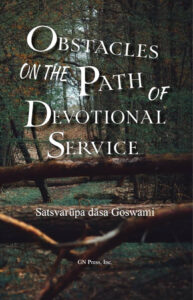
You mentioned that your pathway has become filled with stumbling blocks, but there are no stumbling blocks. I can kick out all those stumbling blocks immediately, provided you accept my guidance. With one stroke of my kick, I can kick out all stumbling blocks. —Letter by Śrīla Prabhupāda, December 9, 1972.

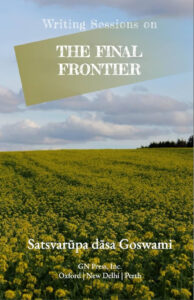
The Writing Sessions are my heart and soul. I’m trying my best to keep up with them. I am working with a few devotees, and they are far ahead of me. I wander in the wilderness of old age. I make my Writing Sessions as best I can. Every day I try to come up with a new subject. Today I am thinking of my parents. But I don’t think of them deeply. They are long gone from my life. Śrīla Prabhupāda wrote a poem when he was a sannyāsī, and he said now all my friends and relatives are gone. They are just a list of names now. I am like that too. I am a sannyāsī with a few friends. I love the books of Śrīla Prabhupāda. I try to keep up with them. I read as much as I can and then listen to his bhajanas.
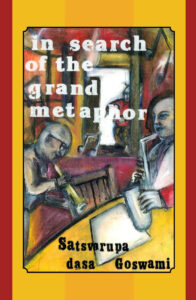
The metaphor is song. Explain it. Yes, particulars may not seem interesting or profound to readers who want structured books.
Wait a minute. Don’t pander to readers or concepts of Art. But Kṛṣṇa conscious criteria are important and must be followed. So, if your little splayed-out life-thoughts are all Kṛṣṇa conscious, then it’s no problem.
I am near the end of my days. But I do like the company of like-minded souls, especially those who are Kṛṣṇa conscious. Yes! I am prone to Kṛṣṇa consciousness. I have been a disciple of Bhaktivedanta Swami Prabhupāda for maybe almost sixty years. Sometimes I fail him. But I always bounce back and fall at his feet. It is a terrible thing that I sometimes do not have the highest love for him. It is a terrible thing. Actually, however, I never fall away from him. He always comes and catches me and brings me back to his loving arms.

This edition of Satsvarūpa dāsa Goswami’s 1996 timed book, Upstate: Room to Write, is published as part of a legacy project to restore Satsvarūpa Mahārāja’s writings to ‘in print’ status and make them globally available for current and future readers.
A factual record of the reform and change in ISKCON guru system of mid ’80s.

Readers will find, in the Appendix of this book, scans of a cover letter written by Satsvarūpa Mahārāja to the GN Press typist at the time, along with some of the original handwritten pages of June Bug. Together, these help to illustrate the process used by Mahārāja when writing his books during this period. These were timed books, in the sense that a distinct time period was allotted for the writing, during SDG’s travels as a visiting sannyāsī

Don’t take my pieces away from me. I need them dearly. My pieces are my prayers to Kṛṣṇa. He wants me to have them, this is my way to love Him. Never take my pieces away.

Many planks and sticks, unable to stay together, are carried away by the force of a river’s waves. Similarly, although we are intimately related with friends and family members, we are unable to stay together because of our varied past deeds and the waves of time.
To Śrīla Prabhupāda, who encouraged his devotees (including me) To write articles and books about Kṛṣṇa Consciousness.
I wrote him personally and asked if it was alright for his disciples to write books, Since he, our spiritual master, was already doing that. He wrote back and said that it was certainly alright For us to produce books.
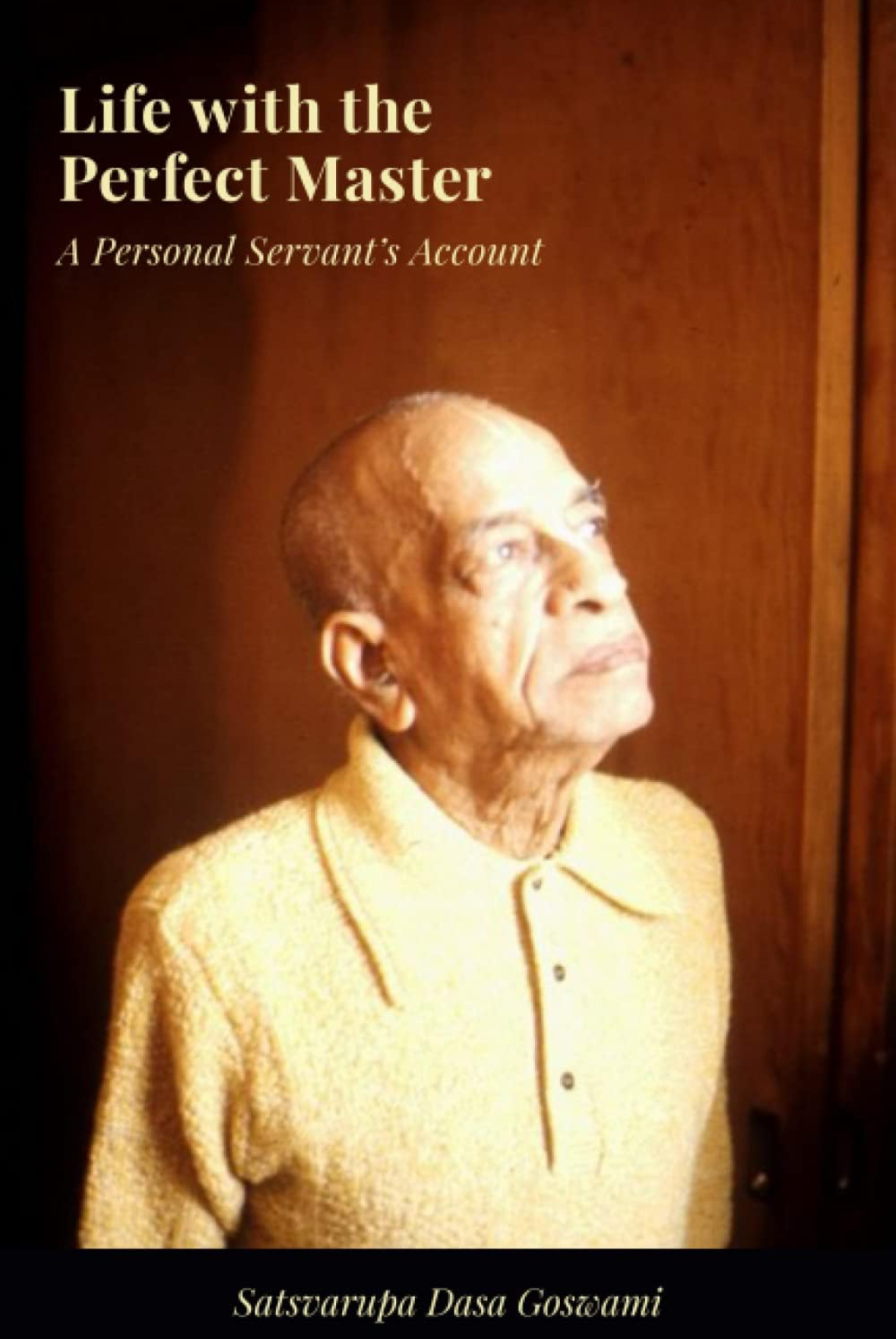
I have a personal story to tell. It is a about a time (January–July 1974) I spent as a personal servant and secretary of my spiritual master, His Divine Grace A.C. Bhaktivedanta Swami Prabhupäda, founder-äcärya of the International Society for Krishna Consciousness. Although I have written extensively about Çréla Prabhupäda, I’ve hesitated to give this account, for fear it would expose me as a poor disciple. But now I’m going ahead, confident that the truth will purify both my readers and myself.

First published by The Gītā-nāgarī Press/GN Press in serialized form in the magazine Among Friends between 1996 and 2001, Best Use of a Bad Bargain is collected here for the first time in this new edition. This volume also contains essays written by Satsvarūpa dāsa Goswami for the occasional periodical, Hope This Meets You in Good Health, between 1994 and 2002, published by the ISKCON Health and Welfare Ministry.

This book has two purposes: to arouse our transcendental feelings of separation from a great personality, Śrīla Prabhupāda, and to encourage all sincere seekers of the Absolute Truth to go forward like an army under the banner of His Divine Grace A.C. Bhaktivedanta Swami Prabhupāda and the Kṛṣṇa consciousness movement.
A single volume collection of the Nimai novels.
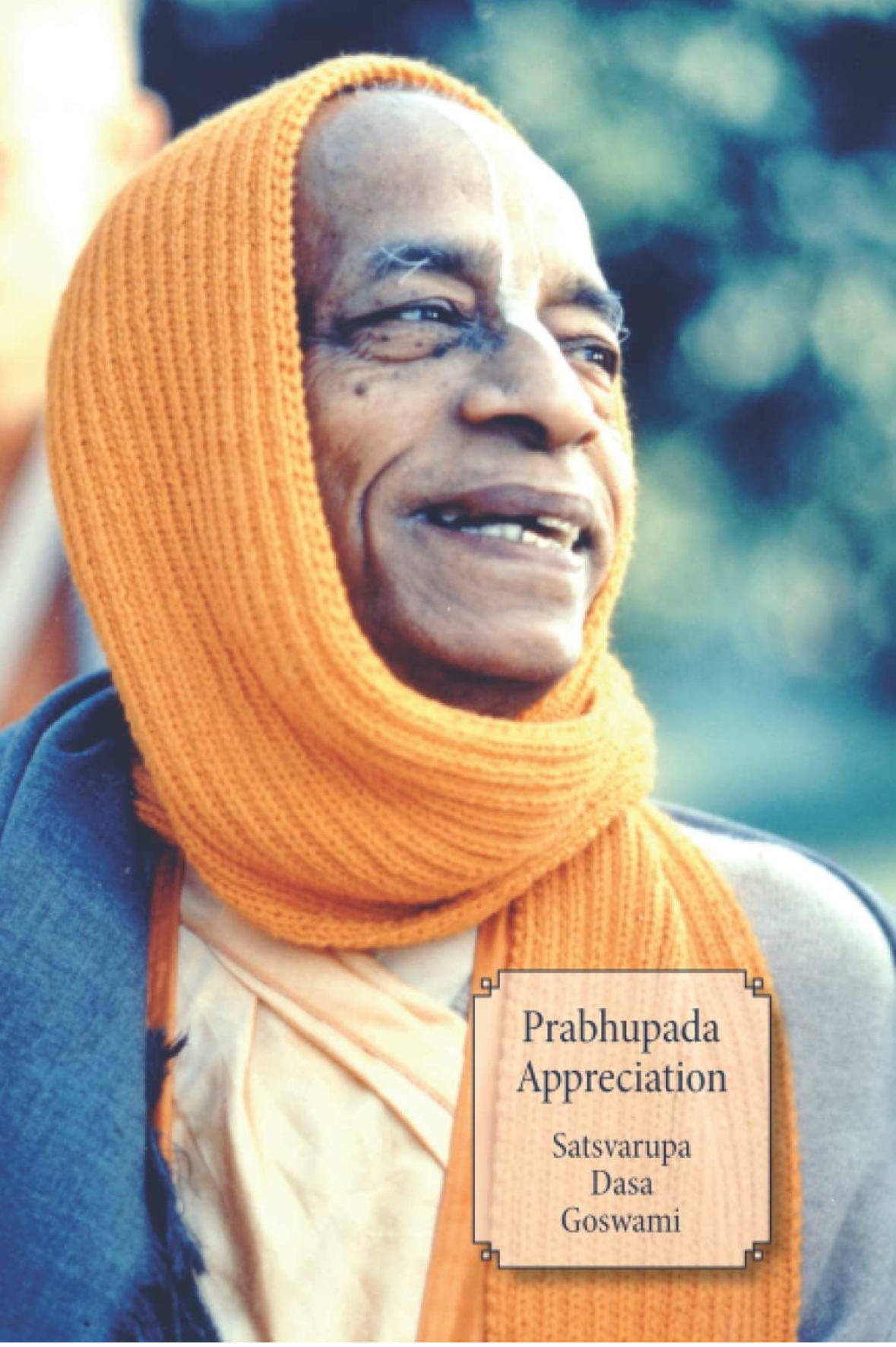
Śrīla Prabhupāda was in the disciplic succession from the Brahmā-Mādhva-Gauḍīya sampradāya, the Vaiṣṇavas who advocate pure devotion to God and who understand Kṛṣṇa as the Supreme Personality of Godhead. He always described himself as simply a messenger who carried the paramparā teachings of his spiritual master and Lord Kṛṣṇa.
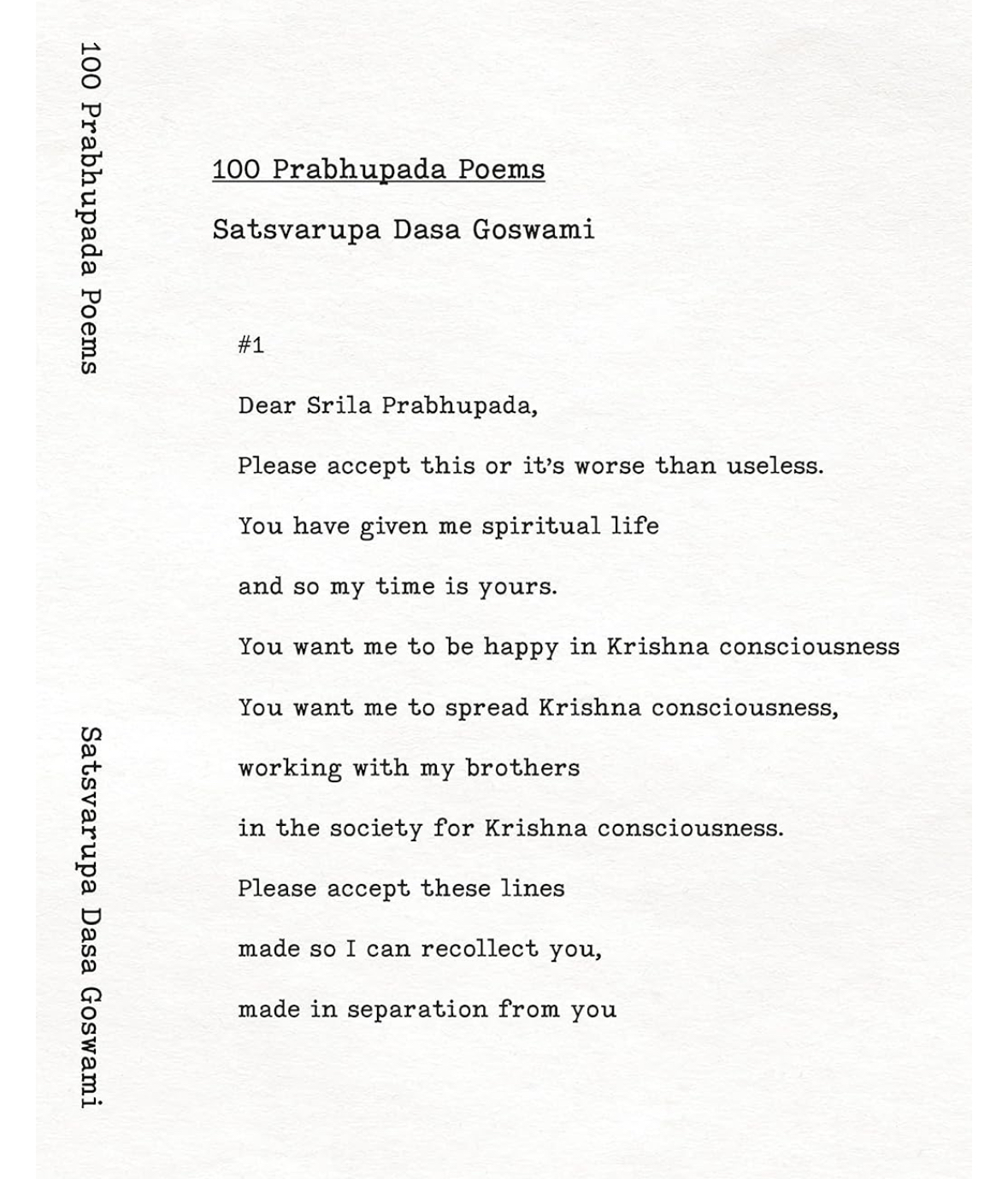
Dear Srila Prabhupada,
Please accept this or it’s worse than useless.
You have given me spiritual life
and so my time is yours.
You want me to be happy in Krishna consciousness
You want me to spread Krishna consciousness,
This collection of Satsvarūpa dāsa Goswami’s writings is comprised of essays that were originally published in Back to Godhead magazine between 1966 and 1978, and compiled in 1979 by Gita Nagari Press as the volume A Handbook for Kṛṣṇa Consciousness.

This second volume of Satsvarūpa dāsa Goswami’s Back to Godhead essays encompasses the last 11 years of his 20-year tenure as Editor-in-Chief of Back to Godhead magazine. The essays in this book consist mostly of SDG’s ‘Notes from the Editor’ column, which was typically featured towards the end of each issue starting in 1978 and running until Mahārāja retired from his duties as editor in 1989.

This collection of Satsvarupa dasa Goswami’s writings is comprised of essays that were originally published in Back to Godhead magazine between 1991 and 2002, picking up where Volume 2 leaves off. The volume is supplemented by essays about devotional service from issues of Satsvarupa dasa Goswami’s magazine, Among Friends, published in the 1990s.

“This is a different kind of book, written in my old age, observing Kṛṣṇa consciousness and assessing myself. I believe it fits under the category of ‘Literature in pursuance of the Vedic version.’ It is autobiography, from a Western-raised man, who has been transformed into a devotee of Kṛṣṇa by Śrīla Prabhupāda.”
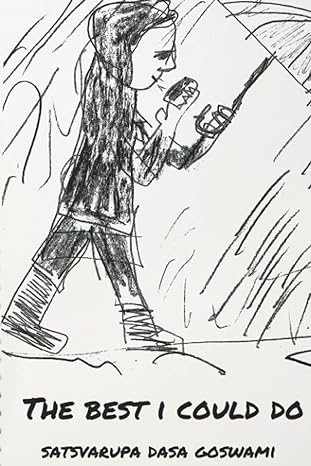 The Best I Could Do
I want to study this evolution of my art, my writing. I want to see what changed from the book In Search of the Grand Metaphor to the next book, The Last Days of the Year.
 a Hare Krishna Man
It’s world enlightenment day
And devotees are giving out books
By milk of kindness, read one page
And your life can become perfect.
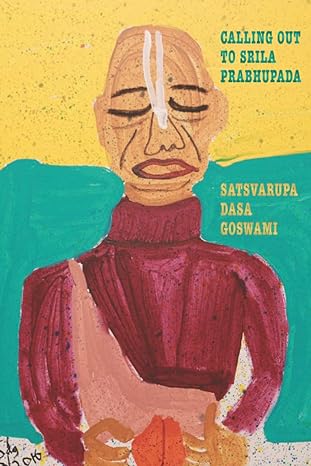 Calling Out to Srila Prabhupada: Poems and Prayers
O Prabhupāda, whose purports are wonderfully clear, having been gathered from what was taught by the previous ācāryas and made all new; O Prabhupāda, who is always sober to expose the material illusion and blissful in knowledge of Kṛṣṇa, may we carefully read your Bhaktivedanta purports.
I use free-writing in my devotional service as part of my sādhana. It is a way for me to enter those realms of myself where only honesty matters; free-writing enables me to reach deeper levels of realization by my repeated attempt to “tell the truth quickly.” Free-writing takes me past polished prose. It takes me past literary effect. It takes me past the need to present something and allows me to just get down and say it. From the viewpoint of a writer, this dropping of all pretense is desirable.
 Geaglum Free Write
This edition of Satsvarūpa dāsa Goswami’s 1996 timed book, Geaglum Free Write Diary, is published as part of a legacy project to restore Satsvarūpa Mahārāja’s writings to ‘in print’ status and make them globally available for current and future readers.