
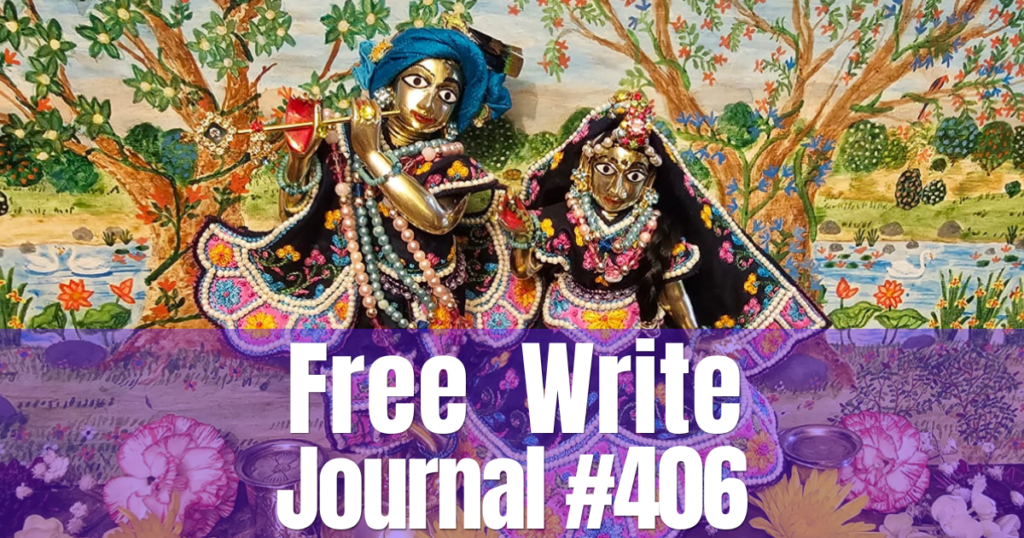
What
Meeting of Disciples and friends of SDG
Where
The Veterans of Foreign Wars Hall – 845 Hudson Avenue – Stuyvesant Falls, New York 12173
There is plenty of parking near the Hall. The facility is just a few minutes’ walk from SDG’s home at 909 Albany Ave.
Schedule
10:00 – 10:30 A.M. Kirtana
10:30 – 11:15 A.M. Presentation by Satsvarupa Maharaja
11:15 – 12:30 P.M. Book Table
12:30 – 1:15 P.M. Arati and kirtana
1:15 — 2:15 P.M. Prasadam FeastContact
Baladeva Vidyabhusana at [email protected] or (518) 754-1108
Krsna dasi at [email protected] or (518) 822-7636SDG: “I request as many devotees as possible to attend so we can feel the family spirit strongly. I become very satisfied when we are all gathered together.”
*******
Śrī Caitanya-caritāmṛta, Madhya-līlā 20.124–125: “O great learned devotee, although there are many faults in this material world, there is one good opportunity—the association with devotees. Such association brings about great happiness. . . . .”
Srila Prabhupāda: “Therefore, our Society is association. If we keep good association, then we don’t touch the darkness. What is the association? There is a song, sat-saṅga chāḍi’ kainu asate vilāsa, te-kāraṇe lāgila mora karma-bandha-phāṅsa (Gaurā Pahū, verse 3). Sat-saṅga. Sat-saṅga means association with the devotees. So the one poet, Vaiṣṇava poet, is regretting that, ‘I did not keep association with the devotees, and I wanted to enjoy life with the nondevotees. Therefore I’m being entangled in the fruitive activities.’ Karma bandha phāṅsa. Entanglement.” [Conversation with David Wynne, July 9, 1973, London]
We need to expand our team of proofreaders as we aim to increase the rate of republication of Satsvarūpa Mahārāja’s books as well as new books that he writes.
This includes a need for fluent bilingual Spanish and English speakers to proofread Spanish translations (we currently have around 20 Spanish translations waiting to be proofread).
Anyone interested in this particular service should contact Manohara dāsa at [email protected]
If you would like to help, please contact Kṛṣṇa-bhajana dāsa at [email protected] or [email protected] and we will find you a service that utilizes your talents.
It’s true that when there’s danger anyone who’s pious thinks right away of Kṛṣṇa. But if the danger culminates in death, then death is such a violent shock to the spirit soul in the body that he’s more preoccupied with that condition. It’s not the best time to chant Hare Kṛṣṇa. Although it is the most crucial time, the best condition we have is now.
******
Mercy means chanting Hare Kṛṣṇa. Of course, this chanting is available to anyone, but it has to be done in disciplic succession. It has to be under the guidance of a spiritual master. This is declared in all the scriptures. The worship of the guru means to chant Hare Kṛṣṇa under his instruction and to follow the regulative principles. This is the actual meaning of guru-pūjā: to follow his instructions is the life and soul of the disciple. And what are those instructions? Chant Hare Kṛṣṇa. Do not commit any more sinful activities. Your sinful activities are now removed by Kṛṣṇa’s grace. Now don’t do anything else sinful, but spend your time serving Kṛṣṇa with body, mind, and words. Chant Hare Kṛṣṇa and give your life to Lord Caitanya’s saṅkīrtana movement. Therefore when we say that if you just follow these four rules and chant Hare Kṛṣṇa sixteen rounds, and you go back to Godhead, that cannot be minimized. But it means you have to do it as all in all.
******
I was just thinking today about my beads. Someone said they were going to get me tulasī beads. And I was thinking, “But these beads have been chanted on by Śrīla Prabhupāda.” Then I thought, “But my beads are so worn out. The paint is worn off.” But what is more important in a devotee’s life than his beads, and that his spiritual master has chanted on them. The spiritual master who gave him Hare Kṛṣṇa has also chanted on his beads. They are blessed. It’s a benediction. Just like mahā-prasādam. Something used by the spiritual master is worshipable. So that’s the significance. And it’s something you can feel. We are appreciating that now. It’s fourteen years since he did it—he only did it once—but they become sacred. Not only has his spiritual master chanted on those beads but he’s asked him to chant nicely. So he should follow the instructions as he chants.
******
We have been given this human form of life with the tongue and the ear just suitable for chanting Hare Kṛṣṇa. So try to concentrate on the sound when you chant. If it takes you a little more time to chant, then chant in the time that you need, and then later you can chant faster. But do not make a problem for the other devotees that you chant too long and cannot do any service.
******
A devotee who is trying to make up for his offensive chanting should offer prayers to the holy name. Also, he should specifically express regret that “I have not appreciated Kṛṣṇa up to now, although He’s so glorious, so kind to come in His holy name. Now I am trying to understand His actual position, my actual position, and take shelter in the holy name.”
******
The Hare Kṛṣṇa mantra has to be received from a spiritual master in the disciplic succession. Of course, anyone can pick up the mantra from a book or he can hear it and that is good and he can benefit in that way. But when one seriously wants to chant Hare Kṛṣṇa to go back to home, back to Godhead in this lifetime, he has to receive the mantra in disciplic succession. Just like Lord Brahmā, he was the first living entity and he received the Hare Kṛṣṇa mantra from Lord Kṛṣṇa directly. And now in disciplic succession from Lord Brahmā, we have to receive from the spiritual master. It cannot be just taken without a spiritual master or by some concoction as to who is the spiritual master.
******
Kṛṣṇa likes to hear His name chanted. It is simply a natural thing. If a little child calls his father’s name, the father does not feel that out of humility he should not be pleased or that out of false ego he should become puffed up. Rather, it just touches his heart. Of course, I do not know what Kṛṣṇa’s mind is or how He is pleased by the devotees. But I have given an example of how it works even in human affairs—that one likes to hear his name called by a lovable relative. At any rate, we should not only believe the śāstra that Kṛṣṇa likes to hear His name, but we should rejoice to know that we can please Kṛṣṇa in such an easy way.
******
Rūpa Gosvāmī has said, “There is nothing sweeter in life than chanting the holy name.” Otherwise how could Lord Caitanya experience such ecstasies? It is actually the ecstasy of the soul in union with Kṛṣṇa. The Bhāgavatam declares that unless you experience these ecstasies, then your heart must be steel-framed.
pp. 243-48
Ripping tall grass for Yamuna. On the way out of the cottage I saw a Back to Godhead magazine on the porch. On the cover was an illustration of Bharata Mahārāja dying while embracing the deer. In his next life, he had to take the body of a stag.
“Spiritual Falldown: Why Does It Happen? What Can You Do About It?”
“Straight-edge Youth: Taking Shelter in Kṛṣṇa.”
An ant is on this white bench with me. A fly is here too. We will part and go our separate ways.
Counting down. I can see what I will not accomplish in the remaining days. I am reading Radha-rasa-suddha-nidhi slower. It is too rich to go quickly.
Will I think of Wicklow grass when I am in Vrndāvana? Will I hanker for these morning walks? Maybe.
Just looked at Pilgrimage: Field Notes from a Pause during Govardhana-parikrama. Then a few sentences at Rādhā-kunda. I clung to the Śrīla Prabhupāda pranama mantras and said, “I know nothing.”
No one can “become” a follower of Rupa-manjari unless He makes arrangements. He appears to be making these arrangements.
Wild flowers blowing to and fro on the hilltop. The sheep bleat and cry; they are killed and new ones are born year after year. The human owner dies too, and his sons take over until they die. No one is here long enough to see it happen. We hear a sheep bleating and it touches us. We feel a breeze like a caress and then it is gone. Someone is sensitive to it and writes a poem like Sandburg’s “The Grass.” Meditations on mutability and mortality. Devotees go beyond that.
This is a late start.
Lord of life—finding You wherever I go is a reason to walk on the empty lane in the morning.
Devotional activity can consist of many things. Arjuna fought on the battlefield, and so did Hanuman. Śrīla Prabhupāda would cite them as examples. Don’t be a “do-nothing” Vaisnava, he would say, but don’t be active-foolish like the monkeys. Be lazy-intelligent.
Prabhupāda dasa wrote me a letter. He trusts me in my solitary bhajana. He says, “You are not ‘just a babaji’ because you produce books. And when we see you on Saturday, you sound good and answer questions. Go on walking and talking; go on deeply into your sadhana.”
Don’t disappoint them. I pray not to lose my standing. It is a prayer for survival. I have asserted that I won’t fall down, but I turn to Sri Kṛṣṇa to validate that boast.
“Yes,” one woman wrote, “we heard that Śrīla Prabhupāda also prayed to Kṛṣṇa that he not fall into maya, so I guess it’s all right if you do it too. But I was wondering, are you a full spiritual master?”
Am I fully surrendered? Am I fully asking for Kṛṣṇa’s help? Am I proud, thinking myself the doer? Only Kṛṣṇa and His fully surrendered Vaisnava is all-powerful. I can only follow the path they chalk out. I cannot claim I won’t be blown down by a hurricane. Yet I am taking precautions, learning to hang on.
Is it too much to ask to live outside the temple and the temple schedule for four weeks in Vrndāvana? I asked for it, and now I am waiting to hear their answer. I will live for constant prayer and writing bhajana. It is a frail existence.
List so far for next (and last) phone call with Baladeva before he leaves for Vrndāvana:
Number three is more important than new kurtas and slippers. Oh, but what if someone steals Prabhupāda’s books while we are out or, even while we are there, takes his books from us at gunpoint? (Only in India would dacoits see value in such books.) Well, that may happen, but what can I do? When Lord Caitanya said He wanted to go at once to Nilacala, the devotees said, “Not now. Wait until the war is over.” He replied, “Obstacles may be there, but I must go.” Then Advaita Ācārya replied honestly that if Lord Caitanya desired, then all the obstacles would be removed: “Now that You have made up Your mind to go to Nilacala, any time you leave will be auspicious.” The Lord was pleased to hear the truth spoken so plainly by Advaita, and He acknowledged it by loudly chanting, “Hari! Hari!”
Later in Orissa, Lord Caitanya and His party were stopped by a tax man who asked Him, “How many men are with You?” He replied, “I do not have anyone in this world and I do not belong to anyone . . . The entire world is Mine.”
But this has no bearing on my situation. I am just a scared, uncertain sannyasi. I want to be with my Godbrothers, but just a little apart from them to constantly read and write for a few weeks. I will take whatever I can get. I need protection. I am not a rebel or deviant or an upstart. Ask and see what they say.
The devotee said, “I’ve had trouble reading your books because you are always justifying yourself in a public forum and writing about stuff that seems too internal to me. But in Shack Notes, I came to see that you are compelled to write, and if this is how you need to do it, I say please go ahead because we don’t want you to stop. Your honest books help us.”
Thank you.
pp. 58-62
I am content that these pages show me to be what I am—noisy, full of the racket of my imperfections and the wide-open wounds left by my sins. Full of my own emptiness. Yet, ruined as my house is, You live there!
The devotees were so busy they didn’t have time to chant their rounds. She said she had a two-hour discussion with a Godsister. Her spiritual master asked her to write him a letter. Two days went by, and she didn’t write the letter. When he asked her whether she had changed her mind about writing the letter, she laughed heartily. She said she would try to do it later. She was in the midst of cooking for half a dozen devotees. Devotees are so busy!
Lunchtime at the āśrama is a high point of the day. The cook becomes the server and describes each preparation as she places it on the dish: “Broccoli soup (hot) seasoned with lime juice, green upma and Irish soda bread, in honor of the day, March 17th, fried potatoes.”
The spiritual master is from New York City. With material parentage from Ireland; he chanted the prasādam prayer, not in Bengali but in the English translation that Swāmījī taught him, beginning, “This material body is a lump of ignorance,” and the prayer ends with a blessing … “Let us glorify Their Lordships Rādhā and Kṛṣṇa, and in love call on Lord Caitanya and Prabhu Nityānanda to please help us!” After a full meal the cook, who is one hundred percent Irish, distributes delicious dessert, and some of the devotees take two or three helpings. Ice cream cones have become a current favorite. The cover of the mint-chip ice cream is green.
******
“… One can get rid of all these material pains only when he takes shelter of the chanting of the Hare Kṛṣṇa mantra … All persons in this material world are suffering from material pains, and if one wants to get rid of them, he must associate with saintly persons, pure devotees of the Lord, and chant the mahā-mantra Hare Kṛṣṇa, Hare Kṛṣṇa, Kṛṣṇa Kṛṣṇa, Hare Hare / Hare Rāma, Hare Rāma, Rāma Rāma, Hare Hare. This is the only auspicious way for materialistic persons.”
—Śrīmad-Bhāgavatam 4.22.15
******
“Material affairs have been compared to an ocean of poison. They have been described in a similar way by Śrīla Narottama dāsa Ṭhākura in one of his songs:
“My heart is always burning in the fire of material existence, and I have made no provisions for getting out of it.
golokera prema-dhana, hari-nāma-saṅkīrtana,
rati nā janmila kene tāya“The only remedy is hari-nāma saṅkīrtana, the chanting of the Hare Kṛṣṇa mahā-mantra, which is imported from the spiritual world, Goloka Vṛndāvana. How unfortunate I am that I have no attraction for this.”
—Śrīmad-Bhāgavatam 5.1.22, purport
******
Śrīla Prabhupāda: If you would like to cooperate with us, then go to the churches and chant, “Christ, Krsta, or Kṛṣṇa.” What could be the objection?
Father Emmanuel: “There is none. For my part, I would be glad to join you….
Śrīla Prabhupāda: “I think the Christian priests should cooperate with the Kṛṣṇa consciousness movement. They could chant the name of Christ, or Krstos, and they could stop condoning the slaughter of animals. This program follows the teachings of the Bible; it is not my philosophy. Please act accordingly and you will see how the world situation will change.
—The Science of Self-Realization, Chapter 4
******
The devotee of the Lord, because of manifesting godly qualities, is called a demigod, whereas the atheist is called a demon. The demon cannot stand in the presence of Viṣṇu, the Personality of Godhead. The demons are always busy in trying to vanquish the Personality of Godhead, but factually as soon as the Personality of Godhead appears, either by His transcendental name, form, attributes, pastimes, paraphernalia or variegatedness, the demon is at once vanquished. It is said that a ghost cannot remain as soon as the holy name of the Lord is chanted.
—Śrīmad-Bhāgavatam 1.19.34, purport
******
“The calves that were pasturing nearby entered into the deep forest, allured by new grasses, and gradually went out of sight. When the boys saw that the calves were not nearby, they became afraid for their safety, and they immediately cried out, “Kṛṣṇa!” Kṛṣṇa is the killer of fear personified. Everyone is afraid of fear personified, but fear personified is afraid of Kṛṣṇa. By crying out the word ‘Kṛṣṇa,’ the boys transcended the fearful situation.”
—KṚṢṆA, Chapter 13
******
“If one can chant and hear Hare Kṛṣṇa and always remember Lord Kṛṣṇa, then he is sure to become fearless of death, which may come at any moment.”
—The Nectar of Devotion, Chapter 2
******
“… Therefore, we should not forget the chanting of the Hare Kṛṣṇa mantra under any circumstances. It will help us in the greatest danger, as we find in the life of Gajendra.”
—Śrīmad-Bhāgavatam 8.3.1, purport
******
“The chanting of Hare Kṛṣṇa, Hare Kṛṣṇa, Kṛṣṇa Kṛṣṇa, Hare Hare / Hare Rāma, Hare Rāma, Rāma Rāma, Hare Hare should be continued without stoppage. This will protect a devotee from all accidental falldowns. He will thus remain perpetually free from all material contaminations.”
—Bhagavad-gītā 9.31, purport
******
“Material life is temporary, and so the ups and downs of life may come and go. When they come, one should be as tolerant as a tree, and as humble and meek as a straw in the street, but certainly he must engage himself in Kṛṣṇa consciousness by chanting Hare Kṛṣṇa, Hare Kṛṣṇa, Kṛṣṇa Kṛṣṇa, Hare Hare.”
—KṚṢṆA, Chapter 90
******
“The process of chanting is herein authorized as the direct method of contacting the Supreme Absolute Truth, the Personality of Godhead. Simply by chanting the holy name ‘Kṛṣṇa,’ the soul is attracted to the Supreme Person, Kṛṣṇa, to go home, back to Godhead.”
—The Science of Self-Realization, Chapter 3
******
“I do not know how much nectar the two syllables ‘kṛṣ-ṇa’ have produced. When the holy name of Kṛṣṇa is chanted, it appears to dance within the mouth. We then desire many, many mouths. When that name enters the holes of the ears, we desire many millions of ears. And when the holy name dances in the courtyard of the heart, it conquers the activities of the mind, and therefore all the senses become inert.”
—Vidagdha-mādhava 1.15 by Śrīla Rūpa Gosvāmī,
quoted in Śrī Caitanya-caritāmṛta, Antya 1.99
******
“Reciting the glories of the holy name, and even more, chanting the syllables of the Hare Kṛṣṇa mantra, purifies one from material thoughts, purifies the mind, and brings one to the stage of love of God.”
“… God will wash away all our tears … He always has …
He always will.
Seek Him every day.
In all ways seek God everyday.
Let us sing all songs to God
to whom all praise is due …
praise God.”
A nonbeliever challenged Śrīla Prabhupāda:
“What is your siddha-deha
(your eternal identity)?”
Prabhupāda replied by reciting
the third verse of Lord Caitanya’s Śikṣāṣṭakam:
tṛṇād api sunīcena
taror api sahiṣṇunā
amāninā mānadena
kīrtanīyaḥ sadā hariḥ
“One should chant the holy name of the Lord in a humble state of mind, thinking oneself lower than the straw in the street; one should be more tolerant than a tree, devoid of all sense of false prestige, and should be ready to offer all respects to others. In such a state of mind, one can chant the holy name of the Lord constantly.”
pp. 8-10
Alligators advises us to take a look at what may be false in your work (writing) and in our life. She suggests that right next to it may be a big truth that we are seeking. I’m not exactly sure I understand this. But certainly there is falsity in me. I guess I don’t go deep enough, as in my claim to be seeking honesty. It’s difficult to live in ISKCON and still be yourself, but I am trying to do it. I can’t be reckless. What is false in me? Is my renunciation false? Is the whole “guru trip” a falsity? My whole stance to be a writer? Is it false that I claim I have headaches and can’t see people, that I don’t want to initiate anymore? Claim that I am after the inner life and therefore don’t take part in shoulder the managerial burden of ISKCON with Godbrothers and the nitty-gritty of temple life? Is my avoiding this (on the plea that I am seeking basic prayer life) something false?
But if so, then what is true? I can be so simple as that to admit that I am wrong and that others are right about me. But there may be something false the way I am going about it. What is that false not in my work that may lie only a few inches away from the big true note I want to strike?
Ah, is my profession of dedication to Prabhupada a false one? Certainly it’s not untrue to want to be loyal to him, but in my attempt to do it I may be hitting some false notes. Sure, it’s likely. I don’t even know for sure what it is. Seems others do tell you easier than you could spot it yourself. Listen to what they say about you. They say I talk about myself too much. They say I treated Srila Prabhupada as an ordinary man in the biography. They say that I have outright turned against him by becoming a spiritual master although unqualified and stealing devotees away from their rightful connection to him. I defy this claim of theirs, and I’ll stand by my service, but what is false in it? I think there are false notes in my “sincere” letters. And in my rushing to print with books that are of inferior quality. Something false here in the way I slink around like a recluse and claim I am doing important work for the ISKCON movement.
Okay enough of this. It’s just a tearing down session. I’ll have to think about it, because the whole concept of big lies in my work doesn’t hit me. I’ll ask Prabhupada and Krsna to explain what it means to me. I don’t want to be a walking and talking lie. I don’t want to be a liar. But who can face the 100 percent truth? Well bub, that’s why you come alone to get peace and order so that you can face these truths, truths about yourself and the world. Okay I’ll do it, at least I won’t be afraid to admit it in this writing which is supposed to be private. If my typists blush or are sorry to hear me admit falsehood (if they don’t believe I am as false as I say, and even if I don’t believe I am as false as I say)—at least I’ll write down what may be wrong about me, and then evaluate later whether it’s true. But if you keep worrying about your immortal memoirs are going to look in the future, then you won’t be able to come out with anything more that “noble toilet water.”
Alligators talks about not knowing. We don’t know if what we wrote will come out right or false. We may never know. But we go ahead despite these doubts, with trust in the passion of writing. I hope I don’t have trust just in some passion. My darkness, that of which I am not sure, is whether this is pleasing to guru and Krsna. In one sense we always have this and have to live with it. We suppose that the food we offered was accepted by Krsna. We have faith in the words of the spiritual master and sastra about that. We have faith when we chant that it is going to Krsna because He is in His name.
But I don’t know how much my chanting struggle pleased the Lord, or perhaps it displeased Him. I have to live in some darkness about that. I have a faith, and only a little tiny direct realization—or actually no realization at all. I hope Krsna will forgive me for being so slow as to have no realization, no direct experience of the scent of His lotus feet. I am willing to go on in this darkness because it is not the unknown tamoguna. It is really not a darkness, it is a dawning not clear yet. I am full of hope.
pp. 48-52
The maha-prasadam was a morsel of dried halava. I knew it would be blissful, so I didn’t gulp it. I worshiped it first. My prison practice has been to imagine opulent offerings for the Deity, but since it is all done in my mind, sometimes the offering suddenly disappears and I can’t get back to it. I will be preparing sweet rice in one pot and steaming sabji in another pot, when suddenly my mind goes to some past demoniac scene, eating meat or laughing at Vaisnavas and so on. Or I just space out and the offering gets forgotten. And as for the daily slop they bring us, it’s hard to “honor” it. Still, I do it. I thank Krsna for providing us the bhakti method whereby we can give Him our devotion with prayers when we eat. I recite the Sanskrit and then I say to Krsna that I know we would be eating lumps of sin if we didn’t offer the foodstuff with prayers. I ask Him to let the prayers be more important to me than the sense gratification of eating afterwards, and I ask to be able to honor the prasadam.
I have taken only a pinch of the halava and I’m saving the rest. Suffice to say the halava prasadam is one of the best things I’ve ever tasted, and it was just a tiny pinch. Maha-prasadam-seva ki jaya!
Indrajit came to see me again in the early evening. He sat on the floor just outside my cell and spoke in a soft voice. He is particularly impressed by Hiranyakasipu’s palace, which he had never entered before.
“The steps is made of coral,” he said, “is that whatcha call it? There’s them bright green things all over the floor, and the walls are real shiny. The people’re all decked out in fancy silks, even the boys. They even got gold bracelets and stuff.”
“So the boys are your friends now?” I asked. “Did you see Prahlada Maharaja?”
“Yeah! He was dancin’ with his arms raised up. He had a flower garland with roses in it. He was singin’ and we all danced round him. I never seen demon boys like that!”
“Did you talk with them?”
“Yeah, but I mostly listened. I ain’t able to understand so good. But I like dancin’ and singin’ Hare Krsna. And they gave me some food. Hey, Mr. Harsasoka, what’s an atma?”
There are usually a few bars of sunlight filtering down to the dungeon, and at night it grows dark. In the almost total darkness, I told Indrajit about the atma, the spirit self. Then he asked about Paramatma. I told him he had a good memory for the words. Paramatma, I said, is the Supreme Soul from whom everything comes. And He kindly resides in each person’s heart to guide us. We have to turn to Him.
“Can ya do it even down in this rat hole?” he asked.
“I try.”
“And what’s a sastra?” Indrajit asked.
“The holy books given by Bhagavan, the Supreme Person. They are perfect, not like the books an ordinary person writes. We can learn everything from sastra.”
“What’s the difference between demons and devotees?”
“There is no difference in spirit. Both are sons or daughters of Bhagavan. But demons don’t obey the Lord. Devotees obey Him. Like you and me, we are demons according to the bodies and families we belong to, but if we act as devotees, then we are no longer demons.”
“What is eke-wa-poised.”
“When you don’t get disturbed even in a bad place. When you see all people equally. Only one who knows the Paramatma in all persons can be equipoised.”
Krsna has rewarded me with prasadam, and now with preaching to Indrajit. I am not able to preach to the big guys, but this pint-sized demon is the right size for me, a perfect recipient. Thank you, Lord Krsna, thank you, Prahlada Maharaja, and thank you, Daityaji for bringing home the teachings of Narada Muni to your covered-over father.
******
Indrajit has continued to visit for the past three nights. He brought me a small piece of silk which he said was a piece of Prahlada Maharaja’s chadar. Another note from my son and my wife. Another morsel of prasadam. And more earnest questions about things he has heard directly from Prahlada but doesn’t understand.
“Hey, Mr. Harsasoka, what’s it mean when Prahlada says, ‘O sons of the demons, your duty is to take to Krsna consciousness, which can burn the seeds of fruitive activities?”
“The seed means our material desires. Say you burn down a field of dry grass. It will grow up again next season. So if you stop the horrible acts of the asuras, that’s good, but later you will do them again unless you take out the ‘seeds’ and burn them. Krsna consciousness can do it.”
“What is the ka-la-ca-kra?”
“Time is like a wheel, Indrajit. It rolls over us and cuts us to pieces and kills all our gains of a lifetime. Even Hiranyakasipu will be destroyed by the kala-cakra. And after one life, we have to take another life according to our karma, and again in that life, we lose everything at death. It’s an endlessly rolling cycle, like a wheel, kala-cakra.”
Indrajit and I always speak as quietly as possible, but one of the prisoners overheard us. He called out in the dark, “Knock off that shit.”
“Indrajit,” I whispered. “I hope you never forget these lessons of Prahlada Maharaja. I hope you take them to heart. Be careful and protect them as your most valuable possession.”
“Yeah. I’ll do it, Mr. Harsasoka. I gotta go now. Haribol.”
The next day when Indrajit’s father passed by my cell, he said that his son wouldn’t be coming to see me anymore. “I know he’s been sneakin’ in here,” he said, “but someone complained. So no more.” The guard figures it is good for his son to mix with the boys in the palace, but he knows Prahlada’s position is uncertain, and he’s wary. But I doubt that he knows how much has transpired between myself and his hard-faced little son.
So another promising relationship has ended. How soon all the relationships of a lifetime will come to an end! Krsna save me and protect me!
pp. 12-15
I seek assurance that what I am doing is important. I just read in the ISKCON World Review of devotees chanting in Sarajevo and being attacked by a gang with knives. Certainly, the devotees think it’s important to chant and give out food there. In the same IWR I read of the important one hour-long TV show put on by ISKCON scientists and how they sold many books and stirred controversies against Darwin’s theory. That is obviously important preaching, bolstered by quotes from Prabhupāda, who said the Bhaktivedanta Institute was most important. I know my books have some effect on readers. As for this bridge I start now, I can’t be sure. It may be just a little rope-bridge over a creek or it could turn out to be something longer, a life’s work (in Vṛndāvana, January, 1996) and I got it, A Poor Man Reads the Bhāgavatam. After 1,400 pages, almost three volumes of that, I’m taking a break from it. Doing what comes to me. So far it has been a collection of sessions I called May Apples and then another diary, Basic Sketchbook. Each one lasts for not much more than a week. Now again I get restless and start off.
The main thing is not to try to judge the importance in an external sense, but burrow as deeply into the process as you can. (Yes, like a mole in the earth, with his little nose and sharp teeth and claws, pushing aside the earth as fast as he can, a little bit at a time, in his subways.)
To penetrate, to ask the questions, not to be afraid. To look for art and to sometimes throw off art. To make writing important in my own life. And then to realize that I can’t go back to Godhead by force of my pen. I need to read the books of His Divine Grace and call to Kṛṣṇa as Prahlāda Maharaja does, “When will You call me back to Your lotus feet?” Keep going, mole. You’ve got a couple of busy days here in Boston, and you haven’t even finished your Basic Sketchbook. After that, you’ve got five days in Saratoga, New York, and then there will be a big break in the mood as you go to New York and catch the British Airways flight that takes you to Ireland (and out of the summer of North American festivals).
So, whatever I get going in Saratoga will probably be interrupted, and I’ll have to start a new one in Ireland. That will be June. All of June to write there, an Ireland-based timed book of one who is writer-in-residence.
Assurance that what I do is important. You have to pray. I just received a letter from a devotee here asking me to help her “concentrate and become more internal while doing book distribution.” She says, “Certainly saṅkīrtana cannot be done automatically.” She wants to know how to pray, and not only when on saṅkīrtana, “but at every step of my life, because it is essential to feel helpless and dependent on the Lord’s mercy.”
How to pray? Does she think I know how to do it at every moment? Do I have a reputation for talking about that? Dear little sister, you do it like this, you interject the “Kṛṣṇa prayer” at every step, at every moment say Hare Kṛṣṇa, Hare Kṛṣṇa and when not out loud then in your mind. And when I write …
You say you want assurance it’s important. That might sound terribly puffed-up, but I don’t mean it that way. Make a humble offering, pray at every step that your offering is acceptable. Hare Kṛṣṇa, Hare Kṛṣṇa. You could pray always reciting the mahā-mantra. Increase your rounds. Chant mentally. People are trying things like that. But if I decided to spend so much time writing then I must learn how to “chant Hare Kṛṣṇa” while other words come onto the page. I tried writing the mantra over and over, called it Japa with Pen. But it felt mechanical. Someone said it looked like the punishment teachers gave kids in school, to write something over and over.
I want to be aloof from strife, from problems. Run away from it? Paul Valery was criticized for writing poems in France during World War II. (Did they want him to engage in politics in the resistance movement?) In reply he said that he was certainly unhappy, but that he to go on in his duty of practicing art.
I want to go alone upstate and write. But what will you write about if you’re tuned out from the latest news? I can write: Dear Self, I have come to a room where there is a large dog barking next door and my secretary just said, “I have to pass on this information to you.” But in spite of it, I am writing—the search for the authentic self. What?
To pursue the self for … to write the words that come. Play surreal games. Imitate poet-masters who are not devotees. Listen friends, I say to you I have come upstate for five days to write and to read my master’s books. I want to read his books and reassure myself that I am satisfied here. To learn methods once again, each day of how to do it. In one book on the artists Bonnard and Matisse, the editor said they loved art but that they weren’t trying to achieve great paintings but to practice art everyday as a religious vocation. He said that art is “grim,” something you have to face every day.
pp. 18-23
Śacī-suta, the chief man at Viraha Bhavan, asked me a teasing question this morning. He knows I have been working intensely with my expert editor, Kṛṣṇa-bhajana, and I have received much benefit from it. But now my editor has temporarily gone away on a traveling mission. So, Śacī asked me, “Are you going to be able to write well without your editor?” His voice took me aback, but I managed to say something like, “Oh, I will push on.” It’s true it will be difficult working without Kṛṣṇa-bhajana. But I have been writing for so long in my life that I think I can pull out and continue writing, just as I have for over fifty years. Can I still do competent writing?
I think I can do it as I have for so many years. But I have grown old (eighty-five years old), and I have learned to depend on my editor in my later years.
Let me hold on to my determination and continue the writing I have done for so long and have depended on. I will think of a new story/essay and pull through. My editor has had much trust in me. He thinks I am a competent writer by my own powers. I have written two hundred or three hundred books without much editorial help. So, I will grit my teeth, and finish my life with final good writing. Can I be so confident? I will pray to Kṛṣṇa for strength and grace. It is He who has enabled me to write so many books, which have been recognized as decent. Now let me go the last miles and continue without hesitation. I have prayed to Kṛṣṇa to produce legible writing. And I have had some success. It is all due to the Lord’s mercy. Let me finish my days with legible books, books which I’ve had to make a decision. I have prayed for this and had some success. May the Lord leave me a legacy that He will be proud of. That is what I want most in my sojourn in the world.
In the middle of this writing poem, John Endler phoned. He threw his praises on me, and I thanked him for it very much. He is a true pastor and a true admirer of my books. I told him about Kṛṣṇa-bhajana and how we have our relationship, and how there are some tensions, that he wants me to do better.
John Endler is a good soul
he picked me up with his short
talk we had on the phone.
He made me think I could make it
the last miles with decent writing.
Thank you, John Endler.
Thank you, Kṛṣṇa-bhajana.
Will I ever really make it?
Will their words come true
and my writing stand worthy?
I told him that I am in my last days
and trying to make a legacy.
I told him that I want to go out with a bang.
John Endler laughed at that.
He referred to my books,
which have free-write in them like
Forgetting the Audience and Shack Notes
and others. Yes, Satsvarūpa,
you go out with a bang.
That’s what he told me.
I’m trying to make my last words worthy.
I’m not bragging.
I’m just praying to the Lord with my last words.
Please let them stand up.
John Endler reminded me that although I write books somewhat like a free-writer, I always make sure it’s spiritual fare. I pray to Kṛṣṇa through my words. I don’t leave it mundane. Prabhupāda has taught me everything, and whatever I’ve learned from teachers like Natalie Goldberg, all of that, it is minor. My real teachers have been Prabhupāda himself and spiritual writers.
It was nice talking to John Endler, even for ten minutes. He picked me up and made me think I can go out with a bang. There’s nothing as swell as writing for the Lord. There’s nothing as beautiful as the Lord Himself. There’s nothing as wonderful as trying to write for Kṛṣṇa and making some success. There’s nothing as beautiful as trying to please the Lord.
If you please Him, you’re successful,
His pleasure is the only reward worth seeking.
I was glad to talk to John Endler
for at least a few minutes. He told me
that he loves me and that
he loves my writing.
John Endler, pastor of the Dutch Reform Church in Connecticut / Kṛṣṇa-bhajana, editor premier to those who seek excellent writing—May I go out with a bang! May I go out with a whimper if they wish. But may I go out loving Kṛṣṇa. That is the only wish I have in this world. Let me write poems.
I often think of my sister Madeline
who died when she was fifty
while I am now eighty-five years old
I ask Kṛṣṇa to forgive me
for being cruel to my sister
but it was too late.
My stomach blew up.
I keep thinking of Madeline
and how she ate too many sweets.
I think of my sister, Madeline
and sometimes I cry tears for her.
She was a pretty girl
and we played games together.
I frequently think of my sister
and wish she was back again.
She died when she was fifty years old,
a very pretty woman.
Now I am eighty-five
and it’s too late now.
I often think of my sister
who died when she was fifty years old.
I write this now in my eighty-fifth year,
and I often feel for her, in my eighty-fifth year.
We were siblings.
I tried to write some poems today, but they weren’t so successful. I had some memories of my sister but couldn’t conjure them up very well. I will go on writing the best I can. Now I have to stop writing and turn to the schedule and do my best to sleep, or talk in my sleep. Other people may not like so much to read or write, or read others’ writing. But I am tied to it. I wish I could like more to read others’ writing, but at least I like to read my own writing. And I look for satisfaction from others. I like to please readers, and I especially like it when my coach finds my reading pleasant and to his satisfaction. I’ll stop now and start again in the morning, writing some more, maybe a kind of continuation of what I’m doing now, writing freely, “free-writing,” writing spontaneously and give it to the world. The most important thing is to please Kṛṣṇa. I will do that in the few seconds that I have left before I have to go to sleep. Then I’ll draw a line, skip lines, and proceed with writing for January 29th. I hope it will be some continuation of what I am doing now. I sometimes have differences with the monitor here. He wants me to go to sleep on time. But I want to go on writing. Anyway, that’s all for now. I have no other time. All glories to Srila Prabhupāda, for whom I write. All glories to Sri Kṛṣṇa, who is the object of my satisfaction. All glories to all the great devotees of the world who try to please Kṛṣṇa. I am doing my best and will continue writing until I have no more energy and no more creativity in my body. I will go on writing until it is no longer creative, until it is no longer filled with the drive of loving Kṛṣṇa. I will go on writing until they take the Dictaphone from my hand and say, “That’s enough, you cannot write creatively any more.” They will take the Dictaphone from my hand.
pp. 78-82
Visitors are a strain.
Visitors relieve you from other duties because they give you an excuse to do nothing but tend to them. Yesterday I talked with visitors and home folks in meetings all day long, so there was no chance to write about visitors.
Janmastami celebrations will begin with kirtans and talking about Krsna. Everyone is expected to cook something and bring it for a potluck feast late at night. Everyone is expected to bring some kind of krsna-katha. The visitors will gather and grow in number. Yesterday, Tad joined for a while. He couldn’t stay so long, but I talked with him alone during my supper. At another part in the day, some visitors had a threesome poetry reading of Lawrence Ferlinghetti’s Americus. The readers all liked it very much.
Visitors are like persons who hitchhiked in your truck. Visitors are standing waiting for a meal. Visitors are sitting all over your couches. Visitors are making you merry. Visitors make you sad. Visitors want you to entertain them. Visitors bring gifts. They dress up in their East Indian clothes with saris and dhotis and kurtas. Some of them dressed up in their Western Indian clothes, like Comanche chiefs and squaws, wearing tall headdresses made of feathers and moccasins for walking softly on the Appalachian Trail.
Visitors don’t like to be upset by bad talk. Neither do hosts. So both participate in making merry and avoiding unpleasantries.
Visitors over special observance days make for a coming and going, like a parking lot on a busy day at a resort. “I have to go early.” “Can I come early?” Some had to cancel. Some decided to stay.
The main program is chanting Hare Krsna, Hare Krsna, Krsna Krsna, Hare Hare, Hare Rama, Hare Rama, Rama Rama, Hare Hare. Everything else is improvisation. Some talk about Krsna’s advent, some talk about the glories of Srila Prabhupada. You can read from a prepared homage. You can read from the hook. You can read from your heart in appreciation of Prabhupada, whom you knew when he was on the earth. You can speak about Krsna and Radha from whatever bhava you have or from the books, mechanically. Gathering of guests enhances the readings. Don’t be bored. Most everyone’s fasting, but a migraineur doesn’t fast.
They lined up for a photograph, husbands and wives. I had an idea how it would look. All the husbands would be taller than their wives, but then someone pushed before the photo, and it was all disarrayed. They had to take it again. But when it was disarrayed, the men fell down on the steps, and they were shorter than their wives. That was interesting to see. The children were odd sizes, some smaller than the others. Gatherings are inevitably family times. Brahmacaris have to accept that and rejoice in the fact that it’s not really family, it’s Vaishnava. The real family is Vaishnava, not little material units. The visiting is with a larger Vaishnava family, Prabhupada’s family.
Some visitors are black magicians, and they overcome your mind when they flay at you and make you think in their own way. You think you are free but then they run after you and capture you like a bird in a cage, and you’ve got nothing to do but follow their commands.
The best way to observe holidays is with true friends, family/community, creating a deep congeniality. No liquor, smokes, or drugs, no flirtations.
Visitors stress me out. They cause nightmares of innumerable thugs on a night trail, tracking me. But I am on a higher level, tracking them before they see me or reach me.
Visitors blow you out, steal your time and inspiration. After they leave, you lie in bed with double pillows, regurgitating what they said. The next morning you wake up again, regurgitating what they said, impressed with their words of dialogue, their aggressions, their situation. They always talk more than you do, and you think of what you might have said, but better that you didn’t. What would be the point in that, to show them that you’re better than they? They tell you all the books they’ve written. You venture to say you’ve written too. They say, “Oh, yes?” You wish to drag them to your bookshelf and show them the whole array. But you only thought of that Japa Reform Notebook after they leave. You go to your bookshelf and look. I could have said, “Look at this, and this, and this,” but maybe it wouldn’t be so impressive. He said, “You have a small halo.” He talks and talks about his books, so you want to talk about yours. You say they are to a wider audience, but is that true? You say they are for younger people who are willing to see things fresh. They are not deep Gaudiya philosophy, but they are truthful, opening new vistas. They are English literature, they are poetry, they are breaking false masks, they are self-deprecating and holding a mirror to everyone. They are self-confessional, self-realization. They’re not like your books, and your books are not like mine.
“But we have so much in common.” Yes, we dress the same and have the same spiritual master and allegiance to the same philosophy. He’s scholarly, he’s deep into Gaudiya philosophy with no angles. I am free-write, the roadrunner.
When two sadhus get together, do they try to impress each other? Do they play “Humbler Than Thou”? When two sadhus get together, do they make beautiful music? When two sadhus get together, are they real? When two sadhus get together, who gets the headache first? Who has the shortest hair? Who gets bored? Who pleases. Krsna most? Who actually cares? Who’s showing off? Who’s trying to bloodsuck from the other? Why did he come here? What does he want? I’m asking you, man, who’s the real host? Who’s the most?
When two sannyasis sit, are they playing affectations? Are their memories of Prabhupada truly from the heart? Of course, of course. Do they run like rabbits? Do they tire quickly? Are they kind to each other? These two are both physically ill. Are they easy on each other in that way too? Boy, it’s getting late. Look at your watch. I tell you, this theme of visitors is not shallow. It’s just you that goes shallow sometimes. It can be as deep as the ocean. It’s just up to you. It’s a matter of your meditation. It’s up to you. Visitors means the soul and the Supersoul coming together. Visitors means God, the Archangel. Visitors means my heart heating in my ribs. Visitors means I ate too much. Visitors means my skull cage, my ribs, my soul stuff, my lack of calling out, visitors is my actually calling out.
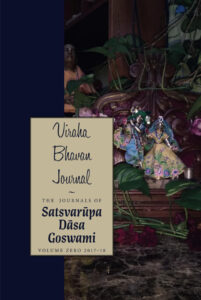
Viraha Bhavan Journal (2017–2018) was written by Satsvarūpa Mahārāja following a brief hiatus in writing activity, and was originally intended to be volume 1 in a series of published journals. However, following its completion and publication, Mahārāja again stopped writing books, subsequently focusing only on what became his current online journal, which began in August of 2018.
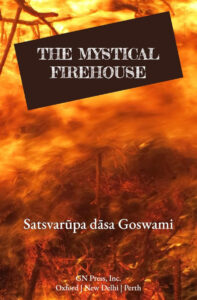
At first, I took it hard that I would have to live surrounded by the firemen, and without my own solitude. After all, for decades I had lived in my own house with my own books and my own friends. I was also now a crippled person who couldn’t walk, living among men who did active duties. But when Baladeva explained it to me, how it was not so bad living continually with other firemen and living in the firehouse with its limited facilities, I came to partially accept it and to accept the other men. I came to accept my new situation. I would live continually in the firehouse and mostly not go outside. I would not lead such a solitary life but associate with the other firemen.
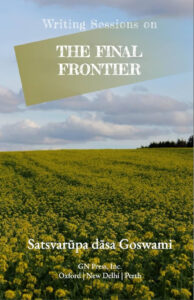
Let me write sweet prose.
Let me write not for my own benefit
but for the pleasure of Their Lordships.
Let me please Kṛṣṇa,
that’s my only wish.
May Kṛṣṇa be pleased with me,
that’s my only hope and desire.
May Kṛṣṇa give me His blessings:
Kṛṣṇa Kṛṣṇa Kṛṣṇa Kṛṣṇa Kṛṣṇa he
Rāma Rāghava Rāma Rāghava
Rāma Rāghava rakṣa mām.
You mentioned that your pathway has become filled with stumbling blocks, but there are no stumbling blocks. I can kick out all those stumbling blocks immediately, provided you accept my guidance. With one stroke of my kick, I can kick out all stumbling blocks. —Letter by Śrīla Prabhupāda, December 9, 1972.
The Writing Sessions are my heart and soul. I’m trying my best to keep up with them. I am working with a few devotees, and they are far ahead of me. I wander in the wilderness of old age. I make my Writing Sessions as best I can. Every day I try to come up with a new subject. Today I am thinking of my parents. But I don’t think of them deeply. They are long gone from my life. Śrīla Prabhupāda wrote a poem when he was a sannyāsī, and he said now all my friends and relatives are gone. They are just a list of names now. I am like that too. I am a sannyāsī with a few friends. I love the books of Śrīla Prabhupāda. I try to keep up with them. I read as much as I can and then listen to his bhajanas.
The metaphor is song. Explain it. Yes, particulars may not seem interesting or profound to readers who want structured books.
Wait a minute. Don’t pander to readers or concepts of Art. But Kṛṣṇa conscious criteria are important and must be followed. So, if your little splayed-out life-thoughts are all Kṛṣṇa conscious, then it’s no problem.
I am near the end of my days. But I do like the company of like-minded souls, especially those who are Kṛṣṇa conscious. Yes! I am prone to Kṛṣṇa consciousness. I have been a disciple of Bhaktivedanta Swami Prabhupāda for maybe almost sixty years. Sometimes I fail him. But I always bounce back and fall at his feet. It is a terrible thing that I sometimes do not have the highest love for him. It is a terrible thing. Actually, however, I never fall away from him. He always comes and catches me and brings me back to his loving arms.

This edition of Satsvarūpa dāsa Goswami’s 1996 timed book, Upstate: Room to Write, is published as part of a legacy project to restore Satsvarūpa Mahārāja’s writings to ‘in print’ status and make them globally available for current and future readers.
A factual record of the reform and change in ISKCON guru system of mid ’80s.

Readers will find, in the Appendix of this book, scans of a cover letter written by Satsvarūpa Mahārāja to the GN Press typist at the time, along with some of the original handwritten pages of June Bug. Together, these help to illustrate the process used by Mahārāja when writing his books during this period. These were timed books, in the sense that a distinct time period was allotted for the writing, during SDG’s travels as a visiting sannyāsī
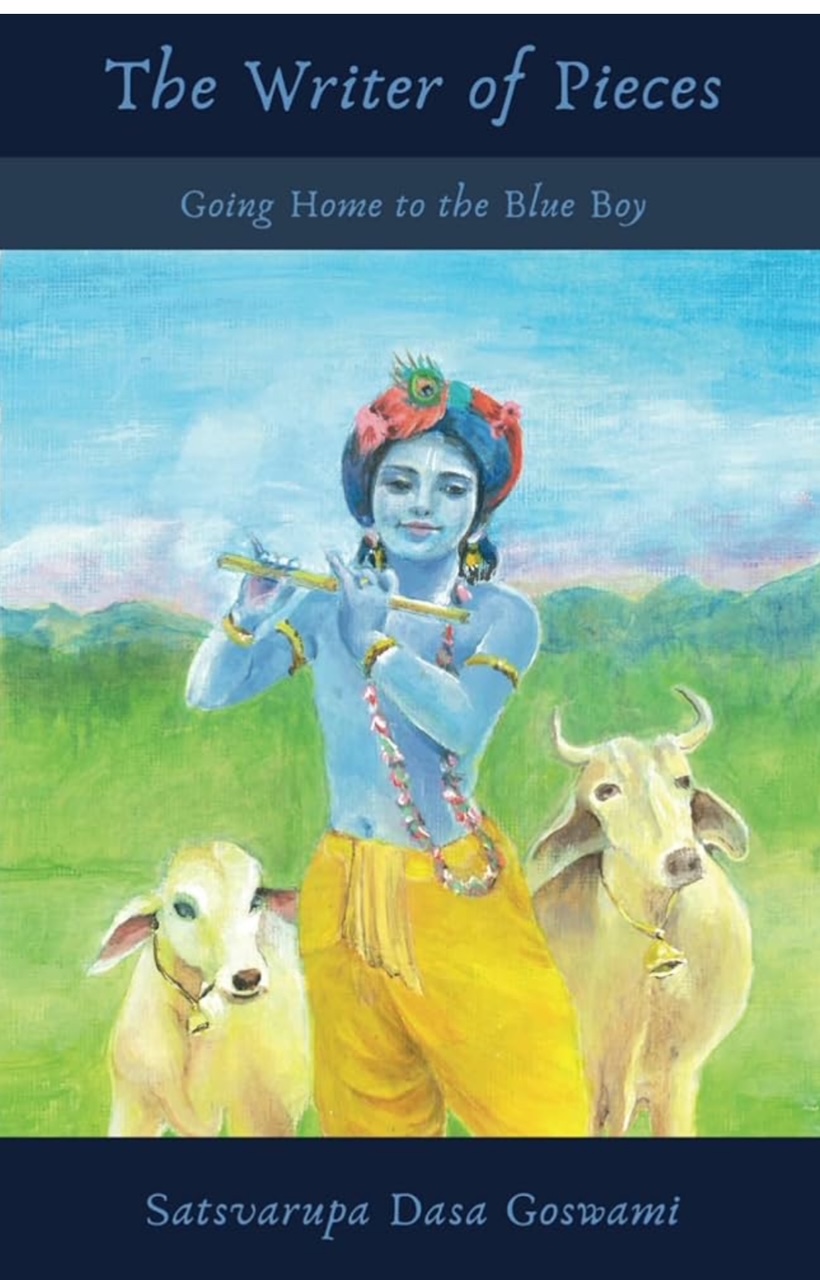
Don’t take my pieces away from me. I need them dearly. My pieces are my prayers to Kṛṣṇa. He wants me to have them, this is my way to love Him. Never take my pieces away.

Many planks and sticks, unable to stay together, are carried away by the force of a river’s waves. Similarly, although we are intimately related with friends and family members, we are unable to stay together because of our varied past deeds and the waves of time.
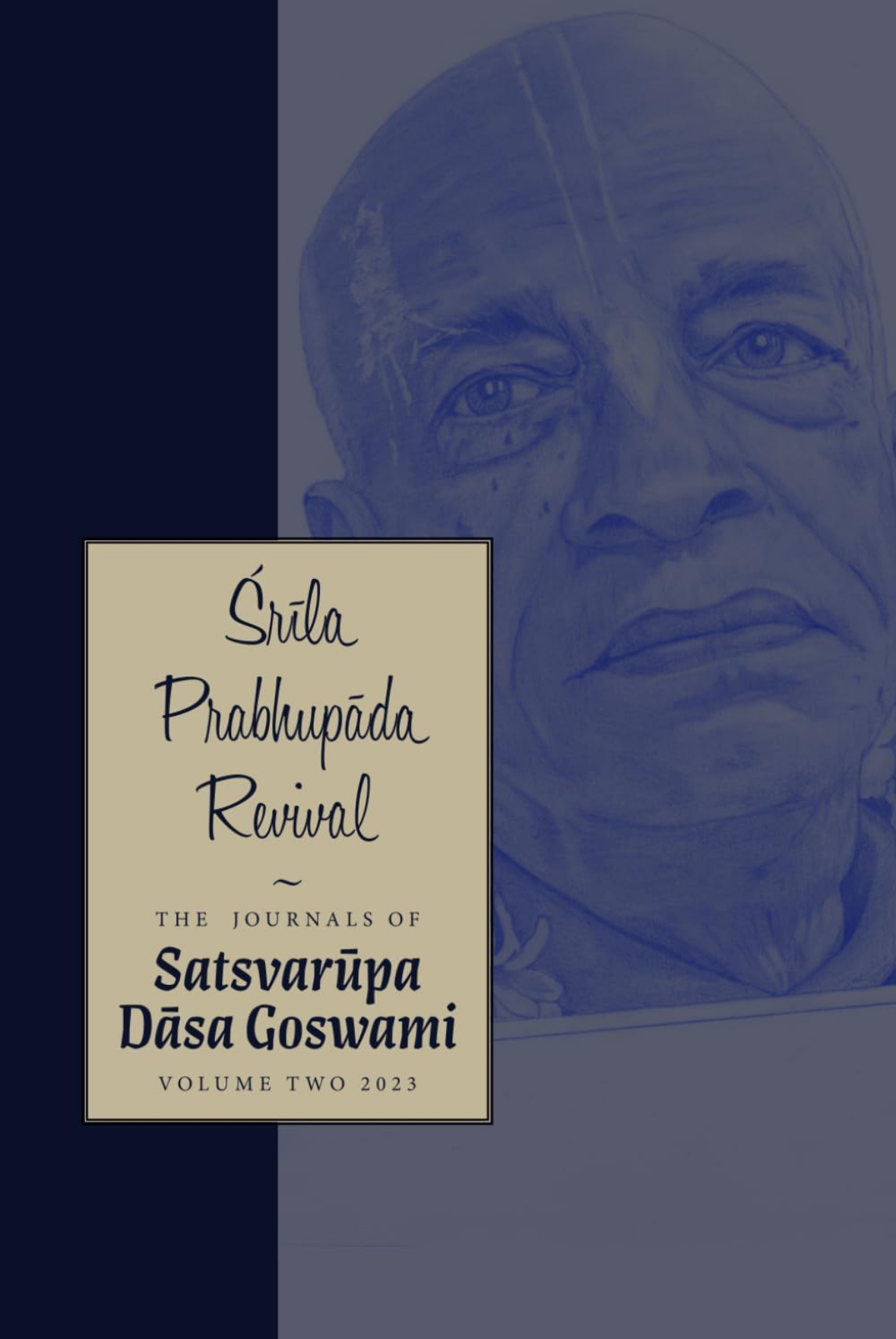
To Śrīla Prabhupāda, who encouraged his devotees (including me) To write articles and books about Kṛṣṇa Consciousness.
I wrote him personally and asked if it was alright for his disciples to write books, Since he, our spiritual master, was already doing that. He wrote back and said that it was certainly alright For us to produce books.
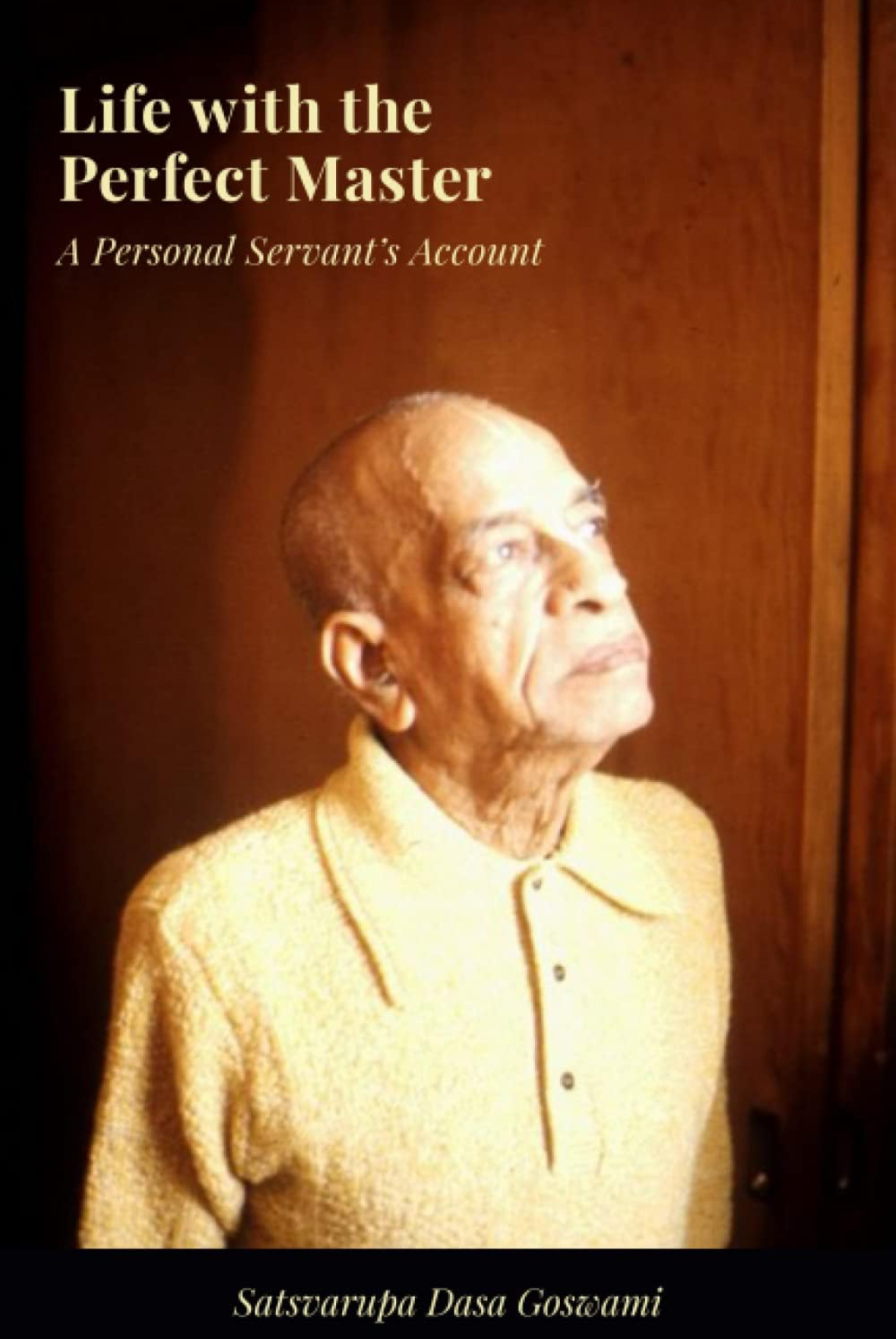
I have a personal story to tell. It is a about a time (January–July 1974) I spent as a personal servant and secretary of my spiritual master, His Divine Grace A.C. Bhaktivedanta Swami Prabhupäda, founder-äcärya of the International Society for Krishna Consciousness. Although I have written extensively about Çréla Prabhupäda, I’ve hesitated to give this account, for fear it would expose me as a poor disciple. But now I’m going ahead, confident that the truth will purify both my readers and myself.

First published by The Gītā-nāgarī Press/GN Press in serialized form in the magazine Among Friends between 1996 and 2001, Best Use of a Bad Bargain is collected here for the first time in this new edition. This volume also contains essays written by Satsvarūpa dāsa Goswami for the occasional periodical, Hope This Meets You in Good Health, between 1994 and 2002, published by the ISKCON Health and Welfare Ministry.

This book has two purposes: to arouse our transcendental feelings of separation from a great personality, Śrīla Prabhupāda, and to encourage all sincere seekers of the Absolute Truth to go forward like an army under the banner of His Divine Grace A.C. Bhaktivedanta Swami Prabhupāda and the Kṛṣṇa consciousness movement.
A single volume collection of the Nimai novels.
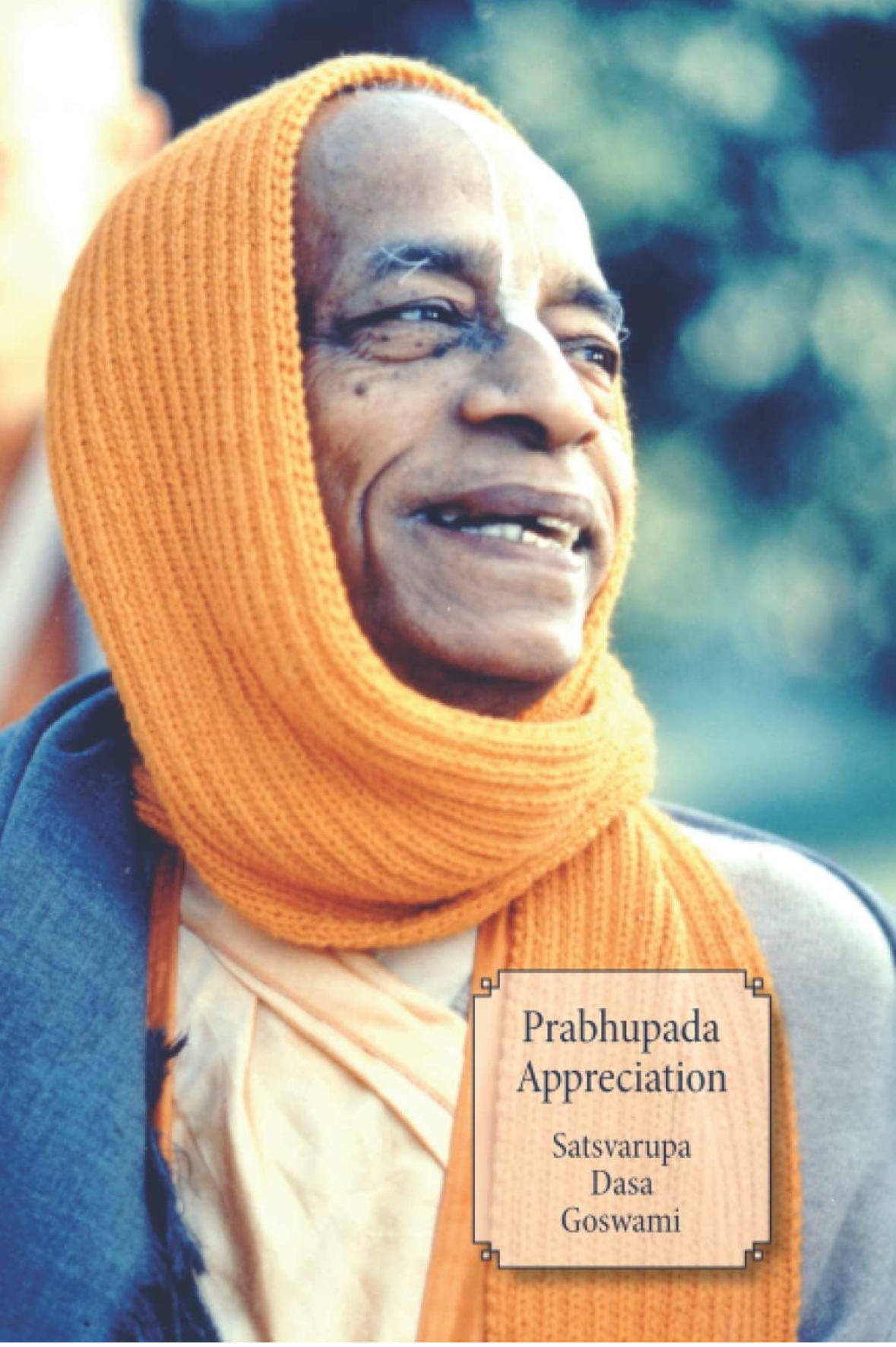
Śrīla Prabhupāda was in the disciplic succession from the Brahmā-Mādhva-Gauḍīya sampradāya, the Vaiṣṇavas who advocate pure devotion to God and who understand Kṛṣṇa as the Supreme Personality of Godhead. He always described himself as simply a messenger who carried the paramparā teachings of his spiritual master and Lord Kṛṣṇa.
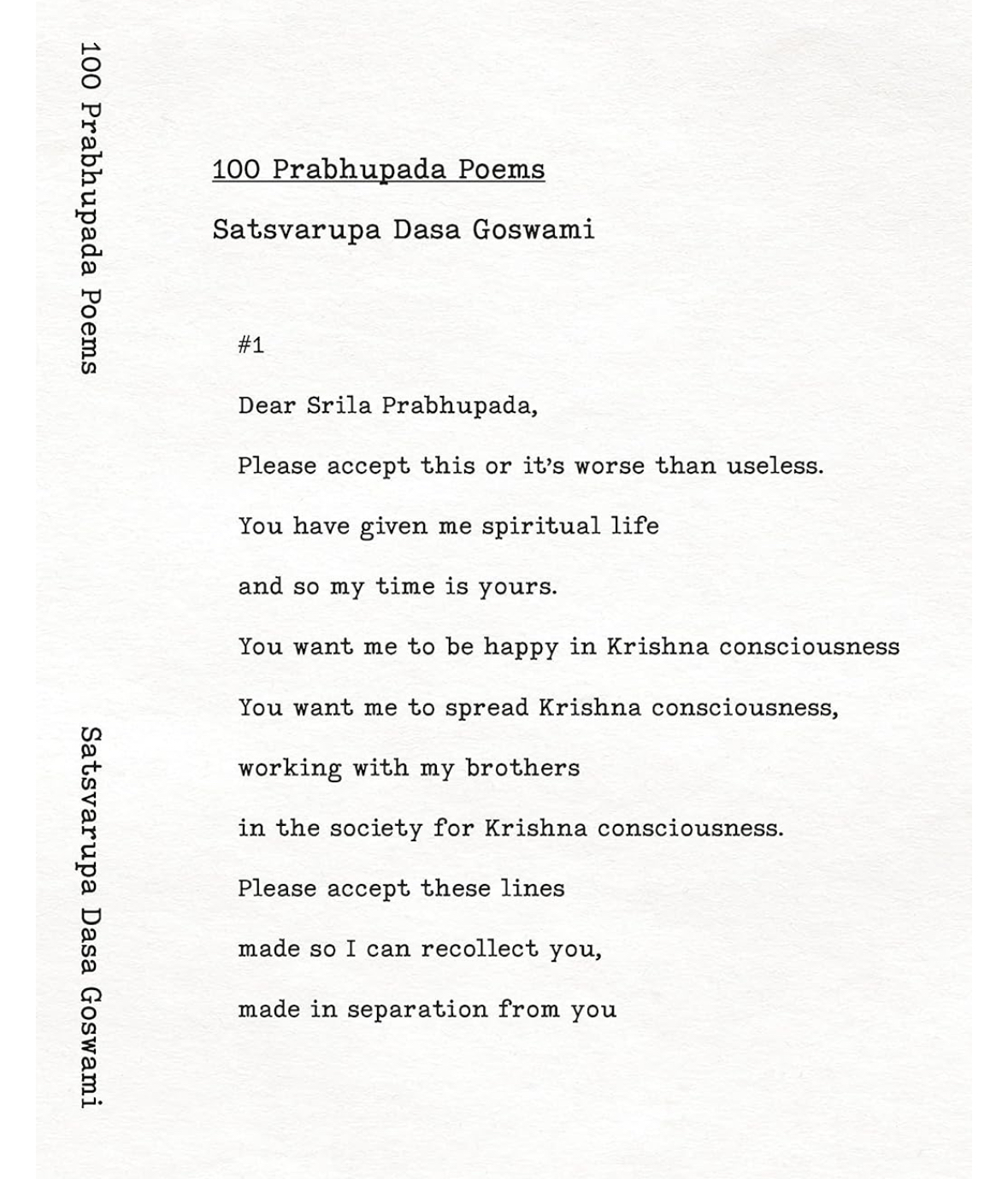
Dear Srila Prabhupada,
Please accept this or it’s worse than useless.
You have given me spiritual life
and so my time is yours.
You want me to be happy in Krishna consciousness
You want me to spread Krishna consciousness,
This collection of Satsvarūpa dāsa Goswami’s writings is comprised of essays that were originally published in Back to Godhead magazine between 1966 and 1978, and compiled in 1979 by Gita Nagari Press as the volume A Handbook for Kṛṣṇa Consciousness.
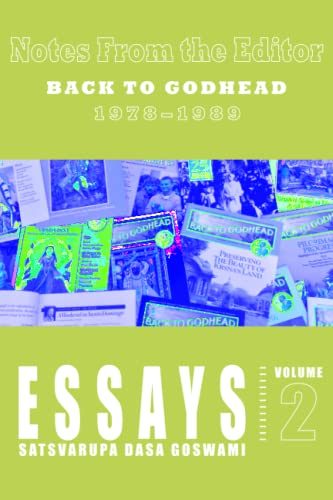
This second volume of Satsvarūpa dāsa Goswami’s Back to Godhead essays encompasses the last 11 years of his 20-year tenure as Editor-in-Chief of Back to Godhead magazine. The essays in this book consist mostly of SDG’s ‘Notes from the Editor’ column, which was typically featured towards the end of each issue starting in 1978 and running until Mahārāja retired from his duties as editor in 1989.
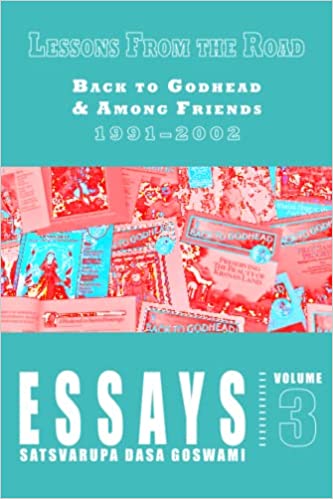
This collection of Satsvarupa dasa Goswami’s writings is comprised of essays that were originally published in Back to Godhead magazine between 1991 and 2002, picking up where Volume 2 leaves off. The volume is supplemented by essays about devotional service from issues of Satsvarupa dasa Goswami’s magazine, Among Friends, published in the 1990s.

“This is a different kind of book, written in my old age, observing Kṛṣṇa consciousness and assessing myself. I believe it fits under the category of ‘Literature in pursuance of the Vedic version.’ It is autobiography, from a Western-raised man, who has been transformed into a devotee of Kṛṣṇa by Śrīla Prabhupāda.”
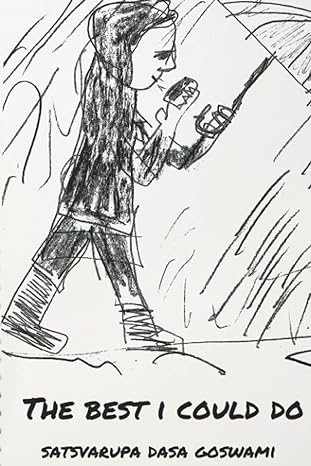 The Best I Could Do
I want to study this evolution of my art, my writing. I want to see what changed from the book In Search of the Grand Metaphor to the next book, The Last Days of the Year.
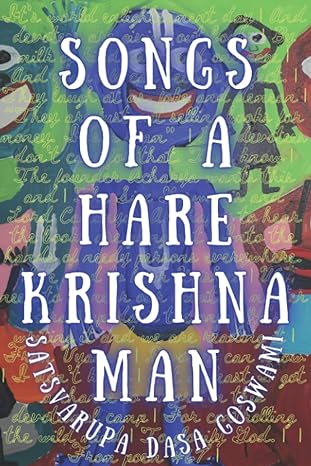 a Hare Krishna Man
It’s world enlightenment day
And devotees are giving out books
By milk of kindness, read one page
And your life can become perfect.
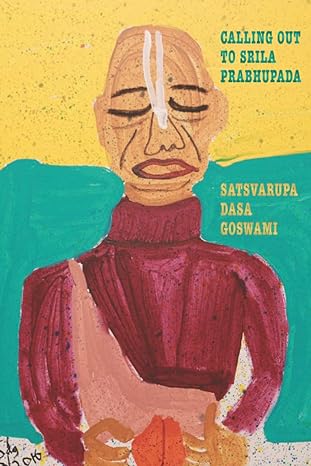 Calling Out to Srila Prabhupada: Poems and Prayers
O Prabhupāda, whose purports are wonderfully clear, having been gathered from what was taught by the previous ācāryas and made all new; O Prabhupāda, who is always sober to expose the material illusion and blissful in knowledge of Kṛṣṇa, may we carefully read your Bhaktivedanta purports.
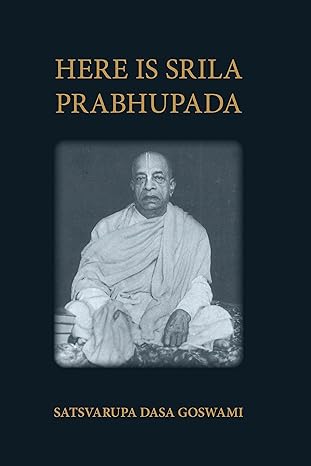
I use free-writing in my devotional service as part of my sādhana. It is a way for me to enter those realms of myself where only honesty matters; free-writing enables me to reach deeper levels of realization by my repeated attempt to “tell the truth quickly.” Free-writing takes me past polished prose. It takes me past literary effect. It takes me past the need to present something and allows me to just get down and say it. From the viewpoint of a writer, this dropping of all pretense is desirable.
 Geaglum Free Write
This edition of Satsvarūpa dāsa Goswami’s 1996 timed book, Geaglum Free Write Diary, is published as part of a legacy project to restore Satsvarūpa Mahārāja’s writings to ‘in print’ status and make them globally available for current and future readers.