

What
Meeting of Disciples and friends of SDG
Where
The Veterans of Foreign Wars Hall – 845 Hudson Avenue – Stuyvesant Falls, New York 12173
There is plenty of parking near the Hall. The facility is just a few minutes’ walk from SDG’s home at 909 Albany Ave.
Schedule
10:00 – 10:30 A.M. Kirtana
10:30 – 11:15 A.M. Presentation by Satsvarupa Maharaja
11:15 – 12:30 P.M. Book Table
12:30 – 1:15 P.M. Arati and kirtana
1:15 — 2:15 P.M. Prasadam FeastContact
Baladeva Vidyabhusana at [email protected] or (518) 754-1108
Krsna dasi at [email protected] or (518) 822-7636SDG: “I request as many devotees as possible to attend so we can feel the family spirit strongly. I become very satisfied when we are all gathered together.”
*******
Śrī Caitanya-caritāmṛta, Madhya-līlā 20.124–125: “O great learned devotee, although there are many faults in this material world, there is one good opportunity—the association with devotees. Such association brings about great happiness. . . . .”
Srila Prabhupāda: “Therefore, our Society is association. If we keep good association, then we don’t touch the darkness. What is the association? There is a song, sat-saṅga chāḍi’ kainu asate vilāsa, te-kāraṇe lāgila mora karma-bandha-phāṅsa (Gaurā Pahū, verse 3). Sat-saṅga. Sat-saṅga means association with the devotees. So the one poet, Vaiṣṇava poet, is regretting that, ‘I did not keep association with the devotees, and I wanted to enjoy life with the nondevotees. Therefore I’m being entangled in the fruitive activities.’ Karma bandha phāṅsa. Entanglement.” [Conversation with David Wynne, July 9, 1973, London]
We need to expand our team of proofreaders as we aim to increase the rate of republication of Satsvarūpa Mahārāja’s books as well as new books that he writes.
This includes a need for fluent bilingual Spanish and English speakers to proofread Spanish translations (we currently have around 20 Spanish translations waiting to be proofread).
Anyone interested in this particular service should contact Manohara dāsa at [email protected]
If you would like to help, please contact Kṛṣṇa-bhajana dāsa at [email protected] or [email protected] and we will find you a service that utilizes your talents.
It is all right if one is doing Deity service and cannot chant in the early hours. Although early hours are the best according to śāstra, that he will have to sacrifice. But not that he sacrifices the good quality of his rounds. He should reserve time in the afternoon, and then eventually he will be able to chant well at that time. I work in the early morning hours myself on the biography of Srila Prabhupada, and I chant a good number of my rounds in the afternoon. But actually, the afternoon chanting is good because I have reserved time—not that I am trying to grab a round here or there.
******
As the sky is overcast with clouds, so my consciousness is covered with subtle material desire preventing me from purely serving the holy name. Whatever temporary thing is going on, it fully distracts me. Is attentive chanting important? Do I even believe that much can be found in japa? Have I lost my faith in great gains that can be made in japa? Thus, I lament.
******
Prabhupāda urges that we should practice chanting. Sometimes he says chant “constantly.” Chant constantly so that we will remember to chant Kṛṣṇa’s name at the time of death. Ante nārāyaṇa-smṛtiḥ.
******
Sometimes a person will try to remember ślokas when he chants Hare Kṛṣṇa. I think this is like trying to run two tracks on a tape recorder at once. If the Hare Kṛṣṇa mantra is being recited then we should hear that and not try to recite ślokas at the same time.
******
Sometimes in India we have seen workers and even women balancing big loads on their head and doing other things at the same time, such as talking or something else. This is an interesting balancing, but I think it is better that we keep our consciousness tuned in to the chanting of Hare Kṛṣṇa mantra while we do our japa.
******
Good management begins by managing your sādhana—your life. It requires intelligence. A karmī has no time for self-realization. He has so many activities that he can’t manage to chant one day or even one round. So somehow you have to manage to chant sixteen nice rounds during your daily activities. You manage to take prasādam, don’t you?
******
“What nectar is in these two alphabets (syllables), Kṛṣ-ṇa!”
—Rūpa Gosvāmī (quoted by Prabhupāda, Chicago, July 1975)
******
Dear Lord, we may not be able to remember Your name, form and qualities due to stumbling, hunger, falling down, yawning or being in a miserable diseased condition at the time of death when there is a high fever. We therefore pray unto You, O Lord, for You are very affectionate to Your devotees. Please help us remember You and utter Your holy names, attributes and activities, which can dispel all the reactions to our sinful lives.
—Śrīmad-Bhāgavatam 5.3.12
******
We can pray while chanting that the holy name bestows upon us love of God. At the same time, this is not different from careful hearing. We must have faith that Kṛṣṇa is in His name and that simply by hearing the name of the Lord we will enter association with Him. Then love of God will appear in our hearts by the grace of the Lord. Prabhupāda has said that the chanting doesn’t happen by a mechanical process but is initiated by the Lord by His free will. In this way, gradually all our material desires will evaporate.
******
Caitanya Mahāprabhu has recommended that everyone chant the Hare Kṛṣṇa mantra just to cleanse the dust from the heart. If the dust of the heart is cleansed away, then one can actually understand the importance of the holy name. For persons who are not inclined to clean the dust from their heart and want to keep things as they are, it is not possible to derive the transcendental result of chanting the Hare Kṛṣṇa mantra. One should therefore be encouraged to develop his service attitude toward the Lord, because this will help him to chant without any offense. And so, under the guidance of a spiritual master the disciple is trained simultaneously to render service and at the same time to chant the Hare Kṛṣṇa mantra. As soon as one develops a spontaneous service attitude, he can immediately understand the transcendental nature of the holy names of the mahā-mantra.
—The Nectar of Devotion
pp. 56-58
I wrote a letter to Ranchor Prime, who lives in England. I have never met him, but I’ve read his books. I very much liked his book on Buddha. I am addressing him because I regard him as a learned devotee of Kṛṣṇa and a highly qualified writer. I’m writing to ask a number of devotees what they think of this idea, and whether they have done any dovetailing in their own writing. Alternatively, do they think the writing should always be strictly Kṛṣṇa conscious according to śāstra and Prabhupāda’s speeches, and that no outside literature should be introduced?
Hopefully I have written enough to Ranchor and other devote writers to convey the idea and to ask them the question, whether they ever do ‘dovetailing.’ If it’s wrong to do dovetailing in this way, then I have “a monkey on my back,” because I can’t stop writing about world literature and English literature. But if it is good to do, then I can go ahead and produce writing in the spirit of yukta-vairāgya, like Rūpa Gosvāmī advised.
I asked the devotees to please write to me and tell me their viewpoint and their own aims and opinions, if any, about using world literature, etc., in a Kṛṣṇa conscious context. In his 1961 Vyāsa-puja offering to Śrīla Bhaktisiddhānta Sarasvatī Ṭhākura, Śrīla Prabhupāda wrote “‘Yukta-vairāgya’ is the essence of all Caitanya philosophy,” so I suspect that I am on solid ground but must ensure that I keep the connection to Kṛṣṇa evident in what I write.
I also wrote to my old Library Party friend, Kālakāṇṭha Prabhu, who has previously written and published a book of Kṛṣṇa conscious rap. I am eager to receive the responses of these devotees. I have written letters to several ISKCON intellectuals, especially those who are innovative, and asked them the same question.
Should I keep up my daily Journal, which gets posted for the devotees? Or my occasional journal that we call The Sunset Years and which tells mostly of my daily affairs. I always try to include verses from the Bhagavad-gītā with some small commentary by me.
The devotees are continuing to read Prabhupāda’s books daily. In the morning, they tell me sixteen devotees listen, but in the afternoon only a few. Guru dāsa is conducting the reading, and my disciples take part in reading out loud.
For the time being I am concentrating on writing the daily journal. I am not doing another type of writing, but I am waiting for answers in the mail from a selection of ISKCON intellectuals who are innovative. I have asked them a question about my writing, and I’m waiting for their answer to see whether I should change my direction. I have asked them what they think of inserting excerpts from great literature, Western and English. I don’t know whether Prabhupāda would approve of it. But he has spoken in favor of Rūpa Gosvāmī’s yukta-vairāgya. Otherwise, he has said sometimes that literature which is not directly Kṛṣṇa conscious is “rubbish.” I’m in between these viewpoints trying to make a decision, whether I will start using references to Western literature (the kind I used to read).
These fictions and novels … they are not books … actually, they are rubbish … That rubbish literature is compared with the enjoyable things of the crows, and spiritual literature, they are enjoyed by the white swans … they take pleasure in clear water where there are lilies, and … crows, they will go where you throw all rubbish things.
—Śrīla Prabhupāda lecture on Bhagavad-gītā 2.26,
Los Angeles, December 6, 1968
Śrīla Prabhupāda, quoting Śrīla Rūpa Gosvāmī’s Bhakti-rasāmṛta-sindhu, explains yukta-vairāgya as follows:
“Whatever is favorable for the rendering of service to the Lord should be accepted and should not be rejected as a material thing.” Yukta-vairāgya, or befitting renunciation, is thus explained:
anāsaktasya viṣayān
yathārham upayuñjataḥ
nirbandhaḥ kṛṣṇa-sambandhe
yuktaṁ vairāgyam ucyate“Things should be accepted for the Lord’s service and not for one’s personal sense gratification. If one accepts something without attachment and accepts it because it is related to Kṛṣṇa, one’s renunciation is called yukta-vairāgya.” Since Kṛṣṇa is the Absolute Truth, whatever is accepted for His service is also the Absolute Truth.
—Caitanya-caritāmṛta, Madhya-līlā 16.238, purport
I have not been able to give up my attraction for Western literature. It is in my blood. When I came to Kṛṣṇa consciousness, I gave up all reading of Western literature. But now I’m thinking about it again and whether it can be used in Kṛṣṇa’s service. I’ve written to these ISKCON intellectuals, some of whom themselves have produced innovative literature outside of what would traditionally be considered Vaiṣṇava. However, they are reputed devotees and mostly stick to the straight śāstric point of view.
The main point is a devotee must keep up his sixteen rounds and four rules and regulations. Only then can he think of innovative creations while remaining in Kṛṣṇa consciousness.
******
When I was a young man, from nineteen to about twenty-one years old, I placed myself deep in the ecstasy of world literature. That was because Kṛṣṇa sent me a college professor, my English teacher, who was truly in love with English and world literature. From her I gained my devotion and lifelong vocation to reading and writing.
Now, in 2025 and at eighty-five years old, I look back at my beloved study of English literature with my wonderful teacher and get to taste it all again. I have been careful from the beginning to definitely state that all of this was before I met Śrīla Prabhupāda, and that once I met him, I mostly dropped out of my deep devotion to English literature. Prabhupāda has stated that it was “rubbish.” But he also followed the teaching of the greatest devotee, Rūpa Gosvāmī (direct disciple of Lord Caitanya) and used everything material in Kṛṣṇa’s service. As Prabhupāda used to teach the audience on the Bowery (composed mostly of young musicians, poets, and others like them—he would teach them “if you are a musician (and very many of them were), then play your music for Kṛṣṇa. If you are a painter, then paint for Kṛṣṇa. Whatever you are, you don’t have to give it up but do it for Kṛṣṇa. This is stated in the Bhagavad-gītā:
yat karoṣi yad aśnāsi
yaj juhoṣi dadāsi yat
yat tapasyasi kaunteya
tat kuruṣva mad-arpaṇamWhatever you do, whatever you eat, whatever you offer or give away, and whatever austerities you perform—do that, O son of Kuntī, as an offering to Me.
—Bhagavad-gītā 9.27
pp. 119-122
So many things can go wrong in the body, the complicated machine. And they do go wrong. You go to the doctor and show him what’s wrong. He gives you something for it. You go on chanting Hare Krishna and hope for the best.
In the meantime, life ebbs out. Are you chanting merely the outer shape of the holy names, material sound? Or do you chant with a pure heart of love and longing to serve Krishna? It seems I used to have more fervor than I do now. Relaxed to a lower level. How could that happen? It has, and one is honest. You’re not even attracted to those who appear to have fervor. You suspect them or just don’t want to go around with them, say, to the source of the Ganges or the Vraja-mandala parikrama. It takes too much effort. So you stay here in exile and come out with your own truths, admissions.
He said by the tongue you can become perfect, although this may seem odd. How is that? By the tongue you chant Hare Krishna always, and don’t let your tongue touch any food that has not been offered to Krishna. And it is actually taking place, these Europeans and American boys and girls are becoming perfect by this process. Still, after all these years? Yes, we are still not perfect, although we are only eating prasadam. We are not chanting so lovingly. I speak for myself. And I am not like a football tackle on the front line taking the punishment from the opposing players. Dugout Doug. [“Dugout Doug” was a term I heard my World War II vet father say the soldiers used for General Douglas MacArthur because he never exposed himself to enemy fire or danger.”—SDG]
You lacerate yourself with words. But it is all jest. You actually like yourself. Treat yourself to rhythm and words. Give to the world (a small portion of it) these books of paradise.
Do I look pretty to you? Did I say so? I told the guy, okay write your big classical novels but write poetic prose. I gave him an example from a play by Tennessee Williams. I fancy myself a poet. We go through life with these illusions. “My mother told me I look like Natalie Wood. Do you think I do?”
“My father said I look like Boris Karloff in Frankenstein.” Bukowski looks a little like that.
What else is on the menu? Tonight was good. Smashed (as Hari says) potatoes and little green peas, gravy and ice cream! Healthy, so I dutifully ate the peas. Do you think I look like Natalie Wood? Marlon Brando? Woody Allen? You look goofy like a guy with a big Adam’s apple, like Ichabod Crane in Walt Disney’s The Legend of Sleepy Hollow. Oh yeah? You look like Mao Tse Tung after he was beat up by a team of GIs.
Stop the silly stuff. Let’s have neoclassical prayers now. Not Muslim or reggae, but Bach will do just fine. He’s outlasted all the rest. Yeah, but he’s saying, “All glories to Christ,” we need some Krishna songs.
That’s exactly what I’m proposing—we write in a high classical standard that the whole world will accept. Oh. But will they know who we’re talking about?
Drive this tractor over the ground. Don’t get bogged down. You are alone with the birds and dark sky in the early morning, scratching the pen in your shed. Do you want . . . to be a first-class scout, an Eagle Scout, a bhakti-shastri, a kalpa-vrksha, a nama-hatta bhakta-vrksha? Want to be an author-official with a literary voice? “Once upon a time, your author was considering what to write to please you, dear reader, and this is what he decided—”
I know what, let’s play hide and seek. Beware of kids of the dark, the park, the danger we see everywhere. I want a Krishna conscious present to give to you. Give me credit. My name is dasa Goswami. He, the great one, gave us these names. That’s the only way.
Shoes tied on tight, he made it all the way down the road. He was carrying a pint of liquor on his hip, and baby, he was making tiny steps fast and clicking off Hare Krishna mantras.
Inclusions
Me and you. Come on,
play mridanga and karatalas and
leave the room if it
gets too noisy, just feel
free to be yourself.
Can’t even sing kirtan I
get so fragile.
Boy that’s some guitar
the young boys stood agape
watching the adults and
seeing which the baby
touched book or money.
“She touched both!” he said and
she also touched the harmonium
and the rug, her mouth, spoon,
anything in her wake.
And we were pleased to include
her as a member of the clan.
Goodnight, whoever you are. Proud pennants fly. Hash tree waving. Skylight cleaned by rain. How is your heart? Cardiac or Krishna conscious, do you mean? Krishna conscious.
Oh, it’s in the right place, but still in a dark night of the soul. The Lord isn’t giving me “consolations,” as the Christians say. Isn’t giving me special graces.
Why say that, ingrate! You’ve got everything you asked for. That’s Krishna rewarding. Now if you want His confidential service, you’ll have to ask for it, and sacrifice all else.
Hmmm. Goodnight. Enough for one day. To the land of waiting for sleep, and near dreams and dreams. Please protect me.
Will I paint something worthy today? I get so tired. I woke around 11:00 p.m. last night and got up and started reading and then started japa before I discovered it was 11:35! Good gosh, get back to bed. O acres of jokers and smokers, get back to sleep on your ortho pillow.
I see myself as a person with various interests. I want to preach, but I also want to write poems. I’m also interested in Vedic philosophy, and I like to read Srila Prabhupada’s books. How to integrate into an entire person when I am put into a situation where I can only act on one of these interests?”
I painted a sincere naive portrait of
Prabhupada, first drawn in pencil, then
filled in tan, then a simple square-headed
Oriental cat. Wrote “Nitai-pada-kamala”
below the cat and thought of a wild,
inarticulate ball of yarn unraveling—a painting
I wanted to see—a lion with a broad nose, roaring.
Then drew the Oldest Man and his house
his disciples built him despite his protest, “I
won’t live long.” Ani says devotees hit
the streets at 10 p.m. tonight and by midnight
plunge into New Year’s Eve bell-ringing
Cathedral crowds and the tense scene, possible
fights. I’ll be here in Wicklow where
I don’t expect to hear a single gunshot,
even a shout or the mooing of a cow
just me getting up and scraping my chair
against the floor
drawing lions that roar
and calm cats ushering in
a new year of hope.
I like to explode into color
if my head holds up
in the afternoons.
Creatures live in me, waiting
to be born. I don’t want to create
like Brahma, yet asuras attack me
and I have to throw off my body, paint a Balarama-
Nitai to deal with them and a simple
student’s rendition of Srila Prabhupada in
seven layers etched, the same
one again and again.
I don’t think having varied interests makes me less of a devotee, but I have to be honest about that. When I lecture and tend to disciples, it is, we might say, my religion. But there is more to me than that.
Rain again, and that familiar sound. Alive on earth. Newly made paints now standing in jars, delivered by Hare Krishna dasi—they appeared suddenly in the art room this morning. I saw them on my way to the bathroom. Shall I take that as an invitation to go in there and use them? Why not?
For the glory of Krishna,
I’ll go into the art room
and play Prabhupada bhajanas
while creatures creep onto
the page with those
Sanskrit letters, sure enough.
pp. 49-53
When I saw the ad for An Exile from Silence by Patricia Wilcox, I was attracted to the book’s subtitle, Poems to God. But now that I’ve got the book, I’m turned away by doubtful, blasphemous addresses to the Supreme.
“The book’s most appreciative readers,” writes the editor in the introduction, “will be those who cannot abide by the various and conflicting certainties of the many religions available to them.” The chronic doubters become pleased to hear Poems to God, which deride the Supreme:
God, you murderer, you scapegrace,
MALINGERER!
. . . I will not call you Lord. Master, King, et al. You fail, as I fail, as people fail . . .
The doubt is complex, mixed with need for faith, but mostly I find these expressions incomprehensible. It reminds me of a more directly expressed collection of poems in the same mood, Psalms, by Ernesto Cardenal, a Catholic priest who was excommunicated.
O God . . .
don’t you care now
about victims of exploitation?
Are you happy
seeing the masses oppressed?
Both poets address God with doubts as to His existence. They disbelieve either His omnipotency or His all-goodness. How can He be all-powerful and allow evil in its various forms? Or if He is all-powerful, then how can He be good and yet create and allow evil? We expect these doubts from the atheists, but not from those who make prayers and devotional poems to God, and who presume to address Him in intimate language. When they spew out ignorance of the science of God, actual devotees of Godhead cannot appreciate it, and how will it help everyone else who is already in doubt?
These “prayers” are more like mental speculations, unguided by guru, sastra, and sadhu. Although there is an advanced stage of Krsna consciousness in which the intimate servant of the Lord chides the Lord, these poets have not earned such intimacy. They barely understand the God they address, and they do not take to the process of faithful hearing by which doubts may be cleared up.
The great stumbling block for them is the existence of evil. But Krsna clearly explains it. The conditioned souls have brought about suffering by their own doing, by misuse of their small amount of free will. Because we are of the same quality as God, we possess some free will, and when we misuse it, we create suffering and evil for ourselves and others. Krsna does not want us to create sinful life and its reactions, but when the spirit souls insist on such behavior, He allows them to carry out their illusions within the material world. The material existence, therefore, is a place constructed for those who desire to break the laws of God. But Krsna never abandons us, and so He comes to the material world to give us information of its suffering and illusory nature. He invites us to return back to Godhead, to devotional service in eternity, bliss, and knowledge.
Evil can be eliminated within ourselves and within the world only when we give up our independent ways and turn to the principles of devotional service. Therefore, only those who distribute real knowledge of God consciousness can bring relief from evil. Poems, prayers, and psalms based on knowledge of God and on faithful surrender to Him can actually inspire others to devotion, but not the outcries of doubters who think that God is dead or that God is a painful paradox never to be solved.
As I write, Vaisnava dasa yells and whips the oxen. They
are trying to pull a car out of the mud.
Headaches came today as if to confirm our decision to go a
month into a sanatorium. But also, waves of optimism. Also, my
mind is filled with the busy particulars of moving tomorrow. We may not be back here for four months.
My optimism is in Krsna consciousness, but I can’t quite express it, nor do I need to. It is beyond me. The cause for great satisfaction is not my own achievement. I have many, many lackings. Stuck in the mud. But Krsna consciousness fills me with great hope.
Glory to the sri-krsna-sankirtana, which cleanses the heart of all the dust accumulated for years and extinguishes the fire of conditional life, of repeated birth and death. This sankirtana movement is the prime benediction for humanity at large because it spreads the rays of the benediction moon. It is the life of all transcendental knowledge. It increases the ocean of transcendental bliss, and it enables us to fully taste the nectar for which we are always anxious.
—Siksastaka, Verse 1
Wherever I go I will think of Gita-nagari. This is Paramananda’s project, given to him by Srila Prabhupada. So he meditates all day how to make Gita Nagari Krsna conscious, and he constantly deals with its affairs. I’m also connected here, resident of the cabin, the initiating spiritual master of many Gita Nagari-ites, lover of Tuscarora seasons, hankering for another return to this country.
what’s the creek saying?
washing by like surf on a beach
sometimes the ice cracks
just think—
how everyone dies.
and every soul lives.
think of Krsna
controller of the universe
the creekside is but a speck to Him
yet each and every creature
moves only by His will
the creek says
“Gita Nagari”
Lord Damodara is pleased
His devotees have succeeded;
these woods are a spiritual village
Paramananda says he’d rather not go to India for the festival this year. Too many things happening at Gita Nagari. Just about that time he hopes to start building the sewage plant and building a toolhouse, and then spring plowing. I said I didn’t mind his staying back. Rather, it gives me a feeling of security to know he’ll be here, even while I’m in India. And on Gaura-purnima, Paramananda intends to accept his first disciples. I’ll go to Mayapur as Gita Nagari’s representative.
Mud mixed with ox turd on the back road. Many shades of dull brown: dead leaves, the flowing creek, the bare trees, treetop squirrels’ nests made of brown leaves. Looking across the fields, I can see bright orange dhotis hanging on a line outside the brahmacari house. Manu dasa is slowly pedaling his bicycle from the temple down to the house.
This morning two teams of oxen went lumbering peacefully past my window, and three ox men walking beside them. The ox men had only to slightly flick their whips and speak a few words—and the oxen were willing at the beginning of the day, to go do their duty, hauling wood.
Outside my cabin, forsythia bushes seem surprisingly alive, although it’s mid-winter. The snow has vanished and these flower bushes are giving us a reminder that they’ll be blooming again in a few months. By the time I come back—in May?
pp. 152-59
Light or heat take your choice, or
typewriter or pen, or celibacy…
remember all the choices.
The Hare Krishna mantra, look at
old ISKCON history, divide your
lines or make them long, play for the
nondevotee folks or the home
crowd. For Miss Eagan and/or your
mother or for the bad kids at school,
for the Navy guys, jazz aficionados
readers of The Realist…
It’s over, the movie is over
my thin wrists are
over for this lifetime, I am in the
Krishna-Balarama Guesthouse or
Baladeva’s pink palace I don’t care anymore
what people say, I am disgusted
with their opinions. I
have made all the choices
to lead me here and I am
no longer happy…
I don’t know what it has led to…here I am a little
lump, stack of bones and flesh lying on the last
bed…I am tired of them, the Philokalia,
it’s so serious and Christ-centered,
or the Buddhists or the Cubists,
or the trappoidists,
the wordists, voidists,
Hare Krishna planners, mice and men going into and
over the rapids and falls of the years,
wrap rapid in cannon push it
into the gun breach, fire
it to Murray Mednick on the West coast,
no more messages.
*****
I mean to say
a minnow regarded my songs
and arrested my flight.
I am telling almost everything that happened.
Make the pages look right, open up
the spaces, give light here, and
paint it and draw it.
TV don’t watch, from the ship watch the land.
Chant Hare Krishna with awareness that God
is close to you. She was able to do that
because God came to her
at a time of worst trouble.
I have it easy eating my cake.
It seems there is more you wanted
to say. Write it on a fax
cake. Put it on the optic nerve.
He’ll get it through and you’ll
experience the illusion that you are
watching a jazz band playing
sixteen inches big in your
room. The leaves are heavy,
a brank broke. He – who, that’s one of the
main questions – went out into the yard
without his shirt and without
hay-fever and said
if your specialist is going to speak against
my meds
I don’t want to see her.
He said, “She’ll just tell you
not to eat wheat.”
Jazz nose. How far you goin’ with this?
Just be true
I will not abandon my own truth. Why don’t you
just pass stool?
Would if I could – be healthy, look in and out for
spiritual or otherwise painting.
All is God,
Krishna with flute
original fly a kite.
Dickie Poo Dickie might
wish I may wish I might.
Oh go on home,
I’m happy, no heat
wave in this country.
Quiver and arrow. That’s enough. Score a triumph
for faith.
*****
Suicide. Sewer side?
I couldn’t hear over the
phone what
the other party was saying.
I can’t remember now.
It might have been tarts
or muffins or Nimai.
We just live here fairly
peacefully unless
death or disease visit
us harshly. Or we
fight. Compassion:
Preach about it.
*****
(Sing with us, play with us
come out of the house, it’s
August)
They sallied they called me
out but I knew it was a
trap.
All right don’t remember
only that or your sister
saying, “The truth hurts
doesn’t it?”
There were some
times, picking black
berries…
that’s true…Krishna Krishna
we went to the altar rail
I sallied forth in
repetition.
Got Communion and
Confirmation, my mother
was always there to offer
some sense
grat, Stevie,
dominating parents.
You were a victim too, get bonds
off, draw a painting
of what’s troubling you. I think it’s this here
pea under the
mattress.
*****
We were believing in good
things
raucous but clear
chasing the bird
Roadrunner.
Listen, drunk in a
bar
monk in a cell
prisoner in the
fed
me in the head.
Wiggle instead the
dancers…back to the prayer-maker.
If you’re not one,
then what? Some
sort of preacher,
deliverer,
one who goes through
the morning program in the
ISKCON temple raises
hand to say “But wasn’t
that in Prabhupada’s time?
Have times changed?” –
and he’s told the guru’s
instructions are eternal.
We could make beautiful
music together. Just a
few years more
give me from Italy a
big journal with a
binding on the top,
I could write
to the music Beatrice,
or from the
heavenly one not
Greek or Roman
academic talk
I fall asleep
on my nose. Give me
just a light
summer prasadam
and hope of a better
song.
He roused himself on
his elbows and read the
health magazine – “No
I won’t cut wheat and
dairy from my diet,
dear.”
Pipe pipe, are you
planning for Karttika
in Vrindavan or
why you’re not going? Yeah I am
not desperate I am
going to keep writing in this genre.
Forty-five volumes and at least
four hundred and fifty to go
gimme strength.
pp. 35-39
There was an important statement for me when Gopa-kumāra was about to tell his own life story to the brāhmaṇa, when they were together in Vṛndāvana. One might think to talk about oneself is not bona fide. Gopa-kumāra didn’t want to appear puffed up talking about himself. But he knew talking about what he had gone through to reach the goal of perfection was the best way to instruct the brāhmaṇa. So, he was confident and went ahead. The commentator says, “Experience is the best form of proof.” There may be other statements about the best form of proof, but there it is in Bṛhad-bhāgavatāmṛta, and I rejoiced to see it and present it to you now. Even if your experience is not the experience of one who has reached the goal of truth, describing it is the best way of instructing someone or telling them what is real, what is true. Mary Oliver entitles her latest poetry book, What Do We Know? We know what we have experienced, that’s for sure. It may be faulty knowledge, but we know it happened. The person who hears from us will get authentic stuff. Even if it is a tale of woe, an uncouth tale, a tale of what we should not do. Of course, the experience of a perfect person is perfect proof in the very best sense. But I have taken it to mean that the experience of a struggler is also the best way to get a particular kind of truth. He’s not bluffing, and you can learn from him. In other words, one form of teaching by experience means, “Do as I did,” and the other is, “Don’t do as I did,” and both are instructive and even inspiring.
Bhakta Tim had so many worries, and now a new one to add to the others. He was in the sanatorium—and not on the front lines in the battle against māyā—because he was a Worrier and it caused him diabetes and arthritis and other diseases. He was thinking he’d let a friend run a horoscope on him, and the news came back that Rāhu, the dark, evil planet that covers the sun, would often visit him. If he could live past age thirty, lots of good things would manifest, but it was unlikely he’d live that long because of something about Jupiter mixing with another planet at a bad time and Rāhu moving in again. Tim worried like anything. His pro-astrology friend said, “Ask the astrologer if there’s something you can do to offset this shortened longevity.”
“It’s just garbage,” said Swami Swims. “If you start listening to those guys, you won’t be able to do anything unless they tell you it’s okay. Chant Hare Kṛṣṇa and all the palm lines in your hands will change. And if you’re going to die at twenty-two, so what? Get on the move and chant your beads and step up your advancement. Anyone of us may go at any moment, regardless of the stars’ prediction. Remember from Shakespeare,
‘The fault, dear Brutus, is not in our stars,
But in ourselves that we are thus or thus’” (from Julius Caesar).
When is snack time? When is rest time? When do the babies play in the backyard? A friend writes and says, “It was in Hawaii (ISKCON) that I found I was Prabhupāda’s son (after depression from a divorce) but in Māyāpur I found my heart,” cried tears there every day and wants to make yearly visits. But you can’t enter the temple with shoes on. You are expected to stand a lot and hear the class. He could do it and he loved it. Don’t exile yourself. The sanatorium is also a sacred place, and they’re getting a bigger altar for Prabhupāda and Rādhā-Govinda, with drawers for all their clothes. Go up there and chant. Discursive prayer, mantra meditation with an unsteady mind. Humble and grateful. Stay out of the firing line.
Why don’t you visit our house? Why don’t you look forward to the next dentist’s visit? The sub-persons get the call from the monitor. They have to go to the gym and exercise, like it or not. Drill time, visitors’ time. Don’t take a pill unless you absolutely need it. Left, right, left, right, left, right, oblique march, about face, left, right
They just had a little difference,
and it spoiled their performance.
You’ve got to play as lovers and
good humble friends to
discover the best in the group.
Looking for Kṛṣṇa. He’s everywhere.
Some place is concentrated. Make your
own temple in the heart. I
don’t have time to read a
Christian book, Difficulties in
Mental Prayer, sent
in the mail, but they said you can
talk to God even at awkward times
when you can’t sleep
or you’re in the
doctor’s waiting room.
All those magazines in waiting
rooms. All the fits you can
get from worries and threats.
Take it to God. A friend advises
you often write in your books
use everything for Kṛṣṇa so
why not try a psychic path
and pray to the Lord
“Could you please relieve me
from these pains?” Remember
Rūpa Gosvāmī said material things
unused in the Lord’s service
are phalgu-vairāgya.
Higher is to use everything for the Lord.
I’ll write to him and tell him I
am, to a limit. Except I don’t
know how to pray. But I do
talk to a counselor and we
hash it out and he’s very
good.
I blew it again. Should have let
the authorities enjoy having the
upper hand. I wrote back
pushing the envelope, reminding
them of their own wrongs and
stating that compassion
is best.
Counselor said it was a mistake.
“But that’s you. You take risks,
you’re innovative.” Just be
careful it doesn’t get you hanged
at the gallows.
Be more legalistic and cool and
that you have just been
given the “Get Out of
Jail Free” card. There’s no more
to say then. Not like Sgt. Bilko.
When he’s defeated, he touches
his authority on the shoulder and
says, “Two for flinching.”
I’m okay I think but I must learn
to seek legal advice before I
move so fast into blabbing about
compassion to those who seem
more concerned with judgment
and fines.
Under dark stars, said Bhakta Tim, I’ve been under dark stars and dangerous planets for a year and a half. I made it through by the skin of my teeth, the astrologer said. Death was in the sky. Does that mean bright skies and starry nights are ahead? I sure hope so. So much anxiety, worry, wrong on my part. Wondering how it would manifest in this material world. Because I want to be a good boy. “How I want to be loved!” said Charles Lamb, “And what I will do to be loved!” But if Rāhu passes, a worse scenario … no, I shall not worry myself to death. Everything is under control of the Lord.
you can’t have all the time.
Bumps in the road they point
you to the Lord, even if you’re
unseated. “Mahaprabhu’s
mercy is to those in the field.”
What about those in the
sanatorium?
Those who are moms busy
with their kids? The sannyasis
have a special role to play.
He’s calming us, assuring us, but
the sharp edge is warning us, you
live in an institution and there
are rules. Tote
them.
Peace is something deep.
Lord Rama had it even when he was
exiled, Yudhisthira too and
Haridasa Thakura while being
whipped. They were under the
control of Krsna and did not
care for the influences
of demons or in the case of a sadhaka,
reactions to their own wrongs. “This was
coming to me. I am not suffering as an
orphan but under the protection
of my Father, who is righting me.”
Peace.
So don’t complain.
Cry. I don’t deserve … but
now I see a light of dawning
Prabhupada’s son,
heart found in Nadia.
Krsna is a living being and wants you back,
you are transcendental
to the influence of those
malefic planets. If you
just call out hari-nama
and see the holy dhama at
least in your mind’s eye,
tomorrow?
pp. 1-5
My Dear Satsvarupa,
Please accept my blessings. I beg to acknowledge receipt of your letter dated 4 January, 1970 along with the newspaper cuttings and I have enjoyed the article with nice pictures. If you go on with your work sincerely, by following the footsteps of our predecessors, certainly our movement will be recognized by the people in general.
Recently, I have received a copy of one letter issued by the draft board recognizing our society as religious. So this means that both the public and government are gradually appreciating our position, and there is no doubt about it, if our motives are sincere, they will do it more and more. Now our immediate duty is that all our society members are strictly following the rules and regulations and chanting routine. That will make them steady and strong in their positions respectively.
Regarding Art Department, Muralidhar has already gone to Boston, and now you have a good board of artists. And I am glad that Devahuti is also returning, so all combined together produce at least one nice picture daily.
So, other news is very encouraging. So execute arotiks regularly and properly. So far my book is concerned, special attention is required in the composing department, otherwise, the whole scheme will be disturbed. Regarding Krishna, please make the MS ready because if George Harrison pays for the printing in Japan, we shall have to send it immediately for the purpose. Regarding transcribing, I have written to Detroit if they can do it. In the meantime, I have engaged Devananda transcribing the tape and a primary editing also, and the copy can be sent to you for final editing and then printing. We have to do things now very dexterously, simply we have to see that in our book there is no spelling or grammatical mistake. We do not mind for any good style, our style is Hare Krishna, but, still, we should not present a shabby thing. Although Krishna literatures are so nice that, even if they are presented in broken and irregular ways, such literatures are welcomed, read and respected by bonafide devotees.
That does not matter because you are not personally tending me in Boston that is formality. I want to see that all my disciples are engaged 24 hours in the service of the Lord. If one is engaged full time in the service of the Lord, under my direction, that is my personal service.
Your ever well-wisher,
A.C. Bhaktivedanta Swami
******
I don’t remember which newspaper clippings we sent Śrīla Prabhupāda, but perhaps it was the article written by Francine Daner, an anthropologist who often visited the temple. Eventually she wrote a book called The American Children of Krishna. In the late `60s and `70s, a variety of people visited the devotees in order to study and write about them. Many of them were friendly, and we developed relationships with them. Whatever Prabhupāda was given, the important point is his statement that “if you go on with your work sincerely, by following the footsteps of our predecessors, certainly our movement will be recognized by the people in general.”
This statement made a deep impression on me. We never thought of Prabhupāda’s statements as trite; we took him literally. Whatever he said motivated and directed us. Prabhupāda was deeply immersed in preaching, and he was in touch with Kṛṣṇa. His words encouraged us to become missionaries on his behalf. Assurances such as this one stating that our movement would be recognized by the dominant culture infected us with enthusiasm.
It may be difficult for devotees joining in the late `90s or thereafter to understand the intense missionary spirit Prabhupāda both exemplified and expected of his disciples. We lived austerely and had very little money with which to maintain temples, print books, or spread Kṛṣṇa consciousness. But we were preachers—all of us. We were caught up in Prabhupāda’s enthusiasm to make Kṛṣṇa a household name. We went out in all weather to distribute magazines and books, to hold harināma, and to try to raise money. In one sense, those things were a lot more difficult to accomplish than they are now, yet in another sense they were easier: we had Prabhupāda physically present to encourage and guide us, and especially to apply the necessary pressure. Who can describe the hope we felt in those days?
Prabhupāda mentions his own hopes in the next paragraph. He was hopeful when he saw our fledgling movement recognized by the government’s draft board. When Prabhupāda shared that recognition with us, we too became hopeful that one day we would have more influence.
Such recognition also increased our sense of righteousness. We were prepared to wait it out until the time when people would recognize us for what we were: pure followers of Kṛṣṇa.
Of course, we weren’t pure followers, and consequently, as a movement we have had to struggle with schisms and differences, falldowns and disillusionment. Neither have we received large-scale recognition from the American government or any other Western government. Still, we should not discount what Prabhupāda said in this letter, and we can understand from it that as we purify ourselves and our movement, we can hope in the future to attract the recognition and acceptance of others by our sincerity.
Here Prabhupāda defines what it means to follow purely: whatever we do in Kṛṣṇa consciousness should be done according to the rules and regulations and according to the philosophy taught by the Six Gosvāmis and Śrīla Bhaktisiddhānta Sarasvatī Ṭhākura. In order to know how to apply such philosophy, we have to hear from our current link in the disciplic chain. Following the predecessor ācāryas for us means strictly following Śrīla Prabhupāda. Śrīla Prabhupāda instructed us to chant and hear, to worship and study, to preach and follow the regulative principles. None of this was his own concoction; rather, his instructions paralleled those given to him by his own Guru Mahārāja. At that time, none of us knew anything about our predecessor ācāryas beyond what our own Śrīla Prabhupāda had told us, but we had faith that he represented them and that he hadn’t come to the West—to us—as an independent agent. We knew he was teaching the same philosophy Nārada Muni had taught because we could read it for ourselves in the Bhāgavatam. We trusted Prabhupāda implicitly.
Prabhupāda mentions the draft board. I was not personally worried about the draft—I had already served my time both in the Naval Reserves and aboard the U.S.S. Saratoga—but other devotees were concerned. The United States president was sending more and more troops to fight in Vietnam. The Vietnam War was an unpopular war, and many young people, especially students, were demonstrating against it both by holding rallies and by dodging the draft. Those who became devotees were no longer involved in active demonstrations against the war, but they were not exempt from the draft. Those who were drafted were selected at random, and any male who had had his eighteenth birthday and was under twenty-six was automatically eligible. There were societal checks to ensure that young men registered for the draft, which they were required to do within two weeks of their eighteenth birthday. If a young man went to a bar, he had to show proof of age before being served. The only proof accepted was a draft card. It was also impossible to obtain a driver’s license without a draft card. College students could be drafted as soon as they had finished their under-graduate undergraduate degrees. Those who were selected received notice to appear before a board to be assessed physically and mentally for service. Many students burned their draft cards, risking imprisonment, and others fled the country to Canada. The Vietnam War fueled the counterculture and divided the country.
When devotees received their draft notices, they chose different paths of action. Some pretended they were insane when they went before the board; others fled to Canada (Acyutānanda went to India). In the meantime, Prabhupāda was trying to obtain ministerial status for his disciples, and in this letter we see that he had been successful. Here Prabhupāda states that the draft authorities had studied our credentials in Los Angeles and had written a significant acknowledgement of our movement. This pleased Prabhupāda because it meant that the United States government accepted ISKCON as a bona fide religion.
Although we would never have admitted it publicly, the devotees often invited young men to join the movement to avoid the draft. Of course, we immediately realized that draft dodgers were not necessarily devotees, and we gradually instituted a system by which we could test candidates’ interest in the Kṛṣṇa consciousness philosophy.
pp. 153-56
Prabhupada singing:
hare krsna hare krsna, krsna krsna hare hare
hare rama hare rama, rama rama hare hare
Broadcasting from Tamil Nadu, India. Faraway snatches of songs in my mind. “The Supreme Lord Sri Krsna is in everyone’s heart/ and each living creature is His own be-loved part./ How can we find freedom from anguish and strife,/ when we torture the helpless we destroy our own life.”
The Vaisnava acaryas sometimes call the Mayavadis Vedantis, “toothless,” playfully interpreting the flexible Sanskrit language. Acaryas such as Ramanuja break the teeth of the poor logical arguments given by Sankara and others. Actually, the Vedanta asserts that everything comes from the Absolute Truth. The Absolute Truth is eternal and un-changing, even though the poor creatures in this material world appear to be in flux. We don’t actually change, but that is the illusion. The Mayavadis say that we are transformations of the energy of the Absolute Truth (Brahman) and therefore Brahman is simultaneously ever-changing and never changed. We agree with that, but from a different angle. They think that if you take from something, it will be diminished, and that that is especially true of a person. Therefore, the Absolute Truth cannot be a person or He would be diminished. But it is impossible to diminish the Absolute Person. He has inconceivable energies and He is never compromised. The Mayavadis interpret this philosophy to mean that in order for the Absolute to be unchanging, He cannot have separated energies. The implication is that we are each one with the Absolute Truth, rather than separated parts and parcels. Well, they’re wrong. We know that because Krsna, the Absolute Person, describes Himself directly in many scriptures, and although He has an aspect of Himself that is the undifferentiated Brahman, that is only His partial manifestation.
Prabhupada singing:
hare krsna hare krsna, krsna krsna hare hare
hare rama hare rama, rama rama hare hare
I have different things to say on this show, reflecting my life here at the clinic and the kind of people who are here. It will be a mixed bag today. Nothing wrong with a little mixing of things, is there? We certainly mix things when we cook, or colors when we paint—all in Krsna’s service.
And that’s another point I have been thinking about: we want to use everything—everything—in Krsna’s service. If we reject something as unfit, Rupa Gosvami calls that phalgu-vairagya, a term denoting a particular river in India that although appearing dry on the surface, runs beneath the surface. In other words, the renunciation is only skin deep. We may say we are not using something that we have, and we may say that we have renounced that thing, but the energy of owning it, or the energy of enjoying it runs on beneath the surface. That energy flows within us. If we don’t use it for Krsna’s service, it doesn’t just go away. It will continue to flow beneath the surface, and our renunciation will remain false.
Of course, yukta-vairagya is not a license to do whatever we like. We have to learn how to make our offerings and to use whatever we have by hearing from the spiritual master.
pp. 18-22
I don’t know what happened to the previous notes I wrote. Maybe they were confiscated. I haven’t written anything down for two weeks, so let me focus on what has happened since then.
After Prahlada Maharaja made his outrageous reply to his father—that the best thing he learned from his guru was to leave material life and go to Vrndavana—Prahlada’s teachers tried to pacify him and pry his secrets from him. They asked him how and from whom he had learned such deviant instructions. They thought some Vaisnavas may have stealthily taught him, and so they wanted their names in order to have them arrested and killed. But Prahlada replied, as he always did, in a philosophical, compassionate way. He said, “Why do you think in terms of friends and enemies? We are all souls, loving servants of God.” He was remarkably brave, you might even say foolhardy, to speak to Sanda and Amarka that way. But that’s Prahlada, he’s fearless.
The teachers were frustrated. They said, “Oh, bring me a stick!” Since their condescending talk didn’t work, they resorted to the fourth of the “four kinds of diplomacy,” argumentum ad baculum. Then they tried drilling him with their lessons in materialistic religion, economic development, and sense gratification. After a while, they thought he was sufficiently educated, and they tried to convince themselves that he would be all right.
Our palace is large, yet everyone knows, at least externally, what’s going on. People may have different opinions, but everyone acts as if they completely agree with the party line. So what I have said so far is common knowledge. Then one day, Prahlada’s mother personally washed the boy, dressed him, and decorated him with royal ornaments, and presented him before his father. Hiranyakasipu doesn’t have time to play with Prahlada on a regular basis, so these audiences, although infrequent, are significant. On this occasion, Prahlada bowed down before his father. This touched the emperor—after all, he does have strong family feelings—so he began blessing and embracing the boy. He took Prahlada on his lap and smelled his head. Then, with affectionate tears gliding down his cheeks onto Prahlada’s smiling face, Hiranyakasipu asked him that same question, “What is the best thing you have learned from your teachers?” Of course, Hiranyakasipu meant the teachers Sanda and Amarka, but Prahlada wanted to tell of the best thing he had learned from his spiritual master, Narada Muni. Prahlada never accepted Sanda and Amarka as real teachers, so he didn’t lie—there was nothing “best” to be learned from them.
Prahlada said, “The best thing is . . . ” and then he recited the names of the nine principles of bhakti, starting with hearing and chanting the holy name, form, qualities, paraphernalia, and pastimes of Lord Visnu! Hiranyakasipu became extremely angry. His lips trembled. He called for Sanda and Amarka and accused them of being heinous traitors. “What is this nonsense?!” He was ready to kill them at once. But they defended themselves, “We did not teach him this! He has learned it by himself! Do not insult brahmanas in this way!” They had always been faithful to the throne, so Hiranyakasipu accepted their version. He then directed his wrath at his little boy. He called Prahlada “rascal” and “most fallen of our family,” and he demanded, “Where did you get this knowledge?”
Prahlada replied eloquently that it wasn’t possible for Hiranyakasipu to learn Krsna consciousness because he was too sinful and he wasn’t inquiring in a submissive way. He said to his father, “People like you are blind rulers leading the blind. Unless you sincerely serve a pure Vaisnava, you cannot gain the education of Krsna consciousness and become free from material contamination.”
Well, that was the straw that broke the camel’s back. Hiranyakasipu threw Prahlada off his lap onto the ground. His eyes were as red and angry as when he fights the demigods. “Take this boy from me!” he ordered his servants. “Kill him as soon as possible!” Hiranyakasipu so much considers Lord Visnu his personal enemy, that he now takes Prahlada to be like a killer of his brother. By Hiranyakasipu’s logic, Prahlada deserves to be killed.
I personally observed this exchange from a distance, along with many other asuras who were at court on that day. But after this, I only know what has happened to me. As for Prahlada, I have heard only rumors. Hiranyakagipu’s secret police started a general purge in their attempt to find out who was corrupting Prahlada. Anybody who is the least suspicious has been arrested. The senior clerk was interrogated and he said that I had written down some principles of bhakti in a notebook. Someone said that they heard me once uttering some Krsna mantra. I wasn’t asked for my explanations. I was forcibly taken from my home during dinner, the same day that Hiranyakasipu gave his order to kill Prahlada. So now I am in the dungeon. I think my son may also be undergoing punishment.

Viraha Bhavan Journal (2017–2018) was written by Satsvarūpa Mahārāja following a brief hiatus in writing activity, and was originally intended to be volume 1 in a series of published journals. However, following its completion and publication, Mahārāja again stopped writing books, subsequently focusing only on what became his current online journal, which began in August of 2018.

At first, I took it hard that I would have to live surrounded by the firemen, and without my own solitude. After all, for decades I had lived in my own house with my own books and my own friends. I was also now a crippled person who couldn’t walk, living among men who did active duties. But when Baladeva explained it to me, how it was not so bad living continually with other firemen and living in the firehouse with its limited facilities, I came to partially accept it and to accept the other men. I came to accept my new situation. I would live continually in the firehouse and mostly not go outside. I would not lead such a solitary life but associate with the other firemen.
Let me write sweet prose.
Let me write not for my own benefit
but for the pleasure of Their Lordships.
Let me please Kṛṣṇa,
that’s my only wish.
May Kṛṣṇa be pleased with me,
that’s my only hope and desire.
May Kṛṣṇa give me His blessings:
Kṛṣṇa Kṛṣṇa Kṛṣṇa Kṛṣṇa Kṛṣṇa he
Rāma Rāghava Rāma Rāghava
Rāma Rāghava rakṣa mām.
You mentioned that your pathway has become filled with stumbling blocks, but there are no stumbling blocks. I can kick out all those stumbling blocks immediately, provided you accept my guidance. With one stroke of my kick, I can kick out all stumbling blocks. —Letter by Śrīla Prabhupāda, December 9, 1972.
The Writing Sessions are my heart and soul. I’m trying my best to keep up with them. I am working with a few devotees, and they are far ahead of me. I wander in the wilderness of old age. I make my Writing Sessions as best I can. Every day I try to come up with a new subject. Today I am thinking of my parents. But I don’t think of them deeply. They are long gone from my life. Śrīla Prabhupāda wrote a poem when he was a sannyāsī, and he said now all my friends and relatives are gone. They are just a list of names now. I am like that too. I am a sannyāsī with a few friends. I love the books of Śrīla Prabhupāda. I try to keep up with them. I read as much as I can and then listen to his bhajanas.
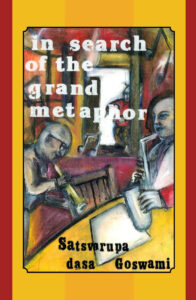
The metaphor is song. Explain it. Yes, particulars may not seem interesting or profound to readers who want structured books.
Wait a minute. Don’t pander to readers or concepts of Art. But Kṛṣṇa conscious criteria are important and must be followed. So, if your little splayed-out life-thoughts are all Kṛṣṇa conscious, then it’s no problem.
I am near the end of my days. But I do like the company of like-minded souls, especially those who are Kṛṣṇa conscious. Yes! I am prone to Kṛṣṇa consciousness. I have been a disciple of Bhaktivedanta Swami Prabhupāda for maybe almost sixty years. Sometimes I fail him. But I always bounce back and fall at his feet. It is a terrible thing that I sometimes do not have the highest love for him. It is a terrible thing. Actually, however, I never fall away from him. He always comes and catches me and brings me back to his loving arms.

This edition of Satsvarūpa dāsa Goswami’s 1996 timed book, Upstate: Room to Write, is published as part of a legacy project to restore Satsvarūpa Mahārāja’s writings to ‘in print’ status and make them globally available for current and future readers.
A factual record of the reform and change in ISKCON guru system of mid ’80s.

Readers will find, in the Appendix of this book, scans of a cover letter written by Satsvarūpa Mahārāja to the GN Press typist at the time, along with some of the original handwritten pages of June Bug. Together, these help to illustrate the process used by Mahārāja when writing his books during this period. These were timed books, in the sense that a distinct time period was allotted for the writing, during SDG’s travels as a visiting sannyāsī

Don’t take my pieces away from me. I need them dearly. My pieces are my prayers to Kṛṣṇa. He wants me to have them, this is my way to love Him. Never take my pieces away.

Many planks and sticks, unable to stay together, are carried away by the force of a river’s waves. Similarly, although we are intimately related with friends and family members, we are unable to stay together because of our varied past deeds and the waves of time.
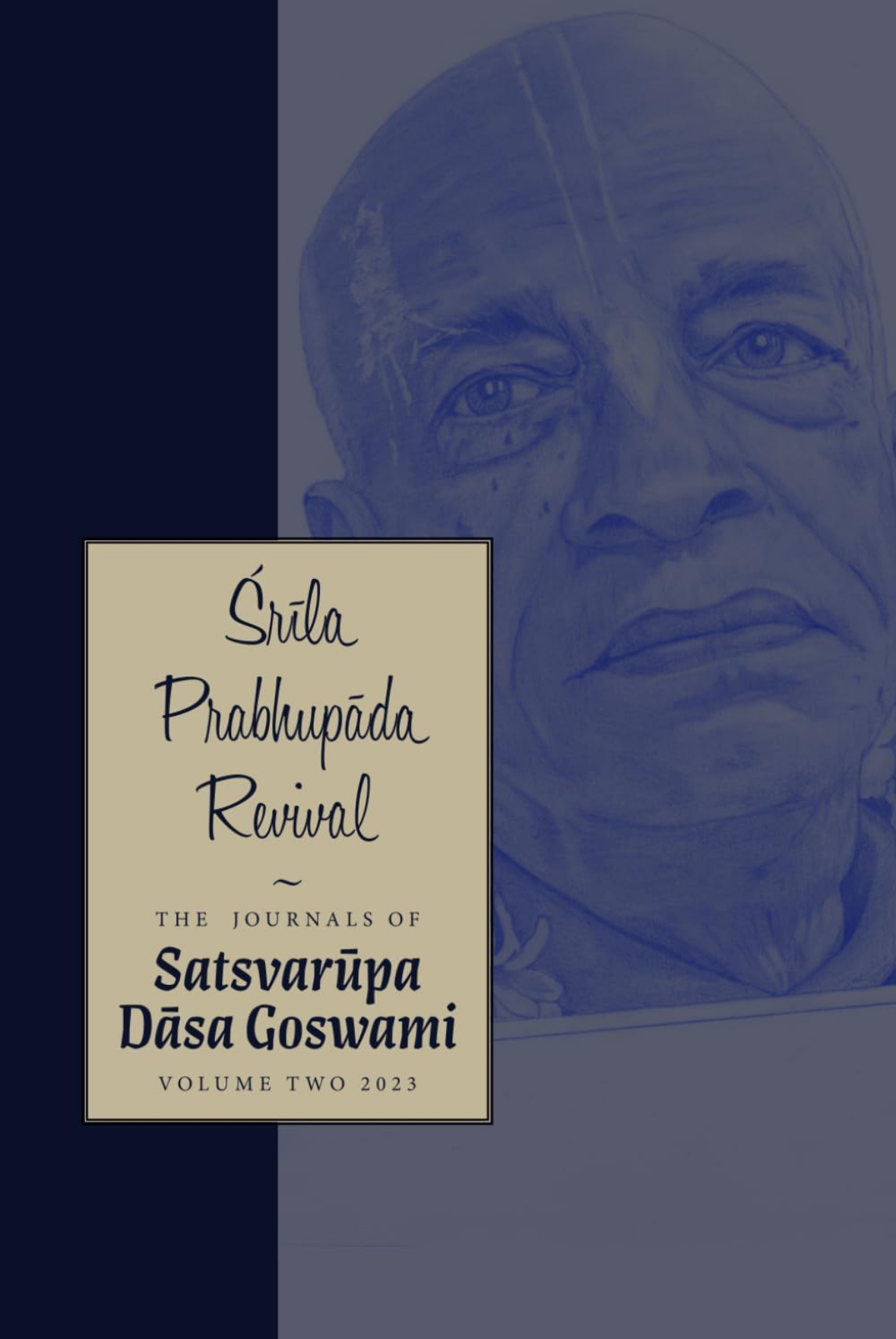
To Śrīla Prabhupāda, who encouraged his devotees (including me) To write articles and books about Kṛṣṇa Consciousness.
I wrote him personally and asked if it was alright for his disciples to write books, Since he, our spiritual master, was already doing that. He wrote back and said that it was certainly alright For us to produce books.
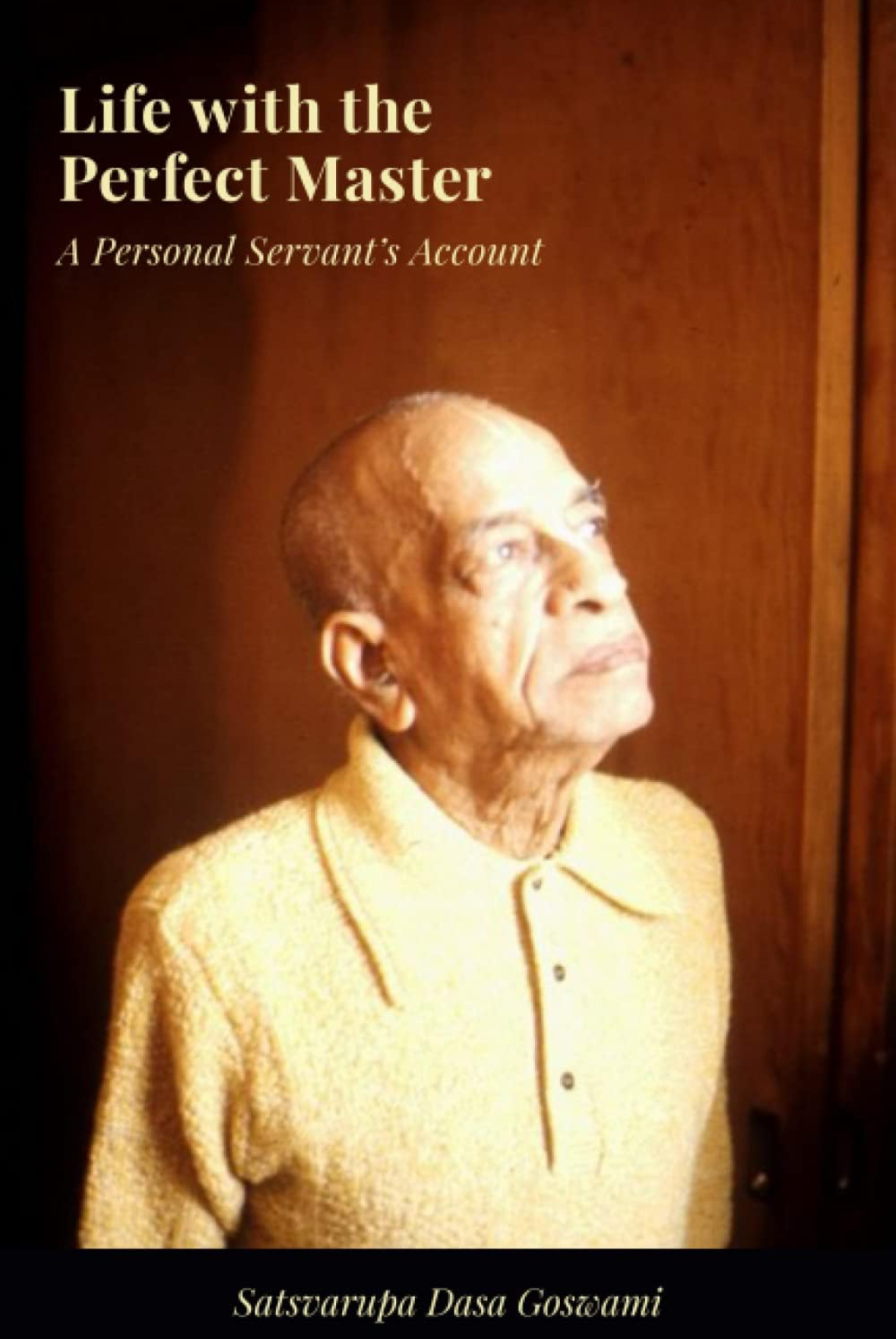
I have a personal story to tell. It is a about a time (January–July 1974) I spent as a personal servant and secretary of my spiritual master, His Divine Grace A.C. Bhaktivedanta Swami Prabhupäda, founder-äcärya of the International Society for Krishna Consciousness. Although I have written extensively about Çréla Prabhupäda, I’ve hesitated to give this account, for fear it would expose me as a poor disciple. But now I’m going ahead, confident that the truth will purify both my readers and myself.

First published by The Gītā-nāgarī Press/GN Press in serialized form in the magazine Among Friends between 1996 and 2001, Best Use of a Bad Bargain is collected here for the first time in this new edition. This volume also contains essays written by Satsvarūpa dāsa Goswami for the occasional periodical, Hope This Meets You in Good Health, between 1994 and 2002, published by the ISKCON Health and Welfare Ministry.

This book has two purposes: to arouse our transcendental feelings of separation from a great personality, Śrīla Prabhupāda, and to encourage all sincere seekers of the Absolute Truth to go forward like an army under the banner of His Divine Grace A.C. Bhaktivedanta Swami Prabhupāda and the Kṛṣṇa consciousness movement.

A single volume collection of the Nimai novels.
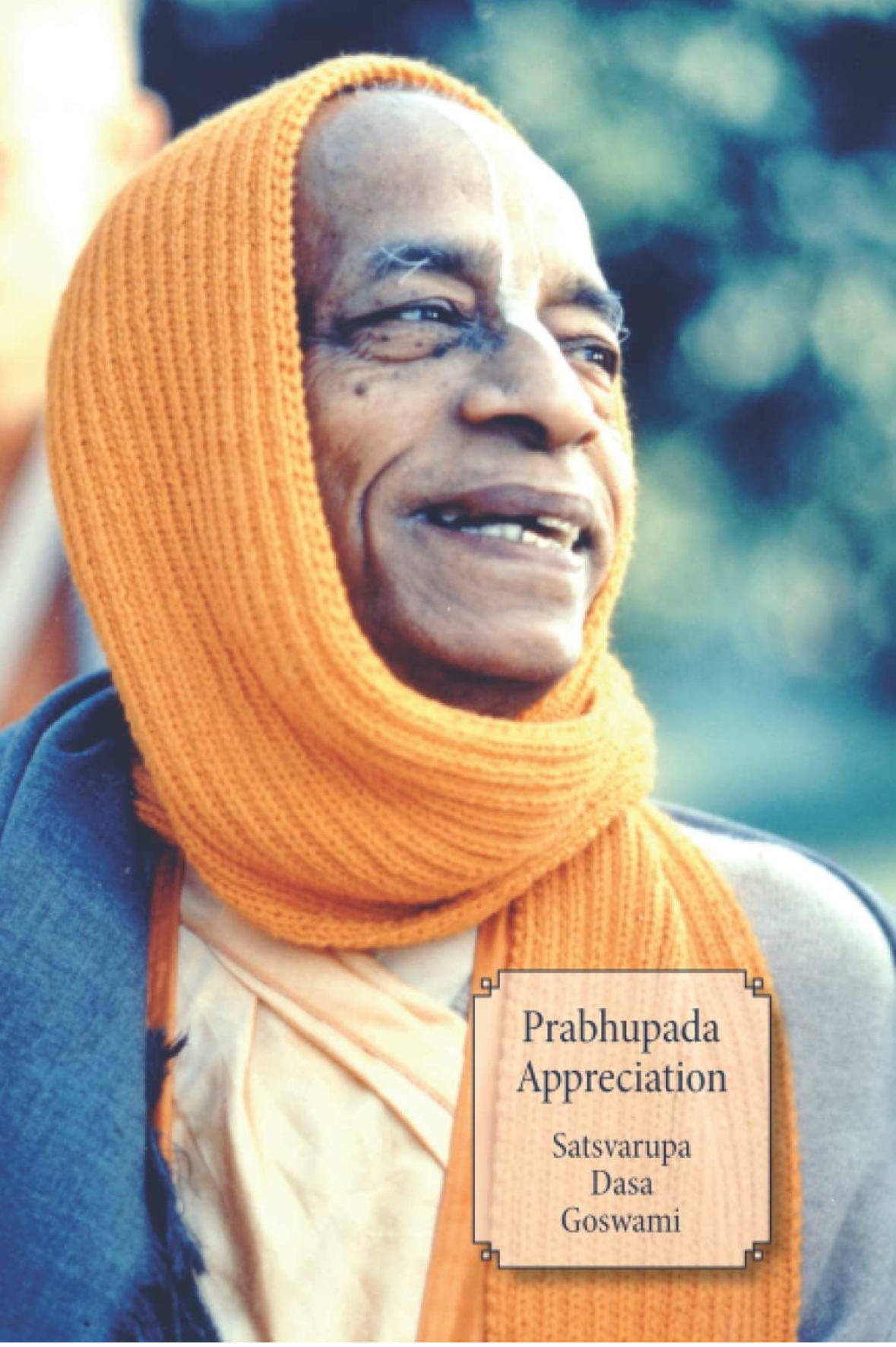
Śrīla Prabhupāda was in the disciplic succession from the Brahmā-Mādhva-Gauḍīya sampradāya, the Vaiṣṇavas who advocate pure devotion to God and who understand Kṛṣṇa as the Supreme Personality of Godhead. He always described himself as simply a messenger who carried the paramparā teachings of his spiritual master and Lord Kṛṣṇa.
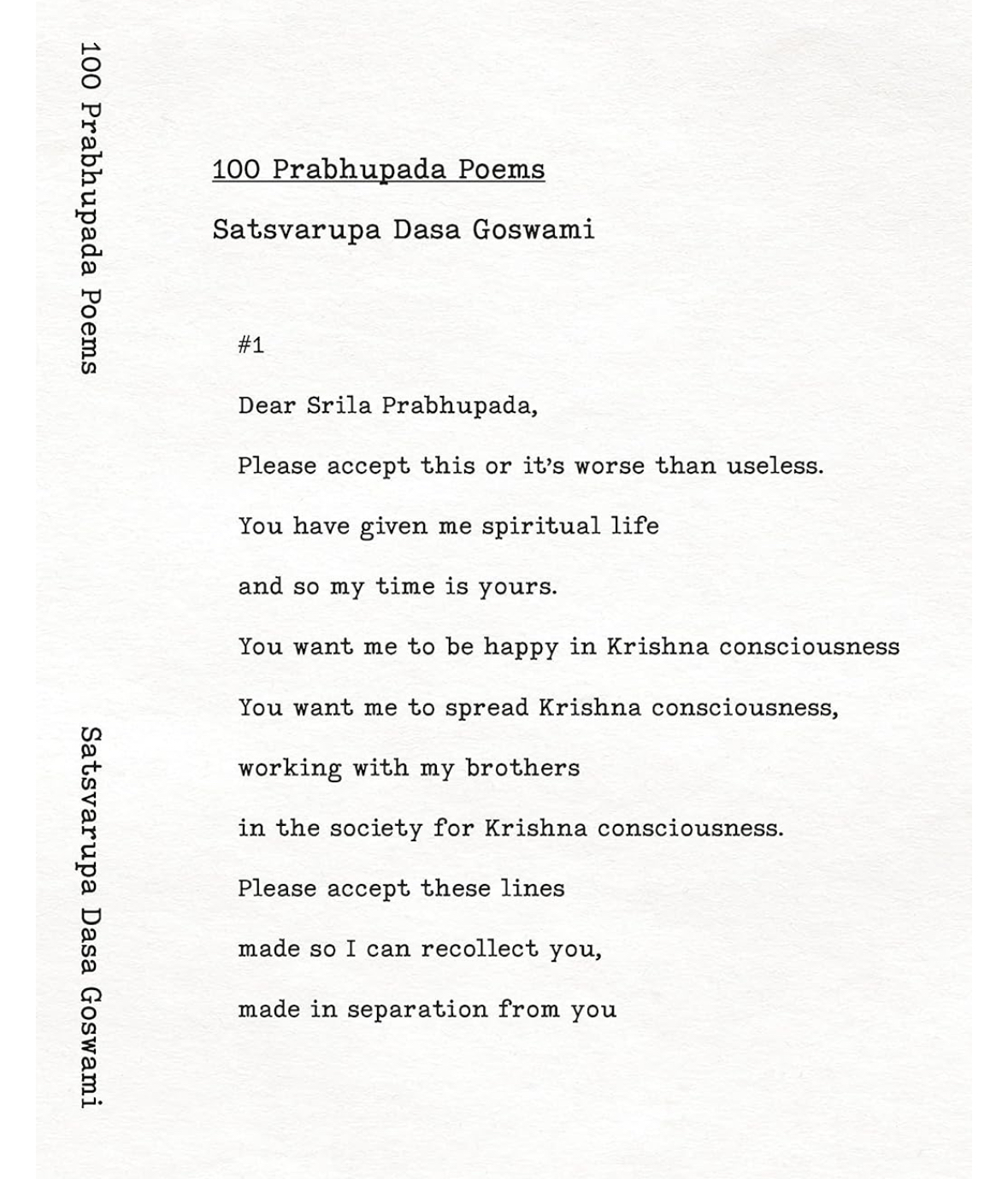
Dear Srila Prabhupada,
Please accept this or it’s worse than useless.
You have given me spiritual life
and so my time is yours.
You want me to be happy in Krishna consciousness
You want me to spread Krishna consciousness,
This collection of Satsvarūpa dāsa Goswami’s writings is comprised of essays that were originally published in Back to Godhead magazine between 1966 and 1978, and compiled in 1979 by Gita Nagari Press as the volume A Handbook for Kṛṣṇa Consciousness.
This second volume of Satsvarūpa dāsa Goswami’s Back to Godhead essays encompasses the last 11 years of his 20-year tenure as Editor-in-Chief of Back to Godhead magazine. The essays in this book consist mostly of SDG’s ‘Notes from the Editor’ column, which was typically featured towards the end of each issue starting in 1978 and running until Mahārāja retired from his duties as editor in 1989.
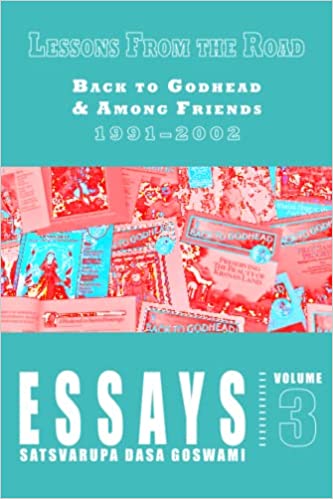
This collection of Satsvarupa dasa Goswami’s writings is comprised of essays that were originally published in Back to Godhead magazine between 1991 and 2002, picking up where Volume 2 leaves off. The volume is supplemented by essays about devotional service from issues of Satsvarupa dasa Goswami’s magazine, Among Friends, published in the 1990s.

“This is a different kind of book, written in my old age, observing Kṛṣṇa consciousness and assessing myself. I believe it fits under the category of ‘Literature in pursuance of the Vedic version.’ It is autobiography, from a Western-raised man, who has been transformed into a devotee of Kṛṣṇa by Śrīla Prabhupāda.”
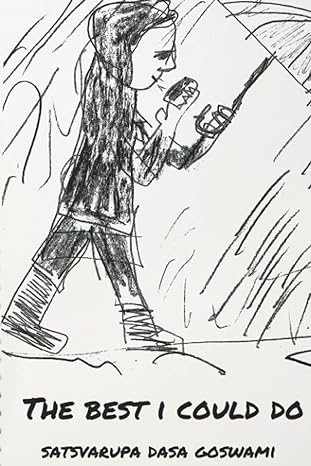 The Best I Could Do
I want to study this evolution of my art, my writing. I want to see what changed from the book In Search of the Grand Metaphor to the next book, The Last Days of the Year.
 a Hare Krishna Man
It’s world enlightenment day
And devotees are giving out books
By milk of kindness, read one page
And your life can become perfect.
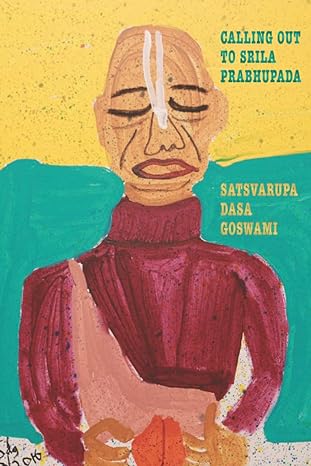 Calling Out to Srila Prabhupada: Poems and Prayers
O Prabhupāda, whose purports are wonderfully clear, having been gathered from what was taught by the previous ācāryas and made all new; O Prabhupāda, who is always sober to expose the material illusion and blissful in knowledge of Kṛṣṇa, may we carefully read your Bhaktivedanta purports.
I use free-writing in my devotional service as part of my sādhana. It is a way for me to enter those realms of myself where only honesty matters; free-writing enables me to reach deeper levels of realization by my repeated attempt to “tell the truth quickly.” Free-writing takes me past polished prose. It takes me past literary effect. It takes me past the need to present something and allows me to just get down and say it. From the viewpoint of a writer, this dropping of all pretense is desirable.
 Geaglum Free Write
This edition of Satsvarūpa dāsa Goswami’s 1996 timed book, Geaglum Free Write Diary, is published as part of a legacy project to restore Satsvarūpa Mahārāja’s writings to ‘in print’ status and make them globally available for current and future readers.