
We are still expanding our team of proofreaders as we aim to increase the rate of republication of Satsvarūpa Mahārāja’s books as well as new books that he writes. As many of you know, during the July 4th festival just held, a total of 18 new and re-edited and published books were present, and we hope to present a similar number at Satsvarupa Maharaja’s Vyasa-puja observance this December. Our call for proofreaders includes a need for fluent bilingual Spanish and English speakers to proofread Spanish translations (we currently have around 20 Spanish translations waiting to be proofread). Anyone interested in this particular service should contact Manohara dāsa at [email protected]
If you would like to help, please contact Kṛṣṇa-bhajana dāsa at [email protected] or [email protected] and we will find you a service that utilizes your talents.
There are ten offenses in chanting Hare Kṛṣṇa. They involve not only the time when we sit down to chant japa, but our whole devotional life. These offenses—disobeying the orders of the spiritual master, committing deliberate sins on the strength of chanting, blaspheming the devotee—have to do with more than correct pronunciation of the names of the Lord. So whether we can carry out the orders of the spiritual master is our test. By the time you sit down to chant, it’s already determined by your service attitude—you’ve either already committed the offenses, or you haven’t. Offenseless chanting and following the spiritual master’s orders are interdependent.
By chanting carefully, you get the strength to follow the orders of your spiritual master, as you associate with Kṛṣṇa’s name. But we know that if you associate without offense, it is much more effective. Following the four rules and living in devotional service assures you of avoiding the ten offenses.
The chanting of Hare Kṛṣṇa has the power to eradicate all sins, but if you become an offender to the holy names of the Lord, then you have no chance of being delivered.
******
THE NINTH OFFENSE is to instruct the glories of the holy name to a faithless person. Only one who is pious and austere can appreciate the confidential nature of the holy name—Hare Kṛṣṇa, Rādhā-Kṛṣṇa. Although we should introduce everyone to the chanting of Hare Kṛṣṇa, we should not describe the intimate glories of the Lord to someone who is inimical, because that will just increase his blasphemous attitude. Better that we try to approach innocent persons who are at least a little receptive.
Although preaching is meant for the non-devotee, we should not preach to the outright atheist who blasphemes the holy name. In our preaching, of course, everyone is faithless, but we should avoid prolonged exposure to blasphemy, what to speak of presenting the intimate glories of the holy name to such a rascal. Prabhupāda has quoted the Christian saying, “One should not throw pearls before swine.” So as far as possible, go to those persons who are a little inclined.
We are very liberal; we distribute Kṛṣṇa consciousness to all persons. But the glories of the holy name should not be preached to persons who incur further offense. You should not be an instrument for that. Actually, until one becomes himself submissive and purified by following the path of Kṛṣṇa consciousness, he cannot understand these elevated principles. But those who are innocent, they can be approached. That is the preaching spirit.
Also, initiation into the holy name should not be given to someone who doesn’t have full faith in the holy name, in the scriptures, and the spiritual master. That is also an offense.
******
Knowledge about Srimati Radharani, Her relationship with Krsna, Her relationships with Her sakhis and gopi manjaris is expanded throughout the confidential literatures of Gaudiya Vaisnavism. In recent years these books are becoming more accessible to English speaking readers. We are becoming more aware, at least theoretically, that devotion to Srimati Radharani is the topmost expression of Krsna consciousness. Bhaktivinoda Thakura says in one of his songs, “Srimati Radhika is the teacher of the mellow of conjugal love. The pure love between Radha and Madhava is meant to be discussed and contemplated.”
But there are many warnings that one should never mistake Srimati Radharani and Her affairs with Krsna to be material dealings of man and woman. There is a danger in being curious about Srimati Radharani but not hearing in the proper way. I wanted to therefore impart Prabhupada’s presentation of Srimati Radharani and confining myself to whatever I have found in his books and lectures and talks. You will find that although Srila Prabhupada was on the one hand very reserved in speaking about Radharani he nevertheless imparted to us a sweet and pure understanding of Radharani and the practical means to advance ourselves in Her service.
In his translations and purports to relevant sections of Nectar of Devotion, KRSNA book and Caitanya-caritamrta, Prabhupada deals in all the intricacies of Srimati Radharani’s love for Krsna. I have gone through these many section especially looking for statements where Prabhupada is speaking personally his own realization in his own words.
I can remember Srila Prabhupada speaking about Srimati Radharani in the summer of 1966 at 26 Second Ave. in New York City.
I always remember Prabhupada on Radhastami because I received first initiation from Prabhupada on this day, September 23rd, 1966. Prabhupada’s qualifications for initiation were very easy in those days and so I could have been initiated at the first initiation in ISKCON which was on Janmastami day 1966. But I didn’t feel ready for the surrender of my so-called free activities. It seemed too much to give up and so I passed up the initiation.
But a few days after that I began to regret that I didn’t get initiated. Then I heard from one of the devotees that Prabhupada was planning to hold another initiation in two weeks on the occasion of the appearance day of Srimati Radharani. So then Prabhupada began to explain to us something about Srimati Radharani.
He said that on Janmastami we had to fast all day until midnight because Krsna is very strong and hard. But on Radhastami we would only have to fast until noon because Radharani is soft and kind.
I therefore decided that I would ask Prabhupada if I could get initiated on Radharani’s appearance day. What had seemed too hard two weeks previously on Krsna’s birthday now seemed easier under the protection of Srimati Radharani.
Prabhupada’s first explanation of Radharani is an unforgettable sutra. Prabhupada said that Srimati Radharani is the best devotee of Krsna. Because She loves Him the most.
Prabhupada then explained that Srimati Radharani was interested in the welfare of all devotees and that we could pray to Her. He said you can’t go directly to Krsna but if Krsna’s devotee is pleased with you then he or she will recommend you to Krsna and Krsna will be obliged to give you His mercy. This is especially true if you get the mercy of Srimati Radharani.
Prabhupada put knowledge of Radharani in the very first books that he translated in America, Teachings of Lord Caitanya 1967, KRSNA book 1968, and Nectar of Devotion in 1969. In the Nectar of Devotion, under the category of “Attracting Krsna”, the characteristics of pure devotional service, Prabhupada explained the principle of approaching Krsna through Radha:
To perform devotional service means to follow in the footsteps of Radharani, and the devotees in Vrndavana put themselves under the care of Radharani in order to achieve perfection in their devotional service. In other words, devotional service is not an activity of the material world; it is directly under the control of Radharani. In Bhagavad Gita it is confirmed that the mahatmas or great souls, are under the protection of daivi prakrti, the internal energy—Radharani. So, being directly under the control of the internal potency of Krsna, devotional service attracts even Krsna Himself.” (NOD pg. 16)
Prabhupada’s remark that Krsna was hard and Radharani was soft and kind, is collaborated by a statement he made in the Nectar of Devotion under Krsna’s quality of “compassionate”:
“Instead of offering obeisances to Krsna, devotees offer obeisances to His compassionate nature. Actually , because Krsna is the Supreme Personality of Godhead, it is very difficult to approach Him. But the devotees, taking advantage of His compassionate nature, which is represented by Radharani, always pray to Radharani for Krsna’s compassion.” (NOD pg. 176)
Prabhupada sometimes described Radharani as Krsna’s tenderhearted female counterpart.
And for praying to Radharani, the easiest way is to address Her in Hare Krsna Mantra which is made up of names of Radha and Krsna. :O Energy of the Lord (Hara) O Lord, please engage me in Your service.”
Prabhupada did not broadcast explicitly the glories of Radharani as much as he did those of Lord Krsna the Supreme Personality of Godhead. And yet he does inform us that, according to Gaudiya Vaisnava siddhanta, Srimati Radharani is the Queen of Vrndavana. She has the power to attract even Krsna. As stated by Prabhupada in the Nectar of Devotion:
“Krsna attracts everyone, but devotional service attracts Krsna. The symbol of devotional service in the highest degree is Radharani. Krsna is called Madana Mohana, which means He is so attractive that He can defeat the attraction of thousands of Cupids. But Radharani is still more attractive, for She can attract Krsna. Therefore devotees call Her Madana Mohana Mohini, the attractor of the attractor of Cupid.” (NOD 16)
Why then was Srila Prabhupada so reserved and grave in speaking about Radharani?
One reason Prabhupada was reserved was that we were such neophytes. Also Prabhupada was preaching in the West and it is the nature of materialistic persons outside of Vedic culture to take Radha Krsna affairs as ordinary sex affairs. Prabhupada explained this with the example of the cow who experienced fire in the barn. Once there was a fire in a barn and a cow became so frightened that thereafter whenever she saw the color red she panicked. In a similar way, conditioned souls are so traumatized or addicted to sex pleasure, that as soon as they see a picture of Krsna embracing Radha they think “Yes that’s the same as what I feel for my girlfriend.”
Prabhupada was also very afraid that if the devotees took prematurely to Radha-Krsna affairs they would become prakrta sahajiyas, those who take confidential matters too cheaply. He told about a man who said, “Whenever I hear the name Radha I always think of a barber’s wife whose name is Radha.”
In the Preface to the KRSNA Book Prabhupada begins, “In these Western countries, when someone sees a cover of a book like Krsna, he immediately asks “Who is Krsna? Who is the girl with Krsna?” But it’s significant that Prabhupada then completes the Preface by answering the question who is Krsna but he does not mention who Radha is.
The Caitanya-caritamrta explains about the Supreme position of Radharani even in relationship to Krsna. This is spoken by Lord Caitanya while dancing at the Ratha Yatra and speaking about Radha and Krsna:
Sri Krsna continued, “All the inhabitants of Vrndavana dhama—my mother, father, cowherd boyfriends and everything else—are like My life and soul. And among all the inhabitants of Vrndavana, the gopis are My very life and soul. Among the gopis, You, Srimati Radharani, are the chief. Therefore You are the very life of My life.”
In the purport Prabhupada says:
Srimati Radharani is the center of all Vrndavana’s activities. In Vrndavana, Krsna is the instrument of Srimati Radharani; therefore all the inhabitants of Vrndavana still chant “Jaya Radhe”. From Krsna’s own statement given herein, it appears that Radharani is the Queen of Vrndavana and that Krsna is simply Her decoration. Krsna is known as Madana Mohana, the enchanter of Cupid, but Srimati Radharani is the enchanter of Krsna. (Madhya-lila 13.150 verse and purport)
So we like to hear of Srimati Radharani from Srila Prabhupada. It is the safe and most expert way. Because, as Srila Prabhupada writes, “The spiritual master is always considered one of the confidential associates of Srimati Radharani or a manifested representative of Sri Nityananda Prabhu.” (Cc. Adi 1.46, purport)
******
Krsna devi dasi is one of the most important devotees at ISKCON Viraha Bhavan in Stuyvesant Falls, N.Y. Krsna dasi takes meticulous care of Radha-Govinda, as well as three-foot tall murtis of Gaura-Nitai, the 12-inch murti of Srila Prabhupada, and several other Deities.
In addition, Krsna dasi is a hands-on manager of most devotees and affairs in the asrama. When she has to temporarily leave Viraha Bhavan to visit her home country of Trinidad, or help out with her daughter and grandson in Houston Texas, the devotees at Viraha Bhavan feel her absence so greatly that everyone anxiously awaits her return so that affairs may return smoothly again.
Krsna dasi’s husband Baladeva dasa passed away from cancer several years ago, but she has bravely overcome her sorrow and is engaged fully and positively in direct service to Radha and Govinda.
SDG
pp. 110-13
December 31, 1968
My dear Satsvarupa,
Please accept my blessing. I beg to acknowledge receipt of your letter of December 27, 1968, along with one very beautiful picture of Jadurany’s. I am so pleased to see this wonderful portrait, and please convey my heartfelt thanks to Jadurany for her fine endeavors.
Regarding the article suggested by Rayrama, you are correct in your doubts that Radha-Krsna-leela should not be discussed in Back to Godhead. In the Srimad Bhagavatam there are so many philosophical discussions, and we should concentrate on these philosophical aspects. Otherwise, the less intelligent will surely understand Radha-Krsna-leela as simply nonsense boy-and-girl sex life. Hanuman Prasad Poddar and company are all mundane types, and they have no entrance into actual spiritual activities. Superficially they pose themselves as great devotees, but we can feel their pulse; ultimately they are impersonalists. We should not depend upon writings from such unauthorized sources. Strictly we should avoid publishing these confidential topics in Back to Godhead. This is dangerous for the conditioned soul.
Although such Krsna-leela can do some good to the mundane people in the long run, to understand the philosophical aspects of Bhagavad Gita and Srimad-Bhagavatam in the beginning is essential. I do not know why Rayrama has asked you to send such an article. It is not to my sanction. We shall be very careful about mundane sex life. That is the pivot of conditioned life. You are intelligent enough, and I hope that Krsna will help you in these matters.
I hope you are well.
Your ever well-wisher,
A.C. Bhaktivedanta Swami
In this letter Śrīla Prabhupāda forbids us to present confidential topics in Back to Godhead. It is interesting that he wrote this while writing Kṛṣṇa’s confidential pastimes in Kṛṣṇa book.
Throughout Śrīla Prabhupāda’s life, he was dedicated to delivering the rāja-vidyā rāja-guhyaṁ, the most confidential knowledge of the Absolute Truth—kṛṣṇa-kathā. Yet he was also dedicated to protesting the misuse of kṛṣṇa-kathā by Māyāvādīs or other materially motivated persons (professional Bhāgavatam reciters and prākṛta-sahajiyās).
In this letter Prabhupāda is concerned that unless persons who speak kṛṣṇa-kathā carefully present Kṛṣṇa’s pastimes, those reciters can ruin the proper understanding of the hearers. Descriptions of the rāsa dance are especially not meant for the public. Śrīla Prabhupāda was preparing to translate all the chapters of the Tenth Canto in his Kṛṣṇa book, but he was compiling the book carefully and beautifully, always giving philosophical explanations so the reader would not be misled.
When we read Prabhupāda’s Kṛṣṇa book, we must not mistake the pastimes of Rādhā-Kṛṣṇa for mundane love affairs between a young man and woman. The affairs of Rādhā and Kṛṣṇa are on the highest level of spiritual reality, but when the spiritual world is reflected into the material world, the highest point becomes the lowest. In the perverted reflection (the material world), the love affairs of Rādhā and Kṛṣṇa become the abominable affairs of illicit sex between man and woman in the mood of mundane enjoyment. The Rādhā-Kṛṣṇa pastimes of the rāsa dance are the highest technology of the science of Kṛṣṇa, and they can be understood only by the topmost devotees. Only they can deliver these pastimes to others. Innocent persons can benefit from hearing kṛṣṇa-kathā only from a Kṛṣṇa conscious master like Śrīla Prabhupāda, who knows the means of presenting topics about Kṛṣṇa according to time and place. If one reads all of Prabhupāda’s books—from Bhagavad-gītā through the Bhāgavatam—only then can he appreciate the rāsa dance.
In Back to Godhead, we should present philosophical topics frequently discussed by the previous ācāryas. Śrīla Prabhupāda later told us how we should present in Back to Godhead the first two levels of transcendental realization: (1) Information to awaken people’s awareness of God. People have no information of God and are therefore sunk in the worst condition of ignorance. The first service, therefore, in delivering Kṛṣṇa consciousness to them is to awaken their knowledge of their relationship with God by philosophical presentations. There are many philosophical arguments and presentations made by the previous ācāryas that oppose the atheistic and impersonal version of reality. Before a person can understand anything in transcendental knowledge, he has to first understand that he is not his body, but spirit soul and an eternal servant of God.
(2) We must present information which instructs people in the activities of devotional service. When we acknowledge that Kṛṣṇa is the Supreme Personality of Godhead and that we have a relationship with Him, then we are eligible to hear about the activities of devotional service—hearing, chanting, and the many practical ways we can engage our senses in the Lord’s service under the spiritual master’s direction.
The third and fourth levels of Kṛṣṇa consciousness—to hear Rādhā-Kṛṣṇa’s pastimes and to directly absorb ourselves in love of God—should not be prematurely presented in a magazine such as Back to Godhead, which is intended for wide distribution. As we see later in this letter, Prabhupāda does not take this transgression of introducing rāsa-līlā into Back to Godhead casually; rather, he is uncompromising: “It is not to my sanction.”
Prabhupāda gave me a charge of his own confidence by saying, “You are intelligent enough, and I hope that Krsna will help you in these matters.” We should not be overconfident or think we maturely understand Kṛṣṇa consciousness and how to deliver it to others. Rūpa Gosvāmī says we should never think of ourselves as great preachers, but should simply try to be an instrument in serving the previous ācāryas; but even serving as that instrument requires some confidence. If we have no confidence, we will hesitate and won’t be able to speak. Our confidence has to rest in faith in our spiritual master, the previous ācāryas, and the message we are delivering. However, by practicing and receiving encouragement from our spiritual master, we will be able to deliver the message properly and understand various intricacies, such as which topics of kṛṣṇa-kathā are suitable to a particular audience according to time and place.
Prabhupāda’s saying, “You are intelligent,” meant to me, “I benedict you with intelligence.” His stating that he hoped Kṛṣṇa would help me meant that I required help from Kṛṣṇa because I was prone to making the same mistakes that Prabhupāda mentions in his letter. Prabhupāda’s saying he hoped Kṛṣṇa would help me meant that with the good wishes of a pure devotee, surely Kṛṣṇa’s blessings would follow.
We have to remain vigilant, using our keen intelligence as far as possible to remember the instructions of our spiritual master, never discussing Kṛṣṇa conscious topics in a way he has not authorized. In this way, each of us is responsible for safeguarding the purity of the paramparā. Prabhupāda never spoiled his cornucopian distribution of the fruits of love of God by including in it anything inappropriate or tinged with the mundane.
pp. 315-19
Every word in Prabhupāda’s purports is perfect. So much wealth and we don’t know how to handle it. We pass over some of it quickly, as if it makes no sense or doesn’t apply to us, but that’s not true. We go through it looking for—what? Each sentence is worth our full attention. But we think we ought to keep moving so we can say to ourselves, “I read another chapter.”
However, it may damage us to read like that—not honoring sentences, as if they contain only platitudes and truisms.
Sometimes the sentences are long. Our short-tempered minds cannot slow down to process all the information they contain. Take this one, for example:
A living entity becomes established in spiritual blissful life when he fully understands that his happiness depends on spiritual self-realization, which is the basic principle of ānanda (bliss), and when he is eternally situated in the service of the Lord, who has no Lord above Him.
—Śrīmad-Bhāgavatam 5.19.20, purport
See what I mean? Did you slow down and read that just now? Go back and read it again.
The sentence makes good sense. I agree with it. Happiness comes in spiritual self-realization and in the Lord’s service. Most of us need active service, not simply reading all day. We are too restless.
Let’s contemplate that sentence.
But we already want to do something else.
Maybe we should just calm down, lay on our backs on the floor.
Maybe we’re not sattvic enough to process sentence after sentence. We are too passionate, or too lonely, or too something—too full of cravings. Just cool it.
While lying on your back, see through
that window the patch of sunlight, the
beautiful blue sky, white clouds moving
from right to left, and gray clouds
mixed in, three immense movements,
sky, white cloud, and gray cloud
in the immense distance
a vision of Kṛṣṇa
that no one can deny.
I am reading Śrīla Prabhupāda’s books exclusively. One of the devotees said he looks up to me for my adeptness in studying. He said he thinks I handle reading about Kṛṣṇa and the gopīs without becoming adversely affected. He said the members of the Caitanya Math (active in Dublin) sometimes criticize ISKCON for not knowing about the higher rasas. Yes, we should be interested in the highest parts of the Gauḍīya Vaiṣṇava teachings, but the way to achieve this knowledge is to read Śrīla Prabhupāda’s books. This understanding is my contribution. Others may read “advanced” books and contribute their knowledge to ISKCON, but I assert that everything is available in Prabhupāda’s books.
I know this is a bold assertion. Can I say for sure that I will be satisfied for the rest of my life reading only Prabhupāda’s books? Am I saying, at least by my action, that it’s better not to read Ṣaṭ-sandarbha or other such books? Will I change as the years go by?
I don’t know. I can’t predict the future. Maybe I should be careful what I announce. But the fact is, everything really is there in Prabhupāda’s books.
******
Bless me, father, for I have sinned. It has been two weeks since my last Confession. These are my sins:
Omission of truth, five and a half times.
Sassed my mother and my sister.
Stubbed my toe and cried out, “Goddamn.”
Wrote crazy stuff, then said I’d stop, then felt the rush in my veins and wanted to do it again. Did it.
Accidentally dropped an ink circle on my kurta.
Wanted to write immortal prose and poetry without considering its effect on my next life.
Gambled.
Gambled.
Read and got tired.
Talked too much and maybe too confessionally.
But I tried, Lord, and I do wish to be Yours.
Please accept this beastly fellow who writes day and night.
“I firmly resolve, with the help of thy Grace, to sin no more and to avoid the near occasions of sins. I do fear the loss of heaven and the pains of hell. Amen.”
For your penance, chant two extra rounds of japa.
Oh no, really? When? By the altar? In front of the golden Eucharist? Alas, old Catholic memories on the brain, wooden kneelers, pews squeaking as parishioners entered and sat down …
******
Some well-known, special verses in the Bhāgavatam 5.19 tell of the fortune of being born in Bhārata-varṣa. I read them, then close my eyes and try to think. So far away from desirable, prayerful consciousness. Could a Christian book on prayer help? Should I be doing something more active? Why don’t Kṛṣṇa’s words and Kṛṣṇa consciousness strike and move me? Śrīla Prabhupāda writes:
Always think of Me … this is very easy, even for a child. Why not take this path? One should try to follow the instructions of Kṛṣṇa exactly and become fully eligible to be promoted to the kingdom of God … One should go directly to Kṛṣṇa and engage in His service.
—Śrīmad-Bhāgavatam 5.19.23, purport
I took a break and went to discuss with M. which plane to take to India and where to stay once we got there.
“This is the best opportunity offered to the inhabitants of Bhārata-varṣa. One who is fit to return home, back to Godhead, is no longer liable to the results of karma, good or bad” (Śrīmad-Bhāgavatam 5.19.23, purport).
Often the same thing is repeated in the purports. Those born in India should perfect their lives by taking to Kṛṣṇa consciousness, then spread the knowledge to others. The Kṛṣṇa consciousness movement, in this spirit, is opening centers all over the world “so that people may associate with the pure devotees of the Kṛṣṇa consciousness movement, understand the science of Kṛṣṇa consciousness and ultimately go home, back to Godhead” (Śrīmad-Bhāgavatam 5.19.28, purport).
I fall at the feet of guru and Kṛṣṇa. The repetition is not a fault. Let me not take it that way. I need to hear with refreshed consciousness in the mood of surrender.
******
Disrupted by the morning meeting, I say. Still choked and blocked. Got no inspiration from The Best American Poetry. This is for me, this is for thee.
I’m hoping tomorrow will be better and I’ll sustain three regular reading and writing sessions. I’m sorry I didn’t read more feelingly and prayerfully today. But that’s no reason to quit trying. I am learning that I have to accept reading sessions in which I comprehend on a certain level but don’t reach anything deeper. Lord Kṛṣṇa knows my intention. When He sees I am sufficiently earnest, He’ll reciprocate. No point sulking. Just keep trying. Wish me smooth sailing tomorrow.
pp. 130-34
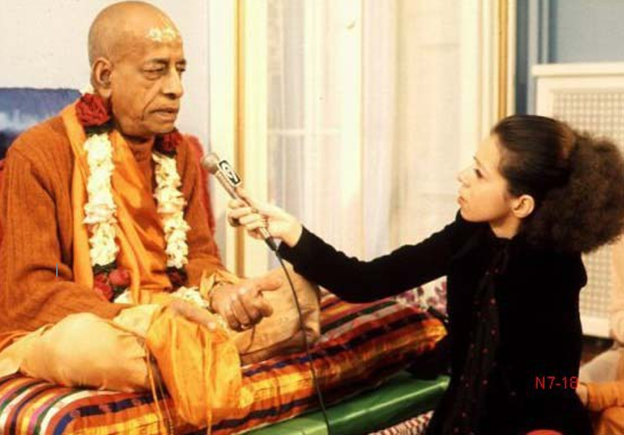
A young woman reporter from Channel 9 holds a microphone to Prabhupada’s mouth. She is young enough to be his granddaughter. She’s been given this assignment by her station, to go and get an interview with the leader of the Hare Krsna movement. He’s paying respect to the opportunity to speak to many people and generously answering her questions. Of course her approach is simplistic. Why are you coming to this city?
What is your philosophy? How many followers do you have? What is the meaning of the chanting? Why do your disciples shave their heads? She may have thrown some curve balls. What is the role of women in your movement? What is your position on war and terrorism? Why are your people so aggressive in the airports distributing books? Prabhupada had already heard all the questions she could possibly ask, and he was never bewildered to come up with an answer. He was always very reasonable, and the interviewers usually warmed up to him and liked him. As one of the first reporters to interview him, a man from the Village Voice recalled of Prabhupada, “I just plain liked the guy.”
Prabhupada is not looking at the microphone, but looking directly at the interviewer. He has finished the formality of the interview and is preaching to her personally. He is reaching out to her. The one aspect of this scene is that she is a link to many people, but another transaction is that she is an individual who has come to him, and he is not overlooking her.
Prabhupada was often interviewed by reporters, starting with a reporter in Butler, Pennsylvania, in 1965, when he stayed at the house of the Agarwals. There an article appeared in the newspaper with a photo showing Prabhupada smiling, wearing his frayed cadar and described as an “ambassador” from India. That was a small-town newspaper, and they saw his visit as a special-interest topic. Later, Prabhupada was approached at airports surrounded by dozens of disciples and treated as the leader of a world religion. The interviewers asked standard questions, such as, “What is Krsna consciousness?” “How many followers do you have?” “Why have you come here to __?” “What is your age?” “How is this different from other religions?” Prabhupada answered the questions at length, always using them as an opportunity to preach the parampara message of Bhagavad-gita and Caitanya Mahaprabhu. Often the news stories that resulted reported verbatim what he had said, and this pleased him. But sometimes there were cynical comments about the fact that he was picked up in a limousine or wore an expensive watch while preaching renunciation.
Prabhupada would sometimes play with the reporters and answer their questions in amusing ways. Once when he used the word “hippies,” the reporter asked him what he thought a hippie was. Prabhupada replied, “You know better than I, something extraordinary.” He also received reporters at the temple and appeared at television interview shows. Commentators who were reputed to be caustic with their subjects were usually put off guard by Prabhupada and treated him as a gentleman without insulting him. He was such a dignified and scholarly gentleman that he raised the level of the intended interview and brought out the best in the reporter. Prabhupada also spoke to the reporters not only as mouthpieces to a larger audience, but he addressed them personally as spirit souls. He sometimes put them on the spot and asked them, in effect, “Why aren’t you taking to Krsna consciousness?”
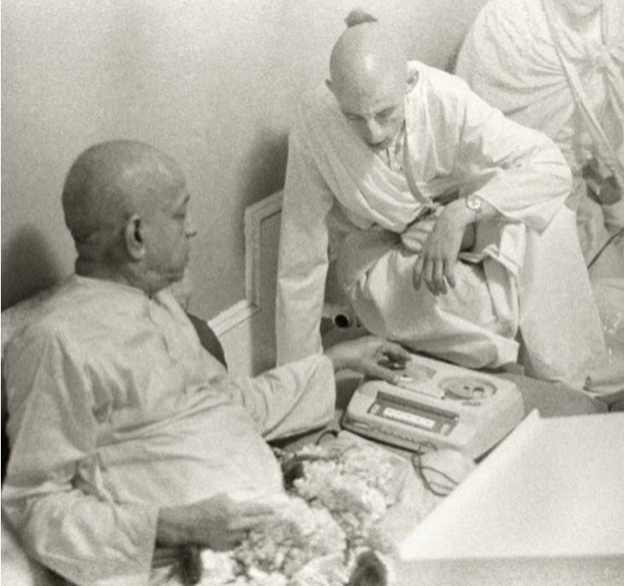
Prabhupada worked with a manual typewriter when he began his publishing of articles and his Srimad- Bhagavatam in India. He would carry the typed manuscripts to the printers, where they would typeset the pages into printed pages.
Prabhupada worked with his old manual typewriter at his rented workroom at Chippiwada in Old Delhi. He was a poor sannyasi and had to beg for paper and printing and had to bring the paper himself and have it carried by rickshaw to the printers. He then read the printed pages and entered corrections by hand and carried it back to the printer. He wrote in the quiet of his room at the Radha Damodara temple, but conducted his printing business by walking through the busy streets of Delhi.
When he came to America, he continued to work with his manual typewriter, composing the translations and purports of Srimad-Bhagavatam. He was on the Second Canto and carried hundreds of pages of already-completed manuscripts with him. But then his typewriter was stolen from his room at Dr. Misra’s ashram. When he moved to the Bowery, he was given another typewriter and continued his work. At 26 Second Avenue he engaged Hayagriva in editing the pages he had already typed. Then Gargamuni bought Prabhupada his first Dictaphone, and e began using it, speaking directly into the microphone and making tapes. He stopped using the typewriter.
I was one of the first ones to type the Dictaphone tapes. No one else wanted to do it. I had my own manual typewriter at my apartment, and I would also type the tapes in Prabhupada’s apartment at 26 Second Avenue. When Prabhupada moved to San Francisco and I moved to Boston, I continued to be the sole typist of the tapes. He began The Teachings of Lord Caitanya and sent me the tapes in the mail. He sent them in loosely-taped envelopes at the rate of about two per week. Typing the tapes was very dear to me. Hearing my master’s voice in my ears and typing early in the morning before I went to my welfare job gave me intense feelings of separation. I used to hear his voice even when I wasn’t typing. I kept the carbon copy and sent the original manuscript to him in the mail. We had much correspondence about which tapes I had and which tapes he had. In this way I typed the Third and Fourth Cantos of Srimad-Bhagavatam, the entire TLC and the Krsna Book. In my morning lectures at the temple I would recite Krsna Book stories to the devotees. Typing was my life and soul. This picture shows Prabhupada and I conferring over the Dictaphone during one of his visits to Boston. Typing for Prabhupada was one of the most intimate services I ever did for him, and it made me steady emotionally, easing my separation from him and teaching me the philosophy.
pp. 31-34
******
If this notebook is lost, please return to:
Satsvarupa dasa Brahmacari
c/o International Society for Krsna Consciousness, Inc.
26 Second Avenue, New York, NY
In this notebook I intend to keep notes I will type down from memory after hearing lectures by His Divine Grace A.C. Bhaktivedanta Swami, my spiritual master and founder-acarya of ISKCON.
I should have begun this earlier. Maybe I can still write down some Krsna consciousness thoughts and activities, something about Swamiji and his society.
It can also be a place for trying out poems and things.
Swamiji, I am remembering you.
I am here now and you are here around the corner in your room. Life is freed for me from the karma of the past. I want to learn Krsna conscious philosophy.
Should I do the typing or go see the Swami? Without any notes, I just start to remember what the Swamiji said in his lecture and I type some of it down. I can type pretty good. I don’t make mistakes. It starts to come to me, some of the things he said in his lecture. At least I remember the essence of it. I don’t attempt to write the whole thing down, just the essence as I remember it.
I don’t really do it for him, it’s more for myself. It’s not that I go to my apartment having memorized what he says, but it just comes out and keeps my head balanced. I really like to walk through the streets feeling the Hare Krsna mantra and seeing the city in the summer. I feel such well-being as Swamiji’s boy.
My yoga is typing. I’m not just typing something for Swamiji. I’m doing yoga. It’s for myself. It’s the last kind of creative writing I’ve allowed myself. I’ve stopped all other writing— my novel-writing and my short-story writing—it was all so corrupt and egotistical. But this remembering and recording short sentences is the fruit of anything I’ve learned as a writer. I try to communicate what Swamiji said, in my own voice, as concisely as possible. It’s Swamiji, but expressed in my own way. I get creative joy out of this writing. It’s a good discipline for spiritual life.
Usually as I start to type, something comes to mind. Yesterday I remembered about the three modes of nature. “There are three modes of material nature, raja-guna, tamo-guna, and sattva-guna. We are all under the modes of nature. Krsna is above the modes of nature. Surrendering to Krsna brings freedom from the modes.” Just things like that. He also said, “The donkey carries the washerman’s load. He thinks the washerman is the source of his food, but he can get grass anywhere. This is the foolishness of the ass.
Materialists are like this donkey.” Typing these things down is a nice way to be with Swamiji. I’m starting to grasp the philosophy too.
I think you have to get a special, mystical revelation from Krsna to understand Swamiji. He’s incomprehensible. Swamiji said that by service the revelation will come. Note-taking helps.
I am trying to kick off my false ego. Novel and poetry-writing is false ego. I’m ready to make the break with the past for Swamiji’s sake.
Hayagriva told me he is going to write for Krsna. I threw my manuscripts into the incinerator. I had to think about that one before I did it though. What if these manuscripts were great works? What if I am a genius, and I just don’t recognize it? Still, they had no Krsna consciousness. How could they help anyone? Swamiji says even great literature, if it is without Krsna consciousness, is like the decoration of a dead body.
Now I only want to express Krsna-thought and read Krsna-thought. That is a pure devotee. We shouldn’t have other books in the storefront.
From Srimad-Bhagwatam: “Great sages laboring hard under stringent regulative principles for salvation by suspending semina upwards and thus remaining naked, as well as successful mendicants who have attained the complete satisfaction by purificatory practices—do achieve the transcendental sky of the name Brahman. But so far we are concerned, oh Great Mystic! We shall transcend this world of abject nescience simply by vibrating the message of your activities as duty-bound devotees of Your Lordship, although we are moving seemingly on the path of fruitive actions” (Preface, Volume 2).
pp. 162-65
Spring is singing in the Esso stations and around the grapevines tortured where they grow, twisted around the trellises. Spring is Krsna’s favorite season: “Of seasons I am flower-bearing spring.” Prabhupada writes,
“Of course spring is a season universally liked because it is neither too hot nor too cold and the flowers and trees blossom and flourish. In spring there are also many ceremonies commemorating Krsna’s pastimes; therefore this is considered to be the most joyful of all seasons, and it is the representative of the Supreme Lord, Krsna.” (Bg. 10.35, purport)
There are ceremonies in the spring. Gaura-Purnima comes during the thaw, and the crocuses and snowdrops appear. Lord Ramacandra appears in the spring. Do you remember the Rama-navami in 1967 when we chanted at some Peace Be-In in the park behind the 42nd Street library with devotees from several cities, singing with drum and karatalas all day, then down to 26 Second Avenue for potatoes, breaking the fast, and talking about Swamiji, who was on the West Coast? It was neither too hot nor too cold, and we were filled with plans for spreading Krsna consciousness and making spiritual advancement.
Srlla Bhaktisiddhanta Sarasvatl Thakura appeared in spring. Prabhupada wrote,
“Adore adore ye all,
The happy day,
Blessed than heaven,
Sweeter than May,
When he appeared at Puri
The holy place,
My lord and master,
His Divine Grace.”
And spring brings out the harinama parties again out of the frozen cities.
This story I am telling wanted it to be spring, but didn’t want to squeeze it in. I can’t squeeze it in, and I can’t squeeze out a story, either. That brings up other stories. I remember one spring how three new bhaktas left the Boston temple together to seek out women or love or just to hitchhike. They’d been devotees all through the winter months, controlling their senses and minds indoors, but now it was full-blown spring and they were called to go out and find what they could, not to be contained or tamed in a wooden temple chanting on beads and reading spiritual books.
You think you can get away with murder. “You’ll be chastised, young man,” my friend Murray said to me on the telephone after reading the manuscript of my latest autobiographical novella, Sagittarius. One of the characters in the book was Murray, and I described him as an unemployed poet living off his wife’s earnings as a schoolteacher. You’ll be chastised, young man, for turning life into literature and thinking you can get away with it unpunished. Your raw baked potato stories will fail. They’ll throw the potatoes back at you. They’ll say this stuff is not from the heart. You don’t know how to write deeply enough. When you write, “I think,” you should do it in your closet.
That’s what’s good about the writing sessions. There’s less pretense. I don’t feel sorry for these stories that aren’t audacious enough. They’re not even up to the skits Uncle Jim used to direct and we cousins played in. He burnt a cork and painted our faces black. Someone wore only a towel. Someone else wore an adult’s hat. We had funny lines to say or sing. Then Dutch Hess or Uncle Mickey combed their hair in the front like Hitler’s and stood on a chair to imitate der Fuhrer making a speech. Uncle Mickey imitated hula dancers or strip teasers. “Mickey! Mickey!” They knew he was wild and asked him, as the day grew old and the room smoke-filled, after the meal and the after-meal tangerines had all been peeled and discarded, after the walnuts were nothing but shells—“Mickey, do something funny! Stand on the table and dance! Do an imitation, a mockery, of someone who usually mocks you! Get it out of your system!”
Those Guarino gatherings and children’s skits and Uncle Mickey routines were wilder than anything I can come up with today. Such a thin trickle now, and ashamed and hiding, so literary and starved.
But this is my story, so don’t knock it. I have no teeth, I’m wearing an old linty, knit cap, I’m a fifty-four-year-old celibate, alone in this house. It’s spring and I want to be as alone as any monk praying in solitude.
This story wants to capture spring, but it can’t. I’m in Italy where spring means motorbikes and girls and ice cream and late nights. Better to let it go and seek the eternal primavera in the pages of the sastra.
I want quiet spring from an open window. St. John of the Cross wrote a poem where he described how on the dark night, the soul goes out to meet the beloved. There is no moon. That allegory is realized in the heart of each prayer-maker who rises before dawn and opens the window to get fresh air, thanking God it’s quiet and he can begin his japa quietly and in peace.
Spring breathes attachment, sex desire, longing in the mode of passion—so for us, April means travel. We speed by the flowers on the highway. You can’t be attached to the world if you want to get out of it. The spring rasa dance—Balarama’s spring and Krsna’s spring. The gopis respond to the flute song, flowers gushing everywhere. Here, we see the Italian version of the lilac. The American lilac is more delicate—a lighter blue bloom. I saw it last sitting on a doorstep and chanting Hare Krsna.
“Of seasons, I am spring.” Krsna, I can find You here. You are all-pervading. I can find You in the flowers. Dina-dayardra brought three potted plants and I put them on my altar.
Spring to me means I can’t live in the van and yet it’s too cold for the campgrounds to be filled (except on weekends). I once spent four beautiful spring days in a very green campground that we had all to ourselves. It was cold in the morning, almost icy, yet in the day’s sunshine I wrote Am I a Demon or a Vaisnava?. That is the unequaled opportunity of spring. It goes by so quickly. I always seem to miss it and then it is suddenly summer.
I’m making confessions and you can blame me, I know. You’ll be chastised, young man. Guilty of wanting to be alone. Of not being able to write with heart and yet claiming to do that.
The story of spring is heard from the chirping of birds. It’s timeless and eternal and everything is right in Krsna. The woman in the small car stops at 7 A.M. and beeps her horn. Her girlfriend runs out of the big building, running, getting into the car for a ride to work. All this happens in winter too, but with heavier coats on. For three years in a row, I have been here in spring for dental treatment. Tomorrow, if our van papers come through and the denture fits, we’ll escape over the border with no questions asked into the wider Europe of the circular stars on a blue flag. Beautiful south France and then jinx-ridden Spain. Machado’s Spain. Better end this while I can. It’s already overdone. I’ll be chastised. Be sober now and chant. I’ve done it.
pp. 280-82
I am writing this letter to you, Srila Prabhupada, after the Radhastami celebrations. Radhastami is special for the devotees, and Vrndavana is the most special place to observe it. I have a personal attachment to Radhastami because it was the day you awarded me hari-nama initiation in September, 1966. Thank you, Prabhupada.
I’m in a different place now, moving toward the end of my life in this body. I was a young, foolish boy at my initiation, not at all prepared for the grave responsibility of lifetime vows. You gave me your mercy anyway and allowed me to chant your pranama-mantra. You chanted it first and I repeated it line by line: nama om visnu-padaya krsna-presthaya bhu-tale … You also gave me my red beads after you had chanted on them in your room at 26 Second Avenue.
That night I was your simple disciple. I admitted that I knew nothing and was solely dependent on you. Now I pray to always stay in that mood. Srila Prabhupada, I don’t know anything and I am still solely dependent on you. You are my eternal spiritual master.
You tell us we cannot be God. We can create a playful sputnik and throw it into outer space, but only God can create countless huge planets and spin them in their orbits. Man cannot become God but he can attain seventy-eight percent of His qualities in part. Narada advised Vyasa to expand on this idea in Srimad-Bhagavatam. Mankind needs to accept the supremacy of the Lord.
This kind of preaching on Lord Krsna’s behalf was your forte. You broadcast an army of topics on behalf of Lord Krsna and your spiritual master. Krsna asks that we surrender to Him and you argue that we should surrender and thus solve the world’s problems.
Srila Prabhupada, your approach does not appeal to those who will never surrender to Krsna. You did not pander to his audience. You weren’t trying to satisfy impersonalists or nondevotees. Your preaching was meant to reach the innocent, and from that audience, you won many disciples. Your call was answered by thousands.
******
When Steve Kowit, my atheist college buddy, read my introduction to Nimai dasa and the Mouse, he said, “I see you are trying something that is very difficult, to be true to yourself and at the same time true to the teachings of Krsna consciousness.” He seemed to think it was impossible. I also recall Raya Rama dasa saying how he and Hayagriva had “intellectual honesty.” Therefore they were willing to defy Vedic truths if they didn’t mesh with their own intellects. Today I heard Prajapati dasa say to Prabhupada on tape, “For the last 150 years, theologians have had a great problem in reconciling faith with reason . . . They want to believe, but can’t reach God by reason.” Prabhupada proceeded to give examples how God is a reasonable truth. He said we have a relationship with everything, for example, with the road we walk on. Since we have a relationship with everything in the world, why not with God who created it? The devotees on the walk persisted in giving agnostic challenges. Karandhara said, “They want God to be proved to the senses. Otherwise they think the devotees are fantasizing.” At first Srila Prabhupada replied by saying that devotional service is verified by the senses, because we walk to the temple, smell incense, see the Deity form, eat prasadam, but Karandhara said when a devotee offers food to Krsna, he believes on faith that Krsna takes the food. We don’t see Krsna doing it. Srila Prabhupada replied, “You do not see, but I see. You are blind, and I am not so foolish. So you have to come to me in order to see. You have a cataract on your eyes and I shall remove it.”
It was a wonderful thing to hear. I was on this particular walk on Venice Beach twenty years ago. I remember when Srila Prabhupada said that: “You can’t see, but I can see.” I remember how I felt subdued and convinced by his words. The so-called gap between faith and reason was closed by his assertion of his own seeing Krsna. The atheist can’t follow. Leave them behind. We want to follow.
I want to always keep these feelings with me. I don’t want to forget that my spiritual master convinced me again and again. If I allow the feeling to slip away, how will I follow only dogma or ISKCON policy? My following is based on remembering the pure devotee, Srila Prabhupada. It’s also based on my cultivating my relationship with him not only in my memory, but now, in the present.
Viraha Bhavan Journal (2017–2018) was written by Satsvarūpa Mahārāja following a brief hiatus in writing activity, and was originally intended to be volume 1 in a series of published journals. However, following its completion and publication, Mahārāja again stopped writing books, subsequently focusing only on what became his current online journal, which began in August of 2018.

At first, I took it hard that I would have to live surrounded by the firemen, and without my own solitude. After all, for decades I had lived in my own house with my own books and my own friends. I was also now a crippled person who couldn’t walk, living among men who did active duties. But when Baladeva explained it to me, how it was not so bad living continually with other firemen and living in the firehouse with its limited facilities, I came to partially accept it and to accept the other men. I came to accept my new situation. I would live continually in the firehouse and mostly not go outside. I would not lead such a solitary life but associate with the other firemen.
Let me write sweet prose.
Let me write not for my own benefit
but for the pleasure of Their Lordships.
Let me please Kṛṣṇa,
that’s my only wish.
May Kṛṣṇa be pleased with me,
that’s my only hope and desire.
May Kṛṣṇa give me His blessings:
Kṛṣṇa Kṛṣṇa Kṛṣṇa Kṛṣṇa Kṛṣṇa he
Rāma Rāghava Rāma Rāghava
Rāma Rāghava rakṣa mām.
You mentioned that your pathway has become filled with stumbling blocks, but there are no stumbling blocks. I can kick out all those stumbling blocks immediately, provided you accept my guidance. With one stroke of my kick, I can kick out all stumbling blocks. —Letter by Śrīla Prabhupāda, December 9, 1972.
The Writing Sessions are my heart and soul. I’m trying my best to keep up with them. I am working with a few devotees, and they are far ahead of me. I wander in the wilderness of old age. I make my Writing Sessions as best I can. Every day I try to come up with a new subject. Today I am thinking of my parents. But I don’t think of them deeply. They are long gone from my life. Śrīla Prabhupāda wrote a poem when he was a sannyāsī, and he said now all my friends and relatives are gone. They are just a list of names now. I am like that too. I am a sannyāsī with a few friends. I love the books of Śrīla Prabhupāda. I try to keep up with them. I read as much as I can and then listen to his bhajanas.
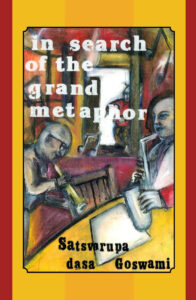
The metaphor is song. Explain it. Yes, particulars may not seem interesting or profound to readers who want structured books.
Wait a minute. Don’t pander to readers or concepts of Art. But Kṛṣṇa conscious criteria are important and must be followed. So, if your little splayed-out life-thoughts are all Kṛṣṇa conscious, then it’s no problem.
I am near the end of my days. But I do like the company of like-minded souls, especially those who are Kṛṣṇa conscious. Yes! I am prone to Kṛṣṇa consciousness. I have been a disciple of Bhaktivedanta Swami Prabhupāda for maybe almost sixty years. Sometimes I fail him. But I always bounce back and fall at his feet. It is a terrible thing that I sometimes do not have the highest love for him. It is a terrible thing. Actually, however, I never fall away from him. He always comes and catches me and brings me back to his loving arms.

This edition of Satsvarūpa dāsa Goswami’s 1996 timed book, Upstate: Room to Write, is published as part of a legacy project to restore Satsvarūpa Mahārāja’s writings to ‘in print’ status and make them globally available for current and future readers.
A factual record of the reform and change in ISKCON guru system of mid ’80s.

Readers will find, in the Appendix of this book, scans of a cover letter written by Satsvarūpa Mahārāja to the GN Press typist at the time, along with some of the original handwritten pages of June Bug. Together, these help to illustrate the process used by Mahārāja when writing his books during this period. These were timed books, in the sense that a distinct time period was allotted for the writing, during SDG’s travels as a visiting sannyāsī
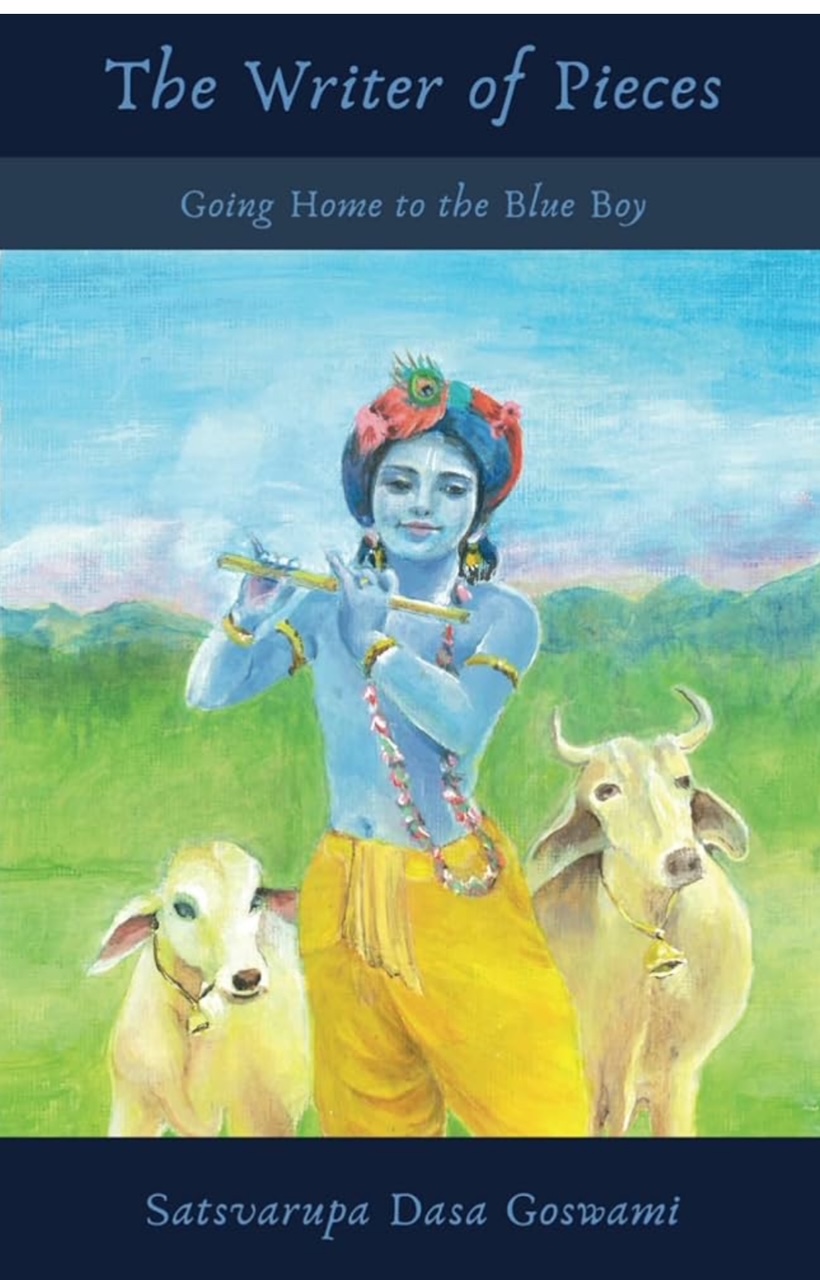
Don’t take my pieces away from me. I need them dearly. My pieces are my prayers to Kṛṣṇa. He wants me to have them, this is my way to love Him. Never take my pieces away.

Many planks and sticks, unable to stay together, are carried away by the force of a river’s waves. Similarly, although we are intimately related with friends and family members, we are unable to stay together because of our varied past deeds and the waves of time.
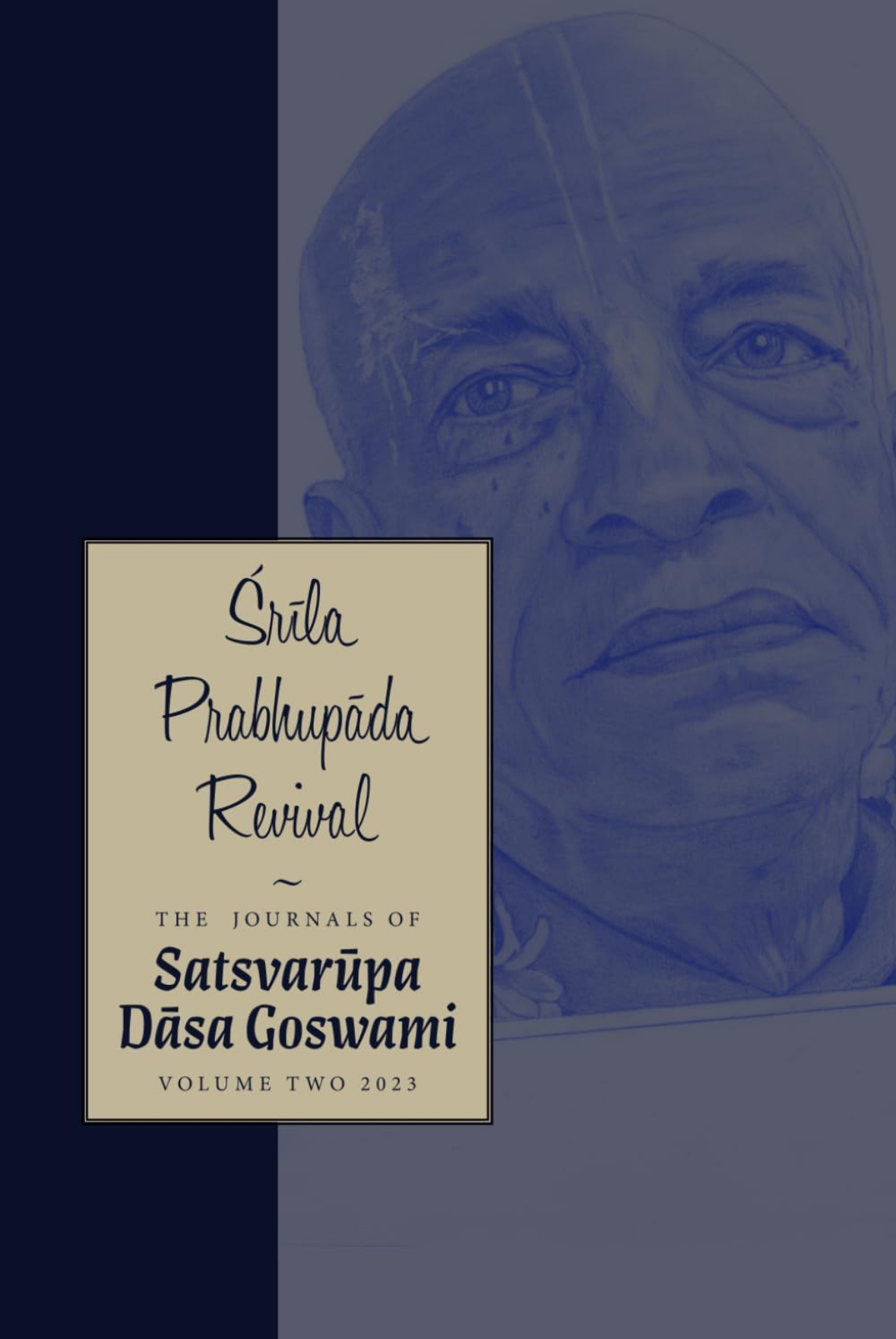
To Śrīla Prabhupāda, who encouraged his devotees (including me) To write articles and books about Kṛṣṇa Consciousness.
I wrote him personally and asked if it was alright for his disciples to write books, Since he, our spiritual master, was already doing that. He wrote back and said that it was certainly alright For us to produce books.
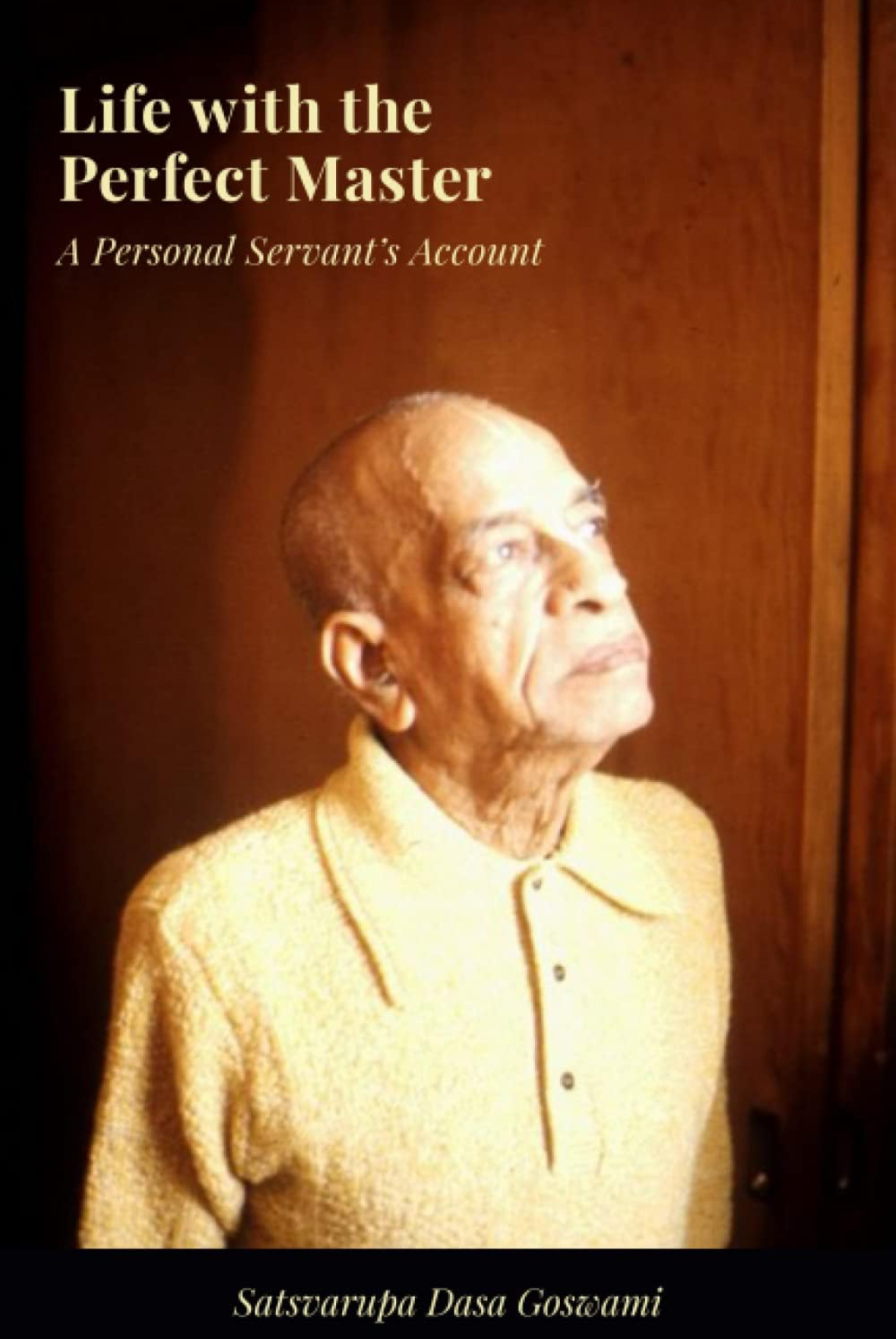
I have a personal story to tell. It is a about a time (January–July 1974) I spent as a personal servant and secretary of my spiritual master, His Divine Grace A.C. Bhaktivedanta Swami Prabhupäda, founder-äcärya of the International Society for Krishna Consciousness. Although I have written extensively about Çréla Prabhupäda, I’ve hesitated to give this account, for fear it would expose me as a poor disciple. But now I’m going ahead, confident that the truth will purify both my readers and myself.

First published by The Gītā-nāgarī Press/GN Press in serialized form in the magazine Among Friends between 1996 and 2001, Best Use of a Bad Bargain is collected here for the first time in this new edition. This volume also contains essays written by Satsvarūpa dāsa Goswami for the occasional periodical, Hope This Meets You in Good Health, between 1994 and 2002, published by the ISKCON Health and Welfare Ministry.

This book has two purposes: to arouse our transcendental feelings of separation from a great personality, Śrīla Prabhupāda, and to encourage all sincere seekers of the Absolute Truth to go forward like an army under the banner of His Divine Grace A.C. Bhaktivedanta Swami Prabhupāda and the Kṛṣṇa consciousness movement.
A single volume collection of the Nimai novels.
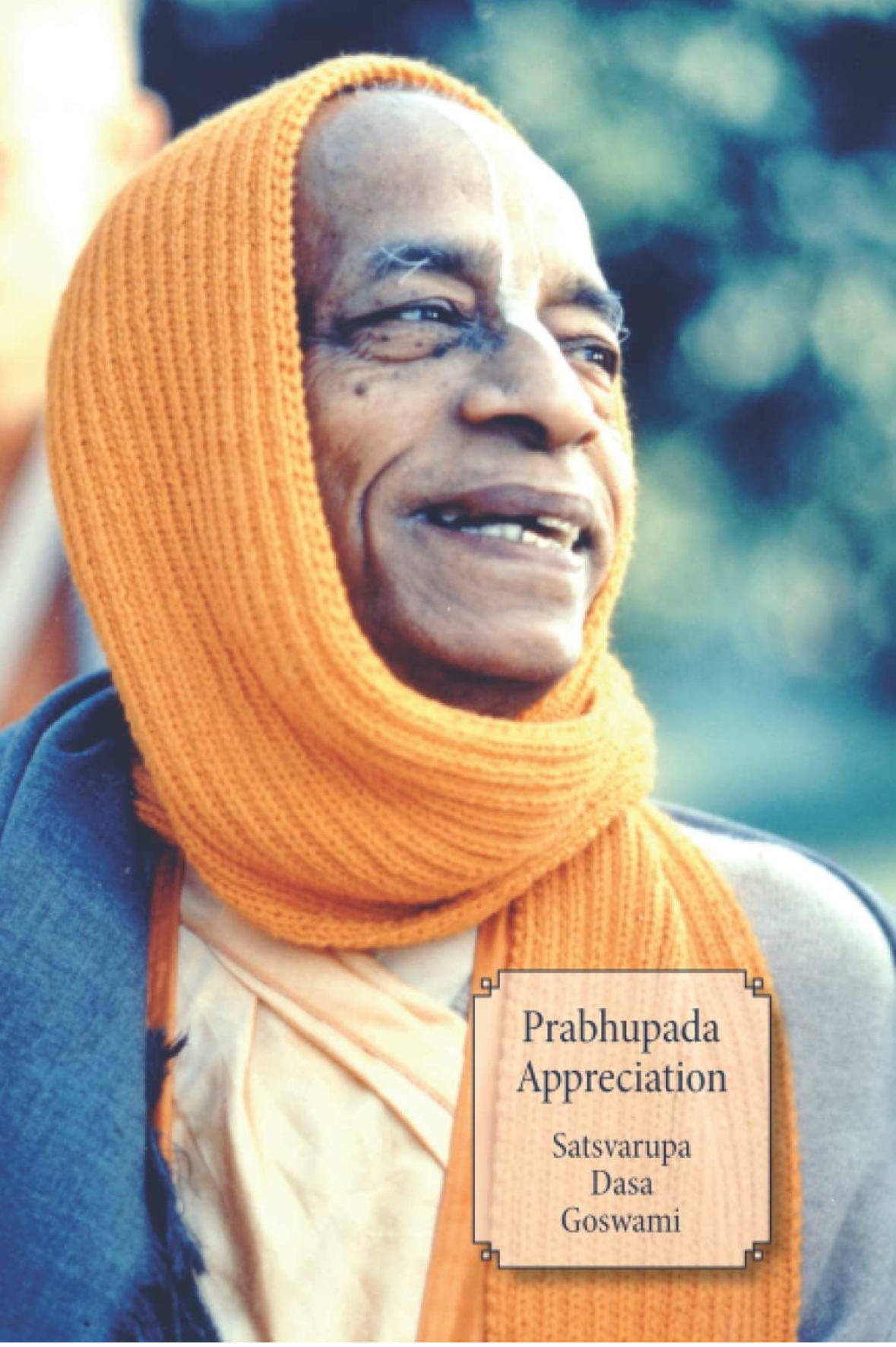
Śrīla Prabhupāda was in the disciplic succession from the Brahmā-Mādhva-Gauḍīya sampradāya, the Vaiṣṇavas who advocate pure devotion to God and who understand Kṛṣṇa as the Supreme Personality of Godhead. He always described himself as simply a messenger who carried the paramparā teachings of his spiritual master and Lord Kṛṣṇa.
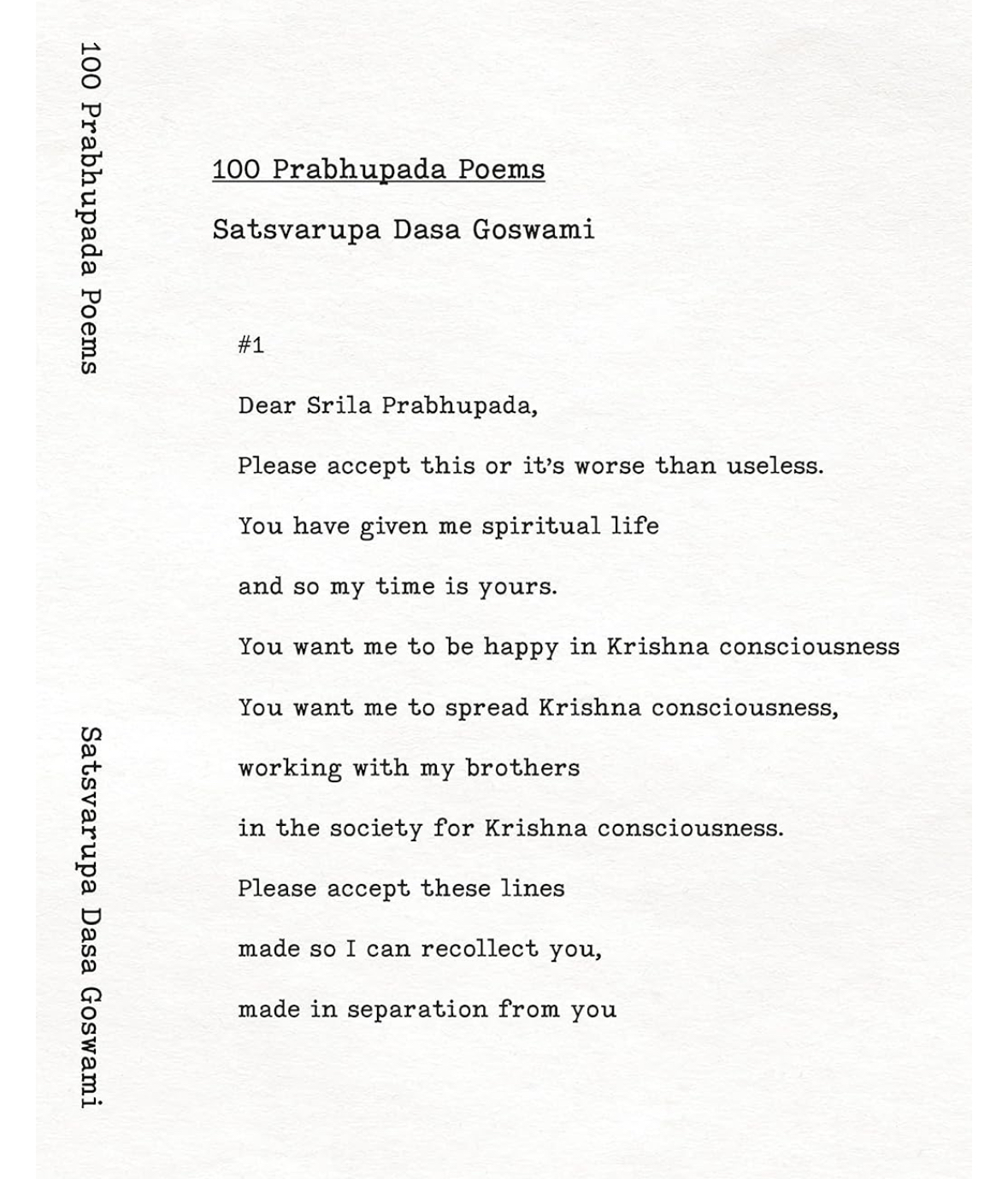
Dear Srila Prabhupada,
Please accept this or it’s worse than useless.
You have given me spiritual life
and so my time is yours.
You want me to be happy in Krishna consciousness
You want me to spread Krishna consciousness,
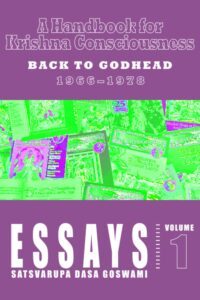
This collection of Satsvarūpa dāsa Goswami’s writings is comprised of essays that were originally published in Back to Godhead magazine between 1966 and 1978, and compiled in 1979 by Gita Nagari Press as the volume A Handbook for Kṛṣṇa Consciousness.

This second volume of Satsvarūpa dāsa Goswami’s Back to Godhead essays encompasses the last 11 years of his 20-year tenure as Editor-in-Chief of Back to Godhead magazine. The essays in this book consist mostly of SDG’s ‘Notes from the Editor’ column, which was typically featured towards the end of each issue starting in 1978 and running until Mahārāja retired from his duties as editor in 1989.
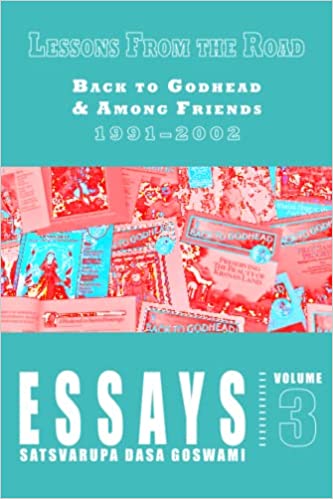
This collection of Satsvarupa dasa Goswami’s writings is comprised of essays that were originally published in Back to Godhead magazine between 1991 and 2002, picking up where Volume 2 leaves off. The volume is supplemented by essays about devotional service from issues of Satsvarupa dasa Goswami’s magazine, Among Friends, published in the 1990s.

“This is a different kind of book, written in my old age, observing Kṛṣṇa consciousness and assessing myself. I believe it fits under the category of ‘Literature in pursuance of the Vedic version.’ It is autobiography, from a Western-raised man, who has been transformed into a devotee of Kṛṣṇa by Śrīla Prabhupāda.”
 The Best I Could Do
I want to study this evolution of my art, my writing. I want to see what changed from the book In Search of the Grand Metaphor to the next book, The Last Days of the Year.
 a Hare Krishna Man
It’s world enlightenment day
And devotees are giving out books
By milk of kindness, read one page
And your life can become perfect.
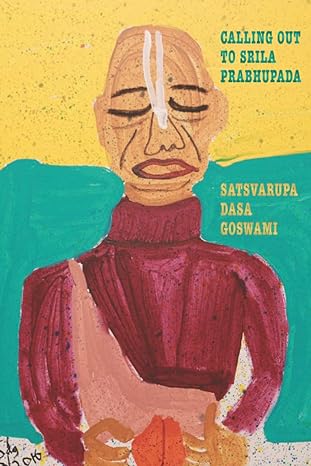 Calling Out to Srila Prabhupada: Poems and Prayers
O Prabhupāda, whose purports are wonderfully clear, having been gathered from what was taught by the previous ācāryas and made all new; O Prabhupāda, who is always sober to expose the material illusion and blissful in knowledge of Kṛṣṇa, may we carefully read your Bhaktivedanta purports.
I use free-writing in my devotional service as part of my sādhana. It is a way for me to enter those realms of myself where only honesty matters; free-writing enables me to reach deeper levels of realization by my repeated attempt to “tell the truth quickly.” Free-writing takes me past polished prose. It takes me past literary effect. It takes me past the need to present something and allows me to just get down and say it. From the viewpoint of a writer, this dropping of all pretense is desirable.
 Geaglum Free Write
This edition of Satsvarūpa dāsa Goswami’s 1996 timed book, Geaglum Free Write Diary, is published as part of a legacy project to restore Satsvarūpa Mahārāja’s writings to ‘in print’ status and make them globally available for current and future readers.